
PREPARED BY:-
   PARTH PATEL
     M.Pharm-I
Quality Assurance
    GUIDED BY:
Mr. Ashok mahajan
   BIOAVAILABILITY: means rate & extent of absorption
    of unchanged drug from its dosage form or site of
    administration to the systemic circulation.
   Order: Parentral(i,.v)>oral>rectal>topical
   Absolute Bioavailability:
         It is the systemic availability of drug after
    extravascular administration compared to i.v dosing of
    the same drug.


    F= [AUC]oral / [AUC]i.v*doseiv/doseoral
 Relative Bioavailability:
     It is the systemic availability of the drug after
 oral administration is compared with that of an
 oral standard of the same drug.


  Fr=[AUC]test/ [AUC]std*dosetest/dosestd,

     where,Fr=Relative Bioavailability
 Primary   stages of development of a suitable dosage
 form for a new drug entity.
 Development    of new formulation of existing drugs.
 Determination    of influence of Excipient, patient
 related factors, drug-interaction on efficiency of
 absorption.
 Control   of quality of drug prior to marketing.
   A number of factors such as health, age, weight,
    enzyme status and number are concern.

   It is better to have the subjects of similar kinetics
    to avoid major variations.

   Health : Subjects should be of great health that is
    ascertained by various biochemical and medical
    examination.
Age :
 Elderly and children have different kinetics to adults.
 Subjects between 18 – 35 years are preferred.


Number :
 Number of participants should be kept minimum
  required for carrying out a reliable, well designed
  study.
However, in overweight and underweight Vd may
be different. Hence, to better match the subject ,
normal weights are preferred. Usually 140-200lb


Enzyme Status :

 Enzyme activity can be altered by altered
kinetics of the drug in case of smokers or subjects
taking other drugs leading to drug-drug
interaction.
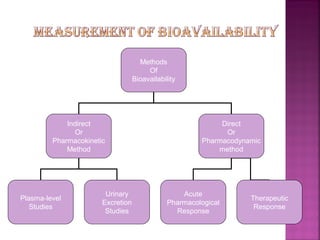
Methods
                                        Of
                                   Bioavailability


             Indirect                                        Direct
               Or                                             Or
         Pharmacokinetic                                Pharmacodynamic
             Method                                         method


                        Urinary                    Acute
Plasma-level                                                        Therapeutic
                       Excretion               Pharmacological
   Studies                                                           Response
                        Studies                  Response
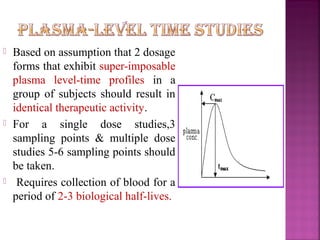
   Based on assumption that 2 dosage
    forms that exhibit super-imposable
    plasma level-time profiles in a
    group of subjects should result in
    identical therapeutic activity.
   For a single dose studies,3
    sampling points & multiple dose
    studies 5-6 sampling points should
    be taken.
    Requires collection of blood for a
    period of 2-3 biological half-lives.
   Cmax :
               Represents maximum plasma drug
    concentration after oral administration of a
    drug.

   Indicates whether drug is sufficiently
    absorbed systemically to give a therapeutic
    response.

   Warns about toxic level of a drug.
   tmax:
                Represents to time required to reach
    maximum plasma concentration after drug
    administration.
   Indicates rate of absorption.
   At tmax, rate of absorption equals to rate of
    elimination.

   AUC:
      It is a measure of extent of drug bioavailability.
   Independent of route of administration.
   Measured by trapezoidal rule method.
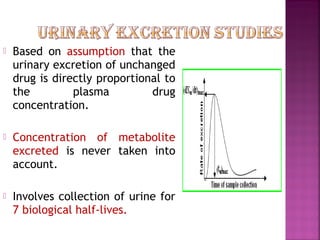
   Based on assumption that the
    urinary excretion of unchanged
    drug is directly proportional to
    the         plasma         drug
    concentration.

   Concentration of metabolite
    excreted is never taken into
    account.

   Involves collection of urine for
    7 biological half-lives.
(1) (dXu/dt)max: Maximum urinary excretion rate.

   Analogous to Cmax.
   It increases as rate & extent of absorption
    increases.

(2) (tu)max: Time for maximum excretion rate.

   It increases as the rate of absorption decreases.

(3) Xu: Cumulative amount of the drug excreted in
    the        urine.
   It increases as the rate of absorption increases.
(1)   Acute Phamacological Response: requires
      demonstration of dose-response curve.

     Includes determination of change in EEG or
      ECG readings,pupil diameter.

     Requires measurement of responses for at
      least 3 biological half-lives.

     Used when indirect method produce
      inaccurate results.
(2) Therapeutic response:

 Based on observing the clinical response to a drug
  formulation given to patient suffering from disease
  for which intended to be used.
 Disadvantages:
 Quantitation of response is too imprecise.
 Physiological status of the patient may be changed
  during study.
 Patient may not get sufficient drug for adequate
  treatment.
(1)   Patient-related factors:
     Age
     Meal
     Body posture
     Emotional state
     Disease state
     G.I.T contents:
       - food-drug interaction
      - drug-drug interaction
(2) Dosage form related:
 Disintegration time


 Manufacturing   variables
        - Manufacturing process
        - Excipients

    Nature & type of dosage form:
         Solutions>emulsion>suspension>coarse
    powder>capsules>tablets
(3) Physico-chemical properties of drug:

 Particle size & effective surface area
 It can be lowered by micronization,but it is true
  for non-hydrophobic drug.
  e.g. :Griseofulvin,Chloramphenicol,etc.
 It is vice-versa for hydrophobic drug e.g.:
  Aspirin,Phenacetin,Phenobarbital.

Polymorphism & Amorphous
 Chloramphenicol palmitate A,B,C,out of these
 three polymorphic forms,B shows best availability.
Pseudo polymorphism (hydrates & solvates)
 Anhydrous form of theophylline & ampicillin have
 higher aqueous solubility than monohydrate &
 trihydrate form.
 Chloroform solvate of Griseofulvin are more water-
 soluble than their non-solvated form.

Salt form of the drug
 Bioavailability of novobiocin from its sodium or
 calcium salt, & free acid was found to be in ratio of
 50:25:1.

   Lipophilicity of the drug
     Bioavailability problems in oral controlled
      delivery system:
(a)    G.I.T transit time & regional absorption
(b)    Incomplete absorption
(c)    Increased first pass metabolism
(d)    Dose dumping
(e)    Effect of food
(f)    Effect of diurnal variation
(g)    Increased variability
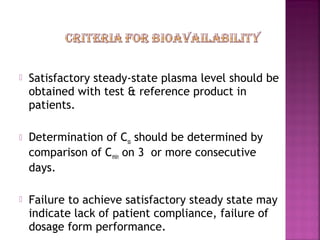
   Satisfactory steady-state plasma level should be
    obtained with test & reference product in
    patients.

   Determination of Css should be determined by
    comparison of Cmin on 3 or more consecutive
    days.

   Failure to achieve satisfactory steady state may
    indicate lack of patient compliance, failure of
    dosage form performance.
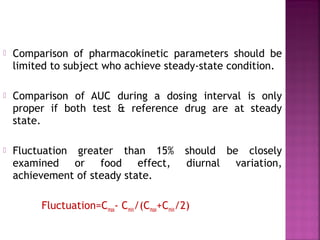
   Comparison of pharmacokinetic parameters should be
    limited to subject who achieve steady-state condition.

   Comparison of AUC during a dosing interval is only
    proper if both test & reference drug are at steady
    state.

   Fluctuation greater than 15%           should be closely
    examined or food effect,               diurnal variation,
    achievement of steady state.

         Fluctuation=Cmax- Cmin/(Cmax+Cmin/2)
1.Title
  a. Principal investigator
  b. Project or protocol number & date


2.Study objective
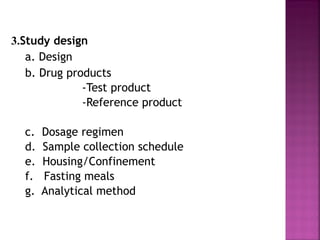
3.Study design
   a. Design
   b. Drug products
              -Test product
              -Reference product

  c.   Dosage regimen
  d.   Sample collection schedule
  e.   Housing/Confinement
  f.   Fasting meals
  g.   Analytical method
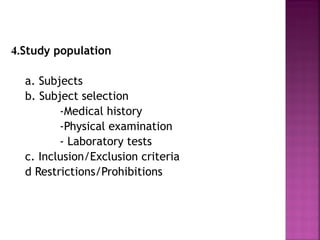
4.Study population

  a. Subjects
  b. Subject selection
         -Medical history
         -Physical examination
         - Laboratory tests
  c. Inclusion/Exclusion criteria
  d Restrictions/Prohibitions
5. Clinical procedures
   a. Basic principles
   b. Biological sampling schedule & handling
  procedures
   c. Activity of subjects
6. Ethical considerations:
      a. Basic principles
      b. Instituitional review board
      c. Informed consent
      d. Indications for subject withdrawal
      e. Adverse reactions & emergency procedures
7. Facilities

8. Data analysis
    a. Analytical validation procedure
    b. Statistical treatment of data

9. Drug accountability

10. Appendix
   Shargel.L,Applied Biopharmaceutics & pharmacokinetics,
    Fourth edition, Page no.247-252.
   Robinson.J,Controlled drug delivery,Second edition, Marcel
    Dekker Vol-29,Page no.294-321.


.
   Brahmankar.D.M,Biopharmaceutics &
    Pharmacokinetics-A Treatise, Page no.292-392.
Bioavailibility  112070804016

Bioavailibility 112070804016

  • 1.
    PREPARED BY:- PARTH PATEL M.Pharm-I Quality Assurance GUIDED BY: Mr. Ashok mahajan
  • 2.
    BIOAVAILABILITY: means rate & extent of absorption of unchanged drug from its dosage form or site of administration to the systemic circulation.  Order: Parentral(i,.v)>oral>rectal>topical  Absolute Bioavailability: It is the systemic availability of drug after extravascular administration compared to i.v dosing of the same drug. F= [AUC]oral / [AUC]i.v*doseiv/doseoral
  • 3.
     Relative Bioavailability: It is the systemic availability of the drug after oral administration is compared with that of an oral standard of the same drug. Fr=[AUC]test/ [AUC]std*dosetest/dosestd, where,Fr=Relative Bioavailability
  • 4.
     Primary stages of development of a suitable dosage form for a new drug entity.  Development of new formulation of existing drugs.  Determination of influence of Excipient, patient related factors, drug-interaction on efficiency of absorption.  Control of quality of drug prior to marketing.
  • 5.
    A number of factors such as health, age, weight, enzyme status and number are concern.  It is better to have the subjects of similar kinetics to avoid major variations.  Health : Subjects should be of great health that is ascertained by various biochemical and medical examination.
  • 6.
    Age : Elderlyand children have different kinetics to adults. Subjects between 18 – 35 years are preferred. Number :  Number of participants should be kept minimum required for carrying out a reliable, well designed study.
  • 7.
    However, in overweightand underweight Vd may be different. Hence, to better match the subject , normal weights are preferred. Usually 140-200lb Enzyme Status :  Enzyme activity can be altered by altered kinetics of the drug in case of smokers or subjects taking other drugs leading to drug-drug interaction.
  • 8.
    Methods Of Bioavailability Indirect Direct Or Or Pharmacokinetic Pharmacodynamic Method method Urinary Acute Plasma-level Therapeutic Excretion Pharmacological Studies Response Studies Response
  • 9.
    Based on assumption that 2 dosage forms that exhibit super-imposable plasma level-time profiles in a group of subjects should result in identical therapeutic activity.  For a single dose studies,3 sampling points & multiple dose studies 5-6 sampling points should be taken.  Requires collection of blood for a period of 2-3 biological half-lives.
  • 10.
    Cmax : Represents maximum plasma drug concentration after oral administration of a drug.  Indicates whether drug is sufficiently absorbed systemically to give a therapeutic response.  Warns about toxic level of a drug.
  • 11.
    tmax: Represents to time required to reach maximum plasma concentration after drug administration.  Indicates rate of absorption.  At tmax, rate of absorption equals to rate of elimination.  AUC: It is a measure of extent of drug bioavailability.  Independent of route of administration.  Measured by trapezoidal rule method.
  • 12.
    Based on assumption that the urinary excretion of unchanged drug is directly proportional to the plasma drug concentration.  Concentration of metabolite excreted is never taken into account.  Involves collection of urine for 7 biological half-lives.
  • 13.
    (1) (dXu/dt)max: Maximumurinary excretion rate.  Analogous to Cmax.  It increases as rate & extent of absorption increases. (2) (tu)max: Time for maximum excretion rate.  It increases as the rate of absorption decreases. (3) Xu: Cumulative amount of the drug excreted in the urine.  It increases as the rate of absorption increases.
  • 14.
    (1) Acute Phamacological Response: requires demonstration of dose-response curve.  Includes determination of change in EEG or ECG readings,pupil diameter.  Requires measurement of responses for at least 3 biological half-lives.  Used when indirect method produce inaccurate results.
  • 15.
    (2) Therapeutic response: Based on observing the clinical response to a drug formulation given to patient suffering from disease for which intended to be used.  Disadvantages:  Quantitation of response is too imprecise.  Physiological status of the patient may be changed during study.  Patient may not get sufficient drug for adequate treatment.
  • 16.
    (1) Patient-related factors:  Age  Meal  Body posture  Emotional state  Disease state  G.I.T contents: - food-drug interaction - drug-drug interaction
  • 17.
    (2) Dosage formrelated:  Disintegration time  Manufacturing variables - Manufacturing process - Excipients  Nature & type of dosage form: Solutions>emulsion>suspension>coarse powder>capsules>tablets
  • 18.
    (3) Physico-chemical propertiesof drug:  Particle size & effective surface area  It can be lowered by micronization,but it is true for non-hydrophobic drug. e.g. :Griseofulvin,Chloramphenicol,etc.  It is vice-versa for hydrophobic drug e.g.: Aspirin,Phenacetin,Phenobarbital. Polymorphism & Amorphous  Chloramphenicol palmitate A,B,C,out of these three polymorphic forms,B shows best availability.
  • 19.
    Pseudo polymorphism (hydrates& solvates)  Anhydrous form of theophylline & ampicillin have higher aqueous solubility than monohydrate & trihydrate form.  Chloroform solvate of Griseofulvin are more water- soluble than their non-solvated form. Salt form of the drug  Bioavailability of novobiocin from its sodium or calcium salt, & free acid was found to be in ratio of 50:25:1.  Lipophilicity of the drug
  • 20.
    Bioavailability problems in oral controlled delivery system: (a) G.I.T transit time & regional absorption (b) Incomplete absorption (c) Increased first pass metabolism (d) Dose dumping (e) Effect of food (f) Effect of diurnal variation (g) Increased variability
  • 21.
    Satisfactory steady-state plasma level should be obtained with test & reference product in patients.  Determination of Css should be determined by comparison of Cmin on 3 or more consecutive days.  Failure to achieve satisfactory steady state may indicate lack of patient compliance, failure of dosage form performance.
  • 22.
    Comparison of pharmacokinetic parameters should be limited to subject who achieve steady-state condition.  Comparison of AUC during a dosing interval is only proper if both test & reference drug are at steady state.  Fluctuation greater than 15% should be closely examined or food effect, diurnal variation, achievement of steady state. Fluctuation=Cmax- Cmin/(Cmax+Cmin/2)
  • 23.
    1.Title a.Principal investigator b. Project or protocol number & date 2.Study objective
  • 24.
    3.Study design a. Design b. Drug products -Test product -Reference product c. Dosage regimen d. Sample collection schedule e. Housing/Confinement f. Fasting meals g. Analytical method
  • 25.
    4.Study population a. Subjects b. Subject selection -Medical history -Physical examination - Laboratory tests c. Inclusion/Exclusion criteria d Restrictions/Prohibitions
  • 26.
    5. Clinical procedures a. Basic principles b. Biological sampling schedule & handling procedures c. Activity of subjects 6. Ethical considerations: a. Basic principles b. Instituitional review board c. Informed consent d. Indications for subject withdrawal e. Adverse reactions & emergency procedures
  • 27.
    7. Facilities 8. Dataanalysis a. Analytical validation procedure b. Statistical treatment of data 9. Drug accountability 10. Appendix
  • 28.
    Shargel.L,Applied Biopharmaceutics & pharmacokinetics, Fourth edition, Page no.247-252.  Robinson.J,Controlled drug delivery,Second edition, Marcel Dekker Vol-29,Page no.294-321. .
  • 29.
    Brahmankar.D.M,Biopharmaceutics & Pharmacokinetics-A Treatise, Page no.292-392.