SEMINAR
COMPUTER AIDED DRUG DEVELOPMENT
REGULATORY AND INDUSTRY VIEWS ON QbD,
SCIENTIFICALLY BASED QbD- EXAMPLES OF
APPLICATION
SUBMITTED BY,
ARDRA KRISHNA P V
MPHARM 2ND SEMESTER
DEPARTMENT OF PHARMACEUTICS
KMCH COLLEGE OF PHARMACY
CONTENT
INTRODUCTION
REGULATORY VIEWS ON QbD
QbD FACILITIES
INDUSTRY VIEWS ON QbD
QbD FOR INDUSTRY AND REGULATORY BODIES
INTRODUCTION
• The pharmaceutical Quantity by Design (QbD) is a systemic approach
to development that begins with predefined objectives and
emphasizes product and process understanding and process control,
based on sound science and quantity risk management.
• QbD has been adopted by U.S Food and Drug Administration (FDA)
for the discovery, development and manufacture of drugs.
• Quality- by- design (QbD) is a concept introduces by the International
Conference on Harmonization (ICH) Q8 guidelines.
• According to ICH Q 8(R1) QbD is defined as:
A systemic approach to development that begins with predefined
objectives.
• It emphasizes on product and process understanding and process control.
• It is based on sound science and quality risk management.
AIM OF QbD
• Design a quality product
• Quality of Mfg process
• Product should meet patients need
• Product development may vary between products.
As defined by an FDA official
“The QbD concept represents product and process performance
characteristics scientifically designed to meet specific objectives, not
merely empirically derived from performance of test batches”.
“Another FDA representative (Shah,2009) states that introduction of
the QbD concept can lead to cost saving and efficiency improvement for
both industry and regulators”.
OR
The QbD concept represents product and process performance
characteristics scientifically designed to meet specific objectives.
REGULATORY VIEWS ON QbD
FDA:
• It states that QbD concept can lead to cost savings and efficiency
improvement for both industry and regulators.
• Provides implementation of QbD in Abbreviated New Drug
Application (ANDA) for both immediate and modified release dosage
form.
QbD FACILITIES
• Innovation,
• Increase manufacturing efficiency,
• Reduce cost/product rejects,
• Minimize/ eliminate potential compliance actions,
• Enhance opportunities for first cycle approval,
• Streamline post approval changes and regulatory processes,
• Enable more focused inspection,
• Provide opportunities for continual improvement
• EMA representatives point out that it is preferable for a
design space to be complemented by an appropriate control
strategy.
• The review of variations regulations and the revised
variations classification guidelines (2008) has taken into
account QbD submissions, to enables easier updates of the
registration dossier.
• EMA templates and guidance documents used for the
assessment of any new drug application in the centralized
procedure include the possibility of design space
appointment.
INDUSTRY VIEWS ON QbD
• Pfizer was one of the first companies to implement QbD and PAT
concept.
• Through these concepts, the company gained enhanced process
understanding, higher process capability, better product quality, and
increased flexibility to implement continuous improvement change.
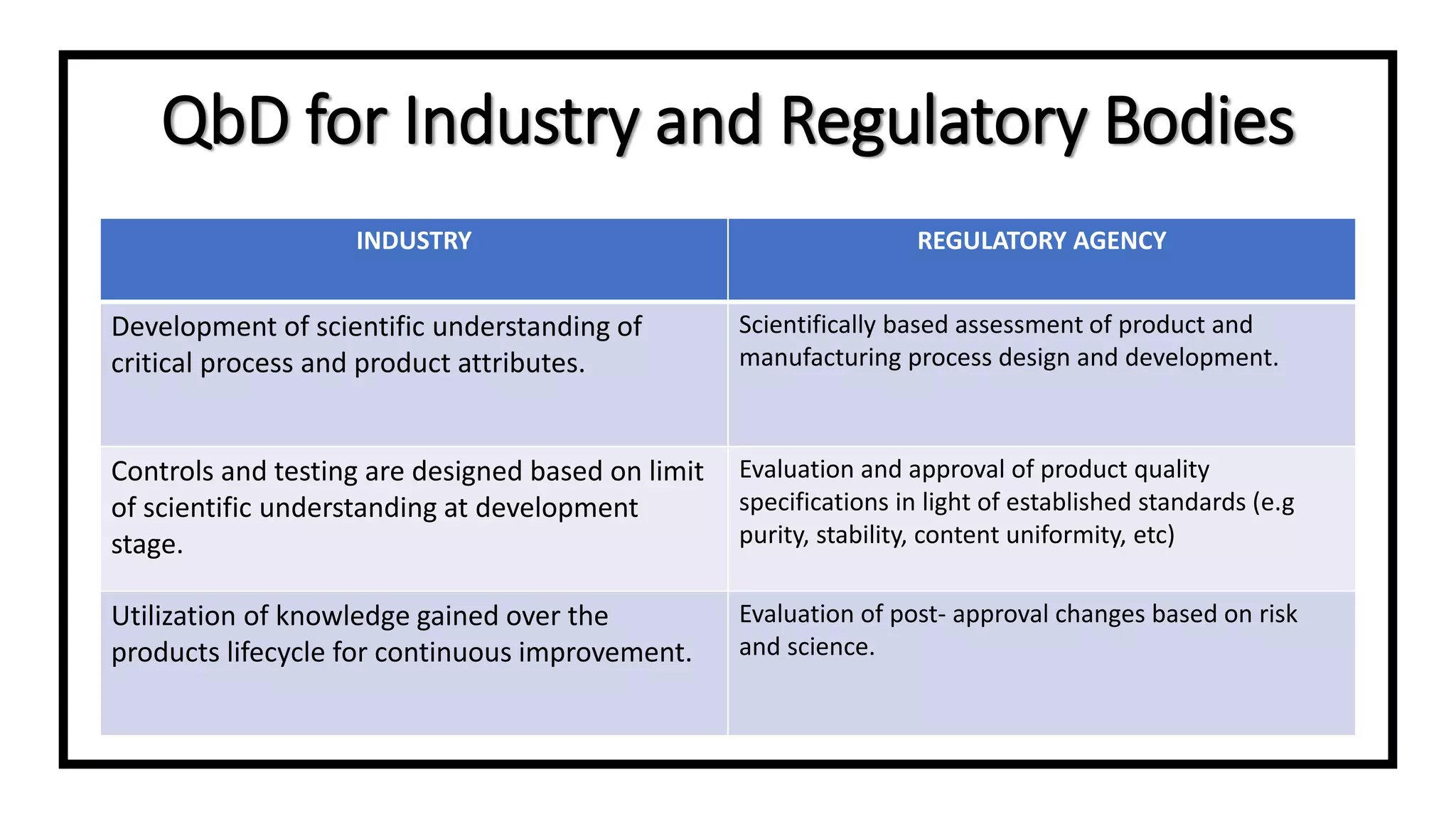
QbD for Industry and Regulatory Bodies
INDUSTRY REGULATORY AGENCY
Development of scientific understanding of
critical process and product attributes.
Scientifically based assessment of product and
manufacturing process design and development.
Controls and testing are designed based on limit
of scientific understanding at development
stage.
Evaluation and approval of product quality
specifications in light of established standards (e.g
purity, stability, content uniformity, etc)
Utilization of knowledge gained over the
products lifecycle for continuous improvement.
Evaluation of post- approval changes based on risk
and science.
THANK YOU!

REGULATORY AND INDUSTRY VIEWS ON QbD, SCIENTIFICALLY BASED QbD- EXAMPLES OF APPLICATION.pptx

  • 1.
    SEMINAR COMPUTER AIDED DRUGDEVELOPMENT REGULATORY AND INDUSTRY VIEWS ON QbD, SCIENTIFICALLY BASED QbD- EXAMPLES OF APPLICATION SUBMITTED BY, ARDRA KRISHNA P V MPHARM 2ND SEMESTER DEPARTMENT OF PHARMACEUTICS KMCH COLLEGE OF PHARMACY
  • 2.
    CONTENT INTRODUCTION REGULATORY VIEWS ONQbD QbD FACILITIES INDUSTRY VIEWS ON QbD QbD FOR INDUSTRY AND REGULATORY BODIES
  • 3.
    INTRODUCTION • The pharmaceuticalQuantity by Design (QbD) is a systemic approach to development that begins with predefined objectives and emphasizes product and process understanding and process control, based on sound science and quantity risk management. • QbD has been adopted by U.S Food and Drug Administration (FDA) for the discovery, development and manufacture of drugs. • Quality- by- design (QbD) is a concept introduces by the International Conference on Harmonization (ICH) Q8 guidelines.
  • 4.
    • According toICH Q 8(R1) QbD is defined as: A systemic approach to development that begins with predefined objectives. • It emphasizes on product and process understanding and process control. • It is based on sound science and quality risk management. AIM OF QbD • Design a quality product • Quality of Mfg process • Product should meet patients need • Product development may vary between products.
  • 5.
    As defined byan FDA official “The QbD concept represents product and process performance characteristics scientifically designed to meet specific objectives, not merely empirically derived from performance of test batches”. “Another FDA representative (Shah,2009) states that introduction of the QbD concept can lead to cost saving and efficiency improvement for both industry and regulators”. OR The QbD concept represents product and process performance characteristics scientifically designed to meet specific objectives. REGULATORY VIEWS ON QbD
  • 6.
    FDA: • It statesthat QbD concept can lead to cost savings and efficiency improvement for both industry and regulators. • Provides implementation of QbD in Abbreviated New Drug Application (ANDA) for both immediate and modified release dosage form.
  • 7.
    QbD FACILITIES • Innovation, •Increase manufacturing efficiency, • Reduce cost/product rejects, • Minimize/ eliminate potential compliance actions, • Enhance opportunities for first cycle approval, • Streamline post approval changes and regulatory processes, • Enable more focused inspection, • Provide opportunities for continual improvement
  • 8.
    • EMA representativespoint out that it is preferable for a design space to be complemented by an appropriate control strategy. • The review of variations regulations and the revised variations classification guidelines (2008) has taken into account QbD submissions, to enables easier updates of the registration dossier. • EMA templates and guidance documents used for the assessment of any new drug application in the centralized procedure include the possibility of design space appointment.
  • 9.
    INDUSTRY VIEWS ONQbD • Pfizer was one of the first companies to implement QbD and PAT concept. • Through these concepts, the company gained enhanced process understanding, higher process capability, better product quality, and increased flexibility to implement continuous improvement change.
  • 10.
    QbD for Industryand Regulatory Bodies INDUSTRY REGULATORY AGENCY Development of scientific understanding of critical process and product attributes. Scientifically based assessment of product and manufacturing process design and development. Controls and testing are designed based on limit of scientific understanding at development stage. Evaluation and approval of product quality specifications in light of established standards (e.g purity, stability, content uniformity, etc) Utilization of knowledge gained over the products lifecycle for continuous improvement. Evaluation of post- approval changes based on risk and science.
  • 11.