NUMBER SYSTEM
Binary Arithmetic
Dr. (Mrs.) Gargi Khanna
Associate Professor
Electronics & Communication Engg. Deptt..
National Institute of Technology Hamirpur (HP)
Chapter-I
Lecture-III
G.Khanna, NITH
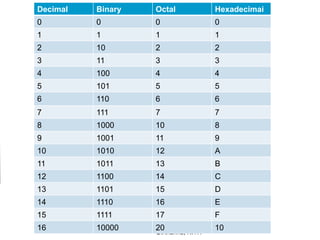
Decimal Binary Octal Hexadecimai
0 0 0 0
1 1 1 1
2 10 2 2
3 11 3 3
4 100 4 4
5 101 5 5
6 110 6 6
7 111 7 7
8 1000 10 8
9 1001 11 9
10 1010 12 A
11 1011 13 B
12 1100 14 C
13 1101 15 D
14 1110 16 E
15 1111 17 F
16 10000 20 10
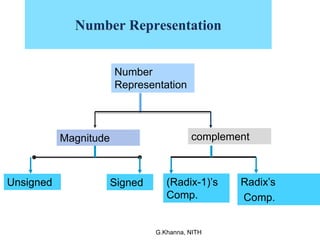
Number Representation
Number
Representation
Signed
complementMagnitude
Unsigned Radix’s
Comp.
(Radix-1)’s
Comp.
G.Khanna, NITH
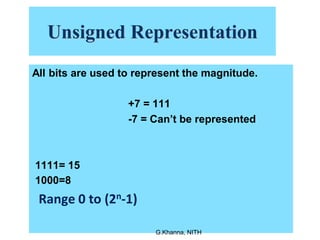
Unsigned Representation
All bits are used to represent the magnitude.
+7 = 111
-7 = Can’t be represented
1111= 15
1000=8
Range 0 to (2n-1)
G.Khanna, NITH
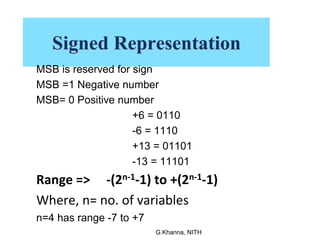
Signed Representation
MSB is reserved for sign
MSB =1 Negative number
MSB= 0 Positive number
+6 = 0110
-6 = 1110
+13 = 01101
-13 = 11101
Range => -(2n-1-1) to +(2n-1-1)
Where, n= no. of variables
n=4 has range -7 to +7
G.Khanna, NITH
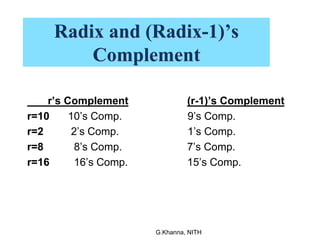
Radix and (Radix-1)’s
Complement
r’s Complement (r-1)’s Complement
r=10 10’s Comp. 9’s Comp.
r=2 2’s Comp. 1’s Comp.
r=8 8’s Comp. 7’s Comp.
r=16 16’s Comp. 15’s Comp.
G.Khanna, NITH
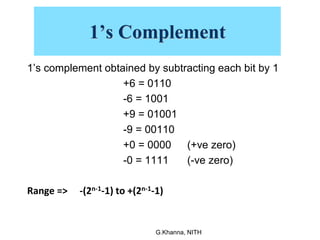
1’s Complement
1’s complement obtained by subtracting each bit by 1
+6 = 0110
-6 = 1001
+9 = 01001
-9 = 00110
+0 = 0000 (+ve zero)
-0 = 1111 (-ve zero)
Range => -(2n-1-1) to +(2n-1-1)
G.Khanna, NITH
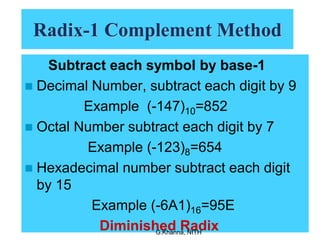
Radix-1 Complement Method
Subtract each symbol by base-1
 Decimal Number, subtract each digit by 9
Example (-147)10=852
 Octal Number subtract each digit by 7
Example (-123)8=654
 Hexadecimal number subtract each digit
by 15
Example (-6A1)16=95E
Diminished RadixG.Khanna, NITH
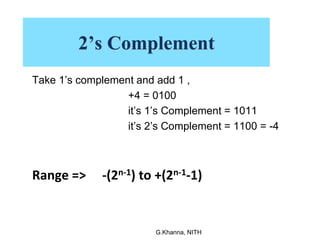
2’s Complement
Take 1’s complement and add 1 ,
+4 = 0100
it’s 1’s Complement = 1011
it’s 2’s Complement = 1100 = -4
Range => -(2n-1) to +(2n-1-1)
G.Khanna, NITH
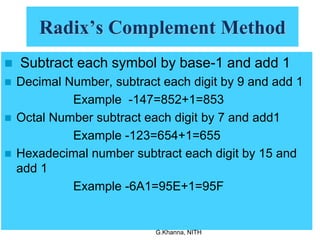
Radix’s Complement Method
 Subtract each symbol by base-1 and add 1
 Decimal Number, subtract each digit by 9 and add 1
Example -147=852+1=853
 Octal Number subtract each digit by 7 and add1
Example -123=654+1=655
 Hexadecimal number subtract each digit by 15 and
add 1
Example -6A1=95E+1=95F
G.Khanna, NITH
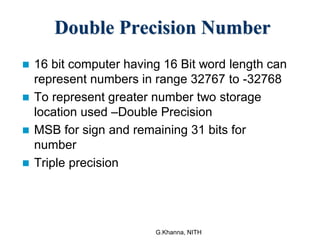
Double Precision Number
 16 bit computer having 16 Bit word length can
represent numbers in range 32767 to -32768
 To represent greater number two storage
location used –Double Precision
 MSB for sign and remaining 31 bits for
number
 Triple precision
G.Khanna, NITH
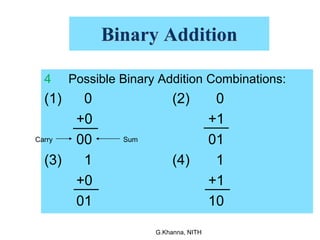
Binary Addition
4 Possible Binary Addition Combinations:
(1) 0 (2) 0
+0 +1
00 01
(3) 1 (4) 1
+0 +1
01 10
SumCarry
G.Khanna, NITH
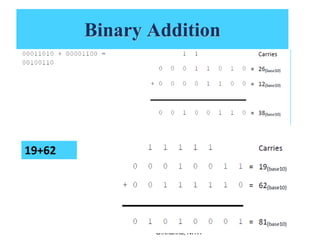
Binary Addition
G.Khanna, NITH
19+62
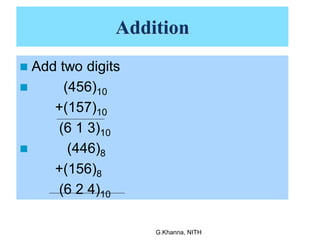
Addition
 Add two digits
 (456)10
+(157)10
(6 1 3)10
 (446)8
+(156)8
(6 2 4)10
G.Khanna, NITH
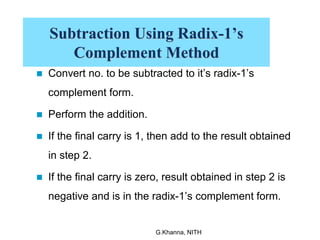
Subtraction Using Radix-1’s
Complement Method
 Convert no. to be subtracted to it’s radix-1’s
complement form.
 Perform the addition.
 If the final carry is 1, then add to the result obtained
in step 2.
 If the final carry is zero, result obtained in step 2 is
negative and is in the radix-1’s complement form.
G.Khanna, NITH
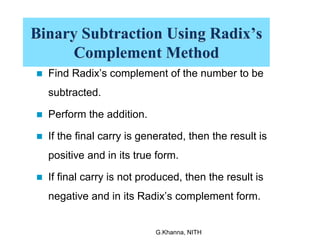
Binary Subtraction Using Radix’s
Complement Method
 Find Radix’s complement of the number to be
subtracted.
 Perform the addition.
 If the final carry is generated, then the result is
positive and in its true form.
 If final carry is not produced, then the result is
negative and in its Radix’s complement form.
G.Khanna, NITH
G.Khanna, NITH
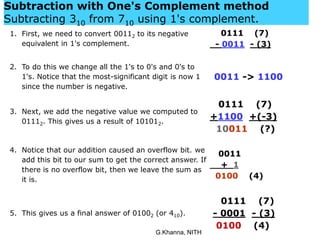
1. First, we need to convert 00112 to its negative
equivalent in 1's complement.
0111 (7)
- 0011 - (3)
2. To do this we change all the 1's to 0's and 0's to
1's. Notice that the most-significant digit is now 1
since the number is negative.
0011 -> 1100
3. Next, we add the negative value we computed to
01112. This gives us a result of 101012.
0111 (7)
+1100 +(-3)
10011 (?)
4. Notice that our addition caused an overflow bit. we
add this bit to our sum to get the correct answer. If
there is no overflow bit, then we leave the sum as
it is.
0011
+ 1
0100 (4)
5. This gives us a final answer of 01002 (or 410).
0111 (7)
- 0001 - (3)
0100 (4)
Subtraction with One's Complement method
Subtracting 310 from 710 using 1's complement.
G.Khanna, NITH
Decimal
Addition
Binary
representation
2's Complement
Addition
+100 0110 0100 01100100
- 30 0001 1110 11100010
+70 1 0100 0110
Subtraction with Two's Complement method
Discard the carry
and answer is
positive
Decimal Addition Binary representation
2's Complement
Addition
+30 00011110 00011110
- 100 01100100 10011100
-70 10111010
No carry and
answer is
negative, in 2’s
complement form
and magnitude
is 01000110
G.Khanna, NITH

Binary Arithmetic

  • 1.
    NUMBER SYSTEM Binary Arithmetic Dr.(Mrs.) Gargi Khanna Associate Professor Electronics & Communication Engg. Deptt.. National Institute of Technology Hamirpur (HP) Chapter-I Lecture-III
  • 2.
    G.Khanna, NITH Decimal BinaryOctal Hexadecimai 0 0 0 0 1 1 1 1 2 10 2 2 3 11 3 3 4 100 4 4 5 101 5 5 6 110 6 6 7 111 7 7 8 1000 10 8 9 1001 11 9 10 1010 12 A 11 1011 13 B 12 1100 14 C 13 1101 15 D 14 1110 16 E 15 1111 17 F 16 10000 20 10
  • 3.
  • 4.
    Unsigned Representation All bitsare used to represent the magnitude. +7 = 111 -7 = Can’t be represented 1111= 15 1000=8 Range 0 to (2n-1) G.Khanna, NITH
  • 5.
    Signed Representation MSB isreserved for sign MSB =1 Negative number MSB= 0 Positive number +6 = 0110 -6 = 1110 +13 = 01101 -13 = 11101 Range => -(2n-1-1) to +(2n-1-1) Where, n= no. of variables n=4 has range -7 to +7 G.Khanna, NITH
  • 6.
    Radix and (Radix-1)’s Complement r’sComplement (r-1)’s Complement r=10 10’s Comp. 9’s Comp. r=2 2’s Comp. 1’s Comp. r=8 8’s Comp. 7’s Comp. r=16 16’s Comp. 15’s Comp. G.Khanna, NITH
  • 7.
    1’s Complement 1’s complementobtained by subtracting each bit by 1 +6 = 0110 -6 = 1001 +9 = 01001 -9 = 00110 +0 = 0000 (+ve zero) -0 = 1111 (-ve zero) Range => -(2n-1-1) to +(2n-1-1) G.Khanna, NITH
  • 8.
    Radix-1 Complement Method Subtracteach symbol by base-1  Decimal Number, subtract each digit by 9 Example (-147)10=852  Octal Number subtract each digit by 7 Example (-123)8=654  Hexadecimal number subtract each digit by 15 Example (-6A1)16=95E Diminished RadixG.Khanna, NITH
  • 9.
    2’s Complement Take 1’scomplement and add 1 , +4 = 0100 it’s 1’s Complement = 1011 it’s 2’s Complement = 1100 = -4 Range => -(2n-1) to +(2n-1-1) G.Khanna, NITH
  • 10.
    Radix’s Complement Method Subtract each symbol by base-1 and add 1  Decimal Number, subtract each digit by 9 and add 1 Example -147=852+1=853  Octal Number subtract each digit by 7 and add1 Example -123=654+1=655  Hexadecimal number subtract each digit by 15 and add 1 Example -6A1=95E+1=95F G.Khanna, NITH
  • 11.
    Double Precision Number 16 bit computer having 16 Bit word length can represent numbers in range 32767 to -32768  To represent greater number two storage location used –Double Precision  MSB for sign and remaining 31 bits for number  Triple precision G.Khanna, NITH
  • 12.
    Binary Addition 4 PossibleBinary Addition Combinations: (1) 0 (2) 0 +0 +1 00 01 (3) 1 (4) 1 +0 +1 01 10 SumCarry G.Khanna, NITH
  • 13.
  • 14.
    Addition  Add twodigits  (456)10 +(157)10 (6 1 3)10  (446)8 +(156)8 (6 2 4)10 G.Khanna, NITH
  • 15.
    Subtraction Using Radix-1’s ComplementMethod  Convert no. to be subtracted to it’s radix-1’s complement form.  Perform the addition.  If the final carry is 1, then add to the result obtained in step 2.  If the final carry is zero, result obtained in step 2 is negative and is in the radix-1’s complement form. G.Khanna, NITH
  • 16.
    Binary Subtraction UsingRadix’s Complement Method  Find Radix’s complement of the number to be subtracted.  Perform the addition.  If the final carry is generated, then the result is positive and in its true form.  If final carry is not produced, then the result is negative and in its Radix’s complement form. G.Khanna, NITH
  • 17.
    G.Khanna, NITH 1. First,we need to convert 00112 to its negative equivalent in 1's complement. 0111 (7) - 0011 - (3) 2. To do this we change all the 1's to 0's and 0's to 1's. Notice that the most-significant digit is now 1 since the number is negative. 0011 -> 1100 3. Next, we add the negative value we computed to 01112. This gives us a result of 101012. 0111 (7) +1100 +(-3) 10011 (?) 4. Notice that our addition caused an overflow bit. we add this bit to our sum to get the correct answer. If there is no overflow bit, then we leave the sum as it is. 0011 + 1 0100 (4) 5. This gives us a final answer of 01002 (or 410). 0111 (7) - 0001 - (3) 0100 (4) Subtraction with One's Complement method Subtracting 310 from 710 using 1's complement.
  • 18.
    G.Khanna, NITH Decimal Addition Binary representation 2's Complement Addition +1000110 0100 01100100 - 30 0001 1110 11100010 +70 1 0100 0110 Subtraction with Two's Complement method Discard the carry and answer is positive Decimal Addition Binary representation 2's Complement Addition +30 00011110 00011110 - 100 01100100 10011100 -70 10111010 No carry and answer is negative, in 2’s complement form and magnitude is 01000110
  • 19.