Complements
Digital Logic Design
BY SHEHZAD ALI
Subtraction using addition
Conventional addition (using carry) is
easily implemented in digital computers.
However; subtraction by borrowing is difficult
and inefficient for digital computers.
Much more efficient to implement subtraction
using ADDITION OF the COMPLEMENTS of
numbers.
Types of Complement
There are two types of complements:
R’s complement
e.g. 2’s complement for base 2 and 10’s
complement for base 10
R-1’s complement
e.g. 1’s complement for base 2 and 9’s
complement for base 10
Complements of Numbers
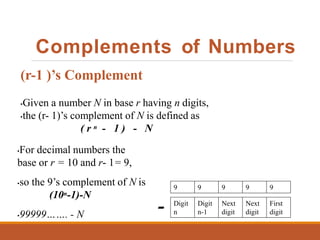
(r-1 )’s Complement
•Given a number N in base r having n digits,
•the (r- 1)’s complement of N is defined as
( r n - 1 ) - N
•For decimal numbers the
base or r = 10 and r- 1= 9,
•so the 9’s complement of N is
(10n-1)-N
•99999……. - N
Digit
n
Digit
n-1
Next
digit
Next
digit
First
digit
9 9 9 9 9
-
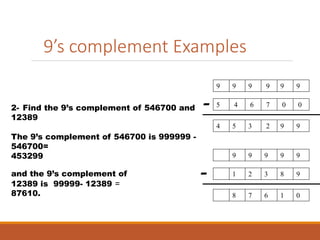
2- Find the 9’s complement of 546700 and
12389
The 9’s complement of 546700 is 999999 -
546700=
453299
and the 9’s complement of
12389 is 99999- 12389 =
87610.
9’s complement Examples
- 5 4 6 7 0 0
9 9 9 9 9 9
4 5 3 2 9 9
- 1 2 3 8 9
9 9 9 9 9
8 7 6 1 0
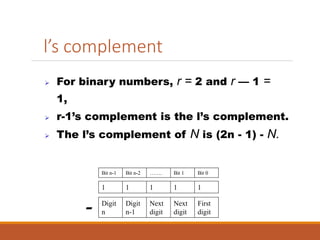
l’s complement
 For binary numbers, r = 2 and r — 1 =
1,
 r-1’s complement is the l’s complement.
 The l’s complement of N is (2n - 1) - N.
Digit
n
Digit
n-1
Next
digit
Next
digit
First
digit
1 1 1 1 1
Bit n-1 Bit n-2 ……. Bit 1 Bit 0
-
l’s complement
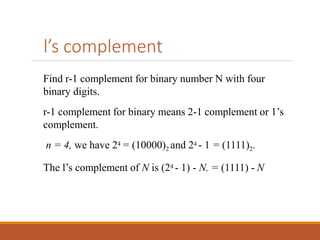
Find r-1 complement for binary number N with four
binary digits.
r-1 complement for binary means 2-1 complement or 1’s
complement.
n = 4, we have 24 = (10000)2 and 24 - 1 = (1111)2.
The l’s complement of N is (24 - 1) - N. = (1111) - N
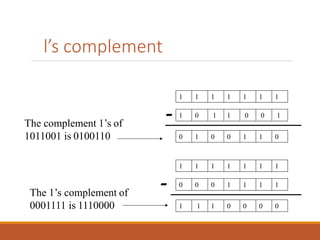
The complement 1’s of
1011001 is 0100110
-
-
1 0 1 1 0 0 1
1 1 1 1 1 1 1
0 1 0 0 1 1 0
The 1’s complement of
0001111 is 1110000
0 0 0 1 1 1 1
1 1 1 1 1 1 1
1 1 1 0 0 0 0
l’s complement
r’s Complement
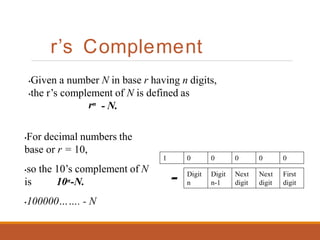
•Given a number N in base r having n digits,
•the r’s complement of N is defined as
rn
- N.
•For decimal numbers the
base or r = 10,
•so the 10’s complement of N
is 10n-N.
•100000……. - N
Digit
n
Digit
n-1
Next
digit
Next
digit
First
digit-
1 0 0 0 0 0
10’s complement Examples
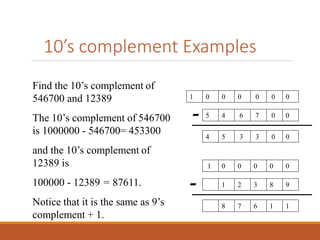
Find the 10’s complement of
546700 and 12389
The 10’s complement of 546700
is 1000000 - 546700= 453300
and the 10’s complement of
12389 is
100000 - 12389 = 87611.
Notice that it is the same as 9’s
complement + 1.
- 5 4 6 7 0 0
4 5 3 3 0 0
- 1 2 3 8 9
1 0 0 0 0 0
8 7 6 1 1
1 0 0 0 0 0 0
For binary numbers, r = 2,
r’s complement is the 2’s complement.
The 2’s complement of N is 2n - N.
2’s complement
Digit
n
Digit
n-1
Next
digit
Next
digit
First
digit-
1 0 0 0 0 0
2’s complement Example
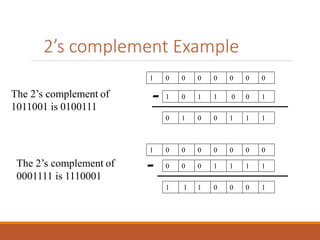
The 2’s complement of
1011001 is 0100111
The 2’s complement of
0001111 is 1110001
-
-
1 0 1 1 0 0 1
0 1 0 0 1 1 1
0 0 0 1 1 1 1
1 1 1 0 0 0 1
1 0 0 0 0 0 0 0
1 0 0 0 0 0 0 0
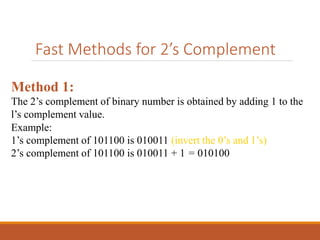
Fast Methods for 2’s Complement
Method 1:
The 2’s complement of binary number is obtained by adding 1 to the
l’s complement value.
Example:
1’s complement of 101100 is 010011 (invert the 0’s and 1’s)
2’s complement of 101100 is 010011 + 1 = 010100
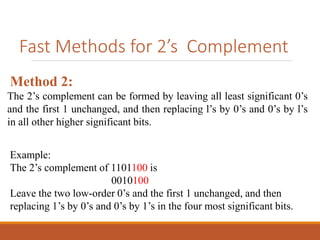
Fast Methods for 2’s Complement
Method 2:
The 2’s complement can be formed by leaving all least significant 0’s
and the first 1 unchanged, and then replacing l’s by 0’s and 0’s by l’s
in all other higher significant bits.
Example:
The 2’s complement of 1101100 is
0010100
Leave the two low-order 0’s and the first 1 unchanged, and then
replacing 1’s by 0’s and 0’s by 1’s in the four most significant bits.
Examples
Finding the 2’s complement of(01100101)2
• Method 1 – Simply complement each bit and then add
1 to the result.
(01100101)2
[N] = 2’s complement = 1’s complement (10011010)2 +1
=(10011011)2
• Method 2 – Starting with the least significant bit, copy
all the bits up to and including the first 1 bit and then
complement the remaining bits.
N = 0 1 1 0 0 1 0 1
[N] = 1 0 0 1 1 0 1 1
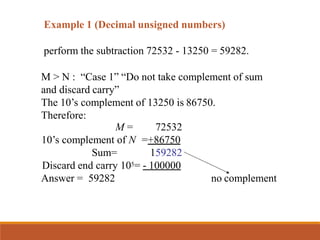
Example 1 (Decimal unsigned numbers)
perform the subtraction 72532 - 13250 = 59282.
M > N : “Case 1” “Do not take complement of sum
and discard carry”
The 10’s complement of 13250 is 86750.
Therefore:
M = 72532
10’s complement of N =+86750
Sum= 159282
Discard end carry 105= - 100000
Answer = 59282 no complement
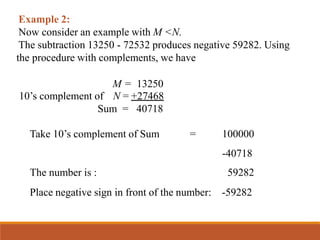
Example 2:
Now consider an example with M <N.
The subtraction 13250 - 72532 produces negative 59282. Using
the procedure with complements, we have
M = 13250
10’s complement of N = +27468
Sum = 40718
Take 10’s complement of Sum = 100000
-40718
The number is : 59282
Place negative sign in front of the number: -59282

Complement in DLD

  • 1.
  • 2.
    Subtraction using addition Conventionaladdition (using carry) is easily implemented in digital computers. However; subtraction by borrowing is difficult and inefficient for digital computers. Much more efficient to implement subtraction using ADDITION OF the COMPLEMENTS of numbers.
  • 3.
    Types of Complement Thereare two types of complements: R’s complement e.g. 2’s complement for base 2 and 10’s complement for base 10 R-1’s complement e.g. 1’s complement for base 2 and 9’s complement for base 10
  • 4.
    Complements of Numbers (r-1)’s Complement •Given a number N in base r having n digits, •the (r- 1)’s complement of N is defined as ( r n - 1 ) - N •For decimal numbers the base or r = 10 and r- 1= 9, •so the 9’s complement of N is (10n-1)-N •99999……. - N Digit n Digit n-1 Next digit Next digit First digit 9 9 9 9 9 -
  • 5.
    2- Find the9’s complement of 546700 and 12389 The 9’s complement of 546700 is 999999 - 546700= 453299 and the 9’s complement of 12389 is 99999- 12389 = 87610. 9’s complement Examples - 5 4 6 7 0 0 9 9 9 9 9 9 4 5 3 2 9 9 - 1 2 3 8 9 9 9 9 9 9 8 7 6 1 0
  • 6.
    l’s complement  Forbinary numbers, r = 2 and r — 1 = 1,  r-1’s complement is the l’s complement.  The l’s complement of N is (2n - 1) - N. Digit n Digit n-1 Next digit Next digit First digit 1 1 1 1 1 Bit n-1 Bit n-2 ……. Bit 1 Bit 0 -
  • 7.
    l’s complement Find r-1complement for binary number N with four binary digits. r-1 complement for binary means 2-1 complement or 1’s complement. n = 4, we have 24 = (10000)2 and 24 - 1 = (1111)2. The l’s complement of N is (24 - 1) - N. = (1111) - N
  • 8.
    The complement 1’sof 1011001 is 0100110 - - 1 0 1 1 0 0 1 1 1 1 1 1 1 1 0 1 0 0 1 1 0 The 1’s complement of 0001111 is 1110000 0 0 0 1 1 1 1 1 1 1 1 1 1 1 1 1 1 0 0 0 0 l’s complement
  • 9.
    r’s Complement •Given anumber N in base r having n digits, •the r’s complement of N is defined as rn - N. •For decimal numbers the base or r = 10, •so the 10’s complement of N is 10n-N. •100000……. - N Digit n Digit n-1 Next digit Next digit First digit- 1 0 0 0 0 0
  • 10.
    10’s complement Examples Findthe 10’s complement of 546700 and 12389 The 10’s complement of 546700 is 1000000 - 546700= 453300 and the 10’s complement of 12389 is 100000 - 12389 = 87611. Notice that it is the same as 9’s complement + 1. - 5 4 6 7 0 0 4 5 3 3 0 0 - 1 2 3 8 9 1 0 0 0 0 0 8 7 6 1 1 1 0 0 0 0 0 0
  • 11.
    For binary numbers,r = 2, r’s complement is the 2’s complement. The 2’s complement of N is 2n - N. 2’s complement Digit n Digit n-1 Next digit Next digit First digit- 1 0 0 0 0 0
  • 12.
    2’s complement Example The2’s complement of 1011001 is 0100111 The 2’s complement of 0001111 is 1110001 - - 1 0 1 1 0 0 1 0 1 0 0 1 1 1 0 0 0 1 1 1 1 1 1 1 0 0 0 1 1 0 0 0 0 0 0 0 1 0 0 0 0 0 0 0
  • 13.
    Fast Methods for2’s Complement Method 1: The 2’s complement of binary number is obtained by adding 1 to the l’s complement value. Example: 1’s complement of 101100 is 010011 (invert the 0’s and 1’s) 2’s complement of 101100 is 010011 + 1 = 010100
  • 14.
    Fast Methods for2’s Complement Method 2: The 2’s complement can be formed by leaving all least significant 0’s and the first 1 unchanged, and then replacing l’s by 0’s and 0’s by l’s in all other higher significant bits. Example: The 2’s complement of 1101100 is 0010100 Leave the two low-order 0’s and the first 1 unchanged, and then replacing 1’s by 0’s and 0’s by 1’s in the four most significant bits.
  • 15.
    Examples Finding the 2’scomplement of(01100101)2 • Method 1 – Simply complement each bit and then add 1 to the result. (01100101)2 [N] = 2’s complement = 1’s complement (10011010)2 +1 =(10011011)2 • Method 2 – Starting with the least significant bit, copy all the bits up to and including the first 1 bit and then complement the remaining bits. N = 0 1 1 0 0 1 0 1 [N] = 1 0 0 1 1 0 1 1
  • 16.
    Example 1 (Decimalunsigned numbers) perform the subtraction 72532 - 13250 = 59282. M > N : “Case 1” “Do not take complement of sum and discard carry” The 10’s complement of 13250 is 86750. Therefore: M = 72532 10’s complement of N =+86750 Sum= 159282 Discard end carry 105= - 100000 Answer = 59282 no complement
  • 17.
    Example 2: Now consideran example with M <N. The subtraction 13250 - 72532 produces negative 59282. Using the procedure with complements, we have M = 13250 10’s complement of N = +27468 Sum = 40718 Take 10’s complement of Sum = 100000 -40718 The number is : 59282 Place negative sign in front of the number: -59282