KONGUNADU COLLEGE OF ENGINEERING AND TECHNOLOGY
(AUTONOMOUS)
DEPARTMENT OF ELECTRICALAND ELECTRONICS ENGINEERING
20EC302 - DIGITAL ELECTRONICS
UNIT I - DIGITAL FUNDAMENTALS
Number Systems Decimal, Binary, Octal,
Hexadecimal, radix conversion ,1's and 2's
complements, Codes – Binary, BCD, Excess 3,
Gray, Alphanumeric codes, Boolean theorems
and Postulates, Logic gates – Universal gates –
Sum of products and product of sums –
Minterms and Maxterms – Karnaugh Map
Minimization.
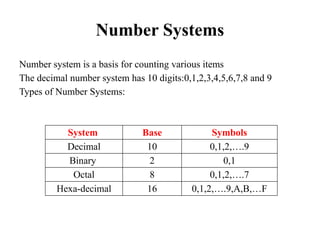
Number Systems
Number system is a basis for counting various items
The decimal number system has 10 digits:0,1,2,3,4,5,6,7,8 and 9
Types of Number Systems:
System Base Symbols
Decimal 10 0,1,2,….9
Binary 2 0,1
Octal 8 0,1,2,….7
Hexa-decimal 16 0,1,2,….9,A,B,…F
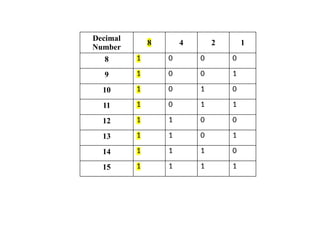
Decimal
Number
8 4 2 1
8 1 0 0 0
9 1 0 0 1
10 1 0 1 0
11 1 0 1 1
12 1 1 0 0
13 1 1 0 1
14 1 1 1 0
15 1 1 1 1
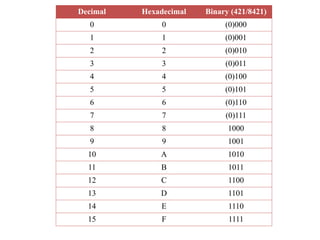
Decimal Hexadecimal Binary (421/8421)
0 0 (0)000
1 1 (0)001
2 2 (0)010
3 3 (0)011
4 4 (0)100
5 5 (0)101
6 6 (0)110
7 7 (0)111
8 8 1000
9 9 1001
10 A 1010
11 B 1011
12 C 1100
13 D 1101
14 E 1110
15 F 1111
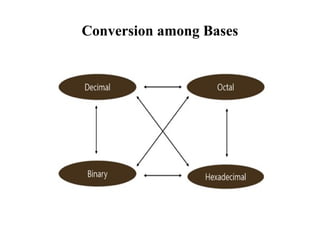
Conversion among Bases
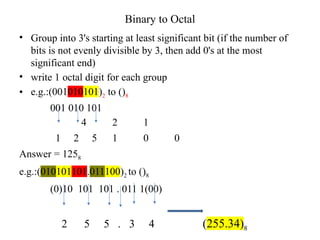
Binary to Octal
• Group into 3's starting at least significant bit (if the number of
bits is not evenly divisible by 3, then add 0's at the most
significant end)
• write 1 octal digit for each group
• e.g.:(001010101)2 to ()8
001 010 101
4 2 1
1 2 5 1 0 0
Answer = 1258
e.g.:(010101101.011100)2 to ()8
(0)10 101 101 . 011 1(00)
2 5 5 . 3 4 (255.34)8
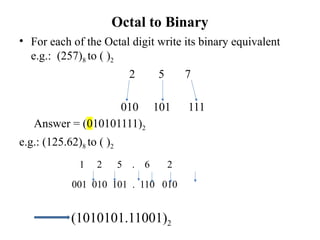
Octal to Binary
• For each of the Octal digit write its binary equivalent
e.g.: (257)8 to ( )2
2 5 7
010 101 111
Answer = (010101111)2
e.g.: (125.62)8 to ( )2
1 2 5 . 6 2
001 010 101 . 110 010
(1010101.11001)2
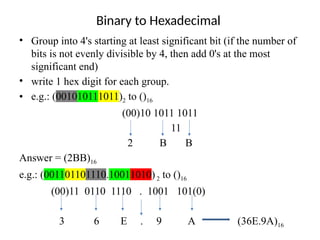
Binary to Hexadecimal
• Group into 4's starting at least significant bit (if the number of
bits is not evenly divisible by 4, then add 0's at the most
significant end)
• write 1 hex digit for each group.
• e.g.: (001010111011)2 to ()16
(00)10 1011 1011
11
2 B B
Answer = (2BB)16
e.g.: (001101101110.10011010)2 to ()16
(00)11 0110 1110 . 1001 101(0)
3 6 E . 9 A (36E.9A)16
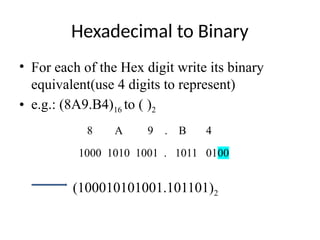
Hexadecimal to Binary
• For each of the Hex digit write its binary
equivalent(use 4 digits to represent)
• e.g.: (8A9.B4)16 to ( )2
8 A 9 . B 4
1000 1010 1001 . 1011 0100
(100010101001.101101)2
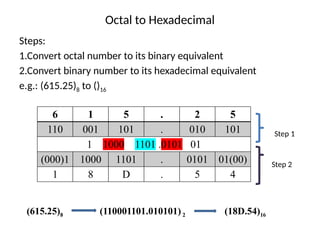
Octal to Hexadecimal
Steps:
1.Convert octal number to its binary equivalent
2.Convert binary number to its hexadecimal equivalent
e.g.: (615.25)8 to ()16
6 1 5 . 2 5
110 001 101 . 010 101
1 1000 1101 .0101 01
(000)1 1000 1101 . 0101 01(00)
1 8 D . 5 4
(615.25)8 (110001101.010101) 2 (18D.54)16
Step 1
Step 2
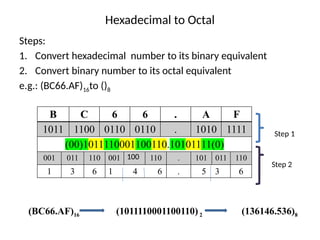
Hexadecimal to Octal
Steps:
1. Convert hexadecimal number to its binary equivalent
2. Convert binary number to its octal equivalent
e.g.: (BC66.AF)16to ()8
B C 6 6 . A F
1011 1100 0110 0110 . 1010 1111
(00)1011110001100110.10101111(0)
001 011 110 001 100 110 . 101 011 110
1 3 6 1 4 6 . 5 3 6
(BC66.AF)16 (1011110001100110) 2 (136146.536)8
Step 1
Step 2
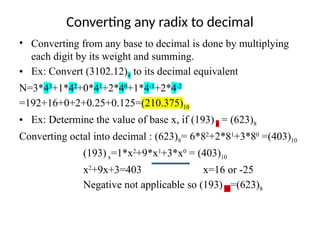
Converting any radix to decimal
• Converting from any base to decimal is done by multiplying
each digit by its weight and summing.
• Ex: Convert (3102.12)4 to its decimal equivalent
N=3*43
+1*42
+0*41
+2*40
+1*4-1
+2*4-2
=192+16+0+2+0.25+0.125=(210.375)10
• Ex: Determine the value of base x, if (193) x = (623)8
Converting octal into decimal : (623)8= 6*82
+2*81
+3*80
=(403)10
(193)x=1*x2
+9*x1
+3*x0
= (403)10
x2
+9x+3=403 x=16 or -25
Negative not applicable so (193) 16=(623)8
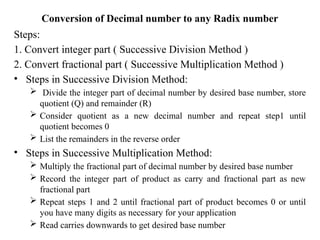
Conversion of Decimal number to any Radix number
Steps:
1. Convert integer part ( Successive Division Method )
2. Convert fractional part ( Successive Multiplication Method )
• Steps in Successive Division Method:
 Divide the integer part of decimal number by desired base number, store
quotient (Q) and remainder (R)
 Consider quotient as a new decimal number and repeat step1 until
quotient becomes 0
 List the remainders in the reverse order
• Steps in Successive Multiplication Method:
 Multiply the fractional part of decimal number by desired base number
 Record the integer part of product as carry and fractional part as new
fractional part
 Repeat steps 1 and 2 until fractional part of product becomes 0 or until
you have many digits as necessary for your application
 Read carries downwards to get desired base number
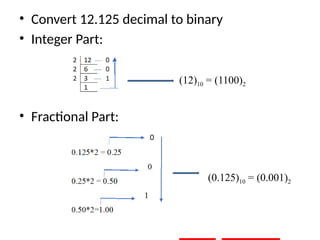
• Convert 12.125 decimal to binary
• Integer Part:
(12)10 = (1100)2
• Fractional Part:
(0.125)10 = (0.001)2
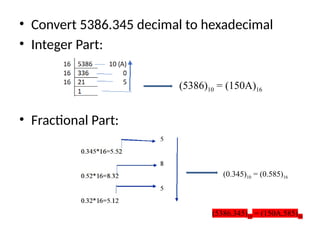
• Convert 5386.345 decimal to hexadecimal
• Integer Part:
(5386)10 = (150A)16
• Fractional Part:
(0.345)10 = (0.585)16
(5386.345)10 = (150A.585)16
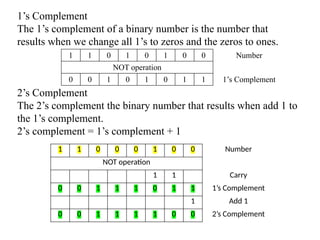
1’s Complement
The 1’s complement of a binary number is the number that
results when we change all 1’s to zeros and the zeros to ones.
2’s Complement
The 2’s complement the binary number that results when add 1 to
the 1’s complement.
2’s complement = 1’s complement + 1
1 1 0 1 0 1 0 0 Number
NOT operation
0 0 1 0 1 0 1 1 1’s Complement
1 1 0 0 0 1 0 0 Number
NOT operation
1 1 Carry
0 0 1 1 1 0 1 1 1’s Complement
1 Add 1
0 0 1 1 1 1 0 0 2’s Complement
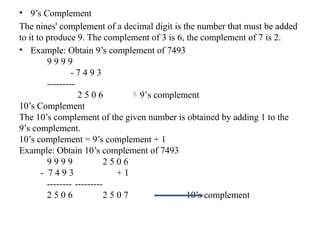
• 9’s Complement
The nines' complement of a decimal digit is the number that must be added
to it to produce 9. The complement of 3 is 6, the complement of 7 is 2.
• Example: Obtain 9’s complement of 7493
9 9 9 9
- 7 4 9 3
---------
2 5 0 6 9’s complement
10’s Complement
The 10’s complement of the given number is obtained by adding 1 to the
9’s complement.
10’s complement = 9’s complement + 1
Example: Obtain 10’s complement of 7493
9 9 9 9 2 5 0 6
- 7 4 9 3 + 1
-------- ---------
2 5 0 6 2 5 0 7 10’s complement
Arithmetic Operations
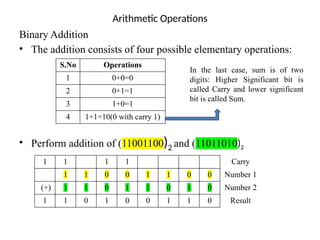
Binary Addition
• The addition consists of four possible elementary operations:
• Perform addition of (11001100)2 and (11011010)2
S.No Operations
1 0+0=0
2 0+1=1
3 1+0=1
4 1+1=10(0 with carry 1)
In the last case, sum is of two
digits: Higher Significant bit is
called Carry and lower significant
bit is called Sum.
1 1 1 1 Carry
1 1 0 0 1 1 0 0 Number 1
(+) 1 1 0 1 1 0 1 0 Number 2
1 1 0 1 0 0 1 1 0 Result
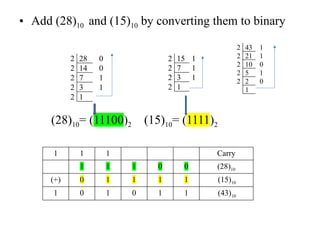
• Add (28)10 and (15)10 by converting them to binary
(28)10= (11100)2 (15)10= (1111)2
2 28 0
2 14 0
2 7 1
2 3 1
2 1
2 15 1
2 7 1
2 3 1
2 1
1 1 1 Carry
1 1 1 0 0 (28)10
(+) 0 1 1 1 1 (15)10
1 0 1 0 1 1 (43)10
2 43 1
2 21 1
2 10 0
2 5 1
2 2 0
1
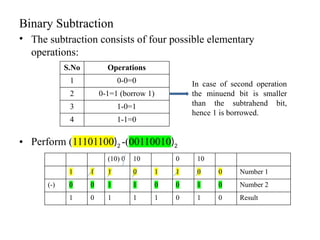
Binary Subtraction
• The subtraction consists of four possible elementary
operations:
• Perform (11101100)2 -(00110010)2
S.No Operations
1 0-0=0
2 0-1=1 (borrow 1)
3 1-0=1
4 1-1=0
In case of second operation
the minuend bit is smaller
than the subtrahend bit,
hence 1 is borrowed.
(10) 0 10 0 10
1 1 1 0 1 1 0 0 Number 1
(-) 0 0 1 1 0 0 1 0 Number 2
1 0 1 1 1 0 1 0 Result
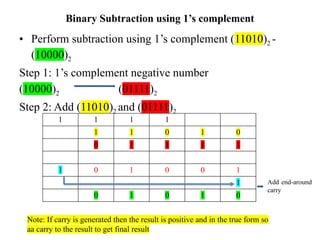
Binary Subtraction using 1’s complement
• Perform subtraction using 1’s complement (11010)2 -
(10000)2
Step 1: 1’s complement negative number
(10000)2 (01111)2
Step 2: Add (11010)2 and (01111)2
1 1 1 1
1 1 0 1 0
0 1 1 1 1
1 0 1 0 0 1
1
0 1 0 1 0
Add end-around
carry
Note: If carry is generated then the result is positive and in the true form so
aa carry to the result to get final result
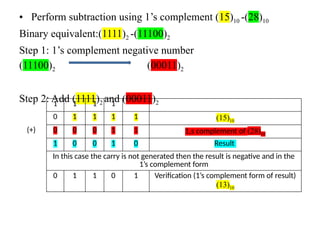
• Perform subtraction using 1’s complement (15)10 -(28)10
Binary equivalent:(1111)2 -(11100)2
Step 1: 1’s complement negative number
(11100)2 (00011)2
Step 2: Add (1111)2 and (00011)2
1 1 1 1
0 1 1 1 1 (15)10
(+) 0 0 0 1 1 1,s complement of (28)10
1 0 0 1 0 Result
In this case the carry is not generated then the result is negative and in the
1’s complement form
0 1 1 0 1 Verification (1’s complement form of result)
(13)10
Binary Subtraction using 2’s complement
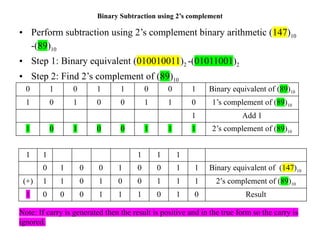
• Perform subtraction using 2’s complement binary arithmetic (147)10
-(89)10
• Step 1: Binary equivalent (010010011)2 -(01011001)2
• Step 2: Find 2’s complement of (89)10
0 1 0 1 1 0 0 1 Binary equivalent of (89)10
1 0 1 0 0 1 1 0 1’s complement of (89)10
1 Add 1
1 0 1 0 0 1 1 1 2’s complement of (89)10
1 1 1 1 1
0 1 0 0 1 0 0 1 1 Binary equivalent of (147)10
(+) 1 1 0 1 0 0 1 1 1 2’s complement of (89)10
1 0 0 0 1 1 1 0 1 0 Result
Note: If carry is generated then the result is positive and in the true form so the carry is
ignored.
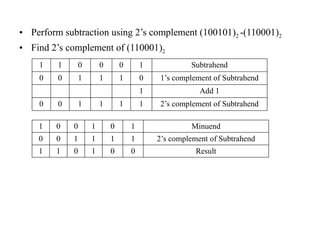
• Perform subtraction using 2’s complement (100101)2 -(110001)2
• Find 2’s complement of (110001)2
1 1 0 0 0 1 Subtrahend
0 0 1 1 1 0 1’s complement of Subtrahend
1 Add 1
0 0 1 1 1 1 2’s complement of Subtrahend
1 0 0 1 0 1 Minuend
0 0 1 1 1 1 2’s complement of Subtrahend
1 1 0 1 0 0 Result
Binary Subtraction using 2’s complement
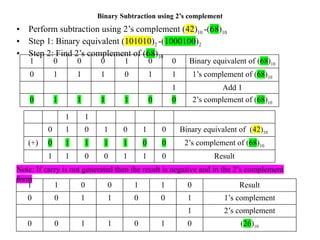
• Perform subtraction using 2’s complement (42)10 -(68)10
• Step 1: Binary equivalent (101010)2 -(1000100)2
• Step 2: Find 2’s complement of (68)10
1 0 0 0 1 0 0 Binary equivalent of (68)10
0 1 1 1 0 1 1 1’s complement of (68)10
1 Add 1
0 1 1 1 1 0 0 2’s complement of (68)10
1 1
0 1 0 1 0 1 0 Binary equivalent of (42)10
(+) 0 1 1 1 1 0 0 2’s complement of (68)10
1 1 0 0 1 1 0 Result
Note: If carry is not generated then the result is negative and in the 2’s complement
form
1 1 0 0 1 1 0 Result
0 0 1 1 0 0 1 1’s complement
1 2’s complement
0 0 1 1 0 1 0 (26)10
Binary Multiplication
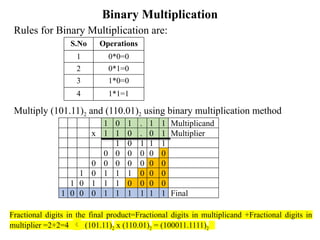
Rules for Binary Multiplication are:
Multiply (101.11)2 and (110.01)2 using binary multiplication method
S.No Operations
1 0*0=0
2 0*1=0
3 1*0=0
4 1*1=1
1 0 1 . 1 1 Multiplicand
x 1 1 0 . 0 1 Multiplier
1 0 1 1 1
0 0 0 0 0 0
0 0 0 0 0 0 0
1 0 1 1 1 0 0 0
1 0 1 1 1 0 0 0 0
1 0 0 0 1 1 1 1 1 1 Final
Fractional digits in the final product=Fractional digits in multiplicand +Fractional digits in
multiplier =2+2=4  (101.11)2 x (110.01)2 = (100011.1111)2
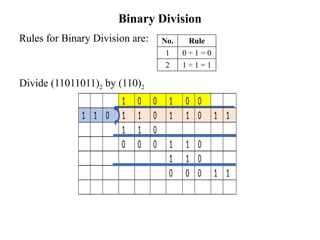
Binary Division
Rules for Binary Division are:
Divide (11011011)2 by (110)2
No. Rule
1 0 ÷ 1 = 0
2 1 ÷ 1 = 1
1 0 0 1 0 0
1 1 0 1 1 0 1 1 0 1 1
1 1 0
0 0 0 1 1 0
1 1 0
0 0 0 1 1
Binary Codes
• When numbers, alphabets or words are represented by a
specific group of symbols i.e., they are encoded
• The group of symbols used to encode them is called codes.
The digital data is represented, stored and transmitted as
groups of binary digits (bits)
• Group of bits--- binary code---- numeric and alphanumeric
code
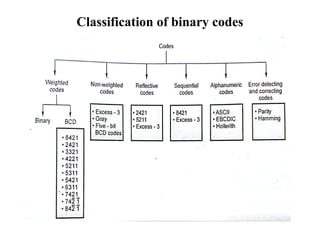
Classification of binary codes
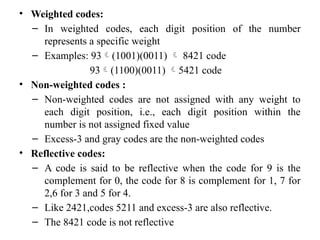
• Weighted codes:
– In weighted codes, each digit position of the number
represents a specific weight
– Examples: 93(1001)(0011)  8421 code
93(1100)(0011) 5421 code
• Non-weighted codes :
– Non-weighted codes are not assigned with any weight to
each digit position, i.e., each digit position within the
number is not assigned fixed value
– Excess-3 and gray codes are the non-weighted codes
• Reflective codes:
– A code is said to be reflective when the code for 9 is the
complement for 0, the code for 8 is complement for 1, 7 for
2,6 for 3 and 5 for 4.
– Like 2421,codes 5211 and excess-3 are also reflective.
– The 8421 code is not reflective
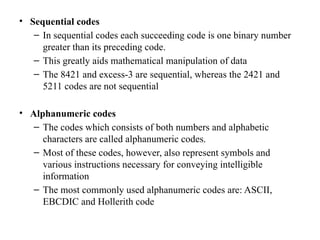
• Sequential codes
– In sequential codes each succeeding code is one binary number
greater than its preceding code.
– This greatly aids mathematical manipulation of data
– The 8421 and excess-3 are sequential, whereas the 2421 and
5211 codes are not sequential
• Alphanumeric codes
– The codes which consists of both numbers and alphabetic
characters are called alphanumeric codes.
– Most of these codes, however, also represent symbols and
various instructions necessary for conveying intelligible
information
– The most commonly used alphanumeric codes are: ASCII,
EBCDIC and Hollerith code
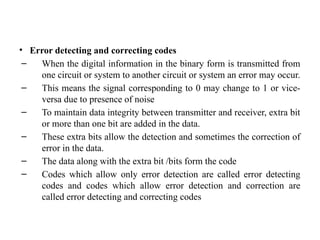
• Error detecting and correcting codes
– When the digital information in the binary form is transmitted from
one circuit or system to another circuit or system an error may occur.
– This means the signal corresponding to 0 may change to 1 or vice-
versa due to presence of noise
– To maintain data integrity between transmitter and receiver, extra bit
or more than one bit are added in the data.
– These extra bits allow the detection and sometimes the correction of
error in the data.
– The data along with the extra bit /bits form the code
– Codes which allow only error detection are called error detecting
codes and codes which allow error detection and correction are
called error detecting and correcting codes
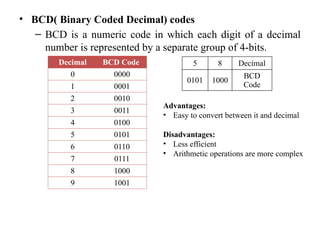
• BCD( Binary Coded Decimal) codes
– BCD is a numeric code in which each digit of a decimal
number is represented by a separate group of 4-bits.
Decimal BCD Code
0 0000
1 0001
2 0010
3 0011
4 0100
5 0101
6 0110
7 0111
8 1000
9 1001
5 8 Decimal
0101 1000
BCD
Code
Advantages:
• Easy to convert between it and decimal
Disadvantages:
• Less efficient
• Arithmetic operations are more complex
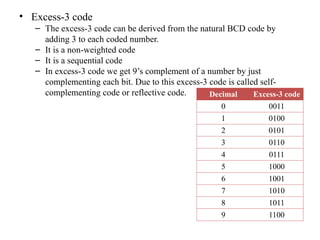
• Excess-3 code
– The excess-3 code can be derived from the natural BCD code by
adding 3 to each coded number.
– It is a non-weighted code
– It is a sequential code
– In excess-3 code we get 9’s complement of a number by just
complementing each bit. Due to this excess-3 code is called self-
complementing code or reflective code. Decimal Excess-3 code
0 0011
1 0100
2 0101
3 0110
4 0111
5 1000
6 1001
7 1010
8 1011
9 1100
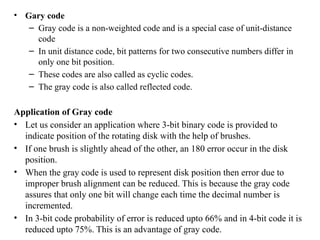
• Gary code
– Gray code is a non-weighted code and is a special case of unit-distance
code
– In unit distance code, bit patterns for two consecutive numbers differ in
only one bit position.
– These codes are also called as cyclic codes.
– The gray code is also called reflected code.
Application of Gray code
• Let us consider an application where 3-bit binary code is provided to
indicate position of the rotating disk with the help of brushes.
• If one brush is slightly ahead of the other, an 180 error occur in the disk
position.
• When the gray code is used to represent disk position then error due to
improper brush alignment can be reduced. This is because the gray code
assures that only one bit will change each time the decimal number is
incremented.
• In 3-bit code probability of error is reduced upto 66% and in 4-bit code it is
reduced upto 75%. This is an advantage of gray code.
Gray to Binary Conversion:
Exclusive OR operation
Convert gray code 101011 into its binary equivalent.
(101011) gray = (110010) 2
A B AꚚ
B
0 0 0
0 1 1
1 0 1
1 1 0
1 0 1 0 1 1 Gray code
Exclusive OR operation
1 1 0 0 1 0 Binary code
Binary to Gray code:
Convert 10111011 in binary into its equivalent gray
code.
1 0 1 1 1 0 1 1 Binar
y
code
1 1 1 0 0 1 1 0 Gray
code
Exclusive OR
operation
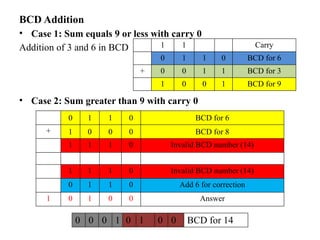
BCD Addition
• Case 1: Sum equals 9 or less with carry 0
Addition of 3 and 6 in BCD
• Case 2: Sum greater than 9 with carry 0
1 1 Carry
0 1 1 0 BCD for 6
+ 0 0 1 1 BCD for 3
1 0 0 1 BCD for 9
0 1 1 0 BCD for 6
+ 1 0 0 0 BCD for 8
1 1 1 0 Invalid BCD number (14)
0 1 1 0 Add 6 for correction
1 0 1 0 0 Answer
0 0 0 1 0 1 0 0 BCD for 14
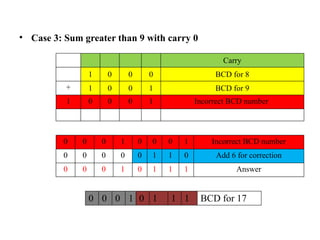
• Case 3: Sum greater than 9 with carry 0
Carry
1 0 0 0 BCD for 8
+ 1 0 0 1 BCD for 9
1 0 0 0 1 Incorrect BCD number
0 0 0 1 0 1 1 1 BCD for 17
0 0 0 1 0 0 0 1 Incorrect BCD number
0 0 0 0 0 1 1 0 Add 6 for correction
0 0 0 1 0 1 1 1 Answer
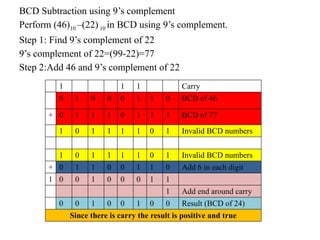
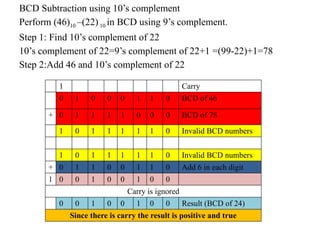
BCD Subtraction using 9’s complement
Perform (46)10 –(22)10 in BCD using 9’s complement.
Step 1: Find 9’s complement of 22
9’s complement of 22=(99-22)=77
Step 2:Add 46 and 9’s complement of 22
1 1 1 Carry
0 1 0 0 0 1 1 0 BCD of 46
+ 0 1 1 1 0 1 1 1 BCD of 77
1 0 1 1 1 1 0 1 Invalid BCD numbers
+ 0 1 1 0 0 1 1 0 Add 6 in each digit
1 0 0 1 0 0 0 1 1
1 Add end around carry
0 0 1 0 0 1 0 0 Result (BCD of 24)
Since there is carry the result is positive and true
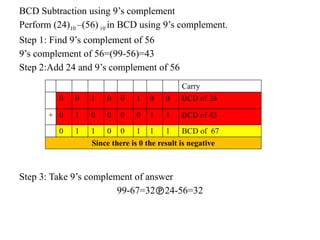
BCD Subtraction using 9’s complement
Perform (24)10 –(56)10 in BCD using 9’s complement.
Step 1: Find 9’s complement of 56
9’s complement of 56=(99-56)=43
Step 2:Add 24 and 9’s complement of 56
Step 3: Take 9’s complement of answer
99-67=3224-56=32
Carry
0 0 1 0 0 1 0 0 BCD of 24
+ 0 1 0 0 0 0 1 1 BCD of 43
0 1 1 0 0 1 1 1 BCD of 67
Since there is 0 the result is negative
BCD Subtraction using 10’s complement
Perform (46)10 –(22)10 in BCD using 9’s complement.
Step 1: Find 10’s complement of 22
10’s complement of 22=9’s complement of 22+1 =(99-22)+1=78
Step 2:Add 46 and 10’s complement of 22
1 Carry
0 1 0 0 0 1 1 0 BCD of 46
+ 0 1 1 1 1 0 0 0 BCD of 78
1 0 1 1 1 1 1 0 Invalid BCD numbers
+ 0 1 1 0 0 1 1 0 Add 6 in each digit
1 0 0 1 0 0 1 0 0
Carry is ignored
0 0 1 0 0 1 0 0 Result (BCD of 24)
Since there is carry the result is positive and true
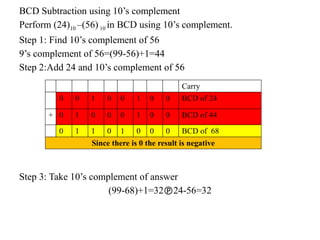
BCD Subtraction using 10’s complement
Perform (24)10 –(56)10 in BCD using 10’s complement.
Step 1: Find 10’s complement of 56
9’s complement of 56=(99-56)+1=44
Step 2:Add 24 and 10’s complement of 56
Step 3: Take 10’s complement of answer
(99-68)+1=3224-56=32
Carry
0 0 1 0 0 1 0 0 BCD of 24
+ 0 1 0 0 0 1 0 0 BCD of 44
0 1 1 0 1 0 0 0 BCD of 68
Since there is 0 the result is negative
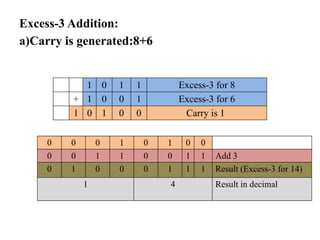
Excess-3 Addition:
a)Carry is generated:8+6
1 0 1 1 Excess-3 for 8
+ 1 0 0 1 Excess-3 for 6
1 0 1 0 0 Carry is 1
0 0 0 1 0 1 0 0
0 0 1 1 0 0 1 1 Add 3
0 1 0 0 0 1 1 1 Result (Excess-3 for 14)
1 4 Result in decimal
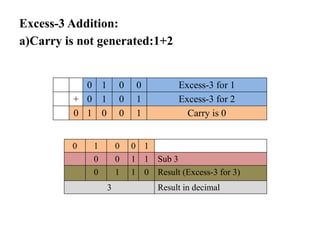
Excess-3 Addition:
a)Carry is not generated:1+2
0 1 0 0 Excess-3 for 1
+ 0 1 0 1 Excess-3 for 2
0 1 0 0 1 Carry is 0
0 1 0 0 1
0 0 1 1 Sub 3
0 1 1 0 Result (Excess-3 for 3)
3 Result in decimal
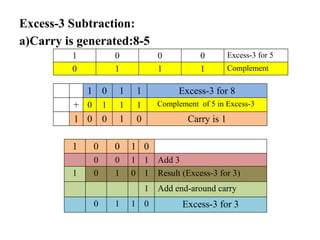
Excess-3 Subtraction:
a)Carry is generated:8-5
1 0 1 1 Excess-3 for 8
+ 0 1 1 1 Complement of 5 in Excess-3
1 0 0 1 0 Carry is 1
1 0 0 1 0
0 0 1 1 Add 3
1 0 1 0 1 Result (Excess-3 for 3)
1 Add end-around carry
0 1 1 0 Excess-3 for 3
1 0 0 0 Excess-3 for 5
0 1 1 1 Complement
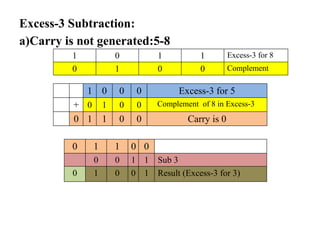
Excess-3 Subtraction:
a)Carry is not generated:5-8
1 0 0 0 Excess-3 for 5
+ 0 1 0 0 Complement of 8 in Excess-3
0 1 1 0 0 Carry is 0
0 1 1 0 0
0 0 1 1 Sub 3
0 1 0 0 1 Result (Excess-3 for 3)
1 0 1 1 Excess-3 for 8
0 1 0 0 Complement
Boolean Algebra
• Boolean algebra is a mathematical system that defines a series
of logical operations (AND,OR,NOT) performed on sets of
variables (a,b,c,….).
• When stated in this form, the expression is called a Boolean
equation or switching equation.
Terminologies :
Variable: The symbol which represent an arbitrary elements of
an Boolean algebra is known as variable.
Any single variable or a function of several variables can have
either a 1 or 0 value.
Constant: In expression Y=A+1, the first term A is a variable
and the second term has a fixed value 1. So 1 is a constant here.
The constant may be 1 or 0.
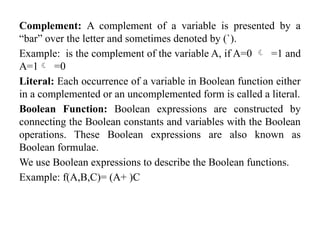
Complement: A complement of a variable is presented by a
“bar” over the letter and sometimes denoted by (`).
Example: is the complement of the variable A, if A=0  =1 and
A=1 =0
Literal: Each occurrence of a variable in Boolean function either
in a complemented or an uncomplemented form is called a literal.
Boolean Function: Boolean expressions are constructed by
connecting the Boolean constants and variables with the Boolean
operations. These Boolean expressions are also known as
Boolean formulae.
We use Boolean expressions to describe the Boolean functions.
Example: f(A,B,C)= (A+ )C
Properties of Boolean Algebra
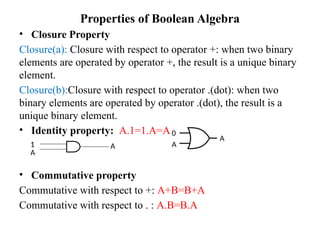
• Closure Property
Closure(a): Closure with respect to operator +: when two binary
elements are operated by operator +, the result is a unique binary
element.
Closure(b):Closure with respect to operator .(dot): when two
binary elements are operated by operator .(dot), the result is a
unique binary element.
• Identity property: A.1=1.A=A
• Commutative property
Commutative with respect to +: A+B=B+A
Commutative with respect to . : A.B=B.A
1
A
A
0
A
A
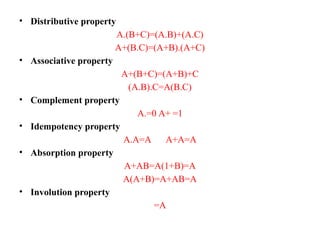
• Distributive property
A.(B+C)=(A.B)+(A.C)
A+(B.C)=(A+B).(A+C)
• Associative property
A+(B+C)=(A+B)+C
(A.B).C=A(B.C)
• Complement property
A.=0 A+ =1
• Idempotency property
A.A=A A+A=A
• Absorption property
A+AB=A(1+B)=A
A(A+B)=A+AB=A
• Involution property
=A
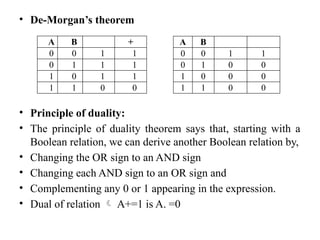
• De-Morgan’s theorem
• Principle of duality:
• The principle of duality theorem says that, starting with a
Boolean relation, we can derive another Boolean relation by,
• Changing the OR sign to an AND sign
• Changing each AND sign to an OR sign and
• Complementing any 0 or 1 appearing in the expression.
• Dual of relation  A+=1 is A. =0
A B +
0 0 1 1
0 1 1 1
1 0 1 1
1 1 0 0
A B
0 0 1 1
0 1 0 0
1 0 0 0
1 1 0 0
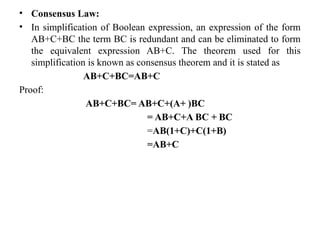
• Consensus Law:
• In simplification of Boolean expression, an expression of the form
AB+C+BC the term BC is redundant and can be eliminated to form
the equivalent expression AB+C. The theorem used for this
simplification is known as consensus theorem and it is stated as
AB+C+BC=AB+C
Proof:
AB+C+BC= AB+C+(A+ )BC
= AB+C+A BC + BC
=AB(1+C)+C(1+B)
=AB+C
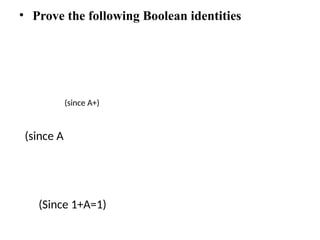
• Prove the following Boolean identities
(since A+)
(since A
(Since 1+A=1)
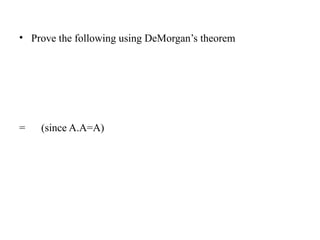
• Prove the following using DeMorgan’s theorem
= (since A.A=A)
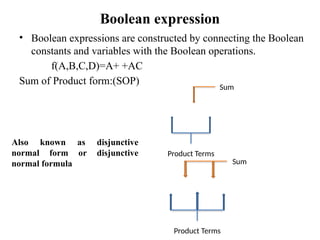
Boolean expression
• Boolean expressions are constructed by connecting the Boolean
constants and variables with the Boolean operations.
f(A,B,C,D)=A+ +AC
Sum of Product form:(SOP)
Product Terms
Sum
Product Terms
Sum
Also known as disjunctive
normal form or disjunctive
normal formula
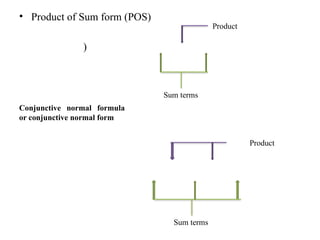
• Product of Sum form (POS)
)
Sum terms
Product
Sum terms
Product
Conjunctive normal formula
or conjunctive normal form
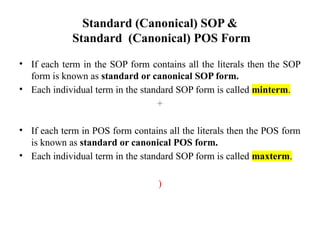
Standard (Canonical) SOP &
Standard (Canonical) POS Form
• If each term in the SOP form contains all the literals then the SOP
form is known as standard or canonical SOP form.
• Each individual term in the standard SOP form is called minterm.
+
• If each term in POS form contains all the literals then the POS form
is known as standard or canonical POS form.
• Each individual term in the standard SOP form is called maxterm.
)
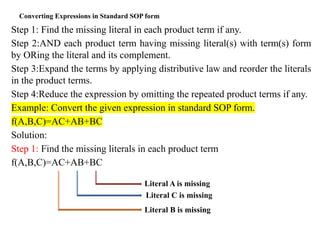
Converting Expressions in Standard SOP form
Step 1: Find the missing literal in each product term if any.
Step 2:AND each product term having missing literal(s) with term(s) form
by ORing the literal and its complement.
Step 3:Expand the terms by applying distributive law and reorder the literals
in the product terms.
Step 4:Reduce the expression by omitting the repeated product terms if any.
Example: Convert the given expression in standard SOP form.
f(A,B,C)=AC+AB+BC
Solution:
Step 1: Find the missing literals in each product term
f(A,B,C)=AC+AB+BC
Literal A is missing
Literal C is missing
Literal B is missing
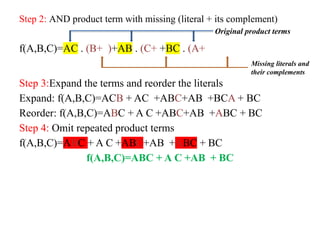
Step 2: AND product term with missing (literal + its complement)
f(A,B,C)=AC . (B+ )+AB . (C+ +BC . (A+
Step 3:Expand the terms and reorder the literals
Expand: f(A,B,C)=ACB + AC +ABC+AB +BCA + BC
Reorder: f(A,B,C)=ABC + A C +ABC+AB +ABC + BC
Step 4: Omit repeated product terms
f(A,B,C)=ABC + A C +ABC+AB +ABC + BC
f(A,B,C)=ABC + A C +AB + BC
Original product terms
Missing literals and
their complements
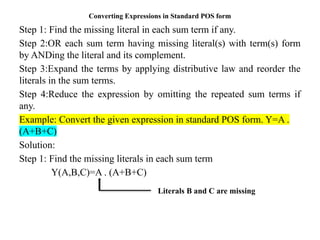
Converting Expressions in Standard POS form
Step 1: Find the missing literal in each sum term if any.
Step 2:OR each sum term having missing literal(s) with term(s) form
by ANDing the literal and its complement.
Step 3:Expand the terms by applying distributive law and reorder the
literals in the sum terms.
Step 4:Reduce the expression by omitting the repeated sum terms if
any.
Example: Convert the given expression in standard POS form. Y=A .
(A+B+C)
Solution:
Step 1: Find the missing literals in each sum term
Y(A,B,C)=A . (A+B+C)
Literals B and C are missing
Step 2: OR sum term with (missing literal . its complement)
Y=[A+(B. )+ (C. ) ]. (A+B+C)
Step 3: Expand the terms and reorder literals
Y=(A+B). (A+)+ (C. ) ]. (A+B+C)
Y=(A+B+C). (A++C) . (A+B+ ). (A++ ). (A+B+C)
Step 4: Omit repeated sum terms
Y=(A+B+C). (A++C) . (A+B+ ). (A++ ). (A+B+C)
Y=(A+B+C). (A++C) . (A+B+ ). (A++ )
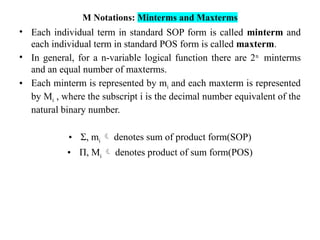
M Notations: Minterms and Maxterms
• Each individual term in standard SOP form is called minterm and
each individual term in standard POS form is called maxterm.
• In general, for a n-variable logical function there are 2n
minterms
and an equal number of maxterms.
• Each minterm is represented by mi and each maxterm is represented
by Mi , where the subscript i is the decimal number equivalent of the
natural binary number.
• Σ, mi  denotes sum of product form(SOP)
• Π, Mi  denotes product of sum form(POS)
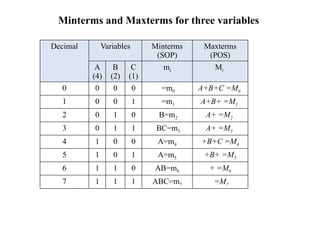
Minterms and Maxterms for three variables
Decimal Variables Minterms
(SOP)
Maxterms
(POS)
A
(4)
B
(2)
C
(1)
mi Mi
0 0 0 0 =m0 A+B+C =M0
1 0 0 1 =m1 A+B+ =M1
2 0 1 0 B=m2 A+ =M2
3 0 1 1 BC=m3 A+ =M3
4 1 0 0 A=m4 +B+C =M4
5 1 0 1 A=m5 +B+ =M5
6 1 1 0 AB=m6 + =M6
7 1 1 1 ABC=m7 =M7
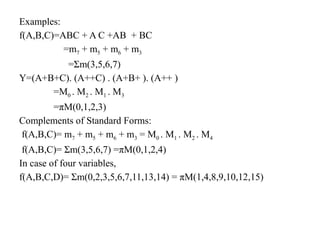
Examples:
f(A,B,C)=ABC + A C +AB + BC
=m7 + m5 + m6 + m3
=Σm(3,5,6,7)
Y=(A+B+C). (A++C) . (A+B+ ). (A++ )
=M0 . M2 . M1 . M3
=πM(0,1,2,3)
Complements of Standard Forms:
f(A,B,C)= m7 + m5 + m6 + m3 = M0 . M1 . M2 . M4
f(A,B,C)= Σm(3,5,6,7) =πM(0,1,2,4)
In case of four variables,
f(A,B,C,D)= Σm(0,2,3,5,6,7,11,13,14) = πM(1,4,8,9,10,12,15)
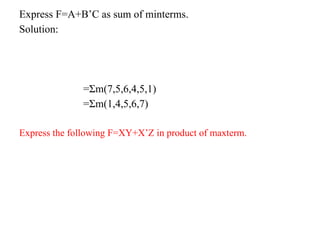
Express F=A+B’C as sum of minterms.
Solution:
=Σm(7,5,6,4,5,1)
=Σm(1,4,5,6,7)
Express the following F=XY+X’Z in product of maxterm.
K-map Minimization
• During the process of simplification of Boolean
expression we have to predict each successive step
• We can never be absolutely certain that an expression
simplified by Boolean algebra alone is the simplest
possible expression
• On the other hand, the map method gives us a
systematic approach for simplifying a Boolean
expression
• The map method, first proposed by Veitch and
modified by Karnaugh, hence it is known as the
Veitch diagram or the Karnaugh map.
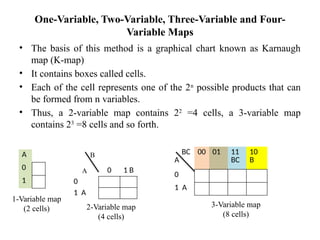
One-Variable, Two-Variable, Three-Variable and Four-
Variable Maps
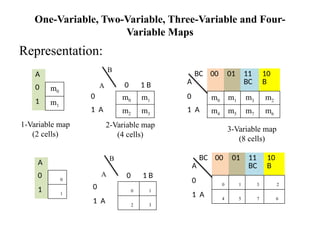
• The basis of this method is a graphical chart known as Karnaugh
map (K-map)
• It contains boxes called cells.
• Each of the cell represents one of the 2n possible products that can
be formed from n variables.
• Thus, a 2-variable map contains 22
=4 cells, a 3-variable map
contains 23
=8 cells and so forth.
A
0
1
B
A 0 1 B
0
1 A
BC
A
00 01 11
BC
10
B
0
1 A
1-Variable map
(2 cells) 2-Variable map
(4 cells)
3-Variable map
(8 cells)
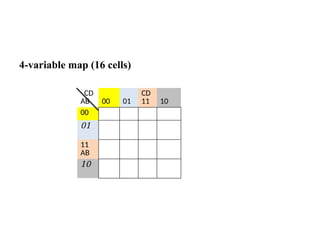
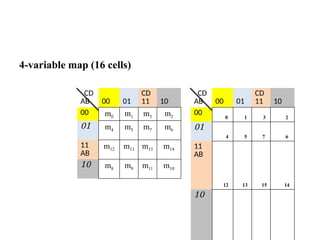
4-variable map (16 cells)
CD
AB 00 01
CD
11 10
00
01
11
AB
10
One-Variable, Two-Variable, Three-Variable and Four-
Variable Maps
Representation:
B
A 0 1 B
0 m0 m1
1 A m2 m3
BC
A
00 01 11
BC
10
B
0 m0 m1 m3 m2
1 A m4 m5 m7 m6
1-Variable map
(2 cells)
2-Variable map
(4 cells)
3-Variable map
(8 cells)
A
0 m0
1 m1
A
0 0
1 1
B
A 0 1 B
0 0 1
1 A 2 3
BC
A
00 01 11
BC
10
B
0 0 1 3 2
1 A 4 5 7 6
4-variable map (16 cells)
CD
AB 00 01
CD
11 10
00 m0 m1 m3 m2
01 m4 m5 m7 m6
11
AB
m12 m13 m15 m14
10 m8 m9 m11 m10
CD
AB 00 01
CD
11 10
00
0 1 3 2
01
4 5 7 6
11
AB
12 13 15 14
10
One-Variable, Two-Variable, Three-Variable and Four-
Variable Maps
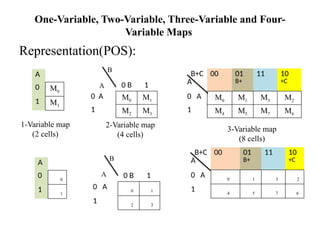
Representation(POS):
B
A 0 B 1
0 A M0 M1
1 M2 M3
B+C
A
00 01
B+
11 10
+C
0 A M0 M1 M3 M2
1 M4 M5 M7 M6
1-Variable map
(2 cells)
2-Variable map
(4 cells)
3-Variable map
(8 cells)
A
0 M0
1 M1
A
0 0
1 1
B
A 0 B 1
0 A 0 1
1 2 3
B+C
A
00 01
B+
11 10
+C
0 A 0 1 3 2
1 4 5 7 6
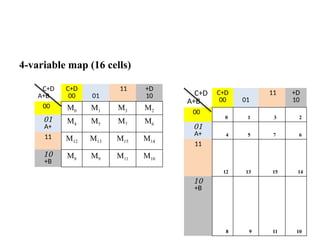
4-variable map (16 cells)
C+D
A+B
C+D
00 01
11 +D
10
00 M0 M1 M3 M2
01
A+
M4 M5 M7 M6
11 M12 M13 M15 M14
10
+B
M8 M9 M11 M10
C+D
A+B
C+D
00 01
11 +D
10
00
0 1 3 2
01
A+ 4 5 7 6
11
12 13 15 14
10
+B
8 9 11 10
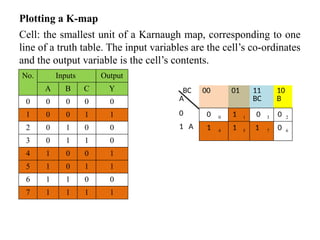
Plotting a K-map
Cell: the smallest unit of a Karnaugh map, corresponding to one
line of a truth table. The input variables are the cell’s co-ordinates
and the output variable is the cell’s contents.
No. Inputs Output
A B C Y
0 0 0 0 0
1 0 0 1 1
2 0 1 0 0
3 0 1 1 0
4 1 0 0 1
5 1 0 1 1
6 1 1 0 0
7 1 1 1 1
BC
A
00 01 11
BC
10
B
0 0 0 1 1 0 3 0 2
1 A 1 4 1 5 1 7 0 6
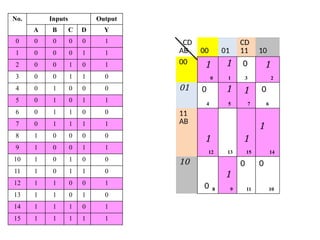
No. Inputs Output
A B C D Y
0 0 0 0 0 1
1 0 0 0 1 1
2 0 0 1 0 1
3 0 0 1 1 0
4 0 1 0 0 0
5 0 1 0 1 1
6 0 1 1 0 0
7 0 1 1 1 1
8 1 0 0 0 0
9 1 0 0 1 1
10 1 0 1 0 0
11 1 0 1 1 0
12 1 1 0 0 1
13 1 1 0 1 0
14 1 1 1 0 1
15 1 1 1 1 1
CD
AB 00 01
CD
11 10
00 1
0
1
1
0
3
1
2
01 0
4
1
5
1
7
0
6
11
AB
1
12 13
1
15
1
14
10
0 8
1
9
0
11
0
10
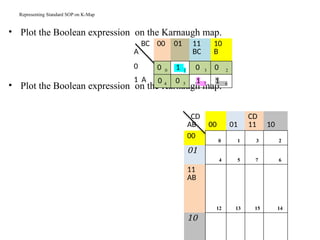
Representing Standard SOP on K-Map
• Plot the Boolean expression on the Karnaugh map.
BC
A
00 01 11
BC
10
B
0 0 0 1 1 0 3 0 2
1 A 0 4 0 5 1 7 1 6
CD
AB 00 01
CD
11 10
00
0 1 3 2
01
4 5 7 6
11
AB
12 13 15 14
10
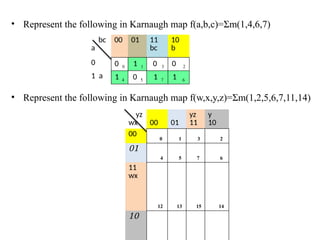
• Represent the following in Karnaugh map f(a,b,c)=Σm(1,4,6,7)
• Represent the following in Karnaugh map f(w,x,y,z)=Σm(1,2,5,6,7,11,14)
bc
a
00 01 11
bc
10
b
0 0 0 1 1 0 3 0 2
1 a 1 4 0 5 1 7 1 6
yz
wx 00 01
yz
11
y
10
00
0 1 3 2
01
4 5 7 6
11
wx
12 13 15 14
10
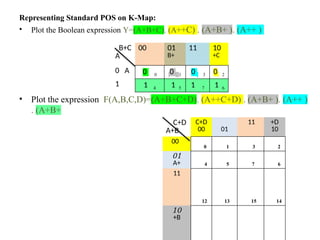
Representing Standard POS on K-Map:
• Plot the Boolean expression Y=(A+B+C). (A++C) . (A+B+ ). (A++ )
• Plot the expression F(A,B,C,D)=(A+B+C+D). (A++C+D) . (A+B+ ). (A++ )
. (A+B+
B+C
A
00 01
B+
11 10
+C
0 A 0 0 0 1 0 3 0 2
1 1 4 1 5 1 7 1 6
C+D
A+B
C+D
00 01
11 +D
10
00
0 1 3 2
01
A+ 4 5 7 6
11
12 13 15 14
10
+B
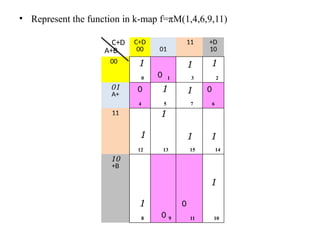
• Represent the function in k-map f=πM(1,4,6,9,11)
C+D
A+B
C+D
00 01
11 +D
10
00 1
0 0 1
1
3
1
2
01
A+
0
4
1
5
1
7
0
6
11
1
12
1
13
1
15
1
14
10
+B
1
8 0 9
0
11
1
10
Grouping cells for simplification
• Once the Boolean function is plotted on the Karnaugh
map we have to use grouping technique to simplify
the Boolean function.
• The grouping is nothing combining terms in adjacent
cells.
• Two cells are said to be adjacent if they conform the
single change rule.,i.e., there is only one variable
difference between co-ordinates of two cells.
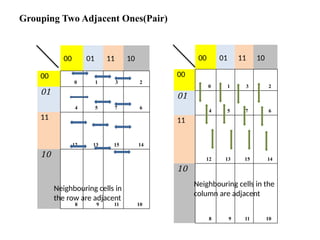
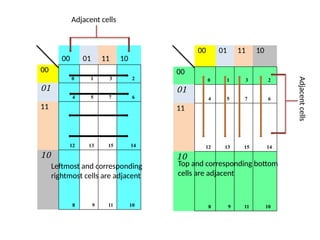
Grouping Two Adjacent Ones(Pair)
00 01 11 10
00
0 1 3 2
01
4 5 7 6
11
12 13 15 14
10
8 9 11 10
00 01 11 10
00
0 1 3 2
01
4 5 7 6
11
12 13 15 14
10
8 9 11 10
Neighbouring cells in
the row are adjacent
Neighbouring cells in the
column are adjacent
00 01 11 10
00
0 1 3 2
01
4 5 7 6
11
12 13 15 14
10
8 9 11 10
00 01 11 10
00
0 1 3 2
01
4 5 7 6
11
12 13 15 14
10
8 9 11 10
Adjacent cells
Adjacent
cells
Leftmost and corresponding
rightmost cells are adjacent
Top and corresponding bottom
cells are adjacent
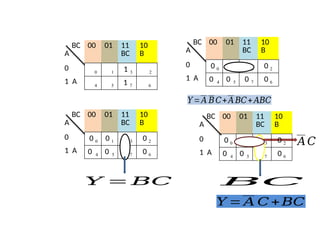
BC
A
00 01 11
BC
10
B
0 0 1 1 3 2
1 A 4 5 1 7 6
BC
A
00 01 11
BC
10
B
0 0 0 0 1 1 3 0 2
1 A 0 4 0 5 1 7 0 6
𝑌 = 𝐵𝐶
BC
A
00 01 11
BC
10
B
0 0 0 1 1 1 3 0 2
1 A 0 4 0 5 0 7 0 6
𝐴𝐶
BC
A
00 01 11
BC
10
B
0 0 0 1 1 1 3 0 2
1 A 0 4 0 5 1 7 0 6
𝑌=𝐴 𝐵𝐶+ 𝐴𝐵𝐶+ 𝐴𝐵𝐶
𝐵𝐶
𝑌 = 𝐴 𝐶 +𝐵𝐶
CD
AB 00 01
CD
11 10
00
0 1 1 3 2
01
4 5 7 6
11
AB
12 13 15 14
10
8 1 9 11 10
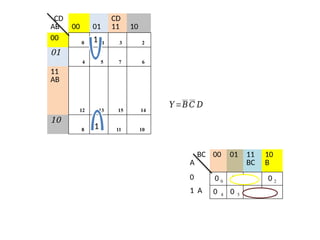
𝑌=𝐵𝐶 𝐷
BC
A
00 01 11
BC
10
B
0 0 0 1 1 1 3 0 2
1 A 0 4 0 5 1 7 1 6
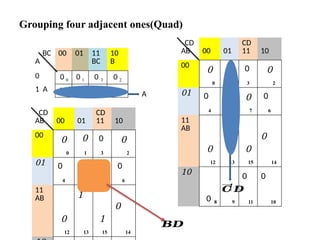
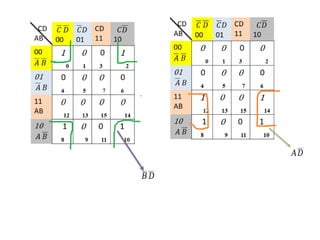
Grouping four adjacent ones(Quad)
BC
A
00 01 11
BC
10
B
0 0 0 0 1 0 3 0 2
1 A 1 4 1 5 1 7 1 6 A
CD
AB 00 01
CD
11 10
00
0
0
1
1
0
3
0
2
01 0
4
1
5
0
7
0
6
11
AB
0
12
1
13
0
15
0
14
10
0 8
1
9
0
11
0
10
𝑪 𝑫
CD
AB 00 01
CD
11 10
00
0
0
0
1
0
3
0
2
01 0
4
1
5
1
7
0
6
11
AB
0
12
1
13
1
15
0
14
𝑩𝑫
𝐴𝐷
𝐵 𝐷
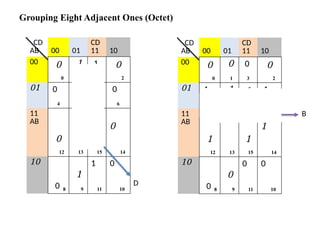
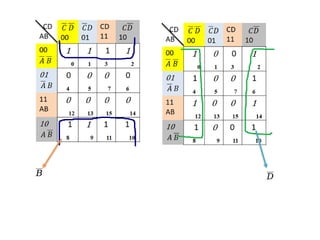
Grouping Eight Adjacent Ones (Octet)
CD
AB 00 01
CD
11 10
00 0
0
1
1
1
3
0
2
01 0
4
1
5
1
7
0
6
11
AB
0
12
1
13
1
15
0
14
10
0 8
1
9
1
11
0
10
CD
AB 00 01
CD
11 10
00 0
0
0
1
0
3
0
2
01 1
4
1
5
1
7
1
6
11
AB
1
12
1
13
1
15
1
14
10
0 8
0
9
0
11
0
10
D
B
𝐵 𝐷
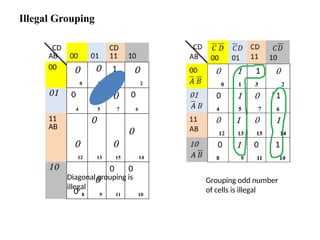
Illegal Grouping
CD
AB 00 01
CD
11 10
00 0
0
0
1
1
3
0
2
01 0
4
1
5
0
7
0
6
11
AB
0
12
0
13
0
15
0
14
10
0 8
0
9
0
11
0
10
Grouping odd number
of cells is illegal
Diagonal grouping is
illegal
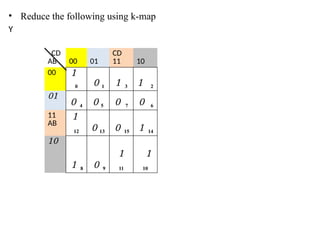
• Reduce the following using k-map
Y
CD
AB 00 01
CD
11 10
00 1
0 0 1 1 3 1 2
01
0 4 0 5 0 7 0 6
11
AB
1
12 0 13 0 15 1 14
10
1 8 0 9
1
11
1
10
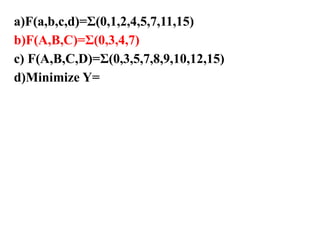
a)F(a,b,c,d)=Σ(0,1,2,4,5,7,11,15)
b)F(A,B,C)=Σ(0,3,4,7)
c) F(A,B,C,D)=Σ(0,3,5,7,8,9,10,12,15)
d)Minimize Y=
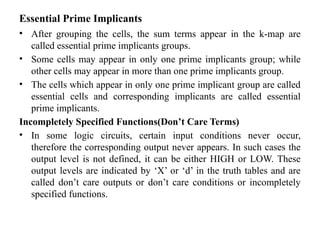
Essential Prime Implicants
• After grouping the cells, the sum terms appear in the k-map are
called essential prime implicants groups.
• Some cells may appear in only one prime implicants group; while
other cells may appear in more than one prime implicants group.
• The cells which appear in only one prime implicant group are called
essential cells and corresponding implicants are called essential
prime implicants.
Incompletely Specified Functions(Don’t Care Terms)
• In some logic circuits, certain input conditions never occur,
therefore the corresponding output never appears. In such cases the
output level is not defined, it can be either HIGH or LOW. These
output levels are indicated by ‘X’ or ‘d’ in the truth tables and are
called don’t care outputs or don’t care conditions or incompletely
specified functions.
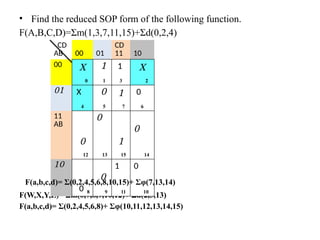
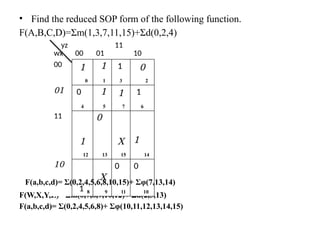
• Find the reduced SOP form of the following function.
F(A,B,C,D)=Σm(1,3,7,11,15)+Σd(0,2,4)
F(W,X,Y,Z)= Σm(0,7,8,9,10,12)+ Σd(2,5,13)
F(a,b,c,d)= Σ(0,2,4,5,6,8)+ Σφ(10,11,12,13,14,15)
CD
AB 00 01
CD
11 10
00 X
0
1
1
1
3
X
2
01 X
4
0
5
1
7
0
6
11
AB
0
12
0
13
1
15
0
14
10
0 8
0
9
1
11
0
10
F(a,b,c,d)= Σ(0,2,4,5,6,8,10,15)+ Σφ(7,13,14)
• Find the reduced SOP form of the following function.
F(A,B,C,D)=Σm(1,3,7,11,15)+Σd(0,2,4)
F(W,X,Y,Z)= Σm(0,7,8,9,10,12)+ Σd(2,5,13)
F(a,b,c,d)= Σ(0,2,4,5,6,8)+ Σφ(10,11,12,13,14,15)
yz
wx 00 01
11
10
00 1
0
1
1
1
3
0
2
01 0
4
1
5
1
7
1
6
11
1
12
0
13
X
15
1
14
10
1 8
X
9
0
11
0
10
F(a,b,c,d)= Σ(0,2,4,5,6,8,10,15)+ Σφ(7,13,14)
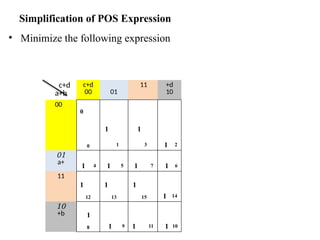
Simplification of POS Expression
• Minimize the following expression
c+d
a+b
c+d
00 01
11 +d
10
00
0
0
1
1
1
3 1 2
01
a+
1 4 1 5 1 7 1 6
11
1
12
1
13
1
15 1 14
10
+b 1
8 1 9 1 11 1 10
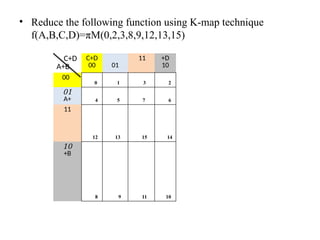
• Reduce the following function using K-map technique
f(A,B,C,D)=πM(0,2,3,8,9,12,13,15)
C+D
A+B
C+D
00 01
11 +D
10
00
0 1 3 2
01
A+ 4 5 7 6
11
12 13 15 14
10
+B
8 9 11 10
• Reduce the following function f(A,B,C,D)=π(0,3,4,7,8,10,12,14)+d(2,6)
• Simplify f(x,y,z)= πM(3,5,7)
• Simplify F(A,B,C,D)=Σ(0,1,2,5,8,9,10) in sum of products and product
of sums using K-map.
• Simplify the Boolean expression in sum of products and product of
sums using K-map,
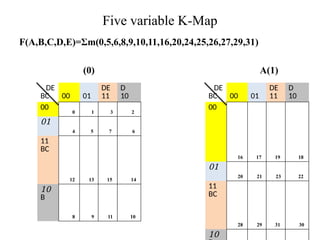
Five variable K-Map
F(A,B,C,D,E)=Σm(0,5,6,8,9,10,11,16,20,24,25,26,27,29,31)
(0) A(1)
DE
BC 00 01
DE
11
D
10
00
0 1 3 2
01
4 5 7 6
11
BC
12 13 15 14
10
B
8 9 11 10
DE
BC 00 01
DE
11
D
10
00
16 17 19 18
01
20 21 23 22
11
BC
28 29 31 30
10
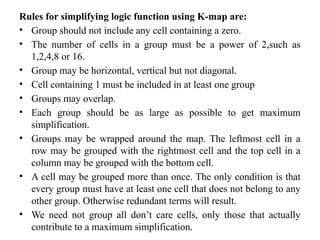
Rules for simplifying logic function using K-map are:
• Group should not include any cell containing a zero.
• The number of cells in a group must be a power of 2,such as
1,2,4,8 or 16.
• Group may be horizontal, vertical but not diagonal.
• Cell containing 1 must be included in at least one group
• Groups may overlap.
• Each group should be as large as possible to get maximum
simplification.
• Groups may be wrapped around the map. The leftmost cell in a
row may be grouped with the rightmost cell and the top cell in a
column may be grouped with the bottom cell.
• A cell may be grouped more than once. The only condition is that
every group must have at least one cell that does not belong to any
other group. Otherwise redundant terms will result.
• We need not group all don’t care cells, only those that actually
contribute to a maximum simplification.
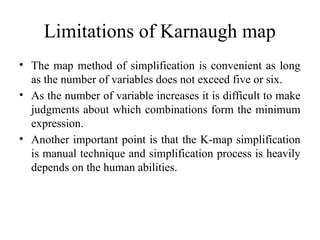
Limitations of Karnaugh map
• The map method of simplification is convenient as long
as the number of variables does not exceed five or six.
• As the number of variable increases it is difficult to make
judgments about which combinations form the minimum
expression.
• Another important point is that the K-map simplification
is manual technique and simplification process is heavily
depends on the human abilities.
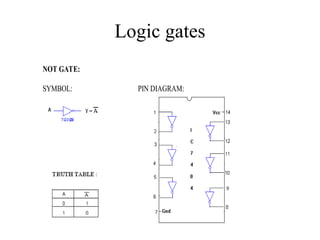
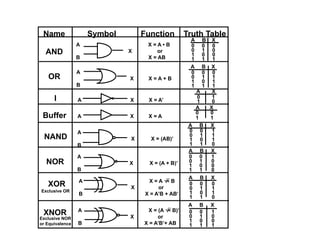
Logic gates
NOT GATE:
SYMBOL: PIN DIAGRAM:
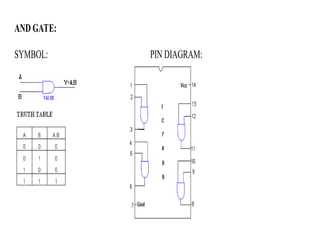
AND GATE:
SYMBOL: PIN DIAGRAM:
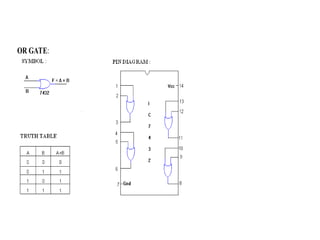
OR GATE:
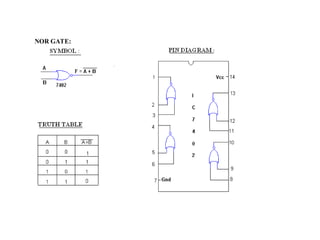
NOR GATE:
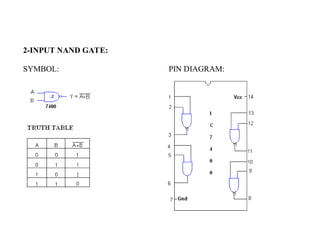
2-INPUT NAND GATE:
SYMBOL: PIN DIAGRAM:
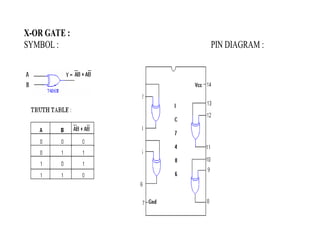
X-OR GATE :
SYMBOL : PIN DIAGRAM :
A
X X = (A + B)’
B
Name Symbol Function Truth Table
AND
A X = A • B
X or
B X = AB
0 0 0
0 1 0
1 0 0
1 1 1
0 0 0
0 1 1
1 0 1
1 1 1
OR
A
X X = A + B
B
I A X X = A’
0 1
1 0
Buffer A X X = A
A X
0 0
1 1
NAND
A
X X = (AB)’
B
0 0 1
0 1 1
1 0 1
1 1 0
NOR
0 0 1
0 1 0
1 0 0
1 1 0
XOR
Exclusive OR
A X = A  B
X or
B X = A’B + AB’
0 0 0
0 1 1
1 0 1
1 1 0
A X = (A  B)’
X or
B X = A’B’+ AB
0 0 1
0 1 0
1 0 0
1 1 1
XNOR
Exclusive NOR
or Equivalence
A B X
A B X
A X
A B X
A B X
A B X
A B X
Digital Electronics: UNIT-I DIGITAL FUNDAMENTALS

Digital Electronics: UNIT-I DIGITAL FUNDAMENTALS

  • 1.
    KONGUNADU COLLEGE OFENGINEERING AND TECHNOLOGY (AUTONOMOUS) DEPARTMENT OF ELECTRICALAND ELECTRONICS ENGINEERING 20EC302 - DIGITAL ELECTRONICS UNIT I - DIGITAL FUNDAMENTALS
  • 2.
    UNIT I -DIGITAL FUNDAMENTALS Number Systems Decimal, Binary, Octal, Hexadecimal, radix conversion ,1's and 2's complements, Codes – Binary, BCD, Excess 3, Gray, Alphanumeric codes, Boolean theorems and Postulates, Logic gates – Universal gates – Sum of products and product of sums – Minterms and Maxterms – Karnaugh Map Minimization.
  • 3.
    Number Systems Number systemis a basis for counting various items The decimal number system has 10 digits:0,1,2,3,4,5,6,7,8 and 9 Types of Number Systems: System Base Symbols Decimal 10 0,1,2,….9 Binary 2 0,1 Octal 8 0,1,2,….7 Hexa-decimal 16 0,1,2,….9,A,B,…F
  • 4.
    Decimal Number 8 4 21 8 1 0 0 0 9 1 0 0 1 10 1 0 1 0 11 1 0 1 1 12 1 1 0 0 13 1 1 0 1 14 1 1 1 0 15 1 1 1 1
  • 5.
    Decimal Hexadecimal Binary(421/8421) 0 0 (0)000 1 1 (0)001 2 2 (0)010 3 3 (0)011 4 4 (0)100 5 5 (0)101 6 6 (0)110 7 7 (0)111 8 8 1000 9 9 1001 10 A 1010 11 B 1011 12 C 1100 13 D 1101 14 E 1110 15 F 1111
  • 6.
  • 7.
    Binary to Octal •Group into 3's starting at least significant bit (if the number of bits is not evenly divisible by 3, then add 0's at the most significant end) • write 1 octal digit for each group • e.g.:(001010101)2 to ()8 001 010 101 4 2 1 1 2 5 1 0 0 Answer = 1258 e.g.:(010101101.011100)2 to ()8 (0)10 101 101 . 011 1(00) 2 5 5 . 3 4 (255.34)8
  • 8.
    Octal to Binary •For each of the Octal digit write its binary equivalent e.g.: (257)8 to ( )2 2 5 7 010 101 111 Answer = (010101111)2 e.g.: (125.62)8 to ( )2 1 2 5 . 6 2 001 010 101 . 110 010 (1010101.11001)2
  • 9.
    Binary to Hexadecimal •Group into 4's starting at least significant bit (if the number of bits is not evenly divisible by 4, then add 0's at the most significant end) • write 1 hex digit for each group. • e.g.: (001010111011)2 to ()16 (00)10 1011 1011 11 2 B B Answer = (2BB)16 e.g.: (001101101110.10011010)2 to ()16 (00)11 0110 1110 . 1001 101(0) 3 6 E . 9 A (36E.9A)16
  • 10.
    Hexadecimal to Binary •For each of the Hex digit write its binary equivalent(use 4 digits to represent) • e.g.: (8A9.B4)16 to ( )2 8 A 9 . B 4 1000 1010 1001 . 1011 0100 (100010101001.101101)2
  • 11.
    Octal to Hexadecimal Steps: 1.Convertoctal number to its binary equivalent 2.Convert binary number to its hexadecimal equivalent e.g.: (615.25)8 to ()16 6 1 5 . 2 5 110 001 101 . 010 101 1 1000 1101 .0101 01 (000)1 1000 1101 . 0101 01(00) 1 8 D . 5 4 (615.25)8 (110001101.010101) 2 (18D.54)16 Step 1 Step 2
  • 12.
    Hexadecimal to Octal Steps: 1.Convert hexadecimal number to its binary equivalent 2. Convert binary number to its octal equivalent e.g.: (BC66.AF)16to ()8 B C 6 6 . A F 1011 1100 0110 0110 . 1010 1111 (00)1011110001100110.10101111(0) 001 011 110 001 100 110 . 101 011 110 1 3 6 1 4 6 . 5 3 6 (BC66.AF)16 (1011110001100110) 2 (136146.536)8 Step 1 Step 2
  • 13.
    Converting any radixto decimal • Converting from any base to decimal is done by multiplying each digit by its weight and summing. • Ex: Convert (3102.12)4 to its decimal equivalent N=3*43 +1*42 +0*41 +2*40 +1*4-1 +2*4-2 =192+16+0+2+0.25+0.125=(210.375)10 • Ex: Determine the value of base x, if (193) x = (623)8 Converting octal into decimal : (623)8= 6*82 +2*81 +3*80 =(403)10 (193)x=1*x2 +9*x1 +3*x0 = (403)10 x2 +9x+3=403 x=16 or -25 Negative not applicable so (193) 16=(623)8
  • 14.
    Conversion of Decimalnumber to any Radix number Steps: 1. Convert integer part ( Successive Division Method ) 2. Convert fractional part ( Successive Multiplication Method ) • Steps in Successive Division Method:  Divide the integer part of decimal number by desired base number, store quotient (Q) and remainder (R)  Consider quotient as a new decimal number and repeat step1 until quotient becomes 0  List the remainders in the reverse order • Steps in Successive Multiplication Method:  Multiply the fractional part of decimal number by desired base number  Record the integer part of product as carry and fractional part as new fractional part  Repeat steps 1 and 2 until fractional part of product becomes 0 or until you have many digits as necessary for your application  Read carries downwards to get desired base number
  • 15.
    • Convert 12.125decimal to binary • Integer Part: (12)10 = (1100)2 • Fractional Part: (0.125)10 = (0.001)2
  • 16.
    • Convert 5386.345decimal to hexadecimal • Integer Part: (5386)10 = (150A)16 • Fractional Part: (0.345)10 = (0.585)16 (5386.345)10 = (150A.585)16
  • 17.
    1’s Complement The 1’scomplement of a binary number is the number that results when we change all 1’s to zeros and the zeros to ones. 2’s Complement The 2’s complement the binary number that results when add 1 to the 1’s complement. 2’s complement = 1’s complement + 1 1 1 0 1 0 1 0 0 Number NOT operation 0 0 1 0 1 0 1 1 1’s Complement 1 1 0 0 0 1 0 0 Number NOT operation 1 1 Carry 0 0 1 1 1 0 1 1 1’s Complement 1 Add 1 0 0 1 1 1 1 0 0 2’s Complement
  • 18.
    • 9’s Complement Thenines' complement of a decimal digit is the number that must be added to it to produce 9. The complement of 3 is 6, the complement of 7 is 2. • Example: Obtain 9’s complement of 7493 9 9 9 9 - 7 4 9 3 --------- 2 5 0 6 9’s complement 10’s Complement The 10’s complement of the given number is obtained by adding 1 to the 9’s complement. 10’s complement = 9’s complement + 1 Example: Obtain 10’s complement of 7493 9 9 9 9 2 5 0 6 - 7 4 9 3 + 1 -------- --------- 2 5 0 6 2 5 0 7 10’s complement
  • 19.
    Arithmetic Operations Binary Addition •The addition consists of four possible elementary operations: • Perform addition of (11001100)2 and (11011010)2 S.No Operations 1 0+0=0 2 0+1=1 3 1+0=1 4 1+1=10(0 with carry 1) In the last case, sum is of two digits: Higher Significant bit is called Carry and lower significant bit is called Sum. 1 1 1 1 Carry 1 1 0 0 1 1 0 0 Number 1 (+) 1 1 0 1 1 0 1 0 Number 2 1 1 0 1 0 0 1 1 0 Result
  • 20.
    • Add (28)10and (15)10 by converting them to binary (28)10= (11100)2 (15)10= (1111)2 2 28 0 2 14 0 2 7 1 2 3 1 2 1 2 15 1 2 7 1 2 3 1 2 1 1 1 1 Carry 1 1 1 0 0 (28)10 (+) 0 1 1 1 1 (15)10 1 0 1 0 1 1 (43)10 2 43 1 2 21 1 2 10 0 2 5 1 2 2 0 1
  • 21.
    Binary Subtraction • Thesubtraction consists of four possible elementary operations: • Perform (11101100)2 -(00110010)2 S.No Operations 1 0-0=0 2 0-1=1 (borrow 1) 3 1-0=1 4 1-1=0 In case of second operation the minuend bit is smaller than the subtrahend bit, hence 1 is borrowed. (10) 0 10 0 10 1 1 1 0 1 1 0 0 Number 1 (-) 0 0 1 1 0 0 1 0 Number 2 1 0 1 1 1 0 1 0 Result
  • 22.
    Binary Subtraction using1’s complement • Perform subtraction using 1’s complement (11010)2 - (10000)2 Step 1: 1’s complement negative number (10000)2 (01111)2 Step 2: Add (11010)2 and (01111)2 1 1 1 1 1 1 0 1 0 0 1 1 1 1 1 0 1 0 0 1 1 0 1 0 1 0 Add end-around carry Note: If carry is generated then the result is positive and in the true form so aa carry to the result to get final result
  • 23.
    • Perform subtractionusing 1’s complement (15)10 -(28)10 Binary equivalent:(1111)2 -(11100)2 Step 1: 1’s complement negative number (11100)2 (00011)2 Step 2: Add (1111)2 and (00011)2 1 1 1 1 0 1 1 1 1 (15)10 (+) 0 0 0 1 1 1,s complement of (28)10 1 0 0 1 0 Result In this case the carry is not generated then the result is negative and in the 1’s complement form 0 1 1 0 1 Verification (1’s complement form of result) (13)10
  • 24.
    Binary Subtraction using2’s complement • Perform subtraction using 2’s complement binary arithmetic (147)10 -(89)10 • Step 1: Binary equivalent (010010011)2 -(01011001)2 • Step 2: Find 2’s complement of (89)10 0 1 0 1 1 0 0 1 Binary equivalent of (89)10 1 0 1 0 0 1 1 0 1’s complement of (89)10 1 Add 1 1 0 1 0 0 1 1 1 2’s complement of (89)10 1 1 1 1 1 0 1 0 0 1 0 0 1 1 Binary equivalent of (147)10 (+) 1 1 0 1 0 0 1 1 1 2’s complement of (89)10 1 0 0 0 1 1 1 0 1 0 Result Note: If carry is generated then the result is positive and in the true form so the carry is ignored.
  • 25.
    • Perform subtractionusing 2’s complement (100101)2 -(110001)2 • Find 2’s complement of (110001)2 1 1 0 0 0 1 Subtrahend 0 0 1 1 1 0 1’s complement of Subtrahend 1 Add 1 0 0 1 1 1 1 2’s complement of Subtrahend 1 0 0 1 0 1 Minuend 0 0 1 1 1 1 2’s complement of Subtrahend 1 1 0 1 0 0 Result
  • 26.
    Binary Subtraction using2’s complement • Perform subtraction using 2’s complement (42)10 -(68)10 • Step 1: Binary equivalent (101010)2 -(1000100)2 • Step 2: Find 2’s complement of (68)10 1 0 0 0 1 0 0 Binary equivalent of (68)10 0 1 1 1 0 1 1 1’s complement of (68)10 1 Add 1 0 1 1 1 1 0 0 2’s complement of (68)10 1 1 0 1 0 1 0 1 0 Binary equivalent of (42)10 (+) 0 1 1 1 1 0 0 2’s complement of (68)10 1 1 0 0 1 1 0 Result Note: If carry is not generated then the result is negative and in the 2’s complement form 1 1 0 0 1 1 0 Result 0 0 1 1 0 0 1 1’s complement 1 2’s complement 0 0 1 1 0 1 0 (26)10
  • 27.
    Binary Multiplication Rules forBinary Multiplication are: Multiply (101.11)2 and (110.01)2 using binary multiplication method S.No Operations 1 0*0=0 2 0*1=0 3 1*0=0 4 1*1=1 1 0 1 . 1 1 Multiplicand x 1 1 0 . 0 1 Multiplier 1 0 1 1 1 0 0 0 0 0 0 0 0 0 0 0 0 0 1 0 1 1 1 0 0 0 1 0 1 1 1 0 0 0 0 1 0 0 0 1 1 1 1 1 1 Final Fractional digits in the final product=Fractional digits in multiplicand +Fractional digits in multiplier =2+2=4  (101.11)2 x (110.01)2 = (100011.1111)2
  • 28.
    Binary Division Rules forBinary Division are: Divide (11011011)2 by (110)2 No. Rule 1 0 ÷ 1 = 0 2 1 ÷ 1 = 1 1 0 0 1 0 0 1 1 0 1 1 0 1 1 0 1 1 1 1 0 0 0 0 1 1 0 1 1 0 0 0 0 1 1
  • 29.
    Binary Codes • Whennumbers, alphabets or words are represented by a specific group of symbols i.e., they are encoded • The group of symbols used to encode them is called codes. The digital data is represented, stored and transmitted as groups of binary digits (bits) • Group of bits--- binary code---- numeric and alphanumeric code
  • 30.
  • 31.
    • Weighted codes: –In weighted codes, each digit position of the number represents a specific weight – Examples: 93(1001)(0011)  8421 code 93(1100)(0011) 5421 code • Non-weighted codes : – Non-weighted codes are not assigned with any weight to each digit position, i.e., each digit position within the number is not assigned fixed value – Excess-3 and gray codes are the non-weighted codes • Reflective codes: – A code is said to be reflective when the code for 9 is the complement for 0, the code for 8 is complement for 1, 7 for 2,6 for 3 and 5 for 4. – Like 2421,codes 5211 and excess-3 are also reflective. – The 8421 code is not reflective
  • 32.
    • Sequential codes –In sequential codes each succeeding code is one binary number greater than its preceding code. – This greatly aids mathematical manipulation of data – The 8421 and excess-3 are sequential, whereas the 2421 and 5211 codes are not sequential • Alphanumeric codes – The codes which consists of both numbers and alphabetic characters are called alphanumeric codes. – Most of these codes, however, also represent symbols and various instructions necessary for conveying intelligible information – The most commonly used alphanumeric codes are: ASCII, EBCDIC and Hollerith code
  • 33.
    • Error detectingand correcting codes – When the digital information in the binary form is transmitted from one circuit or system to another circuit or system an error may occur. – This means the signal corresponding to 0 may change to 1 or vice- versa due to presence of noise – To maintain data integrity between transmitter and receiver, extra bit or more than one bit are added in the data. – These extra bits allow the detection and sometimes the correction of error in the data. – The data along with the extra bit /bits form the code – Codes which allow only error detection are called error detecting codes and codes which allow error detection and correction are called error detecting and correcting codes
  • 34.
    • BCD( BinaryCoded Decimal) codes – BCD is a numeric code in which each digit of a decimal number is represented by a separate group of 4-bits. Decimal BCD Code 0 0000 1 0001 2 0010 3 0011 4 0100 5 0101 6 0110 7 0111 8 1000 9 1001 5 8 Decimal 0101 1000 BCD Code Advantages: • Easy to convert between it and decimal Disadvantages: • Less efficient • Arithmetic operations are more complex
  • 35.
    • Excess-3 code –The excess-3 code can be derived from the natural BCD code by adding 3 to each coded number. – It is a non-weighted code – It is a sequential code – In excess-3 code we get 9’s complement of a number by just complementing each bit. Due to this excess-3 code is called self- complementing code or reflective code. Decimal Excess-3 code 0 0011 1 0100 2 0101 3 0110 4 0111 5 1000 6 1001 7 1010 8 1011 9 1100
  • 36.
    • Gary code –Gray code is a non-weighted code and is a special case of unit-distance code – In unit distance code, bit patterns for two consecutive numbers differ in only one bit position. – These codes are also called as cyclic codes. – The gray code is also called reflected code. Application of Gray code • Let us consider an application where 3-bit binary code is provided to indicate position of the rotating disk with the help of brushes. • If one brush is slightly ahead of the other, an 180 error occur in the disk position. • When the gray code is used to represent disk position then error due to improper brush alignment can be reduced. This is because the gray code assures that only one bit will change each time the decimal number is incremented. • In 3-bit code probability of error is reduced upto 66% and in 4-bit code it is reduced upto 75%. This is an advantage of gray code.
  • 37.
    Gray to BinaryConversion: Exclusive OR operation Convert gray code 101011 into its binary equivalent. (101011) gray = (110010) 2 A B AꚚ B 0 0 0 0 1 1 1 0 1 1 1 0 1 0 1 0 1 1 Gray code Exclusive OR operation 1 1 0 0 1 0 Binary code
  • 38.
    Binary to Graycode: Convert 10111011 in binary into its equivalent gray code. 1 0 1 1 1 0 1 1 Binar y code 1 1 1 0 0 1 1 0 Gray code Exclusive OR operation
  • 39.
    BCD Addition • Case1: Sum equals 9 or less with carry 0 Addition of 3 and 6 in BCD • Case 2: Sum greater than 9 with carry 0 1 1 Carry 0 1 1 0 BCD for 6 + 0 0 1 1 BCD for 3 1 0 0 1 BCD for 9 0 1 1 0 BCD for 6 + 1 0 0 0 BCD for 8 1 1 1 0 Invalid BCD number (14) 1 1 1 0 Invalid BCD number (14) 0 1 1 0 Add 6 for correction 1 0 1 0 0 Answer 0 0 0 1 0 1 0 0 BCD for 14
  • 40.
    • Case 3:Sum greater than 9 with carry 0 Carry 1 0 0 0 BCD for 8 + 1 0 0 1 BCD for 9 1 0 0 0 1 Incorrect BCD number 0 0 0 1 0 1 1 1 BCD for 17 0 0 0 1 0 0 0 1 Incorrect BCD number 0 0 0 0 0 1 1 0 Add 6 for correction 0 0 0 1 0 1 1 1 Answer
  • 41.
    BCD Subtraction using9’s complement Perform (46)10 –(22)10 in BCD using 9’s complement. Step 1: Find 9’s complement of 22 9’s complement of 22=(99-22)=77 Step 2:Add 46 and 9’s complement of 22 1 1 1 Carry 0 1 0 0 0 1 1 0 BCD of 46 + 0 1 1 1 0 1 1 1 BCD of 77 1 0 1 1 1 1 0 1 Invalid BCD numbers 1 0 1 1 1 1 0 1 Invalid BCD numbers + 0 1 1 0 0 1 1 0 Add 6 in each digit 1 0 0 1 0 0 0 1 1 1 Add end around carry 0 0 1 0 0 1 0 0 Result (BCD of 24) Since there is carry the result is positive and true
  • 42.
    BCD Subtraction using9’s complement Perform (24)10 –(56)10 in BCD using 9’s complement. Step 1: Find 9’s complement of 56 9’s complement of 56=(99-56)=43 Step 2:Add 24 and 9’s complement of 56 Step 3: Take 9’s complement of answer 99-67=3224-56=32 Carry 0 0 1 0 0 1 0 0 BCD of 24 + 0 1 0 0 0 0 1 1 BCD of 43 0 1 1 0 0 1 1 1 BCD of 67 Since there is 0 the result is negative
  • 43.
    BCD Subtraction using10’s complement Perform (46)10 –(22)10 in BCD using 9’s complement. Step 1: Find 10’s complement of 22 10’s complement of 22=9’s complement of 22+1 =(99-22)+1=78 Step 2:Add 46 and 10’s complement of 22 1 Carry 0 1 0 0 0 1 1 0 BCD of 46 + 0 1 1 1 1 0 0 0 BCD of 78 1 0 1 1 1 1 1 0 Invalid BCD numbers 1 0 1 1 1 1 1 0 Invalid BCD numbers + 0 1 1 0 0 1 1 0 Add 6 in each digit 1 0 0 1 0 0 1 0 0 Carry is ignored 0 0 1 0 0 1 0 0 Result (BCD of 24) Since there is carry the result is positive and true
  • 44.
    BCD Subtraction using10’s complement Perform (24)10 –(56)10 in BCD using 10’s complement. Step 1: Find 10’s complement of 56 9’s complement of 56=(99-56)+1=44 Step 2:Add 24 and 10’s complement of 56 Step 3: Take 10’s complement of answer (99-68)+1=3224-56=32 Carry 0 0 1 0 0 1 0 0 BCD of 24 + 0 1 0 0 0 1 0 0 BCD of 44 0 1 1 0 1 0 0 0 BCD of 68 Since there is 0 the result is negative
  • 45.
    Excess-3 Addition: a)Carry isgenerated:8+6 1 0 1 1 Excess-3 for 8 + 1 0 0 1 Excess-3 for 6 1 0 1 0 0 Carry is 1 0 0 0 1 0 1 0 0 0 0 1 1 0 0 1 1 Add 3 0 1 0 0 0 1 1 1 Result (Excess-3 for 14) 1 4 Result in decimal
  • 46.
    Excess-3 Addition: a)Carry isnot generated:1+2 0 1 0 0 Excess-3 for 1 + 0 1 0 1 Excess-3 for 2 0 1 0 0 1 Carry is 0 0 1 0 0 1 0 0 1 1 Sub 3 0 1 1 0 Result (Excess-3 for 3) 3 Result in decimal
  • 47.
    Excess-3 Subtraction: a)Carry isgenerated:8-5 1 0 1 1 Excess-3 for 8 + 0 1 1 1 Complement of 5 in Excess-3 1 0 0 1 0 Carry is 1 1 0 0 1 0 0 0 1 1 Add 3 1 0 1 0 1 Result (Excess-3 for 3) 1 Add end-around carry 0 1 1 0 Excess-3 for 3 1 0 0 0 Excess-3 for 5 0 1 1 1 Complement
  • 48.
    Excess-3 Subtraction: a)Carry isnot generated:5-8 1 0 0 0 Excess-3 for 5 + 0 1 0 0 Complement of 8 in Excess-3 0 1 1 0 0 Carry is 0 0 1 1 0 0 0 0 1 1 Sub 3 0 1 0 0 1 Result (Excess-3 for 3) 1 0 1 1 Excess-3 for 8 0 1 0 0 Complement
  • 49.
    Boolean Algebra • Booleanalgebra is a mathematical system that defines a series of logical operations (AND,OR,NOT) performed on sets of variables (a,b,c,….). • When stated in this form, the expression is called a Boolean equation or switching equation. Terminologies : Variable: The symbol which represent an arbitrary elements of an Boolean algebra is known as variable. Any single variable or a function of several variables can have either a 1 or 0 value. Constant: In expression Y=A+1, the first term A is a variable and the second term has a fixed value 1. So 1 is a constant here. The constant may be 1 or 0.
  • 50.
    Complement: A complementof a variable is presented by a “bar” over the letter and sometimes denoted by (`). Example: is the complement of the variable A, if A=0  =1 and A=1 =0 Literal: Each occurrence of a variable in Boolean function either in a complemented or an uncomplemented form is called a literal. Boolean Function: Boolean expressions are constructed by connecting the Boolean constants and variables with the Boolean operations. These Boolean expressions are also known as Boolean formulae. We use Boolean expressions to describe the Boolean functions. Example: f(A,B,C)= (A+ )C
  • 51.
    Properties of BooleanAlgebra • Closure Property Closure(a): Closure with respect to operator +: when two binary elements are operated by operator +, the result is a unique binary element. Closure(b):Closure with respect to operator .(dot): when two binary elements are operated by operator .(dot), the result is a unique binary element. • Identity property: A.1=1.A=A • Commutative property Commutative with respect to +: A+B=B+A Commutative with respect to . : A.B=B.A 1 A A 0 A A
  • 52.
    • Distributive property A.(B+C)=(A.B)+(A.C) A+(B.C)=(A+B).(A+C) •Associative property A+(B+C)=(A+B)+C (A.B).C=A(B.C) • Complement property A.=0 A+ =1 • Idempotency property A.A=A A+A=A • Absorption property A+AB=A(1+B)=A A(A+B)=A+AB=A • Involution property =A
  • 53.
    • De-Morgan’s theorem •Principle of duality: • The principle of duality theorem says that, starting with a Boolean relation, we can derive another Boolean relation by, • Changing the OR sign to an AND sign • Changing each AND sign to an OR sign and • Complementing any 0 or 1 appearing in the expression. • Dual of relation  A+=1 is A. =0 A B + 0 0 1 1 0 1 1 1 1 0 1 1 1 1 0 0 A B 0 0 1 1 0 1 0 0 1 0 0 0 1 1 0 0
  • 54.
    • Consensus Law: •In simplification of Boolean expression, an expression of the form AB+C+BC the term BC is redundant and can be eliminated to form the equivalent expression AB+C. The theorem used for this simplification is known as consensus theorem and it is stated as AB+C+BC=AB+C Proof: AB+C+BC= AB+C+(A+ )BC = AB+C+A BC + BC =AB(1+C)+C(1+B) =AB+C
  • 55.
    • Prove thefollowing Boolean identities (since A+) (since A (Since 1+A=1)
  • 56.
    • Prove thefollowing using DeMorgan’s theorem = (since A.A=A)
  • 57.
    Boolean expression • Booleanexpressions are constructed by connecting the Boolean constants and variables with the Boolean operations. f(A,B,C,D)=A+ +AC Sum of Product form:(SOP) Product Terms Sum Product Terms Sum Also known as disjunctive normal form or disjunctive normal formula
  • 58.
    • Product ofSum form (POS) ) Sum terms Product Sum terms Product Conjunctive normal formula or conjunctive normal form
  • 59.
    Standard (Canonical) SOP& Standard (Canonical) POS Form • If each term in the SOP form contains all the literals then the SOP form is known as standard or canonical SOP form. • Each individual term in the standard SOP form is called minterm. + • If each term in POS form contains all the literals then the POS form is known as standard or canonical POS form. • Each individual term in the standard SOP form is called maxterm. )
  • 60.
    Converting Expressions inStandard SOP form Step 1: Find the missing literal in each product term if any. Step 2:AND each product term having missing literal(s) with term(s) form by ORing the literal and its complement. Step 3:Expand the terms by applying distributive law and reorder the literals in the product terms. Step 4:Reduce the expression by omitting the repeated product terms if any. Example: Convert the given expression in standard SOP form. f(A,B,C)=AC+AB+BC Solution: Step 1: Find the missing literals in each product term f(A,B,C)=AC+AB+BC Literal A is missing Literal C is missing Literal B is missing
  • 61.
    Step 2: ANDproduct term with missing (literal + its complement) f(A,B,C)=AC . (B+ )+AB . (C+ +BC . (A+ Step 3:Expand the terms and reorder the literals Expand: f(A,B,C)=ACB + AC +ABC+AB +BCA + BC Reorder: f(A,B,C)=ABC + A C +ABC+AB +ABC + BC Step 4: Omit repeated product terms f(A,B,C)=ABC + A C +ABC+AB +ABC + BC f(A,B,C)=ABC + A C +AB + BC Original product terms Missing literals and their complements
  • 62.
    Converting Expressions inStandard POS form Step 1: Find the missing literal in each sum term if any. Step 2:OR each sum term having missing literal(s) with term(s) form by ANDing the literal and its complement. Step 3:Expand the terms by applying distributive law and reorder the literals in the sum terms. Step 4:Reduce the expression by omitting the repeated sum terms if any. Example: Convert the given expression in standard POS form. Y=A . (A+B+C) Solution: Step 1: Find the missing literals in each sum term Y(A,B,C)=A . (A+B+C) Literals B and C are missing
  • 63.
    Step 2: ORsum term with (missing literal . its complement) Y=[A+(B. )+ (C. ) ]. (A+B+C) Step 3: Expand the terms and reorder literals Y=(A+B). (A+)+ (C. ) ]. (A+B+C) Y=(A+B+C). (A++C) . (A+B+ ). (A++ ). (A+B+C) Step 4: Omit repeated sum terms Y=(A+B+C). (A++C) . (A+B+ ). (A++ ). (A+B+C) Y=(A+B+C). (A++C) . (A+B+ ). (A++ )
  • 64.
    M Notations: Mintermsand Maxterms • Each individual term in standard SOP form is called minterm and each individual term in standard POS form is called maxterm. • In general, for a n-variable logical function there are 2n minterms and an equal number of maxterms. • Each minterm is represented by mi and each maxterm is represented by Mi , where the subscript i is the decimal number equivalent of the natural binary number. • Σ, mi  denotes sum of product form(SOP) • Π, Mi  denotes product of sum form(POS)
  • 65.
    Minterms and Maxtermsfor three variables Decimal Variables Minterms (SOP) Maxterms (POS) A (4) B (2) C (1) mi Mi 0 0 0 0 =m0 A+B+C =M0 1 0 0 1 =m1 A+B+ =M1 2 0 1 0 B=m2 A+ =M2 3 0 1 1 BC=m3 A+ =M3 4 1 0 0 A=m4 +B+C =M4 5 1 0 1 A=m5 +B+ =M5 6 1 1 0 AB=m6 + =M6 7 1 1 1 ABC=m7 =M7
  • 66.
    Examples: f(A,B,C)=ABC + AC +AB + BC =m7 + m5 + m6 + m3 =Σm(3,5,6,7) Y=(A+B+C). (A++C) . (A+B+ ). (A++ ) =M0 . M2 . M1 . M3 =πM(0,1,2,3) Complements of Standard Forms: f(A,B,C)= m7 + m5 + m6 + m3 = M0 . M1 . M2 . M4 f(A,B,C)= Σm(3,5,6,7) =πM(0,1,2,4) In case of four variables, f(A,B,C,D)= Σm(0,2,3,5,6,7,11,13,14) = πM(1,4,8,9,10,12,15)
  • 67.
    Express F=A+B’C assum of minterms. Solution: =Σm(7,5,6,4,5,1) =Σm(1,4,5,6,7) Express the following F=XY+X’Z in product of maxterm.
  • 68.
    K-map Minimization • Duringthe process of simplification of Boolean expression we have to predict each successive step • We can never be absolutely certain that an expression simplified by Boolean algebra alone is the simplest possible expression • On the other hand, the map method gives us a systematic approach for simplifying a Boolean expression • The map method, first proposed by Veitch and modified by Karnaugh, hence it is known as the Veitch diagram or the Karnaugh map.
  • 69.
    One-Variable, Two-Variable, Three-Variableand Four- Variable Maps • The basis of this method is a graphical chart known as Karnaugh map (K-map) • It contains boxes called cells. • Each of the cell represents one of the 2n possible products that can be formed from n variables. • Thus, a 2-variable map contains 22 =4 cells, a 3-variable map contains 23 =8 cells and so forth. A 0 1 B A 0 1 B 0 1 A BC A 00 01 11 BC 10 B 0 1 A 1-Variable map (2 cells) 2-Variable map (4 cells) 3-Variable map (8 cells)
  • 70.
    4-variable map (16cells) CD AB 00 01 CD 11 10 00 01 11 AB 10
  • 71.
    One-Variable, Two-Variable, Three-Variableand Four- Variable Maps Representation: B A 0 1 B 0 m0 m1 1 A m2 m3 BC A 00 01 11 BC 10 B 0 m0 m1 m3 m2 1 A m4 m5 m7 m6 1-Variable map (2 cells) 2-Variable map (4 cells) 3-Variable map (8 cells) A 0 m0 1 m1 A 0 0 1 1 B A 0 1 B 0 0 1 1 A 2 3 BC A 00 01 11 BC 10 B 0 0 1 3 2 1 A 4 5 7 6
  • 72.
    4-variable map (16cells) CD AB 00 01 CD 11 10 00 m0 m1 m3 m2 01 m4 m5 m7 m6 11 AB m12 m13 m15 m14 10 m8 m9 m11 m10 CD AB 00 01 CD 11 10 00 0 1 3 2 01 4 5 7 6 11 AB 12 13 15 14 10
  • 73.
    One-Variable, Two-Variable, Three-Variableand Four- Variable Maps Representation(POS): B A 0 B 1 0 A M0 M1 1 M2 M3 B+C A 00 01 B+ 11 10 +C 0 A M0 M1 M3 M2 1 M4 M5 M7 M6 1-Variable map (2 cells) 2-Variable map (4 cells) 3-Variable map (8 cells) A 0 M0 1 M1 A 0 0 1 1 B A 0 B 1 0 A 0 1 1 2 3 B+C A 00 01 B+ 11 10 +C 0 A 0 1 3 2 1 4 5 7 6
  • 74.
    4-variable map (16cells) C+D A+B C+D 00 01 11 +D 10 00 M0 M1 M3 M2 01 A+ M4 M5 M7 M6 11 M12 M13 M15 M14 10 +B M8 M9 M11 M10 C+D A+B C+D 00 01 11 +D 10 00 0 1 3 2 01 A+ 4 5 7 6 11 12 13 15 14 10 +B 8 9 11 10
  • 75.
    Plotting a K-map Cell:the smallest unit of a Karnaugh map, corresponding to one line of a truth table. The input variables are the cell’s co-ordinates and the output variable is the cell’s contents. No. Inputs Output A B C Y 0 0 0 0 0 1 0 0 1 1 2 0 1 0 0 3 0 1 1 0 4 1 0 0 1 5 1 0 1 1 6 1 1 0 0 7 1 1 1 1 BC A 00 01 11 BC 10 B 0 0 0 1 1 0 3 0 2 1 A 1 4 1 5 1 7 0 6
  • 76.
    No. Inputs Output AB C D Y 0 0 0 0 0 1 1 0 0 0 1 1 2 0 0 1 0 1 3 0 0 1 1 0 4 0 1 0 0 0 5 0 1 0 1 1 6 0 1 1 0 0 7 0 1 1 1 1 8 1 0 0 0 0 9 1 0 0 1 1 10 1 0 1 0 0 11 1 0 1 1 0 12 1 1 0 0 1 13 1 1 0 1 0 14 1 1 1 0 1 15 1 1 1 1 1 CD AB 00 01 CD 11 10 00 1 0 1 1 0 3 1 2 01 0 4 1 5 1 7 0 6 11 AB 1 12 13 1 15 1 14 10 0 8 1 9 0 11 0 10
  • 77.
    Representing Standard SOPon K-Map • Plot the Boolean expression on the Karnaugh map. • Plot the Boolean expression on the Karnaugh map. BC A 00 01 11 BC 10 B 0 0 0 1 1 0 3 0 2 1 A 0 4 0 5 1 7 1 6 CD AB 00 01 CD 11 10 00 0 1 3 2 01 4 5 7 6 11 AB 12 13 15 14 10
  • 78.
    • Represent thefollowing in Karnaugh map f(a,b,c)=Σm(1,4,6,7) • Represent the following in Karnaugh map f(w,x,y,z)=Σm(1,2,5,6,7,11,14) bc a 00 01 11 bc 10 b 0 0 0 1 1 0 3 0 2 1 a 1 4 0 5 1 7 1 6 yz wx 00 01 yz 11 y 10 00 0 1 3 2 01 4 5 7 6 11 wx 12 13 15 14 10
  • 79.
    Representing Standard POSon K-Map: • Plot the Boolean expression Y=(A+B+C). (A++C) . (A+B+ ). (A++ ) • Plot the expression F(A,B,C,D)=(A+B+C+D). (A++C+D) . (A+B+ ). (A++ ) . (A+B+ B+C A 00 01 B+ 11 10 +C 0 A 0 0 0 1 0 3 0 2 1 1 4 1 5 1 7 1 6 C+D A+B C+D 00 01 11 +D 10 00 0 1 3 2 01 A+ 4 5 7 6 11 12 13 15 14 10 +B
  • 80.
    • Represent thefunction in k-map f=πM(1,4,6,9,11) C+D A+B C+D 00 01 11 +D 10 00 1 0 0 1 1 3 1 2 01 A+ 0 4 1 5 1 7 0 6 11 1 12 1 13 1 15 1 14 10 +B 1 8 0 9 0 11 1 10
  • 81.
    Grouping cells forsimplification • Once the Boolean function is plotted on the Karnaugh map we have to use grouping technique to simplify the Boolean function. • The grouping is nothing combining terms in adjacent cells. • Two cells are said to be adjacent if they conform the single change rule.,i.e., there is only one variable difference between co-ordinates of two cells.
  • 82.
    Grouping Two AdjacentOnes(Pair) 00 01 11 10 00 0 1 3 2 01 4 5 7 6 11 12 13 15 14 10 8 9 11 10 00 01 11 10 00 0 1 3 2 01 4 5 7 6 11 12 13 15 14 10 8 9 11 10 Neighbouring cells in the row are adjacent Neighbouring cells in the column are adjacent
  • 83.
    00 01 1110 00 0 1 3 2 01 4 5 7 6 11 12 13 15 14 10 8 9 11 10 00 01 11 10 00 0 1 3 2 01 4 5 7 6 11 12 13 15 14 10 8 9 11 10 Adjacent cells Adjacent cells Leftmost and corresponding rightmost cells are adjacent Top and corresponding bottom cells are adjacent
  • 84.
    BC A 00 01 11 BC 10 B 00 1 1 3 2 1 A 4 5 1 7 6 BC A 00 01 11 BC 10 B 0 0 0 0 1 1 3 0 2 1 A 0 4 0 5 1 7 0 6 𝑌 = 𝐵𝐶 BC A 00 01 11 BC 10 B 0 0 0 1 1 1 3 0 2 1 A 0 4 0 5 0 7 0 6 𝐴𝐶 BC A 00 01 11 BC 10 B 0 0 0 1 1 1 3 0 2 1 A 0 4 0 5 1 7 0 6 𝑌=𝐴 𝐵𝐶+ 𝐴𝐵𝐶+ 𝐴𝐵𝐶 𝐵𝐶 𝑌 = 𝐴 𝐶 +𝐵𝐶
  • 85.
    CD AB 00 01 CD 1110 00 0 1 1 3 2 01 4 5 7 6 11 AB 12 13 15 14 10 8 1 9 11 10 𝑌=𝐵𝐶 𝐷 BC A 00 01 11 BC 10 B 0 0 0 1 1 1 3 0 2 1 A 0 4 0 5 1 7 1 6
  • 86.
    Grouping four adjacentones(Quad) BC A 00 01 11 BC 10 B 0 0 0 0 1 0 3 0 2 1 A 1 4 1 5 1 7 1 6 A CD AB 00 01 CD 11 10 00 0 0 1 1 0 3 0 2 01 0 4 1 5 0 7 0 6 11 AB 0 12 1 13 0 15 0 14 10 0 8 1 9 0 11 0 10 𝑪 𝑫 CD AB 00 01 CD 11 10 00 0 0 0 1 0 3 0 2 01 0 4 1 5 1 7 0 6 11 AB 0 12 1 13 1 15 0 14 𝑩𝑫
  • 87.
  • 88.
    Grouping Eight AdjacentOnes (Octet) CD AB 00 01 CD 11 10 00 0 0 1 1 1 3 0 2 01 0 4 1 5 1 7 0 6 11 AB 0 12 1 13 1 15 0 14 10 0 8 1 9 1 11 0 10 CD AB 00 01 CD 11 10 00 0 0 0 1 0 3 0 2 01 1 4 1 5 1 7 1 6 11 AB 1 12 1 13 1 15 1 14 10 0 8 0 9 0 11 0 10 D B
  • 89.
  • 90.
    Illegal Grouping CD AB 0001 CD 11 10 00 0 0 0 1 1 3 0 2 01 0 4 1 5 0 7 0 6 11 AB 0 12 0 13 0 15 0 14 10 0 8 0 9 0 11 0 10 Grouping odd number of cells is illegal Diagonal grouping is illegal
  • 91.
    • Reduce thefollowing using k-map Y CD AB 00 01 CD 11 10 00 1 0 0 1 1 3 1 2 01 0 4 0 5 0 7 0 6 11 AB 1 12 0 13 0 15 1 14 10 1 8 0 9 1 11 1 10
  • 92.
  • 93.
    Essential Prime Implicants •After grouping the cells, the sum terms appear in the k-map are called essential prime implicants groups. • Some cells may appear in only one prime implicants group; while other cells may appear in more than one prime implicants group. • The cells which appear in only one prime implicant group are called essential cells and corresponding implicants are called essential prime implicants. Incompletely Specified Functions(Don’t Care Terms) • In some logic circuits, certain input conditions never occur, therefore the corresponding output never appears. In such cases the output level is not defined, it can be either HIGH or LOW. These output levels are indicated by ‘X’ or ‘d’ in the truth tables and are called don’t care outputs or don’t care conditions or incompletely specified functions.
  • 94.
    • Find thereduced SOP form of the following function. F(A,B,C,D)=Σm(1,3,7,11,15)+Σd(0,2,4) F(W,X,Y,Z)= Σm(0,7,8,9,10,12)+ Σd(2,5,13) F(a,b,c,d)= Σ(0,2,4,5,6,8)+ Σφ(10,11,12,13,14,15) CD AB 00 01 CD 11 10 00 X 0 1 1 1 3 X 2 01 X 4 0 5 1 7 0 6 11 AB 0 12 0 13 1 15 0 14 10 0 8 0 9 1 11 0 10 F(a,b,c,d)= Σ(0,2,4,5,6,8,10,15)+ Σφ(7,13,14)
  • 95.
    • Find thereduced SOP form of the following function. F(A,B,C,D)=Σm(1,3,7,11,15)+Σd(0,2,4) F(W,X,Y,Z)= Σm(0,7,8,9,10,12)+ Σd(2,5,13) F(a,b,c,d)= Σ(0,2,4,5,6,8)+ Σφ(10,11,12,13,14,15) yz wx 00 01 11 10 00 1 0 1 1 1 3 0 2 01 0 4 1 5 1 7 1 6 11 1 12 0 13 X 15 1 14 10 1 8 X 9 0 11 0 10 F(a,b,c,d)= Σ(0,2,4,5,6,8,10,15)+ Σφ(7,13,14)
  • 96.
    Simplification of POSExpression • Minimize the following expression c+d a+b c+d 00 01 11 +d 10 00 0 0 1 1 1 3 1 2 01 a+ 1 4 1 5 1 7 1 6 11 1 12 1 13 1 15 1 14 10 +b 1 8 1 9 1 11 1 10
  • 97.
    • Reduce thefollowing function using K-map technique f(A,B,C,D)=πM(0,2,3,8,9,12,13,15) C+D A+B C+D 00 01 11 +D 10 00 0 1 3 2 01 A+ 4 5 7 6 11 12 13 15 14 10 +B 8 9 11 10
  • 98.
    • Reduce thefollowing function f(A,B,C,D)=π(0,3,4,7,8,10,12,14)+d(2,6) • Simplify f(x,y,z)= πM(3,5,7) • Simplify F(A,B,C,D)=Σ(0,1,2,5,8,9,10) in sum of products and product of sums using K-map. • Simplify the Boolean expression in sum of products and product of sums using K-map,
  • 99.
    Five variable K-Map F(A,B,C,D,E)=Σm(0,5,6,8,9,10,11,16,20,24,25,26,27,29,31) (0)A(1) DE BC 00 01 DE 11 D 10 00 0 1 3 2 01 4 5 7 6 11 BC 12 13 15 14 10 B 8 9 11 10 DE BC 00 01 DE 11 D 10 00 16 17 19 18 01 20 21 23 22 11 BC 28 29 31 30 10
  • 100.
    Rules for simplifyinglogic function using K-map are: • Group should not include any cell containing a zero. • The number of cells in a group must be a power of 2,such as 1,2,4,8 or 16. • Group may be horizontal, vertical but not diagonal. • Cell containing 1 must be included in at least one group • Groups may overlap. • Each group should be as large as possible to get maximum simplification. • Groups may be wrapped around the map. The leftmost cell in a row may be grouped with the rightmost cell and the top cell in a column may be grouped with the bottom cell. • A cell may be grouped more than once. The only condition is that every group must have at least one cell that does not belong to any other group. Otherwise redundant terms will result. • We need not group all don’t care cells, only those that actually contribute to a maximum simplification.
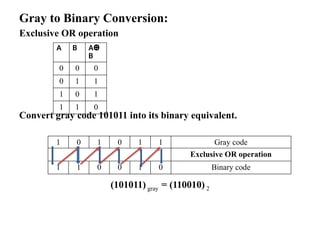
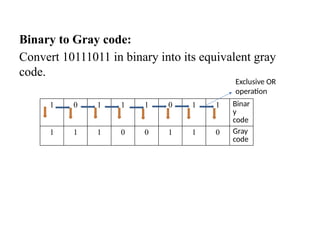
  • 101.
    Limitations of Karnaughmap • The map method of simplification is convenient as long as the number of variables does not exceed five or six. • As the number of variable increases it is difficult to make judgments about which combinations form the minimum expression. • Another important point is that the K-map simplification is manual technique and simplification process is heavily depends on the human abilities.
  • 102.
  • 103.
  • 104.
  • 105.
  • 106.
  • 107.
    X-OR GATE : SYMBOL: PIN DIAGRAM :
  • 108.
    A X X =(A + B)’ B Name Symbol Function Truth Table AND A X = A • B X or B X = AB 0 0 0 0 1 0 1 0 0 1 1 1 0 0 0 0 1 1 1 0 1 1 1 1 OR A X X = A + B B I A X X = A’ 0 1 1 0 Buffer A X X = A A X 0 0 1 1 NAND A X X = (AB)’ B 0 0 1 0 1 1 1 0 1 1 1 0 NOR 0 0 1 0 1 0 1 0 0 1 1 0 XOR Exclusive OR A X = A  B X or B X = A’B + AB’ 0 0 0 0 1 1 1 0 1 1 1 0 A X = (A  B)’ X or B X = A’B’+ AB 0 0 1 0 1 0 1 0 0 1 1 1 XNOR Exclusive NOR or Equivalence A B X A B X A X A B X A B X A B X A B X