Moderator:
Ms. Tarika Sharma
Assistant Professor
CON, ILBS,
New Delhi, India
Presented by:
Mr
. Shashi Prakash
M.Sc. Nursing 1st Year
CON, ILBS,
New Delhi, India
BETTY NEUMANN’S THEORY
12/5/2020 BETTY NEUMANN’S THEORY 1
Objectives
• Explore credentials, theoretical sources, and historical
perspective of Betty Neuman
• Review concepts/definitions and concept map
• Critique theory
• Examine the Neuman Systems Model’s acceptance by the
nursing community
• Demonstrate NSM’s use through case
12/5/2020 BETTY NEUMANN’S THEORY 2
BETTY NEUMANN’S SYSTEM MODEL
• Betty Neumann’s system model provides a
comprehensive, flexible, holistic and system based
perspective for nursing.
• It focuses attention on the response of
the client system to actual or potential
environmental stressors.
12/5/2020 BETTY NEUMANN’S THEORY 3
BETTY NEUMANN’S SYSTEM MODEL
• The use of primary, secondary and tertiary nursing
prevention intervention for retention, attainment, and
maintenance of optimal client system wellness.
12/5/2020 BETTY NEUMANN’S THEORY 4
Background and History of Theory
12/5/2020 BETTY NEUMANN’S THEORY 5
HISTORY AND BACKGROUND OF THE
THEORIST
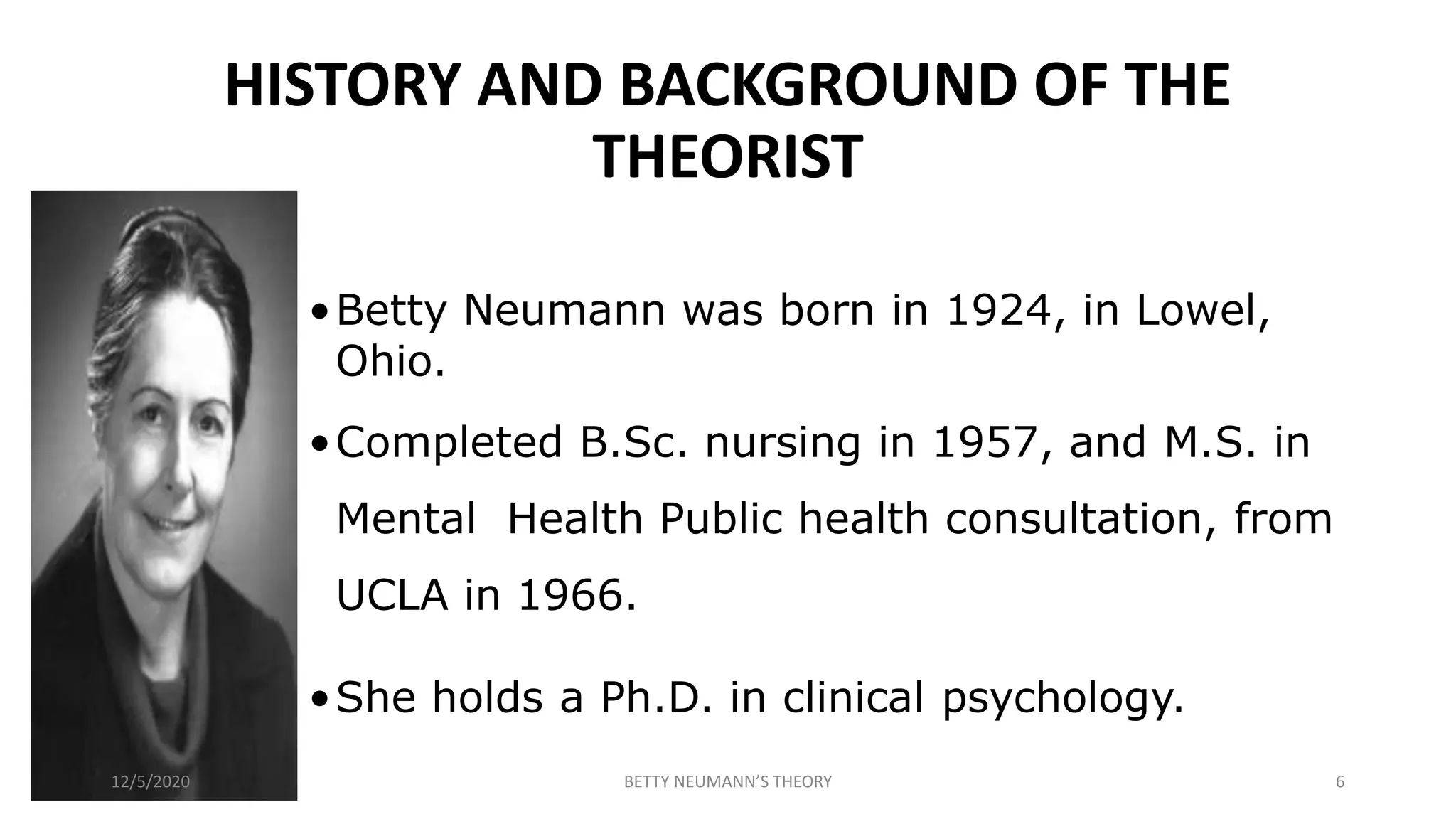
•Betty Neumann was born in 1924, in Lowel,
Ohio.
•Completed B.Sc. nursing in 1957, and M.S. in
Mental Health Public health consultation, from
UCLA in 1966.
•She holds a Ph.D. in clinical psychology.
12/5/2020 BETTY NEUMANN’S THEORY 6
HISTORY AND BACKGROUND OF THE
THEORIST
•The models was initially developed, in response to
graduate nursing students expression of a need for
course content, that would expose them to breadth of
nursing problems, prior to focusing on specific nursing
problem areas.
12/5/2020 BETTY NEUMANN’S THEORY 7
HISTORY AND BACKGROUND OF THE
THEORIST
•The model was published in 1972 as “A Model for
Teaching Total Person Approach to Patient Problems” in
Nursing Research.
•It was refined, and subsequently published in the first
edition of Conceptual Models for Nursing Practice, in
1974, and in the second edition in 1980.
12/5/2020 BETTY NEUMANN’S THEORY 8
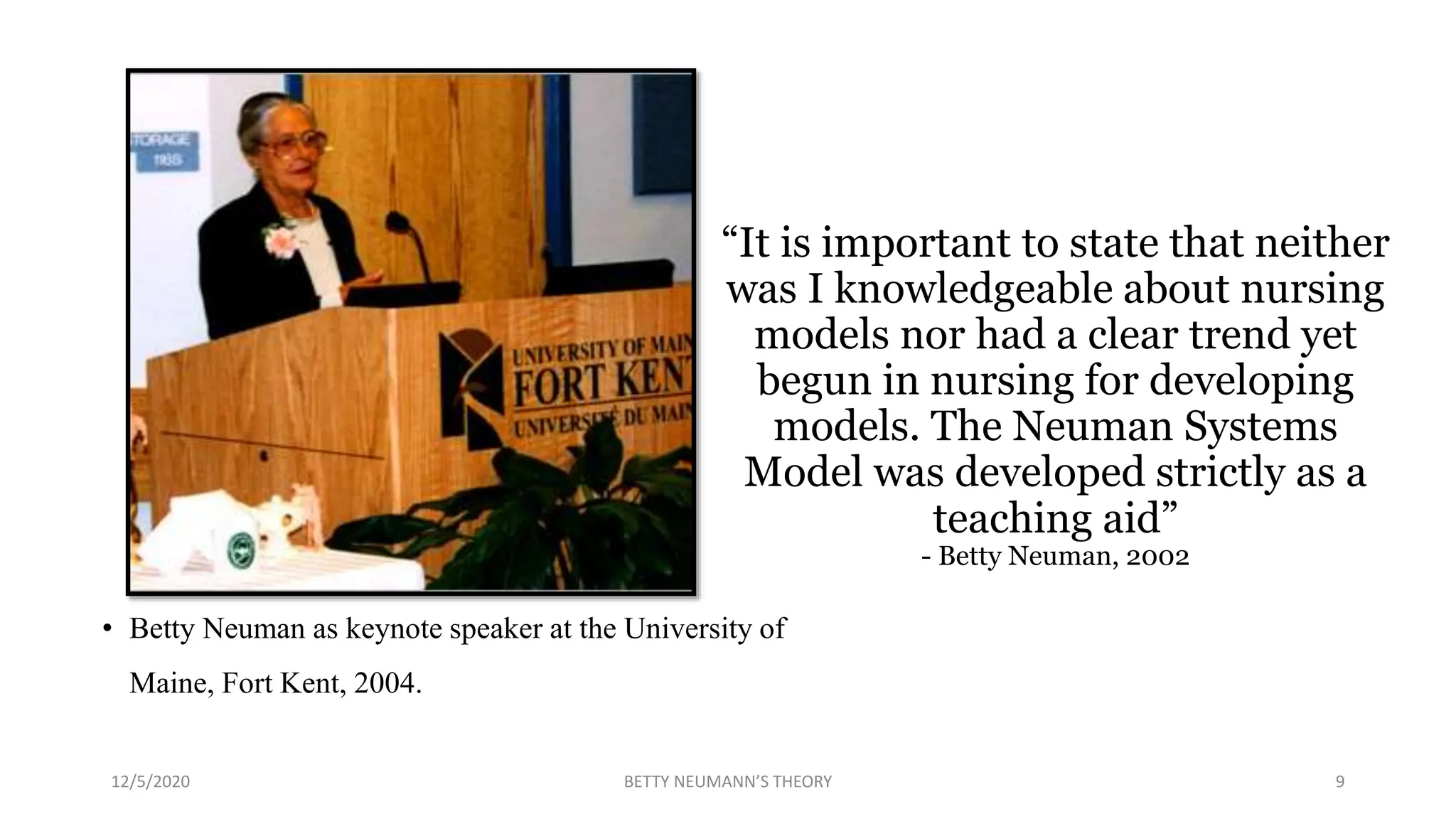
“It is important to state that neither
was I knowledgeable about nursing
models nor had a clear trend yet
begun in nursing for developing
models. The Neuman Systems
Model was developed strictly as a
teaching aid”
- Betty Neuman, 2002
• Betty Neuman as keynote speaker at the University of
Maine, Fort Kent, 2004.
12/5/2020 BETTY NEUMANN’S THEORY 9
12/5/2020 BETTY NEUMANN’S THEORY 10
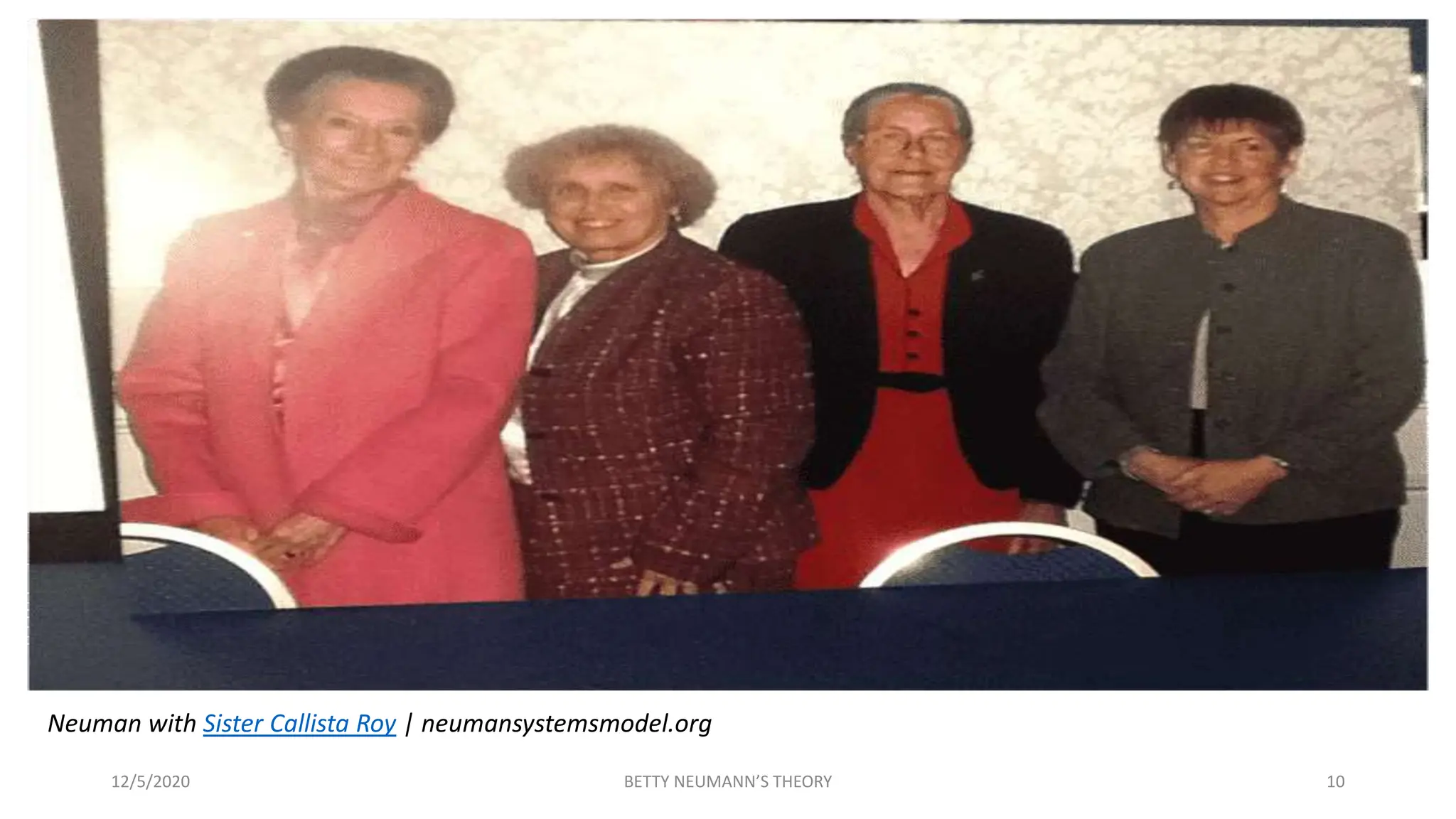
Neuman with Sister Callista Roy | neumansystemsmodel.org
12/5/2020 BETTY NEUMANN’S THEORY 11
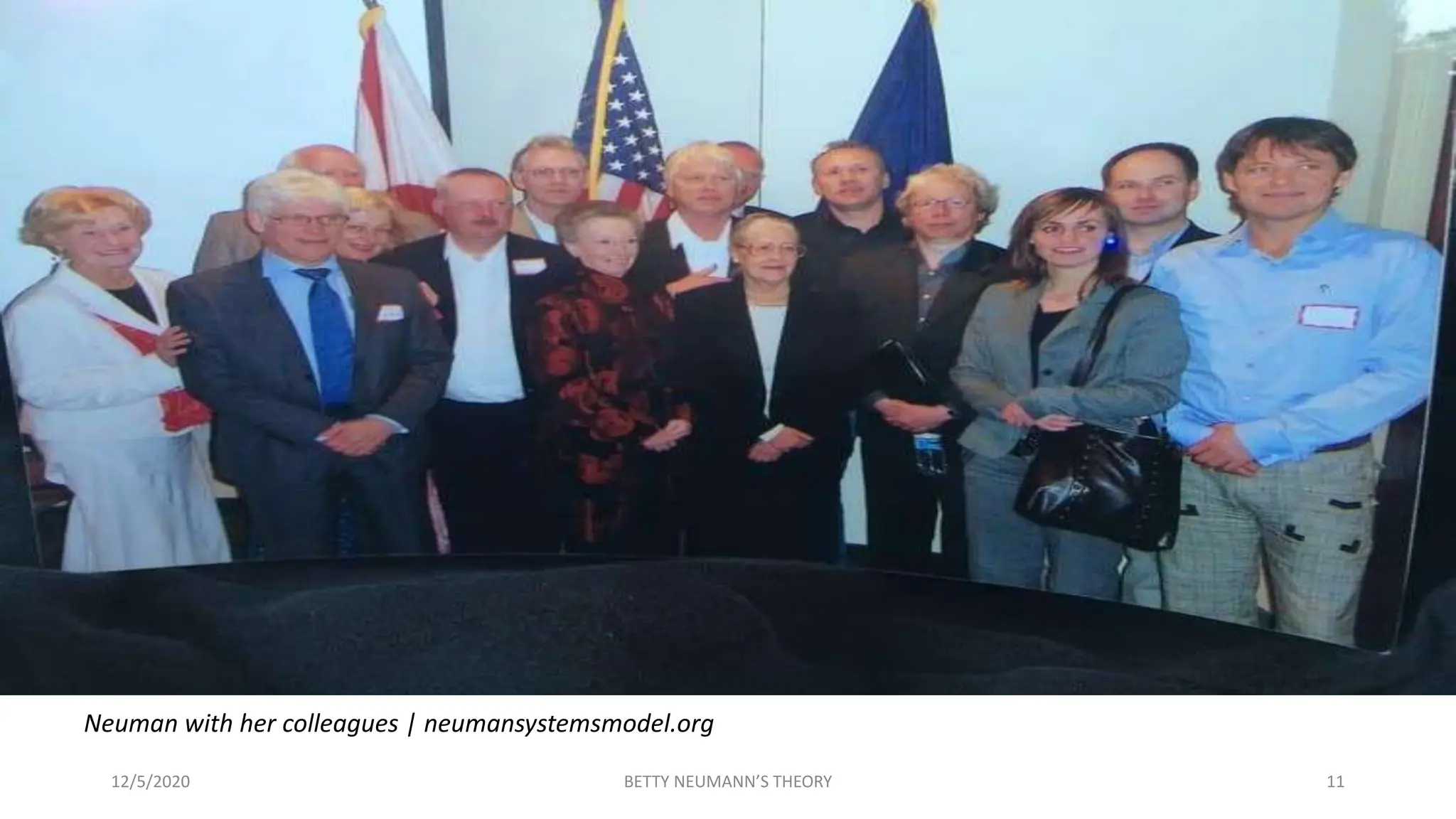
Neuman with her colleagues | neumansystemsmodel.org
Awards and Honors of Betty Neuman
• Betty Neuman has done many things including a nurse,
educator, health counselor, therapist, author, speaker,
and researcher.
• Honorary Doctorate of Letters, Neumann College,
Aston, PA (1992)
• Honorary Member of the Fellowship of the American
Academy of Nursing (1993)
• Honorary Doctorate of Science, Grand Valley State
University, Michigan (1998)
12/5/2020 BETTY NEUMANN’S THEORY 12
12/5/2020 BETTY NEUMANN’S THEORY 13
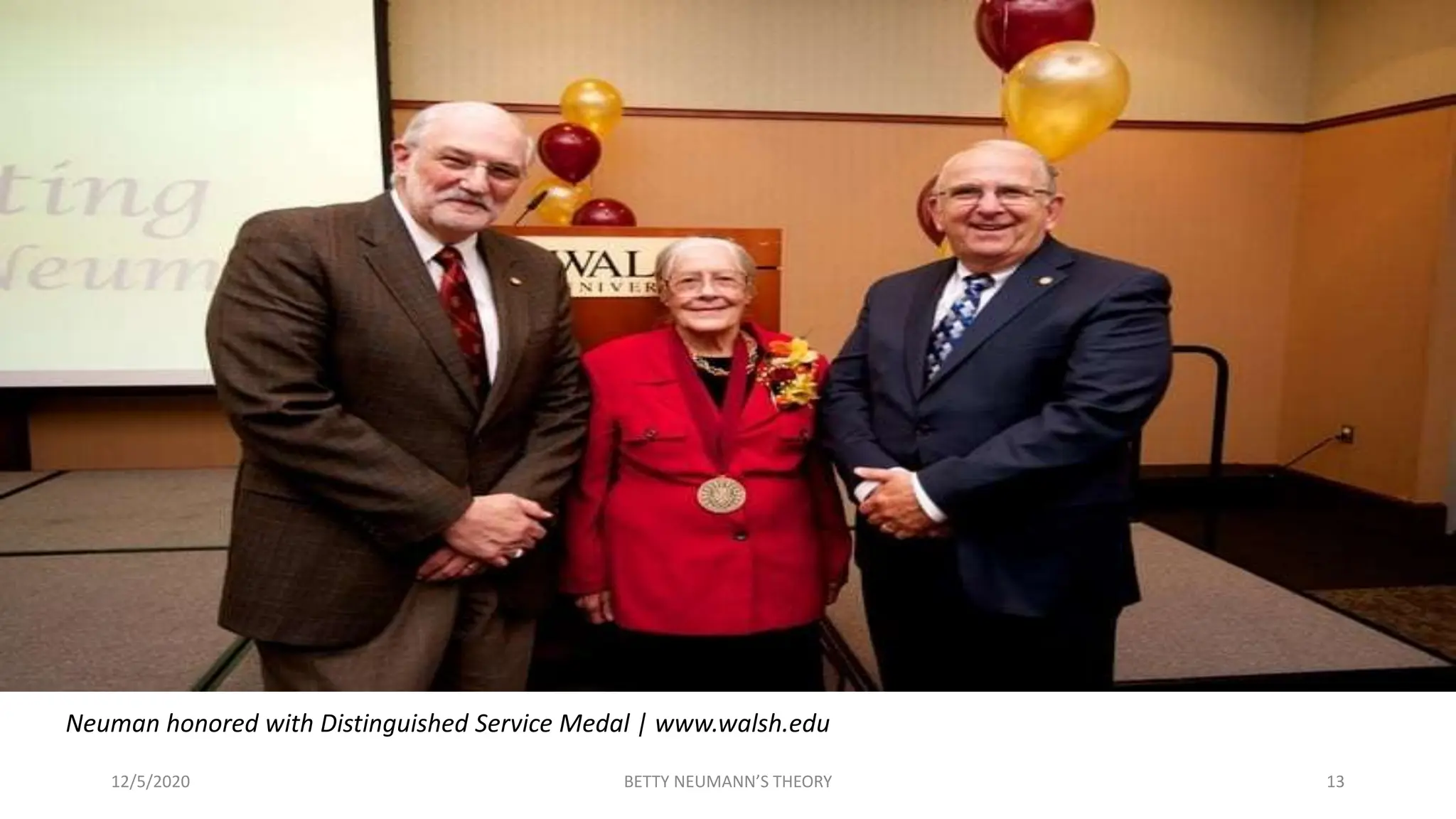
Neuman honored with Distinguished Service Medal | www.walsh.edu
DEVELOPMENT OF THE MODEL
•Neumann’s model was influenced by a variety of
sources.
•The philosophy writers de Chardin and cornu (on
wholeness in system).
•Von Bertalanfy, and Lazlo on general system theory.
•Selye on stress theory.
•Lararus on stress and coping.
12/5/2020 BETTY NEUMANN’S THEORY 14
NEUMANN’S WORK & THE CHARACTERISTICS
OF A THEORY
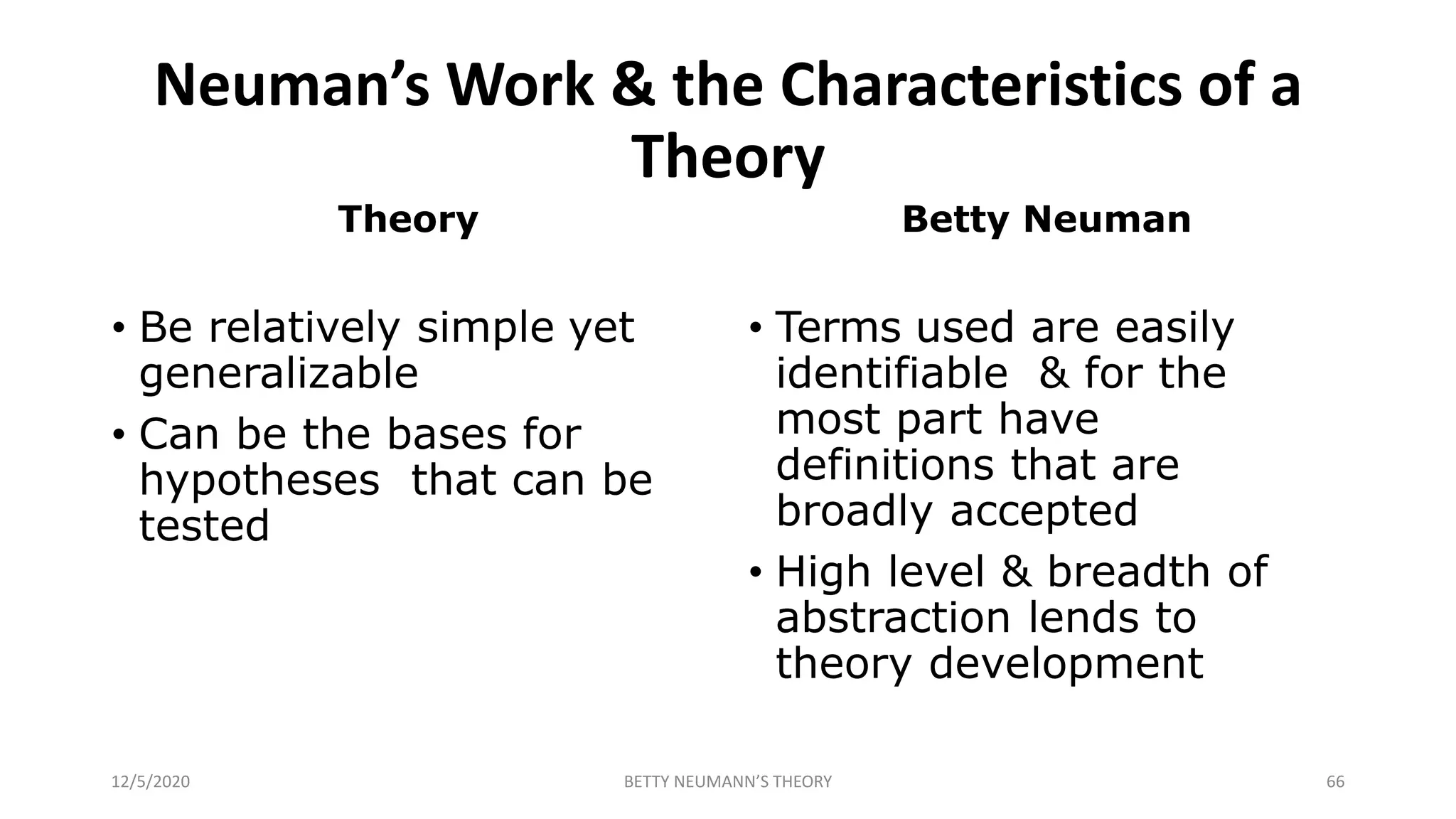
•Theories can be the bases for hypotheses, that can be
tested.
•Theories contribute to and assist in, increasing the
general body of knowledge within the discipline, through
the research implemented to validate them.
12/5/2020 BETTY NEUMANN’S THEORY 15
NEUMANN’S WORK & THE CHARACTERISTICS
OF A THEORY
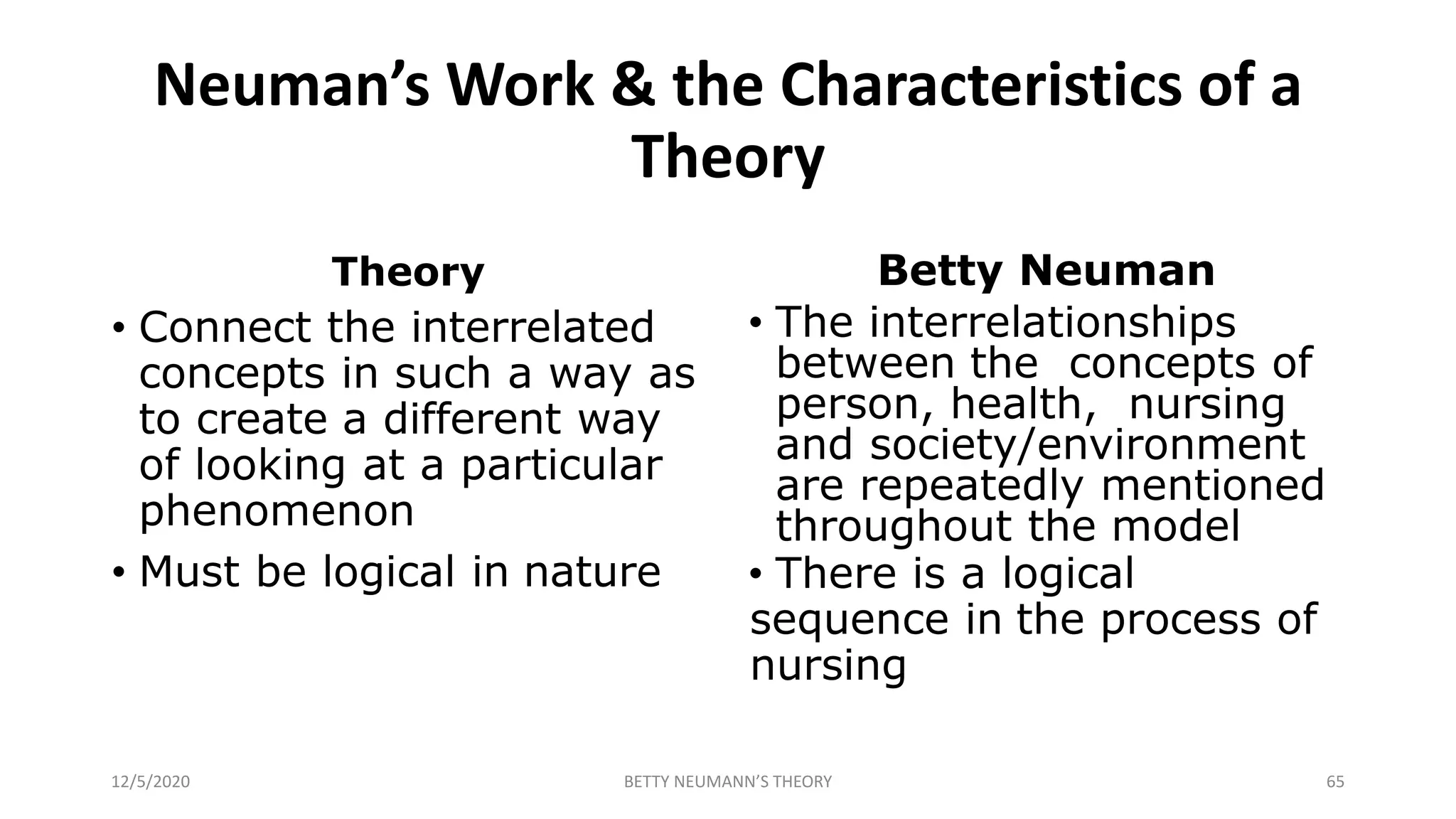
• Theories connects the interrelated concepts in such a
way, as to create a different way of looking at a
particular phenomenon.
• Theories must be logical in nature .
• Theories should be relatively simple yet generalizable.
12/5/2020 BETTY NEUMANN’S THEORY 16
NEUMANN’S WORK & THE CHARACTERISTICS
OF A THEORY
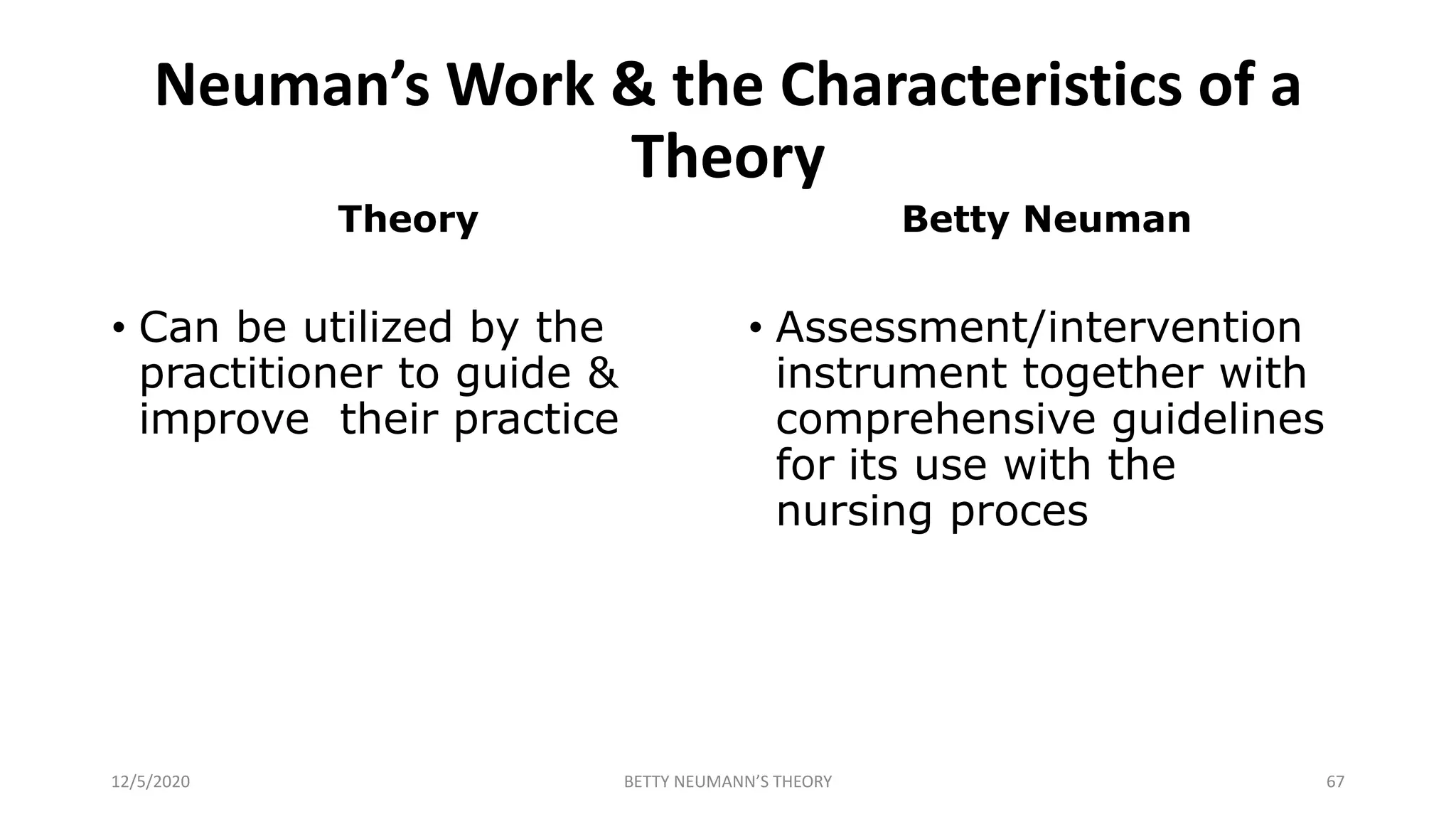
•Theories can be utilized by the practitioner, to guide and
improve their practice.
•Theories must be consistent with other validated
theories, laws and principles but will leave open
unanswered questions, that need to be investigated.
12/5/2020 BETTY NEUMANN’S THEORY 17
BASIC ASSUMPTIONS OF NEUMANN’S
THEORY
Sunday, February 12,2017
13
12/5/2020 BETTY NEUMANN’S THEORY 18
BASIC ASSUMPTIONS
1. Each client system is unique, a composite of factors
and characteristics within a given range of responses
contained within a basic structure.
I amunique
12/5/2020 BETTY NEUMANN’S THEORY 19
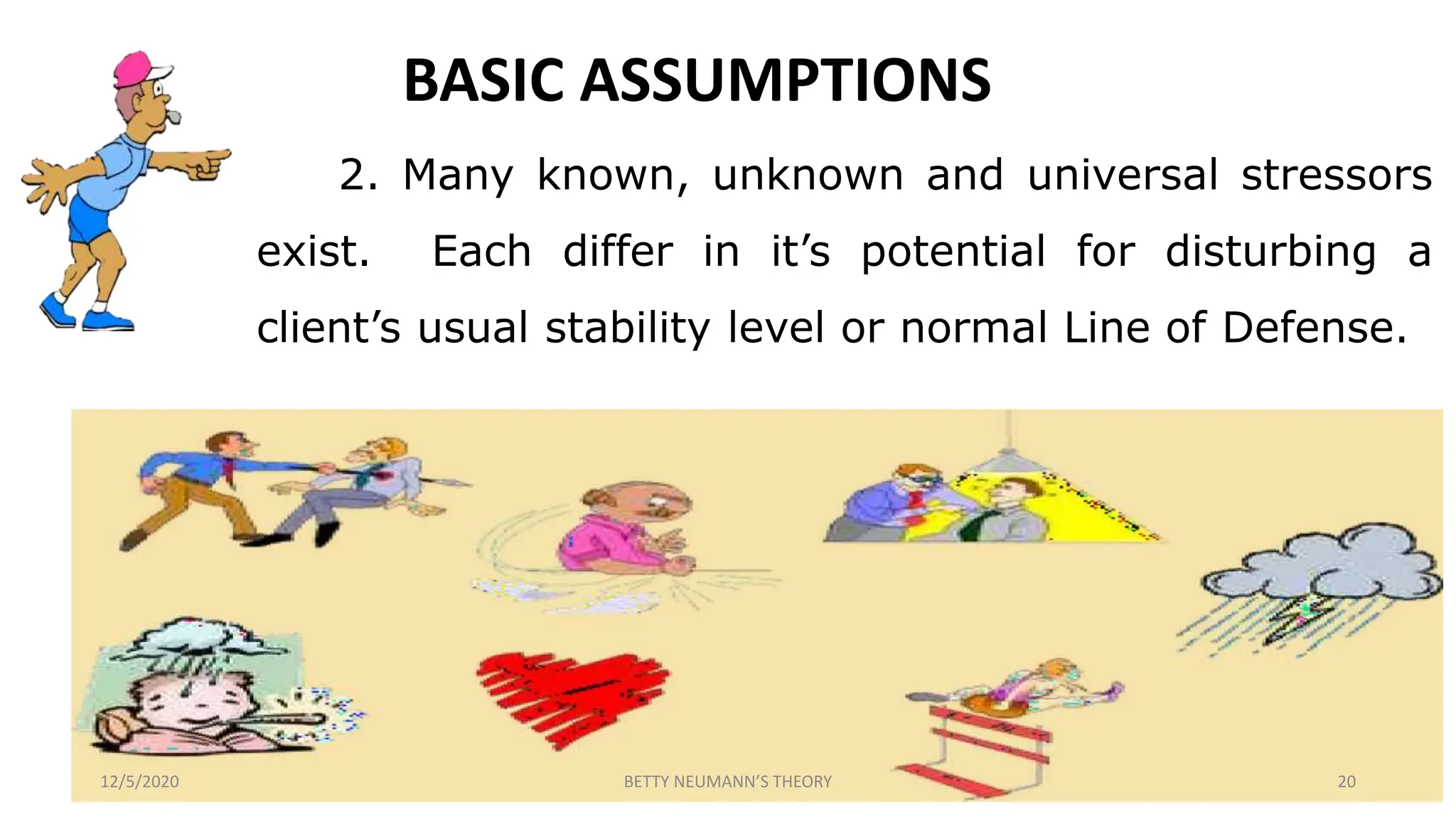
2. Many known, unknown and universal stressors
exist. Each differ in it’s potential for disturbing a
client’s usual stability level or normal Line of Defense.
BASIC ASSUMPTIONS
12/5/2020 BETTY NEUMANN’S THEORY 20
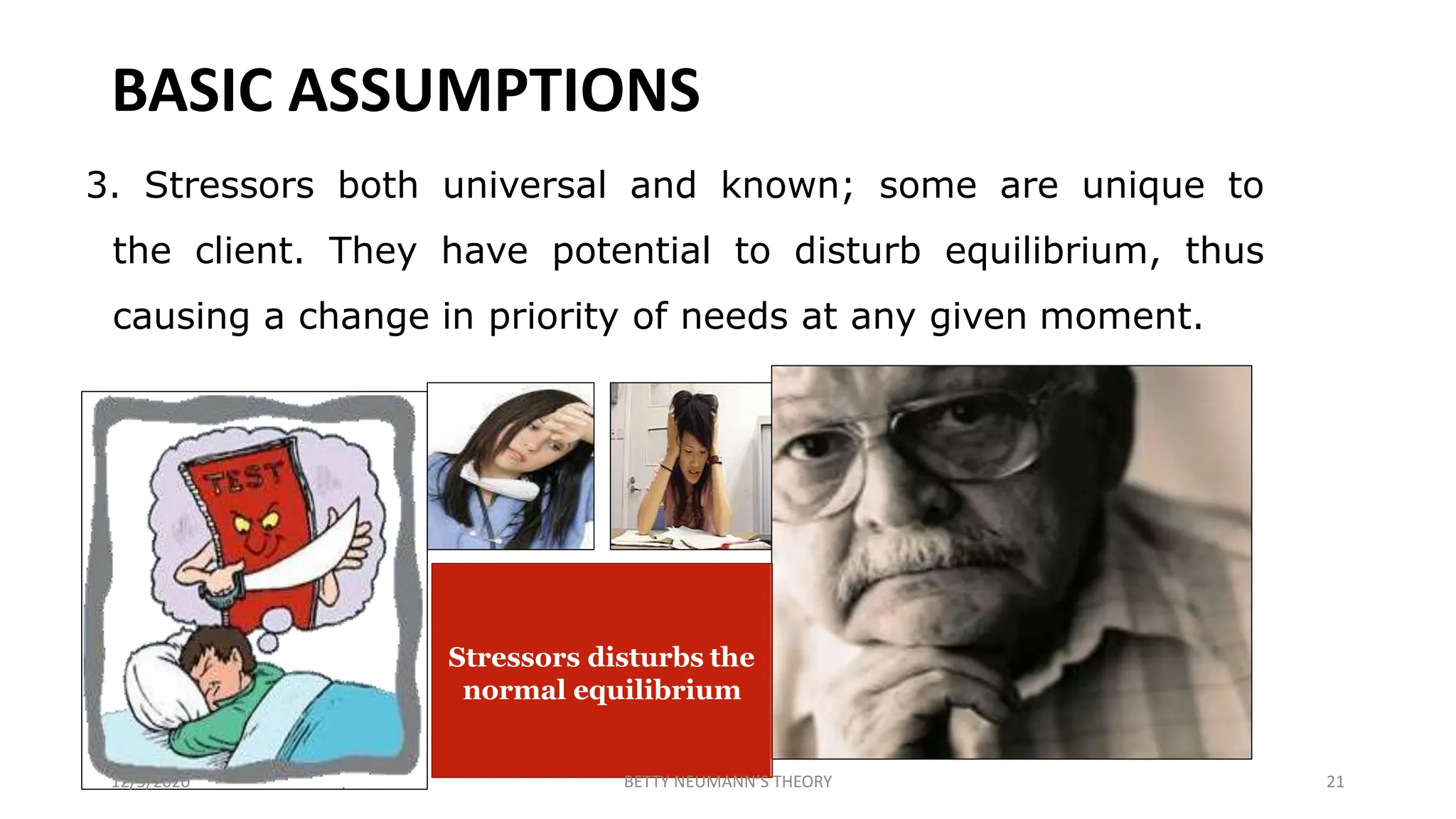
3. Stressors both universal and known; some are unique to
the client. They have potential to disturb equilibrium, thus
causing a change in priority of needs at any given moment.
BASIC ASSUMPTIONS
Stressors disturbs the
normal equilibrium
12/5/2020 BETTY NEUMANN’S THEORY 21
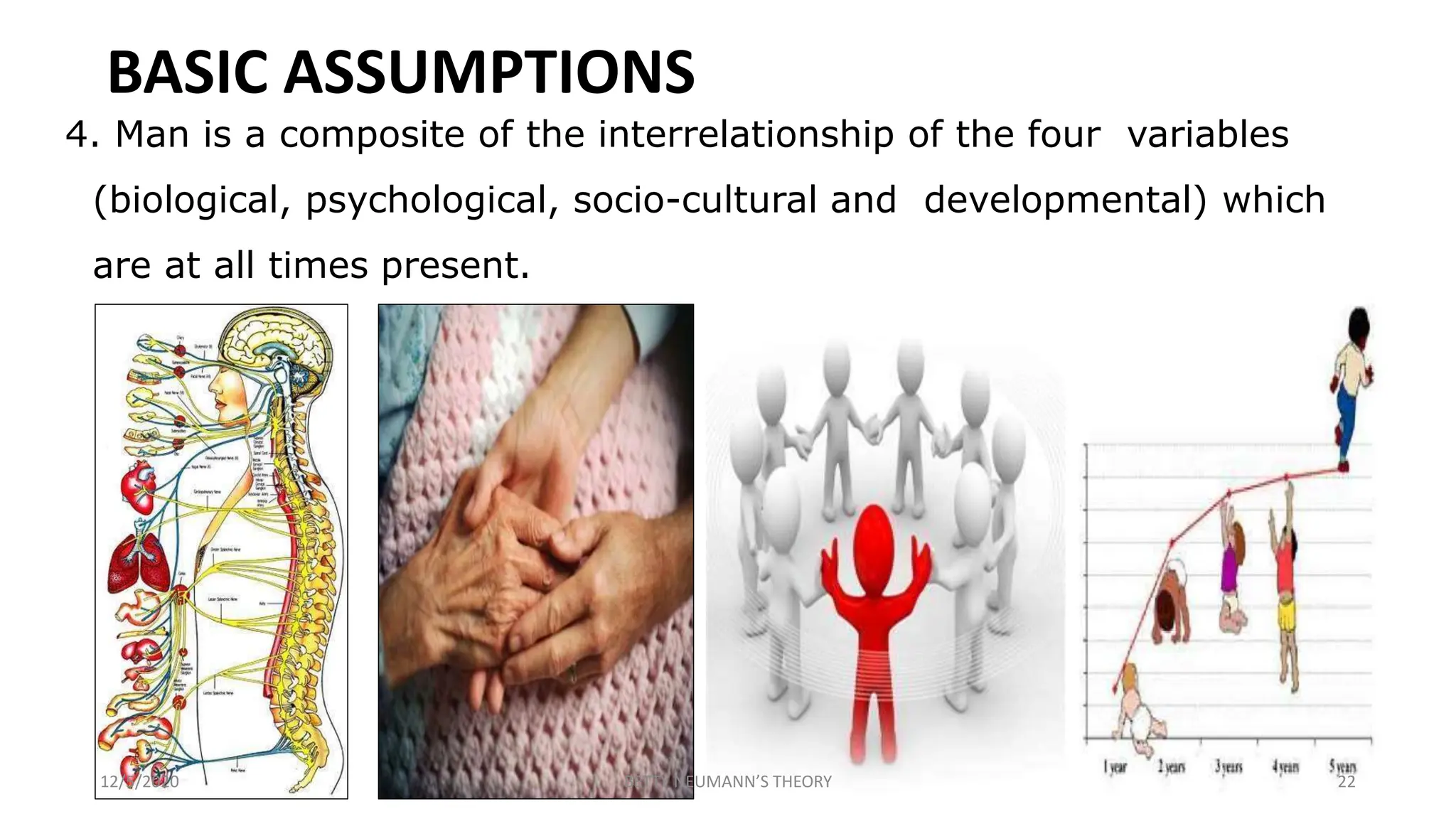
4. Man is a composite of the interrelationship of the four variables
(biological, psychological, socio-cultural and developmental) which
are at all times present.
BASIC ASSUMPTIONS
12/5/2020 BETTY NEUMANN’S THEORY 22
BASIC ASSUMPTIONS
5. Each client/ client system has evolved a normal range of
responses to the environment that is referred to as a normal Line
of Defense. The normal Line of Defense can be used as a
standard from which to measure health deviation.
12/5/2020 BETTY NEUMANN’S THEORY 23
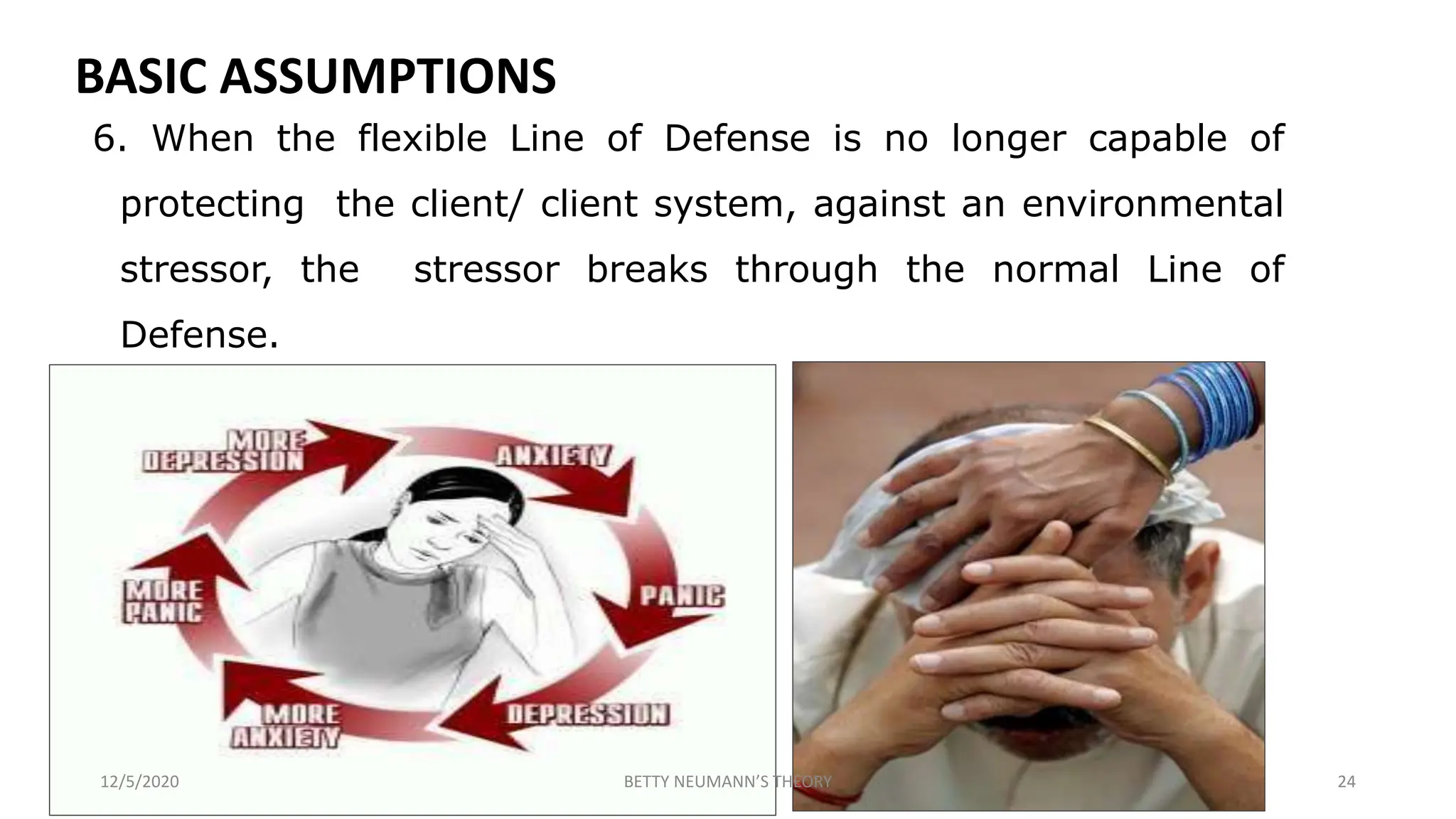
6. When the flexible Line of Defense is no longer capable of
protecting the client/ client system, against an environmental
stressor, the stressor breaks through the normal Line of
Defense.
BASIC ASSUMPTIONS
12/5/2020 BETTY NEUMANN’S THEORY 24
Primary Prevention
Secondary Prevention
Tertiary Prevention
BASIC ASSUMPTIONS
12/5/2020 BETTY NEUMANN’S THEORY 25
7.Primary prevention relates to general knowledge
applied to clients assessment to identify stressors before
they occur.
8.Secondary prevention relates to symptomatology. These
are interventions generally initiated after an encounter
with a stressor.
9.Tertiary prevention relates to the adaptive process, as
reconstitution begins and moves back towards primary
prevention. These are the interventions initiated after
treatment.
BASIC ASSUMPTIONS
12/5/2020 BETTY NEUMANN’S THEORY 26
MAJOR CONCEPTS OF NEUMANN'S THEORY
12/5/2020 BETTY NEUMANN’S THEORY 27
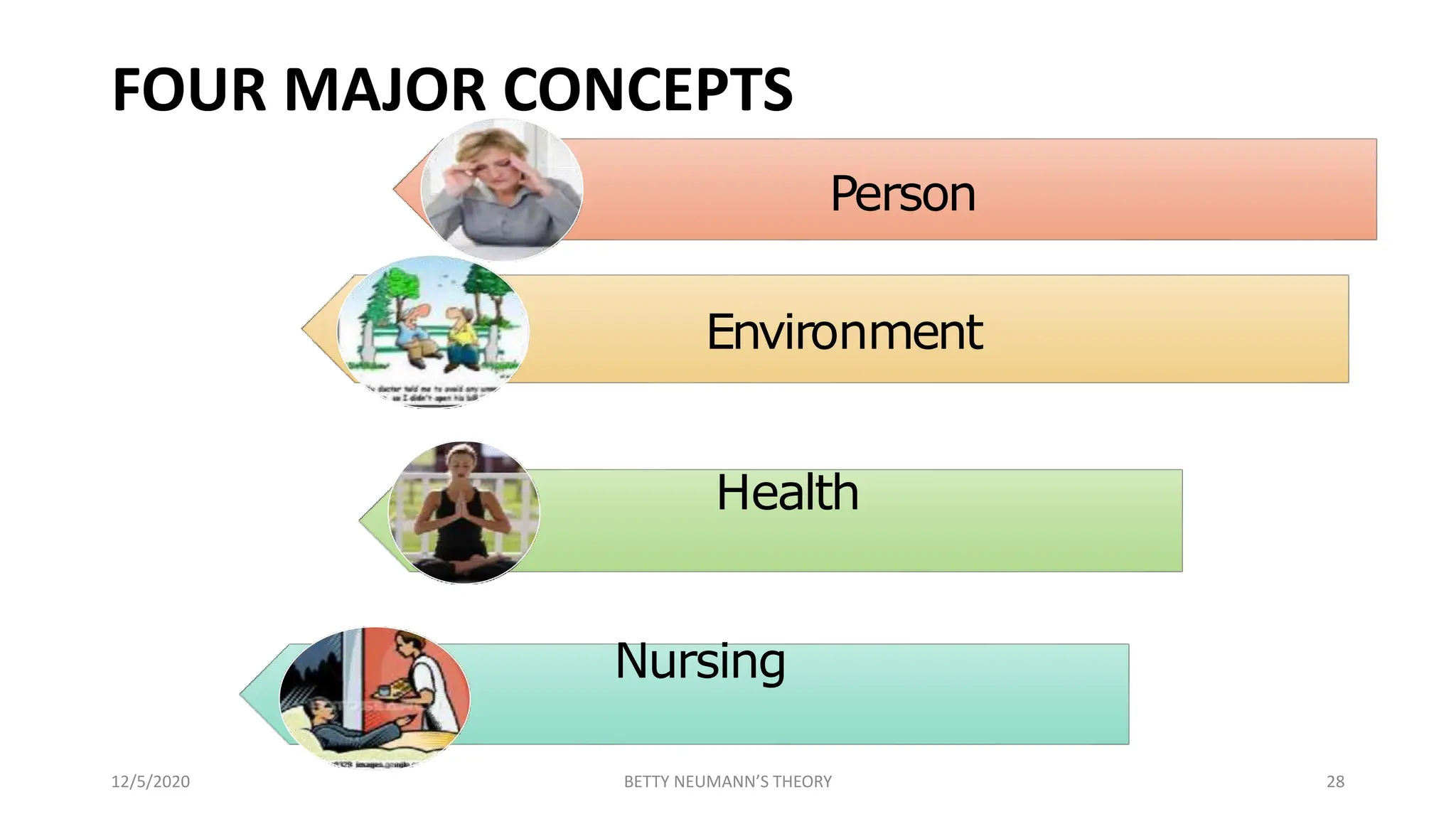
FOUR MAJOR CONCEPTS
Person
Environment
Health
Nursing
12/5/2020 BETTY NEUMANN’S THEORY 28
1.PERSON
Each layer consists of five person variable or subsystems:
Physiological- Refer to the physiochemical structure and
function of
processes
the body. Psychological- Refers to mental
and emotions. Socio-cultural- Refers to
relationships; and social/cultural expectations and activities.
Spiritual- Refers to the influence of spiritual beliefs.
Developmental- Refers to those processes related to
development over the lifespan.
12/5/2020 BETTY NEUMANN’S THEORY 29
2.ENVIRONMENT
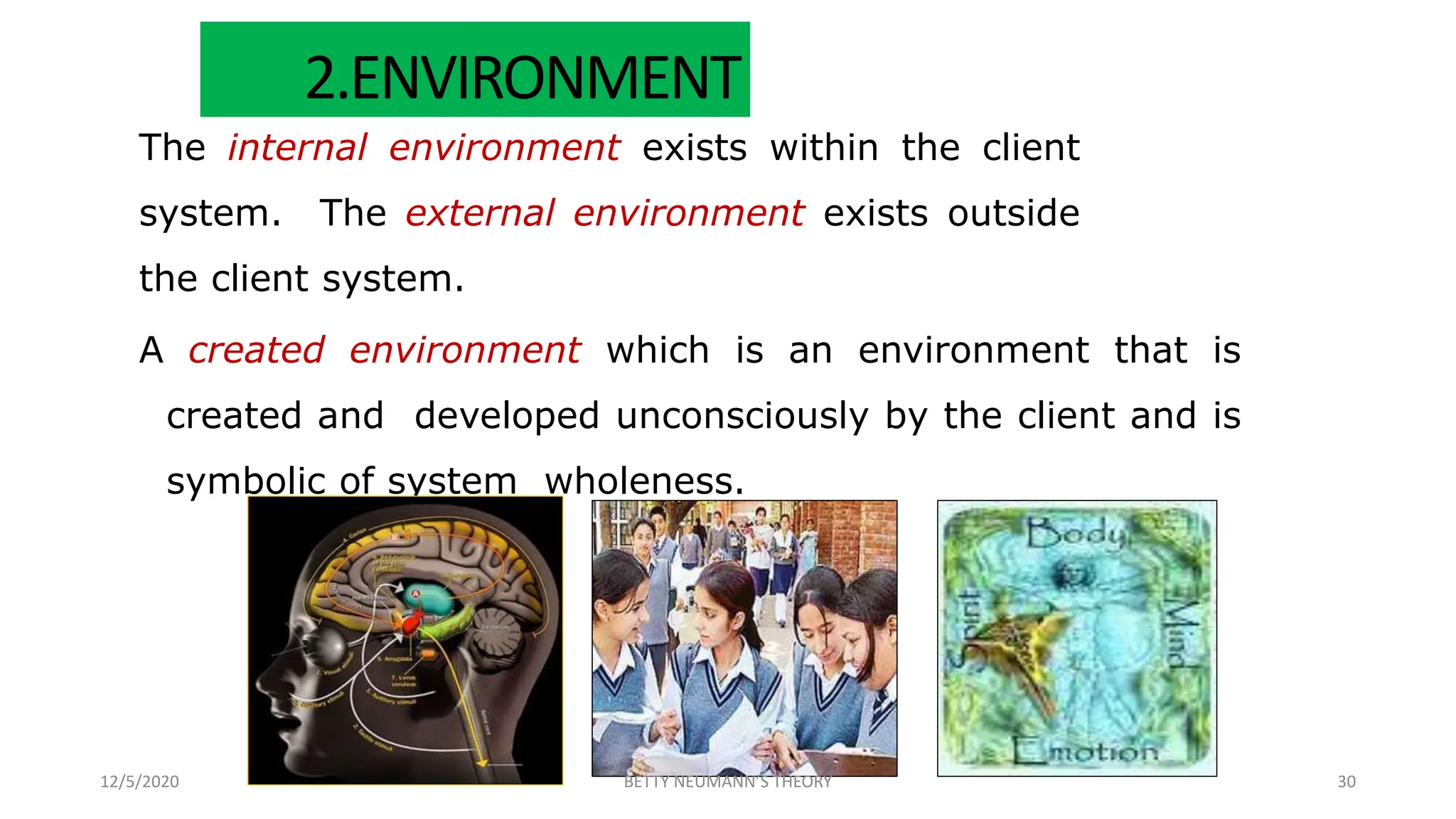
The internal environment exists within the client
system. The external environment exists outside
the client system.
A created environment which is an environment that is
created and developed unconsciously by the client and is
symbolic of system wholeness.
12/5/2020 BETTY NEUMANN’S THEORY 30
3.HEALTH
Neuman sees health as being equated
with wellness. She defines health/wellness
as “the condition in which all parts and
subparts (variables) are in harmony with the
whole of the client (Neumann, 1995)”.
12/5/2020 BETTY NEUMANN’S THEORY 31
3.HEALTH
The client system moved toward
wellness when more energy is
available than is needed.
The client system moves toward illness
and death when more energy is needed
than is available.
.
12/5/2020 BETTY NEUMANN’S THEORY 32
4. NURSING
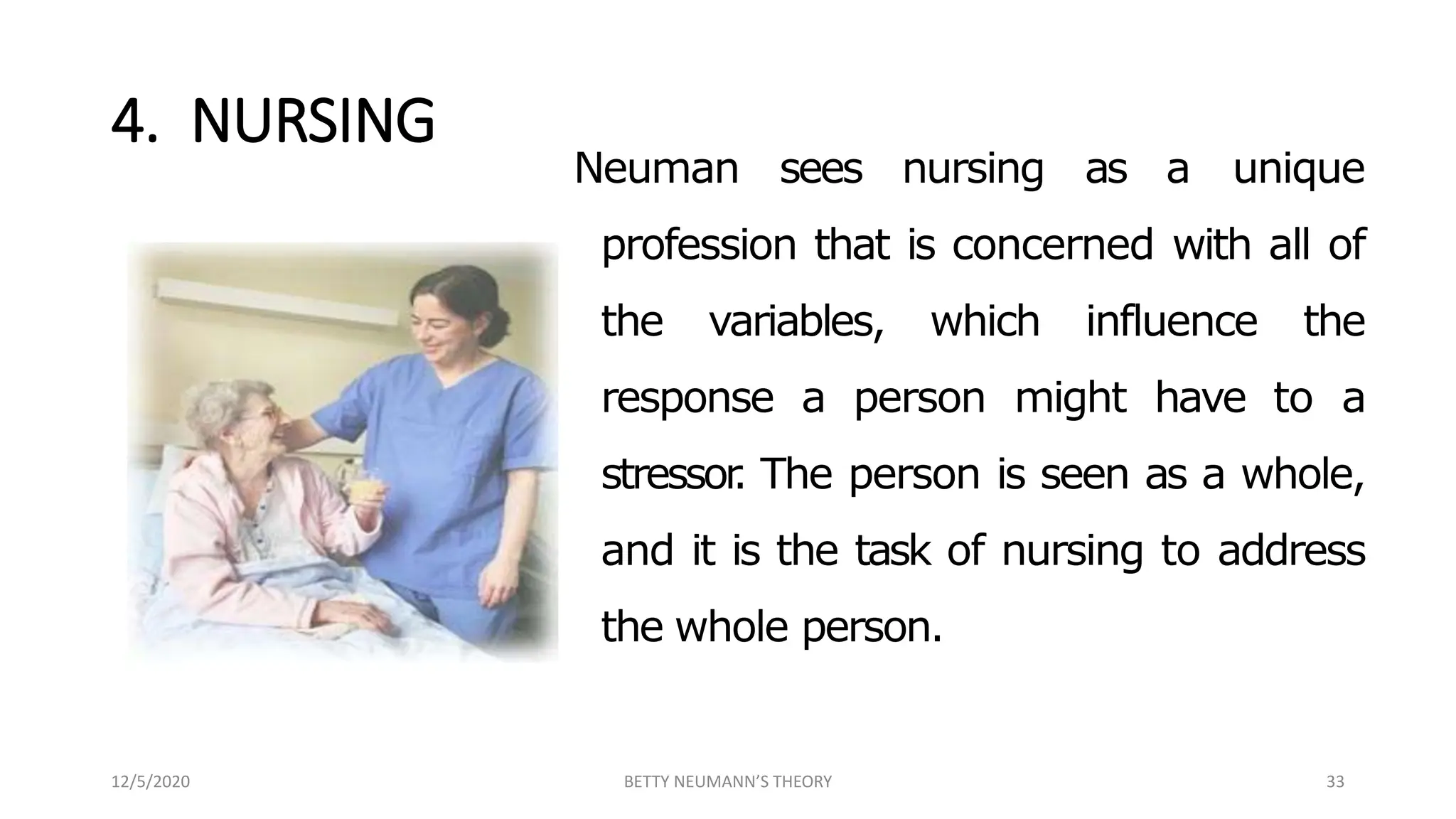
Neuman sees nursing as a unique
profession that is concerned with all of
the variables, which influence the
response a person might have to a
stressor
. The person is seen as a whole,
and it is the task of nursing to address
the whole person.
12/5/2020 BETTY NEUMANN’S THEORY 33
4. NURSING
Neuman defines nursing as “action
which assist individuals, families and
groups to maintain a maximum level
of wellness, and the primary aim is
stability of the patient/client system,
through nursing interventions to
reduce stressors.’’
12/5/2020 BETTY NEUMANN’S THEORY 34
4. NURSING
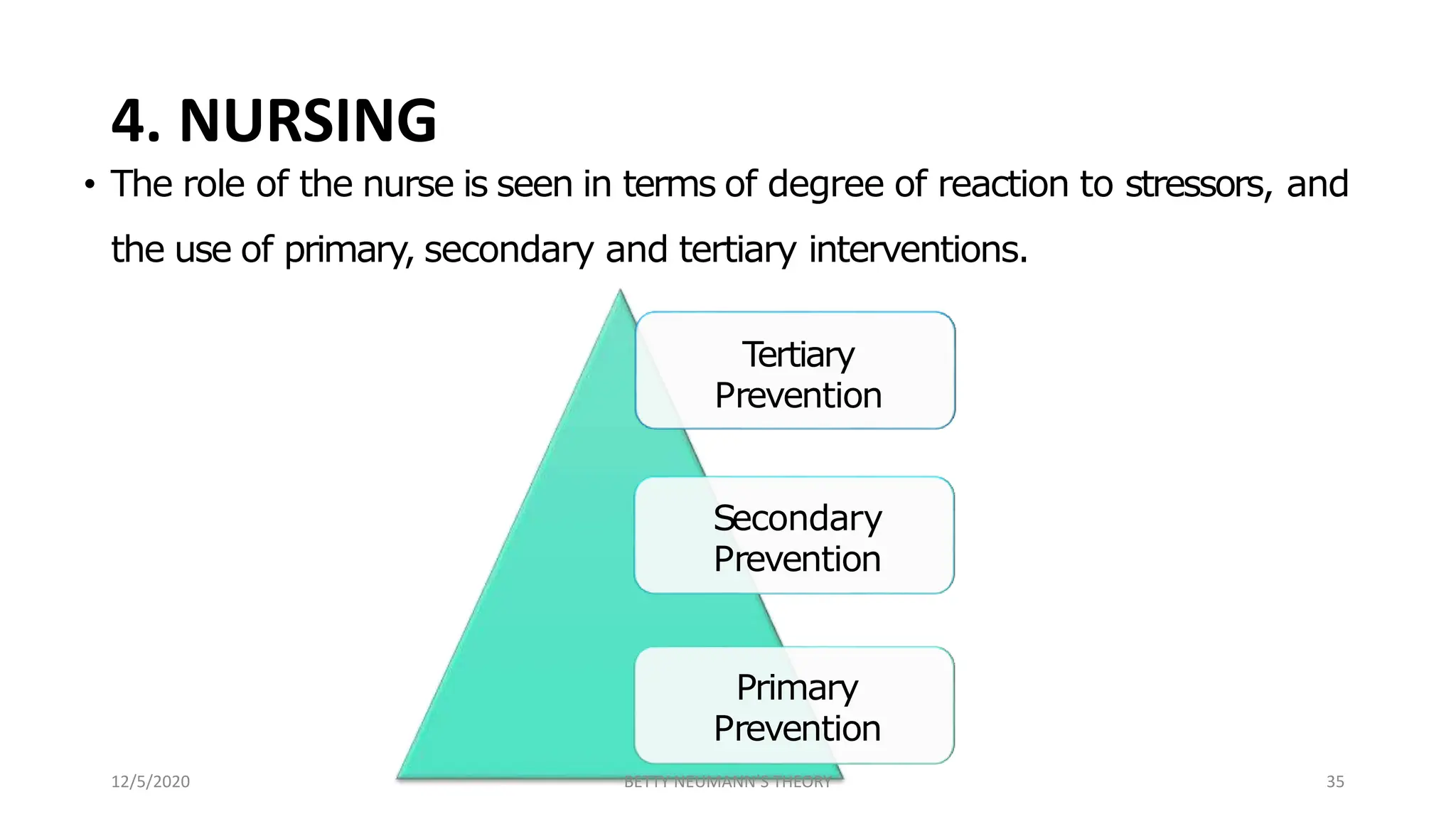
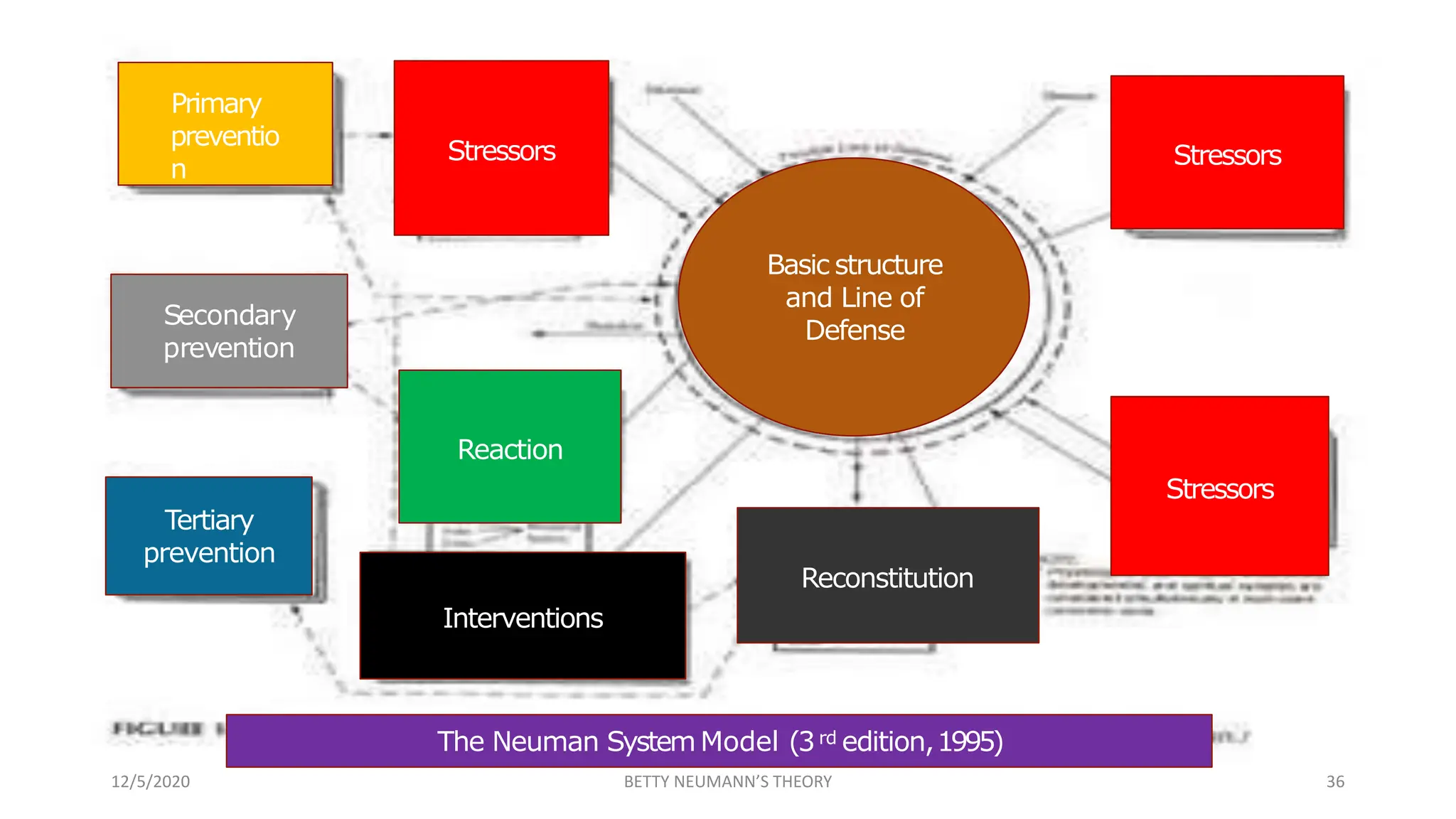
• The role of the nurse is seen in terms of degree of reaction to stressors, and
the use of primary, secondary and tertiary interventions.
Tertiary
Prevention
Secondary
Prevention
Primary
Prevention
12/5/2020 BETTY NEUMANN’S THEORY 35
Secondary
prevention
Tertiary
prevention
Stressors
Reaction
Interventions
Reconstitution
Stressors
Stressors
Basic structure
and Line of
Defense
The Neuman System Model (3rd edition,1995)
Primary
preventio
n
12/5/2020 BETTY NEUMANN’S THEORY 36
RESEARCH - 1
• Effectiveness of health education about the risk factors of
Hepatitis B & C infection and knowledge regarding prevention
of transmission is helpful in decreasing the Hepatitis B & C
infection among adults in community.
• Govinda
• A study was done to assess the risk factors and effectiveness of
health education of Hepatitis B & C infection and knowledge
regarding prevention of transmission among adults.
12/5/2020 BETTY NEUMANN’S THEORY 37
Cont…
• • Material and method: Sample consisted of 500
adult attending a selected clinic at Delhi Government
Dispensary, Chhatarpur, Delhi, and their knowledge
were assessed using structured questionnaire.
• Results: The findings showed that adult had least
knowledge in the domain prevention of transmission
of Hepatitis B & C infection among adults in community.
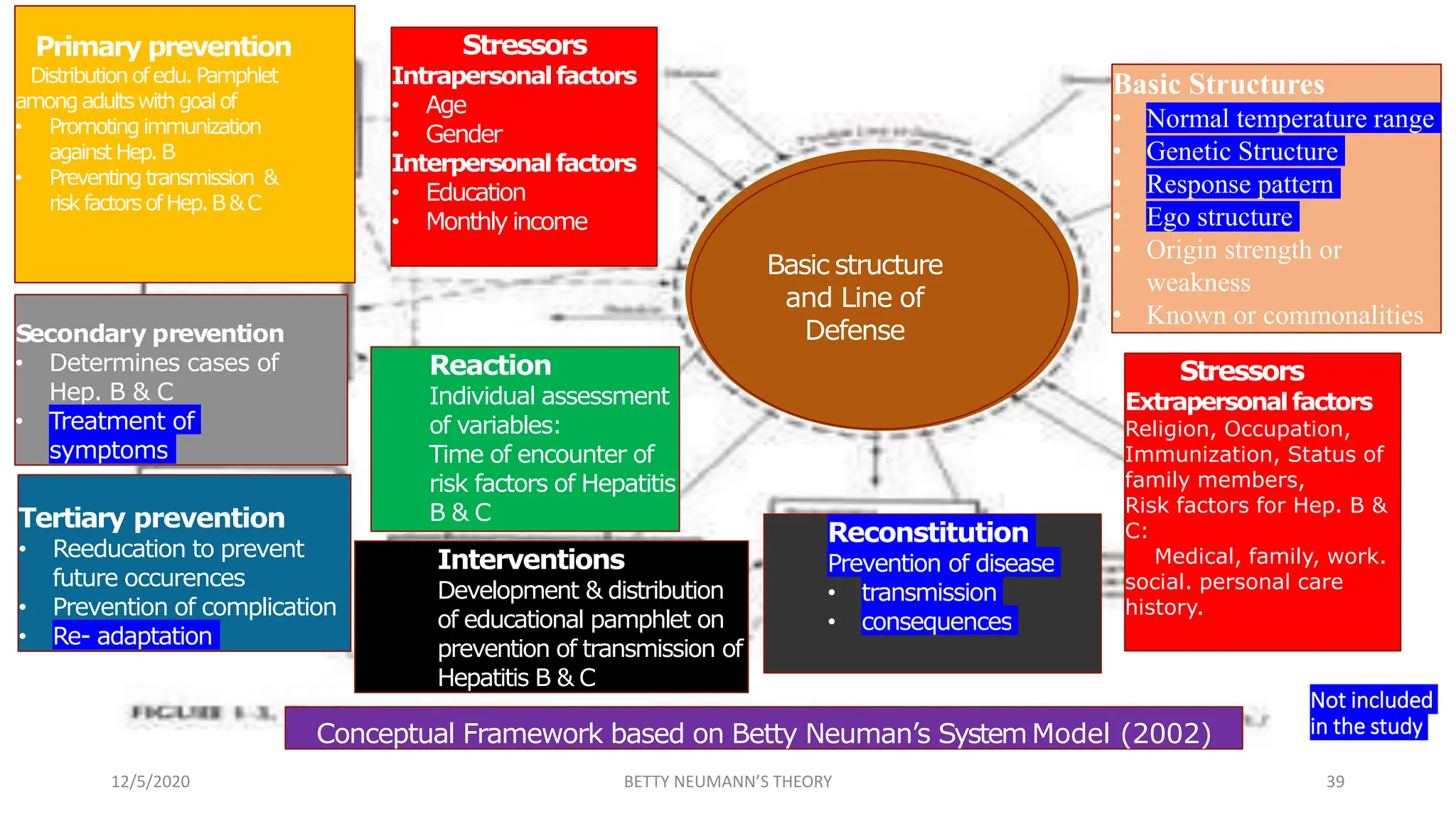
• In this research study the author used Conceptual
Framework based on Betty Neuman’s System Model
(2002).
12/5/2020 BETTY NEUMANN’S THEORY 38
Secondary prevention
• Determines cases of
Hep. B & C
• Treatment of
symptoms
Tertiary prevention
• Reeducation to prevent
future occurences
• Prevention of complication
• Re- adaptation
Stressors
Intrapersonalfactors
• Age
• Gender
Interpersonalfactors
• Education
• Monthly income
Reaction
Individual assessment
of variables:
Time of encounter of
risk factors of Hepatitis
B & C
Interventions
Development & distribution
of educational pamphlet on
prevention of transmission of
Hepatitis B & C
Reconstitution
Prevention of disease
• transmission
• consequences
Stressors
Extrapersonalfactors
Religion, Occupation,
Immunization, Status of
family members,
Risk factors for Hep. B &
C:
Medical, family, work.
social. personal care
history.
Basic structure
and Line of
Defense
Primary prevention
Distribution ofedu.Pamphlet
amongadultswithgoalof
• Promoting immunization
againstHep.B
• Preventing transmission &
riskfactorsofHep.B&C
Basic Structures
• Normal temperature range
• Genetic Structure
• Response pattern
• Ego structure
• Origin strength or
weakness
• Known or commonalities
Conceptual Framework based on Betty Neuman’s System Model (2002)
 Not included
in the study
12/5/2020 BETTY NEUMANN’S THEORY 39
RESEARCH - 2
• Assessment and comparision of Cognitive Function and
Depression level among patients with Chronic Liver Disease and
Healthy Controls.
• Lincy Varghese
• A study was done in this area to fulfill the gap of practice as well
as to facilitate the nursing personnel to support clinician in this
challenging area.
12/5/2020 BETTY NEUMANN’S THEORY 40
Cont…
• Material and method: Sample consisted of 220
subjects (110 patient with CLD and 110 healthy
controls), and their cognitive function and depression
level were assessed by using Modified Mini Mental
Status Examination & Beck Depression Inventory.
• Results: The findings showed that the patient with CLD
had poor cognitive function and severe depression
compared to healthy controls.
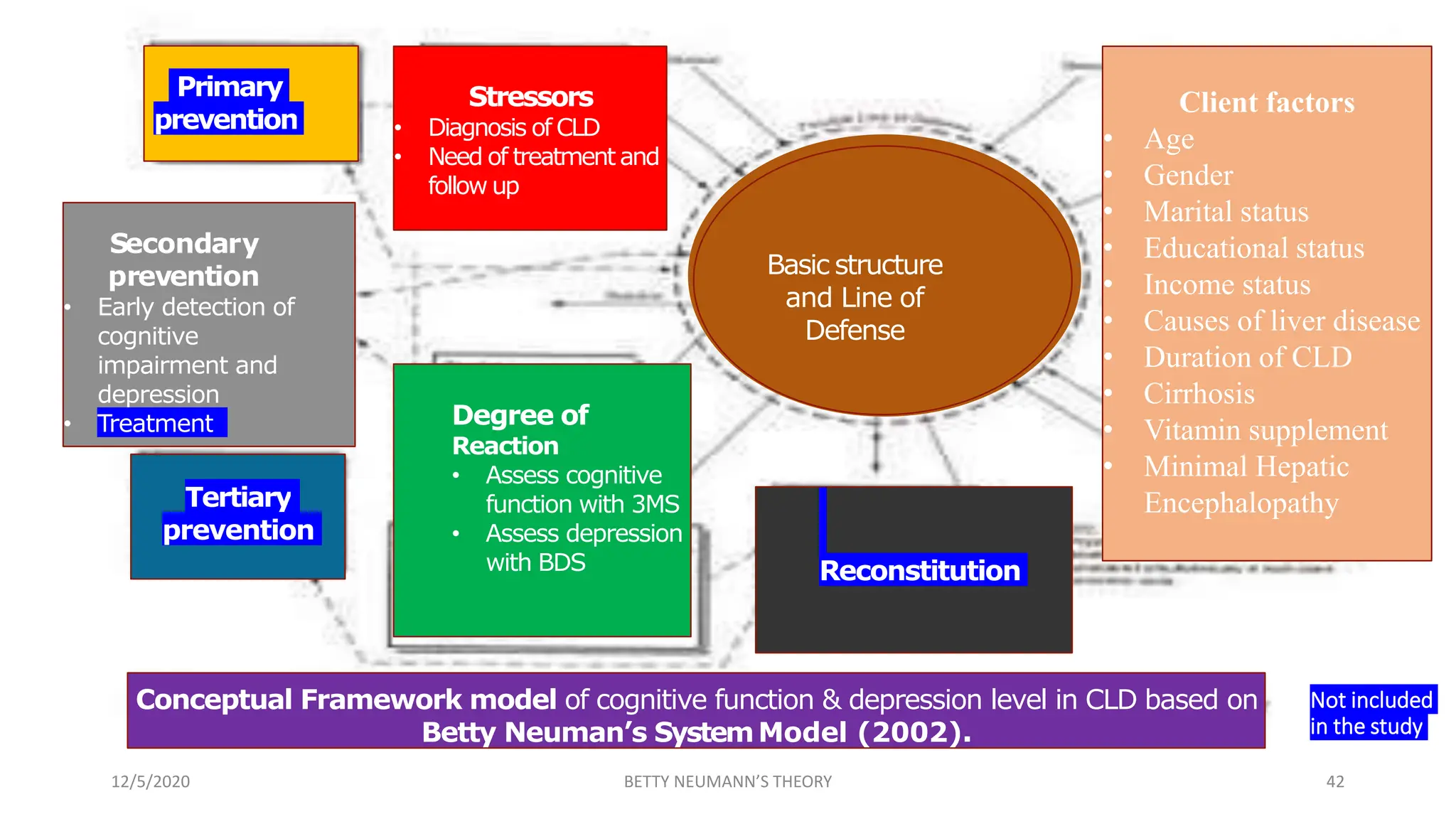
• In this research study the author used Conceptual
Framework model of cognitive function & depression level
in CLD based on Betty Neuman’s System Model
(2002).
12/5/2020 BETTY NEUMANN’S THEORY 41
Secondary
prevention
• Early detection of
cognitive
impairment and
depression
• Treatment
Tertiary
prevention
Stressors
• Diagnosis of CLD
• Need of treatmentand
follow up
Degree of
Reaction
• Assess cognitive
function with 3MS
• Assess depression
with BDS Reconstitution
Basic structure
and Line of
Defense
Primary
prevention
Client factors
• Age
• Gender
• Marital status
• Educational status
• Income status
• Causes of liver disease
• Duration of CLD
• Cirrhosis
• Vitamin supplement
• Minimal Hepatic
Encephalopathy
Conceptual Framework model of cognitive function & depression level in CLD based on
Betty Neuman’s SystemModel (2002).
 Not included
in the study
12/5/2020 BETTY NEUMANN’S THEORY 42
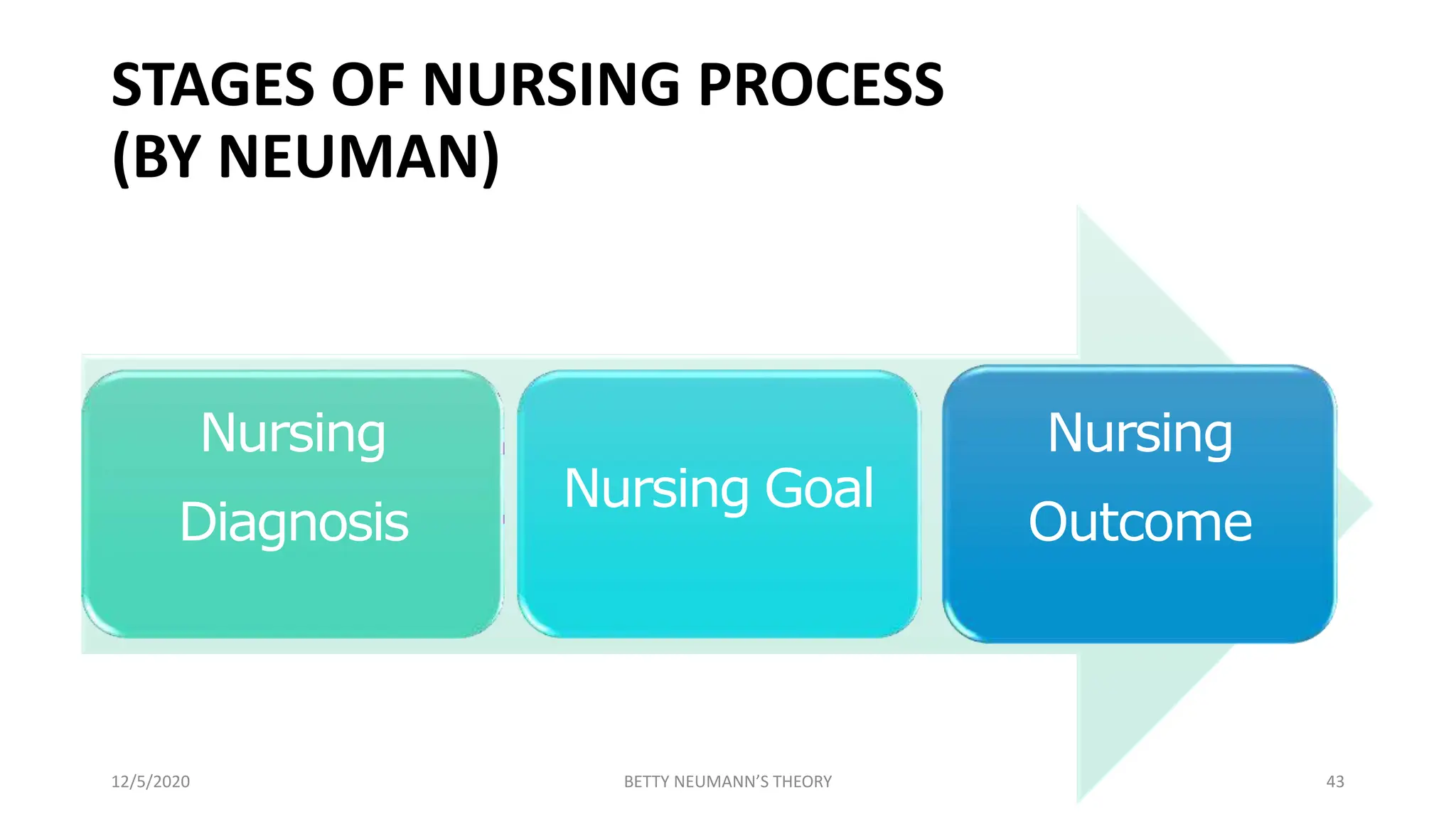
STAGES OF NURSING PROCESS
(BY NEUMAN)
Nursing
Diagnosis
Nursing Goal
Nursing
Outcome
12/5/2020 BETTY NEUMANN’S THEORY 43
STAGES OF NURSING PROCESS
(BY NEUMAN)
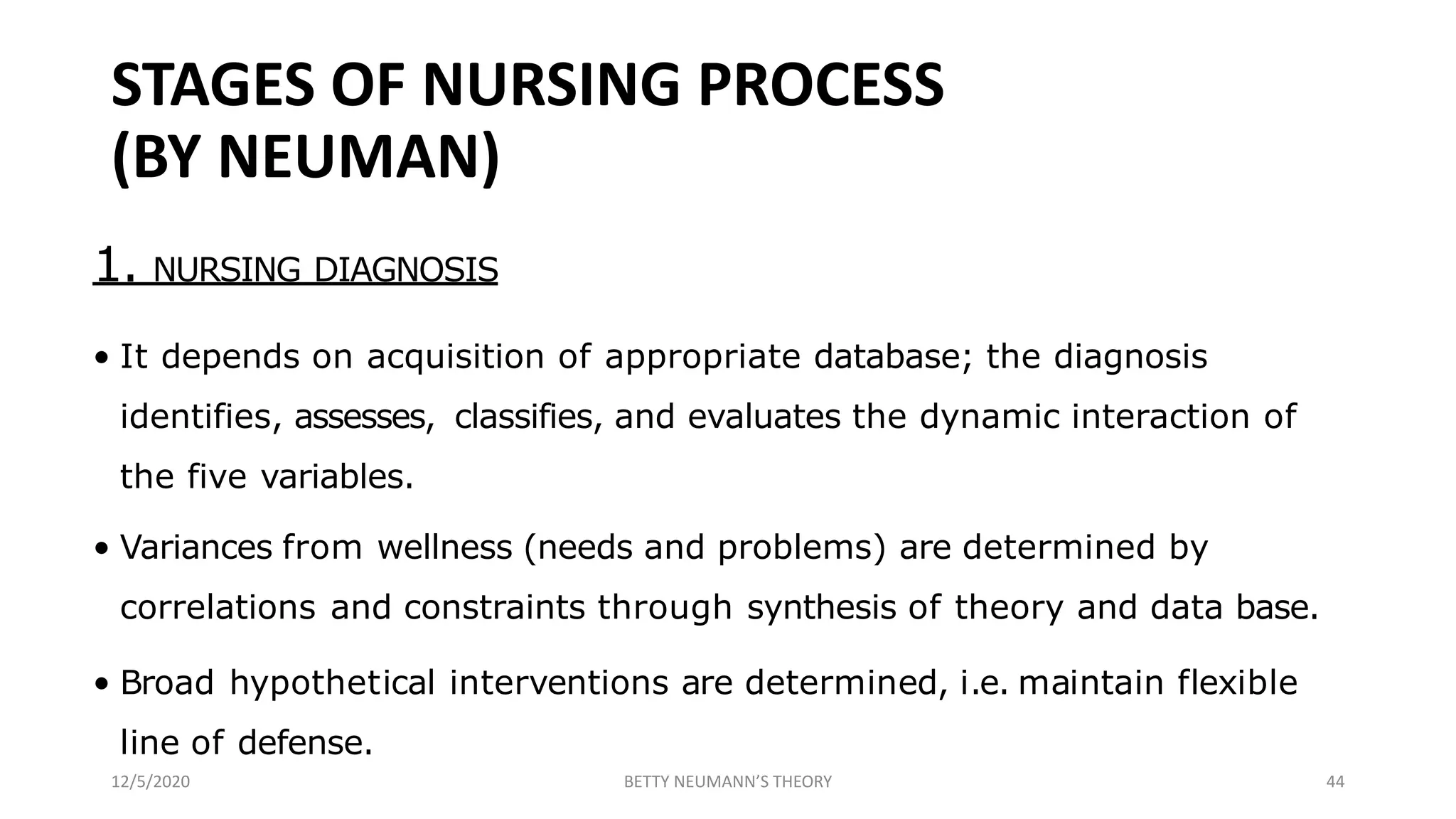
1. NURSING DIAGNOSIS
• It depends on acquisition of appropriate database; the diagnosis
identifies, assesses, classifies, and evaluates the dynamic interaction of
the five variables.
• Variances from wellness (needs and problems) are determined by
correlations and constraints through synthesis of theory and data base.
• Broad hypothetical interventions are determined, i.e. maintain flexible
line of defense.
12/5/2020 BETTY NEUMANN’S THEORY 44
STAGES OF NURSING PROCESS
(BY NEUMAN)
2. NURSING GOALS
• These must be negotiated with the patient, and take account of patient’s and
nurse’s perceptions of variance from wellness.
3. NURSING OUTCOMES
• Nursing intervention using one or more preventive modes.
• Confirmation of prescriptive change or reformulation of nursing goals.
• Short term goal outcomes influence determination of intermediate and long
– term goals.
• A client outcome validates nursing process.
12/5/2020 BETTY NEUMANN’S THEORY 45
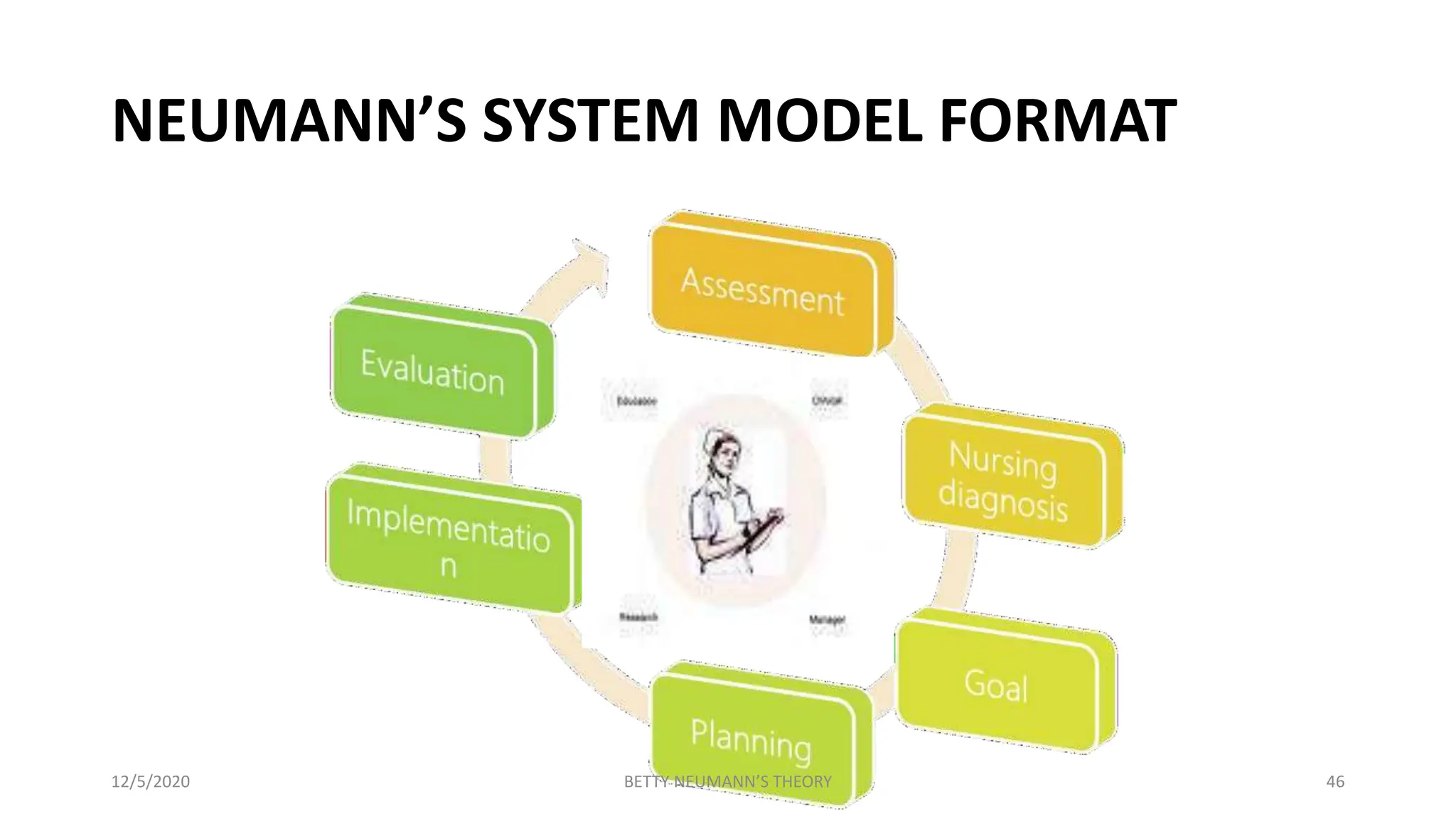
NEUMANN’S SYSTEM MODEL FORMAT
12/5/2020 BETTY NEUMANN’S THEORY 46
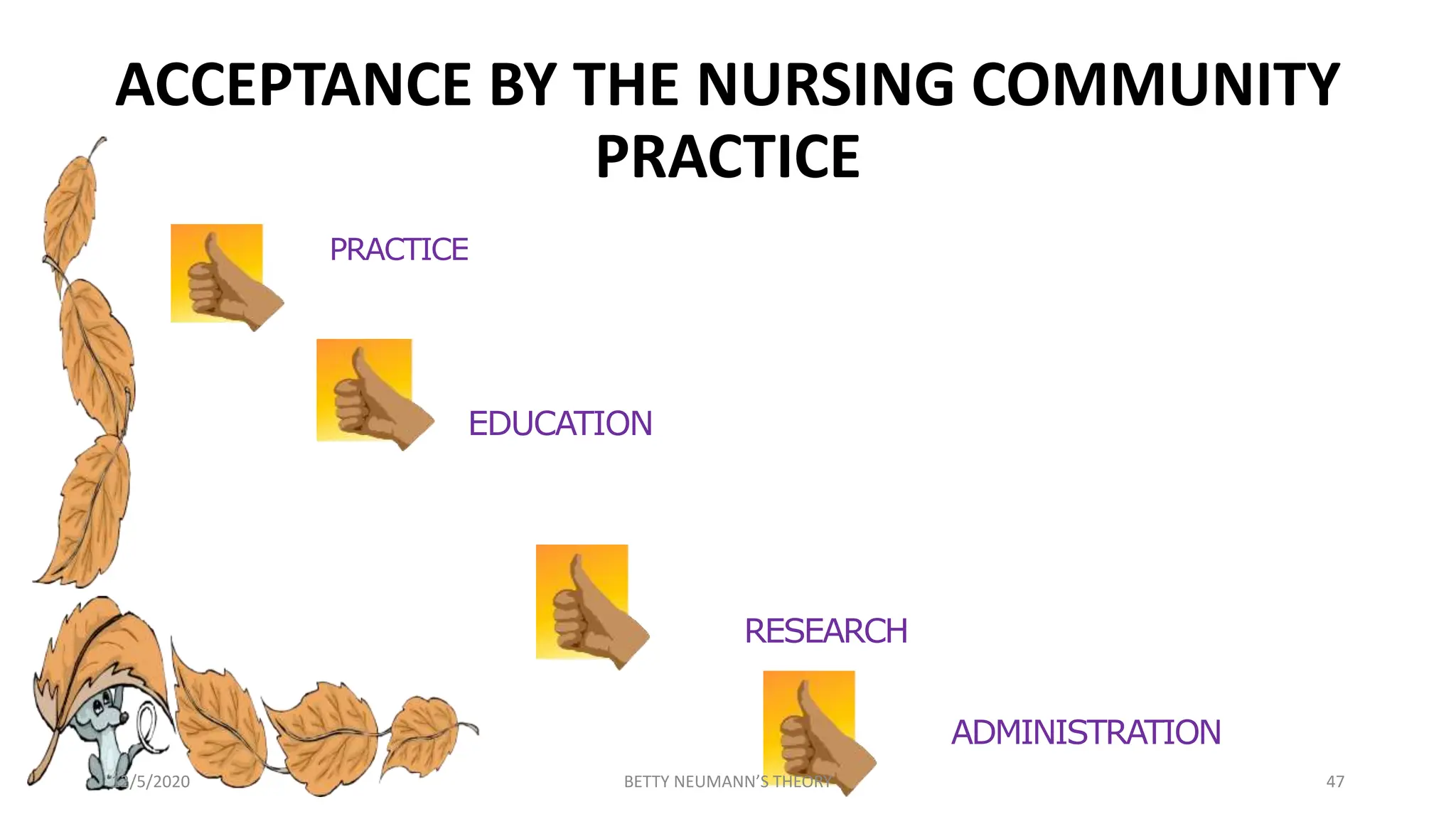
ACCEPTANCE BY THE NURSING COMMUNITY
PRACTICE
EDUCATION
RESEARCH
ADMINISTRATION
PRACTICE
12/5/2020 BETTY NEUMANN’S THEORY 47
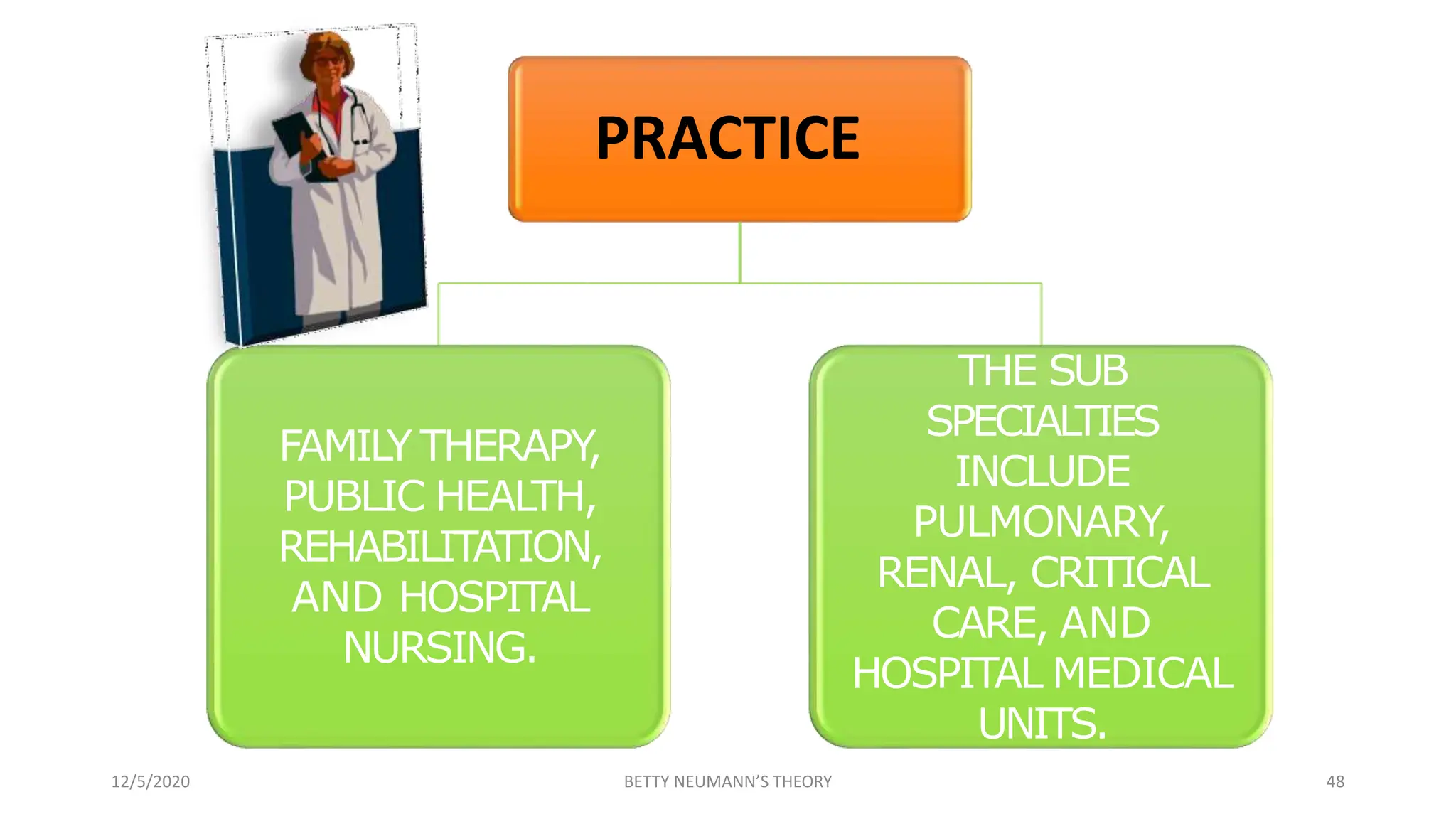
PRACTICE
FAMILY THERAPY
,
PUBLIC HEALTH,
REHABILITATION,
AND HOSPITAL
NURSING.
THE SUB
SPECIALTIES
INCLUDE
PULMONARY,
RENAL, CRITICAL
CARE, AND
HOSPITAL MEDICAL
UNITS.
12/5/2020 BETTY NEUMANN’S THEORY 48
•As a curriculum guide for a
conceptual framework oriented
more toward wellness than toward
a medical model and has been used
at various levels of nursing
education.
reference
•Developing a frame of
centered on holistic care.
EDUCATION
12/5/2020 BETTY NEUMANN’S THEORY 49
•The identification of
congruence between the
client’s perception of stressors
and the Method of collecting
and analyzing data for
identifying client problems.
care giver’s perception of
client stressors.
RESEARCH
• Case management of
patients.
• Total quality management is
used to prepare health care
administrators for future.
ADMINISTR
ATION
12/5/2020 BETTY NEUMANN’S THEORY 50
Case example-1
Radha a young woman age 19 years old.
newly married (married only for 3 months)
She is pregnant
Her husband is unemployed.
Her IPR with mother in law is not good.
She is under weight
12/5/2020 BETTY NEUMANN’S THEORY 51
Case example cont..
Intrapersonal stresses.
◦ Her poor nutritional status
◦ Emotional status
Interpersonal stress
◦ Relationship with mother in law
Extra personal
◦ unemployment of husband
12/5/2020 BETTY NEUMANN’S THEORY 52
Case example cont..
Flexible line of defense
◦ Suffering from poor nutritional status.
◦ Lacks enough sleep due to the nature of her work
The normal line of defense
◦ Uncaring attitude toward her pregnancy.
◦ Her coping abilities are also affected.
12/5/2020 BETTY NEUMANN’S THEORY 53
Case example cont..
• Nursing diagnosis
Nutritional imbalance r/t financial constraints
Knowledge deficit regarding pregnancy and care r/t
being primigravida and young age
Anxiety r/t pregnancy, job, family relations
• Goals
To improve the nutritional status
To ensure a safe motherhood
12/5/2020 BETTY NEUMANN’S THEORY 54
Case example cont..
• Outcomes
Primary prevention
◦ Educate their family on the importance of having
good nutrition.
◦ Suggested some nutritious but cheap food choices.
◦ Possible alternative jobs that would not jeopardize
her health and that of her unborn baby.
12/5/2020 BETTY NEUMANN’S THEORY 55
Case example cont..
• Outcomes
Secondary prevention
◦ Advised to seek pre-natal check-up
◦ Make use of the available services of the nearby
health center.
Tertiary prevention
◦ supporting and commending the positive
behavioral changes exhibited by the couple
12/5/2020 BETTY NEUMANN’S THEORY 56
Case Example-2:
• Mr. Mango Man is a 38 year-old business executive. His
colleagues describe him as hard working, perfectionist,
and very dedicated to work. His day starts by leaving
the house very early from Delhi to Noida and begins
work by delegating various tasks with firm expectations
and deadlines that somewhat impossible to meet. He
usually responds with pressure and intimidating
remarks for works not perfectly done. He smokes and
drinks alcohol whenever he is stressed. Recently, the
company experienced continuous dropped in their sells
and his bosses started to put blame to him.
12/5/2020 BETTY NEUMANN’S THEORY 57
continuation…
• Mr. Mango Man began exhibiting weird mannerisms and
behaviors that appear strange to his family and people
around him. He misses breakfast and lunch very often
and sleeps very late at night while doing work. He has
no time anymore for his family and focuses to hard on
meeting deadlines and his preconceived objectives.
Because of these weird changes in him, the company
decided to temporarily relieve him from his position as
executive manager. A week later, he started to have
periods of mania and depression. His family becomes
worried and called up the hospital to seek assistance
after he locked himself in the room, refusing to eat, and
most of the time quiet and staring blankly on the wall.
Later, he developed pneumonia.
12/5/2020 BETTY NEUMANN’S THEORY 58
Applying Neuman’s System Model
•Using Neuman’s System Model in the above situation,
the identified possible stressors that contributed to Mr.
Mango Man condition were as follows: work, personality,
and attitude. Mr. Mango Man is not anymore able to
handle the stressors and that had caused the
“breakdown” of his lines of defense.
• Without seeking help from his family and friends, he
was not able to maintain his flexible line of defense and
brought instability to his system.
12/5/2020 BETTY NEUMANN’S THEORY 59
C
O
C
O
R
R
E
E
Work-related stressors
Effects on Normal Line of Defense:
•exhibiting weird
mannerisms and behaviors
•periods of mania and depression
Effects on Flexible Line of
Defense:
•sleeps very late at night
•misses breakfast and lunch
•responds with pressure and
intimidating remarks for works not
perfectly done
•smokes and drinks alcohol
whenever he is stressed
Primary Prevention:
•Stress management activities
•Relaxation techniques
•Anger-management
techniques
•Smoking cessation
Tertiary Prevention
•Re-assessing patient’s ability to
independently perform and maintain
variables of health.
•Regular consult to psychologist.
•Maintaining client’s support
system
Effects on Lines of Resistance:
•weakened immune
response
•developed pneumonia
Secondary Prevention
•Medication (to treat
symptoms)
•Opportunities to verbalize feelings and
concerns
12/5/2020 BETTY NEUMANN’S THEORY 60
Applied and adapted to
Nursing education
Nursing research
Nursing practice
Family therapy
Public health
Rehabilitation
Hospital nursing
Applications of Newman’s system model
12/5/2020 BETTY NEUMANN’S THEORY 61
Education
As a curriculum guide for a conceptual framework
At various levels of nursing education.
Helps prepare students for developing a frame of
reference centered on holistic care.
12/5/2020 BETTY NEUMANN’S THEORY 62
Research input
• A study to assess the effectiveness of a structured health
teaching regarding BSE on knowledge, attitude and
practices of close relatives of breast cancer patients.
• Jose J, Sharma K, Srivastava A (2010)
Intrapersonal stressors -family history, old age,
nulliparity, early menarche, late menopause
Interpersonal - inadequate knowledge regarding the
warning signs, lack of access to health info
Extrapersonal- costly preventive and therapeutic options,
increased financial burden, increased hospital visits
12/5/2020 BETTY NEUMANN’S THEORY 63
Research input
Primary prevention- structured teaching regarding
BSE, motivation for BSE performance
Secondary prevention- BSE, Motivation for BSE and
screening in HRGs
Tertiary prevention- psycho support, effective
communication, strengthening coping skills (not
studied)
12/5/2020 BETTY NEUMANN’S THEORY 64
Neuman’s Work & the Characteristics of a
Theory
Theory
Theory
• Connect the interrelated
concepts in such a way as
to create a different way
of looking at a particular
phenomenon
• Must be logical in nature
Betty Neuman
• The interrelationships
between the concepts of
person, health, nursing
and society/environment
are repeatedly mentioned
throughout the model
• There is a logical
sequence in the process of
nursing
12/5/2020 BETTY NEUMANN’S THEORY 65
Neuman’s Work & the Characteristics of a
Theory
Theory
• Be relatively simple yet
generalizable
• Can be the bases for
hypotheses that can be
tested
Betty Neuman
• Terms used are easily
identifiable & for the
most part have
definitions that are
broadly accepted
• High level & breadth of
abstraction lends to
theory development
12/5/2020 BETTY NEUMANN’S THEORY 66
Neuman’s Work & the Characteristics of a
Theory
Theory
• Can be utilized by the
practitioner to guide &
improve their practice
Betty Neuman
• Assessment/intervention
instrument together with
comprehensive guidelines
for its use with the
nursing proces
12/5/2020 BETTY NEUMANN’S THEORY 67
STRENGTHS
• Included clients as holistic being
• It gives clear direction for interventions
• Permits flexibility
• Facilitated cultural considerations
• Provided a nursing focus as opposed to medical focus
• Provided a framework to study individual illness &
reaction to stressors
• Considered the created environment
12/5/2020 BETTY NEUMANN’S THEORY 68
LIMITATION
• Neuman has explained nicely about the prevention but
the other factors that will help in reconstitution as well
as maintenance of the stability of client like, peer
group, family, and many others are not explained.
• Values inherent in nursing in relationship to role of
patients in maintaining & promoting health are not
addressed.
12/5/2020 BETTY NEUMANN’S THEORY 69
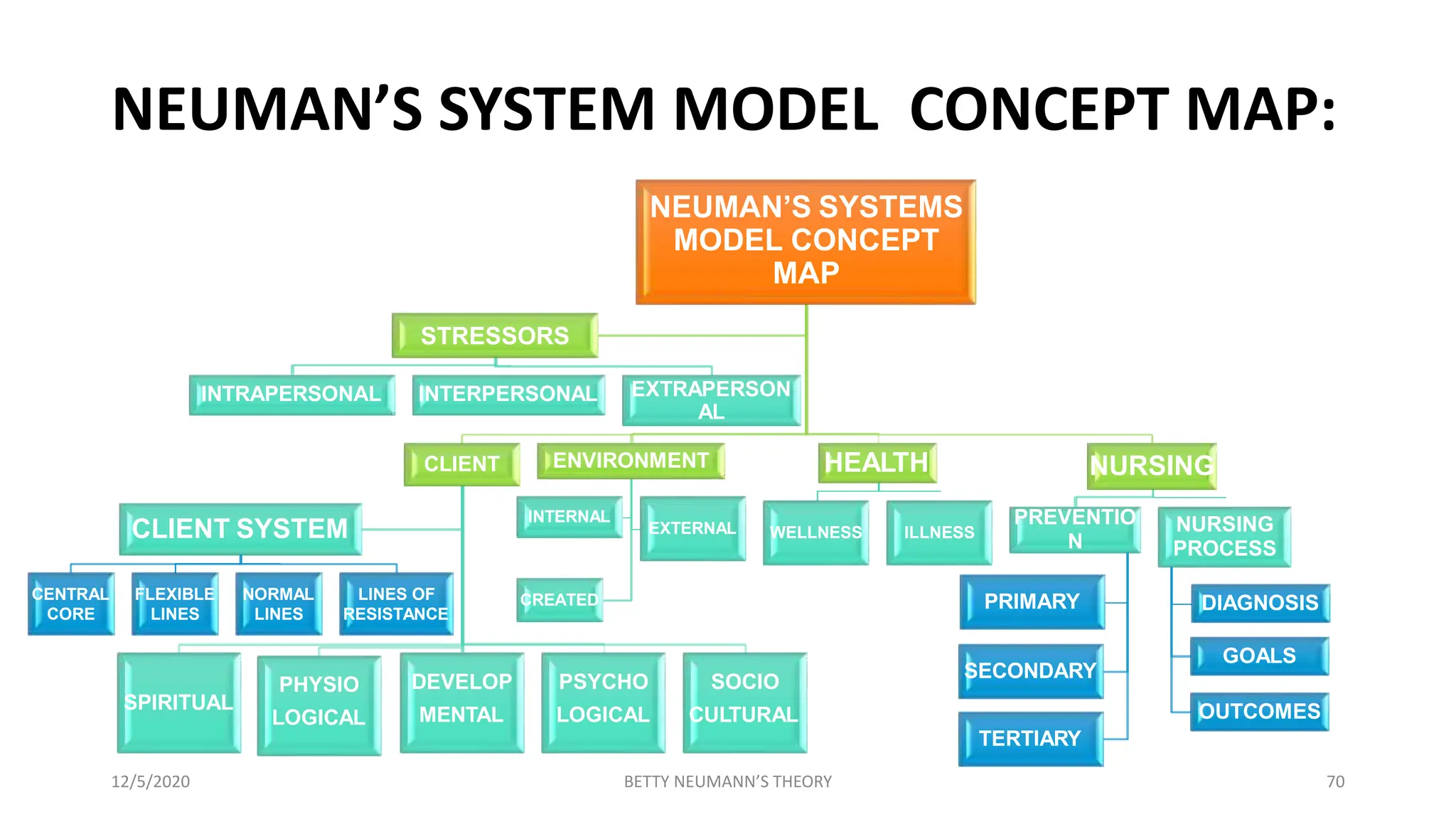
NEUMAN’S SYSTEM MODEL CONCEPT MAP:
CLIENT
SPIRITUAL
PHYSIO
LOGICAL
DEVELOP
MENTAL
PSYCHO
LOGICAL
SOCIO
CULTURAL
CLIENT SYSTEM
CENTRAL FLEXIBLE
CORE LINES
NORMAL
LINES
LINES OF
RESISTANCE
ENVIRONMENT
INTERNAL
EXTERNAL
CREATED
HEALTH
WELLNESS ILLNESS
NURSING
PREVENTIO
N
PRIMARY
SECONDARY
TERTIARY
NURSING
PROCESS
DIAGNOSIS
GOALS
OUTCOMES
NEUMAN’S SYSTEMS
MODEL CONCEPT
MAP
STRESSORS
INTRAPERSONAL INTERPERSONAL EXTRAPERSON
AL
12/5/2020 BETTY NEUMANN’S THEORY 70
SUMMARY
Introduction of theory
History and background of theorist
Development of model
Characteristics of theory
Basic assumptions
Major concepts
Applications in nursing practice
Neuman’s & characteristics of a theory
Strengths & limitations
12/5/2020 BETTY NEUMANN’S THEORY 71
CONCLUSION
“Health is a condition in which all parts and subparts are
in harmony with the whole of the client.”
“The future of the Newman System Model looks bright”
Dr Neuman (1997)
12/5/2020 BETTY NEUMANN’S THEORY 72
Case Simulation
• Barry Stinson 60-year-old male presents to surgical
staging area for bilateral knee replacement surgery.
12/5/2020 BETTY NEUMANN’S THEORY 73
Case Simulation
• https://youtu.be/WEY9pxxcxSQ
12/5/2020 BETTY NEUMANN’S THEORY 74
Comparison of NSM with two other nursing
theories / models
12/5/2020 BETTY NEUMANN’S THEORY 75
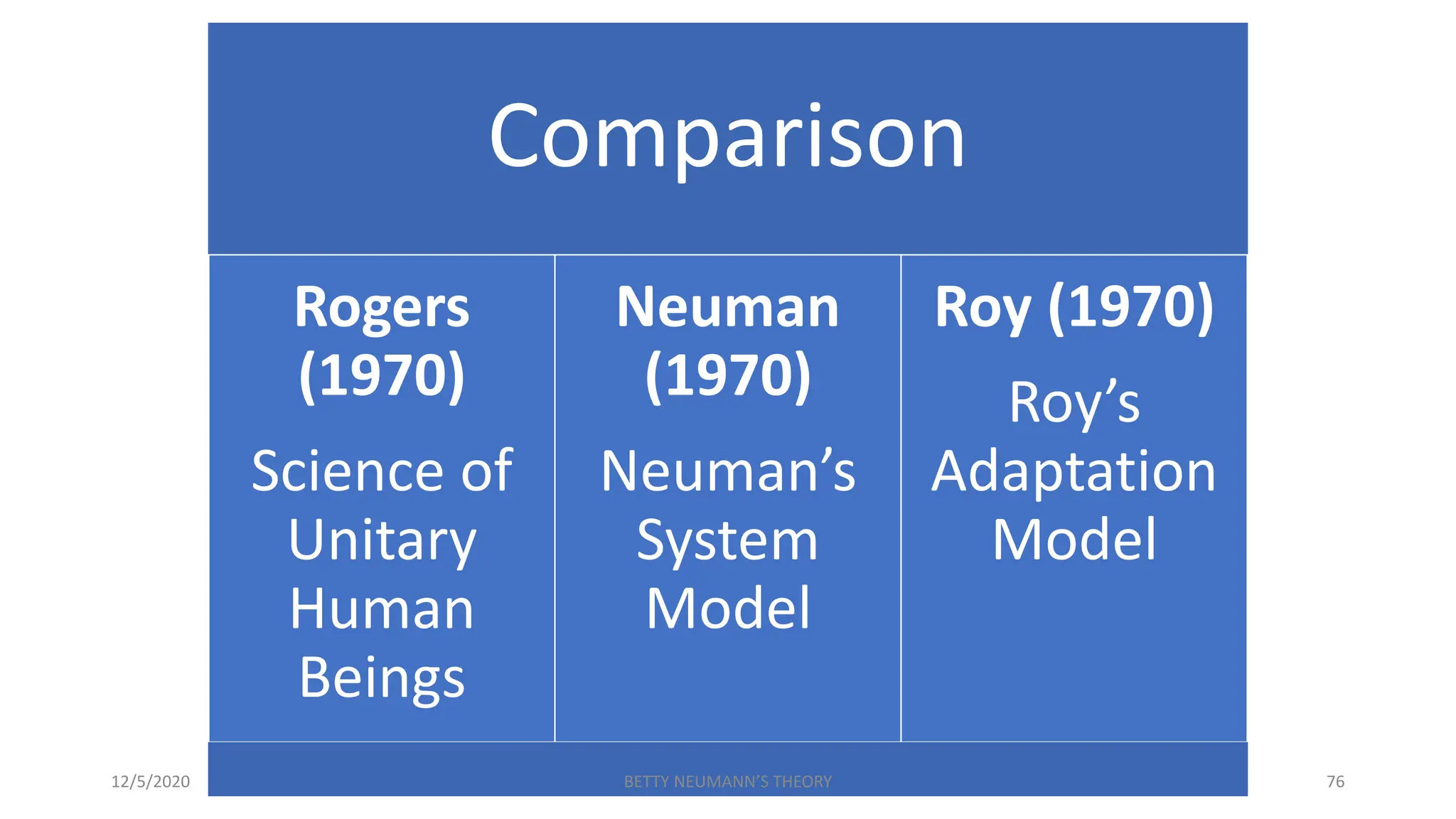
Comparison
Rogers
(1970)
Science of
Unitary
Human
Beings
Neuman
(1970)
Neuman’s
System
Model
Roy (1970)
Roy’s
Adaptation
Model
12/5/2020 BETTY NEUMANN’S THEORY 76
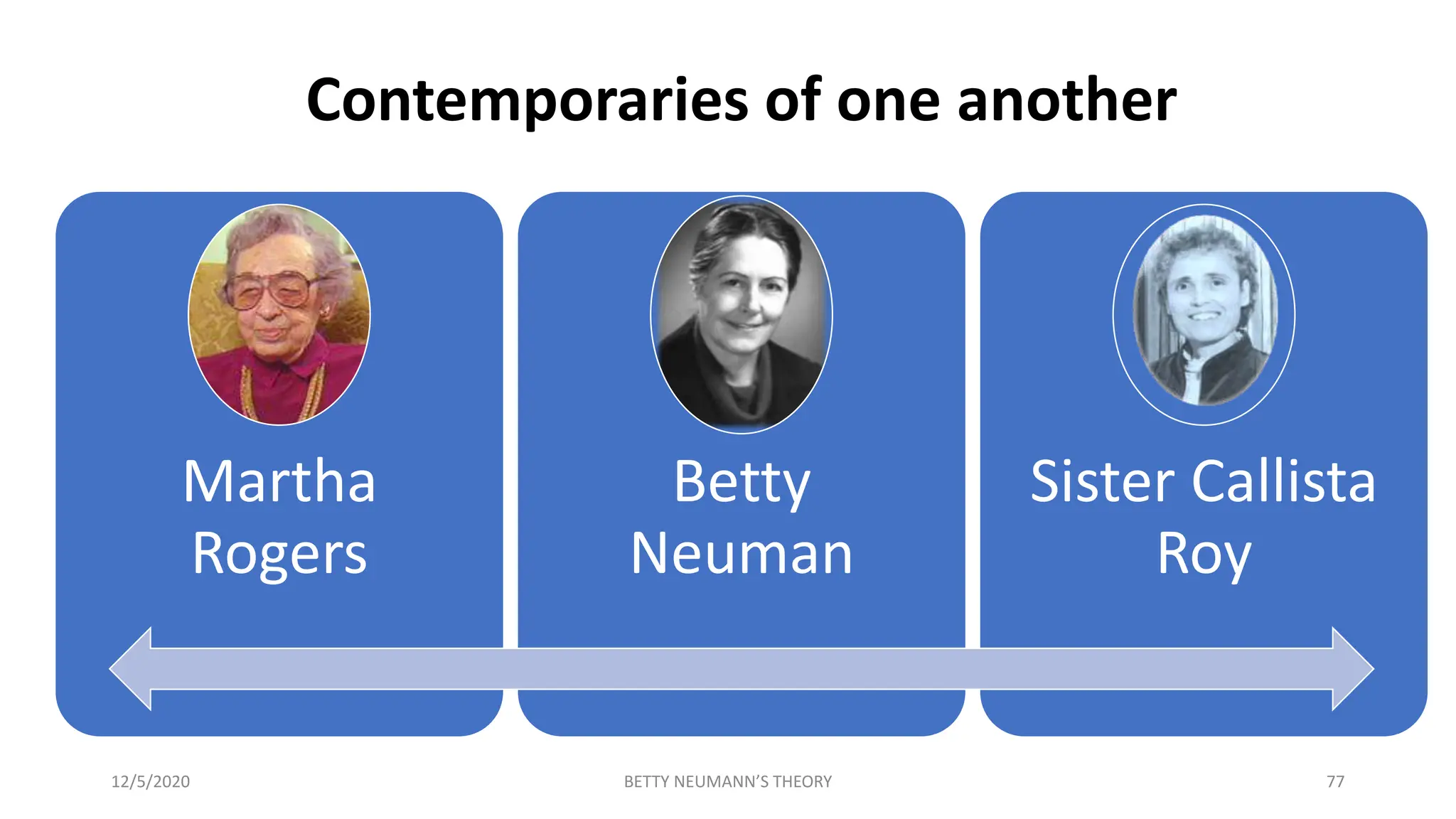
Contemporaries of one another
Martha
Rogers
Betty
Neuman
Sister Callista
Roy
12/5/2020 BETTY NEUMANN’S THEORY 77
Each Define the Metaparadigm Concepts: :
• Person
• Health
• Environment
• Nursing
12/5/2020 BETTY NEUMANN’S THEORY 78
Each Used in Nursing:
• Practice
• Administration
• Education
12/5/2020 BETTY NEUMANN’S THEORY 79
Meets Fawcett’s criteria eligibility:
• Rogers
• Roy?
• Neuman?
12/5/2020 BETTY NEUMANN’S THEORY 80
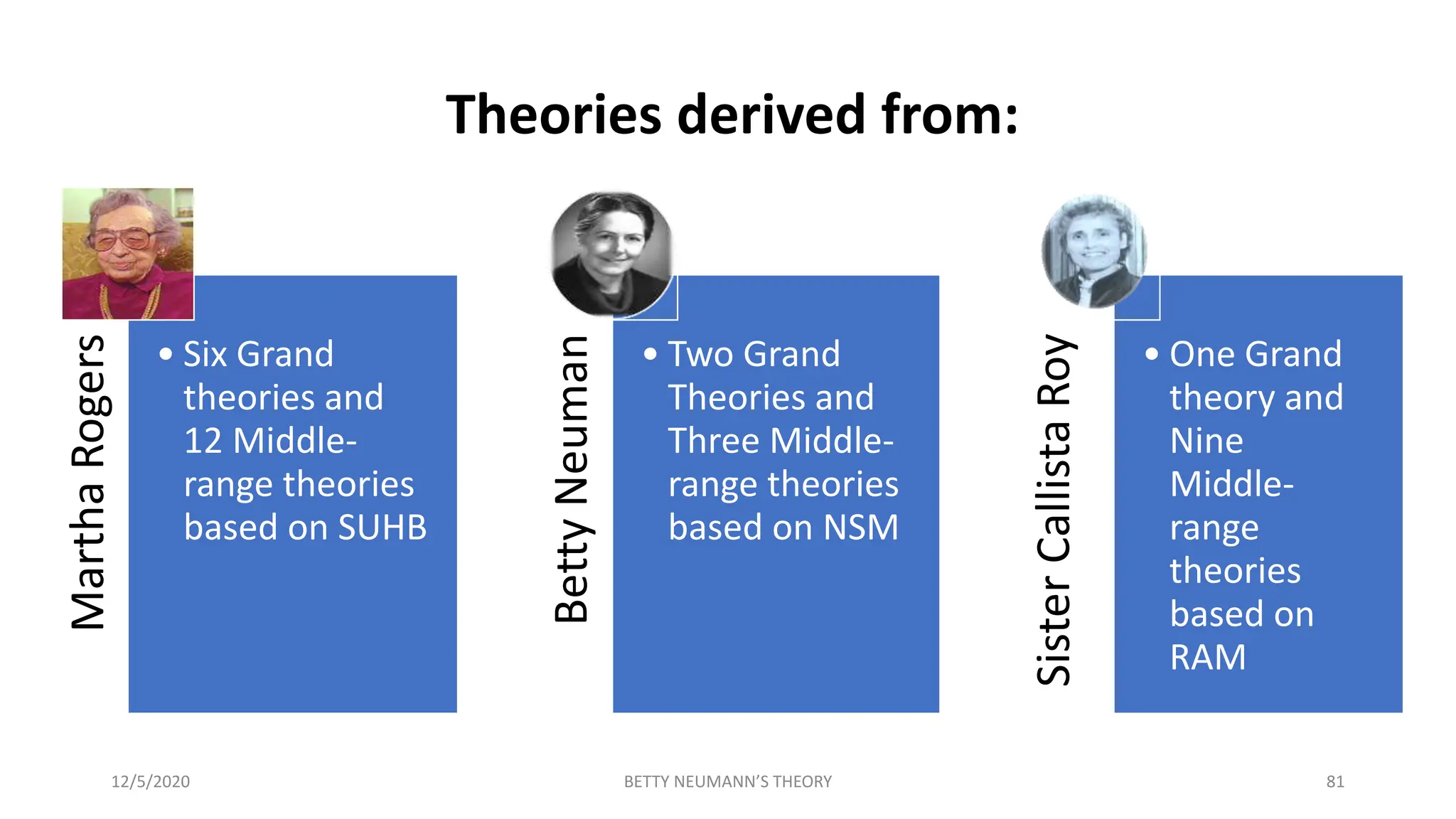
Theories derived from:
Martha
Rogers
• Six Grand
theories and
12 Middle-
range theories
based on SUHB
Betty
Neuman
• Two Grand
Theories and
Three Middle-
range theories
based on NSM
Sister
Callista
Roy
• One Grand
theory and
Nine
Middle-
range
theories
based on
RAM
12/5/2020 BETTY NEUMANN’S THEORY 81
Goal of Nursing
To Promote Human Betterment wherever People Are, on Planet Earth or in
Outer Space.
To Facilitate Optimal Wellness for the Client Through Retention, Attainment, or
Maintenance of Client System Stability.
To Promote Adaptation for Individuals and Groups in the Four Adaptive Modes,
Thus Contributing to Health, Quality of Life, and Dying with Dignity by Assessing
Behavior and Factors That Influence Adaptive Abilities and by Intervening to
Expand those Abilities and to Enhance Environmental Interactions.
12/5/2020 BETTY NEUMANN’S THEORY 82
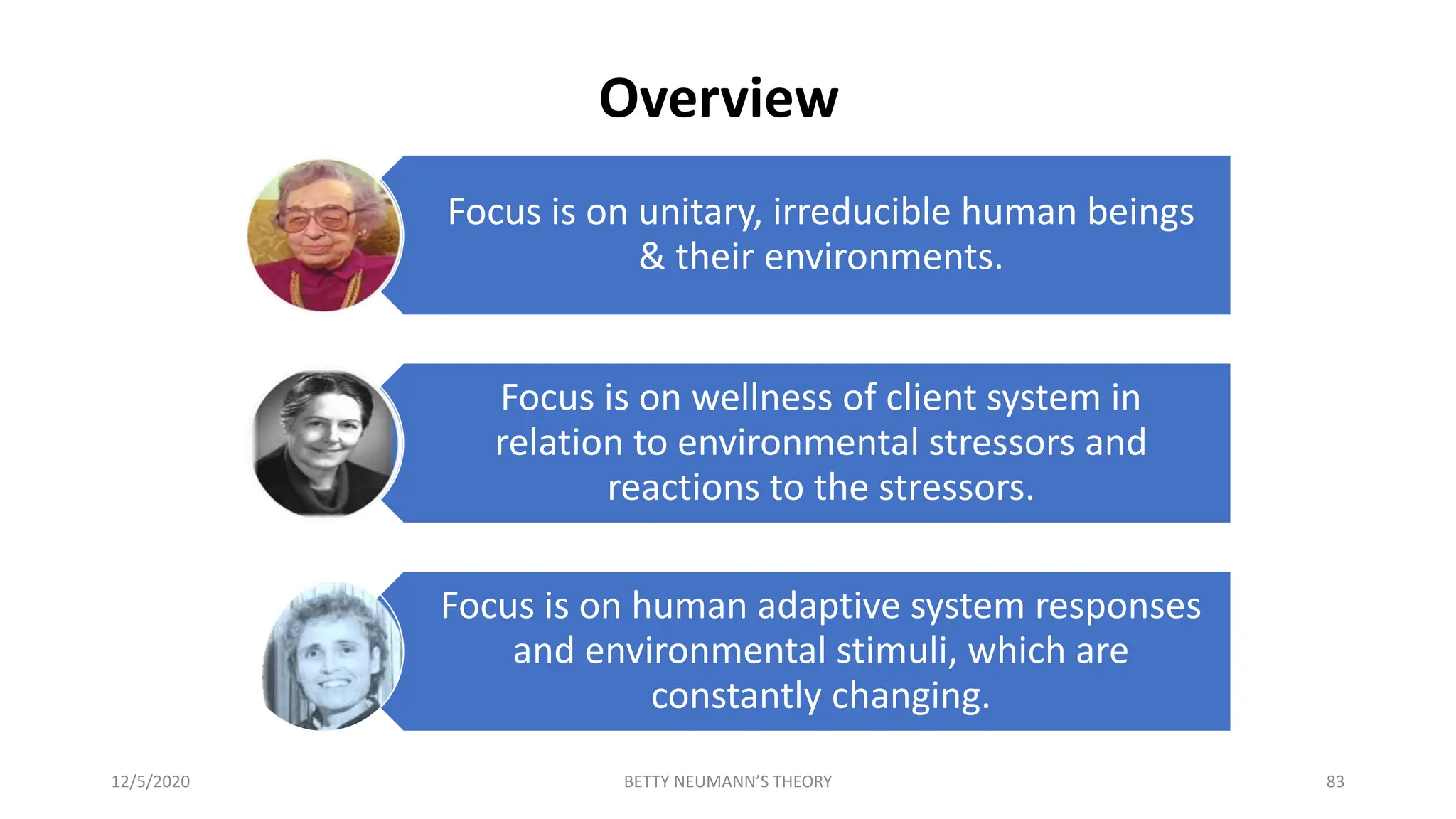
Overview
Focus is on unitary, irreducible human beings
& their environments.
Focus is on wellness of client system in
relation to environmental stressors and
reactions to the stressors.
Focus is on human adaptive system responses
and environmental stimuli, which are
constantly changing.
12/5/2020 BETTY NEUMANN’S THEORY 83
Worldview
Reflects the simultaneous action
worldview
Reflects the reciprocal
interaction worldview
Reflects the reciprocal
interaction worldview
12/5/2020 BETTY NEUMANN’S THEORY 84
Rogers
Roy
Neuman
Selection Rationale
12/5/2020 BETTY NEUMANN’S THEORY 85
Discussion of the Nurse as the Client
• Galloway (1993) offered an informative NSM-based self-analysis of
her practice with a mentally and physically impaired infant. She
stated:
• “Through analyzing my role as a student nurse in a difficult clinical
situation, I learned that I not only adapted well but also
experienced personal growth. I did not avoid the reality of my
situation; rather, I worked within the difficulties it presented.
Understanding the importance of identifying and expressing
emotions, I did not deny my positive and negative feelings. By
using effective coping mechanisms and introducing alternative
methods as necessary to deal with stressors, I achieved a positive
result. Although my flexible line of defense contracted slightly due
to the influence of specific negative variables, it buffered effectively
so that my underlying normal line of defense was not penetrated.”
12/5/2020 BETTY NEUMANN’S THEORY 86
Steps taken to ensure the Continued
Evolution of the NSM
• Establishment of the NSM Trustees Group
• Support & promote the NSM through scholarly work &
professional forums
• Establishment of the NSM Archives at Neumann College in
Aston, Pennsylvania
• Facilitates access to important documents
• Establishment of the Neuman Institute
• Enhance continuation of NSM-based scholarly work
12/5/2020 BETTY NEUMANN’S THEORY 87
Evaluation: Recapitulation
1. What are the 9 Assumptions of Betty Neuman’s Nursing Theory?
2. What Are Stressors in Betty Neuman’s Nursing Theory?
3. What Are the Strengths of Betty Neuman’s Nursing Theory?
4. What Are the Weaknesses of Betty Neuman’s Nursing Theory?
12/5/2020 BETTY NEUMANN’S THEORY 88
In a one whole sheet of paper
write an essay about ‘Theory
Critique of Neuman’s
System Model”.
Submit it before 10/12/2020
before 5 PM on my table.
12/5/2020 BETTY NEUMANN’S THEORY 89
References
• Navdeep Kaur Brar, HC Rawat. Textbook of Advanced
Nursing Practice. New Delhi: Jaypee Brothers Medical;
2015. 553-62.
• Potter A Patricia, Perry G Anne (1992) Fundamentals Of
Nursing –Concepts Process & Practice. 3rd ed. London
Mosby Year Book.
• George B. Julia . Nursing Theories- The base for
professional Nursing Practice , 3rd ed. Norwalk, Appleton
and Lange. 1989.
• Neuman, B. (1996). The Neuman systems model in
research and practice. Nursing Science Quarterly, 9(2), 67-
70.
• Neuman, B. (1995). The neuman systems model (3rd ed.).
In McEwen, M. and Wills, E. (Ed.). Theoretical basis for
nursing. USA: Lippincott Williams & Wilkins.
12/5/2020 BETTY NEUMANN’S THEORY 90
Cont…
• Alligood, M.R. & Tomey, A.M. (2010). Nursing Theorists and
Their Work 7th Edition. Maryland Heights, Missouri: Mosby
Inc.
• Photo and diagram courtesy of Neuman Systems Model Inc.
www.neumansystemsmodel.org Last updated 2011.
• Mc. Even M, Wills EM. Theoretical basis for Nursing. 2nd ed.
USA: Lippincott Williams & Wilkins. 200
• www.nurses.info/nursing_theory_person_neuman_betty
• http://currentnursing.com/nursing_theory/Neumann.html
• www.neumansystemsmodel.org/
12/5/2020 BETTY NEUMANN’S THEORY 91
12/5/2020 BETTY NEUMANN’S THEORY 92

BETTY NEUMANN’S SYSTEM MODEL THEORY .pptx

  • 1.
    Moderator: Ms. Tarika Sharma AssistantProfessor CON, ILBS, New Delhi, India Presented by: Mr . Shashi Prakash M.Sc. Nursing 1st Year CON, ILBS, New Delhi, India BETTY NEUMANN’S THEORY 12/5/2020 BETTY NEUMANN’S THEORY 1
  • 2.
    Objectives • Explore credentials,theoretical sources, and historical perspective of Betty Neuman • Review concepts/definitions and concept map • Critique theory • Examine the Neuman Systems Model’s acceptance by the nursing community • Demonstrate NSM’s use through case 12/5/2020 BETTY NEUMANN’S THEORY 2
  • 3.
    BETTY NEUMANN’S SYSTEMMODEL • Betty Neumann’s system model provides a comprehensive, flexible, holistic and system based perspective for nursing. • It focuses attention on the response of the client system to actual or potential environmental stressors. 12/5/2020 BETTY NEUMANN’S THEORY 3
  • 4.
    BETTY NEUMANN’S SYSTEMMODEL • The use of primary, secondary and tertiary nursing prevention intervention for retention, attainment, and maintenance of optimal client system wellness. 12/5/2020 BETTY NEUMANN’S THEORY 4
  • 5.
    Background and Historyof Theory 12/5/2020 BETTY NEUMANN’S THEORY 5
  • 6.
    HISTORY AND BACKGROUNDOF THE THEORIST •Betty Neumann was born in 1924, in Lowel, Ohio. •Completed B.Sc. nursing in 1957, and M.S. in Mental Health Public health consultation, from UCLA in 1966. •She holds a Ph.D. in clinical psychology. 12/5/2020 BETTY NEUMANN’S THEORY 6
  • 7.
    HISTORY AND BACKGROUNDOF THE THEORIST •The models was initially developed, in response to graduate nursing students expression of a need for course content, that would expose them to breadth of nursing problems, prior to focusing on specific nursing problem areas. 12/5/2020 BETTY NEUMANN’S THEORY 7
  • 8.
    HISTORY AND BACKGROUNDOF THE THEORIST •The model was published in 1972 as “A Model for Teaching Total Person Approach to Patient Problems” in Nursing Research. •It was refined, and subsequently published in the first edition of Conceptual Models for Nursing Practice, in 1974, and in the second edition in 1980. 12/5/2020 BETTY NEUMANN’S THEORY 8
  • 9.
    “It is importantto state that neither was I knowledgeable about nursing models nor had a clear trend yet begun in nursing for developing models. The Neuman Systems Model was developed strictly as a teaching aid” - Betty Neuman, 2002 • Betty Neuman as keynote speaker at the University of Maine, Fort Kent, 2004. 12/5/2020 BETTY NEUMANN’S THEORY 9
  • 10.
    12/5/2020 BETTY NEUMANN’STHEORY 10 Neuman with Sister Callista Roy | neumansystemsmodel.org
  • 11.
    12/5/2020 BETTY NEUMANN’STHEORY 11 Neuman with her colleagues | neumansystemsmodel.org
  • 12.
    Awards and Honorsof Betty Neuman • Betty Neuman has done many things including a nurse, educator, health counselor, therapist, author, speaker, and researcher. • Honorary Doctorate of Letters, Neumann College, Aston, PA (1992) • Honorary Member of the Fellowship of the American Academy of Nursing (1993) • Honorary Doctorate of Science, Grand Valley State University, Michigan (1998) 12/5/2020 BETTY NEUMANN’S THEORY 12
  • 13.
    12/5/2020 BETTY NEUMANN’STHEORY 13 Neuman honored with Distinguished Service Medal | www.walsh.edu
  • 14.
    DEVELOPMENT OF THEMODEL •Neumann’s model was influenced by a variety of sources. •The philosophy writers de Chardin and cornu (on wholeness in system). •Von Bertalanfy, and Lazlo on general system theory. •Selye on stress theory. •Lararus on stress and coping. 12/5/2020 BETTY NEUMANN’S THEORY 14
  • 15.
    NEUMANN’S WORK &THE CHARACTERISTICS OF A THEORY •Theories can be the bases for hypotheses, that can be tested. •Theories contribute to and assist in, increasing the general body of knowledge within the discipline, through the research implemented to validate them. 12/5/2020 BETTY NEUMANN’S THEORY 15
  • 16.
    NEUMANN’S WORK &THE CHARACTERISTICS OF A THEORY • Theories connects the interrelated concepts in such a way, as to create a different way of looking at a particular phenomenon. • Theories must be logical in nature . • Theories should be relatively simple yet generalizable. 12/5/2020 BETTY NEUMANN’S THEORY 16
  • 17.
    NEUMANN’S WORK &THE CHARACTERISTICS OF A THEORY •Theories can be utilized by the practitioner, to guide and improve their practice. •Theories must be consistent with other validated theories, laws and principles but will leave open unanswered questions, that need to be investigated. 12/5/2020 BETTY NEUMANN’S THEORY 17
  • 18.
    BASIC ASSUMPTIONS OFNEUMANN’S THEORY Sunday, February 12,2017 13 12/5/2020 BETTY NEUMANN’S THEORY 18
  • 19.
    BASIC ASSUMPTIONS 1. Eachclient system is unique, a composite of factors and characteristics within a given range of responses contained within a basic structure. I amunique 12/5/2020 BETTY NEUMANN’S THEORY 19
  • 20.
    2. Many known,unknown and universal stressors exist. Each differ in it’s potential for disturbing a client’s usual stability level or normal Line of Defense. BASIC ASSUMPTIONS 12/5/2020 BETTY NEUMANN’S THEORY 20
  • 21.
    3. Stressors bothuniversal and known; some are unique to the client. They have potential to disturb equilibrium, thus causing a change in priority of needs at any given moment. BASIC ASSUMPTIONS Stressors disturbs the normal equilibrium 12/5/2020 BETTY NEUMANN’S THEORY 21
  • 22.
    4. Man isa composite of the interrelationship of the four variables (biological, psychological, socio-cultural and developmental) which are at all times present. BASIC ASSUMPTIONS 12/5/2020 BETTY NEUMANN’S THEORY 22
  • 23.
    BASIC ASSUMPTIONS 5. Eachclient/ client system has evolved a normal range of responses to the environment that is referred to as a normal Line of Defense. The normal Line of Defense can be used as a standard from which to measure health deviation. 12/5/2020 BETTY NEUMANN’S THEORY 23
  • 24.
    6. When theflexible Line of Defense is no longer capable of protecting the client/ client system, against an environmental stressor, the stressor breaks through the normal Line of Defense. BASIC ASSUMPTIONS 12/5/2020 BETTY NEUMANN’S THEORY 24
  • 25.
    Primary Prevention Secondary Prevention TertiaryPrevention BASIC ASSUMPTIONS 12/5/2020 BETTY NEUMANN’S THEORY 25
  • 26.
    7.Primary prevention relatesto general knowledge applied to clients assessment to identify stressors before they occur. 8.Secondary prevention relates to symptomatology. These are interventions generally initiated after an encounter with a stressor. 9.Tertiary prevention relates to the adaptive process, as reconstitution begins and moves back towards primary prevention. These are the interventions initiated after treatment. BASIC ASSUMPTIONS 12/5/2020 BETTY NEUMANN’S THEORY 26
  • 27.
    MAJOR CONCEPTS OFNEUMANN'S THEORY 12/5/2020 BETTY NEUMANN’S THEORY 27
  • 28.
  • 29.
    1.PERSON Each layer consistsof five person variable or subsystems: Physiological- Refer to the physiochemical structure and function of processes the body. Psychological- Refers to mental and emotions. Socio-cultural- Refers to relationships; and social/cultural expectations and activities. Spiritual- Refers to the influence of spiritual beliefs. Developmental- Refers to those processes related to development over the lifespan. 12/5/2020 BETTY NEUMANN’S THEORY 29
  • 30.
    2.ENVIRONMENT The internal environmentexists within the client system. The external environment exists outside the client system. A created environment which is an environment that is created and developed unconsciously by the client and is symbolic of system wholeness. 12/5/2020 BETTY NEUMANN’S THEORY 30
  • 31.
    3.HEALTH Neuman sees healthas being equated with wellness. She defines health/wellness as “the condition in which all parts and subparts (variables) are in harmony with the whole of the client (Neumann, 1995)”. 12/5/2020 BETTY NEUMANN’S THEORY 31
  • 32.
    3.HEALTH The client systemmoved toward wellness when more energy is available than is needed. The client system moves toward illness and death when more energy is needed than is available. . 12/5/2020 BETTY NEUMANN’S THEORY 32
  • 33.
    4. NURSING Neuman seesnursing as a unique profession that is concerned with all of the variables, which influence the response a person might have to a stressor . The person is seen as a whole, and it is the task of nursing to address the whole person. 12/5/2020 BETTY NEUMANN’S THEORY 33
  • 34.
    4. NURSING Neuman definesnursing as “action which assist individuals, families and groups to maintain a maximum level of wellness, and the primary aim is stability of the patient/client system, through nursing interventions to reduce stressors.’’ 12/5/2020 BETTY NEUMANN’S THEORY 34
  • 35.
    4. NURSING • Therole of the nurse is seen in terms of degree of reaction to stressors, and the use of primary, secondary and tertiary interventions. Tertiary Prevention Secondary Prevention Primary Prevention 12/5/2020 BETTY NEUMANN’S THEORY 35
  • 36.
    Secondary prevention Tertiary prevention Stressors Reaction Interventions Reconstitution Stressors Stressors Basic structure and Lineof Defense The Neuman System Model (3rd edition,1995) Primary preventio n 12/5/2020 BETTY NEUMANN’S THEORY 36
  • 37.
    RESEARCH - 1 •Effectiveness of health education about the risk factors of Hepatitis B & C infection and knowledge regarding prevention of transmission is helpful in decreasing the Hepatitis B & C infection among adults in community. • Govinda • A study was done to assess the risk factors and effectiveness of health education of Hepatitis B & C infection and knowledge regarding prevention of transmission among adults. 12/5/2020 BETTY NEUMANN’S THEORY 37
  • 38.
    Cont… • • Materialand method: Sample consisted of 500 adult attending a selected clinic at Delhi Government Dispensary, Chhatarpur, Delhi, and their knowledge were assessed using structured questionnaire. • Results: The findings showed that adult had least knowledge in the domain prevention of transmission of Hepatitis B & C infection among adults in community. • In this research study the author used Conceptual Framework based on Betty Neuman’s System Model (2002). 12/5/2020 BETTY NEUMANN’S THEORY 38
  • 39.
    Secondary prevention • Determinescases of Hep. B & C • Treatment of symptoms Tertiary prevention • Reeducation to prevent future occurences • Prevention of complication • Re- adaptation Stressors Intrapersonalfactors • Age • Gender Interpersonalfactors • Education • Monthly income Reaction Individual assessment of variables: Time of encounter of risk factors of Hepatitis B & C Interventions Development & distribution of educational pamphlet on prevention of transmission of Hepatitis B & C Reconstitution Prevention of disease • transmission • consequences Stressors Extrapersonalfactors Religion, Occupation, Immunization, Status of family members, Risk factors for Hep. B & C: Medical, family, work. social. personal care history. Basic structure and Line of Defense Primary prevention Distribution ofedu.Pamphlet amongadultswithgoalof • Promoting immunization againstHep.B • Preventing transmission & riskfactorsofHep.B&C Basic Structures • Normal temperature range • Genetic Structure • Response pattern • Ego structure • Origin strength or weakness • Known or commonalities Conceptual Framework based on Betty Neuman’s System Model (2002)  Not included in the study 12/5/2020 BETTY NEUMANN’S THEORY 39
  • 40.
    RESEARCH - 2 •Assessment and comparision of Cognitive Function and Depression level among patients with Chronic Liver Disease and Healthy Controls. • Lincy Varghese • A study was done in this area to fulfill the gap of practice as well as to facilitate the nursing personnel to support clinician in this challenging area. 12/5/2020 BETTY NEUMANN’S THEORY 40
  • 41.
    Cont… • Material andmethod: Sample consisted of 220 subjects (110 patient with CLD and 110 healthy controls), and their cognitive function and depression level were assessed by using Modified Mini Mental Status Examination & Beck Depression Inventory. • Results: The findings showed that the patient with CLD had poor cognitive function and severe depression compared to healthy controls. • In this research study the author used Conceptual Framework model of cognitive function & depression level in CLD based on Betty Neuman’s System Model (2002). 12/5/2020 BETTY NEUMANN’S THEORY 41
  • 42.
    Secondary prevention • Early detectionof cognitive impairment and depression • Treatment Tertiary prevention Stressors • Diagnosis of CLD • Need of treatmentand follow up Degree of Reaction • Assess cognitive function with 3MS • Assess depression with BDS Reconstitution Basic structure and Line of Defense Primary prevention Client factors • Age • Gender • Marital status • Educational status • Income status • Causes of liver disease • Duration of CLD • Cirrhosis • Vitamin supplement • Minimal Hepatic Encephalopathy Conceptual Framework model of cognitive function & depression level in CLD based on Betty Neuman’s SystemModel (2002).  Not included in the study 12/5/2020 BETTY NEUMANN’S THEORY 42
  • 43.
    STAGES OF NURSINGPROCESS (BY NEUMAN) Nursing Diagnosis Nursing Goal Nursing Outcome 12/5/2020 BETTY NEUMANN’S THEORY 43
  • 44.
    STAGES OF NURSINGPROCESS (BY NEUMAN) 1. NURSING DIAGNOSIS • It depends on acquisition of appropriate database; the diagnosis identifies, assesses, classifies, and evaluates the dynamic interaction of the five variables. • Variances from wellness (needs and problems) are determined by correlations and constraints through synthesis of theory and data base. • Broad hypothetical interventions are determined, i.e. maintain flexible line of defense. 12/5/2020 BETTY NEUMANN’S THEORY 44
  • 45.
    STAGES OF NURSINGPROCESS (BY NEUMAN) 2. NURSING GOALS • These must be negotiated with the patient, and take account of patient’s and nurse’s perceptions of variance from wellness. 3. NURSING OUTCOMES • Nursing intervention using one or more preventive modes. • Confirmation of prescriptive change or reformulation of nursing goals. • Short term goal outcomes influence determination of intermediate and long – term goals. • A client outcome validates nursing process. 12/5/2020 BETTY NEUMANN’S THEORY 45
  • 46.
    NEUMANN’S SYSTEM MODELFORMAT 12/5/2020 BETTY NEUMANN’S THEORY 46
  • 47.
    ACCEPTANCE BY THENURSING COMMUNITY PRACTICE EDUCATION RESEARCH ADMINISTRATION PRACTICE 12/5/2020 BETTY NEUMANN’S THEORY 47
  • 48.
    PRACTICE FAMILY THERAPY , PUBLIC HEALTH, REHABILITATION, ANDHOSPITAL NURSING. THE SUB SPECIALTIES INCLUDE PULMONARY, RENAL, CRITICAL CARE, AND HOSPITAL MEDICAL UNITS. 12/5/2020 BETTY NEUMANN’S THEORY 48
  • 49.
    •As a curriculumguide for a conceptual framework oriented more toward wellness than toward a medical model and has been used at various levels of nursing education. reference •Developing a frame of centered on holistic care. EDUCATION 12/5/2020 BETTY NEUMANN’S THEORY 49
  • 50.
    •The identification of congruencebetween the client’s perception of stressors and the Method of collecting and analyzing data for identifying client problems. care giver’s perception of client stressors. RESEARCH • Case management of patients. • Total quality management is used to prepare health care administrators for future. ADMINISTR ATION 12/5/2020 BETTY NEUMANN’S THEORY 50
  • 51.
    Case example-1 Radha ayoung woman age 19 years old. newly married (married only for 3 months) She is pregnant Her husband is unemployed. Her IPR with mother in law is not good. She is under weight 12/5/2020 BETTY NEUMANN’S THEORY 51
  • 52.
    Case example cont.. Intrapersonalstresses. ◦ Her poor nutritional status ◦ Emotional status Interpersonal stress ◦ Relationship with mother in law Extra personal ◦ unemployment of husband 12/5/2020 BETTY NEUMANN’S THEORY 52
  • 53.
    Case example cont.. Flexibleline of defense ◦ Suffering from poor nutritional status. ◦ Lacks enough sleep due to the nature of her work The normal line of defense ◦ Uncaring attitude toward her pregnancy. ◦ Her coping abilities are also affected. 12/5/2020 BETTY NEUMANN’S THEORY 53
  • 54.
    Case example cont.. •Nursing diagnosis Nutritional imbalance r/t financial constraints Knowledge deficit regarding pregnancy and care r/t being primigravida and young age Anxiety r/t pregnancy, job, family relations • Goals To improve the nutritional status To ensure a safe motherhood 12/5/2020 BETTY NEUMANN’S THEORY 54
  • 55.
    Case example cont.. •Outcomes Primary prevention ◦ Educate their family on the importance of having good nutrition. ◦ Suggested some nutritious but cheap food choices. ◦ Possible alternative jobs that would not jeopardize her health and that of her unborn baby. 12/5/2020 BETTY NEUMANN’S THEORY 55
  • 56.
    Case example cont.. •Outcomes Secondary prevention ◦ Advised to seek pre-natal check-up ◦ Make use of the available services of the nearby health center. Tertiary prevention ◦ supporting and commending the positive behavioral changes exhibited by the couple 12/5/2020 BETTY NEUMANN’S THEORY 56
  • 57.
    Case Example-2: • Mr.Mango Man is a 38 year-old business executive. His colleagues describe him as hard working, perfectionist, and very dedicated to work. His day starts by leaving the house very early from Delhi to Noida and begins work by delegating various tasks with firm expectations and deadlines that somewhat impossible to meet. He usually responds with pressure and intimidating remarks for works not perfectly done. He smokes and drinks alcohol whenever he is stressed. Recently, the company experienced continuous dropped in their sells and his bosses started to put blame to him. 12/5/2020 BETTY NEUMANN’S THEORY 57
  • 58.
    continuation… • Mr. MangoMan began exhibiting weird mannerisms and behaviors that appear strange to his family and people around him. He misses breakfast and lunch very often and sleeps very late at night while doing work. He has no time anymore for his family and focuses to hard on meeting deadlines and his preconceived objectives. Because of these weird changes in him, the company decided to temporarily relieve him from his position as executive manager. A week later, he started to have periods of mania and depression. His family becomes worried and called up the hospital to seek assistance after he locked himself in the room, refusing to eat, and most of the time quiet and staring blankly on the wall. Later, he developed pneumonia. 12/5/2020 BETTY NEUMANN’S THEORY 58
  • 59.
    Applying Neuman’s SystemModel •Using Neuman’s System Model in the above situation, the identified possible stressors that contributed to Mr. Mango Man condition were as follows: work, personality, and attitude. Mr. Mango Man is not anymore able to handle the stressors and that had caused the “breakdown” of his lines of defense. • Without seeking help from his family and friends, he was not able to maintain his flexible line of defense and brought instability to his system. 12/5/2020 BETTY NEUMANN’S THEORY 59
  • 60.
    C O C O R R E E Work-related stressors Effects onNormal Line of Defense: •exhibiting weird mannerisms and behaviors •periods of mania and depression Effects on Flexible Line of Defense: •sleeps very late at night •misses breakfast and lunch •responds with pressure and intimidating remarks for works not perfectly done •smokes and drinks alcohol whenever he is stressed Primary Prevention: •Stress management activities •Relaxation techniques •Anger-management techniques •Smoking cessation Tertiary Prevention •Re-assessing patient’s ability to independently perform and maintain variables of health. •Regular consult to psychologist. •Maintaining client’s support system Effects on Lines of Resistance: •weakened immune response •developed pneumonia Secondary Prevention •Medication (to treat symptoms) •Opportunities to verbalize feelings and concerns 12/5/2020 BETTY NEUMANN’S THEORY 60
  • 61.
    Applied and adaptedto Nursing education Nursing research Nursing practice Family therapy Public health Rehabilitation Hospital nursing Applications of Newman’s system model 12/5/2020 BETTY NEUMANN’S THEORY 61
  • 62.
    Education As a curriculumguide for a conceptual framework At various levels of nursing education. Helps prepare students for developing a frame of reference centered on holistic care. 12/5/2020 BETTY NEUMANN’S THEORY 62
  • 63.
    Research input • Astudy to assess the effectiveness of a structured health teaching regarding BSE on knowledge, attitude and practices of close relatives of breast cancer patients. • Jose J, Sharma K, Srivastava A (2010) Intrapersonal stressors -family history, old age, nulliparity, early menarche, late menopause Interpersonal - inadequate knowledge regarding the warning signs, lack of access to health info Extrapersonal- costly preventive and therapeutic options, increased financial burden, increased hospital visits 12/5/2020 BETTY NEUMANN’S THEORY 63
  • 64.
    Research input Primary prevention-structured teaching regarding BSE, motivation for BSE performance Secondary prevention- BSE, Motivation for BSE and screening in HRGs Tertiary prevention- psycho support, effective communication, strengthening coping skills (not studied) 12/5/2020 BETTY NEUMANN’S THEORY 64
  • 65.
    Neuman’s Work &the Characteristics of a Theory Theory Theory • Connect the interrelated concepts in such a way as to create a different way of looking at a particular phenomenon • Must be logical in nature Betty Neuman • The interrelationships between the concepts of person, health, nursing and society/environment are repeatedly mentioned throughout the model • There is a logical sequence in the process of nursing 12/5/2020 BETTY NEUMANN’S THEORY 65
  • 66.
    Neuman’s Work &the Characteristics of a Theory Theory • Be relatively simple yet generalizable • Can be the bases for hypotheses that can be tested Betty Neuman • Terms used are easily identifiable & for the most part have definitions that are broadly accepted • High level & breadth of abstraction lends to theory development 12/5/2020 BETTY NEUMANN’S THEORY 66
  • 67.
    Neuman’s Work &the Characteristics of a Theory Theory • Can be utilized by the practitioner to guide & improve their practice Betty Neuman • Assessment/intervention instrument together with comprehensive guidelines for its use with the nursing proces 12/5/2020 BETTY NEUMANN’S THEORY 67
  • 68.
    STRENGTHS • Included clientsas holistic being • It gives clear direction for interventions • Permits flexibility • Facilitated cultural considerations • Provided a nursing focus as opposed to medical focus • Provided a framework to study individual illness & reaction to stressors • Considered the created environment 12/5/2020 BETTY NEUMANN’S THEORY 68
  • 69.
    LIMITATION • Neuman hasexplained nicely about the prevention but the other factors that will help in reconstitution as well as maintenance of the stability of client like, peer group, family, and many others are not explained. • Values inherent in nursing in relationship to role of patients in maintaining & promoting health are not addressed. 12/5/2020 BETTY NEUMANN’S THEORY 69
  • 70.
    NEUMAN’S SYSTEM MODELCONCEPT MAP: CLIENT SPIRITUAL PHYSIO LOGICAL DEVELOP MENTAL PSYCHO LOGICAL SOCIO CULTURAL CLIENT SYSTEM CENTRAL FLEXIBLE CORE LINES NORMAL LINES LINES OF RESISTANCE ENVIRONMENT INTERNAL EXTERNAL CREATED HEALTH WELLNESS ILLNESS NURSING PREVENTIO N PRIMARY SECONDARY TERTIARY NURSING PROCESS DIAGNOSIS GOALS OUTCOMES NEUMAN’S SYSTEMS MODEL CONCEPT MAP STRESSORS INTRAPERSONAL INTERPERSONAL EXTRAPERSON AL 12/5/2020 BETTY NEUMANN’S THEORY 70
  • 71.
    SUMMARY Introduction of theory Historyand background of theorist Development of model Characteristics of theory Basic assumptions Major concepts Applications in nursing practice Neuman’s & characteristics of a theory Strengths & limitations 12/5/2020 BETTY NEUMANN’S THEORY 71
  • 72.
    CONCLUSION “Health is acondition in which all parts and subparts are in harmony with the whole of the client.” “The future of the Newman System Model looks bright” Dr Neuman (1997) 12/5/2020 BETTY NEUMANN’S THEORY 72
  • 73.
    Case Simulation • BarryStinson 60-year-old male presents to surgical staging area for bilateral knee replacement surgery. 12/5/2020 BETTY NEUMANN’S THEORY 73
  • 74.
  • 75.
    Comparison of NSMwith two other nursing theories / models 12/5/2020 BETTY NEUMANN’S THEORY 75
  • 76.
  • 77.
    Contemporaries of oneanother Martha Rogers Betty Neuman Sister Callista Roy 12/5/2020 BETTY NEUMANN’S THEORY 77
  • 78.
    Each Define theMetaparadigm Concepts: : • Person • Health • Environment • Nursing 12/5/2020 BETTY NEUMANN’S THEORY 78
  • 79.
    Each Used inNursing: • Practice • Administration • Education 12/5/2020 BETTY NEUMANN’S THEORY 79
  • 80.
    Meets Fawcett’s criteriaeligibility: • Rogers • Roy? • Neuman? 12/5/2020 BETTY NEUMANN’S THEORY 80
  • 81.
    Theories derived from: Martha Rogers •Six Grand theories and 12 Middle- range theories based on SUHB Betty Neuman • Two Grand Theories and Three Middle- range theories based on NSM Sister Callista Roy • One Grand theory and Nine Middle- range theories based on RAM 12/5/2020 BETTY NEUMANN’S THEORY 81
  • 82.
    Goal of Nursing ToPromote Human Betterment wherever People Are, on Planet Earth or in Outer Space. To Facilitate Optimal Wellness for the Client Through Retention, Attainment, or Maintenance of Client System Stability. To Promote Adaptation for Individuals and Groups in the Four Adaptive Modes, Thus Contributing to Health, Quality of Life, and Dying with Dignity by Assessing Behavior and Factors That Influence Adaptive Abilities and by Intervening to Expand those Abilities and to Enhance Environmental Interactions. 12/5/2020 BETTY NEUMANN’S THEORY 82
  • 83.
    Overview Focus is onunitary, irreducible human beings & their environments. Focus is on wellness of client system in relation to environmental stressors and reactions to the stressors. Focus is on human adaptive system responses and environmental stimuli, which are constantly changing. 12/5/2020 BETTY NEUMANN’S THEORY 83
  • 84.
    Worldview Reflects the simultaneousaction worldview Reflects the reciprocal interaction worldview Reflects the reciprocal interaction worldview 12/5/2020 BETTY NEUMANN’S THEORY 84
  • 85.
  • 86.
    Discussion of theNurse as the Client • Galloway (1993) offered an informative NSM-based self-analysis of her practice with a mentally and physically impaired infant. She stated: • “Through analyzing my role as a student nurse in a difficult clinical situation, I learned that I not only adapted well but also experienced personal growth. I did not avoid the reality of my situation; rather, I worked within the difficulties it presented. Understanding the importance of identifying and expressing emotions, I did not deny my positive and negative feelings. By using effective coping mechanisms and introducing alternative methods as necessary to deal with stressors, I achieved a positive result. Although my flexible line of defense contracted slightly due to the influence of specific negative variables, it buffered effectively so that my underlying normal line of defense was not penetrated.” 12/5/2020 BETTY NEUMANN’S THEORY 86
  • 87.
    Steps taken toensure the Continued Evolution of the NSM • Establishment of the NSM Trustees Group • Support & promote the NSM through scholarly work & professional forums • Establishment of the NSM Archives at Neumann College in Aston, Pennsylvania • Facilitates access to important documents • Establishment of the Neuman Institute • Enhance continuation of NSM-based scholarly work 12/5/2020 BETTY NEUMANN’S THEORY 87
  • 88.
    Evaluation: Recapitulation 1. Whatare the 9 Assumptions of Betty Neuman’s Nursing Theory? 2. What Are Stressors in Betty Neuman’s Nursing Theory? 3. What Are the Strengths of Betty Neuman’s Nursing Theory? 4. What Are the Weaknesses of Betty Neuman’s Nursing Theory? 12/5/2020 BETTY NEUMANN’S THEORY 88
  • 89.
    In a onewhole sheet of paper write an essay about ‘Theory Critique of Neuman’s System Model”. Submit it before 10/12/2020 before 5 PM on my table. 12/5/2020 BETTY NEUMANN’S THEORY 89
  • 90.
    References • Navdeep KaurBrar, HC Rawat. Textbook of Advanced Nursing Practice. New Delhi: Jaypee Brothers Medical; 2015. 553-62. • Potter A Patricia, Perry G Anne (1992) Fundamentals Of Nursing –Concepts Process & Practice. 3rd ed. London Mosby Year Book. • George B. Julia . Nursing Theories- The base for professional Nursing Practice , 3rd ed. Norwalk, Appleton and Lange. 1989. • Neuman, B. (1996). The Neuman systems model in research and practice. Nursing Science Quarterly, 9(2), 67- 70. • Neuman, B. (1995). The neuman systems model (3rd ed.). In McEwen, M. and Wills, E. (Ed.). Theoretical basis for nursing. USA: Lippincott Williams & Wilkins. 12/5/2020 BETTY NEUMANN’S THEORY 90
  • 91.
    Cont… • Alligood, M.R.& Tomey, A.M. (2010). Nursing Theorists and Their Work 7th Edition. Maryland Heights, Missouri: Mosby Inc. • Photo and diagram courtesy of Neuman Systems Model Inc. www.neumansystemsmodel.org Last updated 2011. • Mc. Even M, Wills EM. Theoretical basis for Nursing. 2nd ed. USA: Lippincott Williams & Wilkins. 200 • www.nurses.info/nursing_theory_person_neuman_betty • http://currentnursing.com/nursing_theory/Neumann.html • www.neumansystemsmodel.org/ 12/5/2020 BETTY NEUMANN’S THEORY 91
  • 92.