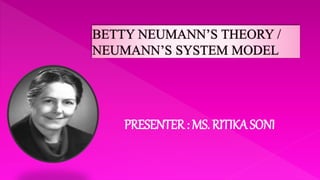


PRESENTER:MS.RITIKASONI
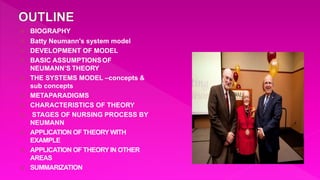
 BIOGRAPHY
 Batty Neumann's system model
 DEVELOPMENT OF MODEL
 BASIC ASSUMPTIONSOF
NEUMANN’S THEORY
 THE SYSTEMS MODEL –concepts &
sub concepts
 METAPARADIGMS
 CHARACTERISTICS OF THEORY
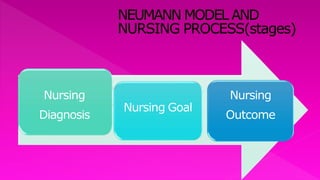
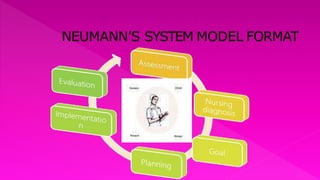
 STAGES OF NURSING PROCESS BY
NEUMANN
 APPLICATION OF THEORY WITH
EXAMPLE
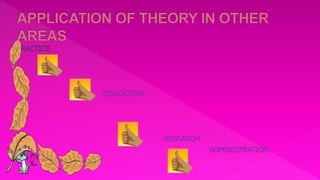
 APPLICATION OF THEORY IN OTHER
AREAS
 SUMMARIZATION
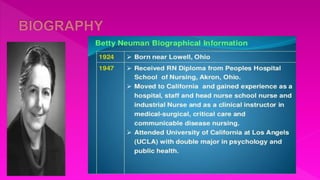
1960 • A pioneer in the community mental health movement in the late 1960s.
• Began developing her health system model, while
a lecturer in community health nursing
at University of California, Los Angeles.
• The models was initially developed, in response to graduate nursing
students expression of a need for course content, that would expose them
to breadth of nursing problems, prior to focusing on specific nursing
problem areas.
1966 •Received Mastered Degree in mental health , public health consultation &
counseling from UCLA,
•Broad background in nursing includes public health, school, industry, hospital
settings.
•Involved in family therapy, continuing education & curriculum consultation.
• Teaching experience include areas like mental health , consultation, organization,
leadership, &counseling.
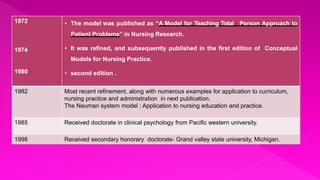
1972
1974
1980
• The model was published as “A Model for Teaching Total Person Approach to
Patient Problems” in Nursing Research.
• It was refined, and subsequently published in the first edition of Conceptual
Models for Nursing Practice.
• second edition .
1982 Most recent refinement, along with numerous examples for application to curriculum,
nursing practice and administration in next publication.
The Neuman system model : Application to nursing education and practice.
1985 Received doctorate in clinical psychology from Pacific western university.
1998 Received secondary honorary doctorate- Grand valley state university, Michigan.
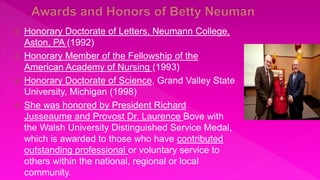
 Honorary Doctorate of Letters, Neumann College,
Aston, PA (1992)
 Honorary Member of the Fellowship of the
American Academy of Nursing (1993)
 Honorary Doctorate of Science, Grand Valley State
University, Michigan (1998)
 She was honored by President Richard
Jusseaume and Provost Dr. Laurence Bove with
the Walsh University Distinguished Service Medal,
which is awarded to those who have contributed
outstanding professional or voluntary service to
others within the national, regional or local
community.
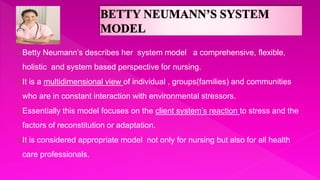
Betty Neumann’s describes her system model a comprehensive, flexible,
holistic and system based perspective for nursing.
It is a multidimensional view of individual , groups(families) and communities
who are in constant interaction with environmental stressors.
Essentially this model focuses on the client system’s reaction to stress and the
factors of reconstitution or adaptation.
It is considered appropriate model not only for nursing but also for all health
care professionals.
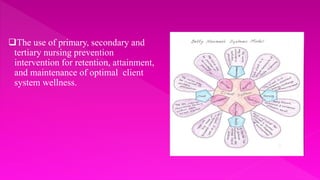
The use of primary, secondary and
tertiary nursing prevention
intervention for retention, attainment,
and maintenance of optimal client
system wellness.
• Neumann’s model was influenced by several theoreticalsources,
along with her own personal experiences in mental health nursing.
• Her conceptual approach is the result of a synthesis of knowledge
from several sources, including:
• De chardin: philosophy of wholeness or totality of life.
• Cornu: Marxian philosophy of man’s oneness with nature.
• Gestalt: interaction of person and environment.
• Selye : stress adaptation & interaction with environment .
• Von Bertalanffy: general living open system theory
• Caplan: levels of prevention approach
• Lazlo : general system theory.
• Lararus : stress and coping.
Sunday, February 12,2017
13
1. Each individual has a basic energy resource structure which contains
characteristics both unique and common to all human kind, and is essential
to life.
I amunique
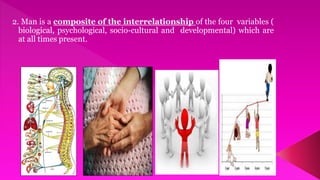
2. Man is a composite of the interrelationship of the four variables (
biological, psychological, socio-cultural and developmental) which are
at all times present.
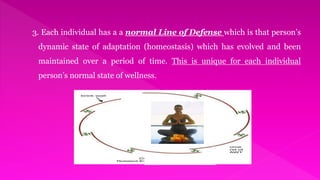
3. Each individual has a a normal Line of Defense which is that person’s
dynamic state of adaptation (homeostasis) which has evolved and been
maintained over a period of time. This is unique for each individual
person’s normal state of wellness.
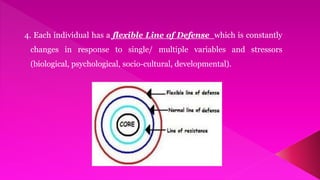
4. Each individual has a flexible Line of Defense which is constantly
changes in response to single/ multiple variables and stressors
(biological, psychological, socio-cultural, developmental).
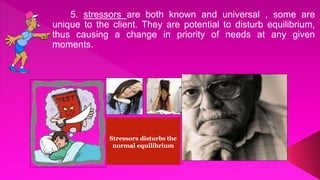
5. stressors are both known and universal , some are
unique to the client. They are potential to disturb equilibrium,
thus causing a change in priority of needs at any given
moments.
Stressors disturbs the
normal equilibrium
6.. The degree of client reaction to stressors depends upon
the resistant factors encountered by the stressors and the
inter- relationship of variables.
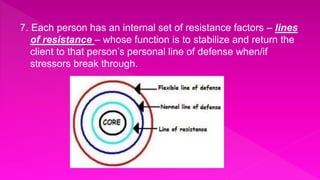
7. Each person has an internal set of resistance factors – lines
of resistance – whose function is to stabilize and return the
client to that person’s personal line of defense when/if
stressors break through.
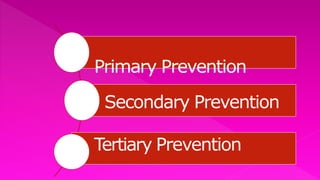
Primary Prevention
Secondary Prevention
Tertiary Prevention
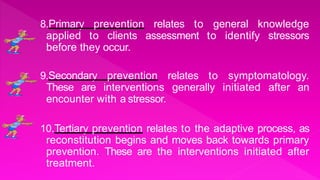
8.Primary prevention relates to general knowledge
applied to clients assessment to identify stressors
before they occur.
9.Secondary prevention relates to symptomatology.
These are interventions generally initiated after an
encounter with a stressor.
10.Tertiary prevention relates to the adaptive process, as
reconstitution begins and moves back towards primary
prevention. These are the interventions initiated after
treatment.
 The total person framework is basically an open systems model
with two components- stress and reaction.
 The “person” is viewed as an open system interacting with the
environment. The person or system is capable of intake of extra
personal/interpersonal factors from the environment, and
interacts with this intake by adjusting it to the system.
 Logistically the model appears fairly simple & straightforward.
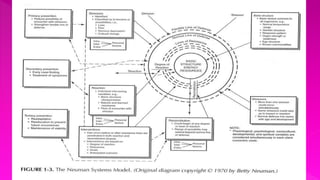
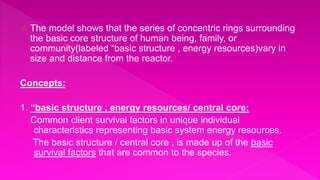
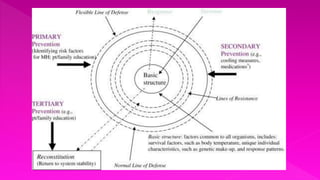
 The model shows that the series of concentric rings surrounding
the basic core structure of human being, family, or
community(labeled “basic structure , energy resources)vary in
size and distance from the reactor.
Concepts:
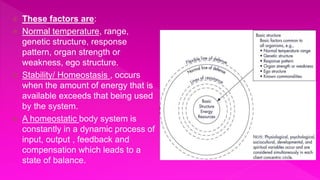
1. “basic structure , energy resources/ central core:
Common client survival factors in unique individual
characteristics representing basic system energy resources.
The basic structure / central core , is made up of the basic
survival factors that are common to the species.
 These factors are:
 Normal temperature, range,
genetic structure, response
pattern, organ strength or
weakness, ego structure.
 Stability/ Homeostasis , occurs
when the amount of energy that is
available exceeds that being used
by the system.
 A homeostatic body system is
constantly in a dynamic process of
input, output , feedback and
compensation which leads to a
state of balance.
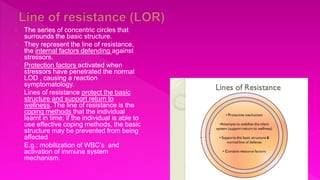
 The series of concentric circles that
surrounds the basic structure.
 They represent the line of resistance,
the internal factors defending against
stressors.
 Protection factors activated when
stressors have penetrated the normal
LOD , causing a reaction
symptomatology.
 Lines of resistance protect the basic
structure and support return to
wellness. The line of resistance is the
coping methods that the individual
learnt in time; if the individual is able to
use effective coping methods, the basic
structure may be prevented from being
affected
 E.g.: mobilization of WBC’s and
activation of immune system
mechanism.
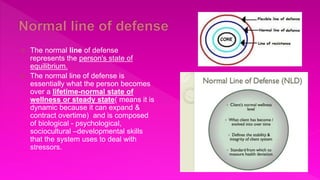
 The normal line of defense
represents the person's state of
equilibrium.
 The normal line of defense is
essentially what the person becomes
over a lifetime-normal state of
wellness or steady state( means it is
dynamic because it can expand &
contract overtime) and is composed
of biological - psychological,
sociocultural –developmental skills
that the system uses to deal with
stressors.
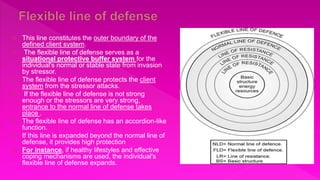
 This line constitutes the outer boundary of the
defined client system.
 The flexible line of defense serves as a
situational protective buffer system for the
individual's normal or stable state from invasion
by stressor.
 The flexible line of defense protects the client
system from the stressor attacks.
 If the flexible line of defense is not strong
enough or the stressors are very strong,
entrance to the normal line of defense takes
place .
 The flexible line of defense has an accordion-like
function.
 If this line is expanded beyond the normal line of
defense, it provides high protection
 For instance, if healthy lifestyles and effective
coping mechanisms are used, the individual's
flexible line of defense expands.
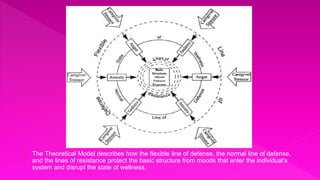
 The Theoretical Model describes how the flexible line of defense, the normal line of defense,
and the lines of resistance protect the basic structure from moods that enter the individual's
system and disrupt the state of wellness.
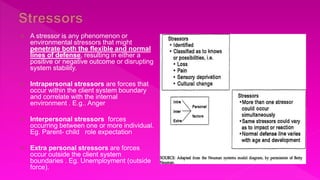
 A stressor is any phenomenon or
environmental stressors that might
penetrate both the flexible and normal
lines of defense, resulting in either a
positive or negative outcome or disrupting
system stability.
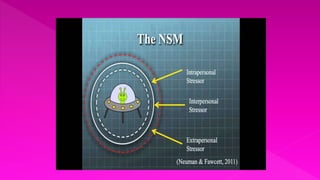
 Intrapersonal stressors are forces that
occur within the client system boundary
and correlate with the internal
environment . E.g.. Anger
 Interpersonal stressors forces
occurring between one or more individual.
Eg. Parent- child role expectation
 Extra personal stressors are forces
occur outside the client system
boundaries . Eg. Unemployment (outside
force).
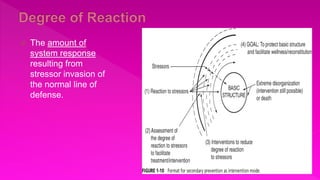
 The amount of
system response
resulting from
stressor invasion of
the normal line of
defense.
 Intervention modes for nursing action and determinants for entry of both client
and nurse into the health care system.
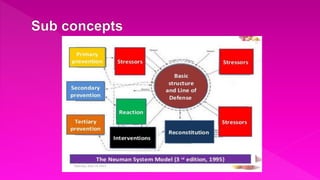
 Primary prevention occurs before the system reacts to a stressor that is either
suspected or identified . It includes health promotion and maintenance of
wellness. Primary prevention focuses on strengthening the flexible line of
defense through preventing stress and reducing risk factors. This intervention
occurs when the risk or hazard is identified but before a reaction occurs.
Strategies that might be used include immunization, health education,
exercise, and lifestyle changes.
 Secondary prevention occurs after the system reacts to a stressor and is
provided in terms of existing symptoms. Secondary prevention focuses on
strengthening the internal lines of resistance and, thus, protects the basic
structure through appropriate treatment of symptoms. The intent is to regain
optimal system stability and to conserve energy in doing so. If secondary
prevention is unsuccessful and reconstitution does not occur, the basic structure
will be unable to support the system and its interventions, and death will occur.
 Tertiary prevention occurs after the system has been
treated through secondary prevention strategies. Its purpose
is to maintain wellness or protect the client system
reconstitution through supporting existing strengths and
continuing to preserve energy.
 Tertiary prevention may begin at any point after system
stability has begun to be reestablished (reconstitution has
begun). Tertiary prevention tends to lead back to primary
prevention. (Neuman, 1995)
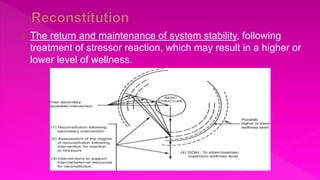
 The return and maintenance of system stability, following
treatment of stressor reaction, which may result in a higher or
lower level of wellness.
 A system in which there is a continuous flow of input , process,
output and feedback. It is a system of organized complexity,
where all elements are in interaction.
 Input/output
The matter, energy, and information exchanged between the
client and environment that is entering or leaving the system at
any point in time.
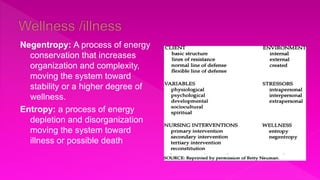
Negentropy: A process of energy
conservation that increases
organization and complexity,
moving the system toward
stability or a higher degree of
wellness.
Entropy: a process of energy
depletion and disorganization
moving the system toward
illness or possible death
Neuman views the individual client holistically and considers the
variables simultaneously and comprehensively.
 The physiological variable refers to the structure and functions
of the body.
 The psychological variable refers to mental processes and
relationships.
 The sociocultural variable refers to system functions that relate
to social and cultural expectations and activities.
 The developmental variable refers to those processes related to
development over the lifespan.
 The spiritual variable refers to the influence of spiritual beliefs.
 A state of balance or harmony requiring energy exchanges
as the client adequately copes with stressors to retain, attain,
or maintain an optimal level of health thus preserving system
integrity.
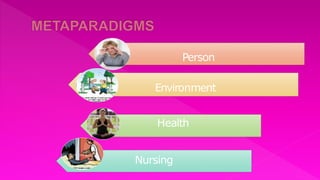
Person
Environment
Health
Nursing
Each human is a “total person” as a client system & person is
multidimensional , a composite of variable :
 Physiological- Refer to the physiochemical structure
and functions of body.
 Psychological- Refers to mental processes and emotions.
 Socio-cultural-Refers to relationships; and social/cultural
expectations and activities.
 Spiritual- Refers to the influence of spiritual beliefs.
 Developmental- Refers to those processes related to
development over the lifespan.
Other variables include basic survival core characteristics
such as normal temperature range, genetic response
patterns, ego structure, and various strength &
weaknesses of physical body.
The dynamic interaction of these variables and core
characteristics along with the lines of normal defense and
flexible resistance, combined with many stressors,
provide the essence of the ‘total person approach’.
2.ENVIRONMENT
/ SOCIETY
Basic to the Neumann model is the concept that
humans are in constant interactions with their
environment.
She defines environment as those internal &
external forces surrounding humans at any point in time.
These forces includes the interpersonal, intrapersonal
& extra personal stressors which can affect the normal
line of defense and so can affect the stability of the
system.
 The internal environment exists within the client system.
 The external environment exists outside the client system.
A created environment which is an environment that is created and
developed unconsciously by the client and is symbolic of system wholeness.
Neuman sees health as being equated with
wellness.
• She defines health/wellness as “the condition in
which all parts and subparts (variables) are in
harmony with the whole of the client (Neumann,
1995)”.
• Harmonyandbalancebetweentheinternalandexternal environments
throughaprocessofinteracionandadjustment.
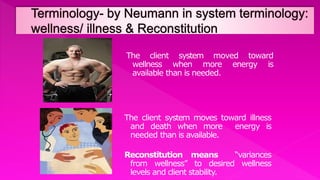
The client system moved toward
wellness when more energy is
available than is needed.
The client system moves toward illness
and death when more energy is
needed than is available.
Reconstitution means “variances
from wellness” to desired wellness
levels and client stability.
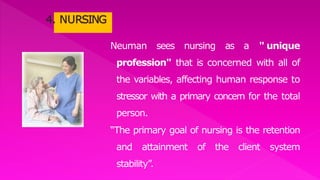
Neuman sees nursing as a " unique
profession" that is concerned with all of
the variables, affecting human response to
stressor with a primary concern for the total
person.
“The primary goal of nursing is the retention
and attainment of the client system
stability”.
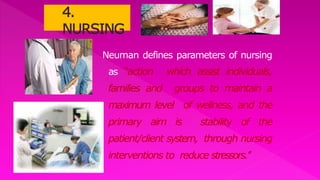
Neuman defines parameters of nursing
as “action which assist individuals,
families and groups to maintain a
maximum level of wellness, and the
primary aim is stability of the
patient/client system, through nursing
interventions to reduce stressors.’’
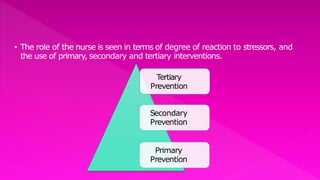
• The role of the nurse is seen in terms of degree of reaction to stressors, and
the use of primary, secondary and tertiary interventions.
Tertiary
Prevention
Secondary
Prevention
Primary
Prevention
• Theories can be the bases for hypotheses, that can be tested.
• Theories contribute to and assist in, increasing the general body
of knowledge within the discipline, through the research
implemented to validate them.
 Theories connects the interrelated concepts in such a way,
as to create a different way of looking at a particular
phenomenon.
 Theories must be logical in nature .
 Theories should be relatively simple yet generalizable.
• Theories can be utilized by the practitioner, to guide and improve
their practice.
• Theories must be consistent with other validated theories, laws
and principles but will leave open unanswered questions, that
need to be investigated.
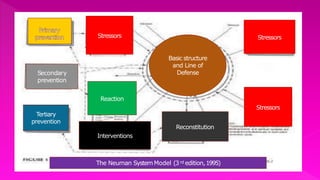
Secondary
prevention
Tertiary
prevention
Stressors
Reaction
Interventions
Reconstitution
Stressors
Stressors
Basic structure
and Line of
Defense
The Neuman System Model (3rd edition,1995)
Nursing
Diagnosis
Nursing Goal
Nursing
Outcome
Initially Neumann has systematized the nursing process in to three categories of nursing
diagnosis, nursing goals and nursing outcomes. she had ignored or given less emphasis
to the assessment and implementation phases. However, she refers to the assessment and
intervention in relation to stressors and to the three levels of prevention.
An assessment tool was included in her second revision of the model with an
explanation of how to utilize the tool.
Principles:
1) Good assessment requires knowledge of all the factors influencing a client’s perceptual
field.
2) The meaning a stressor has to the client is validated by the client as well as the caregiver.
3) Factors in the caregiver ‘s perceptual field that influence the assessment of client’s
situation should become apparent.
 It depends on acquisition of appropriate database; the
diagnosis identifies, assesses, classifies, and evaluates the
dynamic interaction of the five variables.
 Variances from wellness (needs and problems) are
determined by correlations and constraints through
synthesis of theory and data base.
 Broad hypothetical interventions are determined, i.e.
maintain flexible line of defense.
2. NURSING GOALS
• These must be negotiated for the prescriptive change.
The nurse intervention strategies postulated to retain, attain, and
maintain client system stability.
3. NURSING OUTCOMES
• Nursing intervention using one or more preventive modes.
• Confirmation of prescriptive change or reformulation of nursing goals.
• Short term goal outcomes influence determination of intermediate and long
– term goals.
• A client outcome validates nursing process.
 Mr. x ,age 66 yrs, male admitted in hospital with symptoms
severe abdominal pain, nausea, vomiting, yellowish
discolorations of eye, palm, urine, reduced appetite, and
gross weight loss (8kg with in 4 months).
 Patient is been diagnosed to have Periampullary carcinoma
one week back. Patient underwent operative procedure I.e.
Whipple’s procedure- Pancreato duodenectomy .
 Pp: 418
EDUCATION
RESEARCH
ADMINISTRATION
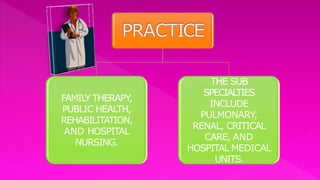
FAMILY THERAPY,
PUBLIC HEALTH,
REHABILITATION,
AND HOSPITAL
NURSING.
THE SUB
SPECIALTIES
INCLUDE
PULMONARY,
RENAL, CRITICAL
CARE, AND
HOSPITAL MEDICAL
UNITS.
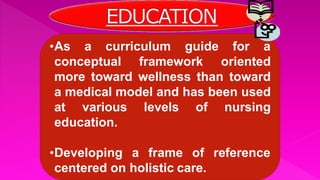
•As a curriculum guide for a
conceptual framework oriented
more toward wellness than toward
a medical model and has been used
at various levels of nursing
education.
reference•Developing a frame of
centered on holistic care.
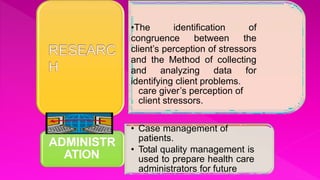
•The identification of
congruence between the
client’s perception of stressors
and the Method of collecting
and analyzing data for
identifying client problems.
care giver’s perception of
client stressors.
• Case management of
patients.
• Total quality management is
used to prepare health care
administrators for future.
ADMINISTR
ATION
CLIENT
SPIRITUAL
PHYSIO
LOGICAL
DEVELOP
MENTAL
PSYCHO
LOGICAL
SOCIO
CULTURAL
CLIENT SYSTEM
CENTRAL FLEXIBLE
CORE LINES
NORMAL
LINES
LINES OF
RESISTANCE
ENVIRONMENT
INTERNAL
EXTERNAL
CREATED
HEALTH
WELLNESS ILLNESS
NURSING
PREVENTIO
N
PRIMARY
SECONDARY
TERTIARY
NURSING
PROCESS
DIAGNOSIS
GOALS
OUTCOMES
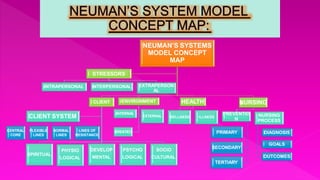
NEUMAN’S SYSTEMS
MODEL CONCEPT
MAP
STRESSORS
INTRAPERSONAL INTERPERSONAL EXTRAPERSON
AL
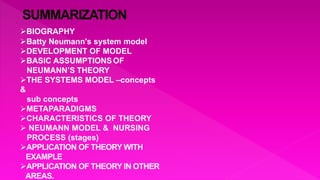
BIOGRAPHY
Batty Neumann's system model
DEVELOPMENT OF MODEL
BASIC ASSUMPTIONSOF
NEUMANN’S THEORY
THE SYSTEMS MODEL –concepts
&
sub concepts
METAPARADIGMS
CHARACTERISTICS OF THEORY
 NEUMANN MODEL & NURSING
PROCESS (stages)
APPLICATION OF THEORY WITH
EXAMPLE
APPLICATION OF THEORY IN OTHER
AREAS.
THANK YOU

Betty neumann theory by Ritika soni

  • 1.
  • 2.
     BIOGRAPHY  BattyNeumann's system model  DEVELOPMENT OF MODEL  BASIC ASSUMPTIONSOF NEUMANN’S THEORY  THE SYSTEMS MODEL –concepts & sub concepts  METAPARADIGMS  CHARACTERISTICS OF THEORY  STAGES OF NURSING PROCESS BY NEUMANN  APPLICATION OF THEORY WITH EXAMPLE  APPLICATION OF THEORY IN OTHER AREAS  SUMMARIZATION
  • 4.
    1960 • Apioneer in the community mental health movement in the late 1960s. • Began developing her health system model, while a lecturer in community health nursing at University of California, Los Angeles. • The models was initially developed, in response to graduate nursing students expression of a need for course content, that would expose them to breadth of nursing problems, prior to focusing on specific nursing problem areas. 1966 •Received Mastered Degree in mental health , public health consultation & counseling from UCLA, •Broad background in nursing includes public health, school, industry, hospital settings. •Involved in family therapy, continuing education & curriculum consultation. • Teaching experience include areas like mental health , consultation, organization, leadership, &counseling.
  • 5.
    1972 1974 1980 • The modelwas published as “A Model for Teaching Total Person Approach to Patient Problems” in Nursing Research. • It was refined, and subsequently published in the first edition of Conceptual Models for Nursing Practice. • second edition . 1982 Most recent refinement, along with numerous examples for application to curriculum, nursing practice and administration in next publication. The Neuman system model : Application to nursing education and practice. 1985 Received doctorate in clinical psychology from Pacific western university. 1998 Received secondary honorary doctorate- Grand valley state university, Michigan.
  • 6.
     Honorary Doctorateof Letters, Neumann College, Aston, PA (1992)  Honorary Member of the Fellowship of the American Academy of Nursing (1993)  Honorary Doctorate of Science, Grand Valley State University, Michigan (1998)  She was honored by President Richard Jusseaume and Provost Dr. Laurence Bove with the Walsh University Distinguished Service Medal, which is awarded to those who have contributed outstanding professional or voluntary service to others within the national, regional or local community.
  • 7.
    Betty Neumann’s describesher system model a comprehensive, flexible, holistic and system based perspective for nursing. It is a multidimensional view of individual , groups(families) and communities who are in constant interaction with environmental stressors. Essentially this model focuses on the client system’s reaction to stress and the factors of reconstitution or adaptation. It is considered appropriate model not only for nursing but also for all health care professionals.
  • 8.
    The use ofprimary, secondary and tertiary nursing prevention intervention for retention, attainment, and maintenance of optimal client system wellness.
  • 9.
    • Neumann’s modelwas influenced by several theoreticalsources, along with her own personal experiences in mental health nursing. • Her conceptual approach is the result of a synthesis of knowledge from several sources, including: • De chardin: philosophy of wholeness or totality of life. • Cornu: Marxian philosophy of man’s oneness with nature. • Gestalt: interaction of person and environment. • Selye : stress adaptation & interaction with environment . • Von Bertalanffy: general living open system theory • Caplan: levels of prevention approach • Lazlo : general system theory. • Lararus : stress and coping.
  • 10.
  • 11.
    1. Each individualhas a basic energy resource structure which contains characteristics both unique and common to all human kind, and is essential to life. I amunique
  • 12.
    2. Man isa composite of the interrelationship of the four variables ( biological, psychological, socio-cultural and developmental) which are at all times present.
  • 13.
    3. Each individualhas a a normal Line of Defense which is that person’s dynamic state of adaptation (homeostasis) which has evolved and been maintained over a period of time. This is unique for each individual person’s normal state of wellness.
  • 14.
    4. Each individualhas a flexible Line of Defense which is constantly changes in response to single/ multiple variables and stressors (biological, psychological, socio-cultural, developmental).
  • 15.
    5. stressors areboth known and universal , some are unique to the client. They are potential to disturb equilibrium, thus causing a change in priority of needs at any given moments. Stressors disturbs the normal equilibrium
  • 16.
    6.. The degreeof client reaction to stressors depends upon the resistant factors encountered by the stressors and the inter- relationship of variables.
  • 17.
    7. Each personhas an internal set of resistance factors – lines of resistance – whose function is to stabilize and return the client to that person’s personal line of defense when/if stressors break through.
  • 18.
  • 19.
    8.Primary prevention relatesto general knowledge applied to clients assessment to identify stressors before they occur. 9.Secondary prevention relates to symptomatology. These are interventions generally initiated after an encounter with a stressor. 10.Tertiary prevention relates to the adaptive process, as reconstitution begins and moves back towards primary prevention. These are the interventions initiated after treatment.
  • 20.
     The totalperson framework is basically an open systems model with two components- stress and reaction.  The “person” is viewed as an open system interacting with the environment. The person or system is capable of intake of extra personal/interpersonal factors from the environment, and interacts with this intake by adjusting it to the system.  Logistically the model appears fairly simple & straightforward.
  • 22.
     The modelshows that the series of concentric rings surrounding the basic core structure of human being, family, or community(labeled “basic structure , energy resources)vary in size and distance from the reactor. Concepts: 1. “basic structure , energy resources/ central core: Common client survival factors in unique individual characteristics representing basic system energy resources. The basic structure / central core , is made up of the basic survival factors that are common to the species.
  • 23.
     These factorsare:  Normal temperature, range, genetic structure, response pattern, organ strength or weakness, ego structure.  Stability/ Homeostasis , occurs when the amount of energy that is available exceeds that being used by the system.  A homeostatic body system is constantly in a dynamic process of input, output , feedback and compensation which leads to a state of balance.
  • 24.
     The seriesof concentric circles that surrounds the basic structure.  They represent the line of resistance, the internal factors defending against stressors.  Protection factors activated when stressors have penetrated the normal LOD , causing a reaction symptomatology.  Lines of resistance protect the basic structure and support return to wellness. The line of resistance is the coping methods that the individual learnt in time; if the individual is able to use effective coping methods, the basic structure may be prevented from being affected  E.g.: mobilization of WBC’s and activation of immune system mechanism.
  • 25.
     The normalline of defense represents the person's state of equilibrium.  The normal line of defense is essentially what the person becomes over a lifetime-normal state of wellness or steady state( means it is dynamic because it can expand & contract overtime) and is composed of biological - psychological, sociocultural –developmental skills that the system uses to deal with stressors.
  • 26.
     This lineconstitutes the outer boundary of the defined client system.  The flexible line of defense serves as a situational protective buffer system for the individual's normal or stable state from invasion by stressor.  The flexible line of defense protects the client system from the stressor attacks.  If the flexible line of defense is not strong enough or the stressors are very strong, entrance to the normal line of defense takes place .  The flexible line of defense has an accordion-like function.  If this line is expanded beyond the normal line of defense, it provides high protection  For instance, if healthy lifestyles and effective coping mechanisms are used, the individual's flexible line of defense expands.
  • 27.
     The TheoreticalModel describes how the flexible line of defense, the normal line of defense, and the lines of resistance protect the basic structure from moods that enter the individual's system and disrupt the state of wellness.
  • 29.
     A stressoris any phenomenon or environmental stressors that might penetrate both the flexible and normal lines of defense, resulting in either a positive or negative outcome or disrupting system stability.  Intrapersonal stressors are forces that occur within the client system boundary and correlate with the internal environment . E.g.. Anger  Interpersonal stressors forces occurring between one or more individual. Eg. Parent- child role expectation  Extra personal stressors are forces occur outside the client system boundaries . Eg. Unemployment (outside force).
  • 31.
     The amountof system response resulting from stressor invasion of the normal line of defense.
  • 32.
     Intervention modesfor nursing action and determinants for entry of both client and nurse into the health care system.  Primary prevention occurs before the system reacts to a stressor that is either suspected or identified . It includes health promotion and maintenance of wellness. Primary prevention focuses on strengthening the flexible line of defense through preventing stress and reducing risk factors. This intervention occurs when the risk or hazard is identified but before a reaction occurs. Strategies that might be used include immunization, health education, exercise, and lifestyle changes.  Secondary prevention occurs after the system reacts to a stressor and is provided in terms of existing symptoms. Secondary prevention focuses on strengthening the internal lines of resistance and, thus, protects the basic structure through appropriate treatment of symptoms. The intent is to regain optimal system stability and to conserve energy in doing so. If secondary prevention is unsuccessful and reconstitution does not occur, the basic structure will be unable to support the system and its interventions, and death will occur.
  • 33.
     Tertiary preventionoccurs after the system has been treated through secondary prevention strategies. Its purpose is to maintain wellness or protect the client system reconstitution through supporting existing strengths and continuing to preserve energy.  Tertiary prevention may begin at any point after system stability has begun to be reestablished (reconstitution has begun). Tertiary prevention tends to lead back to primary prevention. (Neuman, 1995)
  • 35.
     The returnand maintenance of system stability, following treatment of stressor reaction, which may result in a higher or lower level of wellness.
  • 36.
     A systemin which there is a continuous flow of input , process, output and feedback. It is a system of organized complexity, where all elements are in interaction.  Input/output The matter, energy, and information exchanged between the client and environment that is entering or leaving the system at any point in time.
  • 37.
    Negentropy: A processof energy conservation that increases organization and complexity, moving the system toward stability or a higher degree of wellness. Entropy: a process of energy depletion and disorganization moving the system toward illness or possible death
  • 38.
    Neuman views theindividual client holistically and considers the variables simultaneously and comprehensively.  The physiological variable refers to the structure and functions of the body.  The psychological variable refers to mental processes and relationships.  The sociocultural variable refers to system functions that relate to social and cultural expectations and activities.  The developmental variable refers to those processes related to development over the lifespan.  The spiritual variable refers to the influence of spiritual beliefs.
  • 39.
     A stateof balance or harmony requiring energy exchanges as the client adequately copes with stressors to retain, attain, or maintain an optimal level of health thus preserving system integrity.
  • 41.
  • 42.
    Each human isa “total person” as a client system & person is multidimensional , a composite of variable :  Physiological- Refer to the physiochemical structure and functions of body.  Psychological- Refers to mental processes and emotions.  Socio-cultural-Refers to relationships; and social/cultural expectations and activities.  Spiritual- Refers to the influence of spiritual beliefs.  Developmental- Refers to those processes related to development over the lifespan.
  • 43.
    Other variables includebasic survival core characteristics such as normal temperature range, genetic response patterns, ego structure, and various strength & weaknesses of physical body. The dynamic interaction of these variables and core characteristics along with the lines of normal defense and flexible resistance, combined with many stressors, provide the essence of the ‘total person approach’.
  • 44.
    2.ENVIRONMENT / SOCIETY Basic tothe Neumann model is the concept that humans are in constant interactions with their environment. She defines environment as those internal & external forces surrounding humans at any point in time. These forces includes the interpersonal, intrapersonal & extra personal stressors which can affect the normal line of defense and so can affect the stability of the system.
  • 45.
     The internalenvironment exists within the client system.  The external environment exists outside the client system. A created environment which is an environment that is created and developed unconsciously by the client and is symbolic of system wholeness.
  • 46.
    Neuman sees healthas being equated with wellness. • She defines health/wellness as “the condition in which all parts and subparts (variables) are in harmony with the whole of the client (Neumann, 1995)”. • Harmonyandbalancebetweentheinternalandexternal environments throughaprocessofinteracionandadjustment.
  • 47.
    The client systemmoved toward wellness when more energy is available than is needed. The client system moves toward illness and death when more energy is needed than is available. Reconstitution means “variances from wellness” to desired wellness levels and client stability.
  • 48.
    Neuman sees nursingas a " unique profession" that is concerned with all of the variables, affecting human response to stressor with a primary concern for the total person. “The primary goal of nursing is the retention and attainment of the client system stability”.
  • 49.
    Neuman defines parametersof nursing as “action which assist individuals, families and groups to maintain a maximum level of wellness, and the primary aim is stability of the patient/client system, through nursing interventions to reduce stressors.’’
  • 50.
    • The roleof the nurse is seen in terms of degree of reaction to stressors, and the use of primary, secondary and tertiary interventions. Tertiary Prevention Secondary Prevention Primary Prevention
  • 51.
    • Theories canbe the bases for hypotheses, that can be tested. • Theories contribute to and assist in, increasing the general body of knowledge within the discipline, through the research implemented to validate them.
  • 52.
     Theories connectsthe interrelated concepts in such a way, as to create a different way of looking at a particular phenomenon.  Theories must be logical in nature .  Theories should be relatively simple yet generalizable.
  • 53.
    • Theories canbe utilized by the practitioner, to guide and improve their practice. • Theories must be consistent with other validated theories, laws and principles but will leave open unanswered questions, that need to be investigated.
  • 54.
  • 55.
  • 56.
    Initially Neumann hassystematized the nursing process in to three categories of nursing diagnosis, nursing goals and nursing outcomes. she had ignored or given less emphasis to the assessment and implementation phases. However, she refers to the assessment and intervention in relation to stressors and to the three levels of prevention. An assessment tool was included in her second revision of the model with an explanation of how to utilize the tool. Principles: 1) Good assessment requires knowledge of all the factors influencing a client’s perceptual field. 2) The meaning a stressor has to the client is validated by the client as well as the caregiver. 3) Factors in the caregiver ‘s perceptual field that influence the assessment of client’s situation should become apparent.
  • 57.
     It dependson acquisition of appropriate database; the diagnosis identifies, assesses, classifies, and evaluates the dynamic interaction of the five variables.  Variances from wellness (needs and problems) are determined by correlations and constraints through synthesis of theory and data base.  Broad hypothetical interventions are determined, i.e. maintain flexible line of defense.
  • 58.
    2. NURSING GOALS •These must be negotiated for the prescriptive change. The nurse intervention strategies postulated to retain, attain, and maintain client system stability. 3. NURSING OUTCOMES • Nursing intervention using one or more preventive modes. • Confirmation of prescriptive change or reformulation of nursing goals. • Short term goal outcomes influence determination of intermediate and long – term goals. • A client outcome validates nursing process.
  • 59.
     Mr. x,age 66 yrs, male admitted in hospital with symptoms severe abdominal pain, nausea, vomiting, yellowish discolorations of eye, palm, urine, reduced appetite, and gross weight loss (8kg with in 4 months).  Patient is been diagnosed to have Periampullary carcinoma one week back. Patient underwent operative procedure I.e. Whipple’s procedure- Pancreato duodenectomy .  Pp: 418
  • 61.
  • 62.
    FAMILY THERAPY, PUBLIC HEALTH, REHABILITATION, ANDHOSPITAL NURSING. THE SUB SPECIALTIES INCLUDE PULMONARY, RENAL, CRITICAL CARE, AND HOSPITAL MEDICAL UNITS.
  • 63.
    •As a curriculumguide for a conceptual framework oriented more toward wellness than toward a medical model and has been used at various levels of nursing education. reference•Developing a frame of centered on holistic care.
  • 64.
    •The identification of congruencebetween the client’s perception of stressors and the Method of collecting and analyzing data for identifying client problems. care giver’s perception of client stressors. • Case management of patients. • Total quality management is used to prepare health care administrators for future. ADMINISTR ATION
  • 65.
    CLIENT SPIRITUAL PHYSIO LOGICAL DEVELOP MENTAL PSYCHO LOGICAL SOCIO CULTURAL CLIENT SYSTEM CENTRAL FLEXIBLE CORELINES NORMAL LINES LINES OF RESISTANCE ENVIRONMENT INTERNAL EXTERNAL CREATED HEALTH WELLNESS ILLNESS NURSING PREVENTIO N PRIMARY SECONDARY TERTIARY NURSING PROCESS DIAGNOSIS GOALS OUTCOMES NEUMAN’S SYSTEMS MODEL CONCEPT MAP STRESSORS INTRAPERSONAL INTERPERSONAL EXTRAPERSON AL
  • 66.
    BIOGRAPHY Batty Neumann's systemmodel DEVELOPMENT OF MODEL BASIC ASSUMPTIONSOF NEUMANN’S THEORY THE SYSTEMS MODEL –concepts & sub concepts METAPARADIGMS CHARACTERISTICS OF THEORY  NEUMANN MODEL & NURSING PROCESS (stages) APPLICATION OF THEORY WITH EXAMPLE APPLICATION OF THEORY IN OTHER AREAS.
  • 67.