Presentation
on
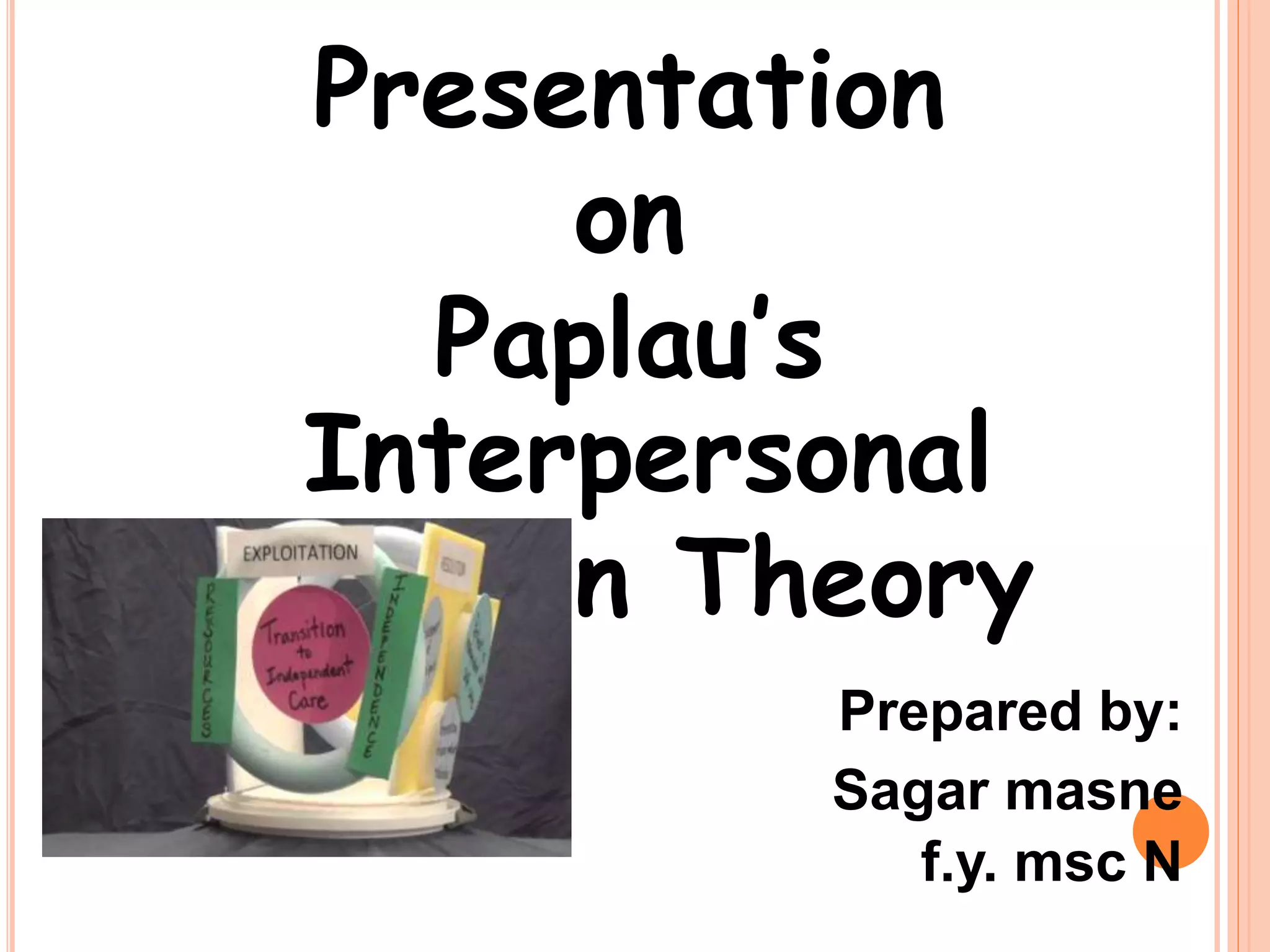
Paplau’s
Interpersonal
Relation Theory
Prepared by:
Sagar masne
f.y. msc N
NURSING THEORY :
 Is defined as ‘a creative and rigorous
structuring of ideas that project a
tentative, purposeful, and systematic
view of phenomena’.
 Theory refers to “a coherent group of
general propositions used as principles
of explanation"
IMPORTANCE OF NURSING THEORIES
 Importance of nursing theories: In the early
part of nursing’s history, knowledge was
awfully lacking and in general a difficult
task from the very beginnings of any nursing
education.
 There was a thirst and need to categorize
knowledge for this exact reason, so
people could evaluate client care situations
in order to connect in comprehensible and
essential ways.
CONT…
 Nursing theories give a plan for reflection
in which examines a certain direction in
where the plan needs to head.
 As new situations are encountered, this
framework provides an arrangement for
management, investigation and decision-
making.
 It’s important for researches, and as a
guideline for practical.
TYPES OF NURSING THEORIES
 Grand nursing theories
 Mid-range nursing theories
 Nursing practice theories
NURSING MODEL
BACKGROUND
 Hildegard Peplau (1909)
 Diploma program in Pottstown, PA, 1931
 BA in Interpersonal Psychology, Bennington
College, 1943
 MA in Psychiatric Nursing, Columbia
University, 1947
 EdD in Curriculum Development, Columbia
University, 1953
 Mother of psychiatric nursing
BACKGROUND
 Published Interpersonal Relations in
Nursing (1952)
 Professor emeritus from Rutgers University
 Started first post-baccalaureate program in
nursing
 Worked as Executive Director and President of
ANA
 Worked with WHO, NIMH and Nurse Corps
 Died peacefully in her sleep at home in
california-1999
PURPOSE OF THEORY
 Focus on nurse-patient relationship
 Identify different roles nurses take on when
working with patients
ASSUMPTIONS OF THEORY
HUMAN BEING
 Peplau defines man as an organism that “A
developing organism that tries to reduce
anxiety caused by needs .
HEALTH
 Health is defined as “a word symbol that
implies forward movement of personality
and other ongoing human processes in the
direction of creative, constructive,
productive, personal, and community living.”
SOCIETY OR ENVIRONMENT
 Existing forces outside the organism and in
the context of culture
NURSING
 Hildegard Peplau defines it as a “human
relationship between an individual who is
sick, or in need of health services, and a
nurse specially educated to recognize and
to respond to the need for help.
RELATIONSHIPS
Phases in nurse-patient relationships
 Orientation
 Identification
 Exploitation
 Resolution
ORIENTATION
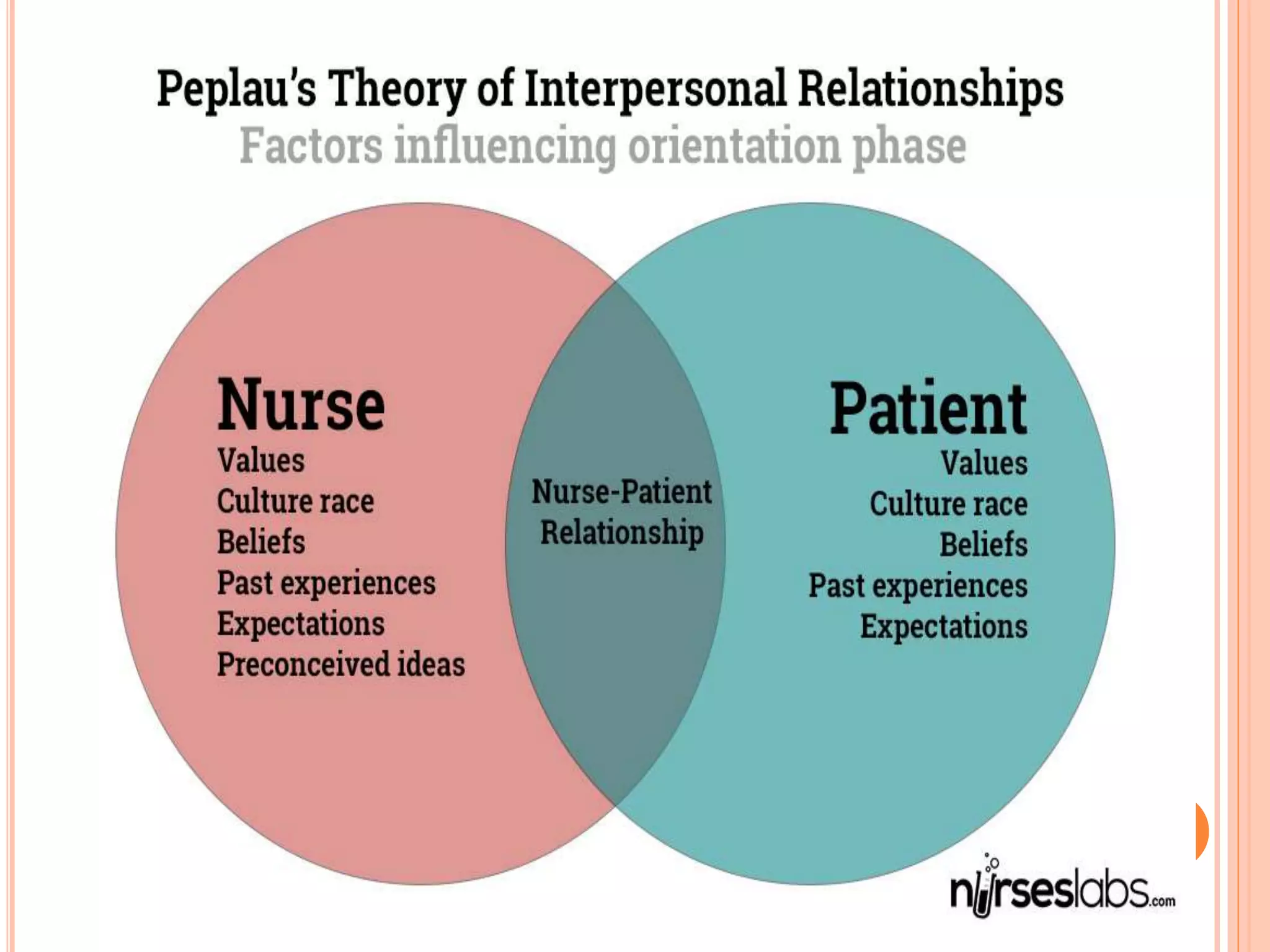
 Problem defining phase
 Starts when client meets nurse as stranger
 Defining problem and client seeks assistance,
conveys needs ,asks questions, shares
preconceptions and expectations of past
experiences
 Nurse responds, explains roles to client, helps to
identify problems and to use available resources
and services
IDENTIFICATION PHASE
 The identification phase begins when the client
works interdependently with the nurse, expresses
feelings, and begins to feel stronger.
 Selection of appropriate professional assistance
 Patient begins to have a feeling of belonging and a
capability of dealing with the problem which
decreases the feeling of helplessness and
hopelessness
EXPLOITATION PHASE
 In the exploitation phase, the client makes full use
of the services offered.
 Use of professional assistance for problem solving
alternatives
 Advantages of services are used is based on the
needs and interests of the patients
CONT……
 Individual feels as an integral part of the helping
environment
 They may make minor requests or attention getting
techniques
 The principles of interview techniques must be used
in order to explore, understand and adequately deal
with the underlying problem
 Patient may fluctuates on independence
 Nurse must be aware about the various phases of
communication
 Nurse aids the patient in exploiting all avenues of
help and progress is made towards the final step
RESOLUTION PHASE
 In the resolution phase, the client no longer
needs professional services and gives up
dependent behavior. The relationship ends.
 Termination of professional relationship
 The patients needs have already been met
by the collaborative effect of patient and
nurse
CONT……
 Now they need to terminate their therapeutic
relationship and dissolve the links between them.
 Sometimes may be difficult for both as
psychological dependence persists
 Patient drifts away and breaks bond with nurse and
healthier emotional balance is demonstrated and
both becomes mature individuals
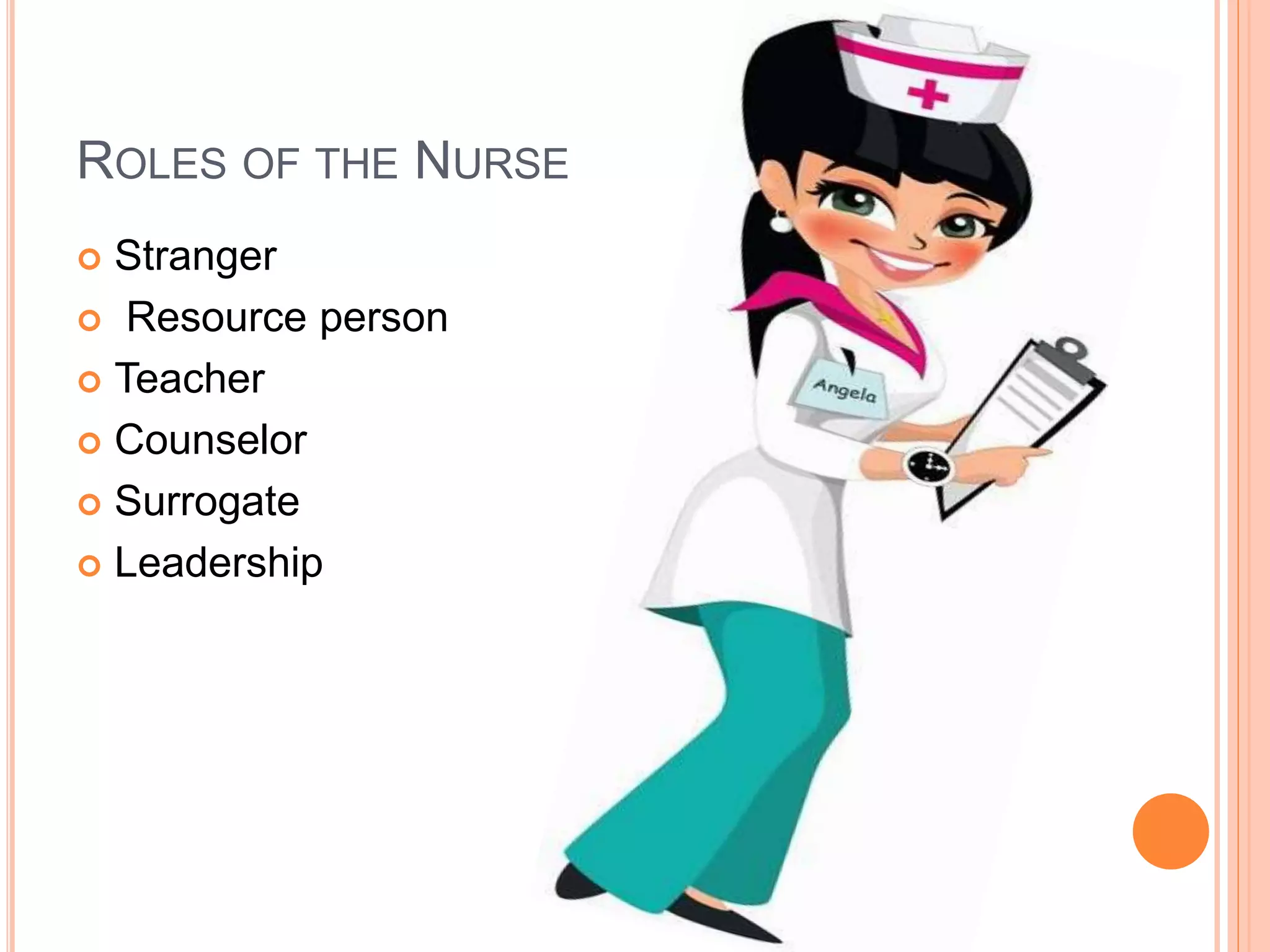
ROLES OF THE NURSE
 Stranger
 Resource person
 Teacher
 Counselor
 Surrogate
 Leadership
STANGER:
 Peplau states that when the nurse and
patient first meet, they are considered to be
strangers to one another.
 Therefore, the patient should be treated with
much respect, courtesy and equally as
anybody else.
RESOURCE ROLE:
 The nurse provides answers to questions
primarily on health information.
 The resource person is also in charge of
relaying information to the patient about the
treatment and plan of care
TEACHING ROLE:
 The teaching role is a role that is a
combination of all roles.
 Peplau determined that there are two
categories that the teaching role consists of:
Instructional and experimental.
 The instructional consists of giving a wide
variety of information that is given to the
patients and experimental is using the
experience of the learner
COUNSELING ROLE:
 Peplau believes that counseling has the
biggest emphasis in psychiatric nursing.
 The counselor role helps the patient
understand and remember what is going on
and what is happening to them in current
life situations. Also, to provide guidance
and encouragement to make changes.
SURROGATE ROLE:
 The patient is responsible for putting the
nurse in the surrogate role.
 The nurse’s behaviors and attitudes create
a feeling tone for the patient that trigger
feelings that were generated in a previous
relationship.
LEADERSHIP ROLE:
 Helps the patient assume maximum
responsibility for meeting treatment goals in
a mutually satisfying way.
 The nurse helps the patient meet these
goals through cooperation and active
participation with the nurse.
CHARACTERISTICS
 Interrelation of concepts
 Four phases interrelate the different components of
each phase.
 Applicability
 The nurse patient interaction can apply to the
concepts of human being, health, environment and
nursing.
 Theories must be logical in nature -
 This theory provides a logical systematic way of
viewing nursing situations
 Key concepts such as anxiety, tension, goals, and
frustration are indicated with explicit relationships
among them and progressive phases
CONT…
 Generalizability
 This theory provides simplicity in regard to the
natural progression of the NP relationship.
 Theories can be the bases for hypothesis that can
be tested
 Peplau's theory has generated testable
hypotheses.
 Theories can be utilized by practitioners to guide
and improve their practice.
 Peplau’s anxiety continuum is still used in
anxiety patients
CONT…
 Theories must be consistent with other validated
theories, laws, and principles but will leave open
unanswered questions that need to be investigated.
 Peplau's theory is consistent with various
theories
STRENGTHS
 Peplau’s theory helped later nursing
theorists and clinicians develop more
therapeutic interventions regarding the roles
in clinical nursing.
 Its phases provide simplicity regarding the
natural progression of the nurse-patient
relationship
 which leads to adaptability in any nurse-
patient interaction, thus providing
generalizability
LIMITATIONS
 Personal space considerations and community
social service resources are considered less.
 Health promotion and maintenance were less
emphasized
 Cannot be used in a patient who doesn’t have a felt
need eg. With drawn patients, unconscious
patients
 Some areas are not specific enough to generate
hypothesis
APPLYING PEPLAU’S THEORY :
 A client JL (36 year old female) was referred to the
UOS hospital with a
Prolapsed Disc
of the lower lumbar spine (lower back). The pain in
her lower back was so great that it radiated down
the front of her thighs. She was unable to sit and
turn in bed (need assistance). The doctor decide to
do surgery, she is concern about her condition and
the surgery.
THE NURSE
*Introduces
herself
*Asks
questions
*Obtains
a health history and assessment
*Helps
to identify problem (pain in her lower back, need
assistance and is concern about her condition and
the surgery)
 - Roles:
Both patient and nurse are in the
stranger
role at this time and must gain mutual trust
ORIENTATION
Patient was initially reluctant to talk
due to pain
Patient was expressing that his health
condition is poor
Nurse established therapeutic
relationship with the patient
IDENTIFICATION
 Both Nurse and patient
identify
the problems to
address:
- Pain in her lower back
- Need assistance self care
- Concern about her condition and the
surgery
EXPLOITATION

For
pain:
-Provide non pharmacological measures
-Provide supine position to the client.
-Support the back during position change
-Use pillows to support the back.
-Administer analgesic to reduce pain
CONT…
 For assistance and self care:
-Keep the articles within the reach of the
client
-Frequently visit the patient and enquire for
any needs.
-Assist the client in doing her self care
activities
CONT….
 For her Concerns:
-Teach the family regarding the disease
process in local
-Allow the client and family members to ask
questions
-allow her and her husband expressed their
anxiety
-Allow the family members to frequently visit
the client
TERMINATION PHASE
Resolution -- problems are resolved
For pain
:Mrs. JL was free to express
problems of pain.
For self-care:
- Mrs. JL was free to express problems of
self care.
- She achieve and maintain her self care
activities within her limits
CONCLUSION…
 With the help of theory of interpersonal
relation the patient need could be
assessed.
 It helped him to achieve them within her
limits.
 The theory application helped in providing
comprehensive care to the client patient
SUMMARY
 The seven nursing roles, which show the
dynamic character roles typical in clinical nursing.
 It entails that a nurse’s duty is not just to care but
the profession also incorporates every activity
that may affect the client’s health.
 However, the idea of a nurse-client cooperation is
found narrow with those individuals who are unfit
and powerless in conversing, specifically those
who are unconscious and paralyzed.
CONT…..
 Studying Peplau’s Interpersonal Relations Theory
of Nursing can be very substantial especially to
those who are aspiring to be part of the
profession.
 Having the knowledge of the seven roles of nursing,
future nurses can apply different roles in different
situations, the best care possible, and along
treatment and recovery.
REFERENCES
 BT Basvanthappa (2007). Nursing Theories.
Jaypee brothers medical publisher 1st edition New
Delhi
 Timber BK. Fundamental skills and concepts in
Patient Care, 7th edition, LWW, N
Paplau theory of interpersonal relationship

Paplau theory of interpersonal relationship

  • 1.
  • 2.
    NURSING THEORY : Is defined as ‘a creative and rigorous structuring of ideas that project a tentative, purposeful, and systematic view of phenomena’.  Theory refers to “a coherent group of general propositions used as principles of explanation"
  • 3.
    IMPORTANCE OF NURSINGTHEORIES  Importance of nursing theories: In the early part of nursing’s history, knowledge was awfully lacking and in general a difficult task from the very beginnings of any nursing education.  There was a thirst and need to categorize knowledge for this exact reason, so people could evaluate client care situations in order to connect in comprehensible and essential ways.
  • 4.
    CONT…  Nursing theoriesgive a plan for reflection in which examines a certain direction in where the plan needs to head.  As new situations are encountered, this framework provides an arrangement for management, investigation and decision- making.  It’s important for researches, and as a guideline for practical.
  • 5.
    TYPES OF NURSINGTHEORIES  Grand nursing theories  Mid-range nursing theories  Nursing practice theories
  • 6.
  • 7.
    BACKGROUND  Hildegard Peplau(1909)  Diploma program in Pottstown, PA, 1931  BA in Interpersonal Psychology, Bennington College, 1943  MA in Psychiatric Nursing, Columbia University, 1947  EdD in Curriculum Development, Columbia University, 1953  Mother of psychiatric nursing
  • 8.
    BACKGROUND  Published InterpersonalRelations in Nursing (1952)  Professor emeritus from Rutgers University  Started first post-baccalaureate program in nursing  Worked as Executive Director and President of ANA  Worked with WHO, NIMH and Nurse Corps  Died peacefully in her sleep at home in california-1999
  • 9.
    PURPOSE OF THEORY Focus on nurse-patient relationship  Identify different roles nurses take on when working with patients
  • 10.
    ASSUMPTIONS OF THEORY HUMANBEING  Peplau defines man as an organism that “A developing organism that tries to reduce anxiety caused by needs .
  • 11.
    HEALTH  Health isdefined as “a word symbol that implies forward movement of personality and other ongoing human processes in the direction of creative, constructive, productive, personal, and community living.”
  • 12.
    SOCIETY OR ENVIRONMENT Existing forces outside the organism and in the context of culture
  • 13.
    NURSING  Hildegard Peplaudefines it as a “human relationship between an individual who is sick, or in need of health services, and a nurse specially educated to recognize and to respond to the need for help.
  • 15.
    RELATIONSHIPS Phases in nurse-patientrelationships  Orientation  Identification  Exploitation  Resolution
  • 16.
    ORIENTATION  Problem definingphase  Starts when client meets nurse as stranger  Defining problem and client seeks assistance, conveys needs ,asks questions, shares preconceptions and expectations of past experiences  Nurse responds, explains roles to client, helps to identify problems and to use available resources and services
  • 17.
    IDENTIFICATION PHASE  Theidentification phase begins when the client works interdependently with the nurse, expresses feelings, and begins to feel stronger.  Selection of appropriate professional assistance  Patient begins to have a feeling of belonging and a capability of dealing with the problem which decreases the feeling of helplessness and hopelessness
  • 18.
    EXPLOITATION PHASE  Inthe exploitation phase, the client makes full use of the services offered.  Use of professional assistance for problem solving alternatives  Advantages of services are used is based on the needs and interests of the patients
  • 19.
    CONT……  Individual feelsas an integral part of the helping environment  They may make minor requests or attention getting techniques  The principles of interview techniques must be used in order to explore, understand and adequately deal with the underlying problem  Patient may fluctuates on independence  Nurse must be aware about the various phases of communication  Nurse aids the patient in exploiting all avenues of help and progress is made towards the final step
  • 20.
    RESOLUTION PHASE  Inthe resolution phase, the client no longer needs professional services and gives up dependent behavior. The relationship ends.  Termination of professional relationship  The patients needs have already been met by the collaborative effect of patient and nurse
  • 21.
    CONT……  Now theyneed to terminate their therapeutic relationship and dissolve the links between them.  Sometimes may be difficult for both as psychological dependence persists  Patient drifts away and breaks bond with nurse and healthier emotional balance is demonstrated and both becomes mature individuals
  • 22.
    ROLES OF THENURSE  Stranger  Resource person  Teacher  Counselor  Surrogate  Leadership
  • 23.
    STANGER:  Peplau statesthat when the nurse and patient first meet, they are considered to be strangers to one another.  Therefore, the patient should be treated with much respect, courtesy and equally as anybody else.
  • 24.
    RESOURCE ROLE:  Thenurse provides answers to questions primarily on health information.  The resource person is also in charge of relaying information to the patient about the treatment and plan of care
  • 25.
    TEACHING ROLE:  Theteaching role is a role that is a combination of all roles.  Peplau determined that there are two categories that the teaching role consists of: Instructional and experimental.  The instructional consists of giving a wide variety of information that is given to the patients and experimental is using the experience of the learner
  • 26.
    COUNSELING ROLE:  Peplaubelieves that counseling has the biggest emphasis in psychiatric nursing.  The counselor role helps the patient understand and remember what is going on and what is happening to them in current life situations. Also, to provide guidance and encouragement to make changes.
  • 27.
    SURROGATE ROLE:  Thepatient is responsible for putting the nurse in the surrogate role.  The nurse’s behaviors and attitudes create a feeling tone for the patient that trigger feelings that were generated in a previous relationship.
  • 28.
    LEADERSHIP ROLE:  Helpsthe patient assume maximum responsibility for meeting treatment goals in a mutually satisfying way.  The nurse helps the patient meet these goals through cooperation and active participation with the nurse.
  • 29.
    CHARACTERISTICS  Interrelation ofconcepts  Four phases interrelate the different components of each phase.  Applicability  The nurse patient interaction can apply to the concepts of human being, health, environment and nursing.  Theories must be logical in nature -  This theory provides a logical systematic way of viewing nursing situations  Key concepts such as anxiety, tension, goals, and frustration are indicated with explicit relationships among them and progressive phases
  • 30.
    CONT…  Generalizability  Thistheory provides simplicity in regard to the natural progression of the NP relationship.  Theories can be the bases for hypothesis that can be tested  Peplau's theory has generated testable hypotheses.  Theories can be utilized by practitioners to guide and improve their practice.  Peplau’s anxiety continuum is still used in anxiety patients
  • 31.
    CONT…  Theories mustbe consistent with other validated theories, laws, and principles but will leave open unanswered questions that need to be investigated.  Peplau's theory is consistent with various theories
  • 32.
    STRENGTHS  Peplau’s theoryhelped later nursing theorists and clinicians develop more therapeutic interventions regarding the roles in clinical nursing.  Its phases provide simplicity regarding the natural progression of the nurse-patient relationship  which leads to adaptability in any nurse- patient interaction, thus providing generalizability
  • 33.
    LIMITATIONS  Personal spaceconsiderations and community social service resources are considered less.  Health promotion and maintenance were less emphasized  Cannot be used in a patient who doesn’t have a felt need eg. With drawn patients, unconscious patients  Some areas are not specific enough to generate hypothesis
  • 34.
    APPLYING PEPLAU’S THEORY:  A client JL (36 year old female) was referred to the UOS hospital with a Prolapsed Disc of the lower lumbar spine (lower back). The pain in her lower back was so great that it radiated down the front of her thighs. She was unable to sit and turn in bed (need assistance). The doctor decide to do surgery, she is concern about her condition and the surgery.
  • 35.
    THE NURSE *Introduces herself *Asks questions *Obtains a healthhistory and assessment *Helps to identify problem (pain in her lower back, need assistance and is concern about her condition and the surgery)  - Roles: Both patient and nurse are in the stranger role at this time and must gain mutual trust
  • 36.
    ORIENTATION Patient was initiallyreluctant to talk due to pain Patient was expressing that his health condition is poor Nurse established therapeutic relationship with the patient
  • 37.
    IDENTIFICATION  Both Nurseand patient identify the problems to address: - Pain in her lower back - Need assistance self care - Concern about her condition and the surgery
  • 38.
    EXPLOITATION  For pain: -Provide non pharmacologicalmeasures -Provide supine position to the client. -Support the back during position change -Use pillows to support the back. -Administer analgesic to reduce pain
  • 39.
    CONT…  For assistanceand self care: -Keep the articles within the reach of the client -Frequently visit the patient and enquire for any needs. -Assist the client in doing her self care activities
  • 40.
    CONT….  For herConcerns: -Teach the family regarding the disease process in local -Allow the client and family members to ask questions -allow her and her husband expressed their anxiety -Allow the family members to frequently visit the client
  • 41.
    TERMINATION PHASE Resolution --problems are resolved For pain :Mrs. JL was free to express problems of pain. For self-care: - Mrs. JL was free to express problems of self care. - She achieve and maintain her self care activities within her limits
  • 42.
    CONCLUSION…  With thehelp of theory of interpersonal relation the patient need could be assessed.  It helped him to achieve them within her limits.  The theory application helped in providing comprehensive care to the client patient
  • 43.
  • 44.
     The sevennursing roles, which show the dynamic character roles typical in clinical nursing.  It entails that a nurse’s duty is not just to care but the profession also incorporates every activity that may affect the client’s health.  However, the idea of a nurse-client cooperation is found narrow with those individuals who are unfit and powerless in conversing, specifically those who are unconscious and paralyzed.
  • 45.
    CONT…..  Studying Peplau’sInterpersonal Relations Theory of Nursing can be very substantial especially to those who are aspiring to be part of the profession.  Having the knowledge of the seven roles of nursing, future nurses can apply different roles in different situations, the best care possible, and along treatment and recovery.
  • 46.
    REFERENCES  BT Basvanthappa(2007). Nursing Theories. Jaypee brothers medical publisher 1st edition New Delhi  Timber BK. Fundamental skills and concepts in Patient Care, 7th edition, LWW, N