PRESENTATION
NURSING
THEORIES
1 2 3 4
GROUP MEMBERS
EYAS, LOVEYZEL P. ENRIQUEZ, LOUIESA
B.
FRESNILLO, KEE SHI
A.
DONA, ANGEL B.
5 6 7 8
GROUP MEMBERS
GIGANTO,
ALIEGHYA B.
DELOS SANTOS, AIZY
MAE V.
ENTRODUCION,
KEZIAH JANA MYKKA
S.
COSTELO, MARY
CHRISTIAN MONA
M.
Virginia Henderson was born on November 30, 1897
in Kansas City, Missouri, and was the fifth of eight
children in her family. In 1921, Henderson graduated
from the Army School of Nursing at Walter Reed
Hospital in Washington, D.C. In 1932, she earned her
Bachelor’s Degree and in 1934 earned her Master’s
Degree in Nursing Education, both from Teachers
College at Columbia University. Henderson died on
March 19, 1996.
HENDERSON’S NEED
THEORY
INTRODUCTION
It is a nursing theory developed by Virginia
Henderson, a pioneering nurse theorist and also
known as "the first lady of nursing" and has been
called, "arguably the most famous nurse of the
20th century".
The theory focuses on the importance of
increasing the patient’s independence to
accelerate their progress in the hospital.
Henderson’s model emphasizes the nurse’s role in
assisting individuals with essential activities that
contribute to health, recovery, or a peaceful death.
1. Eating and drinking
2. Eliminate body wastes
3. Body posture
4. Mobility
5. Day and night pattern
6. Getting dressed and undressed
7. Body temperature
8. Hygiene
9. Avoidance of danger
10. Communication
11. Contact with others
12. Sense of rule and values
13. Daily activities
14. Recreational activities
14 BASIC
NEEDS
• A PATIENT IS RECOVERING FROM SURGERY AND HAS LIMITED MOBILITY.
EXAMPLE
• BY ADDRESSING THESE NEEDS, THE NURSE HELPS THE PATIENT GAIN
INDEPENDENCE IN ACTIVITIES OF DAILY LIVING, IMPROVING THEIR
OVERALL RECOVERY AND SATISFACTION WITH CARE.
• THE NURSE ASSESSES THE PATIENT’S ABILITY TO BREATHE, EAT, MOVE, AND
COMMUNICATE, ALONG WITH OTHER NEEDS OUTLINED IN HENDERSON’S
MODEL.
PENDER’S HEALTH PROMOTION MODEL THEORY
Nola J. Pender, born in 1941, is a nursing theorist known for creating
the Health Promotion Model in 1982. Additionally, she serves as a
writer and a retired professor of nursing at the University of
Michigan. She began researching health-promoting behavior in the
mid-1970s and introduced the Health Promotion Model in 1982. Her
model for promoting health outlines preventive measures and
highlights the crucial role of nurses in assisting patients to prevent
illness through self-care and innovative approaches. Pender has
been recognized as a Living Legend by the American Academy of
Nursing.
Pender's Health Promotion Model serves as a
structure to comprehend and encourage positive
health behaviors. It indicates that people play a
role in managing their own health and their
actions are impacted by a variety of factors. The
model highlights that people actively control their
behavior, engage with their surroundings, and
changing behavior requires self-initiated
adjustments to person-environment interactions.
INTRODUCTION
The model consists of three main components:
1. Individual Characteristics and Experiences: Prior related
behaviors, Personal factors, Biological factors,
Psychological factors, Socio-cultural.
2. Behavior-Specific Cognitions and Affect:
Perceived benefits, Perceived barriers, Perceived self-
efficacy, Activity-related affect, Interpersonal influences,
Situational influences.
3. Behavioral Outcome:
Commitment to action plan and Health-promoting
behavior.
PENDER’S HEALTH PROMOTION MODEL
IMPORTANCE IN NURSING PROFESSION
• Nurses find Pender's Health Promotion Model crucial for
understanding factors influencing individuals' health choices.
Nurses can provide personalized care by considering patients'
diversities and adjusting interventions to meet each person's
specific needs effectively.
• Nurses can help patients acquire healthy habits, master skills, and discover motivation for
positive lifestyle changes using the model. Working with communities to create health-
promoting environments and considering factors that influence health behaviors can help
prevent illness and promote well-being.
• SMOKING CESSATION PROGRAM: USING PENDER'S MODEL, A NURSE
TAILORS A PROGRAM TO HELP A PATIENT QUIT SMOKING BY ADDRESSING
THEIR PERCEIVED BENEFITS OF QUITTING, BARRIERS, AND SELF-EFFICACY.
NG FROM SURGERY AND HAS LIMITED MOBILITY.
EXAMPLE
• DIABETES SELF- MANAGE EDUCATION: A NURSE DESIGNS A DIABETES
EDUCATION PROGRAM BASED ON PENDER'S MODEL, ADDRESSING
PATIENTS' PRIOR BEHAVIORS, BARRIERS TO SELF-MANAGEMENT, AND
EMOTIONAL RESPONSES TO PROMOTE EFFECTIVE SELF-CARE.
• WEIGHT Management Intervention: Applying Pender's model, a healthcare
professional creates a personalized weight management plan by
considering personal factors, benefits of weight loss, and interpersonal
influences.
• Madeleine Leininger born on July 13, 1925, is a well-
known educator, writer, theorist, administrator,
researcher, consultant, public speaker.
LEININGER'S THEORY OF CULTURE
CARE DIVERSITY AND UNIVERSALITY
• She graduated from St. Anthony's Hospital School of
Nursing in 1945 and then attended Mount St. Scholastica
College and Creighton University to obtain her
undergraduate degrees.
• Leininger worked at the University of Utah College Nursing from 1974 to 1980 as
the dean, a professor of nursing, an adjunct professor of anthropology, and the
director of the doctoral and transcultural nursing programs as well as the Center
for Nursing Research.
INTRODUCTION
• Transcultural nursing theory, also known as
culture care theory
• It focuses on providing meaningful and effective
nursing care services to people's cultural values
and health-illness setting by learning about and
comprehending various cultures' nursing and
health-illness caring practices, beliefs, and values.
• It emphasizes how diverse cultural norms, values,
and behavioral patterns related to health and
illness affect how people care for one another
THE IMPORTANCE OF TRANSCULTURAL THEORY IN
NURSING PROFESSION
• Help the nurses develop an understanding of and success with
treating different popuations
• Understanding a patient’s culture allows the nurse to guide
treatment while respecting that patient’s traditions and
worldview
• Establishing a sense of trust with diverse communities is
imperative to successfully treating these patients.
• Nurses who practice transcultural care bridge modern care
with the patient’s heritage, striving to comprehend the
patient’s attitudes and concerns for the health condition
presented.
• SOME JEWISH AND ISLAMIC WOMEN BELIEVE THAT MODESTY REQUIRES
COVERING THEIR HEAD, ARMS, AND LEGS WITH CLOTHING
EXAMPLE
• PEOPLE THAT DON'T TRUST MODERN MEDICINE AND WOULD RATHER
RELY ON UNLICENSE PRACTITIONERS OR QUACK DOCTORS
• COMMUNICATION BARRIERS
1
2
3
CULTURE OF THE INDIVIDUAL
THREE THINGS TO DEEPLY UNDERSTAND THE TRANSCULTURAL
THEORY
CULTURE OF THE NURSE
CULTURE OF THE ENVIRONMENT
Margaret A. Newman (October 10, 1933) was a pioneering
nurse theorist known for her significant contributions to
nursing education and research. She earned her Bachelor's
degree in 1962 from the University of Tennessee and her
Master's in 1964 from the University of California. Newman
completed her doctorate at New York University in 1971 and
taught there until 1977 before becoming the professor-in-
charge of graduate studies in nursing at Penn State
University. In 1984, she joined the University of Minnesota as
a nurse theorist, retiring in 1996.
NEWMAN'S THEORY OF HEALTH AS
EXPANDING CONSCIOUSNESS
INTRODUCTION
Margaret Newman's Theory of Health as
Expanding Consciousness redefines health
beyond the absence of disease. It views health
as a dynamic journey of personal growth and
transformation, even amidst illness. The theory
highlights that every experience contributes to
a deeper self-awareness and understanding of
our surroundings, encouraging us to see
health as an evolving process where adversity
leads to greater awareness and meaning.
ImportanceinNursing
profession
man's Theory of Health as
Expanding Consciousness views
health as personal growth, even in
illness. It encourages nurses to
provide holistic care, focusing on all
aspects of a patient's well-being.
This approach empowers patients,
strengthens nurse-patient
relationships, and aligns with
nursing values, leading to more
meaningful care and professional
satisfaction.
• HOLISTIC CARE: A NURSE TREATS THE PATIENT'S MIND, BODY, AND SPIRIT,
NOT JUST THEIR SYMPTOMS.
EXAMPLE
• ENHANCED RELATIONSHIPS: A NURSE BUILDS TRUST BY DEEPLY
UNDERSTANDING A PATIENT'S LIFE EXPERIENCES.
• PATIENT EMPOWERMENT: A NURSE HELPS A PATIENT WITH CHRONIC
ILLNESS FIND PERSONAL GROWTH AND TAKE CONTROL OF THEIR HEALTH.
Rosemarie Rizzo Parse, a prominent nursing scholar, earned her
degrees from Duquesne University and the University of
Pittsburgh. She served as a faculty member at the University of
Pittsburgh and was a Dean of Duquesne University School of
Nursing. Parse was a professor at CUNY Hunter College and
Loyola University Chicago before becoming a consultant and
visiting scholar at NYU College of Nursing in 2007. She founded
and edits *Nursing Science Quarterly* and leads Discovery
International, Inc. Parse has published nine books and over 100
articles, receiving several awards including the New York Times
Nurse Educator of the Year Award in 2008
THE HUMAN BECOMING
THEORY
The theory offers a new way to understand people and nursing. It suggests that
people can shape their own lives and find personal meaning. Nursing should
help people grow and discover their own paths, rather than setting goals for
them.
Key Points:
• Human Experience: People interact with the world in a rhythmic way, make
their own choices, and are responsible for their actions. They are always
changing and growing.
• Becoming: This is about ongoing personal growth and transformation. It
means prioritizing values, finding meaning, and evolving through
experiences.
Core Ideas:
• Meaning: People create their own purpose through their experiences.
• Rhythmicity: People and their surroundings develop patterns of interaction
together.
• Transcendence: People continuously grow and push beyond their current
limits.
INTRODUCTION
IMPORTANCE IN NURSING PROFESSION
THE THEORY HELPS NURSES DEVELOP BETTER RELATIONSHIPS WITH PATIENTS
BY FOCUSING ON THE WHOLE PERSON RATHER THAN JUST SOLVING SPECIFIC
PROBLEMS. THE HUMAN BECOMING THEORY OF NURSING EMPHASIZES
IMPROVING THE PATIENT’S OVERALL QUALITY OF LIFE AND SEES THEM AS A
COMPLETE INDIVIDUAL, NOT JUST A SET OF ISSUES. THIS APPROACH SETS IT
APART FROM MANY OTHER NURSING THEORIES AND ALIGNS WITH THE
REASON MANY NURSES ENTER THE PROFESSION—TO TRULY HELP PEOPLE.
EXAMPLES
• Revealing-Concealing: a pregnant youth reveals her secret to
her parents, yet waits until she is showing before she does so.
• Enabling-Limiting: A patient chooses to refuse a treatment. He
limits his medical options yet enables his free will and
autonomy.
• Connecting-Separating: A young girl makes the decision to
give her newborn son up for adoption. She chooses to
separate from him, hoping he will connect with others for a
better future.
Margaret Jean Watson, is a living legend and theorist. She was born in West Virginia in the 1940's and received
most of her higher education in colorado.
*1958-61
• R.N. Diploma in Nursing
• Lewis Gale School of Nursing
*1962-64
• B.S. In Nursing
• University of Colorado
*1964-66
• M.S in Psychiatric Mental- Health Nursing; Minor Psychology
• University Colorado
*1969-70
• Graduate Work: Social and Clinical Psychology
• University of Colorado
*1969-73
• Ph.D. in Educational Psychology and Counseling
• University in Colorado
MARGARET JEAN WATSON
• An american nurse theorist and nursing professor who is
well known to her “Philosophy and theory of ”transpersonal
caring” and “ caring science”.
• Her study on caring has been integrated into education and
patient care to various nursing schools and healthcare
facilities all over the world.
MARGARET JEAN WATSON
CONCEPT OF NURSING
• Nursing involves the
application of art and
human and human
science through
transpersonal
transactions in order to
help the person achieve
mind, body and soul
harmony.
7 ASSUMPTION OF THE CARING SCIENCE:
1.Caring can be effective demonstrated and practice only interpersonal
2.Caring consist of carative factors that result in the satisfaction of certain
human needs.
3.Effective caring promotes health an individual or family growth
4.Caring responses accept a person not only as he or she is now but as
what he or she may become.
5.A caring environment is one that offers the development of potential
while allowing the person to choose the best action for himself at a
given point in time.
6. A science of caring is therefore complementary to the science of curing.
7. The practice of caring is central to nursing.
MAJOR ELEMENTS OF CARING THEORY:
1.Transpersonal Caring Relationship
• how the nurse goes beyond an objective assessment, showing concerns toward
the person’s subjective and deeper meaning regarding their own health
situation.
2. Caring Occasion/Moment
• Moment when the nurse and another person come together in such a way that
an occasion for human caring is created.
3. Carative Factors
TEN CARATIVE FACTORS:
• Guide for the core of nursing, need to be addressed by nurses
with their patients when in caring role
• Carative term to contrast with curative
• It honors the human dimensions of nursing work and the
inner life world and subjective experiences of patients
-Watson offered a translation of the original
carative factors into clinical caritas processes
that suggested ways to apply the 10 carative
factors
CARATIVE FACTORS CARITAS PROCESS
1.“ The formation of humanistic-
altruistic system of values”
“Practice of loving-kindness and
equinimity within the context of
caring consciousness
2. “The installation of Faith-Hope” “Being authentically present and
enabling and sustaining the deep
belief system and subjective life-
world of self and one being cared
for”
3. “The cultivation of sensitivity
to one’s self and to others”
“Cultivation of one’s own
spiritual practices and
transpersonal self-going beyond
the ego-self”
CARATIVE FACTORS CARITAS PROCESS
4. “Development of a helping-trust
relationship” became “ development
of a helping-trusting, human caring
relation”
“Developing and sustaining a
helping trusting authentic caring
relationship”
5. “ The promotion and
acceptance of the expression of
positive and negative feelings”
“Being present to, and supportive
of, the expression of positive and
negative feelings as a connection
with deeper spirit and self and the
one being-cared for”
CARATIVE FACTORS CARITAS PROCESS
6. “The systematic use of the
scientific problem- solving method
for decision” became “ systematic
use of a creative problem solving
caring process” (in 2004 watson
website)
“Creative use of self and all ways
of knowing as part of the caring
process; to engage in the artistry
of caring-healing process.”
7. “The promotion of
transpersonal teaching-learning”
“Engaging in genuine teaching-
learning experience that attends
to unity of being and meaning,
attempting to stay within other’s
frame of reference”
CARATIVE FACTORS CARITAS PROCESS
8. “The provision of supportive,
protective, and (or) corrective
mental, physical,societal, and
spiritual environment”
“Creating healing environment at all
levels (physical as well as
nonphysical, subtle environment of
energy and consciousness, whereby
wholeness, beauty,comfort,dignity,
and peace are potentiated”
9. “The assistance with
gratification of human needs”
“Assisting with basic needs, with an
intentional caring consciousness,
administering ‘human care
essentials’, which potentiate
alignment of mind body spirit,
wholeness, and unity of being in all
aspects of care”
CARATIVE FACTORS CARITAS PROCESS
10. “ The allowance for existential-
phenomenological forces” became “
allowance for existential-
phenomenological spiritual forces”
“ Opening and attending to
spiritual- mysterious and
existential dimensions of
one’s own life-death; soul care
for self and the one-being-
cared for”
EXAMPLE:
Scenario: A postpartum women experiencing multiple
emotions
ORLANDO’S NURSING
PROCESS
Ida Jean Orlando, the esteemed nurse theorist, held a nursing diploma from the
New York Medical College and Hospital School of Nursing and earned a Bachelor
of Science in Nursing (BSN) from St. John's University in New York. Her academic
accomplishments include a Master of Arts in Mental Health Consultation from
Teachers College, Columbia University. Orlando's diverse professional experience
encompassed roles in psychiatric nursing, public health nursing, research, as well
as positions as a staff nurse, supervisor, and director of nursing services. In 1961,
Orlando published her groundbreaking work, "The Dynamic Nurse-Patient
Relationship: Function, Process, and Principles," which introduced her influential
theory of the nursing process. Her theory, emphasizing the nurse's perception of
the patient's behavior and needs, has significantly impacted nursing practice,
education, and research. Orlando's enduring legacy as a visionary in nursing is
marked by her advocacy for patient-centered care, therapeutic communication,
and the holistic well-being of individuals in healthcare settings.
Orlando's Nursing Process, developed by Ida Jean Orlando, is a patient-centered
framework emphasizing the dynamic interaction between the nurse and
patient.Orlando's theory emphasizes the nurse's perception of the patient's
behavior and needs, guiding individualized care and therapeutic communication.
This approach enhances the nurse-patient relationship and improves patient
outcomes across diverse healthcare settings. Orlando's Nursing Process is a
significant contribution to nursing practice, highlighting the importance of
holistic care delivery and personalized interventions to meet patient needs
effectively.aculty member at the University of Pittsburgh and was a Dean of
Duquesne University School of Nursing.
INTRODUCTION
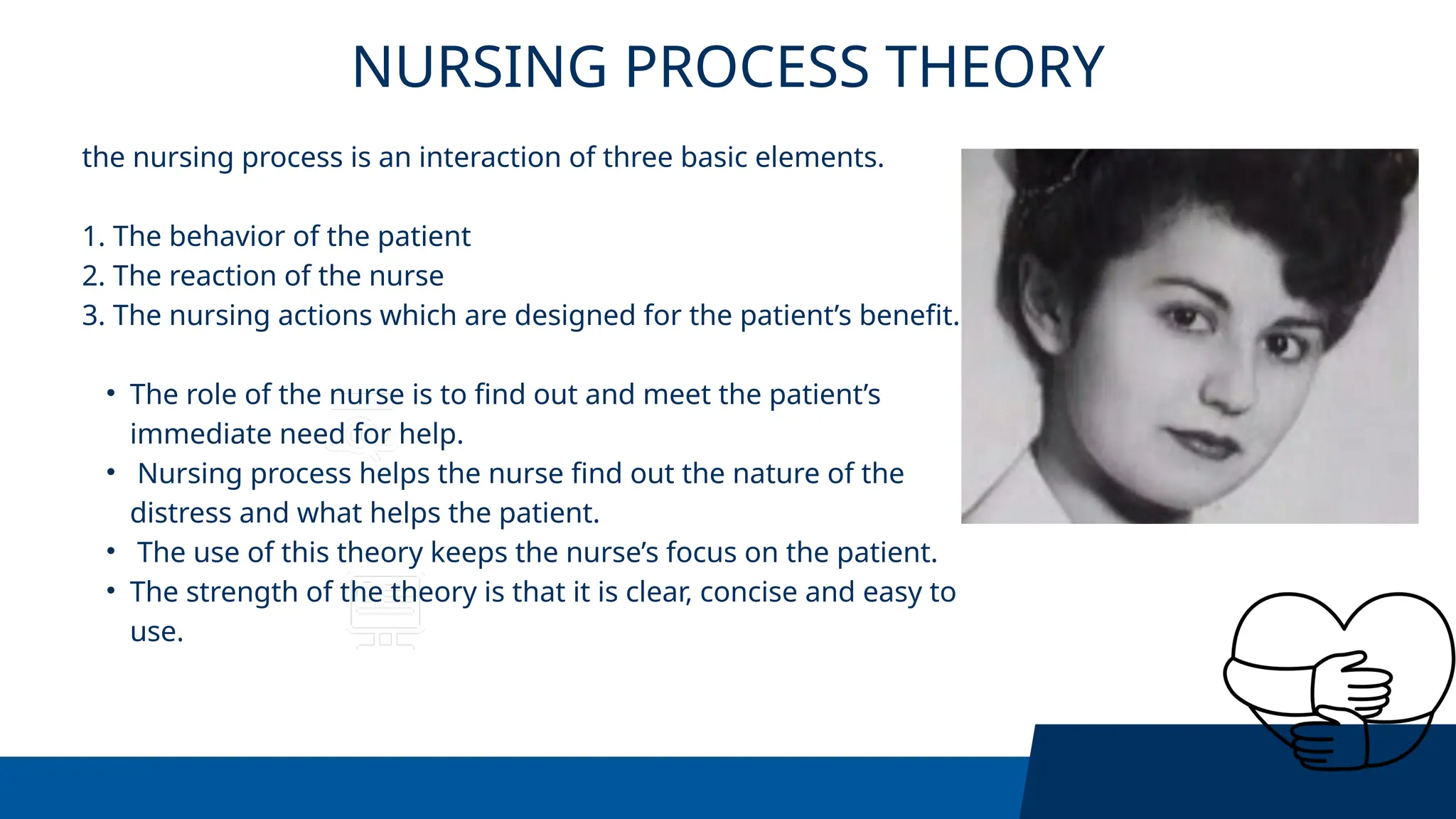
NURSING PROCESS THEORY
the nursing process is an interaction of three basic elements.
1. The behavior of the patient
2. The reaction of the nurse
3. The nursing actions which are designed for the patient’s benefit.
• The role of the nurse is to find out and meet the patient’s
immediate need for help.
• Nursing process helps the nurse find out the nature of the
distress and what helps the patient.
• The use of this theory keeps the nurse’s focus on the patient.
• The strength of the theory is that it is clear, concise and easy to
use.
Borcelle
Company
Theory in View of
Metaparadigms
5 Stages of the
Deliberative Nursing
Process
Ida Jean Orlando described her model as
revolving around the following 5 Stages of the
Deliberative Nursing Process Assesment,
Diagnosis, Planning, Implementation and
Evaluation ( ADPIE )
NURSING PROCESS
EXAMPLE:
Scenario: A patient admitted to the hospital is
exhibiting signs of distress and anxiety.
• Assessment: The nurse observes the patient's behavior, noting
signs of restlessness, increased heart rate, and difficulty
communicating.
• Diagnosis: The nurse identifies the nursing diagnosis as "Anxiety
related to hospitalization and unfamiliar environment."
• Planning: The nurse formulates a care plan to address the
patient's anxiety, including interventions such as therapeutic
communication, relaxation techniques, and emotional support.
• Implementation: The nurse implements the care plan by providing
a calm and reassuring presence, engaging in therapeutic
communication to address the patient's concerns, and teaching
relaxation techniques.
• Evaluation: The nurse evaluates the effectiveness of the
interventions by assessing the patient's level of anxiety and
monitoring changes in behavior. Adjustments to the plan are
made as needed to ensure the patient's emotional well-being is
addressed effectively.
The guarantee that patients will be treated as individuals is very much applied
in Orlando’s theory of the Deliberative Nursing Process. Each patient will have
an active and constant input into their own care.The assertion of nursing’s
independence as a profession and her belief that this independence must be
based on a sound theoretical framework.
The model also guides the nurse to evaluate her care in terms of objectively
observable patient outcomes.
STRENGTHS
The lack of operational definitions of society or environment was evident,
limiting the development of the research hypothesis.
Orlando’s work focuses on short-term care, particularly aware and
conscious individuals, and the virtual absence of reference groups or
family members.
WEAKNESS
Compared to other nursing theories, which are task-oriented, Orlando gave a clear-
cut approach to patient-oriented nursing theory. It uplifts the integrity of
individualized nursing care. This strengthens the role of the nurse as an independent
nurse advocate for the patient. The nurse-patient interaction’s dynamic concept was
justified since the patient’s participation in the relationship was sought. The whole
process is in constant revision through continuous validation of the nurse’s findings
with that of the patient. Because the nurse has to explore her reactions with the
patient constantly, it prevents inaccurate diagnosis or ineffective plans. Since the
model is applied to an immediate situation, its applicability to a long-term care plan is
not feasible. The concept of interaction also limits it to individuals capable of
conversing, a shared limitation with other nurse-client dynamic theories – this theory
does not cover unconscious patients.
ANALYSIS
Orlando's Nursing Process is significant in the nursing profession as it prioritizes the
nurse-patient relationship, communication, critical thinking, prompt needs
assessment, and personalized care planning. It promotes patient-centered care,
enhances therapeutic communication, develops critical thinking skills, ensures timely
intervention, and fosters individualized care plans, ultimately contributing to
compassionate and effective nursing practice.
IMPORTANCE IN NURSING PROFESSION
Orlando's Nursing Process is a valuable framework that enhances nursing practice by
focusing on the dynamic interaction between nurses and patients. Understanding
and implementing Orlando's theory can lead to improved patient satisfaction, better
health outcomes, and a stronger nurse-patient relationship in healthcare settings.ce.
CONCLUSION

nursing theories from the first nursing theory

  • 1.
  • 2.
    1 2 34 GROUP MEMBERS EYAS, LOVEYZEL P. ENRIQUEZ, LOUIESA B. FRESNILLO, KEE SHI A. DONA, ANGEL B.
  • 3.
    5 6 78 GROUP MEMBERS GIGANTO, ALIEGHYA B. DELOS SANTOS, AIZY MAE V. ENTRODUCION, KEZIAH JANA MYKKA S. COSTELO, MARY CHRISTIAN MONA M.
  • 4.
    Virginia Henderson wasborn on November 30, 1897 in Kansas City, Missouri, and was the fifth of eight children in her family. In 1921, Henderson graduated from the Army School of Nursing at Walter Reed Hospital in Washington, D.C. In 1932, she earned her Bachelor’s Degree and in 1934 earned her Master’s Degree in Nursing Education, both from Teachers College at Columbia University. Henderson died on March 19, 1996. HENDERSON’S NEED THEORY
  • 5.
    INTRODUCTION It is anursing theory developed by Virginia Henderson, a pioneering nurse theorist and also known as "the first lady of nursing" and has been called, "arguably the most famous nurse of the 20th century". The theory focuses on the importance of increasing the patient’s independence to accelerate their progress in the hospital. Henderson’s model emphasizes the nurse’s role in assisting individuals with essential activities that contribute to health, recovery, or a peaceful death.
  • 6.
    1. Eating anddrinking 2. Eliminate body wastes 3. Body posture 4. Mobility 5. Day and night pattern 6. Getting dressed and undressed 7. Body temperature 8. Hygiene 9. Avoidance of danger 10. Communication 11. Contact with others 12. Sense of rule and values 13. Daily activities 14. Recreational activities 14 BASIC NEEDS
  • 7.
    • A PATIENTIS RECOVERING FROM SURGERY AND HAS LIMITED MOBILITY. EXAMPLE • BY ADDRESSING THESE NEEDS, THE NURSE HELPS THE PATIENT GAIN INDEPENDENCE IN ACTIVITIES OF DAILY LIVING, IMPROVING THEIR OVERALL RECOVERY AND SATISFACTION WITH CARE. • THE NURSE ASSESSES THE PATIENT’S ABILITY TO BREATHE, EAT, MOVE, AND COMMUNICATE, ALONG WITH OTHER NEEDS OUTLINED IN HENDERSON’S MODEL.
  • 8.
    PENDER’S HEALTH PROMOTIONMODEL THEORY Nola J. Pender, born in 1941, is a nursing theorist known for creating the Health Promotion Model in 1982. Additionally, she serves as a writer and a retired professor of nursing at the University of Michigan. She began researching health-promoting behavior in the mid-1970s and introduced the Health Promotion Model in 1982. Her model for promoting health outlines preventive measures and highlights the crucial role of nurses in assisting patients to prevent illness through self-care and innovative approaches. Pender has been recognized as a Living Legend by the American Academy of Nursing.
  • 9.
    Pender's Health PromotionModel serves as a structure to comprehend and encourage positive health behaviors. It indicates that people play a role in managing their own health and their actions are impacted by a variety of factors. The model highlights that people actively control their behavior, engage with their surroundings, and changing behavior requires self-initiated adjustments to person-environment interactions. INTRODUCTION
  • 10.
    The model consistsof three main components: 1. Individual Characteristics and Experiences: Prior related behaviors, Personal factors, Biological factors, Psychological factors, Socio-cultural. 2. Behavior-Specific Cognitions and Affect: Perceived benefits, Perceived barriers, Perceived self- efficacy, Activity-related affect, Interpersonal influences, Situational influences. 3. Behavioral Outcome: Commitment to action plan and Health-promoting behavior. PENDER’S HEALTH PROMOTION MODEL
  • 11.
  • 12.
    IMPORTANCE IN NURSINGPROFESSION • Nurses find Pender's Health Promotion Model crucial for understanding factors influencing individuals' health choices. Nurses can provide personalized care by considering patients' diversities and adjusting interventions to meet each person's specific needs effectively. • Nurses can help patients acquire healthy habits, master skills, and discover motivation for positive lifestyle changes using the model. Working with communities to create health- promoting environments and considering factors that influence health behaviors can help prevent illness and promote well-being.
  • 13.
    • SMOKING CESSATIONPROGRAM: USING PENDER'S MODEL, A NURSE TAILORS A PROGRAM TO HELP A PATIENT QUIT SMOKING BY ADDRESSING THEIR PERCEIVED BENEFITS OF QUITTING, BARRIERS, AND SELF-EFFICACY. NG FROM SURGERY AND HAS LIMITED MOBILITY. EXAMPLE • DIABETES SELF- MANAGE EDUCATION: A NURSE DESIGNS A DIABETES EDUCATION PROGRAM BASED ON PENDER'S MODEL, ADDRESSING PATIENTS' PRIOR BEHAVIORS, BARRIERS TO SELF-MANAGEMENT, AND EMOTIONAL RESPONSES TO PROMOTE EFFECTIVE SELF-CARE. • WEIGHT Management Intervention: Applying Pender's model, a healthcare professional creates a personalized weight management plan by considering personal factors, benefits of weight loss, and interpersonal influences.
  • 14.
    • Madeleine Leiningerborn on July 13, 1925, is a well- known educator, writer, theorist, administrator, researcher, consultant, public speaker. LEININGER'S THEORY OF CULTURE CARE DIVERSITY AND UNIVERSALITY • She graduated from St. Anthony's Hospital School of Nursing in 1945 and then attended Mount St. Scholastica College and Creighton University to obtain her undergraduate degrees. • Leininger worked at the University of Utah College Nursing from 1974 to 1980 as the dean, a professor of nursing, an adjunct professor of anthropology, and the director of the doctoral and transcultural nursing programs as well as the Center for Nursing Research.
  • 15.
    INTRODUCTION • Transcultural nursingtheory, also known as culture care theory • It focuses on providing meaningful and effective nursing care services to people's cultural values and health-illness setting by learning about and comprehending various cultures' nursing and health-illness caring practices, beliefs, and values. • It emphasizes how diverse cultural norms, values, and behavioral patterns related to health and illness affect how people care for one another
  • 16.
    THE IMPORTANCE OFTRANSCULTURAL THEORY IN NURSING PROFESSION • Help the nurses develop an understanding of and success with treating different popuations • Understanding a patient’s culture allows the nurse to guide treatment while respecting that patient’s traditions and worldview • Establishing a sense of trust with diverse communities is imperative to successfully treating these patients. • Nurses who practice transcultural care bridge modern care with the patient’s heritage, striving to comprehend the patient’s attitudes and concerns for the health condition presented.
  • 17.
    • SOME JEWISHAND ISLAMIC WOMEN BELIEVE THAT MODESTY REQUIRES COVERING THEIR HEAD, ARMS, AND LEGS WITH CLOTHING EXAMPLE • PEOPLE THAT DON'T TRUST MODERN MEDICINE AND WOULD RATHER RELY ON UNLICENSE PRACTITIONERS OR QUACK DOCTORS • COMMUNICATION BARRIERS
  • 18.
    1 2 3 CULTURE OF THEINDIVIDUAL THREE THINGS TO DEEPLY UNDERSTAND THE TRANSCULTURAL THEORY CULTURE OF THE NURSE CULTURE OF THE ENVIRONMENT
  • 19.
    Margaret A. Newman(October 10, 1933) was a pioneering nurse theorist known for her significant contributions to nursing education and research. She earned her Bachelor's degree in 1962 from the University of Tennessee and her Master's in 1964 from the University of California. Newman completed her doctorate at New York University in 1971 and taught there until 1977 before becoming the professor-in- charge of graduate studies in nursing at Penn State University. In 1984, she joined the University of Minnesota as a nurse theorist, retiring in 1996. NEWMAN'S THEORY OF HEALTH AS EXPANDING CONSCIOUSNESS
  • 20.
    INTRODUCTION Margaret Newman's Theoryof Health as Expanding Consciousness redefines health beyond the absence of disease. It views health as a dynamic journey of personal growth and transformation, even amidst illness. The theory highlights that every experience contributes to a deeper self-awareness and understanding of our surroundings, encouraging us to see health as an evolving process where adversity leads to greater awareness and meaning.
  • 21.
    ImportanceinNursing profession man's Theory ofHealth as Expanding Consciousness views health as personal growth, even in illness. It encourages nurses to provide holistic care, focusing on all aspects of a patient's well-being. This approach empowers patients, strengthens nurse-patient relationships, and aligns with nursing values, leading to more meaningful care and professional satisfaction.
  • 22.
    • HOLISTIC CARE:A NURSE TREATS THE PATIENT'S MIND, BODY, AND SPIRIT, NOT JUST THEIR SYMPTOMS. EXAMPLE • ENHANCED RELATIONSHIPS: A NURSE BUILDS TRUST BY DEEPLY UNDERSTANDING A PATIENT'S LIFE EXPERIENCES. • PATIENT EMPOWERMENT: A NURSE HELPS A PATIENT WITH CHRONIC ILLNESS FIND PERSONAL GROWTH AND TAKE CONTROL OF THEIR HEALTH.
  • 23.
    Rosemarie Rizzo Parse,a prominent nursing scholar, earned her degrees from Duquesne University and the University of Pittsburgh. She served as a faculty member at the University of Pittsburgh and was a Dean of Duquesne University School of Nursing. Parse was a professor at CUNY Hunter College and Loyola University Chicago before becoming a consultant and visiting scholar at NYU College of Nursing in 2007. She founded and edits *Nursing Science Quarterly* and leads Discovery International, Inc. Parse has published nine books and over 100 articles, receiving several awards including the New York Times Nurse Educator of the Year Award in 2008 THE HUMAN BECOMING THEORY
  • 24.
    The theory offersa new way to understand people and nursing. It suggests that people can shape their own lives and find personal meaning. Nursing should help people grow and discover their own paths, rather than setting goals for them. Key Points: • Human Experience: People interact with the world in a rhythmic way, make their own choices, and are responsible for their actions. They are always changing and growing. • Becoming: This is about ongoing personal growth and transformation. It means prioritizing values, finding meaning, and evolving through experiences. Core Ideas: • Meaning: People create their own purpose through their experiences. • Rhythmicity: People and their surroundings develop patterns of interaction together. • Transcendence: People continuously grow and push beyond their current limits. INTRODUCTION
  • 25.
    IMPORTANCE IN NURSINGPROFESSION THE THEORY HELPS NURSES DEVELOP BETTER RELATIONSHIPS WITH PATIENTS BY FOCUSING ON THE WHOLE PERSON RATHER THAN JUST SOLVING SPECIFIC PROBLEMS. THE HUMAN BECOMING THEORY OF NURSING EMPHASIZES IMPROVING THE PATIENT’S OVERALL QUALITY OF LIFE AND SEES THEM AS A COMPLETE INDIVIDUAL, NOT JUST A SET OF ISSUES. THIS APPROACH SETS IT APART FROM MANY OTHER NURSING THEORIES AND ALIGNS WITH THE REASON MANY NURSES ENTER THE PROFESSION—TO TRULY HELP PEOPLE.
  • 26.
    EXAMPLES • Revealing-Concealing: apregnant youth reveals her secret to her parents, yet waits until she is showing before she does so. • Enabling-Limiting: A patient chooses to refuse a treatment. He limits his medical options yet enables his free will and autonomy. • Connecting-Separating: A young girl makes the decision to give her newborn son up for adoption. She chooses to separate from him, hoping he will connect with others for a better future.
  • 27.
    Margaret Jean Watson,is a living legend and theorist. She was born in West Virginia in the 1940's and received most of her higher education in colorado. *1958-61 • R.N. Diploma in Nursing • Lewis Gale School of Nursing *1962-64 • B.S. In Nursing • University of Colorado *1964-66 • M.S in Psychiatric Mental- Health Nursing; Minor Psychology • University Colorado *1969-70 • Graduate Work: Social and Clinical Psychology • University of Colorado *1969-73 • Ph.D. in Educational Psychology and Counseling • University in Colorado MARGARET JEAN WATSON
  • 28.
    • An americannurse theorist and nursing professor who is well known to her “Philosophy and theory of ”transpersonal caring” and “ caring science”. • Her study on caring has been integrated into education and patient care to various nursing schools and healthcare facilities all over the world. MARGARET JEAN WATSON
  • 29.
    CONCEPT OF NURSING •Nursing involves the application of art and human and human science through transpersonal transactions in order to help the person achieve mind, body and soul harmony.
  • 30.
    7 ASSUMPTION OFTHE CARING SCIENCE: 1.Caring can be effective demonstrated and practice only interpersonal 2.Caring consist of carative factors that result in the satisfaction of certain human needs. 3.Effective caring promotes health an individual or family growth 4.Caring responses accept a person not only as he or she is now but as what he or she may become. 5.A caring environment is one that offers the development of potential while allowing the person to choose the best action for himself at a given point in time. 6. A science of caring is therefore complementary to the science of curing. 7. The practice of caring is central to nursing.
  • 31.
    MAJOR ELEMENTS OFCARING THEORY: 1.Transpersonal Caring Relationship • how the nurse goes beyond an objective assessment, showing concerns toward the person’s subjective and deeper meaning regarding their own health situation. 2. Caring Occasion/Moment • Moment when the nurse and another person come together in such a way that an occasion for human caring is created. 3. Carative Factors
  • 32.
    TEN CARATIVE FACTORS: •Guide for the core of nursing, need to be addressed by nurses with their patients when in caring role • Carative term to contrast with curative • It honors the human dimensions of nursing work and the inner life world and subjective experiences of patients
  • 33.
    -Watson offered atranslation of the original carative factors into clinical caritas processes that suggested ways to apply the 10 carative factors
  • 34.
    CARATIVE FACTORS CARITASPROCESS 1.“ The formation of humanistic- altruistic system of values” “Practice of loving-kindness and equinimity within the context of caring consciousness 2. “The installation of Faith-Hope” “Being authentically present and enabling and sustaining the deep belief system and subjective life- world of self and one being cared for” 3. “The cultivation of sensitivity to one’s self and to others” “Cultivation of one’s own spiritual practices and transpersonal self-going beyond the ego-self”
  • 35.
    CARATIVE FACTORS CARITASPROCESS 4. “Development of a helping-trust relationship” became “ development of a helping-trusting, human caring relation” “Developing and sustaining a helping trusting authentic caring relationship” 5. “ The promotion and acceptance of the expression of positive and negative feelings” “Being present to, and supportive of, the expression of positive and negative feelings as a connection with deeper spirit and self and the one being-cared for”
  • 36.
    CARATIVE FACTORS CARITASPROCESS 6. “The systematic use of the scientific problem- solving method for decision” became “ systematic use of a creative problem solving caring process” (in 2004 watson website) “Creative use of self and all ways of knowing as part of the caring process; to engage in the artistry of caring-healing process.” 7. “The promotion of transpersonal teaching-learning” “Engaging in genuine teaching- learning experience that attends to unity of being and meaning, attempting to stay within other’s frame of reference”
  • 37.
    CARATIVE FACTORS CARITASPROCESS 8. “The provision of supportive, protective, and (or) corrective mental, physical,societal, and spiritual environment” “Creating healing environment at all levels (physical as well as nonphysical, subtle environment of energy and consciousness, whereby wholeness, beauty,comfort,dignity, and peace are potentiated” 9. “The assistance with gratification of human needs” “Assisting with basic needs, with an intentional caring consciousness, administering ‘human care essentials’, which potentiate alignment of mind body spirit, wholeness, and unity of being in all aspects of care”
  • 38.
    CARATIVE FACTORS CARITASPROCESS 10. “ The allowance for existential- phenomenological forces” became “ allowance for existential- phenomenological spiritual forces” “ Opening and attending to spiritual- mysterious and existential dimensions of one’s own life-death; soul care for self and the one-being- cared for”
  • 39.
    EXAMPLE: Scenario: A postpartumwomen experiencing multiple emotions
  • 40.
    ORLANDO’S NURSING PROCESS Ida JeanOrlando, the esteemed nurse theorist, held a nursing diploma from the New York Medical College and Hospital School of Nursing and earned a Bachelor of Science in Nursing (BSN) from St. John's University in New York. Her academic accomplishments include a Master of Arts in Mental Health Consultation from Teachers College, Columbia University. Orlando's diverse professional experience encompassed roles in psychiatric nursing, public health nursing, research, as well as positions as a staff nurse, supervisor, and director of nursing services. In 1961, Orlando published her groundbreaking work, "The Dynamic Nurse-Patient Relationship: Function, Process, and Principles," which introduced her influential theory of the nursing process. Her theory, emphasizing the nurse's perception of the patient's behavior and needs, has significantly impacted nursing practice, education, and research. Orlando's enduring legacy as a visionary in nursing is marked by her advocacy for patient-centered care, therapeutic communication, and the holistic well-being of individuals in healthcare settings.
  • 41.
    Orlando's Nursing Process,developed by Ida Jean Orlando, is a patient-centered framework emphasizing the dynamic interaction between the nurse and patient.Orlando's theory emphasizes the nurse's perception of the patient's behavior and needs, guiding individualized care and therapeutic communication. This approach enhances the nurse-patient relationship and improves patient outcomes across diverse healthcare settings. Orlando's Nursing Process is a significant contribution to nursing practice, highlighting the importance of holistic care delivery and personalized interventions to meet patient needs effectively.aculty member at the University of Pittsburgh and was a Dean of Duquesne University School of Nursing. INTRODUCTION
  • 42.
    NURSING PROCESS THEORY thenursing process is an interaction of three basic elements. 1. The behavior of the patient 2. The reaction of the nurse 3. The nursing actions which are designed for the patient’s benefit. • The role of the nurse is to find out and meet the patient’s immediate need for help. • Nursing process helps the nurse find out the nature of the distress and what helps the patient. • The use of this theory keeps the nurse’s focus on the patient. • The strength of the theory is that it is clear, concise and easy to use.
  • 43.
  • 44.
    5 Stages ofthe Deliberative Nursing Process Ida Jean Orlando described her model as revolving around the following 5 Stages of the Deliberative Nursing Process Assesment, Diagnosis, Planning, Implementation and Evaluation ( ADPIE )
  • 45.
  • 46.
    EXAMPLE: Scenario: A patientadmitted to the hospital is exhibiting signs of distress and anxiety.
  • 47.
    • Assessment: Thenurse observes the patient's behavior, noting signs of restlessness, increased heart rate, and difficulty communicating. • Diagnosis: The nurse identifies the nursing diagnosis as "Anxiety related to hospitalization and unfamiliar environment." • Planning: The nurse formulates a care plan to address the patient's anxiety, including interventions such as therapeutic communication, relaxation techniques, and emotional support. • Implementation: The nurse implements the care plan by providing a calm and reassuring presence, engaging in therapeutic communication to address the patient's concerns, and teaching relaxation techniques. • Evaluation: The nurse evaluates the effectiveness of the interventions by assessing the patient's level of anxiety and monitoring changes in behavior. Adjustments to the plan are made as needed to ensure the patient's emotional well-being is addressed effectively.
  • 48.
    The guarantee thatpatients will be treated as individuals is very much applied in Orlando’s theory of the Deliberative Nursing Process. Each patient will have an active and constant input into their own care.The assertion of nursing’s independence as a profession and her belief that this independence must be based on a sound theoretical framework. The model also guides the nurse to evaluate her care in terms of objectively observable patient outcomes. STRENGTHS The lack of operational definitions of society or environment was evident, limiting the development of the research hypothesis. Orlando’s work focuses on short-term care, particularly aware and conscious individuals, and the virtual absence of reference groups or family members. WEAKNESS
  • 49.
    Compared to othernursing theories, which are task-oriented, Orlando gave a clear- cut approach to patient-oriented nursing theory. It uplifts the integrity of individualized nursing care. This strengthens the role of the nurse as an independent nurse advocate for the patient. The nurse-patient interaction’s dynamic concept was justified since the patient’s participation in the relationship was sought. The whole process is in constant revision through continuous validation of the nurse’s findings with that of the patient. Because the nurse has to explore her reactions with the patient constantly, it prevents inaccurate diagnosis or ineffective plans. Since the model is applied to an immediate situation, its applicability to a long-term care plan is not feasible. The concept of interaction also limits it to individuals capable of conversing, a shared limitation with other nurse-client dynamic theories – this theory does not cover unconscious patients. ANALYSIS
  • 50.
    Orlando's Nursing Processis significant in the nursing profession as it prioritizes the nurse-patient relationship, communication, critical thinking, prompt needs assessment, and personalized care planning. It promotes patient-centered care, enhances therapeutic communication, develops critical thinking skills, ensures timely intervention, and fosters individualized care plans, ultimately contributing to compassionate and effective nursing practice. IMPORTANCE IN NURSING PROFESSION
  • 51.
    Orlando's Nursing Processis a valuable framework that enhances nursing practice by focusing on the dynamic interaction between nurses and patients. Understanding and implementing Orlando's theory can lead to improved patient satisfaction, better health outcomes, and a stronger nurse-patient relationship in healthcare settings.ce. CONCLUSION