
Presenter : Ms. Ritika soni
 Biography : Background of
the theorist
 Abdellah’s theory : Nursing
as a comprehensive service
 Major assumptions,
concepts & relationships
 10 steps to identify client’s
problems
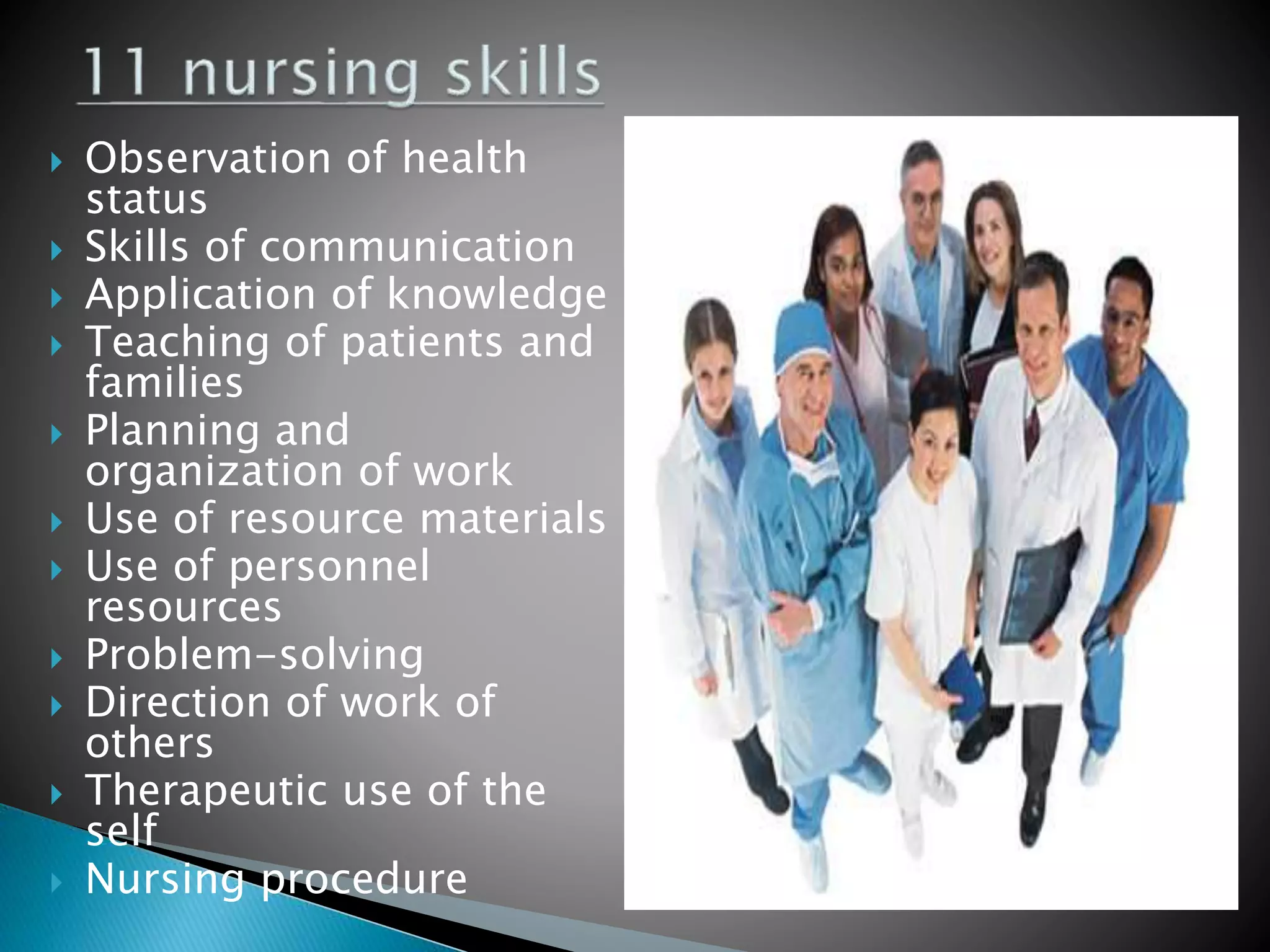
 11 nursing skills
 21 nursing problems
nursing practice
 Metaparadigms
 Characteristics of theory
 Nursing process and
Abdellah’s Theory
 Exercise
Biography
 Born –March 13 ,1919, in New York city.
Educational achievement:
 In 1942, Nursing Diploma from Fitkin Memorial’s Hospital,
school of nursing New Jersey (now Ann may school of nursing)
 Bachelors Degree in Nursing 1945, Columbia University
 Masters Degree in Physiology 1947 ,Columbia University
 Doctorate in Education in teacher’s college, 1955 ,Columbia University
Accomplishments
MILITARY NURSING SERVICES
Served 40 years in U.S. Public Health Service, (PHS) commissioned corps ,a
branch of military.
Also worked in U.S. Public Health Service, dept. of health
and human services, commissioned corps ,a branch of
military, washington,D.C.
 Chief Nurse Officer, head nurse
 Deputy U.S. Surgeon General(1982)
Uniformed Services University of Health Sciences
 Founder and First Dean, Graduate School of Nursing
Yale University School of Nursing
 Nursing Instructor
 Retired in 1989.
Research
• She was pioneer nursing researcher, helped to transform nursing theory,
nursing care and nursing education.
• Leader in nursing research
• Has over one hundred publications related to nursing care, education and
advanced practices in nursing and nursing research.
• Author of more than 147 articles and books
 Assisted in international nursing research studies during the Korean War
(China, Japan, Australia, Russia)
 Abdellah’s research findings led to the first tested coronary care unit
 Theory and research data led to the establishment of the Office of Long-
Term Care
 In 1960, desire to promote client- centered
comprehensive nursing care, described
nursing as a service to individuals, to families
to society.
 Acc. to her, nursing is based on an art and
science that moulds the attitudes, intellectual
competencies and technical skills of the
individual nursing officer in to desire and
ability to help people, sick or well, cope with
their health needs.
 Recognizing the nursing
problems of the patient
 Deciding the appropriate
course of action
 Providing continuous care
of the individuals total
needs
 Providing continuous care
to relieve pain and
discomfort
 Adjusting the total
nursing care plan to meet
the patient’s individual
needs
 Helping the individual to maintain a healthy
state of mind & body
 Instructing nursing personnel and family to
help the individual
 Helping the individual to adjust to his
limitations and emotional problems
 Working with allied health professions in
planning for optimum health on local, state,
national and international levels
 Carrying out continuous evaluation and
research to improve nursing techniques and
to develop new techniques to meet the health
needs of people
 The language of Abdellah's framework is
readable & clear.
 She uses the term ‘she’ for nurses, ‘he’ for
doctors and patients, and refers to the object
of nursing as ‘patient’ rather than client or
consumer.
 Referred to nursing diagnosis
 Need to appreciate the interconnections of
social enterprises and social problems
 Impact of social problems I,e poverty, racism,
pollution, education on health care delivery.
 Changing nursing education
 Continuing education for professional nurses
 Abdellah and colleagues developed a list of
 21 nursing problems
 10 steps to identify the client’s problems.
 11 nursing skills
to be used in developing a treatment typology
 Learn to know the patient
 Sort out relevant and significant data
 Make generalizations about available data
 Identify the therapeutic plan
 Test generalizations with the patient and make
additional generalizations
 Validate the patient’s conclusions about his
nursing problems
 Continue to observe and evaluate the patient
over a period of time
 Explore the patient’s and family’s reaction
 Identify how the nurses feels about the patient’s
nursing problems
 Discuss and develop a comprehensive nursing
care plan
 Observation of health
status
 Skills of communication
 Application of knowledge
 Teaching of patients and
families
 Planning and
organization of work
 Use of resource materials
 Use of personnel
resources
 Problem-solving
 Direction of work of
others
 Therapeutic use of the
self
 Nursing procedure
 Three major categories
 Physical, sociological, and emotional needs of
clients
 Types of interpersonal relationships between
the nurse and patient
 Common elements
of client care
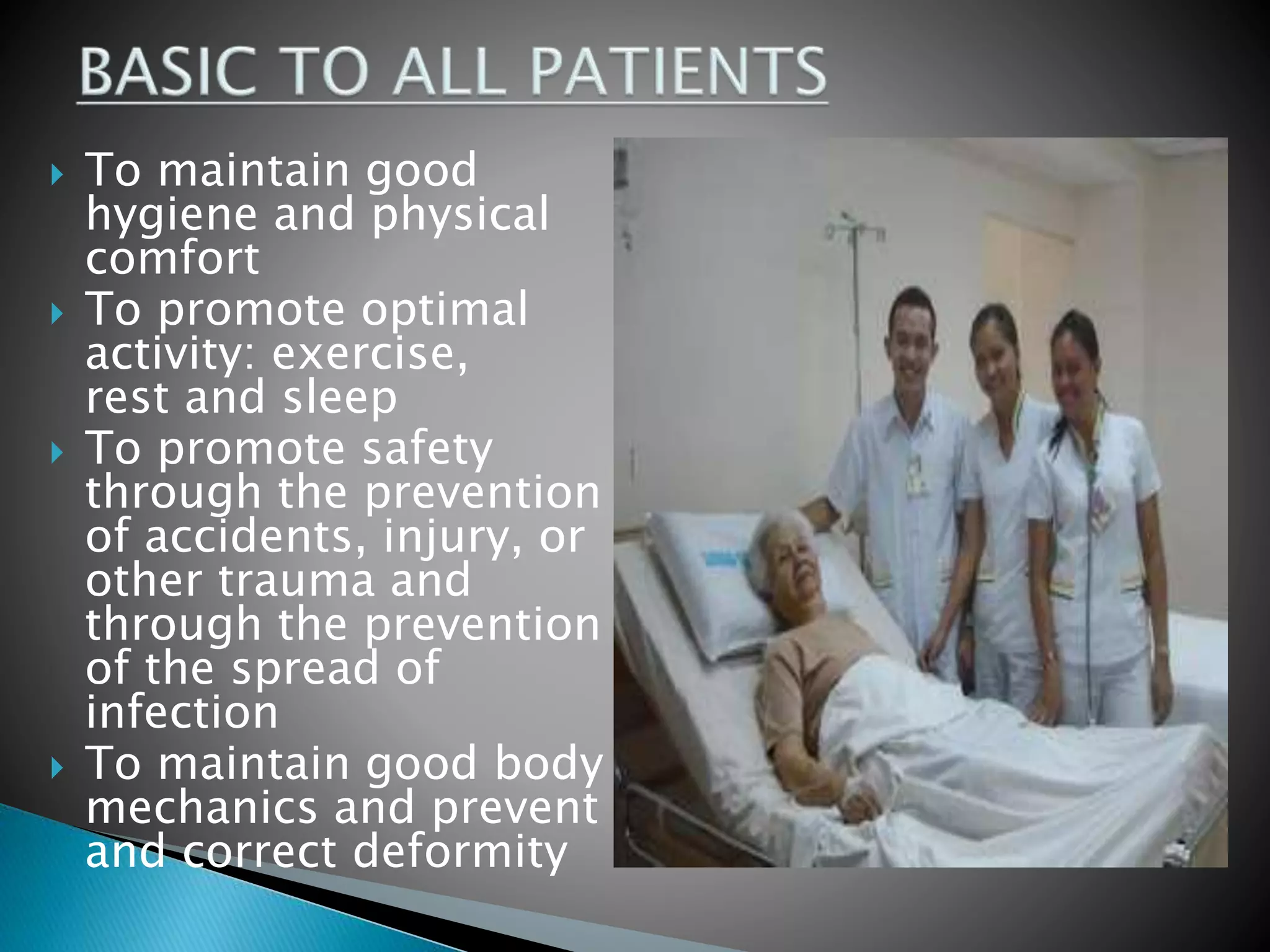
 To maintain good
hygiene and physical
comfort
 To promote optimal
activity: exercise,
rest and sleep
 To promote safety
through the prevention
of accidents, injury, or
other trauma and
through the prevention
of the spread of
infection
 To maintain good body
mechanics and prevent
and correct deformity
 To facilitate the maintenance
of a supply of oxygen
 To facilitate the maintenance
of nutrition
 To facilitate the maintenance
of elimination
 To facilitate the maintenance
of fluid and electrolyte
balance
 To recognize the physiological
responses of the body to
disease conditions
 To facilitate the maintenance
of regulatory mechanisms and
functions
 To facilitate the maintenance
of sensory function.
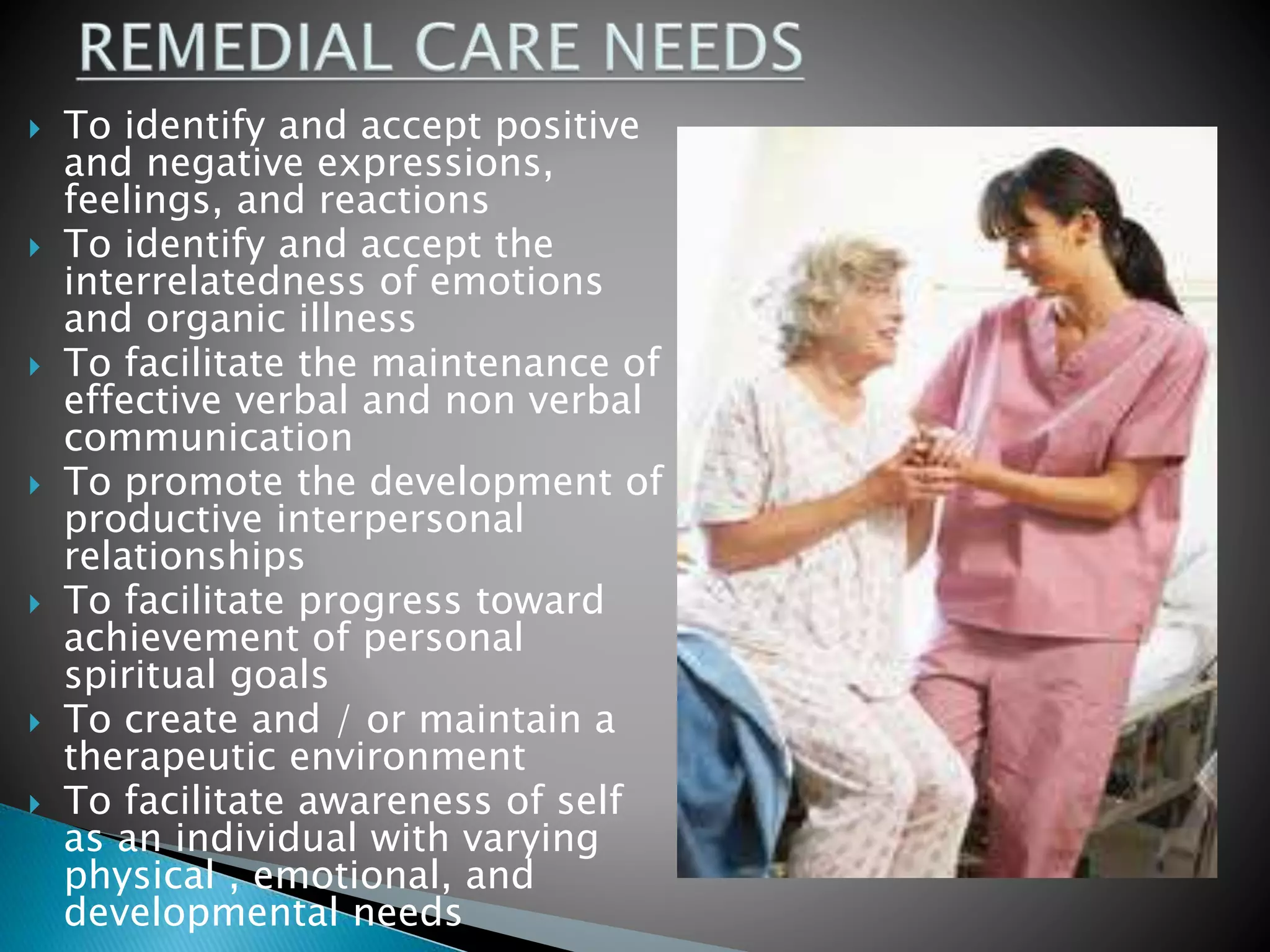
 To identify and accept positive
and negative expressions,
feelings, and reactions
 To identify and accept the
interrelatedness of emotions
and organic illness
 To facilitate the maintenance of
effective verbal and non verbal
communication
 To promote the development of
productive interpersonal
relationships
 To facilitate progress toward
achievement of personal
spiritual goals
 To create and / or maintain a
therapeutic environment
 To facilitate awareness of self
as an individual with varying
physical , emotional, and
developmental needs
 To accept the
optimum possible
goals in the light of
limitations, physical
and emotional
 To use community
resources as an aid
in resolving problems
arising from illness
 To understand the
role of social
problems as
influencing factors in
the case of illness
 NURSING
 Nursing is a helping
profession.
 Nursing care is doing
something to or for the
person or providing
information to the person
 Nursing is broadly
grouped into the 21
problem areas to guide
care and promote use of
nursing judgment.
 Nursing to be
comprehensive service
 PERSON
 Abdellah describes people as having physical,
emotional, and sociological needs.
 Patient is described as the only justification
for the existence of nursing.
 Individuals (and families) are the recipients of
nursing
 Health, or achieving of it, is the purpose of
nursing services.
 HEALTH
 In Patient–Centered Approaches to Nursing,
Abdellah describes health as a state mutually
exclusive of illness.
 Although Abdellah does not give a definition
of health, she speaks to “total health needs”
and “a healthy state of mind and body” in her
description of nursing as a comprehensive
service.
 SOCIETY AND ENVIRONMENT
 Society is included in “planning for optimum
health on local, state, national, and
international levels”.
 The environment is the home or community
from which patient comes.
 Abdellah’s theory has interrelated the
concepts of health, nursing problems, and
problem solving.
 Problem solving is an activity that is
inherently logical in nature.
 Focus on nursing practice and individuals.
 The results of testing such hypothesis would
contribute to the general body of nursing
knowledge
 Easy to apply in practice.
ASSESSMENT PHASE
 Nursing problems provide guidelines for the
collection of data.
 A principle underlying the problem solving
approach is that for each identified problem,
pertinent data are collected.
 The overt or covert nature of the problems
necessitates a direct or indirect approach,
respectively.
 NURSING DIAGNOSIS
 The results of data collection would
determine the client’s specific overt or covert
problems.
 These specific problems would be grouped
under one or more of the broader nursing
problems.
 This step is consistent with that involved in
nursing diagnosis
 PLANNING PHASE
 The statements of nursing problems most
closely resemble goal statements. Once the
problem has been diagnosed, the nursing
goals have been established.
 IMPLEMENTATION
 Using the goals as the framework, a plan is
developed and appropriate nursing
interventions are determined.
 EVALUATION
 The most appropriate evaluation would be
the nurse progress or lack of progress toward
the achievement of the stated goals..
Application of Faye Glenn Abdellah’s theory in
nursing process.
 Case of Mr. Simar:
 Mr. Simar experienced severe chest pain. In
addition he experienced shortness of breath,
tachycardia and profuse diaphoresis.
Faye Glenn Abdellah''s Theory - Ms. Ritika soni

Faye Glenn Abdellah''s Theory - Ms. Ritika soni

  • 1.
    Presenter : Ms.Ritika soni
  • 2.
     Biography :Background of the theorist  Abdellah’s theory : Nursing as a comprehensive service  Major assumptions, concepts & relationships  10 steps to identify client’s problems  11 nursing skills  21 nursing problems nursing practice  Metaparadigms  Characteristics of theory  Nursing process and Abdellah’s Theory  Exercise
  • 3.
    Biography  Born –March13 ,1919, in New York city. Educational achievement:  In 1942, Nursing Diploma from Fitkin Memorial’s Hospital, school of nursing New Jersey (now Ann may school of nursing)  Bachelors Degree in Nursing 1945, Columbia University  Masters Degree in Physiology 1947 ,Columbia University  Doctorate in Education in teacher’s college, 1955 ,Columbia University Accomplishments MILITARY NURSING SERVICES Served 40 years in U.S. Public Health Service, (PHS) commissioned corps ,a branch of military.
  • 4.
    Also worked inU.S. Public Health Service, dept. of health and human services, commissioned corps ,a branch of military, washington,D.C.  Chief Nurse Officer, head nurse  Deputy U.S. Surgeon General(1982) Uniformed Services University of Health Sciences  Founder and First Dean, Graduate School of Nursing Yale University School of Nursing  Nursing Instructor  Retired in 1989.
  • 5.
    Research • She waspioneer nursing researcher, helped to transform nursing theory, nursing care and nursing education. • Leader in nursing research • Has over one hundred publications related to nursing care, education and advanced practices in nursing and nursing research. • Author of more than 147 articles and books  Assisted in international nursing research studies during the Korean War (China, Japan, Australia, Russia)  Abdellah’s research findings led to the first tested coronary care unit  Theory and research data led to the establishment of the Office of Long- Term Care
  • 6.
     In 1960,desire to promote client- centered comprehensive nursing care, described nursing as a service to individuals, to families to society.  Acc. to her, nursing is based on an art and science that moulds the attitudes, intellectual competencies and technical skills of the individual nursing officer in to desire and ability to help people, sick or well, cope with their health needs.
  • 7.
     Recognizing thenursing problems of the patient  Deciding the appropriate course of action  Providing continuous care of the individuals total needs  Providing continuous care to relieve pain and discomfort  Adjusting the total nursing care plan to meet the patient’s individual needs
  • 8.
     Helping theindividual to maintain a healthy state of mind & body  Instructing nursing personnel and family to help the individual  Helping the individual to adjust to his limitations and emotional problems  Working with allied health professions in planning for optimum health on local, state, national and international levels  Carrying out continuous evaluation and research to improve nursing techniques and to develop new techniques to meet the health needs of people
  • 9.
     The languageof Abdellah's framework is readable & clear.  She uses the term ‘she’ for nurses, ‘he’ for doctors and patients, and refers to the object of nursing as ‘patient’ rather than client or consumer.  Referred to nursing diagnosis  Need to appreciate the interconnections of social enterprises and social problems  Impact of social problems I,e poverty, racism, pollution, education on health care delivery.
  • 10.
     Changing nursingeducation  Continuing education for professional nurses  Abdellah and colleagues developed a list of  21 nursing problems  10 steps to identify the client’s problems.  11 nursing skills to be used in developing a treatment typology
  • 11.
     Learn toknow the patient  Sort out relevant and significant data  Make generalizations about available data  Identify the therapeutic plan  Test generalizations with the patient and make additional generalizations  Validate the patient’s conclusions about his nursing problems  Continue to observe and evaluate the patient over a period of time  Explore the patient’s and family’s reaction  Identify how the nurses feels about the patient’s nursing problems  Discuss and develop a comprehensive nursing care plan
  • 12.
     Observation ofhealth status  Skills of communication  Application of knowledge  Teaching of patients and families  Planning and organization of work  Use of resource materials  Use of personnel resources  Problem-solving  Direction of work of others  Therapeutic use of the self  Nursing procedure
  • 13.
     Three majorcategories  Physical, sociological, and emotional needs of clients  Types of interpersonal relationships between the nurse and patient  Common elements of client care
  • 14.
     To maintaingood hygiene and physical comfort  To promote optimal activity: exercise, rest and sleep  To promote safety through the prevention of accidents, injury, or other trauma and through the prevention of the spread of infection  To maintain good body mechanics and prevent and correct deformity
  • 15.
     To facilitatethe maintenance of a supply of oxygen  To facilitate the maintenance of nutrition  To facilitate the maintenance of elimination  To facilitate the maintenance of fluid and electrolyte balance  To recognize the physiological responses of the body to disease conditions  To facilitate the maintenance of regulatory mechanisms and functions  To facilitate the maintenance of sensory function.
  • 16.
     To identifyand accept positive and negative expressions, feelings, and reactions  To identify and accept the interrelatedness of emotions and organic illness  To facilitate the maintenance of effective verbal and non verbal communication  To promote the development of productive interpersonal relationships  To facilitate progress toward achievement of personal spiritual goals  To create and / or maintain a therapeutic environment  To facilitate awareness of self as an individual with varying physical , emotional, and developmental needs
  • 17.
     To acceptthe optimum possible goals in the light of limitations, physical and emotional  To use community resources as an aid in resolving problems arising from illness  To understand the role of social problems as influencing factors in the case of illness
  • 18.
     NURSING  Nursingis a helping profession.  Nursing care is doing something to or for the person or providing information to the person  Nursing is broadly grouped into the 21 problem areas to guide care and promote use of nursing judgment.  Nursing to be comprehensive service
  • 19.
     PERSON  Abdellahdescribes people as having physical, emotional, and sociological needs.  Patient is described as the only justification for the existence of nursing.  Individuals (and families) are the recipients of nursing  Health, or achieving of it, is the purpose of nursing services.
  • 20.
     HEALTH  InPatient–Centered Approaches to Nursing, Abdellah describes health as a state mutually exclusive of illness.  Although Abdellah does not give a definition of health, she speaks to “total health needs” and “a healthy state of mind and body” in her description of nursing as a comprehensive service.
  • 21.
     SOCIETY ANDENVIRONMENT  Society is included in “planning for optimum health on local, state, national, and international levels”.  The environment is the home or community from which patient comes.
  • 22.
     Abdellah’s theoryhas interrelated the concepts of health, nursing problems, and problem solving.  Problem solving is an activity that is inherently logical in nature.  Focus on nursing practice and individuals.  The results of testing such hypothesis would contribute to the general body of nursing knowledge  Easy to apply in practice.
  • 23.
    ASSESSMENT PHASE  Nursingproblems provide guidelines for the collection of data.  A principle underlying the problem solving approach is that for each identified problem, pertinent data are collected.  The overt or covert nature of the problems necessitates a direct or indirect approach, respectively.
  • 24.
     NURSING DIAGNOSIS The results of data collection would determine the client’s specific overt or covert problems.  These specific problems would be grouped under one or more of the broader nursing problems.  This step is consistent with that involved in nursing diagnosis
  • 25.
     PLANNING PHASE The statements of nursing problems most closely resemble goal statements. Once the problem has been diagnosed, the nursing goals have been established.  IMPLEMENTATION  Using the goals as the framework, a plan is developed and appropriate nursing interventions are determined.
  • 26.
     EVALUATION  Themost appropriate evaluation would be the nurse progress or lack of progress toward the achievement of the stated goals..
  • 27.
    Application of FayeGlenn Abdellah’s theory in nursing process.  Case of Mr. Simar:  Mr. Simar experienced severe chest pain. In addition he experienced shortness of breath, tachycardia and profuse diaphoresis.