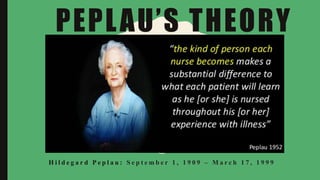
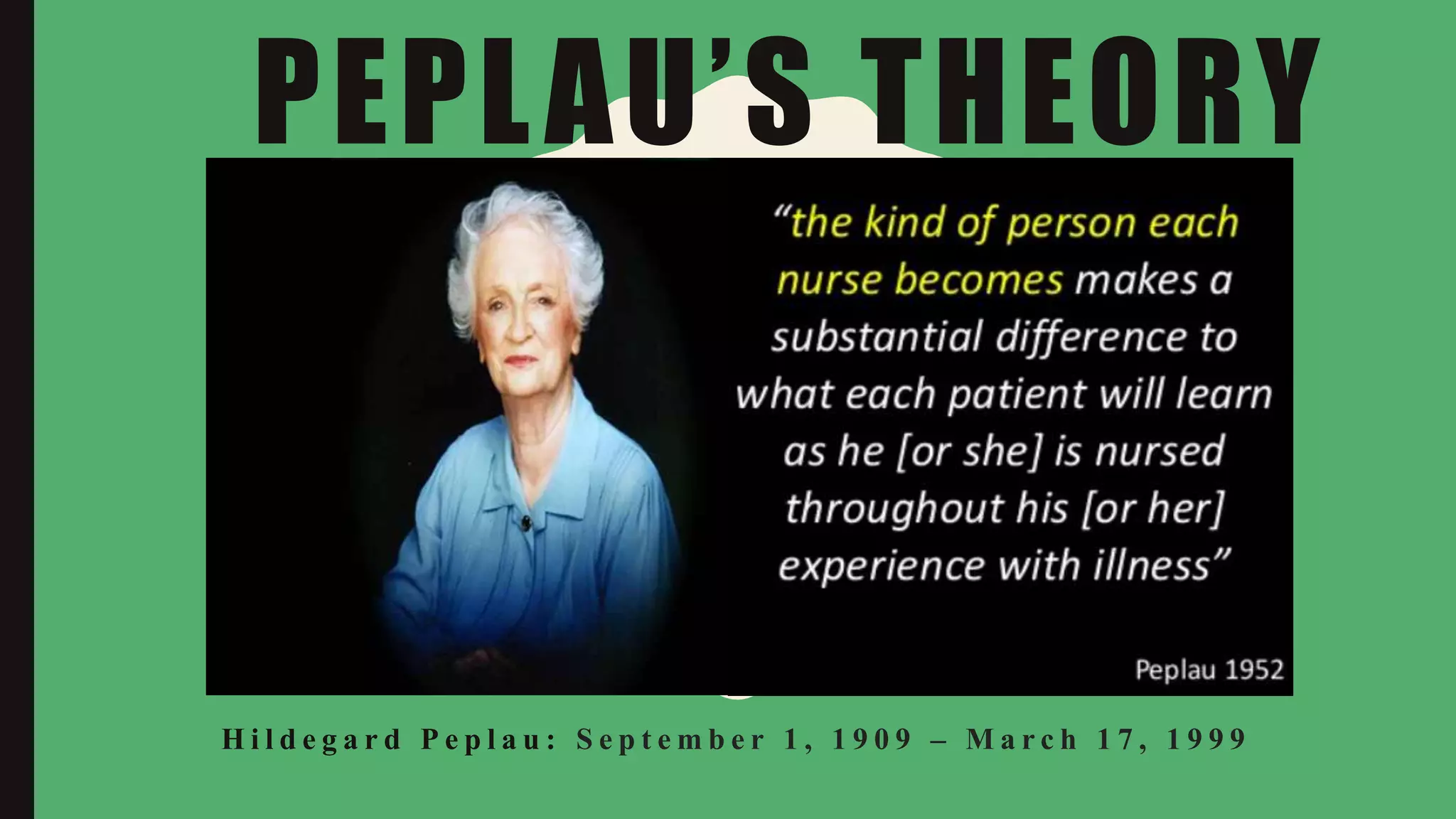
PEPLAU’S THEORY
H i l d e g a r d P e p l a u : S e p t e m b e r 1 , 1 9 0 9 – M a r c h 1 7 , 1 9 9 9
INTRODUCTION
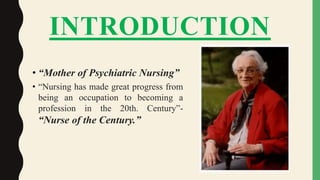
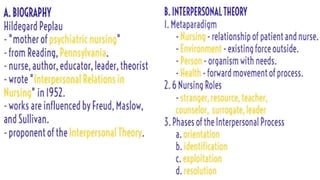
• “Mother of Psychiatric Nursing”
• “Nursing has made great progress from
being an occupation to becoming a
profession in the 20th. Century”-
“Nurse of the Century.”
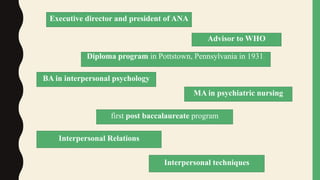
Executive director and president of ANA
Advisor to WHO
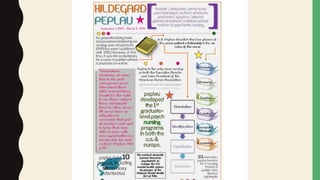
Diploma program in Pottstown, Pennsylvania in 1931.
BA in interpersonal psychology
MA in psychiatric nursing
first post baccalaureate program
Interpersonal Relations
Interpersonal techniques
.
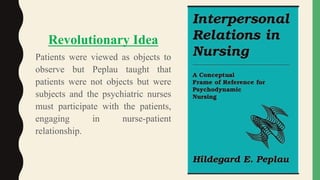
Revolutionary Idea
Patients were viewed as objects to
observe but Peplau taught that
patients were not objects but were
subjects and the psychiatric nurses
must participate with the patients,
engaging in nurse-patient
relationship.
INTERPERSONAL THEORY OF
NURSING
• Theory emphasized the nurse-client relationship as the foundation of
nursing practice.
• It gave emphasis on the give-and-take of nurse-client relationships .
• She defined nursing as interpersonal process of therapeutic
interactions between an individual who is sick or need of health
services and a nurse especially educated to recognize and respond to
the need for help.
ASSUMPTIONS
Nurse and patient can interact.
Both the nurse and patient matures as the result of the therapeutic
interaction.
Communication and interviewing skills remain fundamental
nursing tools.
Nurses must clearly understand themselves to promote their
client’s growth and to avoid limiting the client’s choice to those that
nurses value.
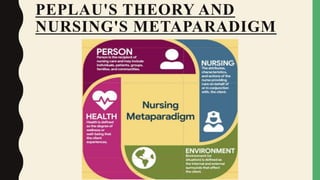
PEPLAU'S THEORY AND
NURSING'S METAPARADIGM
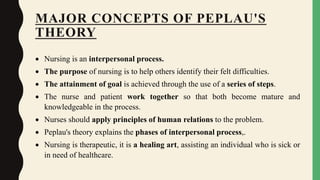
MAJOR CONCEPTS OF PEPLAU'S
THEORY
 Nursing is an interpersonal process.
 The purpose of nursing is to help others identify their felt difficulties.
 The attainment of goal is achieved through the use of a series of steps.
 The nurse and patient work together so that both become mature and
knowledgeable in the process.
 Nurses should apply principles of human relations to the problem.
 Peplau's theory explains the phases of interpersonal process,.
 Nursing is therapeutic, it is a healing art, assisting an individual who is sick or
in need of healthcare.
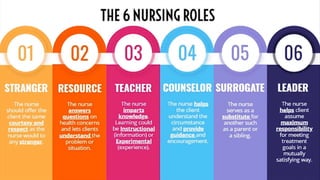
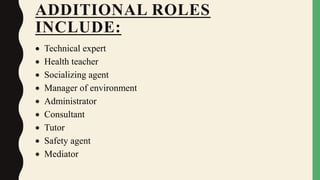
ADDITIONAL ROLES
INCLUDE:
 Technical expert
 Health teacher
 Socializing agent
 Manager of environment
 Administrator
 Consultant
 Tutor
 Safety agent
 Mediator
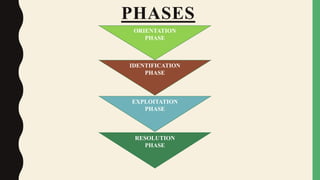
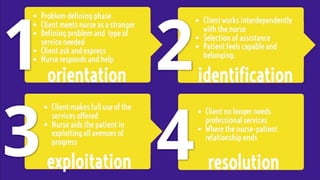
PHASES
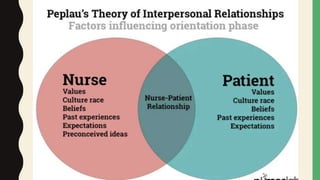
ORIENTATION
PHASE
IDENTIFICATION
PHASE
EXPLOITATION
PHASE
RESOLUTION
PHASE
ELEMENTS INVOLVED IN NURSE-
PATIENT RELATIONSHIP
 Contract
 Boundaries
 Confidentiality
THERAPEUTIC NURSE BEHAVIOURS
 Self-awareness
 Warmth and respectfulness
 Cultural sensitivity
 Ethical practice
 Genuineness
 Empathy
 Responsibility
INTERPERSONAL THEORY AND
NURSING PROCESS
Both are sequential and focus on therapeutic
relationship
Both use problem solving techniques for the nurse and
patient to collaborate on, with the end purpose patient’s
needs.
Both use observation, communication and recording as
basic tools utilized by nursing.
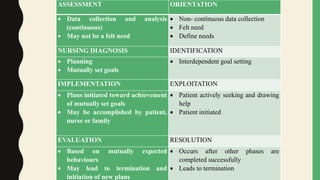
ASSESSMENT ORIENTATION
 Data collection and analysis
(continuous)
 May not be a felt need
 Non- continuous data collection
 Felt need
 Define needs
NURSING DIAGNOSIS IDENTIFICATION
 Planning
 Mutually set goals
 Interdependent goal setting
IMPLEMENTATION EXPLOITATION
 Plans initiated toward achievement
of mutually set goals
 May be accomplished by patient,
nurse or family
 Patient actively seeking and drawing
help
 Patient initiated
EVALUATION RESOLUTION
 Based on mutually expected
behaviours
 May lead to termination and
initiation of new plans
 Occurs after other phases are
completed successfully
 Leads to termination
CHARACTERISTICS OF A THEORY
 Interrelation of concepts
 Applicability
 Theories must be logical in nature
 Generalizable
 Theories can be the basis for hypothesis that can be tested
 Theories can be utilized by practitioners to guide and improve their practice
 Theories must be consistent with other validated theories, laws, and principles
but will leave open unanswered questions that need to be investigated
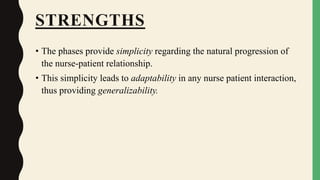
STRENGTHS
• The phases provide simplicity regarding the natural progression of
the nurse-patient relationship.
• This simplicity leads to adaptability in any nurse patient interaction,
thus providing generalizability.
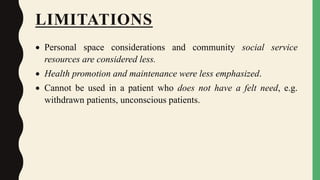
LIMITATIONS
 Personal space considerations and community social service
resources are considered less.
 Health promotion and maintenance were less emphasized.
 Cannot be used in a patient who does not have a felt need, e.g.
withdrawn patients, unconscious patients.
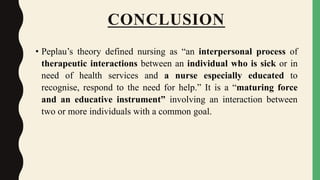
CONCLUSION
• Peplau’s theory defined nursing as “an interpersonal process of
therapeutic interactions between an individual who is sick or in
need of health services and a nurse especially educated to
recognise, respond to the need for help.” It is a “maturing force
and an educative instrument” involving an interaction between
two or more individuals with a common goal.
BIBLIOGRAPHY
 Navdeep Kaur Brar, HC Rawat, Textbook of advance nursing practice, 1st
edition, New Delhi, Jaypee brother’s medical publishers, 2015
 Potter, P.A., perry, A.G. Stockert, P., & hall, A. (2016), fundamentals of
nursing, 9th edition, Mosby
 KP Neerja, textbook of communication and education technology for nurses,
1st edition, New Delhi, Jaypee brother’s medical publishers pvt. Ltd. 2011
 Hildegard Peplau: Interpersonal Relations Theory Guide [Internet].
Nurseslabs. 2020 [cited 30 December 2020]. Available from:
https://nurseslabs.com/hildegard-peplaus-interpersonal-relations-theory/
Peplau's theory ppt slideshare

Peplau's theory ppt slideshare

  • 1.
    PEPLAU’S THEORY H il d e g a r d P e p l a u : S e p t e m b e r 1 , 1 9 0 9 – M a r c h 1 7 , 1 9 9 9
  • 3.
    INTRODUCTION • “Mother ofPsychiatric Nursing” • “Nursing has made great progress from being an occupation to becoming a profession in the 20th. Century”- “Nurse of the Century.”
  • 4.
    Executive director andpresident of ANA Advisor to WHO Diploma program in Pottstown, Pennsylvania in 1931. BA in interpersonal psychology MA in psychiatric nursing first post baccalaureate program Interpersonal Relations Interpersonal techniques
  • 5.
    . Revolutionary Idea Patients wereviewed as objects to observe but Peplau taught that patients were not objects but were subjects and the psychiatric nurses must participate with the patients, engaging in nurse-patient relationship.
  • 6.
    INTERPERSONAL THEORY OF NURSING •Theory emphasized the nurse-client relationship as the foundation of nursing practice. • It gave emphasis on the give-and-take of nurse-client relationships . • She defined nursing as interpersonal process of therapeutic interactions between an individual who is sick or need of health services and a nurse especially educated to recognize and respond to the need for help.
  • 7.
    ASSUMPTIONS Nurse and patientcan interact. Both the nurse and patient matures as the result of the therapeutic interaction. Communication and interviewing skills remain fundamental nursing tools. Nurses must clearly understand themselves to promote their client’s growth and to avoid limiting the client’s choice to those that nurses value.
  • 8.
  • 9.
    MAJOR CONCEPTS OFPEPLAU'S THEORY  Nursing is an interpersonal process.  The purpose of nursing is to help others identify their felt difficulties.  The attainment of goal is achieved through the use of a series of steps.  The nurse and patient work together so that both become mature and knowledgeable in the process.  Nurses should apply principles of human relations to the problem.  Peplau's theory explains the phases of interpersonal process,.  Nursing is therapeutic, it is a healing art, assisting an individual who is sick or in need of healthcare.
  • 11.
    ADDITIONAL ROLES INCLUDE:  Technicalexpert  Health teacher  Socializing agent  Manager of environment  Administrator  Consultant  Tutor  Safety agent  Mediator
  • 12.
  • 15.
    ELEMENTS INVOLVED INNURSE- PATIENT RELATIONSHIP  Contract  Boundaries  Confidentiality
  • 16.
    THERAPEUTIC NURSE BEHAVIOURS Self-awareness  Warmth and respectfulness  Cultural sensitivity  Ethical practice  Genuineness  Empathy  Responsibility
  • 17.
    INTERPERSONAL THEORY AND NURSINGPROCESS Both are sequential and focus on therapeutic relationship Both use problem solving techniques for the nurse and patient to collaborate on, with the end purpose patient’s needs. Both use observation, communication and recording as basic tools utilized by nursing.
  • 18.
    ASSESSMENT ORIENTATION  Datacollection and analysis (continuous)  May not be a felt need  Non- continuous data collection  Felt need  Define needs NURSING DIAGNOSIS IDENTIFICATION  Planning  Mutually set goals  Interdependent goal setting IMPLEMENTATION EXPLOITATION  Plans initiated toward achievement of mutually set goals  May be accomplished by patient, nurse or family  Patient actively seeking and drawing help  Patient initiated EVALUATION RESOLUTION  Based on mutually expected behaviours  May lead to termination and initiation of new plans  Occurs after other phases are completed successfully  Leads to termination
  • 19.
    CHARACTERISTICS OF ATHEORY  Interrelation of concepts  Applicability  Theories must be logical in nature  Generalizable  Theories can be the basis for hypothesis that can be tested  Theories can be utilized by practitioners to guide and improve their practice  Theories must be consistent with other validated theories, laws, and principles but will leave open unanswered questions that need to be investigated
  • 20.
    STRENGTHS • The phasesprovide simplicity regarding the natural progression of the nurse-patient relationship. • This simplicity leads to adaptability in any nurse patient interaction, thus providing generalizability.
  • 21.
    LIMITATIONS  Personal spaceconsiderations and community social service resources are considered less.  Health promotion and maintenance were less emphasized.  Cannot be used in a patient who does not have a felt need, e.g. withdrawn patients, unconscious patients.
  • 23.
    CONCLUSION • Peplau’s theorydefined nursing as “an interpersonal process of therapeutic interactions between an individual who is sick or in need of health services and a nurse especially educated to recognise, respond to the need for help.” It is a “maturing force and an educative instrument” involving an interaction between two or more individuals with a common goal.
  • 24.
    BIBLIOGRAPHY  Navdeep KaurBrar, HC Rawat, Textbook of advance nursing practice, 1st edition, New Delhi, Jaypee brother’s medical publishers, 2015  Potter, P.A., perry, A.G. Stockert, P., & hall, A. (2016), fundamentals of nursing, 9th edition, Mosby  KP Neerja, textbook of communication and education technology for nurses, 1st edition, New Delhi, Jaypee brother’s medical publishers pvt. Ltd. 2011  Hildegard Peplau: Interpersonal Relations Theory Guide [Internet]. Nurseslabs. 2020 [cited 30 December 2020]. Available from: https://nurseslabs.com/hildegard-peplaus-interpersonal-relations-theory/

Editor's Notes

  • #13 pro
  • #16 Time place and person Roles are clearly defined, nurse acts as a professional helper, client’s need are focus of interaction Shares information with the professional staff only