S U P R I Y A B A T W A L K A R
IMOGENE KING THEORY
INTRODUCTION
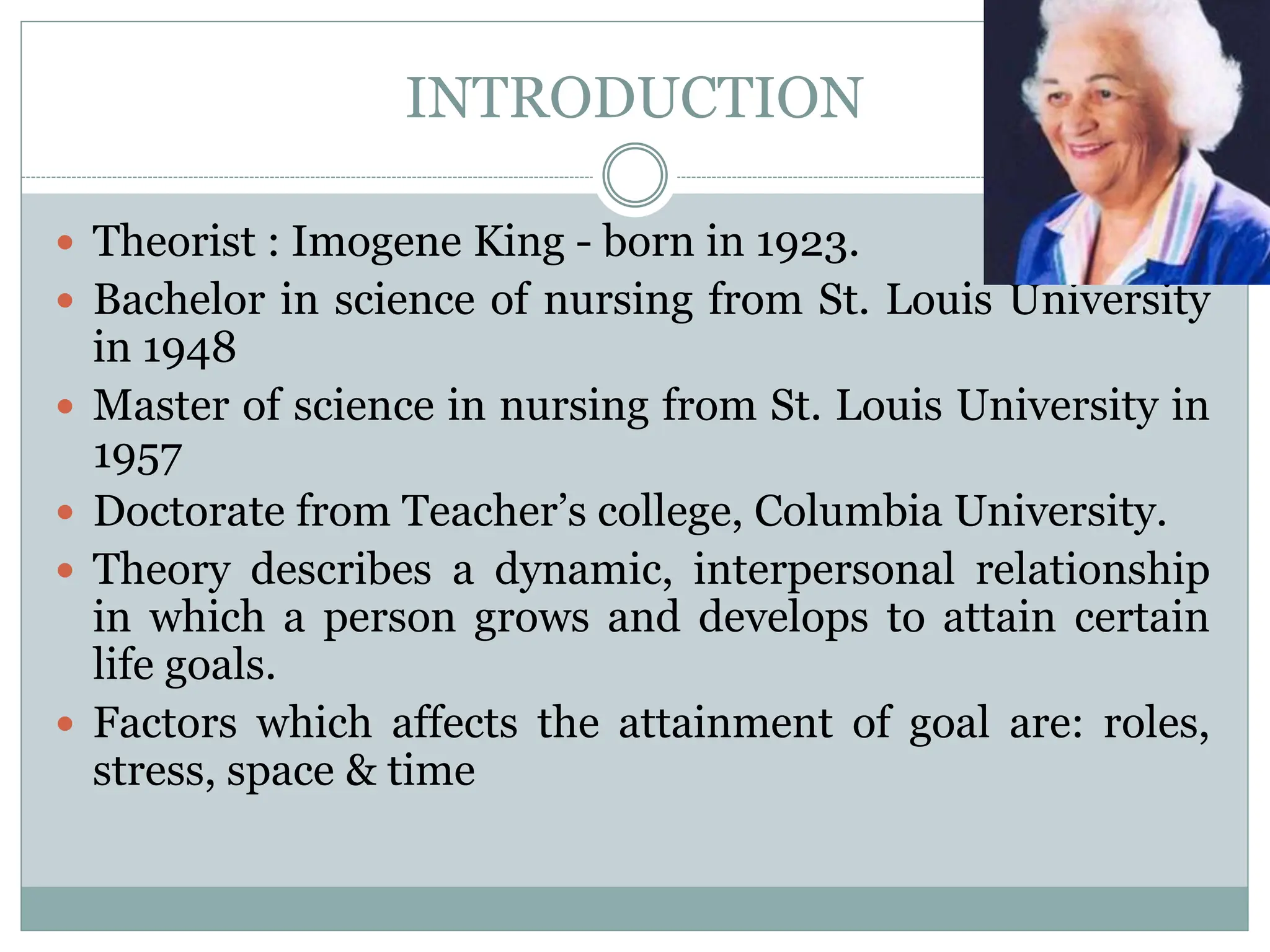
 Theorist : Imogene King - born in 1923.
 Bachelor in science of nursing from St. Louis University
in 1948
 Master of science in nursing from St. Louis University in
1957
 Doctorate from Teacher’s college, Columbia University.
 Theory describes a dynamic, interpersonal relationship
in which a person grows and develops to attain certain
life goals.
 Factors which affects the attainment of goal are: roles,
stress, space & time
BASIC ASSUMPTIONS
 Nursing focus is the care of human being
 Nursing goal is the health care of individuals &
groups
 Human beings: are open systems interacting
constantly with their environment.
 Basic assumption of goal attainment theory is that
nurse and client communicate information, set goal
mutually and then act to attain those goals, is also
the basic assumption of nursing process
BASIC ASSUMPTIONS
 “Each human being perceives the world as a total
person in making transactions with individuals and
things in environment”
 “Transaction represents a life situation in which
perceiver & thing perceived are encountered and in
which person enters the situation as an active
participant and each is changed in the process of
these experiences”
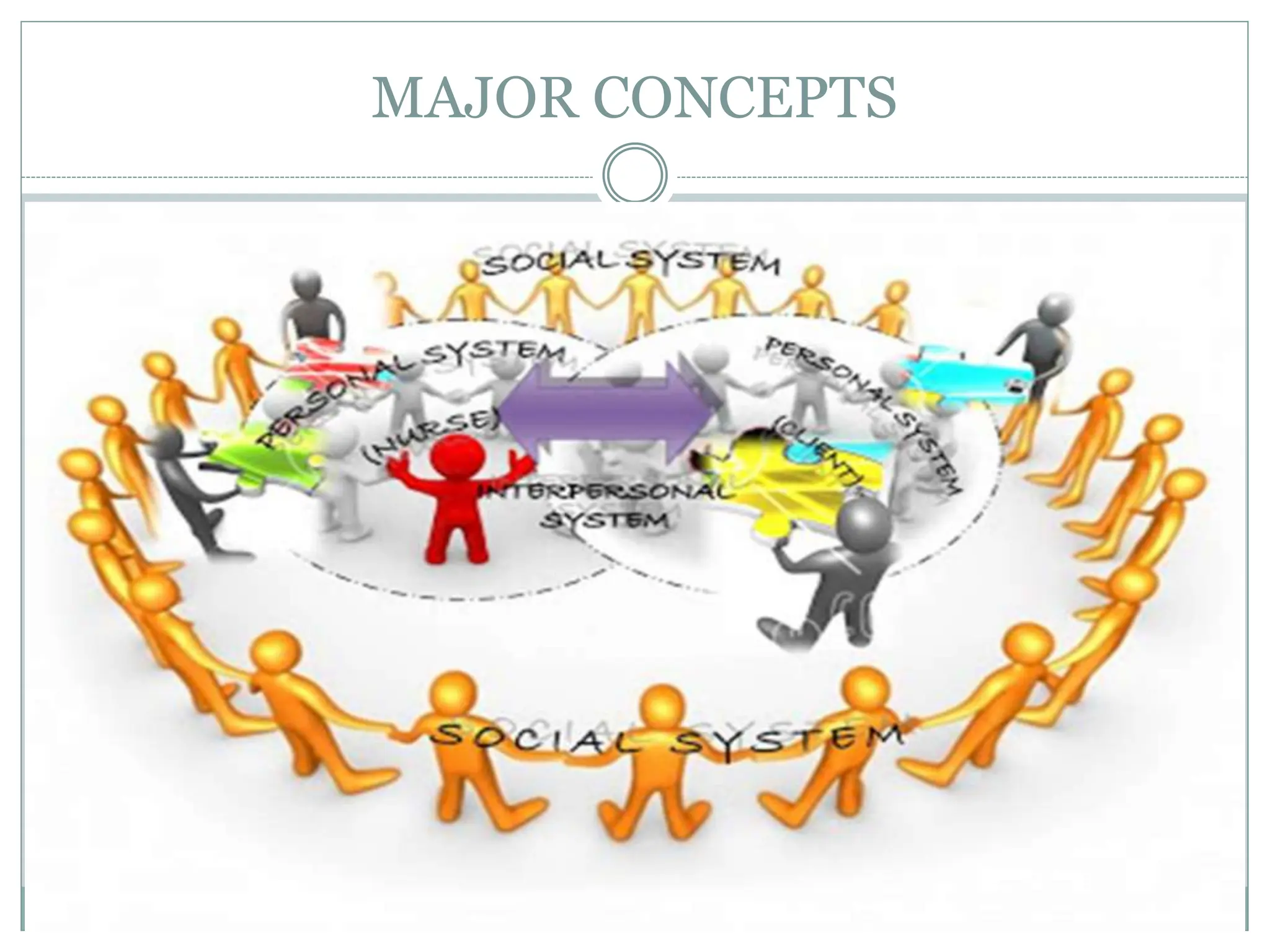
MAJOR CONCEPTS
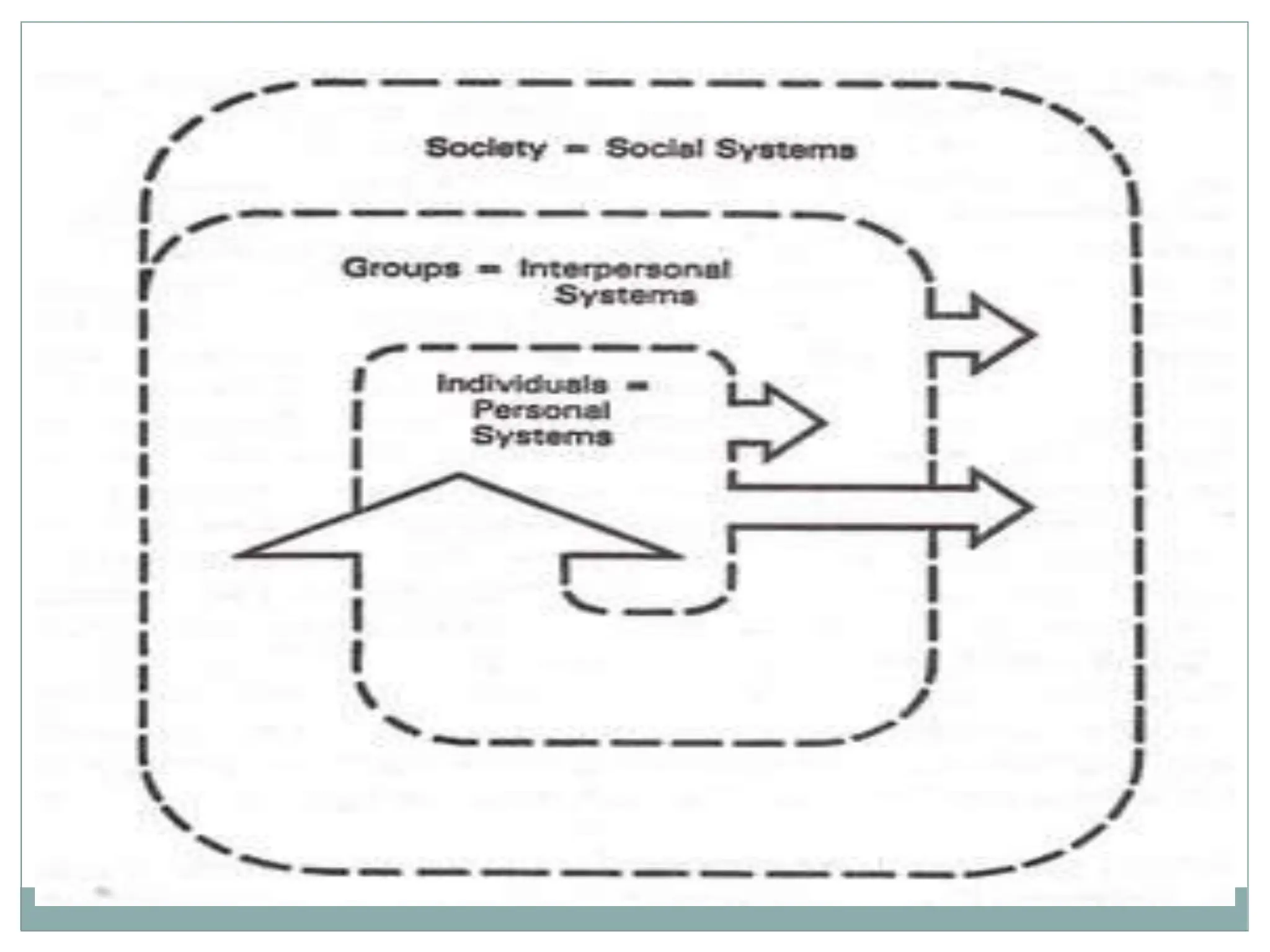
Interacting systems:
 personal system
 Interpersonal system
 Social system
Concepts are given for each system
Concepts for Personal System
 Perception
A process of organizing, interpreting, and
transforming information from sense data and
memory that gives meaning to one's experience,
represents one's image of reality, and influences one's
behaviour.
 Self
A composite of thoughts and feelings that constitute a
person's awareness of individual existence, of who and
what he or she is.
Concepts for Personal System
 Space
The physical area called territory that exists in all
directions.
 Time
The duration between the occurrence of one event and
the occurrence of another event.
 Learning
Gaining knowledge
Concepts for Personal System
 Growth & development
Cellular, molecular, and behavioural changes in
human beings that are a function of genetic
endowment, meaningful and satisfying experiences,
and an environment conducive to helping individuals
move toward maturity.
 Body image
A person's perceptions of his or her body.
Concepts for Interpersonal System
 Interaction
The acts of two or more persons in mutual presence; a
sequence of verbal and nonverbal behaviours that are
goal directed.
 Communication
The vehicle by which human relations are developed
and maintained; encompasses intrapersonal,
interpersonal, verbal, and nonverbal communication.
Concepts for Interpersonal System
 Transaction
A process of interaction in which human beings
communicate with the environment to achieve goals
that are valued; goal-directed human behaviours.
 Role
A set of behaviours expected of a person occupying a
position in a social system.
Concepts for Interpersonal System
 Stress
a dynamic state whereby a human being interacts with
the environment to maintain balance for growth,
development, and performance, involving an exchange
of energy and information between the person and the
environment for regulation and control of stressors.
 Coping
A way of dealing with stress.
Concepts for Social System
 Organization
Composed of human beings with prescribed roles and
positions who use resources to accomplish personal and
organizational goals.
 Authority
a transactional process characterized by active, reciprocal
relations in which members' values, backgrounds, and
perceptions play a role in defining, validating, and
accepting the authority of individuals within an
organization.
Concepts for Social System
 Power
The process whereby one or more persons influence other
persons in a situation.
 Status
The position of an individual in a group or a group in relation to
other groups in an organization.
 Decision making
a dynamic and systematic process by which goal-directed choice
of perceived alternatives is made and acted upon by individuals
or groups to answer a question and attain a goal.
 Control
Being in charge.
Propositions of King’s Theory
 If perceptual interaction accuracy is present in
nurse-client interactions, transaction will occur
 If nurse and client make transaction, goal will be
attained
 If goal are attained, satisfaction will occur
 If transactions are made in nurse-client interactions,
growth & development will be enhanced
Propositions of King’s Theory
 If role expectations and role performance as
perceived by nurse & client are congruent,
transaction will occur
 If role conflict is experienced by nurse or client or
both, stress in nurse-client interaction will occur
 If nurse with special knowledge skill communicate
appropriate information to client, mutual goal
setting and goal attainment will occur.
Nursing Paradigms
1. Human being /person
 being or person refers to social being who are rational and
sentient.
 Person has ability to :
 perceive
 think
 feel
 choose
 set goals
 select means to achieve goals and
 to make decision
Human being has three fundamental needs:
 The need for the health information that is unable
at the time when it is needed and can be used
 The need for care that seek to prevent illness, and
 The need for care when human beings are unable to
help themselves.
Theory of Goal Attainment and Nursing Process
Assessment
 Assessment occurs during interaction.
 The nurse brings special knowledge and skills whereas
client brings knowledge of self and perception of
problems of concern, to this interaction.
 During assessment nurse collects data regarding client
(his/her growth & development, perception of self and
current health status, roles etc.)
 Perception is the base for collection and interpretation of
data.
 Communication is required to verify accuracy of
perception, for interaction and transaction.
Nursing diagnosis
 The data collected by assessment are used to make
nursing diagnosis in nursing process.
 In process of attaining goal the nurse identifies the
problems, concerns and disturbances about which
person seek help.
Planning
 After diagnosis, planning for interventions to solve
those problems is done.
 In goal attainment planning is represented by setting
goals and making decisions about and being agreed
on the means to achieve goals.
 This part of transaction and client’s participation is
encouraged in making decision on the means to
achieve the goals.
Implementations
 In nursing process implementation involves the
actual activities to achieve the goals.
 In goal attainment it is the continuation of
transaction.
Evaluation
 It involves to finding out whether goals are achieved
or not.
 In king description evaluation speaks about
attainment of goal and effectiveness of nursing care.
Nursing Process and Theory of Goal Attainment
Nursing process method Nursing process theory
A system of oriented actions A system of oriented concepts
Assessment
Perception, communication and
interaction of nurse and client
Planning Decision making about the goals
Be agree on the means to attain the
goals
Implementation Transaction made
Evaluation Goal attained

Imogene king theory.pptx

  • 1.
    S U PR I Y A B A T W A L K A R IMOGENE KING THEORY
  • 2.
    INTRODUCTION  Theorist :Imogene King - born in 1923.  Bachelor in science of nursing from St. Louis University in 1948  Master of science in nursing from St. Louis University in 1957  Doctorate from Teacher’s college, Columbia University.  Theory describes a dynamic, interpersonal relationship in which a person grows and develops to attain certain life goals.  Factors which affects the attainment of goal are: roles, stress, space & time
  • 3.
    BASIC ASSUMPTIONS  Nursingfocus is the care of human being  Nursing goal is the health care of individuals & groups  Human beings: are open systems interacting constantly with their environment.  Basic assumption of goal attainment theory is that nurse and client communicate information, set goal mutually and then act to attain those goals, is also the basic assumption of nursing process
  • 4.
    BASIC ASSUMPTIONS  “Eachhuman being perceives the world as a total person in making transactions with individuals and things in environment”  “Transaction represents a life situation in which perceiver & thing perceived are encountered and in which person enters the situation as an active participant and each is changed in the process of these experiences”
  • 5.
    MAJOR CONCEPTS Interacting systems: personal system  Interpersonal system  Social system Concepts are given for each system
  • 6.
    Concepts for PersonalSystem  Perception A process of organizing, interpreting, and transforming information from sense data and memory that gives meaning to one's experience, represents one's image of reality, and influences one's behaviour.  Self A composite of thoughts and feelings that constitute a person's awareness of individual existence, of who and what he or she is.
  • 7.
    Concepts for PersonalSystem  Space The physical area called territory that exists in all directions.  Time The duration between the occurrence of one event and the occurrence of another event.  Learning Gaining knowledge
  • 8.
    Concepts for PersonalSystem  Growth & development Cellular, molecular, and behavioural changes in human beings that are a function of genetic endowment, meaningful and satisfying experiences, and an environment conducive to helping individuals move toward maturity.  Body image A person's perceptions of his or her body.
  • 9.
    Concepts for InterpersonalSystem  Interaction The acts of two or more persons in mutual presence; a sequence of verbal and nonverbal behaviours that are goal directed.  Communication The vehicle by which human relations are developed and maintained; encompasses intrapersonal, interpersonal, verbal, and nonverbal communication.
  • 10.
    Concepts for InterpersonalSystem  Transaction A process of interaction in which human beings communicate with the environment to achieve goals that are valued; goal-directed human behaviours.  Role A set of behaviours expected of a person occupying a position in a social system.
  • 11.
    Concepts for InterpersonalSystem  Stress a dynamic state whereby a human being interacts with the environment to maintain balance for growth, development, and performance, involving an exchange of energy and information between the person and the environment for regulation and control of stressors.  Coping A way of dealing with stress.
  • 12.
    Concepts for SocialSystem  Organization Composed of human beings with prescribed roles and positions who use resources to accomplish personal and organizational goals.  Authority a transactional process characterized by active, reciprocal relations in which members' values, backgrounds, and perceptions play a role in defining, validating, and accepting the authority of individuals within an organization.
  • 13.
    Concepts for SocialSystem  Power The process whereby one or more persons influence other persons in a situation.  Status The position of an individual in a group or a group in relation to other groups in an organization.  Decision making a dynamic and systematic process by which goal-directed choice of perceived alternatives is made and acted upon by individuals or groups to answer a question and attain a goal.  Control Being in charge.
  • 14.
    Propositions of King’sTheory  If perceptual interaction accuracy is present in nurse-client interactions, transaction will occur  If nurse and client make transaction, goal will be attained  If goal are attained, satisfaction will occur  If transactions are made in nurse-client interactions, growth & development will be enhanced
  • 15.
    Propositions of King’sTheory  If role expectations and role performance as perceived by nurse & client are congruent, transaction will occur  If role conflict is experienced by nurse or client or both, stress in nurse-client interaction will occur  If nurse with special knowledge skill communicate appropriate information to client, mutual goal setting and goal attainment will occur.
  • 16.
    Nursing Paradigms 1. Humanbeing /person  being or person refers to social being who are rational and sentient.  Person has ability to :  perceive  think  feel  choose  set goals  select means to achieve goals and  to make decision
  • 17.
    Human being hasthree fundamental needs:  The need for the health information that is unable at the time when it is needed and can be used  The need for care that seek to prevent illness, and  The need for care when human beings are unable to help themselves.
  • 20.
    Theory of GoalAttainment and Nursing Process Assessment  Assessment occurs during interaction.  The nurse brings special knowledge and skills whereas client brings knowledge of self and perception of problems of concern, to this interaction.  During assessment nurse collects data regarding client (his/her growth & development, perception of self and current health status, roles etc.)  Perception is the base for collection and interpretation of data.  Communication is required to verify accuracy of perception, for interaction and transaction.
  • 21.
    Nursing diagnosis  Thedata collected by assessment are used to make nursing diagnosis in nursing process.  In process of attaining goal the nurse identifies the problems, concerns and disturbances about which person seek help.
  • 22.
    Planning  After diagnosis,planning for interventions to solve those problems is done.  In goal attainment planning is represented by setting goals and making decisions about and being agreed on the means to achieve goals.  This part of transaction and client’s participation is encouraged in making decision on the means to achieve the goals.
  • 23.
    Implementations  In nursingprocess implementation involves the actual activities to achieve the goals.  In goal attainment it is the continuation of transaction.
  • 24.
    Evaluation  It involvesto finding out whether goals are achieved or not.  In king description evaluation speaks about attainment of goal and effectiveness of nursing care.
  • 25.
    Nursing Process andTheory of Goal Attainment Nursing Process and Theory of Goal Attainment Nursing process method Nursing process theory A system of oriented actions A system of oriented concepts Assessment Perception, communication and interaction of nurse and client Planning Decision making about the goals Be agree on the means to attain the goals Implementation Transaction made Evaluation Goal attained