GASTROINTESTINAL
EXAMINATION
Mr. Shashi Prakash
M.Sc. Nursing II Year
ILBS
GASTROINTESTINAL
EXAMINATION
 General examination
 General inspection
 Hands and arms
 Face, eyes and mouth
 Neck
 Abdominal examination
 Inspection
 Palpation
 Percussion
 Auscultation
 Nutritional state (wasting)
 Pallor
 Jaundice (liver disease)
 Pigmentation (hemochromatosis)
 Mental state (encephalopathy)
GENERAL INSPECTION
HANDS
 Nails
 Clubbing
 Koilonychia
 Leuconychia
 Palmar erythema
 Dupuytren’s contractures
 Hepatic flap
HANDS
Palmar erythema Dupuytren’s contractures
ARMS
 Spider naevi (telangiectatic lesions)
 Bruising
 Wasting
 Scratch marks (chronic cholestasis)
 Conjuctival pallor (anaemia)
 Sclera: jaundice, iritis
 Cornea: Kaiser Fleischer’s rings (Wilson’s disease)
 Xanthelasma (primary biliary cirrhosis)
 Parotid enlargement (alcohol)
FACE, EYES …
Parotid enlargement
Xanthelasma
… AND MOUTH
 Breath (fetor hepaticus)
 Lips
 Angular stomatitis
 Cheilitis
 Ulceration
 Peutz-Jeghers syndrome
 Gums
 Gingivitis, bleeding
 Candida albicans
 Pigmentation
 Tongue
 Atrophic glossitis
 Leicoplakia
 Furring
Atrophic glossitis Thrush
NECK AND CHEST
 Cervical lymphadenopathy
 Left supraclavicular fossa (Virchov’s node)
 Gynaecomastia
 Loss of hair
ABDOMINAL EXAMINATION
POSITIONING
 Abdomen can be divided in four quadrants
 Patient should be lying on supine position
POSITIONING
 Patients hands remain
on his/hers side
 Legs, straight
 Head resting on pillow –
if neck is flexed, ABD
muscles will tense and
therefore harder to
palpate ABD
 .
ABDOMINAL EXAMINATION
INSPECTION
 Shape and movements
 Scars
 Distension
 Localised: mass, organomegaly
 Generalized: 5 F’s
 Prominent veins (caput medusae)
 Striae
 Bruises
 Pigmentation
 Visible peristalsis
Contour
INSPECTION
 Shape
 Skin Abnormalities
 Masses
 Scars (Previous op's -
laproscopy)
 Signs of Trauma
 Jaundice
 Caput Medusae (portal H-T)
 Ascities (bulging flanks)
 Spider Navi-Pregnant women
 Cushings (red-violet)
 ...
Hands + Mouth
 Clubbing
 Palmer Erythmea
 Mouth ulceration
 Breath (foeter ex ore)
 ...
Tête de Méduse, by Peter Paul Rubens (1618)
Campbell de
Morgan spots
Ascitic abdomen
ABDOMINAL EXAMINATION
AUSCULTATION
 Place the diaphragm of the stethoscope
to the right of the umbilicus
 Bowel sounds (borborygmi) are caused
by peristaltic movements
 Occur every 5-10 sec.
 Absence of b.s.: paralytic ileus or
peritonitis
 Bruits over aorta and renal a. could be
a sign of an aneurysm and stenosis
AUSCULTATION
 Use stethoscope to listen to all
areas
 Detection of Bowel sounds
(Peristalsis/Silent?? = Ileus)
 If no bowel sounds heard –
continue to auscultate up to 3mins
in the different areas to determine
the absence of bowel sounds
 Auscultate for BRUITS!!! -
Swishing (pathological) sounds
over the arteries (eg.
Abdominal Aorta)
 ...
ABDOMINAL EXAMINATION
PALPATION
1. Ensure that your hands are warm
2. Stand on the patient’s right side
3. Help to position the patient
4. Ask whether the patient feels any pain
before you start
5. Begin with superficial examination
6. Move in a systematic manner through the
abdominal quadrants
7. Repeat palpation deeply.
ABDOMINAL EXAMINATION
PALPATION
 Tenderness: discomfort and resistance to
palpation
 Involuntary guarding: reflex contraction of the
abdominal muscles
 Rebound tenderness: patient feels pain when
the hand is released
 Tenderness + rigidity: perforated viscus
 Palpable mass (enlarged organ, faeces, tumour)
 Aortic pulsation
PALPATION
 ALWAYS ASK IF PAIN IS PRESENT
BEFORE PALPATING!!!
 Firstly: Superficial palpation
 Secondly: Deep where no pain is
present. (deep organs)
 Assessing Muscle Tone:
- Guarding = muscles contract when pressure is
applied
- Ridigity = inidicates peritoneal inflamation
- Rebound = Releasing of pressure causing
pain
 .......
 Pain in RUQ
 Inflammation of gallbladder
(cholecystitis)
 Courvoisier's law
ABDOMINAL EXAMINATION
MURPHY’S SIGN
MURPHY'S SIGN
 Indication:
- pain in U.R.Quadrant
 Determines:
- cholecystitis (inflam. of gall
bladder)
- Courvoisier's law – palpable gall
bladder, yet painless
- cholangitis (inflam. Of bile ducts)
 ...
METHOD
 Ask patient to breathe out.
 Gently place your hand below the costal margin on the right side at the
mid-clavicular line (location of the gallbladder).
 Instruct to breathe in.
 Normally, during inspiration, the abdominal contents are pushed
downward as the diaphragm moves down.
 If the patient stops breathing in (as the gallbladder comes in contact
with the examiner's fingers) the patient feels pain with a 'catch' in
breath.
 Test is positive.
 ...
 a.k.a. rebound tenderness
 Pain upon removal of pressure rather than
application of pressure to the abdomen
 Peritonitis and/ or appendicitis
ABDOMINAL EXAMINATION
BLUMBERG’S SIGN
BLUMBERG'S SIGN
 Determines:
- peritonitis
- appendicitis
 ALWAYS START OPP. SIDE TO
WHERE THE PAIN IS !!!!
 ABD is compressed slowly and
then rapidly released.
 Pain upon removal of pressure
rather than application of
pressure to the abdomen
 Pain present = positive.
 ...
 1/3 ASIS to umbilicus
 Location of AV in retrocecal position
 Deep tenderness (= acute appendicitis)
ABDOMINAL EXAMINATION
MCBURNEY’S POINT
McBurney's Point
 From ASIS (anterior
superior iliac spine) to
the umbilicus.
 Determines:
- location of appendix (varies)
- deep tenderness @ point = acute
appendicitis
NOTE: McBURNEY'S PUNCH SIGN = Tenderness is presented when
gently tapping the area of the back overlying the kidney producing pain in
people with an infection around the kidney (perinephric abscess) or
pyelonephritis.
Carnett's sign
 Abd. pain remains unchanged
or increases when the
muscles of the abdominal
wall are tensed.
 Positive = Abd. wall is the
source of the pain (e.g. due to
rectus sheath hematoma).
 Negative = pain decreases
when the patient is asked to lift
the head; this points to an intra-
abdominal cause of the pain
 ..
ABDOMINAL EXAMINATION
FLUID THRILL
 Place the palm of your left
hand against the left side of the
abdomen
 Flick a finger against the right
side of the abdomen
 Ask the patient to put the edge
of a hand on the midline of
the abdomen
 If a ripple is felt upon flicking
we call it a fluid thrill = ascites
Fluid wave test / Iceberg Sign
 Test for ascites.
 Have patient push their
hands down on the midline
of the abdomen.
 Then you tap one flank,
while feeling on the other
flank for the tap.
 > 1 litre of fluid allows the
tap to be felt on the other
side.
 ...
ABDOMINAL EXAMINATION
PALPATION OF THE SPLEEN
1. Roll the patient towards you
2. Palpate with your left hand while using your left hand to
press forward on the patient’s lower ribs from behind
3. Feel along the costal margin
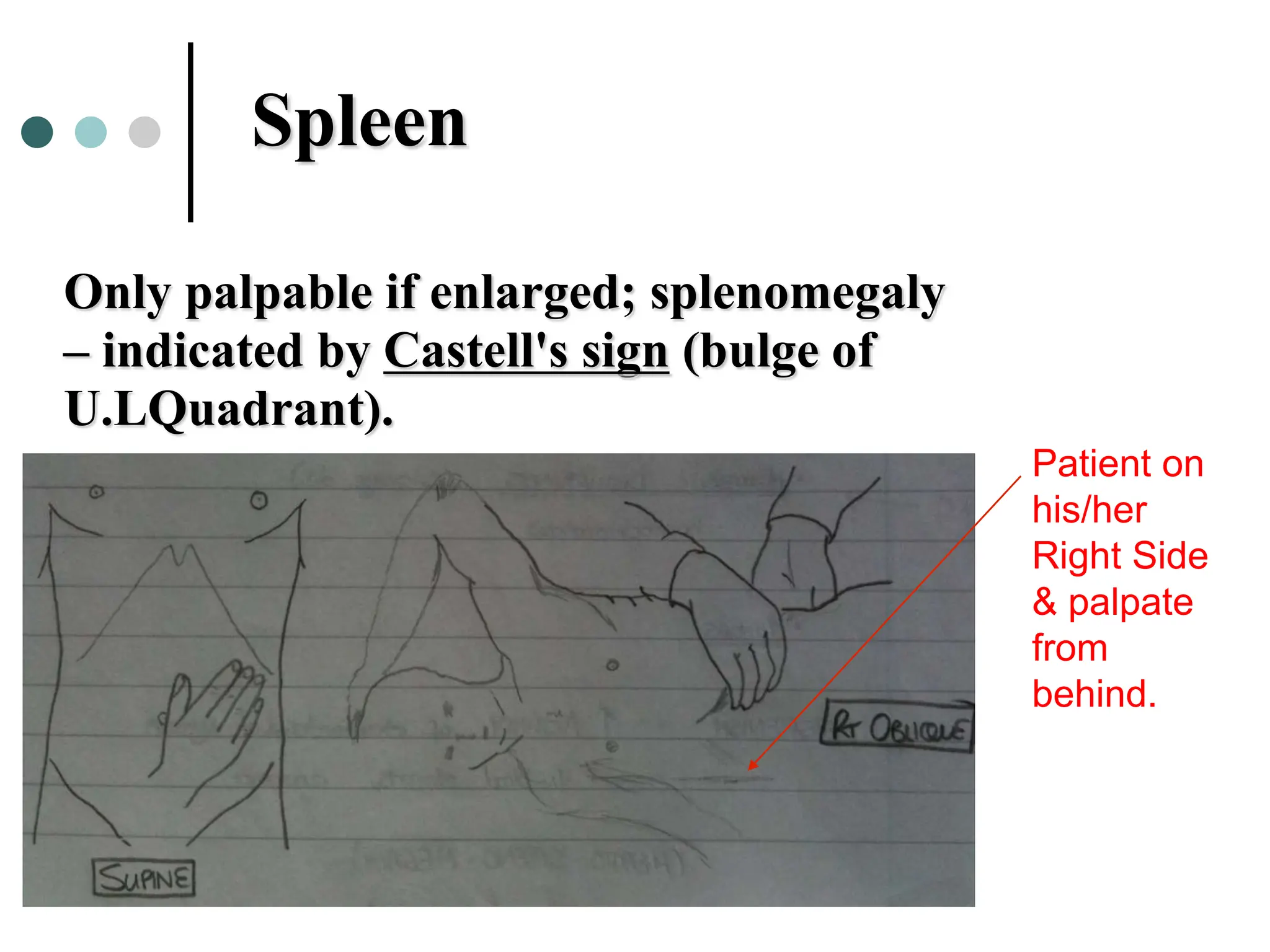
Spleen
Only palpable if enlarged; splenomegaly
– indicated by Castell's sign (bulge of
U.LQuadrant).
Patient on
his/her
Right Side
& palpate
from
behind.
ABDOMINAL EXAMINATION
PALPATION OF THE LIVER
1. Start palpating in the right iliac fossa
2. Ask the patient to take a deep breath in
3. Move your hand progressively further up the abdomen
4. Try to feel the liver edge
Liver
 PALPATE:
- from R.iliac fossa up towards and under
the last rib whilst the patient is breathing
in deeply.
 ASSESSING:
Regulatrities
Smoothness
Tenderness
 PERCUSSION:
- Outline of liver (norm: 8-12 cms)
- In Mid-Clavicular Line from 2nd rib
downwards
 Hollow ---> Dull ----> Hollow
 ...
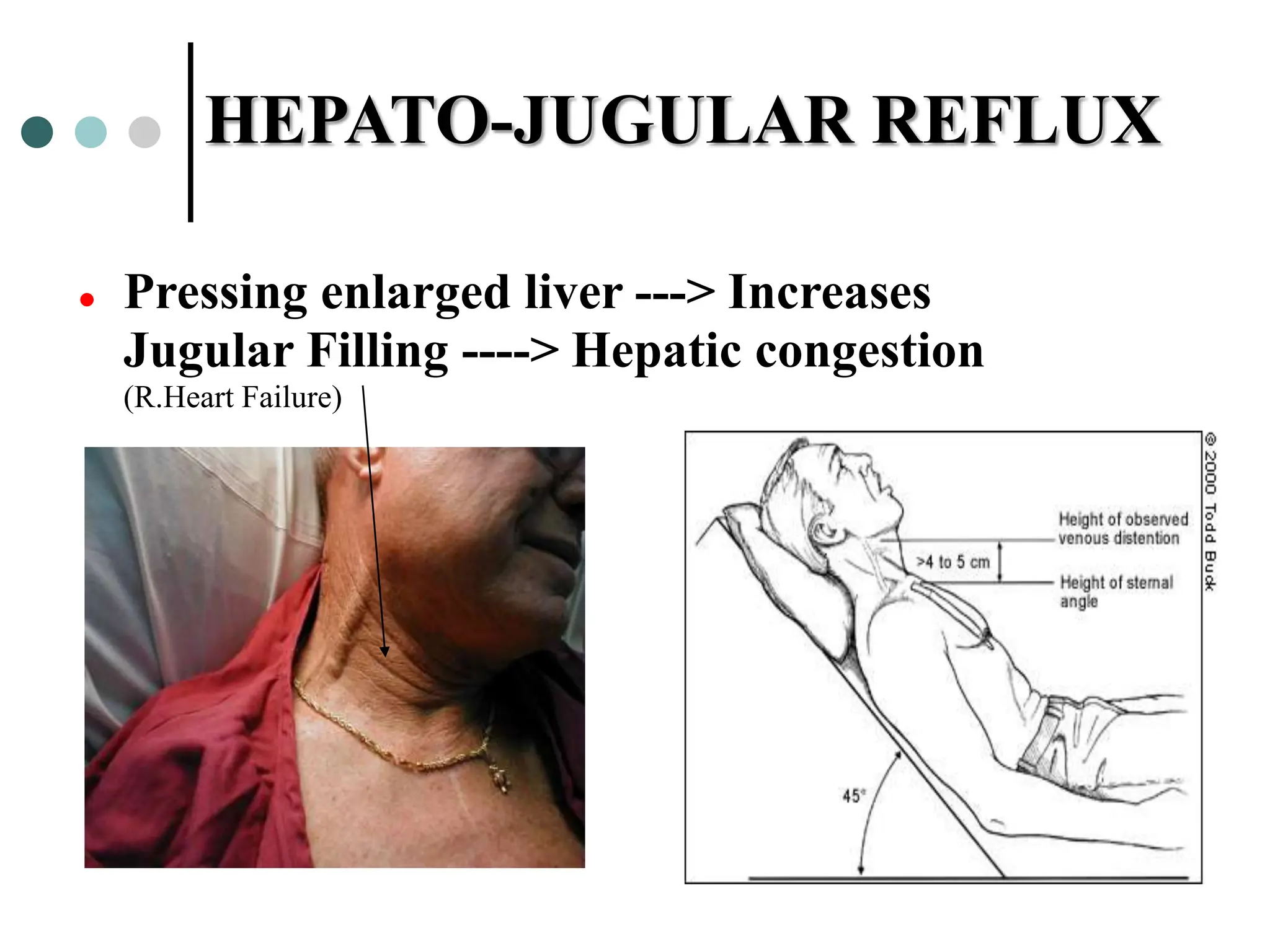
HEPATO-JUGULAR REFLUX
 Pressing enlarged liver ---> Increases
Jugular Filling ----> Hepatic congestion
(R.Heart Failure)
Head of Pancreas
 De Jardins Point:
- MCL
- 9th Costal Cartilage
- Right Side
 Indication:
- Pancreatitis/Tumour @ head
 ...
ABDOMINAL EXAMINATION
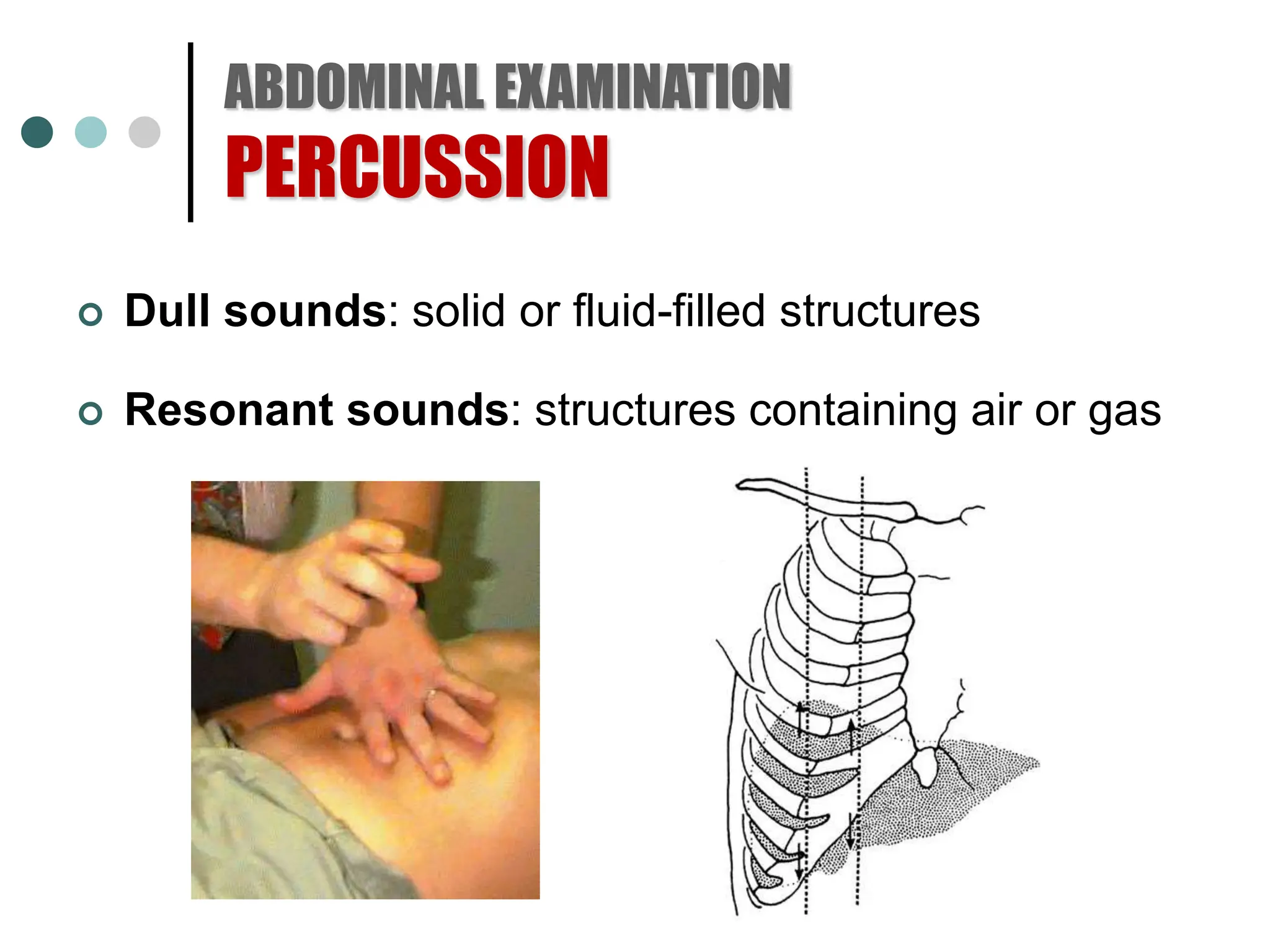
PERCUSSION
 Dull sounds: solid or fluid-filled structures
 Resonant sounds: structures containing air or gas
VIDEO
Sample Charting
Sample Charting
ABDOMINAL EXAMINATION
THANK YOU FOR YOR
ATTENTION.

Gastrointestinal (GI) examination. Seminar ppt.
  • 1.
  • 2.
    GASTROINTESTINAL EXAMINATION  General examination General inspection  Hands and arms  Face, eyes and mouth  Neck  Abdominal examination  Inspection  Palpation  Percussion  Auscultation
  • 3.
     Nutritional state(wasting)  Pallor  Jaundice (liver disease)  Pigmentation (hemochromatosis)  Mental state (encephalopathy) GENERAL INSPECTION
  • 4.
    HANDS  Nails  Clubbing Koilonychia  Leuconychia  Palmar erythema  Dupuytren’s contractures  Hepatic flap
  • 5.
  • 6.
    ARMS  Spider naevi(telangiectatic lesions)  Bruising  Wasting  Scratch marks (chronic cholestasis)
  • 7.
     Conjuctival pallor(anaemia)  Sclera: jaundice, iritis  Cornea: Kaiser Fleischer’s rings (Wilson’s disease)  Xanthelasma (primary biliary cirrhosis)  Parotid enlargement (alcohol) FACE, EYES …
  • 8.
  • 9.
    … AND MOUTH Breath (fetor hepaticus)  Lips  Angular stomatitis  Cheilitis  Ulceration  Peutz-Jeghers syndrome  Gums  Gingivitis, bleeding  Candida albicans  Pigmentation  Tongue  Atrophic glossitis  Leicoplakia  Furring
  • 10.
  • 11.
    NECK AND CHEST Cervical lymphadenopathy  Left supraclavicular fossa (Virchov’s node)  Gynaecomastia  Loss of hair
  • 12.
    ABDOMINAL EXAMINATION POSITIONING  Abdomencan be divided in four quadrants  Patient should be lying on supine position
  • 13.
    POSITIONING  Patients handsremain on his/hers side  Legs, straight  Head resting on pillow – if neck is flexed, ABD muscles will tense and therefore harder to palpate ABD  .
  • 14.
    ABDOMINAL EXAMINATION INSPECTION  Shapeand movements  Scars  Distension  Localised: mass, organomegaly  Generalized: 5 F’s  Prominent veins (caput medusae)  Striae  Bruises  Pigmentation  Visible peristalsis
  • 15.
  • 16.
    INSPECTION  Shape  SkinAbnormalities  Masses  Scars (Previous op's - laproscopy)  Signs of Trauma  Jaundice  Caput Medusae (portal H-T)  Ascities (bulging flanks)  Spider Navi-Pregnant women  Cushings (red-violet)  ...
  • 17.
    Hands + Mouth Clubbing  Palmer Erythmea  Mouth ulceration  Breath (foeter ex ore)  ...
  • 18.
    Tête de Méduse,by Peter Paul Rubens (1618)
  • 19.
  • 20.
    ABDOMINAL EXAMINATION AUSCULTATION  Placethe diaphragm of the stethoscope to the right of the umbilicus  Bowel sounds (borborygmi) are caused by peristaltic movements  Occur every 5-10 sec.  Absence of b.s.: paralytic ileus or peritonitis  Bruits over aorta and renal a. could be a sign of an aneurysm and stenosis
  • 21.
    AUSCULTATION  Use stethoscopeto listen to all areas  Detection of Bowel sounds (Peristalsis/Silent?? = Ileus)  If no bowel sounds heard – continue to auscultate up to 3mins in the different areas to determine the absence of bowel sounds  Auscultate for BRUITS!!! - Swishing (pathological) sounds over the arteries (eg. Abdominal Aorta)  ...
  • 22.
    ABDOMINAL EXAMINATION PALPATION 1. Ensurethat your hands are warm 2. Stand on the patient’s right side 3. Help to position the patient 4. Ask whether the patient feels any pain before you start 5. Begin with superficial examination 6. Move in a systematic manner through the abdominal quadrants 7. Repeat palpation deeply.
  • 23.
    ABDOMINAL EXAMINATION PALPATION  Tenderness:discomfort and resistance to palpation  Involuntary guarding: reflex contraction of the abdominal muscles  Rebound tenderness: patient feels pain when the hand is released  Tenderness + rigidity: perforated viscus  Palpable mass (enlarged organ, faeces, tumour)  Aortic pulsation
  • 24.
    PALPATION  ALWAYS ASKIF PAIN IS PRESENT BEFORE PALPATING!!!  Firstly: Superficial palpation  Secondly: Deep where no pain is present. (deep organs)  Assessing Muscle Tone: - Guarding = muscles contract when pressure is applied - Ridigity = inidicates peritoneal inflamation - Rebound = Releasing of pressure causing pain  .......
  • 25.
     Pain inRUQ  Inflammation of gallbladder (cholecystitis)  Courvoisier's law ABDOMINAL EXAMINATION MURPHY’S SIGN
  • 26.
    MURPHY'S SIGN  Indication: -pain in U.R.Quadrant  Determines: - cholecystitis (inflam. of gall bladder) - Courvoisier's law – palpable gall bladder, yet painless - cholangitis (inflam. Of bile ducts)  ...
  • 27.
    METHOD  Ask patientto breathe out.  Gently place your hand below the costal margin on the right side at the mid-clavicular line (location of the gallbladder).  Instruct to breathe in.  Normally, during inspiration, the abdominal contents are pushed downward as the diaphragm moves down.  If the patient stops breathing in (as the gallbladder comes in contact with the examiner's fingers) the patient feels pain with a 'catch' in breath.  Test is positive.  ...
  • 28.
     a.k.a. reboundtenderness  Pain upon removal of pressure rather than application of pressure to the abdomen  Peritonitis and/ or appendicitis ABDOMINAL EXAMINATION BLUMBERG’S SIGN
  • 29.
    BLUMBERG'S SIGN  Determines: -peritonitis - appendicitis  ALWAYS START OPP. SIDE TO WHERE THE PAIN IS !!!!  ABD is compressed slowly and then rapidly released.  Pain upon removal of pressure rather than application of pressure to the abdomen  Pain present = positive.  ...
  • 30.
     1/3 ASISto umbilicus  Location of AV in retrocecal position  Deep tenderness (= acute appendicitis) ABDOMINAL EXAMINATION MCBURNEY’S POINT
  • 31.
    McBurney's Point  FromASIS (anterior superior iliac spine) to the umbilicus.  Determines: - location of appendix (varies) - deep tenderness @ point = acute appendicitis NOTE: McBURNEY'S PUNCH SIGN = Tenderness is presented when gently tapping the area of the back overlying the kidney producing pain in people with an infection around the kidney (perinephric abscess) or pyelonephritis.
  • 32.
    Carnett's sign  Abd.pain remains unchanged or increases when the muscles of the abdominal wall are tensed.  Positive = Abd. wall is the source of the pain (e.g. due to rectus sheath hematoma).  Negative = pain decreases when the patient is asked to lift the head; this points to an intra- abdominal cause of the pain  ..
  • 33.
    ABDOMINAL EXAMINATION FLUID THRILL Place the palm of your left hand against the left side of the abdomen  Flick a finger against the right side of the abdomen  Ask the patient to put the edge of a hand on the midline of the abdomen  If a ripple is felt upon flicking we call it a fluid thrill = ascites
  • 34.
    Fluid wave test/ Iceberg Sign  Test for ascites.  Have patient push their hands down on the midline of the abdomen.  Then you tap one flank, while feeling on the other flank for the tap.  > 1 litre of fluid allows the tap to be felt on the other side.  ...
  • 35.
    ABDOMINAL EXAMINATION PALPATION OFTHE SPLEEN 1. Roll the patient towards you 2. Palpate with your left hand while using your left hand to press forward on the patient’s lower ribs from behind 3. Feel along the costal margin
  • 36.
    Spleen Only palpable ifenlarged; splenomegaly – indicated by Castell's sign (bulge of U.LQuadrant). Patient on his/her Right Side & palpate from behind.
  • 37.
    ABDOMINAL EXAMINATION PALPATION OFTHE LIVER 1. Start palpating in the right iliac fossa 2. Ask the patient to take a deep breath in 3. Move your hand progressively further up the abdomen 4. Try to feel the liver edge
  • 38.
    Liver  PALPATE: - fromR.iliac fossa up towards and under the last rib whilst the patient is breathing in deeply.  ASSESSING: Regulatrities Smoothness Tenderness  PERCUSSION: - Outline of liver (norm: 8-12 cms) - In Mid-Clavicular Line from 2nd rib downwards  Hollow ---> Dull ----> Hollow  ...
  • 39.
    HEPATO-JUGULAR REFLUX  Pressingenlarged liver ---> Increases Jugular Filling ----> Hepatic congestion (R.Heart Failure)
  • 40.
    Head of Pancreas De Jardins Point: - MCL - 9th Costal Cartilage - Right Side  Indication: - Pancreatitis/Tumour @ head  ...
  • 41.
    ABDOMINAL EXAMINATION PERCUSSION  Dullsounds: solid or fluid-filled structures  Resonant sounds: structures containing air or gas
  • 42.
  • 43.
  • 44.
  • 45.
  • 46.
    THANK YOU FORYOR ATTENTION.