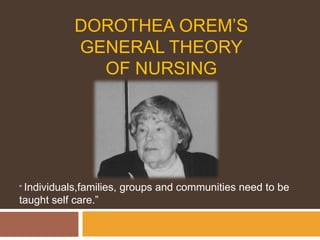
Dorothea Orem’sgeneral theoryof nursing“ Individuals,families, groups and communities need to be taught self care.”
Dorothea orem1914-2007•One of foremost nursing theorists.•Born 1914 in Baltimore.•Earned her diploma at Providence Hospital – Washington, DC•1939 – BSN Ed., Catholic University of America•1945 – MSN Ed., Catholic University of America•Involved in nursing practice, nursing service, and nursing education•During her professional career, she worked as a staff nurse, private duty nurse, nurse educator and administrator and nurse consultant•Received honorary Doctor of Science degree in 1976•Published first formal articulation of her ideas in Nursing: Concepts of Practice in 1971, second in 1980, and in 1995.
General theory of nursingDorothea Orem’s theory is composed of three related parts which are self-care, self-care deficit and nursing systems.
Self-care theoryWHY and HOW people care for themselves.
Self-Care AgencyIt  consists of two agents:Self-care Agent - person who provides the self-care
Dependent Care Agent - person other than the individual who provides the care (such as a   parent)Self- Care Requisites It is composed of the following categories:
UNIVERSALSimilar to Maslow's heirarchy of needs. Important for sustaing life. Common to all people.
DEVELOPMENTALConditions that support life processes and promote specific developmental stages.Intra-uterine life and birthNeonatal lifeInfancyChildhoodAdolescenceAdulthoodPregnancy
HEALTH-DEVIATIONCategories:Seeking and securing appropriate medical assistance2. Being aware of and attending to the effects and results of pathologic conditions and states3. Effectively carrying out medically prescribed diagnostic, therapeutic and rehabilitative measures
4. Being aware of and attending to or regulating the discomforting or deleterious effects of prescribed medical care measures5. Modifying the self – concept in accepting oneself as being in a particular state of health and in need of specific forms of health care6. Learning to live with the effects of pathologic conditions and states of medical diagnostic and treatment measures in a life-style that promotes continued personal development
Self-care deficit theorySelf- Care Deficit: demand to care for oneself is greater than the individual’s capacity or ability to meet it.Nursing is required when the client is incapable of continuous and effective self-care.  It determines the need for nursing care.WHY people can be helped through nursing
Five Methods of Assistance- is the central focus of Orem’s Grand Theory of Nursing- explains when nursing is needed- describes and explains how people can be helped through nursing- results when the Self-care Agency (patient) can’t meet her/his self-care needs or administer self-carenursing meets these self-care needs through five methods of helpFive Methods of Nursing Help-Acting or doing for-Guiding-Teaching-Supporting-Providing an environment to promote the patient’s ability to meet current or future demands
Theory of nursing systemsIt specifies how the client’s self-care needs will be met by the nurse, client or both.  With this theory, the nurse determines whether there is a legitimate need for nursing care and if a self-care deficit exists.  It is also the time when a nurse plans care and identifies what should be done and who should do it.  In addition, it establishes 3 classifications of nursing system to meet the self-care requisite of the client.describes and explains RELATIONSHIPS that must be made and maintained for nursing to be produced
3 Classification of Nursing Systems
Orem’s General Theory of NursingSelf careRRTherapeutic Self care demandsSelf Care / Dep. Care AgencyConditioning factorsConditioning factorsRDeficitRRNursing AgencyConditioning factorsR indicates a relationship between components; < indicates current or potential deficit where nursing would be required.
Core competenciesOut of the 11 core competencies listed, few applies to Dorothea Orem’s General Theory of Nursing.  One main competency that can be practiced using Orem’s theory is the SAFE QUALITY CARE.  To illustrate, the nurse  can diagnose self-care needs and deficit of his/her patient. Once, the patient’s self-care need/deficit is identified, the nurse then formulates a nursing care plan in which COLLABORATION and COMMUNICATION competency comes in. In order to formulate a nursing care plan, the nurse will have to communicate with his/her patient.  She would also have to collaborate with his/her client and others so that they can help apply the plan she developed.
If people cannot care for themselves, they sure need help.  This is when nurses come in to provide assistance.
Theoretical Foundations of NursingGroup 2 Dorothea OremLeader: Jacquiline Parreñas	     Niña Celeste	     Beverly Fabillar	     Amir Baustista

Dorothea Orem

  • 1.
    Dorothea Orem’sgeneral theoryofnursing“ Individuals,families, groups and communities need to be taught self care.”
  • 2.
    Dorothea orem1914-2007•One offoremost nursing theorists.•Born 1914 in Baltimore.•Earned her diploma at Providence Hospital – Washington, DC•1939 – BSN Ed., Catholic University of America•1945 – MSN Ed., Catholic University of America•Involved in nursing practice, nursing service, and nursing education•During her professional career, she worked as a staff nurse, private duty nurse, nurse educator and administrator and nurse consultant•Received honorary Doctor of Science degree in 1976•Published first formal articulation of her ideas in Nursing: Concepts of Practice in 1971, second in 1980, and in 1995.
  • 3.
    General theory ofnursingDorothea Orem’s theory is composed of three related parts which are self-care, self-care deficit and nursing systems.
  • 4.
    Self-care theoryWHY andHOW people care for themselves.
  • 5.
    Self-Care AgencyIt consists of two agents:Self-care Agent - person who provides the self-care
  • 6.
    Dependent Care Agent- person other than the individual who provides the care (such as a   parent)Self- Care Requisites It is composed of the following categories:
  • 7.
    UNIVERSALSimilar to Maslow'sheirarchy of needs. Important for sustaing life. Common to all people.
  • 8.
    DEVELOPMENTALConditions that supportlife processes and promote specific developmental stages.Intra-uterine life and birthNeonatal lifeInfancyChildhoodAdolescenceAdulthoodPregnancy
  • 9.
    HEALTH-DEVIATIONCategories:Seeking and securingappropriate medical assistance2. Being aware of and attending to the effects and results of pathologic conditions and states3. Effectively carrying out medically prescribed diagnostic, therapeutic and rehabilitative measures
  • 10.
    4. Being awareof and attending to or regulating the discomforting or deleterious effects of prescribed medical care measures5. Modifying the self – concept in accepting oneself as being in a particular state of health and in need of specific forms of health care6. Learning to live with the effects of pathologic conditions and states of medical diagnostic and treatment measures in a life-style that promotes continued personal development
  • 11.
    Self-care deficit theorySelf-Care Deficit: demand to care for oneself is greater than the individual’s capacity or ability to meet it.Nursing is required when the client is incapable of continuous and effective self-care. It determines the need for nursing care.WHY people can be helped through nursing
  • 12.
    Five Methods ofAssistance- is the central focus of Orem’s Grand Theory of Nursing- explains when nursing is needed- describes and explains how people can be helped through nursing- results when the Self-care Agency (patient) can’t meet her/his self-care needs or administer self-carenursing meets these self-care needs through five methods of helpFive Methods of Nursing Help-Acting or doing for-Guiding-Teaching-Supporting-Providing an environment to promote the patient’s ability to meet current or future demands
  • 13.
    Theory of nursingsystemsIt specifies how the client’s self-care needs will be met by the nurse, client or both. With this theory, the nurse determines whether there is a legitimate need for nursing care and if a self-care deficit exists. It is also the time when a nurse plans care and identifies what should be done and who should do it. In addition, it establishes 3 classifications of nursing system to meet the self-care requisite of the client.describes and explains RELATIONSHIPS that must be made and maintained for nursing to be produced
  • 14.
    3 Classification ofNursing Systems
  • 15.
    Orem’s General Theoryof NursingSelf careRRTherapeutic Self care demandsSelf Care / Dep. Care AgencyConditioning factorsConditioning factorsRDeficitRRNursing AgencyConditioning factorsR indicates a relationship between components; < indicates current or potential deficit where nursing would be required.
  • 16.
    Core competenciesOut ofthe 11 core competencies listed, few applies to Dorothea Orem’s General Theory of Nursing. One main competency that can be practiced using Orem’s theory is the SAFE QUALITY CARE. To illustrate, the nurse can diagnose self-care needs and deficit of his/her patient. Once, the patient’s self-care need/deficit is identified, the nurse then formulates a nursing care plan in which COLLABORATION and COMMUNICATION competency comes in. In order to formulate a nursing care plan, the nurse will have to communicate with his/her patient. She would also have to collaborate with his/her client and others so that they can help apply the plan she developed.
  • 17.
    If people cannotcare for themselves, they sure need help. This is when nurses come in to provide assistance.
  • 18.
    Theoretical Foundations ofNursingGroup 2 Dorothea OremLeader: Jacquiline Parreñas Niña Celeste Beverly Fabillar Amir Baustista