BETTY NEUMANN’S THEORY
Moderator Mr. L. Gopichandranan
lecturer CON AIIMS
PRESENTATED BY
MR. MAHESH KUMAR SHARMA
M.SC. NURSING 1ST YEAR
CON AIIMS
BETTY NEUMANN’S SYSTEM MODEL
• Betty Neumann’s system model provides a comprehensive, flexible, holistic
and system based perspective for nursing.
• It focuses attention on the response of the client system to actual or potential
environmental stressors.
BETTY NEUMANN’S SYSTEM MODEL
• The use of primary, secondary and tertiary nursing prevention
intervention for retention, attainment, and maintenance of optimal
client system wellness.
HISTORY ANDBACKGROUNDOF THE THEORIST
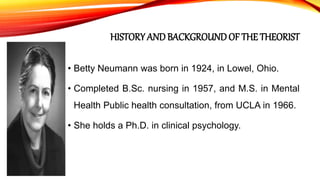
• Betty Neumann was born in 1924, in Lowel, Ohio.
• Completed B.Sc. nursing in 1957, and M.S. in Mental
Health Public health consultation, from UCLA in 1966.
• She holds a Ph.D. in clinical psychology.
HISTORY ANDBACKGROUNDOF THE THEORIST
• A pioneer in the community mental health movement in the late
1960s.
• Began developing her health system model, while a lecturer in
community health nursing at University of California, Los Angeles.
HISTORY ANDBACKGROUNDOF THE THEORIST
• The models was initially developed, in response to graduate
nursing students expression of a need for course content, that
would expose them to breadth of nursing problems, prior to
focusing on specific nursing problem areas.
HISTORY AND BACKGROUND OF THE THEORIST
• The model was published in 1972 as “A Model for Teaching Total
Person Approach to Patient Problems” in Nursing Research.
• It was refined, and subsequently published in the first edition of
Conceptual Models for Nursing Practice, in 1974, and in the
second edition in 1980.
DEVELOPMENT OF THE MODEL
• Neumann’s model was influenced by a variety of sources.
• The philosophy writers de Chardin and cornu (on wholeness in
system).
• Von Bertalanfy, and Lazlo on general system theory.
• Selye on stress theory.
• Lararus on stress and coping.
NEUMANN’S WORK & THE CHARACTERISTICS
OF A THEORY
• Theories can be the bases for hypotheses, that can be tested.
• Theories contribute to and assist in, increasing the general body
of knowledge within the discipline, through the research
implemented to validate them.
NEUMANN’S WORK & THE CHARACTERISTICS
OF A THEORY
• Theories connects the interrelated concepts in such a way, as to
create a different way of looking at a particular phenomenon.
• Theories must be logical in nature .
• Theories should be relatively simple yet generalizable.
NEUMANN’S WORK & THE CHARACTERISTICS
OF A THEORY
• Theories can be utilized by the practitioner, to guide and improve
their practice.
• Theories must be consistent with other validated theories, laws
and principles but will leave open unanswered questions, that
need to be investigated.
BASIC ASSUMPTIONS OF
NEUMANN’S THEORY
Sunday, February 12, 2017
13
BASIC ASSUMPTIONS
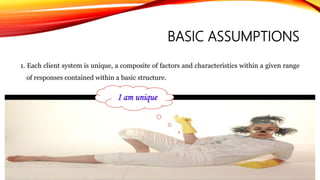
1. Each client system is unique, a composite of factors and characteristics within a given range
of responses contained within a basic structure.
I am unique
BASIC ASSUMPTIONS
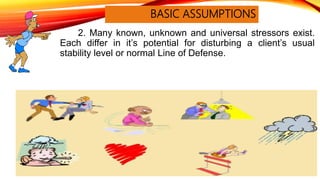
2. Many known, unknown and universal stressors exist.
Each differ in it’s potential for disturbing a client’s usual
stability level or normal Line of Defense.
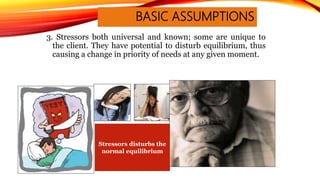
3. Stressors both universal and known; some are unique to
the client. They have potential to disturb equilibrium, thus
causing a change in priority of needs at any given moment.
BASIC ASSUMPTIONS
Stressors disturbs the
normal equilibrium
BASIC ASSUMPTIONS
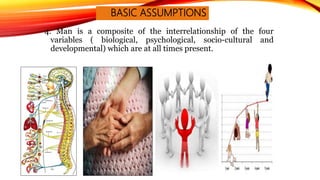
4. Man is a composite of the interrelationship of the four
variables ( biological, psychological, socio-cultural and
developmental) which are at all times present.
BASIC ASSUMPTIONS
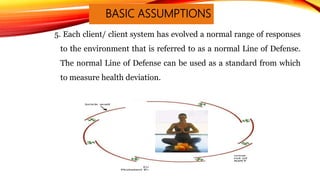
5. Each client/ client system has evolved a normal range of responses
to the environment that is referred to as a normal Line of Defense.
The normal Line of Defense can be used as a standard from which
to measure health deviation.
BASIC ASSUMPTIONS
6. When the flexible Line of Defense is no longer capable of protecting
the client/ client system, against an environmental stressor, the
stressor breaks through the normal Line of Defense.
Primary Prevention
Secondary Prevention
Tertiary Prevention
BASICASSUMPTIONS
8.Primary prevention relates to general knowledge
applied to clients assessment to identify stressors
before they occur.
9.Secondary prevention relates to symptomatology.
These are interventions generally initiated after an
encounter with a stressor.
10.Tertiary prevention relates to the adaptive process, as
reconstitution begins and moves back towards primary
prevention. These are the interventions initiated after
treatment.
BASIC ASSUMPTIONS
MAJOR CONCEPTS
OF NEUMANN'S
THEORY
FOUR MAJOR CONCEPTS
Person
Environment
Health
Nursing
1.PERSON
Each layer consists of five person variable or subsystems:
Physiological- Refer to the physiochemical structure and
function of the body. Psychological- Refers to mental
processes and emotions. Socio-cultural- Refers to
relationships; and social/cultural expectations and activities.
Spiritual- Refers to the influence of spiritual beliefs.
Developmental- Refers to those processes related to
development over the lifespan.
2.ENVIRONMENT
The internal environment exists within the client system.
The external environment exists outside the client system.
A created environment which is an environment that is created and
developed unconsciously by the client and is symbolic of system
wholeness.
3.HEALTH
Neuman sees health as being equated
with wellness. She defines
health/wellness as “the condition in
which all parts and subparts
(variables) are in harmony with the
whole of the client (Neumann, 1995)”.
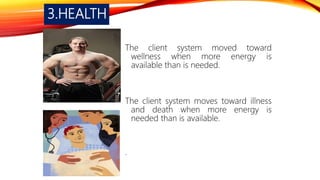
3.HEALTH
The client system moved toward
wellness when more energy is
available than is needed.
The client system moves toward illness
and death when more energy is
needed than is available.
.
4.
NURSING
Neuman sees nursing as a unique
profession that is concerned with all of
the variables, which influence the
response a person might have to a
stressor. The person is seen as a whole,
and it is the task of nursing to address
the whole person.
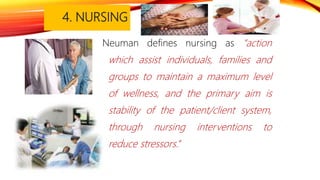
4. NURSING
Neuman defines nursing as “action
which assist individuals, families and
groups to maintain a maximum level
of wellness, and the primary aim is
stability of the patient/client system,
through nursing interventions to
reduce stressors.’’
4. NURSING
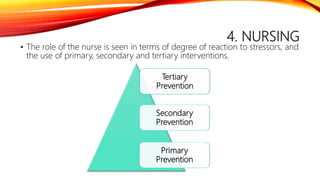
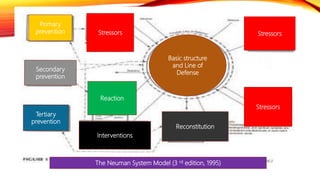
• The role of the nurse is seen in terms of degree of reaction to stressors, and
the use of primary, secondary and tertiary interventions.
Primary
Prevention
Secondary
Prevention
Tertiary
Prevention
Primary
prevention
Secondary
prevention
Tertiary
prevention
Stressors
Reaction
Interventions
Reconstitution
Stressors
Stressors
Basic structure
and Line of
Defense
The Neuman System Model (3 rd edition, 1995)
STAGES OF NURSING PROCESS
(BY NEUMAN)
Nursing
Diagnosis
Nursing Goal
Nursing
Outcome
STAGES OF NURSING PROCESS
(BY NEUMAN)
1. NURSING DIAGNOSIS
• It depends on acquisition of appropriate database; the diagnosis identifies, assesses,
classifies, and evaluates the dynamic interaction of the five variables.
• Variances from wellness (needs and problems) are determined by correlations and
constraints through synthesis of theory and data base.
• Broad hypothetical interventions are determined, i.e. maintain flexible line of
defense.
STAGES OF NURSING PROCESS
(BY NEUMAN)
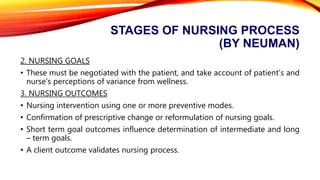
2. NURSING GOALS
• These must be negotiated with the patient, and take account of patient’s and
nurse’s perceptions of variance from wellness.
3. NURSING OUTCOMES
• Nursing intervention using one or more preventive modes.
• Confirmation of prescriptive change or reformulation of nursing goals.
• Short term goal outcomes influence determination of intermediate and long
– term goals.
• A client outcome validates nursing process.
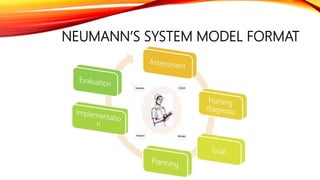
NEUMANN’S SYSTEM MODEL FORMAT
ACCEPTANCE BY THE NURSING COMMUNITY
PRACTICE
EDUCATION
RESEARCH
ADMINISTRATION
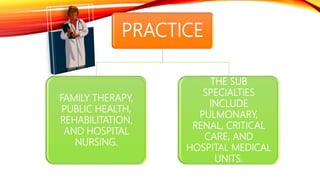
PRACTICE
FAMILY THERAPY,
PUBLIC HEALTH,
REHABILITATION,
AND HOSPITAL
NURSING.
THE SUB
SPECIALTIES
INCLUDE
PULMONARY,
RENAL, CRITICAL
CARE, AND
HOSPITAL MEDICAL
UNITS.
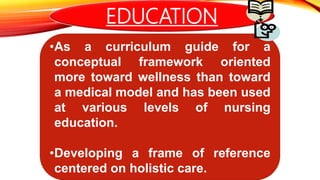
•As a curriculum guide for a
conceptual framework oriented
more toward wellness than toward
a medical model and has been used
at various levels of nursing
education.
•Developing a frame of reference
centered on holistic care.
EDUCATION
•The identification of
congruence between the
client’s perception of stressors
and the Method of collecting
and analyzing data for
identifying client problems.
care giver’s perception of
client stressors.
RESEARCH
• Case management of
patients.
• Total quality management is
used to prepare health care
administrators for future.
ADMINISTR
ATION
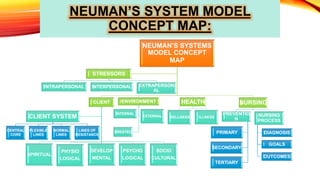
NEUMAN’S SYSTEM MODEL
CONCEPT MAP:
NEUMAN’S SYSTEMS
MODEL CONCEPT
MAP
CLIENT
SPIRITUAL
PHYSIO
LOGICAL
DEVELOP
MENTAL
PSYCHO
LOGICAL
SOCIO
CULTURAL
CLIENT SYSTEM
CENTRAL
CORE
FLEXIBLE
LINES
NORMAL
LINES
LINES OF
RESISTANCE
ENVIRONMENT
INTERNAL
EXTERNAL
CREATED
HEALTH
WELLNESS ILLNESS
NURSING
PREVENTIO
N
PRIMARY
SECONDARY
TERTIARY
NURSING
PROCESS
DIAGNOSIS
GOALS
OUTCOMES
STRESSORS
INTRAPERSONAL INTERPERSONAL EXTRAPERSON
AL
SUMMARY
Introduction of theory
History and background of theorist
Development of model
Characteristics of theory
Basic assumptions
Major concepts
Applications in nursing practice

betty neumann's theory

  • 1.
    BETTY NEUMANN’S THEORY ModeratorMr. L. Gopichandranan lecturer CON AIIMS PRESENTATED BY MR. MAHESH KUMAR SHARMA M.SC. NURSING 1ST YEAR CON AIIMS
  • 2.
    BETTY NEUMANN’S SYSTEMMODEL • Betty Neumann’s system model provides a comprehensive, flexible, holistic and system based perspective for nursing. • It focuses attention on the response of the client system to actual or potential environmental stressors.
  • 3.
    BETTY NEUMANN’S SYSTEMMODEL • The use of primary, secondary and tertiary nursing prevention intervention for retention, attainment, and maintenance of optimal client system wellness.
  • 5.
    HISTORY ANDBACKGROUNDOF THETHEORIST • Betty Neumann was born in 1924, in Lowel, Ohio. • Completed B.Sc. nursing in 1957, and M.S. in Mental Health Public health consultation, from UCLA in 1966. • She holds a Ph.D. in clinical psychology.
  • 6.
    HISTORY ANDBACKGROUNDOF THETHEORIST • A pioneer in the community mental health movement in the late 1960s. • Began developing her health system model, while a lecturer in community health nursing at University of California, Los Angeles.
  • 7.
    HISTORY ANDBACKGROUNDOF THETHEORIST • The models was initially developed, in response to graduate nursing students expression of a need for course content, that would expose them to breadth of nursing problems, prior to focusing on specific nursing problem areas.
  • 8.
    HISTORY AND BACKGROUNDOF THE THEORIST • The model was published in 1972 as “A Model for Teaching Total Person Approach to Patient Problems” in Nursing Research. • It was refined, and subsequently published in the first edition of Conceptual Models for Nursing Practice, in 1974, and in the second edition in 1980.
  • 9.
    DEVELOPMENT OF THEMODEL • Neumann’s model was influenced by a variety of sources. • The philosophy writers de Chardin and cornu (on wholeness in system). • Von Bertalanfy, and Lazlo on general system theory. • Selye on stress theory. • Lararus on stress and coping.
  • 10.
    NEUMANN’S WORK &THE CHARACTERISTICS OF A THEORY • Theories can be the bases for hypotheses, that can be tested. • Theories contribute to and assist in, increasing the general body of knowledge within the discipline, through the research implemented to validate them.
  • 11.
    NEUMANN’S WORK &THE CHARACTERISTICS OF A THEORY • Theories connects the interrelated concepts in such a way, as to create a different way of looking at a particular phenomenon. • Theories must be logical in nature . • Theories should be relatively simple yet generalizable.
  • 12.
    NEUMANN’S WORK &THE CHARACTERISTICS OF A THEORY • Theories can be utilized by the practitioner, to guide and improve their practice. • Theories must be consistent with other validated theories, laws and principles but will leave open unanswered questions, that need to be investigated.
  • 13.
    BASIC ASSUMPTIONS OF NEUMANN’STHEORY Sunday, February 12, 2017 13
  • 14.
    BASIC ASSUMPTIONS 1. Eachclient system is unique, a composite of factors and characteristics within a given range of responses contained within a basic structure. I am unique
  • 15.
    BASIC ASSUMPTIONS 2. Manyknown, unknown and universal stressors exist. Each differ in it’s potential for disturbing a client’s usual stability level or normal Line of Defense.
  • 16.
    3. Stressors bothuniversal and known; some are unique to the client. They have potential to disturb equilibrium, thus causing a change in priority of needs at any given moment. BASIC ASSUMPTIONS Stressors disturbs the normal equilibrium
  • 17.
    BASIC ASSUMPTIONS 4. Manis a composite of the interrelationship of the four variables ( biological, psychological, socio-cultural and developmental) which are at all times present.
  • 18.
    BASIC ASSUMPTIONS 5. Eachclient/ client system has evolved a normal range of responses to the environment that is referred to as a normal Line of Defense. The normal Line of Defense can be used as a standard from which to measure health deviation.
  • 19.
    BASIC ASSUMPTIONS 6. Whenthe flexible Line of Defense is no longer capable of protecting the client/ client system, against an environmental stressor, the stressor breaks through the normal Line of Defense.
  • 20.
  • 21.
    8.Primary prevention relatesto general knowledge applied to clients assessment to identify stressors before they occur. 9.Secondary prevention relates to symptomatology. These are interventions generally initiated after an encounter with a stressor. 10.Tertiary prevention relates to the adaptive process, as reconstitution begins and moves back towards primary prevention. These are the interventions initiated after treatment. BASIC ASSUMPTIONS
  • 22.
  • 23.
  • 24.
    1.PERSON Each layer consistsof five person variable or subsystems: Physiological- Refer to the physiochemical structure and function of the body. Psychological- Refers to mental processes and emotions. Socio-cultural- Refers to relationships; and social/cultural expectations and activities. Spiritual- Refers to the influence of spiritual beliefs. Developmental- Refers to those processes related to development over the lifespan.
  • 25.
    2.ENVIRONMENT The internal environmentexists within the client system. The external environment exists outside the client system. A created environment which is an environment that is created and developed unconsciously by the client and is symbolic of system wholeness.
  • 26.
    3.HEALTH Neuman sees healthas being equated with wellness. She defines health/wellness as “the condition in which all parts and subparts (variables) are in harmony with the whole of the client (Neumann, 1995)”.
  • 27.
    3.HEALTH The client systemmoved toward wellness when more energy is available than is needed. The client system moves toward illness and death when more energy is needed than is available. .
  • 28.
    4. NURSING Neuman sees nursingas a unique profession that is concerned with all of the variables, which influence the response a person might have to a stressor. The person is seen as a whole, and it is the task of nursing to address the whole person.
  • 29.
    4. NURSING Neuman definesnursing as “action which assist individuals, families and groups to maintain a maximum level of wellness, and the primary aim is stability of the patient/client system, through nursing interventions to reduce stressors.’’
  • 30.
    4. NURSING • Therole of the nurse is seen in terms of degree of reaction to stressors, and the use of primary, secondary and tertiary interventions. Primary Prevention Secondary Prevention Tertiary Prevention
  • 31.
  • 32.
    STAGES OF NURSINGPROCESS (BY NEUMAN) Nursing Diagnosis Nursing Goal Nursing Outcome
  • 33.
    STAGES OF NURSINGPROCESS (BY NEUMAN) 1. NURSING DIAGNOSIS • It depends on acquisition of appropriate database; the diagnosis identifies, assesses, classifies, and evaluates the dynamic interaction of the five variables. • Variances from wellness (needs and problems) are determined by correlations and constraints through synthesis of theory and data base. • Broad hypothetical interventions are determined, i.e. maintain flexible line of defense.
  • 34.
    STAGES OF NURSINGPROCESS (BY NEUMAN) 2. NURSING GOALS • These must be negotiated with the patient, and take account of patient’s and nurse’s perceptions of variance from wellness. 3. NURSING OUTCOMES • Nursing intervention using one or more preventive modes. • Confirmation of prescriptive change or reformulation of nursing goals. • Short term goal outcomes influence determination of intermediate and long – term goals. • A client outcome validates nursing process.
  • 35.
  • 36.
    ACCEPTANCE BY THENURSING COMMUNITY PRACTICE EDUCATION RESEARCH ADMINISTRATION
  • 37.
    PRACTICE FAMILY THERAPY, PUBLIC HEALTH, REHABILITATION, ANDHOSPITAL NURSING. THE SUB SPECIALTIES INCLUDE PULMONARY, RENAL, CRITICAL CARE, AND HOSPITAL MEDICAL UNITS.
  • 38.
    •As a curriculumguide for a conceptual framework oriented more toward wellness than toward a medical model and has been used at various levels of nursing education. •Developing a frame of reference centered on holistic care. EDUCATION
  • 39.
    •The identification of congruencebetween the client’s perception of stressors and the Method of collecting and analyzing data for identifying client problems. care giver’s perception of client stressors. RESEARCH • Case management of patients. • Total quality management is used to prepare health care administrators for future. ADMINISTR ATION
  • 40.
    NEUMAN’S SYSTEM MODEL CONCEPTMAP: NEUMAN’S SYSTEMS MODEL CONCEPT MAP CLIENT SPIRITUAL PHYSIO LOGICAL DEVELOP MENTAL PSYCHO LOGICAL SOCIO CULTURAL CLIENT SYSTEM CENTRAL CORE FLEXIBLE LINES NORMAL LINES LINES OF RESISTANCE ENVIRONMENT INTERNAL EXTERNAL CREATED HEALTH WELLNESS ILLNESS NURSING PREVENTIO N PRIMARY SECONDARY TERTIARY NURSING PROCESS DIAGNOSIS GOALS OUTCOMES STRESSORS INTRAPERSONAL INTERPERSONAL EXTRAPERSON AL
  • 41.
    SUMMARY Introduction of theory Historyand background of theorist Development of model Characteristics of theory Basic assumptions Major concepts Applications in nursing practice