
1.10 Bernoulli’s random Variables & Binomial Distribution
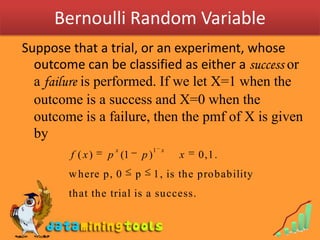
Bernoulli Random VariableSuppose that a trial, or an experiment, whose outcome can be classified as either a success or a failure is performed. If we let X=1 when the outcome is a success and X=0 when the outcome is a failure, then the pmf of X is given by
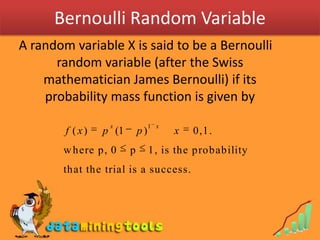
Bernoulli Random Variable A random variable X is said to be a Bernoulli random variable (after the Swiss mathematician James Bernoulli) if its probability mass function is given by
Binomial Random VariableSuppose now that n independent trials, each of which results in a success with probability p and in a failure with probability 1-p, are to be performed. If X represents the number of successes that occur in the n trials, then X  is said to be a Binomial random variable with parameters (n,p) . Thus a Bernoulli random variable is just a binomial random variable with parameters (1,p) .
 Binomial DistributionBernoulli TrialsThere are only two possible outcomes for each trial.The probability of a success is the same for each trial.There are n trials, where n is a constant.The n trials are independent.
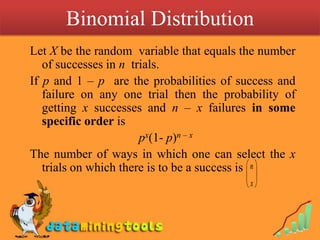
Binomial Distribution Let X be the random variable that equals the number of successes in n  trials.If p and 1 – p  are the probabilities of success and failure on any one trial then the probability of getting x successes and n – x failures in some specific order is px(1- p)n – xThe number of ways in which one can select the x trials on which there is to be a success is
Binomial Distribution Thus the probability of getting x successes in n trials is given byThis probability distribution is called the binomial distribution because for  x = 0, 1, 2, …, and  n the value of the probabilities are successive terms of binomial expansion of [p + (1 – p)]n;
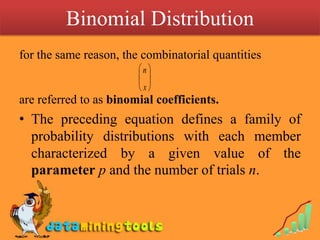
Binomial Distribution for the same reason, the combinatorial quantities are referred to as binomial coefficients. The preceding equation defines a family of probability distributions with each member characterized by a given value of the parameterp and the number of trials n.
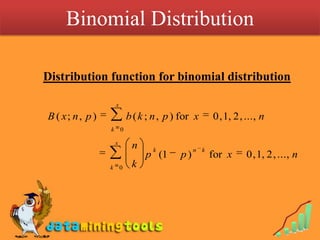
Binomial Distribution Distribution function for binomial distribution
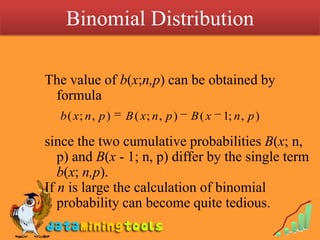
Binomial Distribution The value of b(x;n,p) can be obtained by formulasince the two cumulative probabilities B(x; n, p) and B(x - 1; n, p) differ by the single term b(x; n,p).If n is large the calculation of binomial probability can become quite tedious.
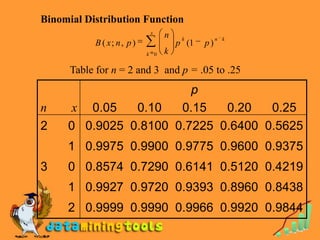
Binomial Distribution FunctionTable for n = 2 and 3  and p = .05 to .25
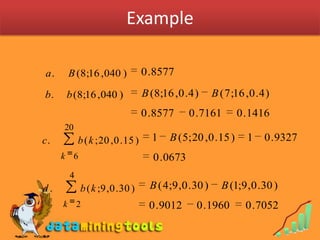
Example
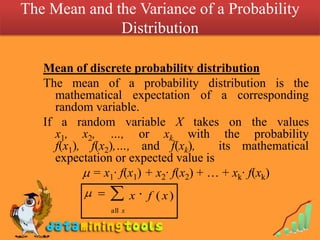
The Mean and the Variance of a Probability DistributionMean of discrete probability distributionThe mean of a probability distribution is the mathematical expectation of a corresponding random variable. If a random variable X takes on the values x1, x2, …, or xk, with the probability f(x1), f(x2),…, and f(xk),  its mathematical expectation or expected value is  = x1Ā· f(x1) + x2Ā· f(x2) + … + xkĀ· f(xk)
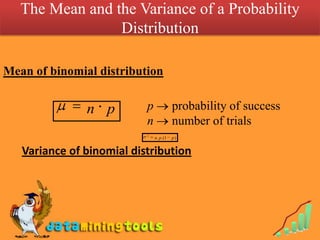
The Mean and the Variance of a Probability Distribution Mean of binomial distributionp ļ‚® probability of successn ļ‚® number of trialsVariance of binomial distribution
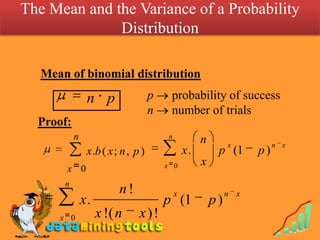
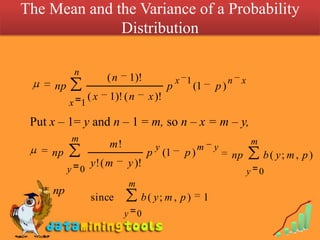
The Mean and the Variance of a Probability Distribution Mean of binomial distributionp ļ‚® probability of successn ļ‚® number of trialsProof:
The Mean and the Variance of a Probability Distribution Put x – 1= y and n – 1 = m, so n – x = m – y,
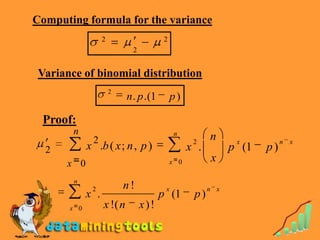
Computing formula for the varianceVariance of binomial distributionProof:
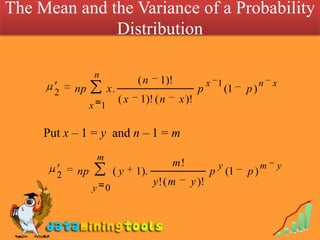
Put x – 1 = y  and n – 1 = m The Mean and the Variance of a Probability Distribution
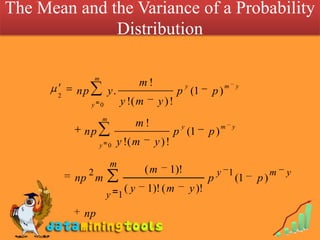
The Mean and the Variance of a Probability Distribution
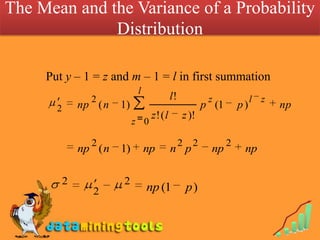
Put y – 1 = z and m – 1 = l in first summationThe Mean and the Variance of a Probability Distribution
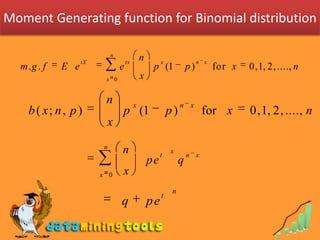
Moment Generating function for Binomial distribution
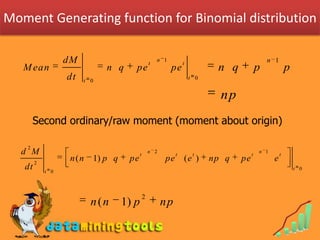
Second ordinary/raw moment (moment about origin)Moment Generating function for Binomial distribution
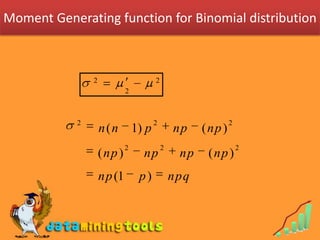
Moment Generating function for Binomial distributionMoment Generating function for Binomial distribution

Bernoullis Random Variables And Binomial Distribution

  • 1.
    1.10 Bernoulli’s randomVariables & Binomial Distribution
  • 2.
    Bernoulli Random VariableSupposethat a trial, or an experiment, whose outcome can be classified as either a success or a failure is performed. If we let X=1 when the outcome is a success and X=0 when the outcome is a failure, then the pmf of X is given by
  • 3.
    Bernoulli Random VariableA random variable X is said to be a Bernoulli random variable (after the Swiss mathematician James Bernoulli) if its probability mass function is given by
  • 4.
    Binomial Random VariableSupposenow that n independent trials, each of which results in a success with probability p and in a failure with probability 1-p, are to be performed. If X represents the number of successes that occur in the n trials, then X is said to be a Binomial random variable with parameters (n,p) . Thus a Bernoulli random variable is just a binomial random variable with parameters (1,p) .
  • 5.
    Binomial DistributionBernoulliTrialsThere are only two possible outcomes for each trial.The probability of a success is the same for each trial.There are n trials, where n is a constant.The n trials are independent.
  • 6.
    Binomial Distribution LetX be the random variable that equals the number of successes in n trials.If p and 1 – p are the probabilities of success and failure on any one trial then the probability of getting x successes and n – x failures in some specific order is px(1- p)n – xThe number of ways in which one can select the x trials on which there is to be a success is
  • 7.
    Binomial Distribution Thusthe probability of getting x successes in n trials is given byThis probability distribution is called the binomial distribution because for x = 0, 1, 2, …, and n the value of the probabilities are successive terms of binomial expansion of [p + (1 – p)]n;
  • 8.
    Binomial Distribution forthe same reason, the combinatorial quantities are referred to as binomial coefficients. The preceding equation defines a family of probability distributions with each member characterized by a given value of the parameterp and the number of trials n.
  • 9.
    Binomial Distribution Distributionfunction for binomial distribution
  • 10.
    Binomial Distribution Thevalue of b(x;n,p) can be obtained by formulasince the two cumulative probabilities B(x; n, p) and B(x - 1; n, p) differ by the single term b(x; n,p).If n is large the calculation of binomial probability can become quite tedious.
  • 11.
    Binomial Distribution FunctionTablefor n = 2 and 3 and p = .05 to .25
  • 12.
  • 13.
    The Mean andthe Variance of a Probability DistributionMean of discrete probability distributionThe mean of a probability distribution is the mathematical expectation of a corresponding random variable. If a random variable X takes on the values x1, x2, …, or xk, with the probability f(x1), f(x2),…, and f(xk), its mathematical expectation or expected value is  = x1Ā· f(x1) + x2Ā· f(x2) + … + xkĀ· f(xk)
  • 14.
    The Mean andthe Variance of a Probability Distribution Mean of binomial distributionp ļ‚® probability of successn ļ‚® number of trialsVariance of binomial distribution
  • 15.
    The Mean andthe Variance of a Probability Distribution Mean of binomial distributionp ļ‚® probability of successn ļ‚® number of trialsProof:
  • 16.
    The Mean andthe Variance of a Probability Distribution Put x – 1= y and n – 1 = m, so n – x = m – y,
  • 17.
    Computing formula forthe varianceVariance of binomial distributionProof:
  • 18.
    Put x –1 = y and n – 1 = m The Mean and the Variance of a Probability Distribution
  • 19.
    The Mean andthe Variance of a Probability Distribution
  • 20.
    Put y –1 = z and m – 1 = l in first summationThe Mean and the Variance of a Probability Distribution
  • 21.
    Moment Generating functionfor Binomial distribution
  • 22.
    Second ordinary/raw moment(moment about origin)Moment Generating function for Binomial distribution
  • 23.
    Moment Generating functionfor Binomial distributionMoment Generating function for Binomial distribution