
Machine Learning
Techniques
Introduction
• Machine Learning is considered as a subfield of
Artificial Intelligence and it is concerned with the
development of techniques and methods which enable
the computer to learn. In simple terms, it is considered
the science of development of algorithms which enable
the machine to learn and perform tasks and activities.
• Limitations
– Algorithms/Techniques vary learning over large datasets
and often misinterpret.
– Learning is based on the data which is provided.
– Machine learning algorithms suffer from the possibility of
overgeneralization
Decision-Tree Learning
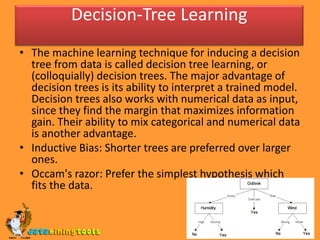
• The machine learning technique for inducing a decision
tree from data is called decision tree learning, or
(colloquially) decision trees. The major advantage of
decision trees is its ability to interpret a trained model.
Decision trees also works with numerical data as input,
since they find the margin that maximizes information
gain. Their ability to mix categorical and numerical data
is another advantage.
• Inductive Bias: Shorter trees are preferred over larger
ones.
• Occam's razor: Prefer the simplest hypothesis which
fits the data.
Artificial Neural Networks
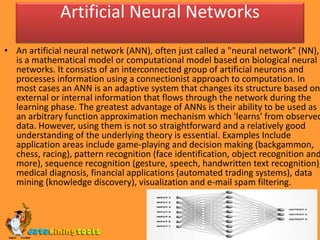
• An artificial neural network (ANN), often just called a "neural network" (NN),
is a mathematical model or computational model based on biological neural
networks. It consists of an interconnected group of artificial neurons and
processes information using a connectionist approach to computation. In
most cases an ANN is an adaptive system that changes its structure based on
external or internal information that flows through the network during the
learning phase. The greatest advantage of ANNs is their ability to be used as
an arbitrary function approximation mechanism which 'learns' from observed
data. However, using them is not so straightforward and a relatively good
understanding of the underlying theory is essential. Examples Include
application areas include game-playing and decision making (backgammon,
chess, racing), pattern recognition (face identification, object recognition and
more), sequence recognition (gesture, speech, handwritten text recognition),
medical diagnosis, financial applications (automated trading systems), data
mining (knowledge discovery), visualization and e-mail spam filtering.
Bayesian Learning
• Bayesian Learning is a probabilistic approach to learning and
inference. It is based on the assumption that the quantities of
interest are governed by probability distributions. It is attractive
because in theory it can arrive at optimal decisions. It provides a
quantitative approach to weighing the evidence supporting
alternative hypotheses. Bayesian learning has been successfully
applied to Data mining, Robotics, Signal processing, Bioinformatics,
Text analysis (spam filters), and graphics. Bayesian methods can be
used to determine the most probable hypothesis given the data,
maximum a posteriori (MAP) hypothesis. A naive Bayes classifier is
a simple probabilistic classifier based on applying Bayes' theorem
with strong (naive) independence assumptions.
• Bayes theorem is
P (H|X) = P(X|H) P(H) / P(X)
Support Vector Machines
• Support vector machines (SVMs) are a set of related supervised
learning methods used for classification and regression. They belong
to a family of generalized linear classifiers. A special property of
SVMs is that they simultaneously minimize the empirical
classification error and maximize the geometric margin; hence they
are also known as maximum margin classifiers. Support vector
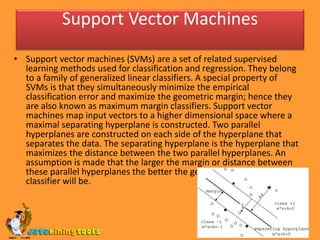
machines map input vectors to a higher dimensional space where a
maximal separating hyperplane is constructed. Two parallel
hyperplanes are constructed on each side of the hyperplane that
separates the data. The separating hyperplane is the hyperplane that
maximizes the distance between the two parallel hyperplanes. An
assumption is made that the larger the margin or distance between
these parallel hyperplanes the better the generalization error of the
classifier will be.
Genetic Algorithms
• Genetic algorithm (GA) is a search technique used in computing to find exact or
approximate solutions to optimization and search problems. Genetic algorithms
are categorized as global search heuristics. Genetic algorithms are a particular
class of evolutionary algorithms (also known as evolutionary computation) that
use techniques inspired by evolutionary biology such as inheritance, mutation,
selection, and crossover (also called recombination). The following steps describe
the application of a genetic algorithm: Start with an initial population (e.g.
random) of candidate solutions, repeatedly apply a number of genetic operators to
generate a new population and denote the best individual of the last generation
(population) as the solution. The operators that a genetic algorithm uses are:
• Reproduction: Select individuals with higher fitness than others to reproduce so
that their children are found in the next generation. Unfit individuals die with
higher probability than fitter ones.
• Crossover: Combine two reproduced individuals so that their children are copies in
the next generation.
• Mutation: Probabilistic change of part of an individual.
• Genetic algorithms are simple to implement, but their behavior is difficult to
understand.
Graph-based Learning
• Graph-based relational learning (GBRL) is the
task of finding novel, useful, and
understandable graph-theoretic patterns in a
graph representation of data. Graph-based
data representation is becoming increasingly
more commonplace, as graphs can represent
some kinds of data more efficiently than
relational tables.
Reinforcement Learning
• Reinforcement learning (RL) is learning by
interacting with an environment. An RL agent
learns from the consequences of its actions,
rather than from being explicitly taught and it
selects its actions on basis of its past
experiences (exploitation) and also by new
choices (exploration), which is essentially trial
and error learning.
Pattern Recognition
• Pattern recognition aims to classify data (patterns)
based on either a priori knowledge or on statistical
information extracted from the patterns. The patterns
to be classified are usually groups of measurements or
observations, defining points in an appropriate
multidimensional space. Typical applications are
automatic speech recognition, classification of text into
several categories (e.g. spam/non-spam email
messages), the automatic recognition of handwritten
postal codes on postal envelopes, or the automatic
recognition of images of human faces.
Visit more self help tutorials
• Pick a tutorial of your choice and browse
through it at your own pace.
• The tutorials section is free, self-guiding and
will not involve any additional support.
• Visit us at www.dataminingtools.net

Techniques Machine Learning

  • 1.
  • 2.
    Introduction • Machine Learningis considered as a subfield of Artificial Intelligence and it is concerned with the development of techniques and methods which enable the computer to learn. In simple terms, it is considered the science of development of algorithms which enable the machine to learn and perform tasks and activities. • Limitations – Algorithms/Techniques vary learning over large datasets and often misinterpret. – Learning is based on the data which is provided. – Machine learning algorithms suffer from the possibility of overgeneralization
  • 3.
    Decision-Tree Learning • Themachine learning technique for inducing a decision tree from data is called decision tree learning, or (colloquially) decision trees. The major advantage of decision trees is its ability to interpret a trained model. Decision trees also works with numerical data as input, since they find the margin that maximizes information gain. Their ability to mix categorical and numerical data is another advantage. • Inductive Bias: Shorter trees are preferred over larger ones. • Occam's razor: Prefer the simplest hypothesis which fits the data.
  • 4.
    Artificial Neural Networks •An artificial neural network (ANN), often just called a "neural network" (NN), is a mathematical model or computational model based on biological neural networks. It consists of an interconnected group of artificial neurons and processes information using a connectionist approach to computation. In most cases an ANN is an adaptive system that changes its structure based on external or internal information that flows through the network during the learning phase. The greatest advantage of ANNs is their ability to be used as an arbitrary function approximation mechanism which 'learns' from observed data. However, using them is not so straightforward and a relatively good understanding of the underlying theory is essential. Examples Include application areas include game-playing and decision making (backgammon, chess, racing), pattern recognition (face identification, object recognition and more), sequence recognition (gesture, speech, handwritten text recognition), medical diagnosis, financial applications (automated trading systems), data mining (knowledge discovery), visualization and e-mail spam filtering.
  • 5.
    Bayesian Learning • BayesianLearning is a probabilistic approach to learning and inference. It is based on the assumption that the quantities of interest are governed by probability distributions. It is attractive because in theory it can arrive at optimal decisions. It provides a quantitative approach to weighing the evidence supporting alternative hypotheses. Bayesian learning has been successfully applied to Data mining, Robotics, Signal processing, Bioinformatics, Text analysis (spam filters), and graphics. Bayesian methods can be used to determine the most probable hypothesis given the data, maximum a posteriori (MAP) hypothesis. A naive Bayes classifier is a simple probabilistic classifier based on applying Bayes' theorem with strong (naive) independence assumptions. • Bayes theorem is P (H|X) = P(X|H) P(H) / P(X)
  • 6.
    Support Vector Machines •Support vector machines (SVMs) are a set of related supervised learning methods used for classification and regression. They belong to a family of generalized linear classifiers. A special property of SVMs is that they simultaneously minimize the empirical classification error and maximize the geometric margin; hence they are also known as maximum margin classifiers. Support vector machines map input vectors to a higher dimensional space where a maximal separating hyperplane is constructed. Two parallel hyperplanes are constructed on each side of the hyperplane that separates the data. The separating hyperplane is the hyperplane that maximizes the distance between the two parallel hyperplanes. An assumption is made that the larger the margin or distance between these parallel hyperplanes the better the generalization error of the classifier will be.
  • 7.
    Genetic Algorithms • Geneticalgorithm (GA) is a search technique used in computing to find exact or approximate solutions to optimization and search problems. Genetic algorithms are categorized as global search heuristics. Genetic algorithms are a particular class of evolutionary algorithms (also known as evolutionary computation) that use techniques inspired by evolutionary biology such as inheritance, mutation, selection, and crossover (also called recombination). The following steps describe the application of a genetic algorithm: Start with an initial population (e.g. random) of candidate solutions, repeatedly apply a number of genetic operators to generate a new population and denote the best individual of the last generation (population) as the solution. The operators that a genetic algorithm uses are: • Reproduction: Select individuals with higher fitness than others to reproduce so that their children are found in the next generation. Unfit individuals die with higher probability than fitter ones. • Crossover: Combine two reproduced individuals so that their children are copies in the next generation. • Mutation: Probabilistic change of part of an individual. • Genetic algorithms are simple to implement, but their behavior is difficult to understand.
  • 8.
    Graph-based Learning • Graph-basedrelational learning (GBRL) is the task of finding novel, useful, and understandable graph-theoretic patterns in a graph representation of data. Graph-based data representation is becoming increasingly more commonplace, as graphs can represent some kinds of data more efficiently than relational tables.
  • 9.
    Reinforcement Learning • Reinforcementlearning (RL) is learning by interacting with an environment. An RL agent learns from the consequences of its actions, rather than from being explicitly taught and it selects its actions on basis of its past experiences (exploitation) and also by new choices (exploration), which is essentially trial and error learning.
  • 10.
    Pattern Recognition • Patternrecognition aims to classify data (patterns) based on either a priori knowledge or on statistical information extracted from the patterns. The patterns to be classified are usually groups of measurements or observations, defining points in an appropriate multidimensional space. Typical applications are automatic speech recognition, classification of text into several categories (e.g. spam/non-spam email messages), the automatic recognition of handwritten postal codes on postal envelopes, or the automatic recognition of images of human faces.
  • 11.
    Visit more selfhelp tutorials • Pick a tutorial of your choice and browse through it at your own pace. • The tutorials section is free, self-guiding and will not involve any additional support. • Visit us at www.dataminingtools.net