Arthropoda
Crustaceans & Insects
Biology / Environmental Studies /
Ecotourism
Mr. R. Estrella
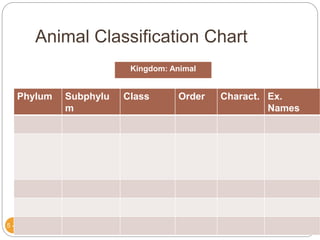
Animal Classification Chart
5 - 2
Phylum Subphylu
m
Class Order Charact. Ex.
Names
Kingdom: Animal
5 - 3
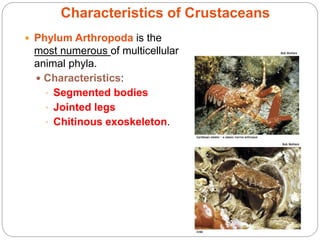
Characteristics of Crustaceans
 Phylum Arthropoda is the
most numerous of multicellular
animal phyla.
 Characteristics:
• Segmented bodies
• Jointed legs
• Chitinous exoskeleton.
5 - 4
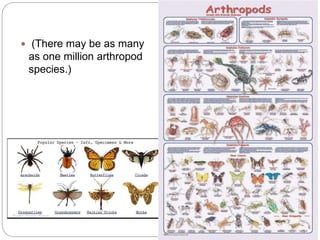
 (There may be as many
as one million arthropod
species.)
5 - 5
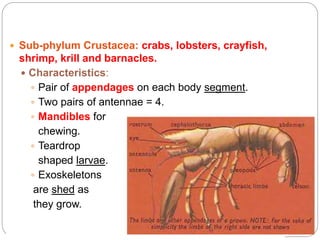
 Sub-phylum Crustacea: crabs, lobsters, crayfish,
shrimp, krill and barnacles.
 Characteristics:
 Pair of appendages on each body segment.
 Two pairs of antennae = 4.
 Mandibles for
chewing.
 Teardrop
shaped larvae.
 Exoskeletons
are shed as
they grow.
5 - 6
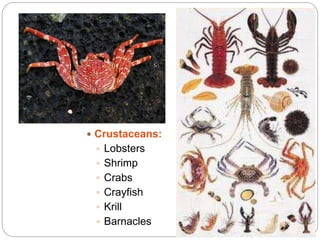
 Crustaceans:
 Lobsters
 Shrimp
 Crabs
 Crayfish
 Krill
 Barnacles
5 - 7
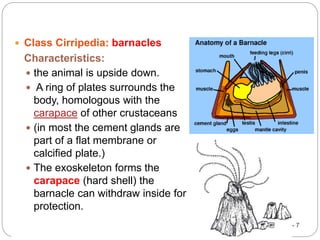
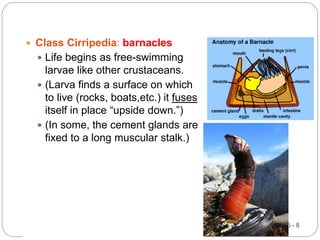
 Class Cirripedia: barnacles
Characteristics:
 the animal is upside down.
 A ring of plates surrounds the
body, homologous with the
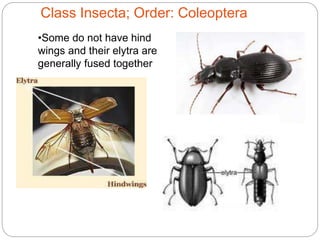
carapace of other crustaceans
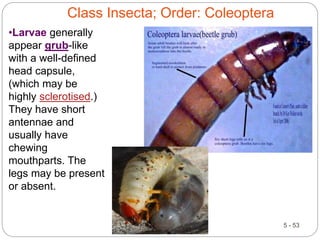
 (in most the cement glands are
part of a flat membrane or
calcified plate.)
 The exoskeleton forms the
carapace (hard shell) the
barnacle can withdraw inside for
protection.
5 - 8
 Class Cirripedia: barnacles
 Life begins as free-swimming
larvae like other crustaceans.
 (Larva finds a surface on which
to live (rocks, boats,etc.) it fuses
itself in place “upside down.”)
 (In some, the cement glands are
fixed to a long muscular stalk.)
5 - 9
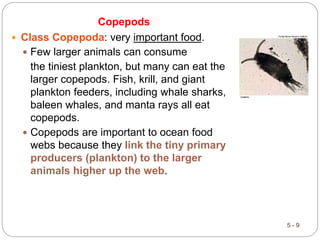
Copepods
 Class Copepoda: very important food.
 Few larger animals can consume
the tiniest plankton, but many can eat the
larger copepods. Fish, krill, and giant
plankton feeders, including whale sharks,
baleen whales, and manta rays all eat
copepods.
 Copepods are important to ocean food
webs because they link the tiny primary
producers (plankton) to the larger
animals higher up the web.
5 - 10
Arthropoda Review #1
1. Segmented
2. Joint
3. Appendage
4. Mandibles
5. Carapace
6. Describe a jointed leg
7. What are the characteristics of
Arthropoda?
8. What are the characteristics of
crustaceans?
9. Name 4 types of crustaceans
10. What is special about barnacles?
11. What is important about copepods?
HW: Crustaceans P.
More work?
Really!?
5 - 11
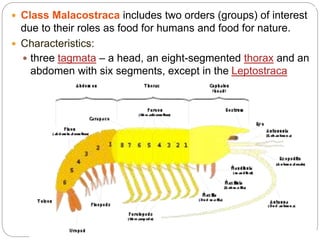
 Class Malacostraca includes two orders (groups) of interest
due to their roles as food for humans and food for nature.
 Characteristics:
 three tagmata – a head, an eight-segmented thorax and an
abdomen with six segments, except in the Leptostraca
5 - 12
Decapods and Krill
 Class Malacostraca
Crustaceans
–
Underwater
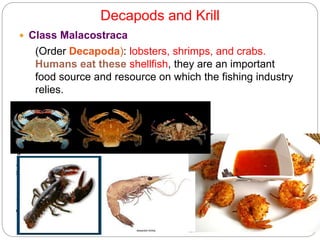
Arthropods
(Order Decapoda): lobsters, shrimps, and crabs.
Humans eat these shellfish, they are an important
food source and resource on which the fishing industry
relies.
5 - 13
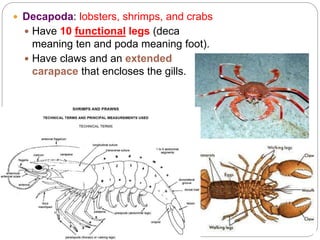
 Decapoda: lobsters, shrimps, and crabs
 Have 10 functional legs (deca
meaning ten and poda meaning foot).
 Have claws and an extended
carapace that encloses the gills.
Chapter
5
Pages
5-53
to
5-55
Crustaceans
–
Underwater
Arthropods
5 - 14
Decapods and Krill
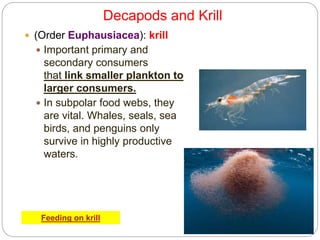
 (Order Euphausiacea): krill
 Important primary and
secondary consumers
that link smaller plankton to
larger consumers.
 In subpolar food webs, they
are vital. Whales, seals, sea
birds, and penguins only
survive in highly productive
waters.
Feeding on krill
5 - 15
Malacostraca Review
1. Why are krill and copepods so
important in the food web?
2. What does deca mean?
3. What animals are decapods?
4. What kingdom and phylum does
Malacostraca belong to?
5. What are the characteristics of
malacostraca?
6. List 3 examples of shellfish you might
find at a restaurant.
HW:
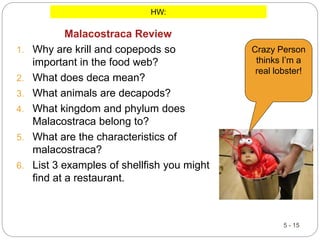
Crazy Person
thinks I’m a
real lobster!
5 - 16
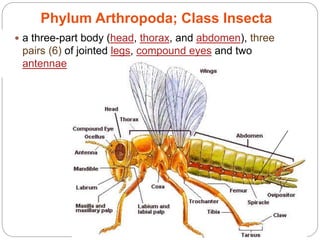
Phylum Arthropoda; Class Insecta
 a three-part body (head, thorax, and abdomen), three
pairs (6) of jointed legs, compound eyes and two
antennae
Phylum Arthropoda; Class Insecta
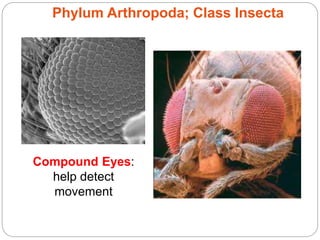
Compound Eyes:
help detect
movement
5 - 20
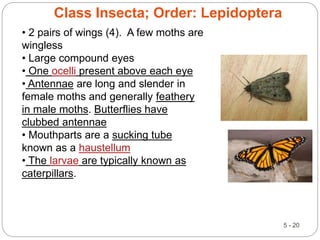
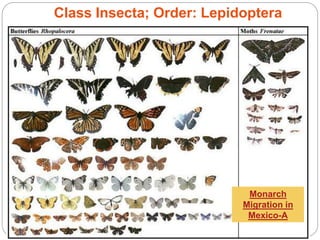
Class Insecta; Order: Lepidoptera
• 2 pairs of wings (4). A few moths are
wingless
• Large compound eyes
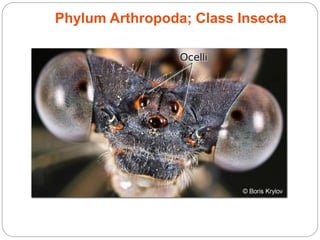
• One ocelli present above each eye
• Antennae are long and slender in
female moths and generally feathery
in male moths. Butterflies have
clubbed antennae
• Mouthparts are a sucking tube
known as a haustellum
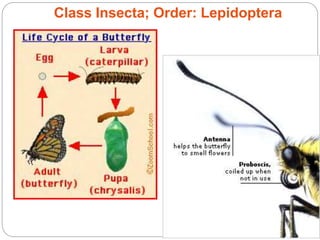
• The larvae are typically known as
caterpillars.
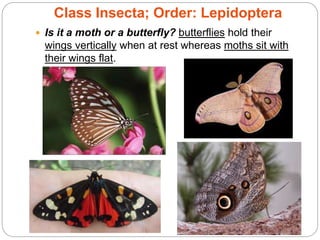
 Is it a moth or a butterfly? butterflies hold their
wings vertically when at rest whereas moths sit with
their wings flat.
Class Insecta; Order: Lepidoptera
5 - 22
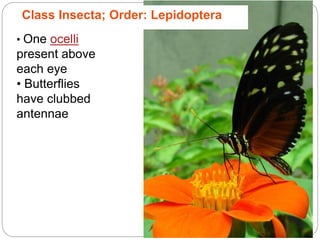
• One ocelli
present above
each eye
• Butterflies
have clubbed
antennae
Class Insecta; Order: Lepidoptera
5 - 23
Class Insecta; Order: Lepidoptera
5 - 24
Class Insecta; Order: Lepidoptera
Monarch
Migration in
Mexico-A
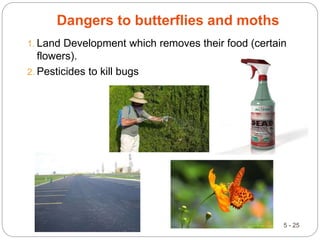
Dangers to butterflies and moths
1. Land Development which removes their food (certain
flowers).
2. Pesticides to kill bugs
5 - 25
5 - 26
Lepidoptera Review
Mollusks
–
A
Bag,
a
Scraper,
and
a
Foot
Chapter
5
Pages
5-45
to
5-48
1. What kingdom, Phylum, Class and Order
are butterflies and moths in?
2. Compound Eye
3. Thorax
4. Abdomen
5. Head
6. Ocellus (ocelli)
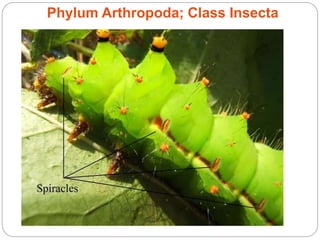
7. Spiracle
8. What is the benefit of compound eyes?
9. What do moths & butterflies eat?
10. What is the larva of moths and butterflies?
11. Short Answer: Explain the importance of
butterflies and moths and 2 activities that
are dangerous to them.
Do NOT stick your
tongue up my
nostril!
5 - 27
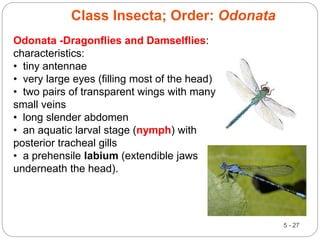
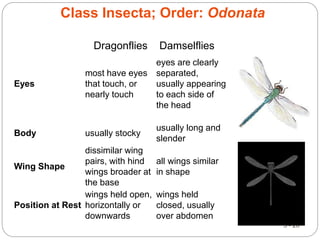
Class Insecta; Order: Odonata
Odonata -Dragonflies and Damselflies:
characteristics:
• tiny antennae
• very large eyes (filling most of the head)
• two pairs of transparent wings with many
small veins
• long slender abdomen
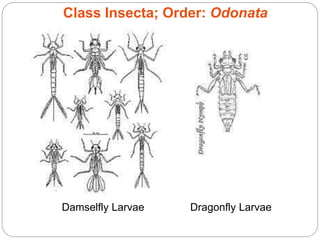
• an aquatic larval stage (nymph) with
posterior tracheal gills
• a prehensile labium (extendible jaws
underneath the head).
5 - 28
Class Insecta; Order: Odonata
Chapter
5
Pages
5-53
to
5-55
Crustaceans
–
Underwater
Arthropods
Eyes
most have eyes
that touch, or
nearly touch
eyes are clearly
separated,
usually appearing
to each side of
the head
Body usually stocky
usually long and
slender
Wing Shape
dissimilar wing
pairs, with hind
wings broader at
the base
all wings similar
in shape
Position at Rest
wings held open,
horizontally or
downwards
wings held
closed, usually
over abdomen
Dragonflies Damselflies
Class Insecta; Order: Odonata
Damselfly Larvae Dragonfly Larvae
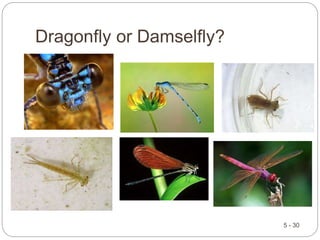
Dragonfly or Damselfly?
5 - 30
Dragonfly & Damselfly
Review
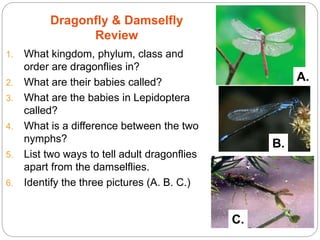
1. What kingdom, phylum, class and
order are dragonflies in?
2. What are their babies called?
3. What are the babies in Lepidoptera
called?
4. What is a difference between the two
nymphs?
5. List two ways to tell adult dragonflies
apart from the damselflies.
6. Identify the three pictures (A. B. C.)
5 - 31
A.
B.
C.
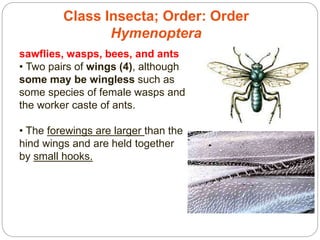
Class Insecta; Order: Order
Hymenoptera
sawflies, wasps, bees, and ants
• Two pairs of wings (4), although
some may be wingless such as
some species of female wasps and
the worker caste of ants.
• The forewings are larger than the
hind wings and are held together
by small hooks.
5 - 33
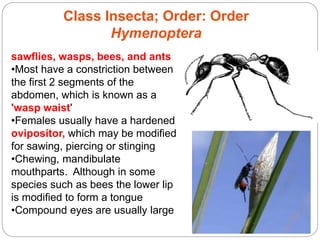
sawflies, wasps, bees, and ants
•Most have a constriction between
the first 2 segments of the
abdomen, which is known as a
'wasp waist'
•Females usually have a hardened
ovipositor, which may be modified
for sawing, piercing or stinging
•Chewing, mandibulate
mouthparts. Although in some
species such as bees the lower lip
is modified to form a tongue
•Compound eyes are usually large
Class Insecta; Order: Order
Hymenoptera
5 - 34
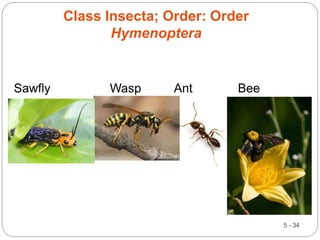
Sawfly Wasp Ant Bee
Class Insecta; Order: Order
Hymenoptera
5 - 35
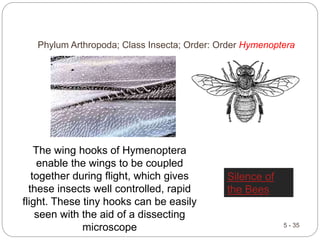
Phylum Arthropoda; Class Insecta; Order: Order Hymenoptera
The wing hooks of Hymenoptera
enable the wings to be coupled
together during flight, which gives
these insects well controlled, rapid
flight. These tiny hooks can be easily
seen with the aid of a dissecting
microscope
Silence of
the Bees
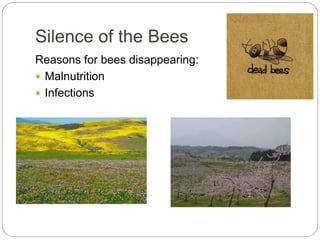
Silence of the Bees
Reasons for bees disappearing:
 Malnutrition
 Infections
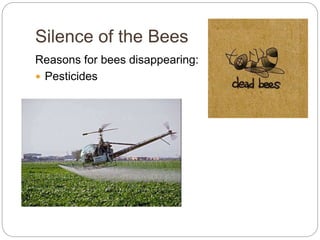
Silence of the Bees
Reasons for bees disappearing:
 Pesticides
5 - 38
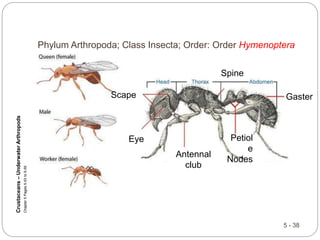
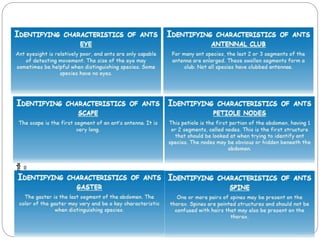
Phylum Arthropoda; Class Insecta; Order: Order Hymenoptera
Chapter
5
Pages
5-53
to
5-55
Crustaceans
–
Underwater
Arthropods
Scape
Eye
Spine
Petiol
e
Nodes
Antennal
club
Gaster
5 - 39
Chapter
5
Pages
5-53
to
5-55
Crustaceans
–
Underwater
Arthropods
5 - 40
Chapter
5
Pages
5-53
to
5-55
Crustaceans
–
Underwater
Arthropods
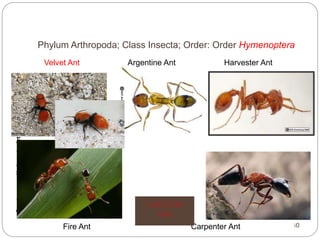
Fire Ant Carpenter Ant
Velvet Ant Argentine Ant Harvester Ant
Phylum Arthropoda; Class Insecta; Order: Order Hymenoptera
Lord of the
Ants
5 - 41
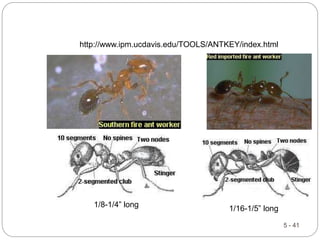
http://www.ipm.ucdavis.edu/TOOLS/ANTKEY/index.html
1/16-1/5” long
1/8-1/4” long
5 - 42
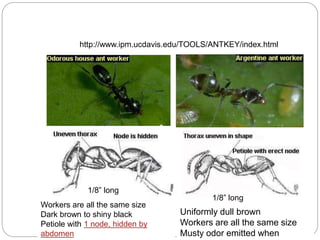
http://www.ipm.ucdavis.edu/TOOLS/ANTKEY/index.html
1/8” long
1/8” long
Uniformly dull brown
Workers are all the same size
Musty odor emitted when
Workers are all the same size
Dark brown to shiny black
Petiole with 1 node, hidden by
abdomen
5 - 43
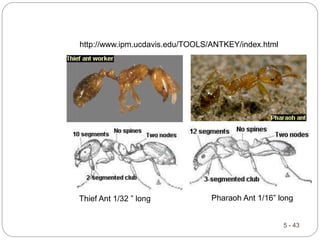
http://www.ipm.ucdavis.edu/TOOLS/ANTKEY/index.html
Pharaoh Ant 1/16” long
Thief Ant 1/32 ” long
5 - 44
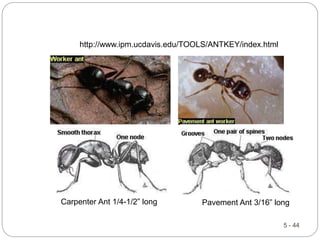
http://www.ipm.ucdavis.edu/TOOLS/ANTKEY/index.html
Carpenter Ant 1/4-1/2” long Pavement Ant 3/16” long
5 - 45
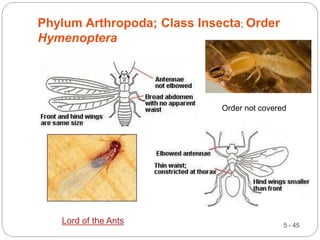
Phylum Arthropoda; Class Insecta; Order
Hymenoptera
Lord of the Ants
Order not covered
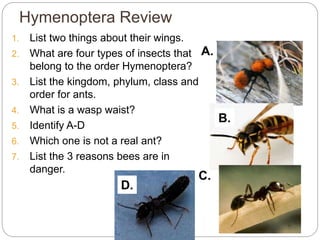
Hymenoptera Review
1. List two things about their wings.
2. What are four types of insects that
belong to the order Hymenoptera?
3. List the kingdom, phylum, class and
order for ants.
4. What is a wasp waist?
5. Identify A-D
6. Which one is not a real ant?
7. List the 3 reasons bees are in
danger.
5 - 46
C.
A.
B.
D.
5 - 47
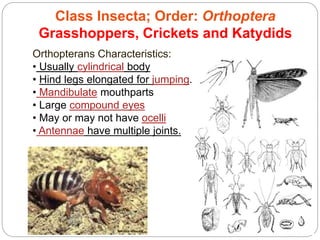
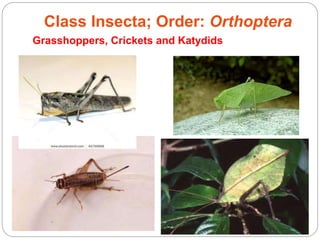
Class Insecta; Order: Orthoptera
Grasshoppers, Crickets and Katydids
Orthopterans Characteristics:
• Usually cylindrical body
• Hind legs elongated for jumping.
• Mandibulate mouthparts
• Large compound eyes
• May or may not have ocelli
• Antennae have multiple joints.
5 - 48
Grasshoppers, Crickets and Katydids
Class Insecta; Order: Orthoptera
5 - 49
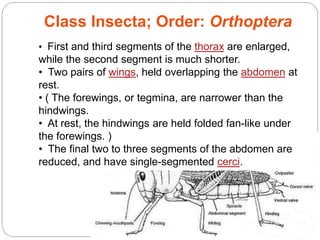
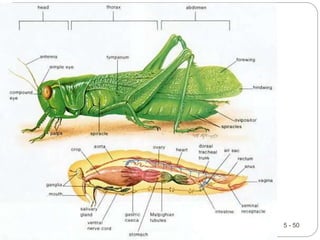
• First and third segments of the thorax are enlarged,
while the second segment is much shorter.
• Two pairs of wings, held overlapping the abdomen at
rest.
• ( The forewings, or tegmina, are narrower than the
hindwings.
• At rest, the hindwings are held folded fan-like under
the forewings. )
• The final two to three segments of the abdomen are
reduced, and have single-segmented cerci.
Class Insecta; Order: Orthoptera
5 - 50
Chapter
5
Pages
5-53
to
5-55
Crustaceans
–
Underwater
Arthropods
5 - 51
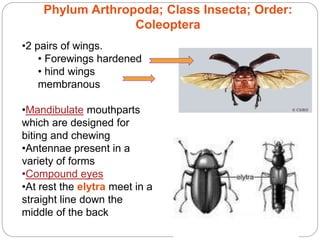
Phylum Arthropoda; Class Insecta; Order:
Coleoptera
•2 pairs of wings.
• Forewings hardened
• hind wings
membranous
•Mandibulate mouthparts
which are designed for
biting and chewing
•Antennae present in a
variety of forms
•Compound eyes
•At rest the elytra meet in a
straight line down the
middle of the back
Class Insecta; Order: Coleoptera
•Some do not have hind
wings and their elytra are
generally fused together
5 - 53
Class Insecta; Order: Coleoptera
•Larvae generally
appear grub-like
with a well-defined
head capsule,
(which may be
highly sclerotised.)
They have short
antennae and
usually have
chewing
mouthparts. The
legs may be present
or absent.
Class Insecta; Order: Coleoptera
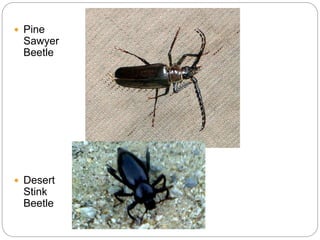
 Pine
Sawyer
Beetle
 Desert
Stink
Beetle
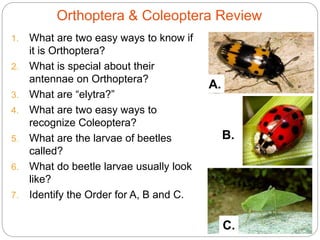
Orthoptera & Coleoptera Review
1. What are two easy ways to know if
it is Orthoptera?
2. What is special about their
antennae on Orthoptera?
3. What are “elytra?”
4. What are two easy ways to
recognize Coleoptera?
5. What are the larvae of beetles
called?
6. What do beetle larvae usually look
like?
7. Identify the Order for A, B and C.
5 - 56
B.
A.
C.
5 - 57
Class Insecta; Order: Diptera
Chapter
5
Pages
5-53
to
5-55
Crustaceans
–
Underwater
Arthropods
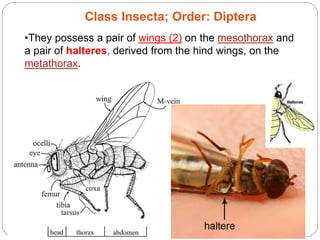
•They possess a pair of wings (2) on the mesothorax and
a pair of halteres, derived from the hind wings, on the
metathorax.
5 - 58
Class Insecta; Order: Diptera
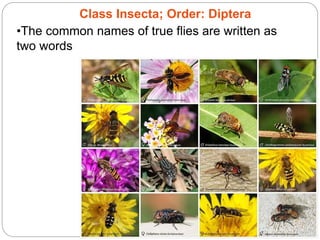
•The common names of true flies are written as
two words
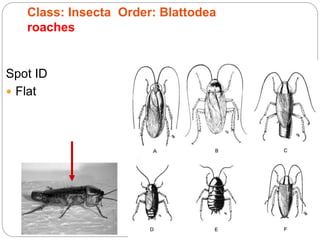
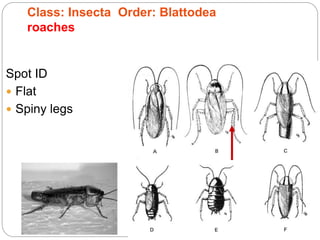
Class: Insecta Order: Blattodea
roaches
Spot ID
 Flat
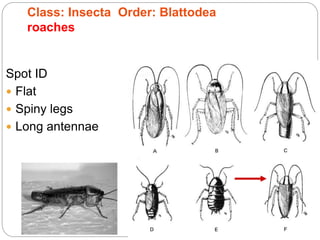
Spot ID
 Flat
 Spiny legs
Class: Insecta Order: Blattodea
roaches
Spot ID
 Flat
 Spiny legs
 Long antennae
Class: Insecta Order: Blattodea
roaches
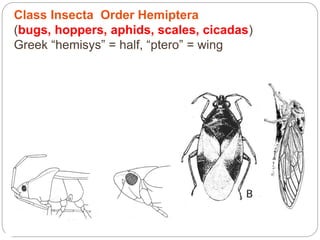
Class Insecta Order Hemiptera
(bugs, hoppers, aphids, scales, cicadas)
Greek “hemisys” = half, “ptero” = wing
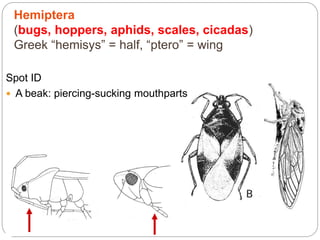
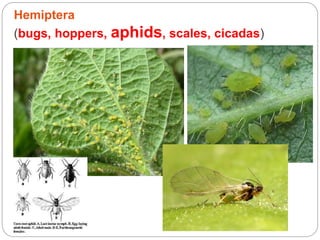
Hemiptera
(bugs, hoppers, aphids, scales, cicadas)
Greek “hemisys” = half, “ptero” = wing
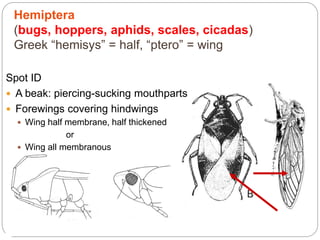
Spot ID
 A beak: piercing-sucking mouthparts
Spot ID
 A beak: piercing-sucking mouthparts
 Forewings covering hindwings
 Wing half membrane, half thickened
or
 Wing all membranous
Hemiptera
(bugs, hoppers, aphids, scales, cicadas)
Greek “hemisys” = half, “ptero” = wing
Hemiptera
(bugs, hoppers, aphids, scales, cicadas)
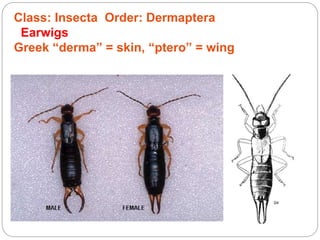
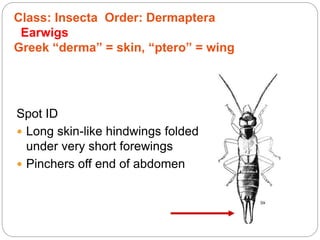
Class: Insecta Order: Dermaptera
Earwigs
Greek “derma” = skin, “ptero” = wing
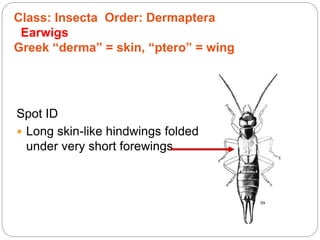
Spot ID
 Long skin-like hindwings folded
under very short forewings
Class: Insecta Order: Dermaptera
Earwigs
Greek “derma” = skin, “ptero” = wing
Spot ID
 Long skin-like hindwings folded
under very short forewings
 Pinchers off end of abdomen
Class: Insecta Order: Dermaptera
Earwigs
Greek “derma” = skin, “ptero” = wing
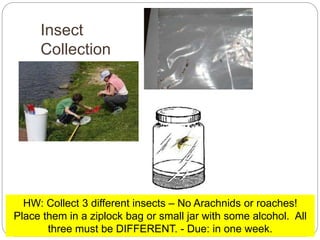
Insect
Collection
5 - 69
HW: Collect 3 different insects – No Arachnids or roaches!
Place them in a ziplock bag or small jar with some alcohol. All
three must be DIFFERENT. - Due: in one week.
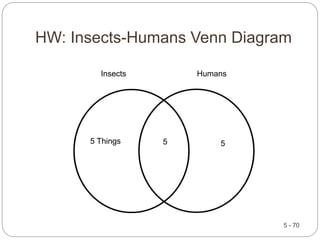
HW: Insects-Humans Venn Diagram
5 - 70
Insects Humans
5 Things 5 5
5 - 71
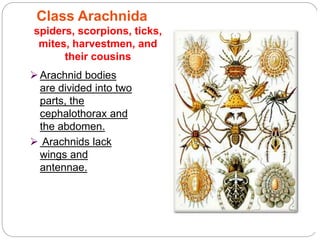
Arachnid bodies
are divided into two
parts, the
cephalothorax and
the abdomen.
 Arachnids lack
wings and
antennae.
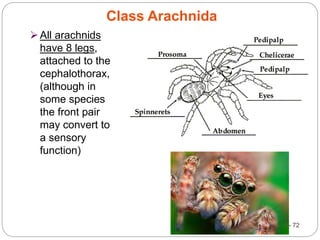
Class Arachnida
spiders, scorpions, ticks,
mites, harvestmen, and
their cousins
5 - 72
All arachnids
have 8 legs,
attached to the
cephalothorax,
(although in
some species
the front pair
may convert to
a sensory
function)
Class Arachnida
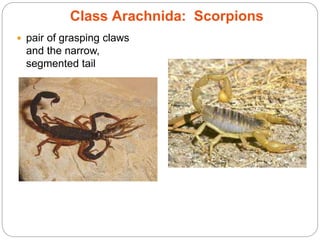
 pair of grasping claws
and the narrow,
segmented tail
Class Arachnida: Scorpions
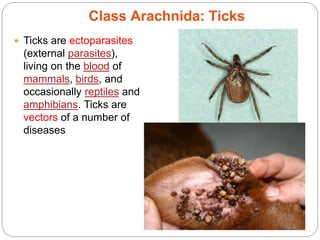
 Ticks are ectoparasites
(external parasites),
living on the blood of
mammals, birds, and
occasionally reptiles and
amphibians. Ticks are
vectors of a number of
diseases
5 - 74
Class Arachnida: Ticks
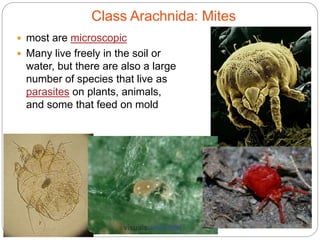
 most are microscopic
 Many live freely in the soil or
water, but there are also a large
number of species that live as
parasites on plants, animals,
and some that feed on mold
5 - 75
Class Arachnida: Mites
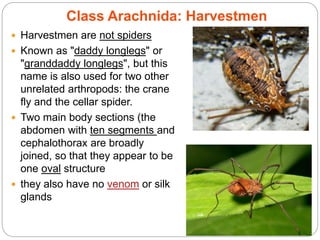
 Harvestmen are not spiders
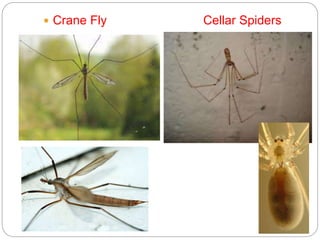
 Known as "daddy longlegs" or
"granddaddy longlegs", but this
name is also used for two other
unrelated arthropods: the crane
fly and the cellar spider.
 Two main body sections (the
abdomen with ten segments and
cephalothorax are broadly
joined, so that they appear to be
one oval structure
 they also have no venom or silk
glands
5 - 76
Class Arachnida: Harvestmen
 Crane Fly Cellar Spiders
5 - 77
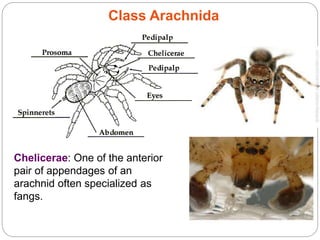
Class Arachnida
Chelicerae: One of the anterior
pair of appendages of an
arachnid often specialized as
fangs.
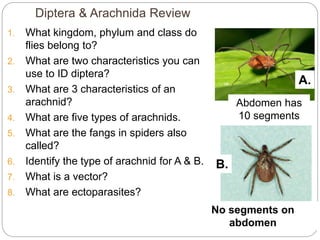
Diptera & Arachnida Review
1. What kingdom, phylum and class do
flies belong to?
2. What are two characteristics you can
use to ID diptera?
3. What are 3 characteristics of an
arachnid?
4. What are five types of arachnids.
5. What are the fangs in spiders also
called?
6. Identify the type of arachnid for A & B.
7. What is a vector?
8. What are ectoparasites?
5 - 79
No segments on
abdomen
A.
Abdomen has
10 segments
B.
Part-2
9. What are two reasons why butterflies are
disappearing?
10. Why are butterflies and bees so important?
11. List some of the members of these orders:
a. Lepidoptera
b. Orthoptera
c. Hymenoptera
d. Diptera
e. Coleoptera
f. Odonata
g. Hemiptera
h. Dermaptera
i. Blattodea
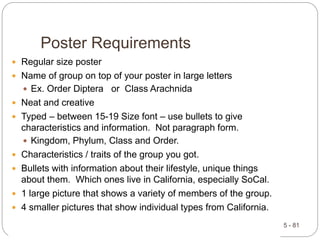
Poster Requirements
 Regular size poster
 Name of group on top of your poster in large letters
 Ex. Order Diptera or Class Arachnida
 Neat and creative
 Typed – between 15-19 Size font – use bullets to give
characteristics and information. Not paragraph form.
 Kingdom, Phylum, Class and Order.
 Characteristics / traits of the group you got.
 Bullets with information about their lifestyle, unique things
about them. Which ones live in California, especially SoCal.
 1 large picture that shows a variety of members of the group.
 4 smaller pictures that show individual types from California.
5 - 81
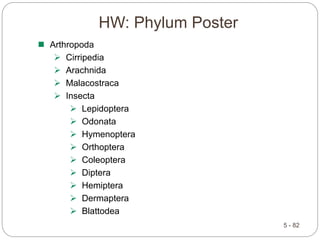
HW: Phylum Poster
5 - 82
 Arthropoda
 Cirripedia
 Arachnida
 Malacostraca
 Insecta
 Lepidoptera
 Odonata
 Hymenoptera
 Orthoptera
 Coleoptera
 Diptera
 Hemiptera
 Dermaptera
 Blattodea
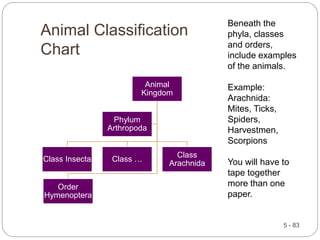
Animal Classification
Chart
5 - 83
Animal
Kingdom
Class Insecta Class …
Class
Arachnida
Order
Hymenoptera
Phylum
Arthropoda
Beneath the
phyla, classes
and orders,
include examples
of the animals.
Example:
Arachnida:
Mites, Ticks,
Spiders,
Harvestmen,
Scorpions
You will have to
tape together
more than one
paper.

Arthropods

  • 1.
    Arthropoda Crustaceans & Insects Biology/ Environmental Studies / Ecotourism Mr. R. Estrella
  • 2.
    Animal Classification Chart 5- 2 Phylum Subphylu m Class Order Charact. Ex. Names Kingdom: Animal
  • 3.
    5 - 3 Characteristicsof Crustaceans  Phylum Arthropoda is the most numerous of multicellular animal phyla.  Characteristics: • Segmented bodies • Jointed legs • Chitinous exoskeleton.
  • 4.
    5 - 4 (There may be as many as one million arthropod species.)
  • 5.
    5 - 5 Sub-phylum Crustacea: crabs, lobsters, crayfish, shrimp, krill and barnacles.  Characteristics:  Pair of appendages on each body segment.  Two pairs of antennae = 4.  Mandibles for chewing.  Teardrop shaped larvae.  Exoskeletons are shed as they grow.
  • 6.
    5 - 6 Crustaceans:  Lobsters  Shrimp  Crabs  Crayfish  Krill  Barnacles
  • 7.
    5 - 7 Class Cirripedia: barnacles Characteristics:  the animal is upside down.  A ring of plates surrounds the body, homologous with the carapace of other crustaceans  (in most the cement glands are part of a flat membrane or calcified plate.)  The exoskeleton forms the carapace (hard shell) the barnacle can withdraw inside for protection.
  • 8.
    5 - 8 Class Cirripedia: barnacles  Life begins as free-swimming larvae like other crustaceans.  (Larva finds a surface on which to live (rocks, boats,etc.) it fuses itself in place “upside down.”)  (In some, the cement glands are fixed to a long muscular stalk.)
  • 9.
    5 - 9 Copepods Class Copepoda: very important food.  Few larger animals can consume the tiniest plankton, but many can eat the larger copepods. Fish, krill, and giant plankton feeders, including whale sharks, baleen whales, and manta rays all eat copepods.  Copepods are important to ocean food webs because they link the tiny primary producers (plankton) to the larger animals higher up the web.
  • 10.
    5 - 10 ArthropodaReview #1 1. Segmented 2. Joint 3. Appendage 4. Mandibles 5. Carapace 6. Describe a jointed leg 7. What are the characteristics of Arthropoda? 8. What are the characteristics of crustaceans? 9. Name 4 types of crustaceans 10. What is special about barnacles? 11. What is important about copepods? HW: Crustaceans P. More work? Really!?
  • 11.
    5 - 11 Class Malacostraca includes two orders (groups) of interest due to their roles as food for humans and food for nature.  Characteristics:  three tagmata – a head, an eight-segmented thorax and an abdomen with six segments, except in the Leptostraca
  • 12.
    5 - 12 Decapodsand Krill  Class Malacostraca Crustaceans – Underwater Arthropods (Order Decapoda): lobsters, shrimps, and crabs. Humans eat these shellfish, they are an important food source and resource on which the fishing industry relies.
  • 13.
    5 - 13 Decapoda: lobsters, shrimps, and crabs  Have 10 functional legs (deca meaning ten and poda meaning foot).  Have claws and an extended carapace that encloses the gills. Chapter 5 Pages 5-53 to 5-55 Crustaceans – Underwater Arthropods
  • 14.
    5 - 14 Decapodsand Krill  (Order Euphausiacea): krill  Important primary and secondary consumers that link smaller plankton to larger consumers.  In subpolar food webs, they are vital. Whales, seals, sea birds, and penguins only survive in highly productive waters. Feeding on krill
  • 15.
    5 - 15 MalacostracaReview 1. Why are krill and copepods so important in the food web? 2. What does deca mean? 3. What animals are decapods? 4. What kingdom and phylum does Malacostraca belong to? 5. What are the characteristics of malacostraca? 6. List 3 examples of shellfish you might find at a restaurant. HW: Crazy Person thinks I’m a real lobster!
  • 16.
    5 - 16 PhylumArthropoda; Class Insecta  a three-part body (head, thorax, and abdomen), three pairs (6) of jointed legs, compound eyes and two antennae
  • 17.
  • 18.
  • 19.
    Phylum Arthropoda; ClassInsecta Compound Eyes: help detect movement
  • 20.
    5 - 20 ClassInsecta; Order: Lepidoptera • 2 pairs of wings (4). A few moths are wingless • Large compound eyes • One ocelli present above each eye • Antennae are long and slender in female moths and generally feathery in male moths. Butterflies have clubbed antennae • Mouthparts are a sucking tube known as a haustellum • The larvae are typically known as caterpillars.
  • 21.
     Is ita moth or a butterfly? butterflies hold their wings vertically when at rest whereas moths sit with their wings flat. Class Insecta; Order: Lepidoptera
  • 22.
    5 - 22 •One ocelli present above each eye • Butterflies have clubbed antennae Class Insecta; Order: Lepidoptera
  • 23.
    5 - 23 ClassInsecta; Order: Lepidoptera
  • 24.
    5 - 24 ClassInsecta; Order: Lepidoptera Monarch Migration in Mexico-A
  • 25.
    Dangers to butterfliesand moths 1. Land Development which removes their food (certain flowers). 2. Pesticides to kill bugs 5 - 25
  • 26.
    5 - 26 LepidopteraReview Mollusks – A Bag, a Scraper, and a Foot Chapter 5 Pages 5-45 to 5-48 1. What kingdom, Phylum, Class and Order are butterflies and moths in? 2. Compound Eye 3. Thorax 4. Abdomen 5. Head 6. Ocellus (ocelli) 7. Spiracle 8. What is the benefit of compound eyes? 9. What do moths & butterflies eat? 10. What is the larva of moths and butterflies? 11. Short Answer: Explain the importance of butterflies and moths and 2 activities that are dangerous to them. Do NOT stick your tongue up my nostril!
  • 27.
    5 - 27 ClassInsecta; Order: Odonata Odonata -Dragonflies and Damselflies: characteristics: • tiny antennae • very large eyes (filling most of the head) • two pairs of transparent wings with many small veins • long slender abdomen • an aquatic larval stage (nymph) with posterior tracheal gills • a prehensile labium (extendible jaws underneath the head).
  • 28.
    5 - 28 ClassInsecta; Order: Odonata Chapter 5 Pages 5-53 to 5-55 Crustaceans – Underwater Arthropods Eyes most have eyes that touch, or nearly touch eyes are clearly separated, usually appearing to each side of the head Body usually stocky usually long and slender Wing Shape dissimilar wing pairs, with hind wings broader at the base all wings similar in shape Position at Rest wings held open, horizontally or downwards wings held closed, usually over abdomen Dragonflies Damselflies
  • 29.
    Class Insecta; Order:Odonata Damselfly Larvae Dragonfly Larvae
  • 30.
  • 31.
    Dragonfly & Damselfly Review 1.What kingdom, phylum, class and order are dragonflies in? 2. What are their babies called? 3. What are the babies in Lepidoptera called? 4. What is a difference between the two nymphs? 5. List two ways to tell adult dragonflies apart from the damselflies. 6. Identify the three pictures (A. B. C.) 5 - 31 A. B. C.
  • 32.
    Class Insecta; Order:Order Hymenoptera sawflies, wasps, bees, and ants • Two pairs of wings (4), although some may be wingless such as some species of female wasps and the worker caste of ants. • The forewings are larger than the hind wings and are held together by small hooks.
  • 33.
    5 - 33 sawflies,wasps, bees, and ants •Most have a constriction between the first 2 segments of the abdomen, which is known as a 'wasp waist' •Females usually have a hardened ovipositor, which may be modified for sawing, piercing or stinging •Chewing, mandibulate mouthparts. Although in some species such as bees the lower lip is modified to form a tongue •Compound eyes are usually large Class Insecta; Order: Order Hymenoptera
  • 34.
    5 - 34 SawflyWasp Ant Bee Class Insecta; Order: Order Hymenoptera
  • 35.
    5 - 35 PhylumArthropoda; Class Insecta; Order: Order Hymenoptera The wing hooks of Hymenoptera enable the wings to be coupled together during flight, which gives these insects well controlled, rapid flight. These tiny hooks can be easily seen with the aid of a dissecting microscope Silence of the Bees
  • 36.
    Silence of theBees Reasons for bees disappearing:  Malnutrition  Infections
  • 37.
    Silence of theBees Reasons for bees disappearing:  Pesticides
  • 38.
    5 - 38 PhylumArthropoda; Class Insecta; Order: Order Hymenoptera Chapter 5 Pages 5-53 to 5-55 Crustaceans – Underwater Arthropods Scape Eye Spine Petiol e Nodes Antennal club Gaster
  • 39.
  • 40.
    5 - 40 Chapter 5 Pages 5-53 to 5-55 Crustaceans – Underwater Arthropods FireAnt Carpenter Ant Velvet Ant Argentine Ant Harvester Ant Phylum Arthropoda; Class Insecta; Order: Order Hymenoptera Lord of the Ants
  • 41.
  • 42.
    5 - 42 http://www.ipm.ucdavis.edu/TOOLS/ANTKEY/index.html 1/8”long 1/8” long Uniformly dull brown Workers are all the same size Musty odor emitted when Workers are all the same size Dark brown to shiny black Petiole with 1 node, hidden by abdomen
  • 43.
  • 44.
    5 - 44 http://www.ipm.ucdavis.edu/TOOLS/ANTKEY/index.html CarpenterAnt 1/4-1/2” long Pavement Ant 3/16” long
  • 45.
    5 - 45 PhylumArthropoda; Class Insecta; Order Hymenoptera Lord of the Ants Order not covered
  • 46.
    Hymenoptera Review 1. Listtwo things about their wings. 2. What are four types of insects that belong to the order Hymenoptera? 3. List the kingdom, phylum, class and order for ants. 4. What is a wasp waist? 5. Identify A-D 6. Which one is not a real ant? 7. List the 3 reasons bees are in danger. 5 - 46 C. A. B. D.
  • 47.
    5 - 47 ClassInsecta; Order: Orthoptera Grasshoppers, Crickets and Katydids Orthopterans Characteristics: • Usually cylindrical body • Hind legs elongated for jumping. • Mandibulate mouthparts • Large compound eyes • May or may not have ocelli • Antennae have multiple joints.
  • 48.
    5 - 48 Grasshoppers,Crickets and Katydids Class Insecta; Order: Orthoptera
  • 49.
    5 - 49 •First and third segments of the thorax are enlarged, while the second segment is much shorter. • Two pairs of wings, held overlapping the abdomen at rest. • ( The forewings, or tegmina, are narrower than the hindwings. • At rest, the hindwings are held folded fan-like under the forewings. ) • The final two to three segments of the abdomen are reduced, and have single-segmented cerci. Class Insecta; Order: Orthoptera
  • 50.
  • 51.
    5 - 51 PhylumArthropoda; Class Insecta; Order: Coleoptera •2 pairs of wings. • Forewings hardened • hind wings membranous •Mandibulate mouthparts which are designed for biting and chewing •Antennae present in a variety of forms •Compound eyes •At rest the elytra meet in a straight line down the middle of the back
  • 52.
    Class Insecta; Order:Coleoptera •Some do not have hind wings and their elytra are generally fused together
  • 53.
    5 - 53 ClassInsecta; Order: Coleoptera •Larvae generally appear grub-like with a well-defined head capsule, (which may be highly sclerotised.) They have short antennae and usually have chewing mouthparts. The legs may be present or absent.
  • 54.
  • 55.
  • 56.
    Orthoptera & ColeopteraReview 1. What are two easy ways to know if it is Orthoptera? 2. What is special about their antennae on Orthoptera? 3. What are “elytra?” 4. What are two easy ways to recognize Coleoptera? 5. What are the larvae of beetles called? 6. What do beetle larvae usually look like? 7. Identify the Order for A, B and C. 5 - 56 B. A. C.
  • 57.
    5 - 57 ClassInsecta; Order: Diptera Chapter 5 Pages 5-53 to 5-55 Crustaceans – Underwater Arthropods •They possess a pair of wings (2) on the mesothorax and a pair of halteres, derived from the hind wings, on the metathorax.
  • 58.
    5 - 58 ClassInsecta; Order: Diptera •The common names of true flies are written as two words
  • 59.
    Class: Insecta Order:Blattodea roaches Spot ID  Flat
  • 60.
    Spot ID  Flat Spiny legs Class: Insecta Order: Blattodea roaches
  • 61.
    Spot ID  Flat Spiny legs  Long antennae Class: Insecta Order: Blattodea roaches
  • 62.
    Class Insecta OrderHemiptera (bugs, hoppers, aphids, scales, cicadas) Greek “hemisys” = half, “ptero” = wing
  • 63.
    Hemiptera (bugs, hoppers, aphids,scales, cicadas) Greek “hemisys” = half, “ptero” = wing Spot ID  A beak: piercing-sucking mouthparts
  • 64.
    Spot ID  Abeak: piercing-sucking mouthparts  Forewings covering hindwings  Wing half membrane, half thickened or  Wing all membranous Hemiptera (bugs, hoppers, aphids, scales, cicadas) Greek “hemisys” = half, “ptero” = wing
  • 65.
  • 66.
    Class: Insecta Order:Dermaptera Earwigs Greek “derma” = skin, “ptero” = wing
  • 67.
    Spot ID  Longskin-like hindwings folded under very short forewings Class: Insecta Order: Dermaptera Earwigs Greek “derma” = skin, “ptero” = wing
  • 68.
    Spot ID  Longskin-like hindwings folded under very short forewings  Pinchers off end of abdomen Class: Insecta Order: Dermaptera Earwigs Greek “derma” = skin, “ptero” = wing
  • 69.
    Insect Collection 5 - 69 HW:Collect 3 different insects – No Arachnids or roaches! Place them in a ziplock bag or small jar with some alcohol. All three must be DIFFERENT. - Due: in one week.
  • 70.
    HW: Insects-Humans VennDiagram 5 - 70 Insects Humans 5 Things 5 5
  • 71.
    5 - 71 Arachnidbodies are divided into two parts, the cephalothorax and the abdomen.  Arachnids lack wings and antennae. Class Arachnida spiders, scorpions, ticks, mites, harvestmen, and their cousins
  • 72.
    5 - 72 Allarachnids have 8 legs, attached to the cephalothorax, (although in some species the front pair may convert to a sensory function) Class Arachnida
  • 73.
     pair ofgrasping claws and the narrow, segmented tail Class Arachnida: Scorpions
  • 74.
     Ticks areectoparasites (external parasites), living on the blood of mammals, birds, and occasionally reptiles and amphibians. Ticks are vectors of a number of diseases 5 - 74 Class Arachnida: Ticks
  • 75.
     most aremicroscopic  Many live freely in the soil or water, but there are also a large number of species that live as parasites on plants, animals, and some that feed on mold 5 - 75 Class Arachnida: Mites
  • 76.
     Harvestmen arenot spiders  Known as "daddy longlegs" or "granddaddy longlegs", but this name is also used for two other unrelated arthropods: the crane fly and the cellar spider.  Two main body sections (the abdomen with ten segments and cephalothorax are broadly joined, so that they appear to be one oval structure  they also have no venom or silk glands 5 - 76 Class Arachnida: Harvestmen
  • 77.
     Crane FlyCellar Spiders 5 - 77
  • 78.
    Class Arachnida Chelicerae: Oneof the anterior pair of appendages of an arachnid often specialized as fangs.
  • 79.
    Diptera & ArachnidaReview 1. What kingdom, phylum and class do flies belong to? 2. What are two characteristics you can use to ID diptera? 3. What are 3 characteristics of an arachnid? 4. What are five types of arachnids. 5. What are the fangs in spiders also called? 6. Identify the type of arachnid for A & B. 7. What is a vector? 8. What are ectoparasites? 5 - 79 No segments on abdomen A. Abdomen has 10 segments B.
  • 80.
    Part-2 9. What aretwo reasons why butterflies are disappearing? 10. Why are butterflies and bees so important? 11. List some of the members of these orders: a. Lepidoptera b. Orthoptera c. Hymenoptera d. Diptera e. Coleoptera f. Odonata g. Hemiptera h. Dermaptera i. Blattodea
  • 81.
    Poster Requirements  Regularsize poster  Name of group on top of your poster in large letters  Ex. Order Diptera or Class Arachnida  Neat and creative  Typed – between 15-19 Size font – use bullets to give characteristics and information. Not paragraph form.  Kingdom, Phylum, Class and Order.  Characteristics / traits of the group you got.  Bullets with information about their lifestyle, unique things about them. Which ones live in California, especially SoCal.  1 large picture that shows a variety of members of the group.  4 smaller pictures that show individual types from California. 5 - 81
  • 82.
    HW: Phylum Poster 5- 82  Arthropoda  Cirripedia  Arachnida  Malacostraca  Insecta  Lepidoptera  Odonata  Hymenoptera  Orthoptera  Coleoptera  Diptera  Hemiptera  Dermaptera  Blattodea
  • 83.
    Animal Classification Chart 5 -83 Animal Kingdom Class Insecta Class … Class Arachnida Order Hymenoptera Phylum Arthropoda Beneath the phyla, classes and orders, include examples of the animals. Example: Arachnida: Mites, Ticks, Spiders, Harvestmen, Scorpions You will have to tape together more than one paper.