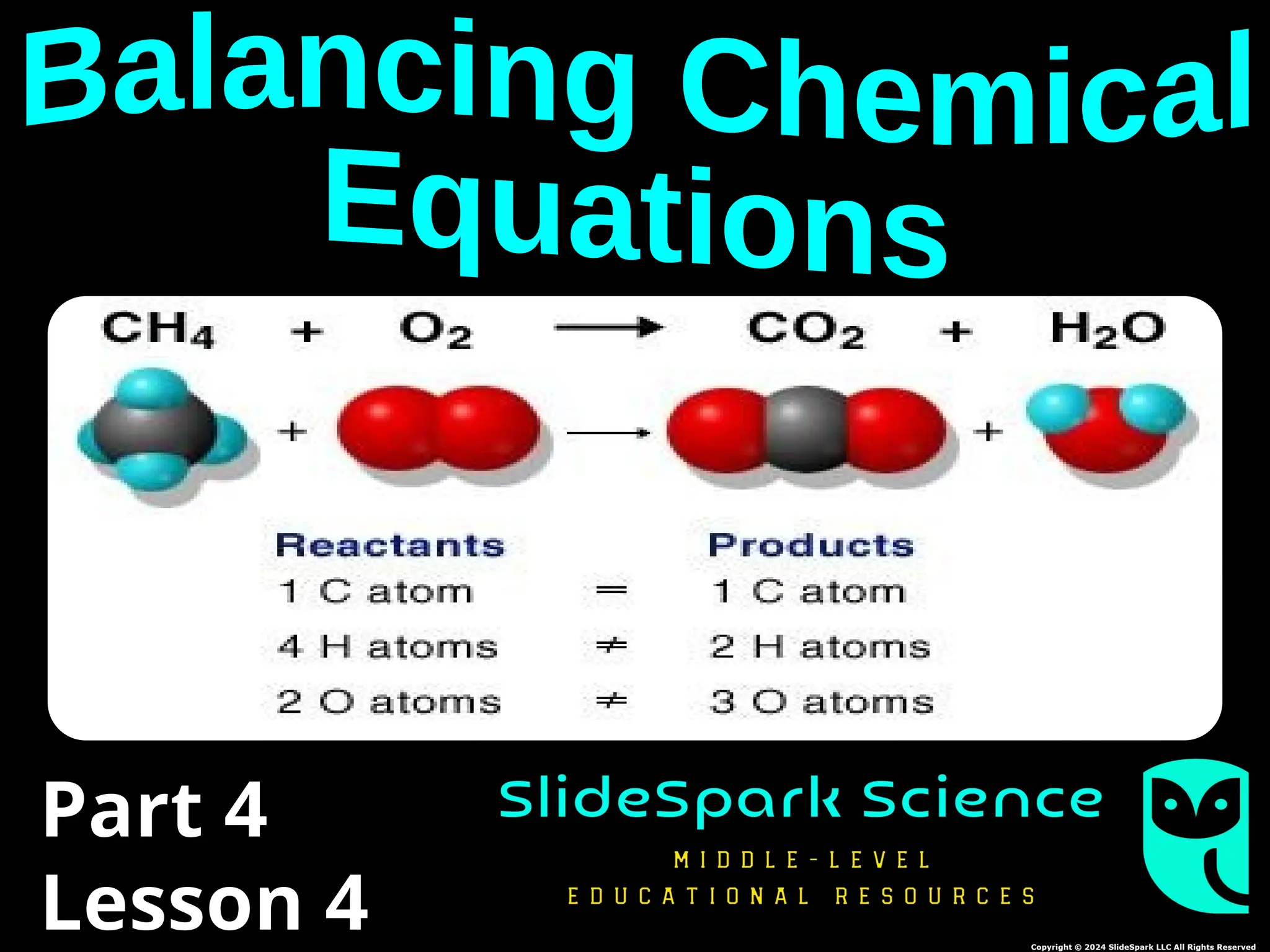
Part 4
Lesson 4
• Red Slides: Please record the important terms
in your work bundle.
Copyright © 2024 SlideSpark .LLC
First and last Name
Science, Grade, Class
• Red Slides: Please record the important terms
in your work bundle.
– You’ll need these notes to complete the work
bundle
Copyright © 2024 SlideSpark .LLC
First and last Name
Science, Grade, Class
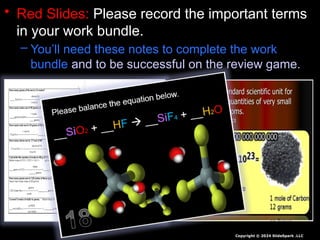
• Red Slides: Please record the important terms
in your work bundle.
– You’ll need these notes to complete the work
bundle and to be successful on the review game.
Copyright © 2024 SlideSpark .LLC
First and last Name
Science, Grade, Class
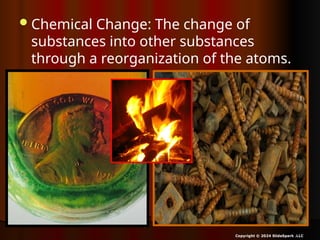
Chemical Change: The change of
substances into other substances
through a reorganization of the atoms.
Copyright © 2024 SlideSpark .LLC
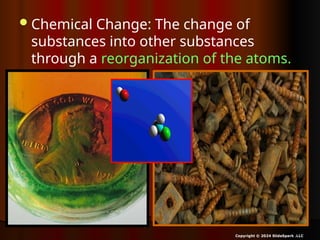
Chemical Change: The change of
substances into other substances
through a reorganization of the atoms.
Copyright © 2024 SlideSpark .LLC
New Area of Focus: Balancing Chemical
Equations.
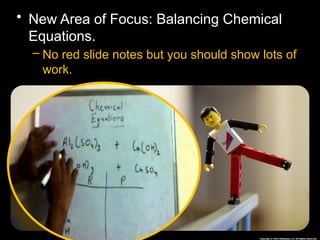
• New Area of Focus: Balancing Chemical
Equations.
– No red slide notes but you should show lots of
work.
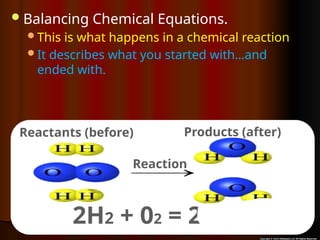
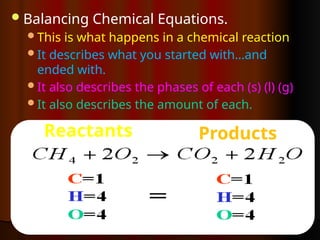
Balancing Chemical Equations.
2H2 + 202 = 2H2O
Reactants (before)
Reaction
Products (after)
Why is this important?
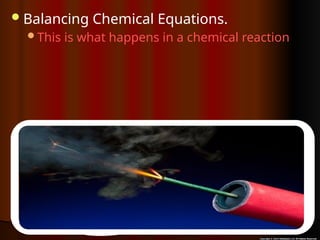
Balancing Chemical Equations.
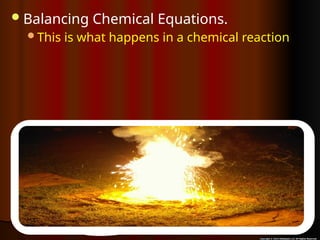
This is what happens in a chemical reaction
2H2 + 202 = 2H2O
Reactants (before)
Reaction
Products (after)
Balancing Chemical Equations.
This is what happens in a chemical reaction
2H2 + 202 = 2H2O
Reactants (before)
Reaction
Products (after)
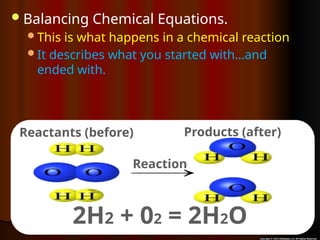
Balancing Chemical Equations.
This is what happens in a chemical reaction
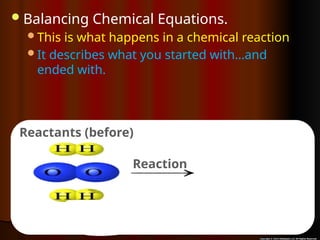
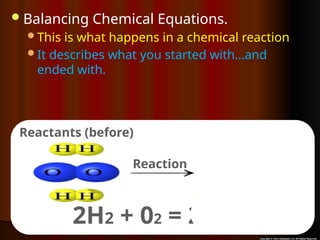
It describes what you started with…and
ended with.
2H2 + 202 = 2H2O
Reactants (before)
Reaction
Products (after)
Balancing Chemical Equations.
This is what happens in a chemical reaction
It describes what you started with…and
ended with.
2H2 + 202 = 2H2O
Reactants (before)
Reaction
Products (after)
Balancing Chemical Equations.
This is what happens in a chemical reaction
It describes what you started with…and
ended with.
2H2 + 02 = 2H2O
Reactants (before)
Reaction
Products (after)
Balancing Chemical Equations.
This is what happens in a chemical reaction
It describes what you started with…and
ended with.
2H2 + 02 = 2H2O
Reactants (before)
Reaction
Products (after)
Balancing Chemical Equations.
This is what happens in a chemical reaction
It describes what you started with…and
ended with.
2H2 + 02 = 2H2O
Reactants (before)
Reaction
Products (after)
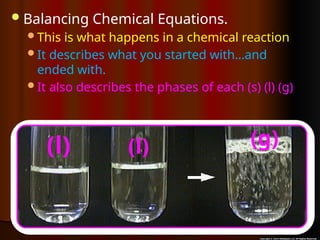
Balancing Chemical Equations.
This is what happens in a chemical reaction
It describes what you started with…and
ended with.
It also describes the phases of each (s) (l) (g)
2H2 + 202 = 2H2O
Reactants (before)
Reaction
Products (after)
(l) (g)
(l)
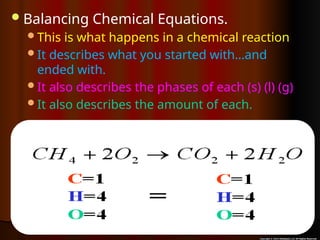
Balancing Chemical Equations.
This is what happens in a chemical reaction
It describes what you started with…and
ended with.
It also describes the phases of each (s) (l) (g)
It also describes the amount of each.
Balancing Chemical Equations.
This is what happens in a chemical reaction
It describes what you started with…and
ended with.
It also describes the phases of each (s) (l) (g)
It also describes the amount of each.
Reactants Products
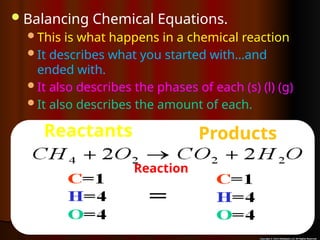
Balancing Chemical Equations.
This is what happens in a chemical reaction
It describes what you started with…and
ended with.
It also describes the phases of each (s) (l) (g)
It also describes the amount of each.
Reactants Products
Reaction
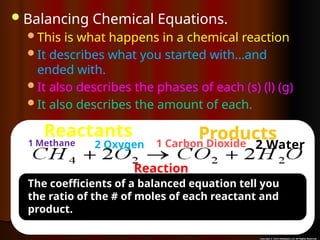
Balancing Chemical Equations.
This is what happens in a chemical reaction
It describes what you started with…and
ended with.
It also describes the phases of each (s) (l) (g)
It also describes the amount of each.
Reactants Products
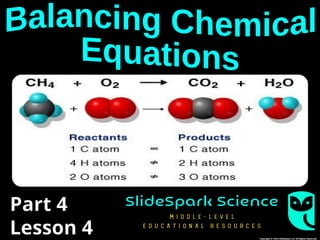
1 Methane 2 Oxygen 1 Carbon Dioxide 2 Water
Reaction
.
The coefficients of a balanced equation tell you
the ratio of the # of moles of each reactant and
product.
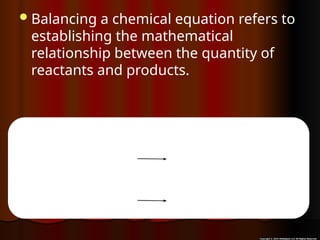
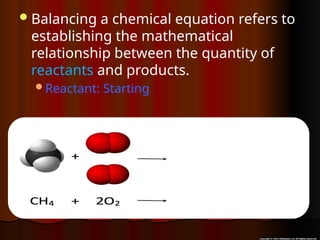
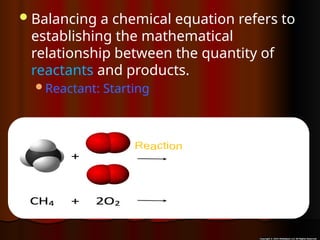
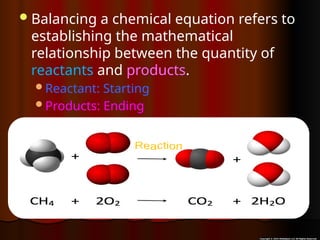
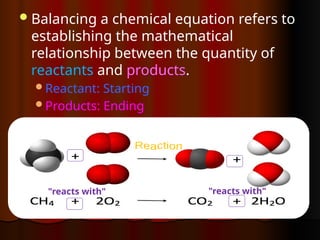
Balancing a chemical equation refers to
establishing the mathematical
relationship between the quantity of
reactants and products.
Balancing a chemical equation refers to
establishing the mathematical
relationship between the quantity of
reactants and products.
Reactant: Starting
Balancing a chemical equation refers to
establishing the mathematical
relationship between the quantity of
reactants and products.
Reactant: Starting
Balancing a chemical equation refers to
establishing the mathematical
relationship between the quantity of
reactants and products.
Reactant: Starting
Balancing a chemical equation refers to
establishing the mathematical
relationship between the quantity of
reactants and products.
Reactant: Starting
Products: Ending
Balancing a chemical equation refers to
establishing the mathematical
relationship between the quantity of
reactants and products.
Reactant: Starting
Products: Ending
"reacts with" "reacts with"
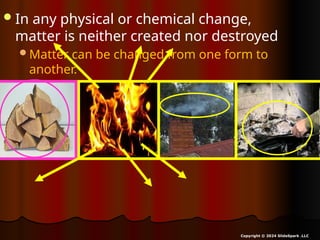
In any physical or chemical change,
matter is neither created nor destroyed
Copyright © 2024 SlideSpark .LLC
In any physical or chemical change,
matter is neither created nor destroyed
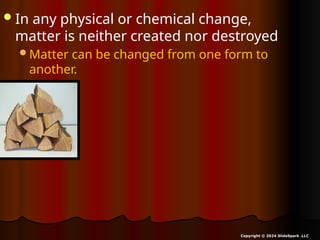
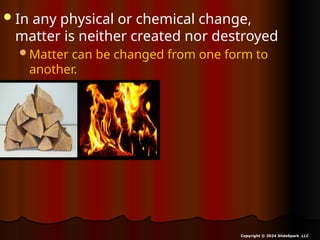
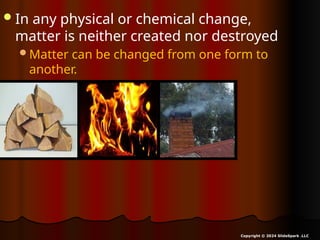
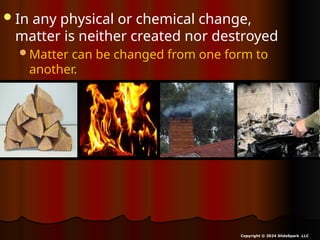
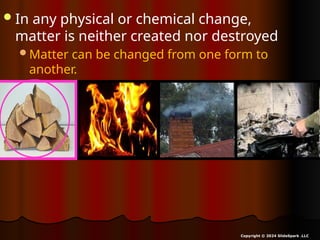
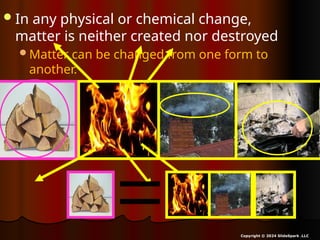
Matter can be changed from one form to
another.
Copyright © 2024 SlideSpark .LLC
In any physical or chemical change,
matter is neither created nor destroyed
Matter can be changed from one form to
another.
Copyright © 2024 SlideSpark .LLC
In any physical or chemical change,
matter is neither created nor destroyed
Matter can be changed from one form to
another.
Copyright © 2024 SlideSpark .LLC
In any physical or chemical change,
matter is neither created nor destroyed
Matter can be changed from one form to
another.
Copyright © 2024 SlideSpark .LLC
In any physical or chemical change,
matter is neither created nor destroyed
Matter can be changed from one form to
another.
Copyright © 2024 SlideSpark .LLC
In any physical or chemical change,
matter is neither created nor destroyed
Matter can be changed from one form to
another.
Copyright © 2024 SlideSpark .LLC
In any physical or chemical change,
matter is neither created nor destroyed
Matter can be changed from one form to
another.
Copyright © 2024 SlideSpark .LLC
In any physical or chemical change,
matter is neither created nor destroyed
Matter can be changed from one form to
another.
Copyright © 2024 SlideSpark .LLC
• Remember the Law Conservation of Mass:
Matter cannot be created or destroyed. That
means we need to have the same amount of
chemicals on each side of the .
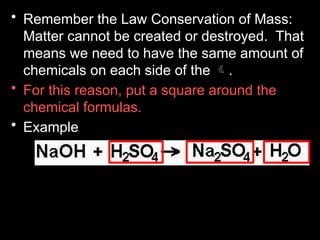
• For this reason, put a square around the
chemical formulas.
• Example
• Remember the Law Conservation of Mass:
Matter cannot be created or destroyed. That
means we need to have the same amount of
chemicals on each side of the .
• For this reason, put a square around the
chemical formulas.
• Example
• Remember the Law Conservation of Mass:
Matter cannot be created or destroyed. That
means we need to have the same amount of
chemicals on each side of the .
• For this reason, put a square around the
chemical formulas.
• Remember the Law Conservation of Mass:
Matter cannot be created or destroyed. That
means we need to have the same amount of
chemicals on each side of the .
• For this reason, put a square around the
chemical formulas.
• Example
Begin balancing chemical equations by
putting numbers (coefficients) in front
of them.
Begin balancing chemical equations by
putting numbers (coefficients) in front of
them.
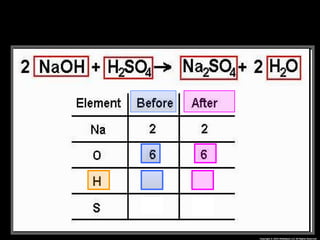
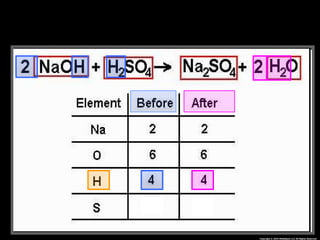
Example H2O on one side could become 2
H2O
Begin balancing chemical equations by
putting numbers (coefficients) in front of
them.
Example H2O on one side could become 2
H2O
Remember that each side needs to have
same number of Hydrogen and Oxygen
Begin balancing chemical equations by
putting numbers (coefficients) in front of
them.
Example H2O on one side could become 2
H2O
Remember that each side needs to have
same number of Hydrogen and Oxygen
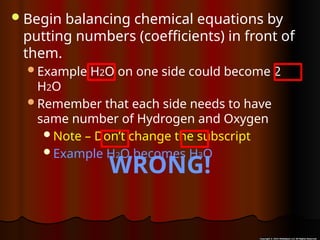
Note – Don’t change the subscript
Example H2O becomes H3O
WRONG!
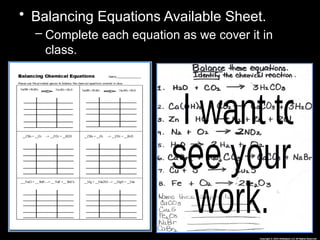
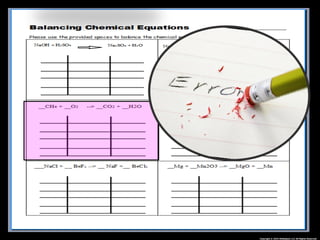
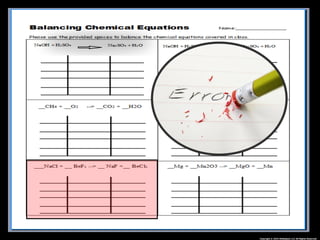
• Balancing Equations Available Sheet.
– Complete each equation as we cover it in
class.
Use a Pencil
with Eraser
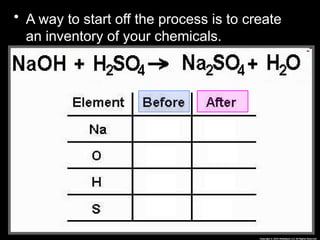
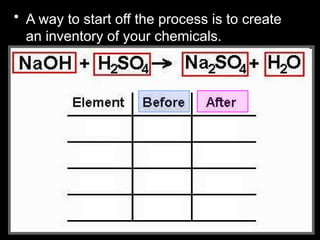
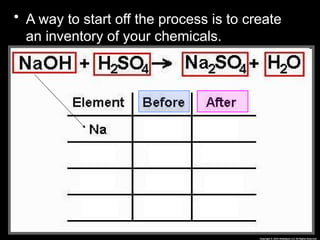
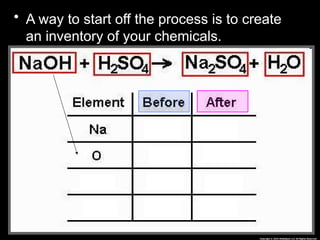
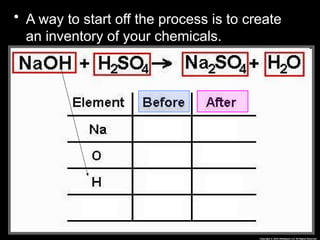
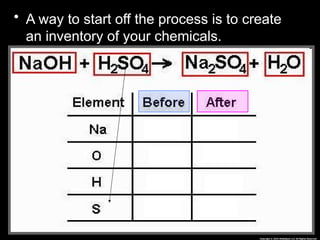
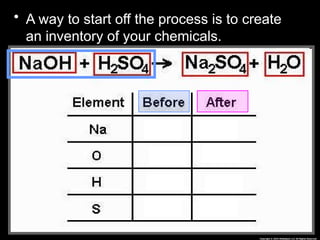
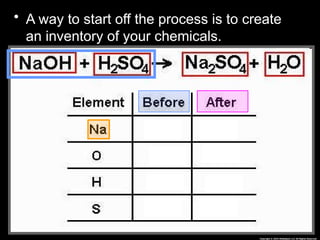
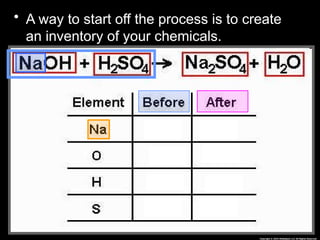
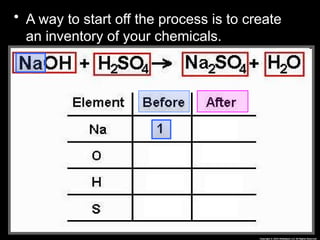
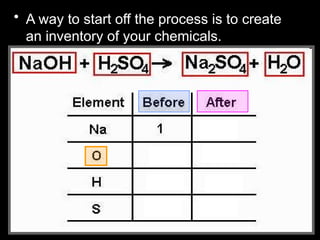
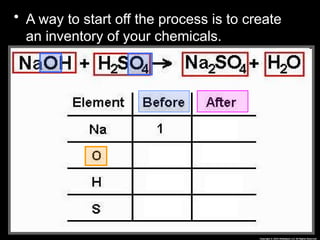
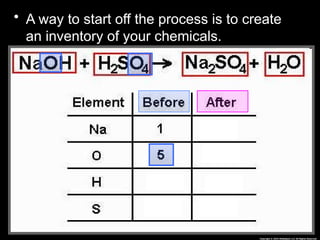
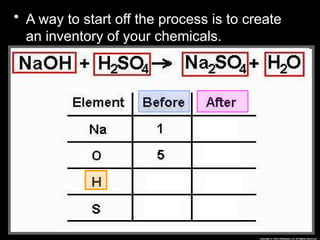
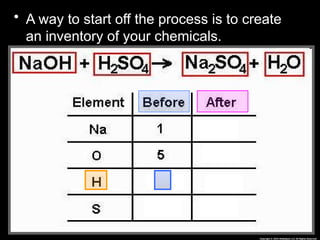
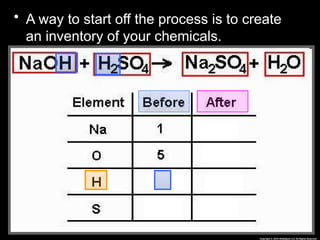
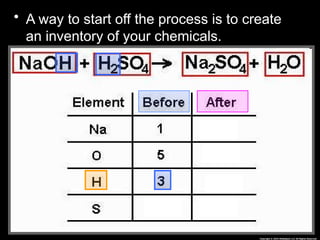
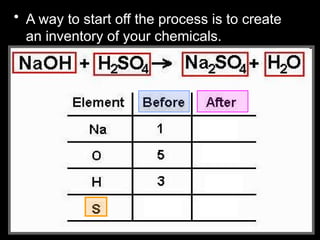
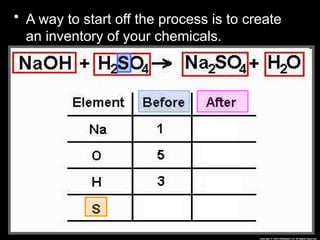
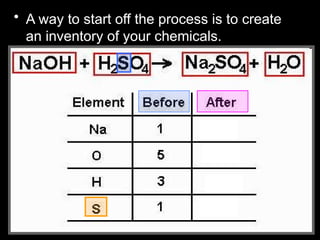
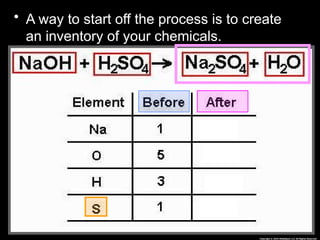
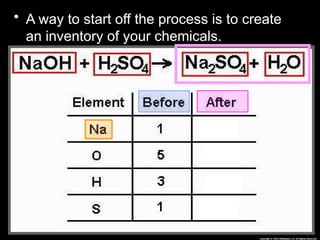
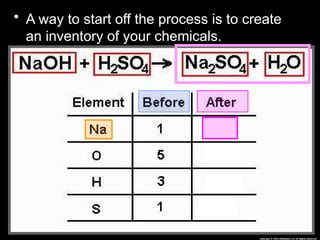
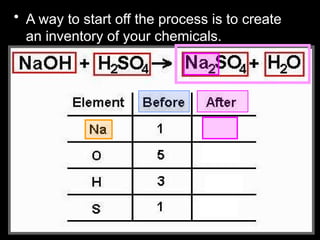
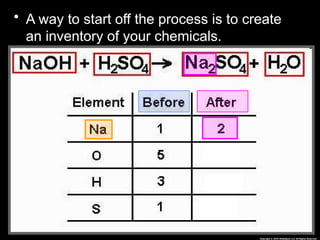
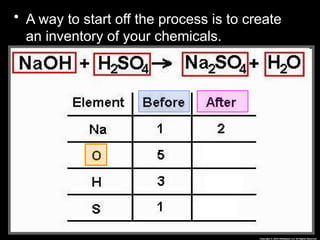
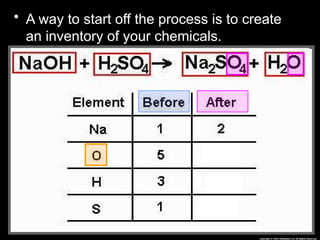
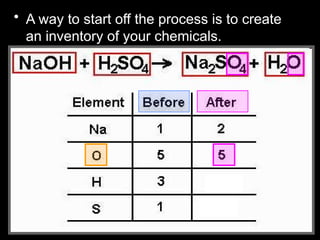
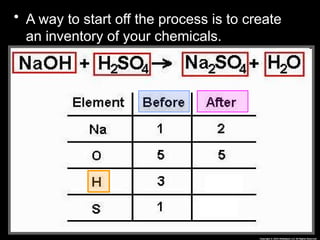
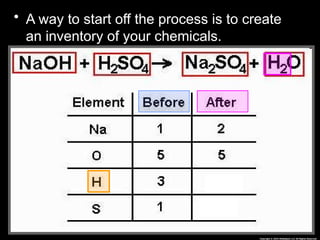
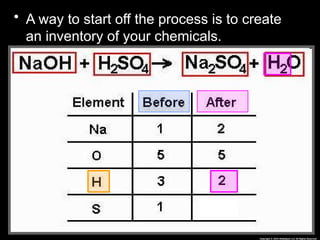
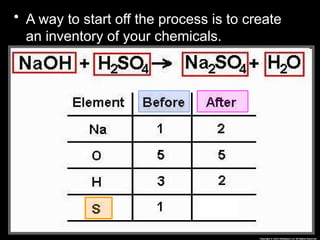
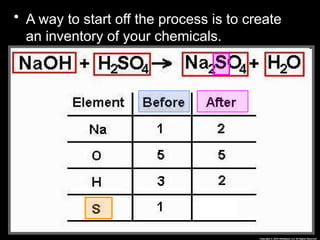
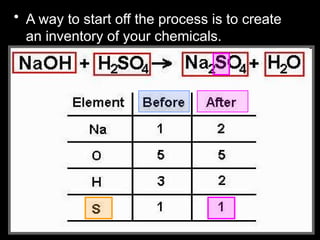
• A way to start off the process is to create
an inventory of your chemicals.
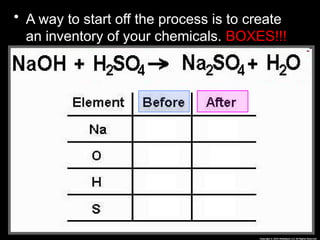
• A way to start off the process is to create
an inventory of your chemicals. BOXES!!!
• A way to start off the process is to create
an inventory of your chemicals.
• A way to start off the process is to create
an inventory of your chemicals.
• A way to start off the process is to create
an inventory of your chemicals.
• A way to start off the process is to create
an inventory of your chemicals.
• A way to start off the process is to create
an inventory of your chemicals.
• A way to start off the process is to create
an inventory of your chemicals.
• A way to start off the process is to create
an inventory of your chemicals.
• A way to start off the process is to create
an inventory of your chemicals.
• A way to start off the process is to create
an inventory of your chemicals.
• A way to start off the process is to create
an inventory of your chemicals.
• A way to start off the process is to create
an inventory of your chemicals.
• A way to start off the process is to create
an inventory of your chemicals.
• A way to start off the process is to create
an inventory of your chemicals.
• A way to start off the process is to create
an inventory of your chemicals.
• A way to start off the process is to create
an inventory of your chemicals.
• A way to start off the process is to create
an inventory of your chemicals.
• A way to start off the process is to create
an inventory of your chemicals.
• A way to start off the process is to create
an inventory of your chemicals.
• A way to start off the process is to create
an inventory of your chemicals.
• A way to start off the process is to create
an inventory of your chemicals.
• A way to start off the process is to create
an inventory of your chemicals.
• A way to start off the process is to create
an inventory of your chemicals.
• A way to start off the process is to create
an inventory of your chemicals.
• A way to start off the process is to create
an inventory of your chemicals.
• A way to start off the process is to create
an inventory of your chemicals.
• A way to start off the process is to create
an inventory of your chemicals.
• A way to start off the process is to create
an inventory of your chemicals.
• A way to start off the process is to create
an inventory of your chemicals.
• A way to start off the process is to create
an inventory of your chemicals.
• A way to start off the process is to create
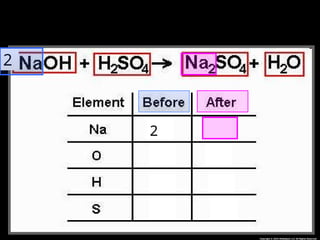
an inventory of your chemicals.
• A way to start off the process is to create
an inventory of your chemicals.
• A way to start off the process is to create
an inventory of your chemicals.
• A way to start off the process is to create
an inventory of your chemicals.
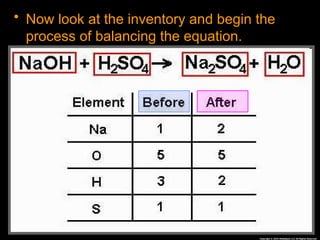
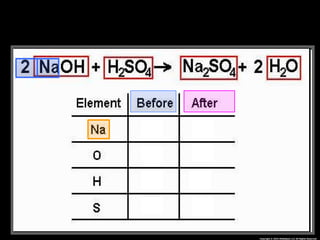
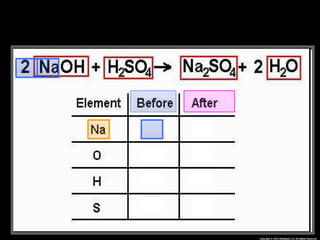
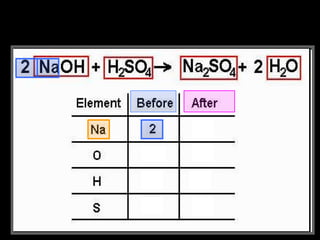
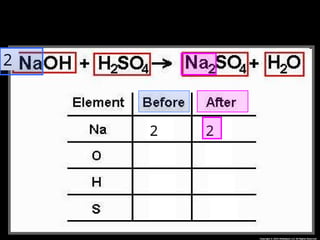
• Now look at the inventory and begin the
process of balancing the equation.
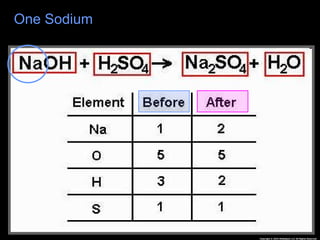
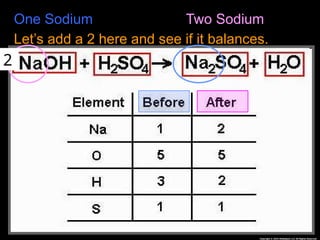
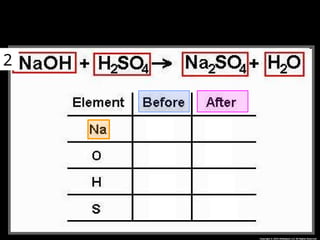
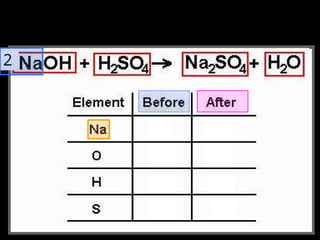
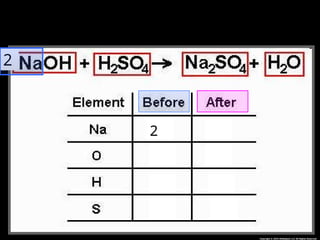
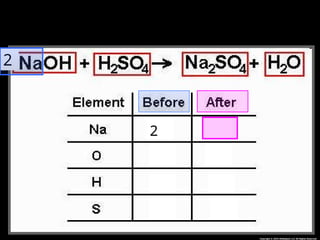
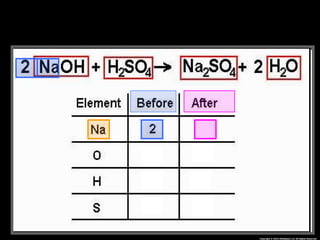
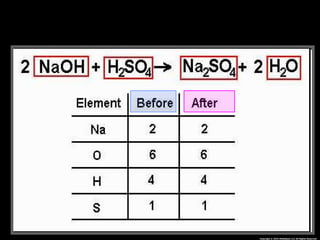
One Sodium
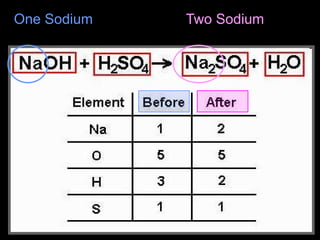
One Sodium Two Sodium
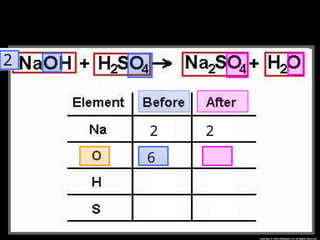
Let’s add a 2 here and see if it balances.
2
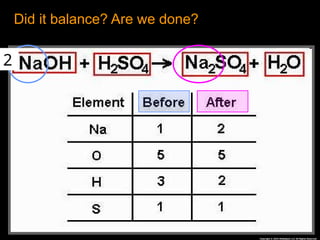
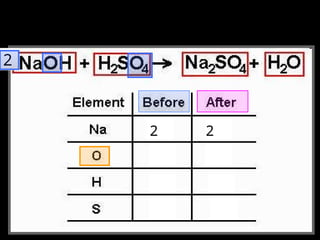
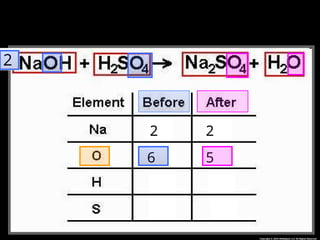
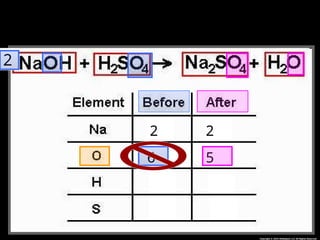
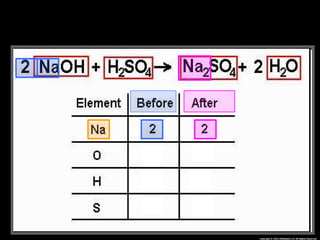
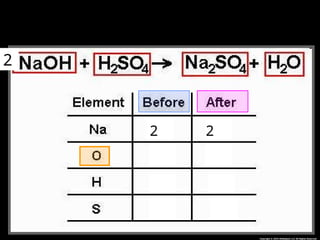
Did it balance? Are we done?
2
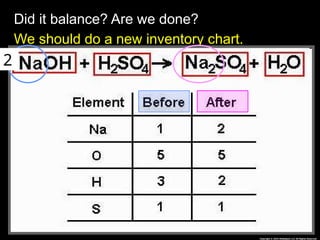
Did it balance? Are we done?
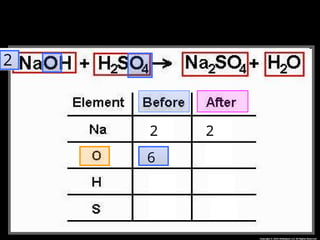
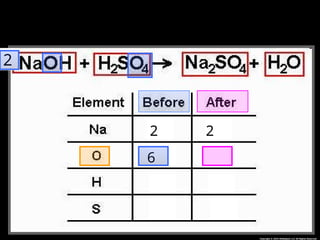
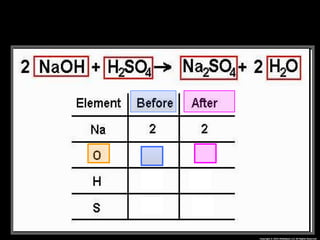
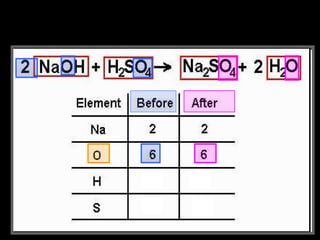
We should do a new inventory chart.
2
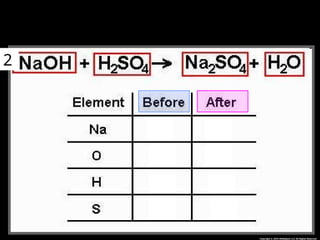
2
2
2
2
2
2
2
2
2
2
2 2
2
2 2
2
2 2
2
2 2
6
2
2 2
6
2
2 2
6
2
2 2
6 5
2
2 2
6 5
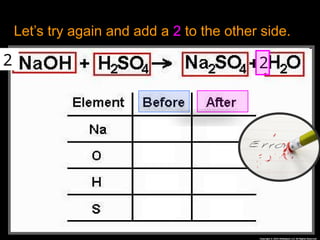
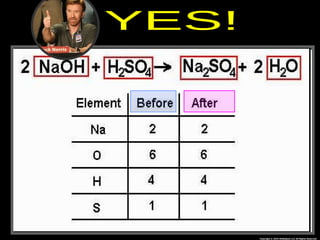
One Sodium Two Sodium
Let’s try again and add a 2 to the other side.
2 2
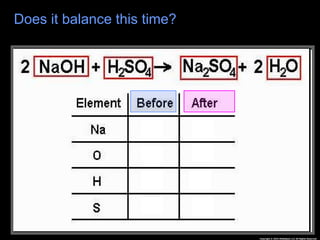
Does it balance this time?
Life is like riding a bicycle.
To keep your balance, you
must keep moving.
-Albert Einstein
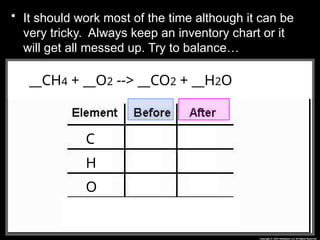
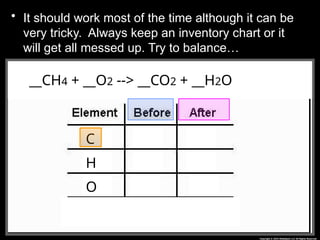
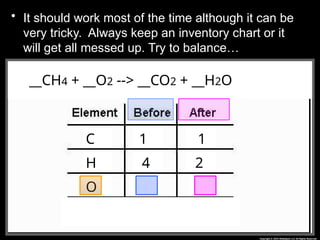
• It should work most of the time although it can be
very tricky. Always keep an inventory chart or it
will get all messed up.
__CH4 + __O2 --> __CO2 + __H2O
C
H
O
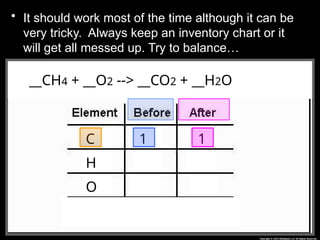
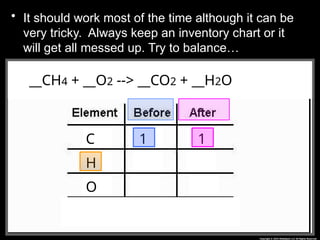
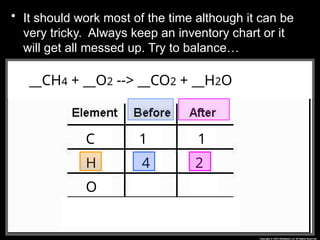
• It should work most of the time although it can be
very tricky. Always keep an inventory chart or it
will get all messed up. Try to balance…
__CH4 + __O2 --> __CO2 + __H2O
C
H
O
• It should work most of the time although it can be
very tricky. Always keep an inventory chart or it
will get all messed up. Try to balance…
__CH4 + __O2 --> __CO2 + __H2O
C
H
O
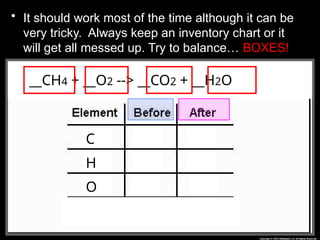
• It should work most of the time although it can be
very tricky. Always keep an inventory chart or it
will get all messed up. Try to balance… BOXES!
__CH4 + __O2 --> __CO2 + __H2O
C
H
O
• It should work most of the time although it can be
very tricky. Always keep an inventory chart or it
will get all messed up. Try to balance…
__CH4 + __O2 --> __CO2 + __H2O
C
H
O
• It should work most of the time although it can be
very tricky. Always keep an inventory chart or it
will get all messed up. Try to balance…
__CH4 + __O2 --> __CO2 + __H2O
C
H
O
1 1
• It should work most of the time although it can be
very tricky. Always keep an inventory chart or it
will get all messed up. Try to balance…
__CH4 + __O2 --> __CO2 + __H2O
C
H
O
1 1
• It should work most of the time although it can be
very tricky. Always keep an inventory chart or it
will get all messed up. Try to balance…
__CH4 + __O2 --> __CO2 + __H2O
C
H
O
1 1
4 2
• It should work most of the time although it can be
very tricky. Always keep an inventory chart or it
will get all messed up. Try to balance…
__CH4 + __O2 --> __CO2 + __H2O
C
H
O
1 1
4 2
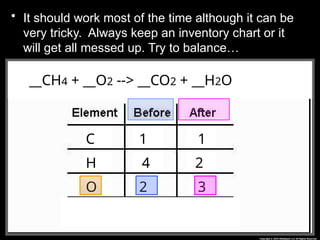
• It should work most of the time although it can be
very tricky. Always keep an inventory chart or it
will get all messed up. Try to balance…
__CH4 + __O2 --> __CO2 + __H2O
C
H
O
1 1
4 2
2 3
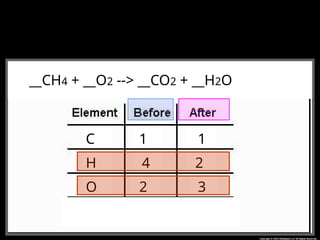
__CH4 + __O2 --> __CO2 + __H2O
C
H
O
1 1
4 2
2 3
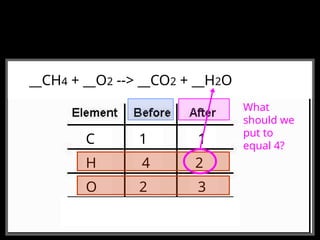
__CH4 + __O2 --> __CO2 + __H2O
C
H
O
1 1
4 2
2 3
What
should we
put to
equal 4?
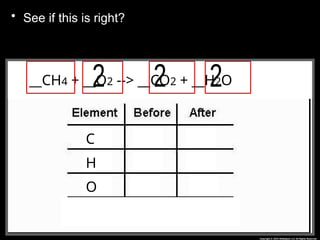
• See if this is right?
__CH4 + __O2 --> __CO2 + __H2O
C
H
O
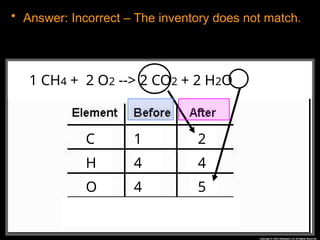
• Answer: Incorrect – The inventory does not match.
__CH4 + __O2 --> __CO2 + __H2O
1 CH4 + 2 O2 --> 2 CO2 + 2 H2O
C
H
O
1 2
4 4
4 5
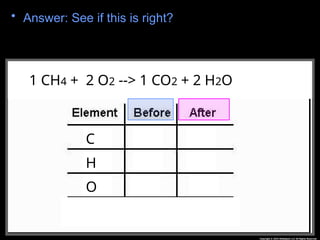
• Answer: See if this is right?
__CH4 + __O2 --> __CO2 + __H2O
1 CH4 + 2 O2 --> 1 CO2 + 2 H2O
C
H
O
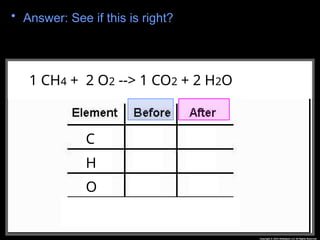
• Answer: See if this is right?
__CH4 + __O2 --> __CO2 + __H2O
1 CH4 + 2 O2 --> 1 CO2 + 2 H2O
C
H
O
• Answer: See if this is right?
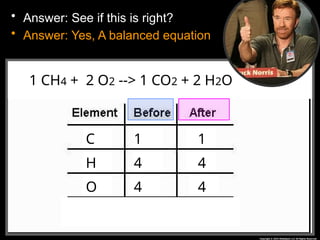
• Answer: Yes, A balanced equation
__CH4 + __O2 --> __CO2 + __H2O
1 CH4 + 2 O2 --> 1 CO2 + 2 H2O
C
H
O
1 1
4 4
4 4
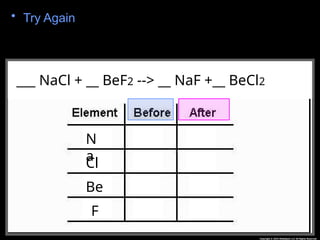
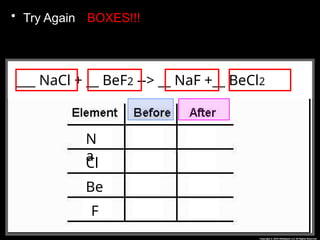
• Try Again
__CH4 + __O2 --> __CO2 + __H2O
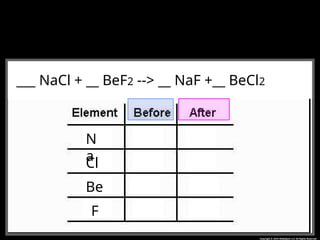
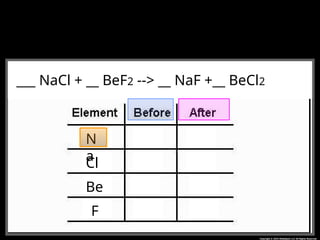
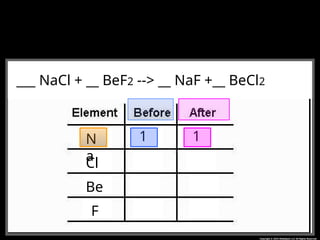
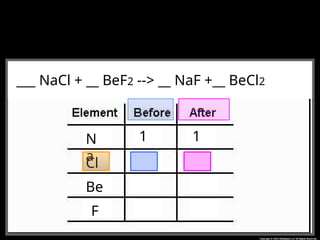
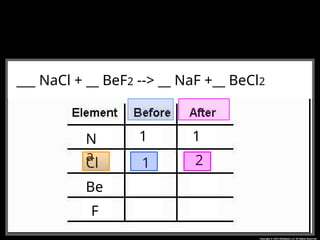
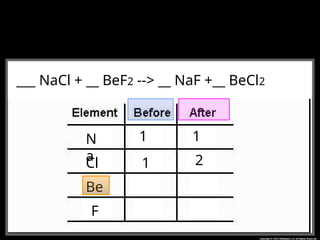
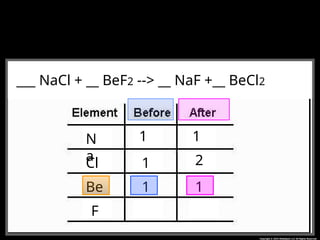
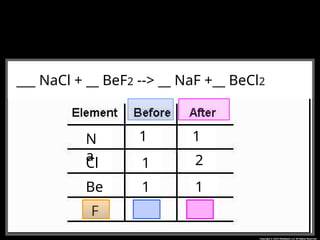
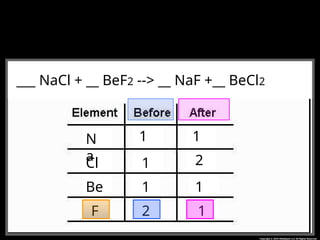
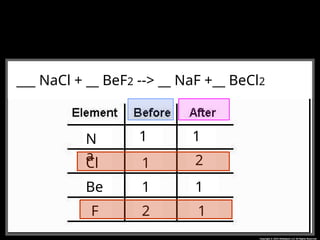
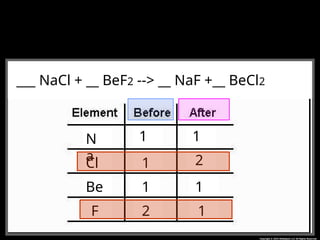
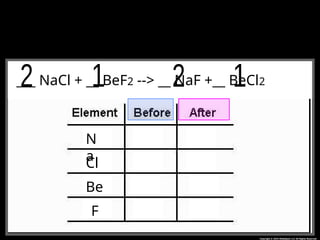
___ NaCl + __ BeF2 --> __ NaF +__ BeCl2
N
a
Cl
Be
F
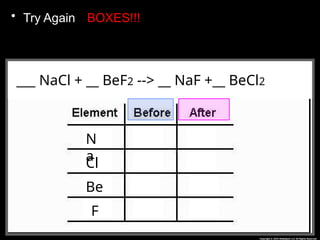
• Try Again BOXES!!!
__CH4 + __O2 --> __CO2 + __H2O
___ NaCl + __ BeF2 --> __ NaF +__ BeCl2
N
a
Cl
Be
F
• Try Again BOXES!!!
__CH4 + __O2 --> __CO2 + __H2O
___ NaCl + __ BeF2 --> __ NaF +__ BeCl2
N
a
Cl
Be
F
__CH4 + __O2 --> __CO2 + __H2O
___ NaCl + __ BeF2 --> __ NaF +__ BeCl2
N
a
Cl
Be
F
__CH4 + __O2 --> __CO2 + __H2O
___ NaCl + __ BeF2 --> __ NaF +__ BeCl2
N
a
Cl
Be
F
__CH4 + __O2 --> __CO2 + __H2O
___ NaCl + __ BeF2 --> __ NaF +__ BeCl2
N
a
Cl
Be
F
1 1
__CH4 + __O2 --> __CO2 + __H2O
___ NaCl + __ BeF2 --> __ NaF +__ BeCl2
N
a
Cl
Be
F
1 1
__CH4 + __O2 --> __CO2 + __H2O
___ NaCl + __ BeF2 --> __ NaF +__ BeCl2
N
a
Cl
Be
F
1 1
1 2
__CH4 + __O2 --> __CO2 + __H2O
___ NaCl + __ BeF2 --> __ NaF +__ BeCl2
N
a
Cl
Be
F
1 1
1 2
__CH4 + __O2 --> __CO2 + __H2O
___ NaCl + __ BeF2 --> __ NaF +__ BeCl2
N
a
Cl
Be
F
1 1
1 2
1 1
__CH4 + __O2 --> __CO2 + __H2O
___ NaCl + __ BeF2 --> __ NaF +__ BeCl2
N
a
Cl
Be
F
1 1
1 2
1 1
__CH4 + __O2 --> __CO2 + __H2O
___ NaCl + __ BeF2 --> __ NaF +__ BeCl2
N
a
Cl
Be
F
1 1
1 2
1 1
2 1
__CH4 + __O2 --> __CO2 + __H2O
___ NaCl + __ BeF2 --> __ NaF +__ BeCl2
N
a
Cl
Be
F
1 1
1 2
1 1
2 1
__CH4 + __O2 --> __CO2 + __H2O
___ NaCl + __ BeF2 --> __ NaF +__ BeCl2
N
a
Cl
Be
F
1 1
1 2
1 1
2 1
__CH4 + __O2 --> __CO2 + __H2O
___ NaCl + __ BeF2 --> __ NaF +__ BeCl2
N
a
Cl
Be
F
__CH4 + __O2 --> __CO2 + __H2O
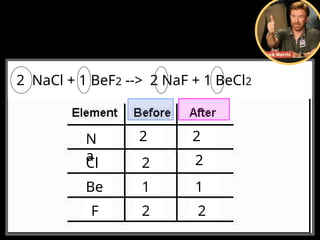
2 NaCl + 1 BeF2 --> 2 NaF + 1 BeCl2
N
a
Cl
Be
F
2 2
2 2
1 1
2 2
Part 4
Lesson 4

Part 4 Lesson 4 Balancing Equations.pptx

  • 1.
  • 2.
    • Red Slides:Please record the important terms in your work bundle. Copyright © 2024 SlideSpark .LLC First and last Name Science, Grade, Class
  • 3.
    • Red Slides:Please record the important terms in your work bundle. – You’ll need these notes to complete the work bundle Copyright © 2024 SlideSpark .LLC First and last Name Science, Grade, Class
  • 4.
    • Red Slides:Please record the important terms in your work bundle. – You’ll need these notes to complete the work bundle and to be successful on the review game. Copyright © 2024 SlideSpark .LLC First and last Name Science, Grade, Class
  • 5.
    Chemical Change: Thechange of substances into other substances through a reorganization of the atoms. Copyright © 2024 SlideSpark .LLC
  • 6.
    Chemical Change: Thechange of substances into other substances through a reorganization of the atoms. Copyright © 2024 SlideSpark .LLC
  • 9.
    New Area ofFocus: Balancing Chemical Equations.
  • 10.
    • New Areaof Focus: Balancing Chemical Equations. – No red slide notes but you should show lots of work.
  • 11.
    Balancing Chemical Equations. 2H2+ 202 = 2H2O Reactants (before) Reaction Products (after) Why is this important?
  • 12.
    Balancing Chemical Equations. Thisis what happens in a chemical reaction 2H2 + 202 = 2H2O Reactants (before) Reaction Products (after)
  • 13.
    Balancing Chemical Equations. Thisis what happens in a chemical reaction 2H2 + 202 = 2H2O Reactants (before) Reaction Products (after)
  • 14.
    Balancing Chemical Equations. Thisis what happens in a chemical reaction It describes what you started with…and ended with. 2H2 + 202 = 2H2O Reactants (before) Reaction Products (after)
  • 15.
    Balancing Chemical Equations. Thisis what happens in a chemical reaction It describes what you started with…and ended with. 2H2 + 202 = 2H2O Reactants (before) Reaction Products (after)
  • 16.
    Balancing Chemical Equations. Thisis what happens in a chemical reaction It describes what you started with…and ended with. 2H2 + 02 = 2H2O Reactants (before) Reaction Products (after)
  • 17.
    Balancing Chemical Equations. Thisis what happens in a chemical reaction It describes what you started with…and ended with. 2H2 + 02 = 2H2O Reactants (before) Reaction Products (after)
  • 18.
    Balancing Chemical Equations. Thisis what happens in a chemical reaction It describes what you started with…and ended with. 2H2 + 02 = 2H2O Reactants (before) Reaction Products (after)
  • 19.
    Balancing Chemical Equations. Thisis what happens in a chemical reaction It describes what you started with…and ended with. It also describes the phases of each (s) (l) (g) 2H2 + 202 = 2H2O Reactants (before) Reaction Products (after) (l) (g) (l)
  • 20.
    Balancing Chemical Equations. Thisis what happens in a chemical reaction It describes what you started with…and ended with. It also describes the phases of each (s) (l) (g) It also describes the amount of each.
  • 21.
    Balancing Chemical Equations. Thisis what happens in a chemical reaction It describes what you started with…and ended with. It also describes the phases of each (s) (l) (g) It also describes the amount of each. Reactants Products
  • 22.
    Balancing Chemical Equations. Thisis what happens in a chemical reaction It describes what you started with…and ended with. It also describes the phases of each (s) (l) (g) It also describes the amount of each. Reactants Products Reaction
  • 23.
    Balancing Chemical Equations. Thisis what happens in a chemical reaction It describes what you started with…and ended with. It also describes the phases of each (s) (l) (g) It also describes the amount of each. Reactants Products 1 Methane 2 Oxygen 1 Carbon Dioxide 2 Water Reaction . The coefficients of a balanced equation tell you the ratio of the # of moles of each reactant and product.
  • 24.
    Balancing a chemicalequation refers to establishing the mathematical relationship between the quantity of reactants and products.
  • 25.
    Balancing a chemicalequation refers to establishing the mathematical relationship between the quantity of reactants and products. Reactant: Starting
  • 26.
    Balancing a chemicalequation refers to establishing the mathematical relationship between the quantity of reactants and products. Reactant: Starting
  • 27.
    Balancing a chemicalequation refers to establishing the mathematical relationship between the quantity of reactants and products. Reactant: Starting
  • 28.
    Balancing a chemicalequation refers to establishing the mathematical relationship between the quantity of reactants and products. Reactant: Starting Products: Ending
  • 29.
    Balancing a chemicalequation refers to establishing the mathematical relationship between the quantity of reactants and products. Reactant: Starting Products: Ending "reacts with" "reacts with"
  • 30.
    In any physicalor chemical change, matter is neither created nor destroyed Copyright © 2024 SlideSpark .LLC
  • 31.
    In any physicalor chemical change, matter is neither created nor destroyed Matter can be changed from one form to another. Copyright © 2024 SlideSpark .LLC
  • 32.
    In any physicalor chemical change, matter is neither created nor destroyed Matter can be changed from one form to another. Copyright © 2024 SlideSpark .LLC
  • 33.
    In any physicalor chemical change, matter is neither created nor destroyed Matter can be changed from one form to another. Copyright © 2024 SlideSpark .LLC
  • 34.
    In any physicalor chemical change, matter is neither created nor destroyed Matter can be changed from one form to another. Copyright © 2024 SlideSpark .LLC
  • 35.
    In any physicalor chemical change, matter is neither created nor destroyed Matter can be changed from one form to another. Copyright © 2024 SlideSpark .LLC
  • 36.
    In any physicalor chemical change, matter is neither created nor destroyed Matter can be changed from one form to another. Copyright © 2024 SlideSpark .LLC
  • 37.
    In any physicalor chemical change, matter is neither created nor destroyed Matter can be changed from one form to another. Copyright © 2024 SlideSpark .LLC
  • 38.
    In any physicalor chemical change, matter is neither created nor destroyed Matter can be changed from one form to another. Copyright © 2024 SlideSpark .LLC
  • 40.
    • Remember theLaw Conservation of Mass: Matter cannot be created or destroyed. That means we need to have the same amount of chemicals on each side of the . • For this reason, put a square around the chemical formulas. • Example
  • 41.
    • Remember theLaw Conservation of Mass: Matter cannot be created or destroyed. That means we need to have the same amount of chemicals on each side of the . • For this reason, put a square around the chemical formulas. • Example
  • 42.
    • Remember theLaw Conservation of Mass: Matter cannot be created or destroyed. That means we need to have the same amount of chemicals on each side of the . • For this reason, put a square around the chemical formulas.
  • 43.
    • Remember theLaw Conservation of Mass: Matter cannot be created or destroyed. That means we need to have the same amount of chemicals on each side of the . • For this reason, put a square around the chemical formulas. • Example
  • 44.
    Begin balancing chemicalequations by putting numbers (coefficients) in front of them.
  • 45.
    Begin balancing chemicalequations by putting numbers (coefficients) in front of them. Example H2O on one side could become 2 H2O
  • 46.
    Begin balancing chemicalequations by putting numbers (coefficients) in front of them. Example H2O on one side could become 2 H2O Remember that each side needs to have same number of Hydrogen and Oxygen
  • 47.
    Begin balancing chemicalequations by putting numbers (coefficients) in front of them. Example H2O on one side could become 2 H2O Remember that each side needs to have same number of Hydrogen and Oxygen Note – Don’t change the subscript Example H2O becomes H3O WRONG!
  • 48.
    • Balancing EquationsAvailable Sheet. – Complete each equation as we cover it in class.
  • 49.
  • 50.
    • A wayto start off the process is to create an inventory of your chemicals.
  • 51.
    • A wayto start off the process is to create an inventory of your chemicals. BOXES!!!
  • 52.
    • A wayto start off the process is to create an inventory of your chemicals.
  • 53.
    • A wayto start off the process is to create an inventory of your chemicals.
  • 54.
    • A wayto start off the process is to create an inventory of your chemicals.
  • 55.
    • A wayto start off the process is to create an inventory of your chemicals.
  • 56.
    • A wayto start off the process is to create an inventory of your chemicals.
  • 57.
    • A wayto start off the process is to create an inventory of your chemicals.
  • 58.
    • A wayto start off the process is to create an inventory of your chemicals.
  • 59.
    • A wayto start off the process is to create an inventory of your chemicals.
  • 60.
    • A wayto start off the process is to create an inventory of your chemicals.
  • 61.
    • A wayto start off the process is to create an inventory of your chemicals.
  • 62.
    • A wayto start off the process is to create an inventory of your chemicals.
  • 63.
    • A wayto start off the process is to create an inventory of your chemicals.
  • 64.
    • A wayto start off the process is to create an inventory of your chemicals.
  • 65.
    • A wayto start off the process is to create an inventory of your chemicals.
  • 66.
    • A wayto start off the process is to create an inventory of your chemicals.
  • 67.
    • A wayto start off the process is to create an inventory of your chemicals.
  • 68.
    • A wayto start off the process is to create an inventory of your chemicals.
  • 69.
    • A wayto start off the process is to create an inventory of your chemicals.
  • 70.
    • A wayto start off the process is to create an inventory of your chemicals.
  • 71.
    • A wayto start off the process is to create an inventory of your chemicals.
  • 72.
    • A wayto start off the process is to create an inventory of your chemicals.
  • 73.
    • A wayto start off the process is to create an inventory of your chemicals.
  • 74.
    • A wayto start off the process is to create an inventory of your chemicals.
  • 75.
    • A wayto start off the process is to create an inventory of your chemicals.
  • 76.
    • A wayto start off the process is to create an inventory of your chemicals.
  • 77.
    • A wayto start off the process is to create an inventory of your chemicals.
  • 78.
    • A wayto start off the process is to create an inventory of your chemicals.
  • 79.
    • A wayto start off the process is to create an inventory of your chemicals.
  • 80.
    • A wayto start off the process is to create an inventory of your chemicals.
  • 81.
    • A wayto start off the process is to create an inventory of your chemicals.
  • 82.
    • A wayto start off the process is to create an inventory of your chemicals.
  • 83.
    • A wayto start off the process is to create an inventory of your chemicals.
  • 84.
    • A wayto start off the process is to create an inventory of your chemicals.
  • 85.
    • Now lookat the inventory and begin the process of balancing the equation.
  • 86.
  • 87.
  • 88.
    One Sodium TwoSodium Let’s add a 2 here and see if it balances. 2
  • 89.
    Did it balance?Are we done? 2
  • 90.
    Did it balance?Are we done? We should do a new inventory chart. 2
  • 91.
  • 92.
  • 93.
  • 94.
  • 95.
  • 96.
  • 97.
  • 98.
  • 99.
  • 100.
  • 101.
  • 102.
  • 103.
  • 104.
  • 105.
    One Sodium TwoSodium Let’s try again and add a 2 to the other side. 2 2
  • 106.
    Does it balancethis time?
  • 120.
    Life is likeriding a bicycle. To keep your balance, you must keep moving. -Albert Einstein
  • 121.
    • It shouldwork most of the time although it can be very tricky. Always keep an inventory chart or it will get all messed up. __CH4 + __O2 --> __CO2 + __H2O __CH4 + __O2 --> __CO2 + __H2O C H O
  • 122.
    • It shouldwork most of the time although it can be very tricky. Always keep an inventory chart or it will get all messed up. Try to balance… __CH4 + __O2 --> __CO2 + __H2O __CH4 + __O2 --> __CO2 + __H2O C H O
  • 124.
    • It shouldwork most of the time although it can be very tricky. Always keep an inventory chart or it will get all messed up. Try to balance… __CH4 + __O2 --> __CO2 + __H2O __CH4 + __O2 --> __CO2 + __H2O C H O
  • 125.
    • It shouldwork most of the time although it can be very tricky. Always keep an inventory chart or it will get all messed up. Try to balance… BOXES! __CH4 + __O2 --> __CO2 + __H2O __CH4 + __O2 --> __CO2 + __H2O C H O
  • 126.
    • It shouldwork most of the time although it can be very tricky. Always keep an inventory chart or it will get all messed up. Try to balance… __CH4 + __O2 --> __CO2 + __H2O __CH4 + __O2 --> __CO2 + __H2O C H O
  • 127.
    • It shouldwork most of the time although it can be very tricky. Always keep an inventory chart or it will get all messed up. Try to balance… __CH4 + __O2 --> __CO2 + __H2O __CH4 + __O2 --> __CO2 + __H2O C H O 1 1
  • 128.
    • It shouldwork most of the time although it can be very tricky. Always keep an inventory chart or it will get all messed up. Try to balance… __CH4 + __O2 --> __CO2 + __H2O __CH4 + __O2 --> __CO2 + __H2O C H O 1 1
  • 129.
    • It shouldwork most of the time although it can be very tricky. Always keep an inventory chart or it will get all messed up. Try to balance… __CH4 + __O2 --> __CO2 + __H2O __CH4 + __O2 --> __CO2 + __H2O C H O 1 1 4 2
  • 130.
    • It shouldwork most of the time although it can be very tricky. Always keep an inventory chart or it will get all messed up. Try to balance… __CH4 + __O2 --> __CO2 + __H2O __CH4 + __O2 --> __CO2 + __H2O C H O 1 1 4 2
  • 131.
    • It shouldwork most of the time although it can be very tricky. Always keep an inventory chart or it will get all messed up. Try to balance… __CH4 + __O2 --> __CO2 + __H2O __CH4 + __O2 --> __CO2 + __H2O C H O 1 1 4 2 2 3
  • 132.
    __CH4 + __O2--> __CO2 + __H2O __CH4 + __O2 --> __CO2 + __H2O C H O 1 1 4 2 2 3
  • 133.
    __CH4 + __O2--> __CO2 + __H2O __CH4 + __O2 --> __CO2 + __H2O C H O 1 1 4 2 2 3 What should we put to equal 4?
  • 134.
    • See ifthis is right? __CH4 + __O2 --> __CO2 + __H2O __CH4 + __O2 --> __CO2 + __H2O C H O
  • 135.
    • Answer: Incorrect– The inventory does not match. __CH4 + __O2 --> __CO2 + __H2O 1 CH4 + 2 O2 --> 2 CO2 + 2 H2O C H O 1 2 4 4 4 5
  • 136.
    • Answer: Seeif this is right? __CH4 + __O2 --> __CO2 + __H2O 1 CH4 + 2 O2 --> 1 CO2 + 2 H2O C H O
  • 137.
    • Answer: Seeif this is right? __CH4 + __O2 --> __CO2 + __H2O 1 CH4 + 2 O2 --> 1 CO2 + 2 H2O C H O
  • 138.
    • Answer: Seeif this is right? • Answer: Yes, A balanced equation __CH4 + __O2 --> __CO2 + __H2O 1 CH4 + 2 O2 --> 1 CO2 + 2 H2O C H O 1 1 4 4 4 4
  • 140.
    • Try Again __CH4+ __O2 --> __CO2 + __H2O ___ NaCl + __ BeF2 --> __ NaF +__ BeCl2 N a Cl Be F
  • 141.
    • Try AgainBOXES!!! __CH4 + __O2 --> __CO2 + __H2O ___ NaCl + __ BeF2 --> __ NaF +__ BeCl2 N a Cl Be F
  • 142.
    • Try AgainBOXES!!! __CH4 + __O2 --> __CO2 + __H2O ___ NaCl + __ BeF2 --> __ NaF +__ BeCl2 N a Cl Be F
  • 143.
    __CH4 + __O2--> __CO2 + __H2O ___ NaCl + __ BeF2 --> __ NaF +__ BeCl2 N a Cl Be F
  • 144.
    __CH4 + __O2--> __CO2 + __H2O ___ NaCl + __ BeF2 --> __ NaF +__ BeCl2 N a Cl Be F
  • 145.
    __CH4 + __O2--> __CO2 + __H2O ___ NaCl + __ BeF2 --> __ NaF +__ BeCl2 N a Cl Be F 1 1
  • 146.
    __CH4 + __O2--> __CO2 + __H2O ___ NaCl + __ BeF2 --> __ NaF +__ BeCl2 N a Cl Be F 1 1
  • 147.
    __CH4 + __O2--> __CO2 + __H2O ___ NaCl + __ BeF2 --> __ NaF +__ BeCl2 N a Cl Be F 1 1 1 2
  • 148.
    __CH4 + __O2--> __CO2 + __H2O ___ NaCl + __ BeF2 --> __ NaF +__ BeCl2 N a Cl Be F 1 1 1 2
  • 149.
    __CH4 + __O2--> __CO2 + __H2O ___ NaCl + __ BeF2 --> __ NaF +__ BeCl2 N a Cl Be F 1 1 1 2 1 1
  • 150.
    __CH4 + __O2--> __CO2 + __H2O ___ NaCl + __ BeF2 --> __ NaF +__ BeCl2 N a Cl Be F 1 1 1 2 1 1
  • 151.
    __CH4 + __O2--> __CO2 + __H2O ___ NaCl + __ BeF2 --> __ NaF +__ BeCl2 N a Cl Be F 1 1 1 2 1 1 2 1
  • 152.
    __CH4 + __O2--> __CO2 + __H2O ___ NaCl + __ BeF2 --> __ NaF +__ BeCl2 N a Cl Be F 1 1 1 2 1 1 2 1
  • 153.
    __CH4 + __O2--> __CO2 + __H2O ___ NaCl + __ BeF2 --> __ NaF +__ BeCl2 N a Cl Be F 1 1 1 2 1 1 2 1
  • 154.
    __CH4 + __O2--> __CO2 + __H2O ___ NaCl + __ BeF2 --> __ NaF +__ BeCl2 N a Cl Be F
  • 155.
    __CH4 + __O2--> __CO2 + __H2O 2 NaCl + 1 BeF2 --> 2 NaF + 1 BeCl2 N a Cl Be F 2 2 2 2 1 1 2 2
  • 156.