PART 3
LESSON 1
• Red Slides: Please record the important terms
in your work bundle.
Copyright © 2024 SlideSpark .LLC
First and last Name
Science, Grade, Class
• Red Slides: Please record the important terms
in your work bundle.
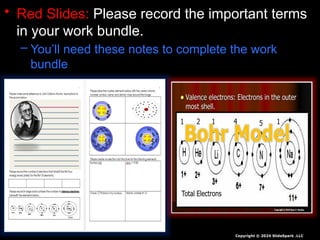
– You’ll need these notes to complete the work
bundle
Copyright © 2024 SlideSpark .LLC
First and last Name
Science, Grade, Class
• Red Slides: Please record the important terms
in your work bundle.
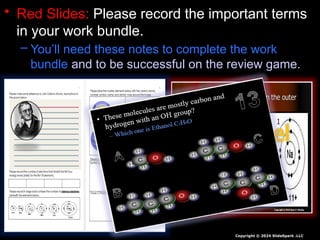
– You’ll need these notes to complete the work
bundle and to be successful on the review game.
Copyright © 2024 SlideSpark .LLC
First and last Name
Science, Grade, Class
Make
Good
Choices
Listen to the teacher
and others.
Please no
shout outs.
One speaker at a
time. Please
raise your
hand.
First,
Last,
and
Always.
Focus on
Task completion
Avoid
Distractions
Stay
Organized
Help
Others
Never
Give
Up!
Copyright © 2024 SlideSpark .LLC
Science from Murf LLC
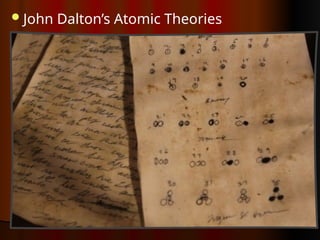
John Dalton’s Atomic Theories
-All matter is composed of _________?
John Dalton’s Atomic Theories
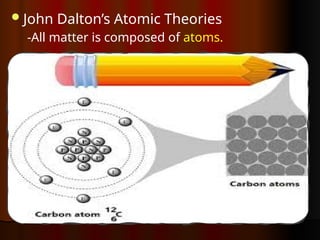
-All matter is composed of atoms.
Atoms cannot be created or ___________.
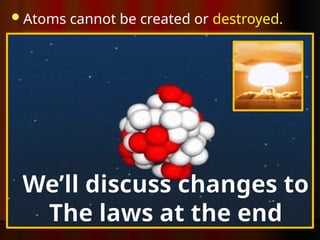
Atoms cannot be created or destroyed.
We’ll discuss changes to
The laws at the end
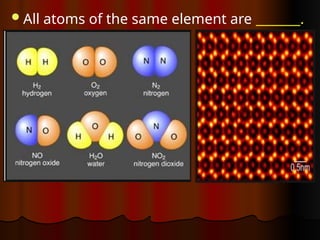
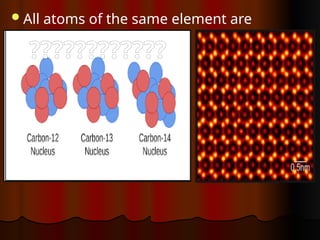
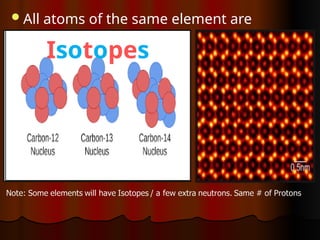
All atoms of the same element are _______.
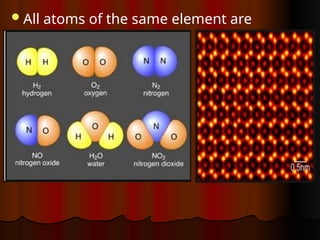
All atoms of the same element are
identical.
All atoms of the same element are
identical.
????????????
All atoms of the same element are
identical.
Isotopes
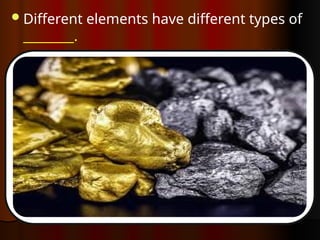
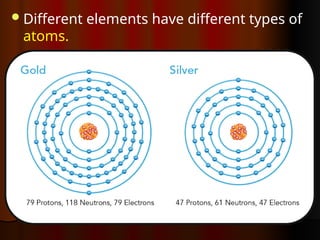
Different elements have different types of
________.
Different elements have different types of
atoms.
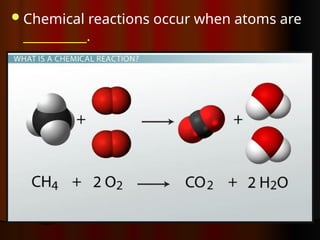
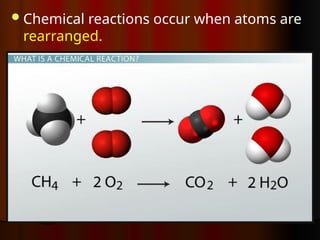
Chemical reactions occur when atoms are
__________.
Chemical reactions occur when atoms are
rearranged.
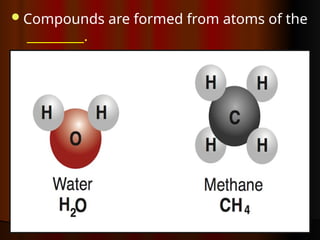
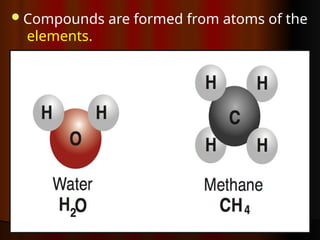
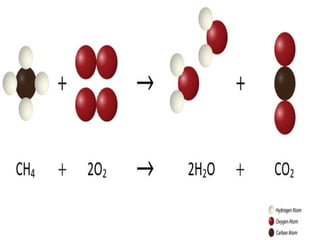
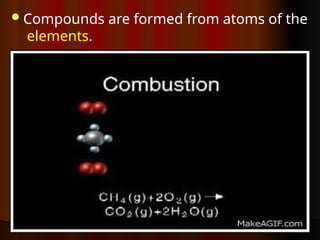
Compounds are formed from atoms of the
_________.
Compounds are formed from atoms of the
elements.
Compounds are formed from atoms of the
elements.
• Which is not one of John Daltons Atomic
Theories?
A.) All matter is composed of atoms.
B.) Atoms cannot be made or destroyed.
C.) All atoms of the same element are identical.
D.) Different elements have the same type of
atoms.
E.) Chemical reactions occur when atoms are
rearranged.
F.) Compounds are formed from atoms of the
constituent elements.
Copyright © 2024 SlideSpark .LLC
• Which is not one of John Daltons Atomic
Theories?
A.) All matter is composed of atoms.
B.) Atoms cannot be made or destroyed.
C.) All atoms of the same element are identical.
D.) Different elements have the same type of
atoms.
E.) Chemical reactions occur when atoms are
rearranged.
F.) Compounds are formed from atoms of the
constituent elements.
Copyright © 2024 SlideSpark .LLC
• Which is not one of John Daltons Atomic
Theories?
A.) All matter is composed of atoms.
B.) Atoms cannot be made or destroyed.
C.) All atoms of the same element are identical.
D.) Different elements have different types of
atoms.
E.) Chemical reactions occur when atoms are
rearranged.
F.) Compounds are formed from atoms of the
constituent elements.
Copyright © 2024 SlideSpark .LLC
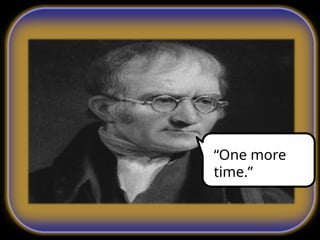
“One more
time.”
• Which is not one of John Daltons Atomic
Theories?
A.) All matter is composed of atoms.
B.) Atoms cannot be made or destroyed.
C.) All atoms of the same element are different.
D.) Different elements have different types of
atoms.
E.) Chemical reactions occur when atoms are
rearranged.
F.) Compounds are formed from atoms of the
constituent elements.
Copyright © 2024 SlideSpark .LLC
• Which is not one of John Daltons Atomic
Theories?
A.) All matter is composed of atoms.
B.) Atoms cannot be made or destroyed.
C.) All atoms of the same element are different.
D.) Different elements have different types of
atoms.
E.) Chemical reactions occur when atoms are
rearranged.
F.) Compounds are formed from atoms of the
constituent elements.
Copyright © 2024 SlideSpark .LLC
• Which is not one of John Daltons Atomic
Theories?
A.) All matter is composed of atoms.
B.) Atoms cannot be made or destroyed.
C.) All atoms of the same element are identical.
D.) Different elements have different types of
atoms.
E.) Chemical reactions occur when atoms are
rearranged.
F.) Compounds are formed from atoms of the
constituent elements.
Copyright © 2024 SlideSpark .LLC
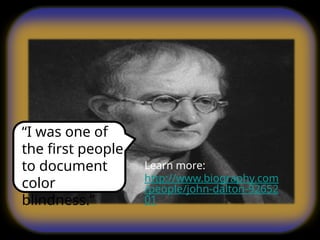
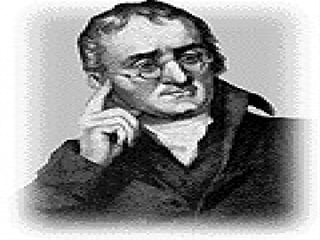
“I was one of
the first people
to document
color
blindness.”
Learn more:
http://www.biography.com
/people/john-dalton-92652
01
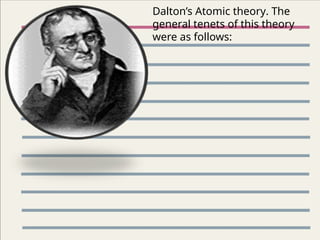
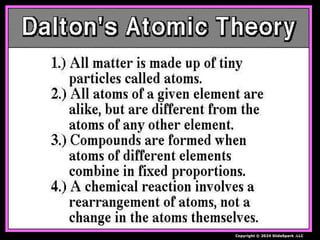
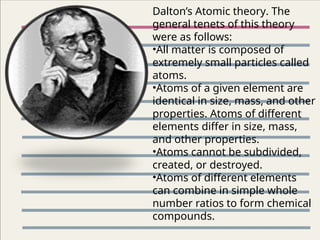
Dalton’s Atomic theory. The
general tenets of this theory
were as follows:
Dalton’s Atomic theory. The
general tenets of this theory
were as follows:
•All matter is composed of
extremely small particles called
atoms.
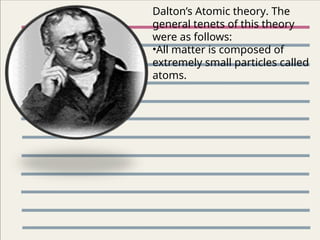
Dalton’s Atomic theory. The
general tenets of this theory
were as follows:
•All matter is composed of
extremely small particles called
atoms.
•Atoms of a given element are
identical in size, mass, and other
properties. Atoms of different
elements differ in size, mass,
and other properties.
Dalton’s Atomic theory. The
general tenets of this theory
were as follows:
•All matter is composed of
extremely small particles called
atoms.
•Atoms of a given element are
identical in size, mass, and other
properties. Atoms of different
elements differ in size, mass,
and other properties.
•Atoms cannot be subdivided,
created, or destroyed.
Dalton’s Atomic theory. The
general tenets of this theory
were as follows:
•All matter is composed of
extremely small particles called
atoms.
•Atoms of a given element are
identical in size, mass, and other
properties. Atoms of different
elements differ in size, mass,
and other properties.
•Atoms cannot be subdivided,
created, or destroyed.
•Atoms of different elements
can combine in simple whole
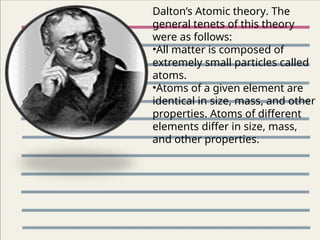
number ratios to form chemical
compounds.
Dalton’s Atomic theory. The
general tenets of this theory
were as follows:
•All matter is composed of
extremely small particles called
atoms.
•Atoms of a given element are
identical in size, mass, and other
properties. Atoms of different
elements differ in size, mass,
and other properties.
•Atoms cannot be subdivided,
created, or destroyed.
•Atoms of different elements
can combine in simple whole
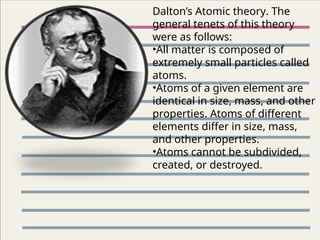
number ratios to form chemical
compounds.
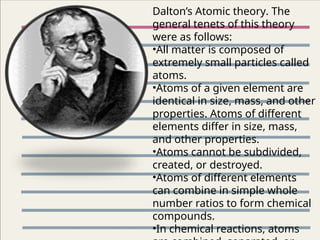
•In chemical reactions, atoms
Dalton’s Atomic theory. The
general tenets of this theory
were as follows:
•All matter is composed of
extremely small particles called
atoms.
•Atoms of a given element are
identical in size, mass, and other
properties. Atoms of different
elements differ in size, mass,
and other properties.
•Atoms cannot be subdivided,
created, or destroyed.
•Atoms of different elements
can combine in simple whole
number ratios to form chemical
compounds.
•In chemical reactions, atoms
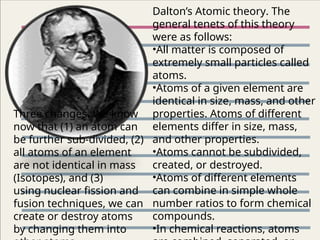
Three changes. We know
now that (1) an atom can
be further sub-divided, (2)
all atoms of an element
are not identical in mass
(Isotopes), and (3)
using nuclear fission and
fusion techniques, we can
create or destroy atoms
by changing them into
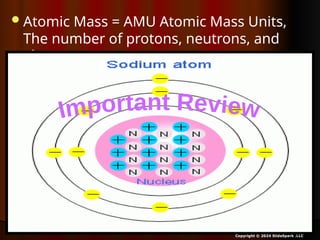
Atomic Mass = AMU Atomic Mass Units,
The number of protons, neutrons, and
electrons.
Copyright © 2024 SlideSpark .LLC
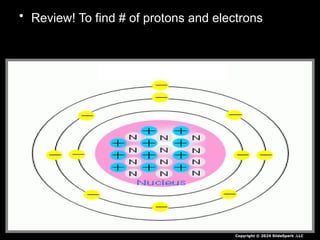
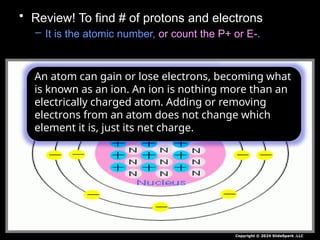
• Review! To find # of protons and electrons
Copyright © 2024 SlideSpark .LLC
• Review! To find # of protons and electrons
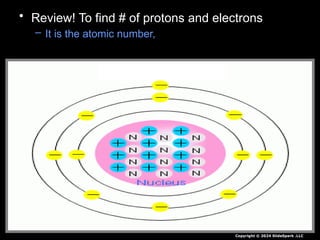
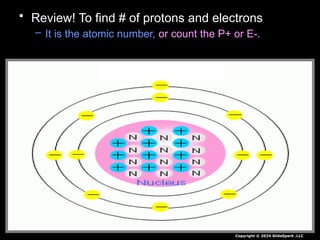
– It is the atomic number, or count the P+ or E-.
Copyright © 2024 SlideSpark .LLC
• Review! To find # of protons and electrons
– It is the atomic number, or count the P+ or E-.
Copyright © 2024 SlideSpark .LLC
• Review! To find # of protons and electrons
– It is the atomic number, or count the P+ or E-.
Copyright © 2024 SlideSpark .LLC
An atom can gain or lose electrons, becoming what
is known as an ion. An ion is nothing more than an
electrically charged atom. Adding or removing
electrons from an atom does not change which
element it is, just its net charge.
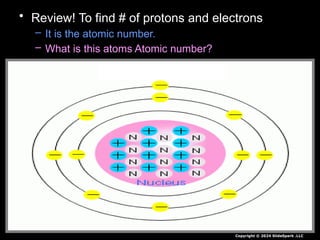
• Review! To find # of protons and electrons
– It is the atomic number.
– What is this atoms Atomic number?
Copyright © 2024 SlideSpark .LLC
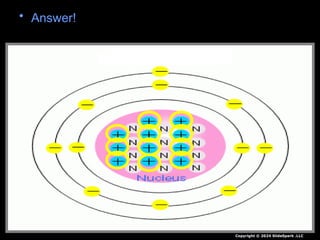
• Answer!
Copyright © 2024 SlideSpark .LLC
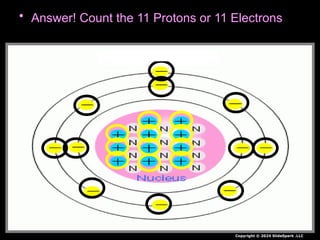
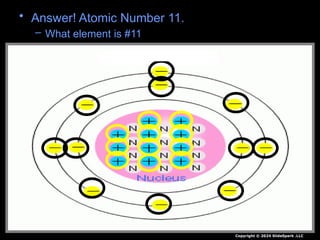
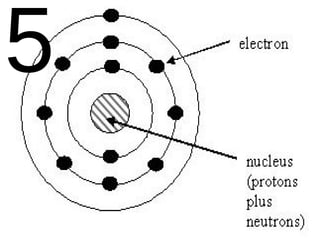
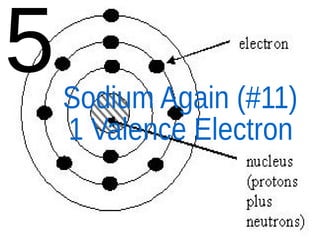
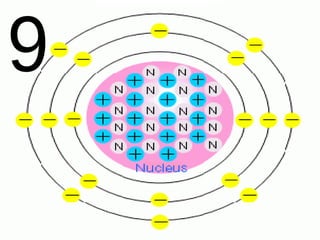
• Answer! Count the 11 Protons or 11 Electrons
Copyright © 2024 SlideSpark .LLC
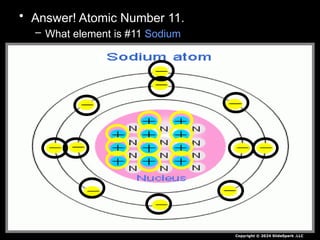
• Answer! Atomic Number 11.
– What element is #11
Copyright © 2024 SlideSpark .LLC
• Answer! Atomic Number 11.
– What element is #11 Sodium
Copyright © 2024 SlideSpark .LLC
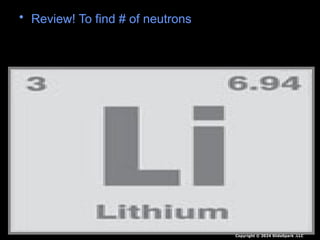
• Review! To find # of neutrons
Copyright © 2024 SlideSpark .LLC
• Review! To find # of neutrons
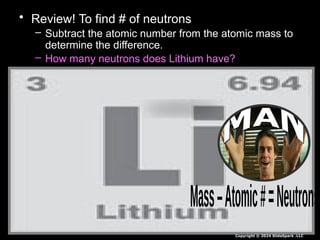
– Subtract the atomic number from the atomic mass to
determine the difference.
Copyright © 2024 SlideSpark .LLC
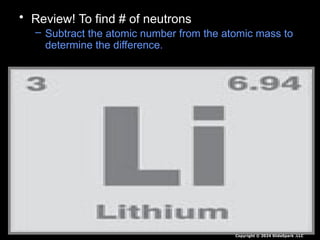
• Review! To find # of neutrons
– Subtract the atomic number from the atomic mass to
determine the difference.
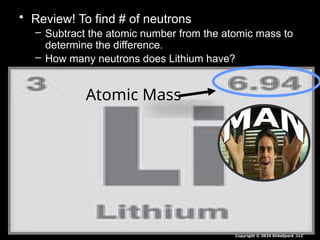
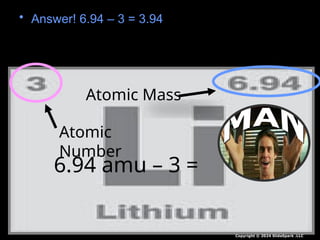
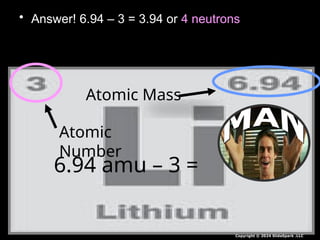
– How many neutrons does Lithium have?
Copyright © 2024 SlideSpark .LLC
• Review! To find # of neutrons
– Subtract the atomic number from the atomic mass to
determine the difference.
– How many neutrons does Lithium have?
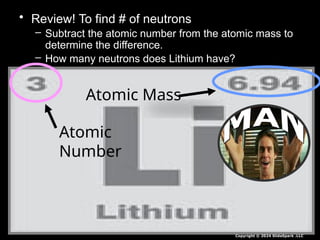
Atomic Mass
Copyright © 2024 SlideSpark .LLC
• Review! To find # of neutrons
– Subtract the atomic number from the atomic mass to
determine the difference.
– How many neutrons does Lithium have?
Atomic Mass
Atomic
Number
Copyright © 2024 SlideSpark .LLC
• Review! To find # of neutrons
– Subtract the atomic number from the atomic mass to
determine the difference.
– How many neutrons does Lithium have?
Atomic Mass
Atomic
Number
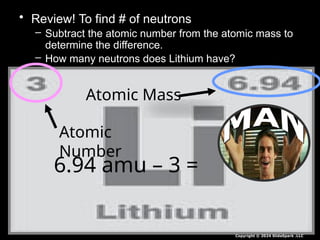
6.94 amu – 3 =
Copyright © 2024 SlideSpark .LLC
• Answer! 6.94 – 3 = 3.94
Atomic Mass
Atomic
Number
6.94 amu – 3 =
Copyright © 2024 SlideSpark .LLC
• Answer! 6.94 – 3 = 3.94 or 4 neutrons
Atomic Mass
Atomic
Number
6.94 amu – 3 =
Copyright © 2024 SlideSpark .LLC
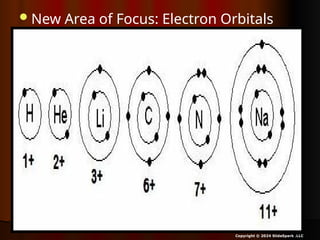
New Area of Focus: Electron Orbitals
Copyright © 2024 SlideSpark .LLC
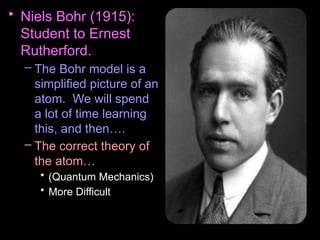
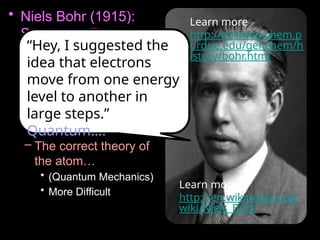
• Niels Bohr (1915):
Student to Ernest
Rutherford.
– The Bohr model is a
simplified picture of an
atom. We will spend
a lot of time learning
this, and then….
– The correct theory of
the atom…
• (Quantum Mechanics)
• More Difficult
• Niels Bohr (1915):
Student to Ernest
Rutherford.
– The Bohr model is a
simplified picture of an
atom. We will spend
a lot of time learning
this, and then….
– The correct theory of
the atom…
• (Quantum Mechanics)
• More Difficult
Learn more
http://chemed.chem.p
urdue.edu/genchem/h
istory/bohr.html
“Hey, I suggested the
idea that electrons
move from one energy
level to another in
large steps.”.-
Quantum….
Learn more:
http://en.wikipedia.org/
wiki/Niels_Bohr
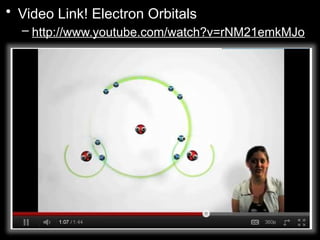
• Video Link! Electron Orbitals
– http://www.youtube.com/watch?v=rNM21emkMJo
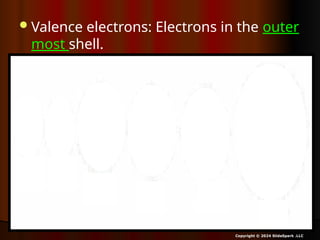
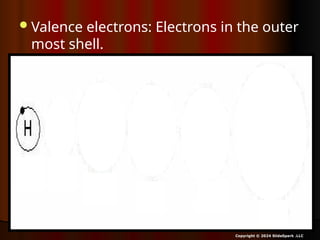
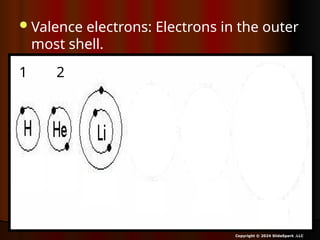
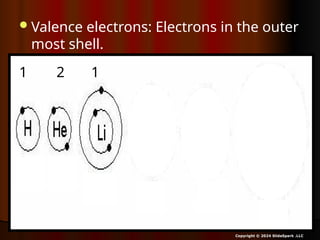
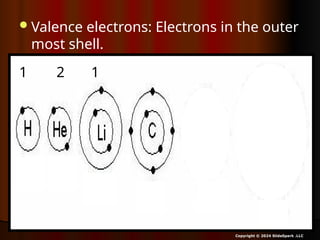
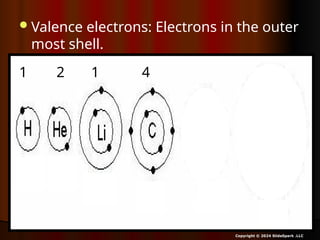
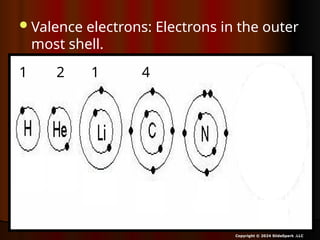
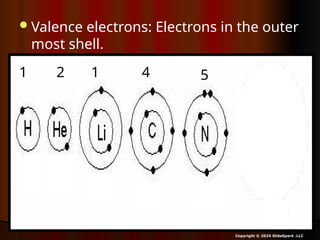
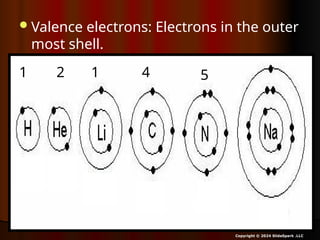
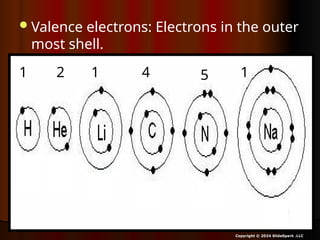
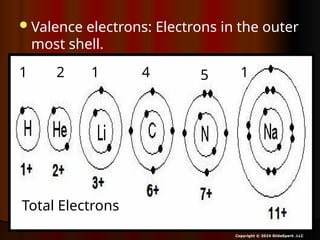
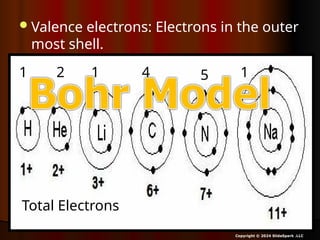
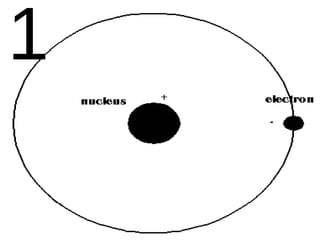
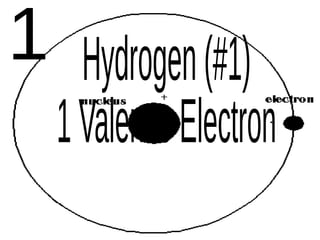
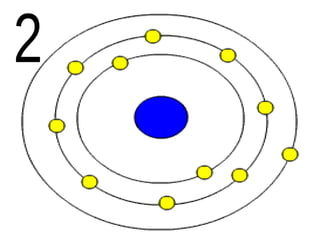
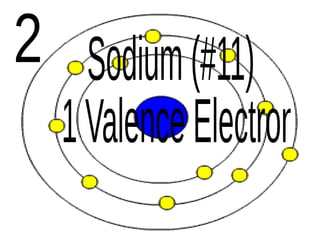
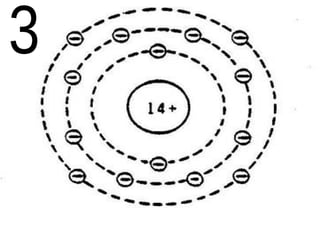
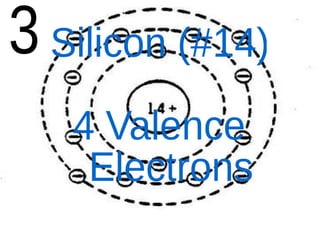
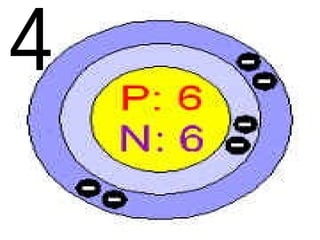
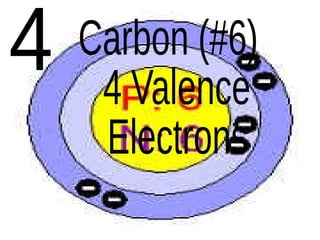
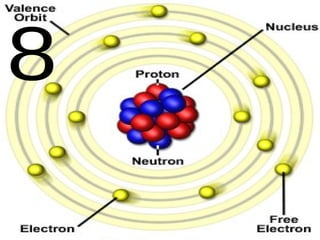
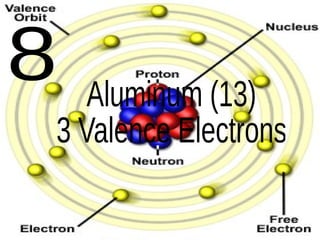
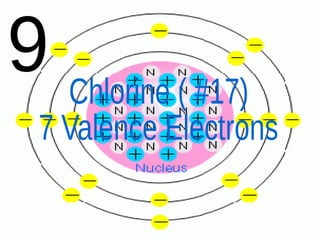
Valence electrons: Electrons in the outer
most shell.
Copyright © 2024 SlideSpark .LLC
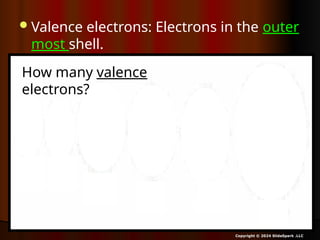
Valence electrons: Electrons in the outer
most shell.
Copyright © 2024 SlideSpark .LLC
How many valence
electrons?
Valence electrons: Electrons in the outer
most shell.
Copyright © 2024 SlideSpark .LLC
Valence electrons: Electrons in the outer
most shell.
Copyright © 2024 SlideSpark .LLC
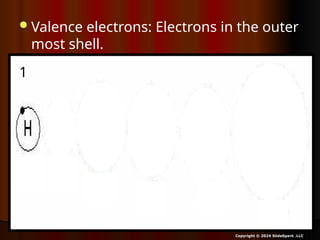
1
Valence electrons: Electrons in the outer
most shell.
Copyright © 2024 SlideSpark .LLC
1
Valence electrons: Electrons in the outer
most shell.
Copyright © 2024 SlideSpark .LLC
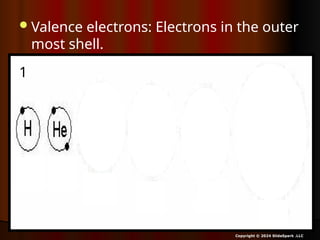
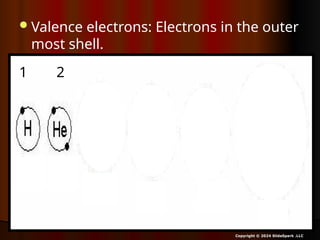
1 2
Valence electrons: Electrons in the outer
most shell.
Copyright © 2024 SlideSpark .LLC
1 2
Valence electrons: Electrons in the outer
most shell.
Copyright © 2024 SlideSpark .LLC
1 2 1
Valence electrons: Electrons in the outer
most shell.
Copyright © 2024 SlideSpark .LLC
1 2 1
Valence electrons: Electrons in the outer
most shell.
Copyright © 2024 SlideSpark .LLC
1 2 1 4
Valence electrons: Electrons in the outer
most shell.
Copyright © 2024 SlideSpark .LLC
1 2 1 4
Valence electrons: Electrons in the outer
most shell.
Copyright © 2024 SlideSpark .LLC
1 2 1 4 5
Valence electrons: Electrons in the outer
most shell.
Copyright © 2024 SlideSpark .LLC
1 2 1 4 5
Valence electrons: Electrons in the outer
most shell.
Copyright © 2024 SlideSpark .LLC
1 2 1 4 5 1
Valence electrons: Electrons in the outer
most shell.
Copyright © 2024 SlideSpark .LLC
1 2 1 4 5 1
Total Electrons
Valence electrons: Electrons in the outer
most shell.
Copyright © 2024 SlideSpark .LLC
1 2 1 4 5 1
Total Electrons
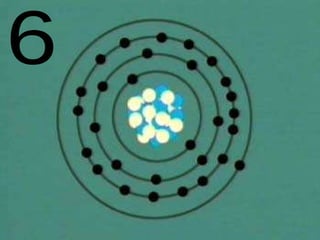
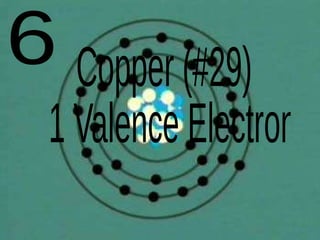
• Activity! Quiz Wiz: Name the atom based
on the electron orbitals / atomic number.
– Also tell me how many valence the atom has?
Copyright © 2024 SlideSpark .LLC
• Answers! Quiz Wiz: The answer will be given
after each questions instead of at the end.
Copyright © 2024 SlideSpark .LLC
We’ll just do out loud
Please raise your hand
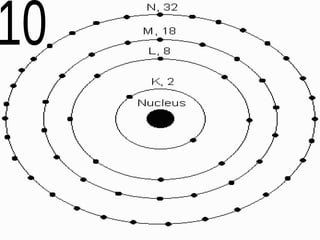
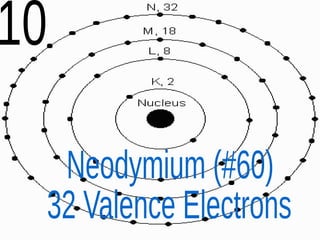
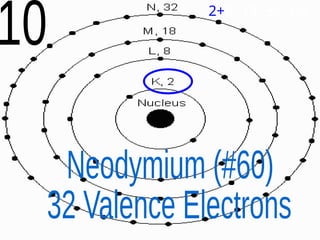
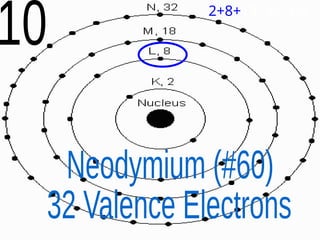
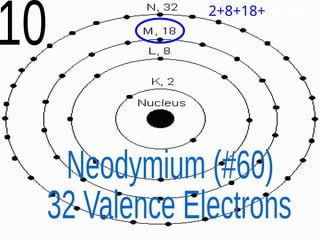
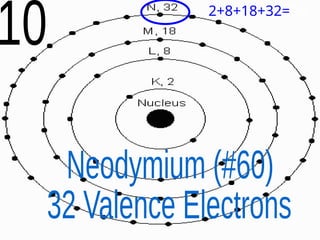
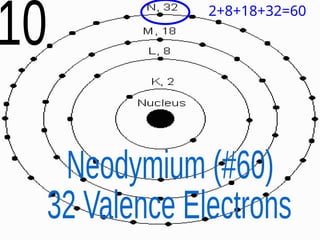
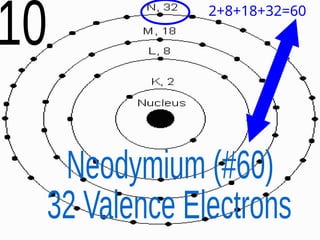
2+8+18+32=60
2+8+18+32=60
2+8+18+32=60
2+8+18+32=60
2+8+18+32=60
2+8+18+32=60
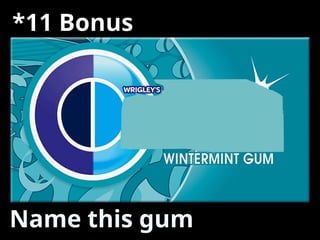
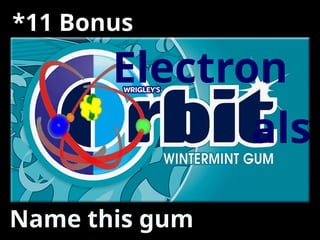
*11 Bonus
Name this gum
*11 Bonus
Name this gum
*11 Bonus
Name this gum
als
Electron
• Try and be the first to name the picture
hidden beneath the boxes?
– Raise your hand when you think you know. You
only get one guess.
– These two box games are work bonus points on
the balancing chemical equations sheet.
Copyright © 2024 SlideSpark .LLC
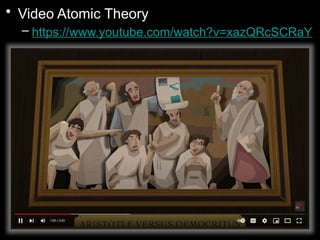
• Video Atomic Theory
– https://www.youtube.com/watch?v=xazQRcSCRaY
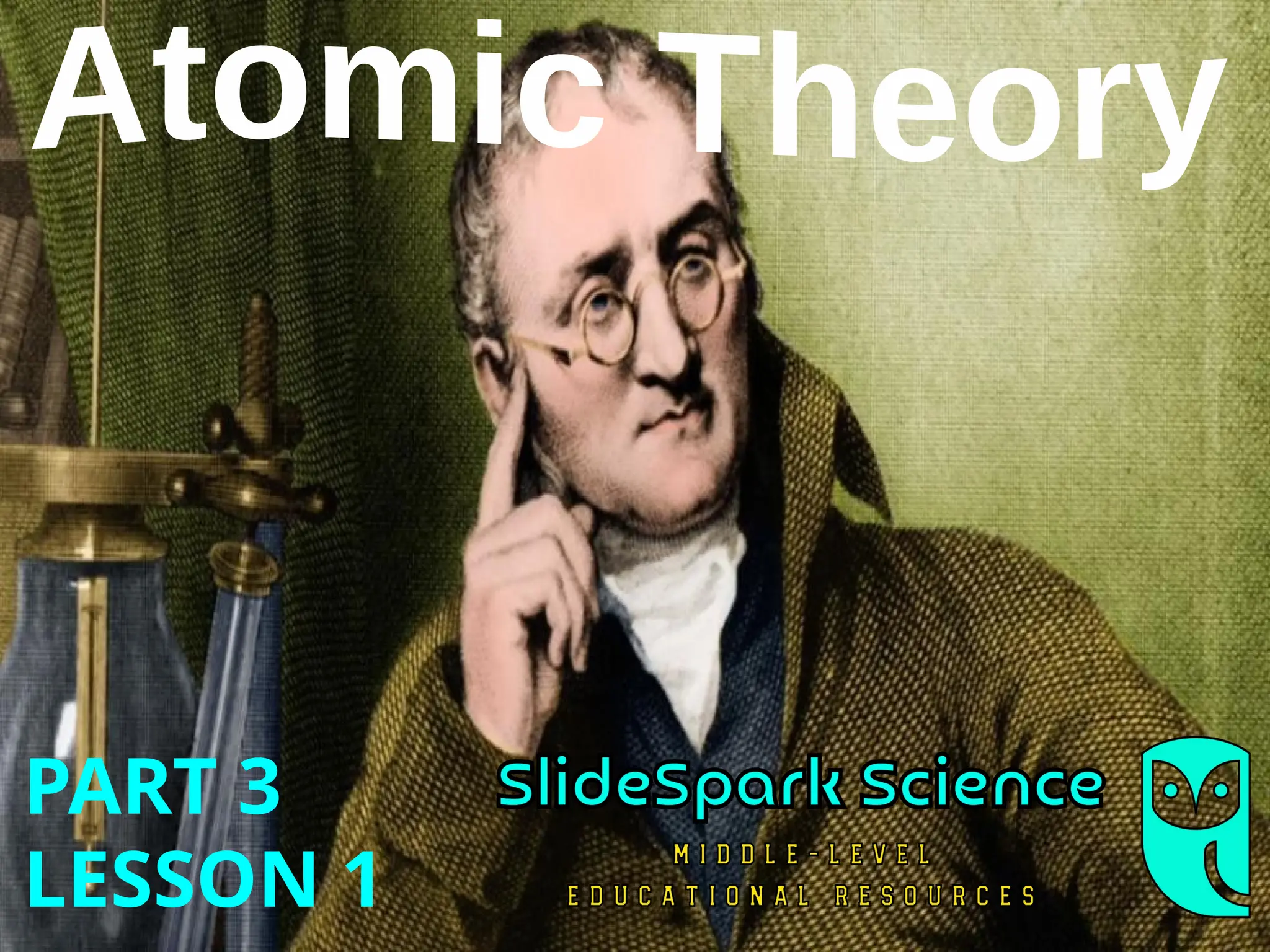
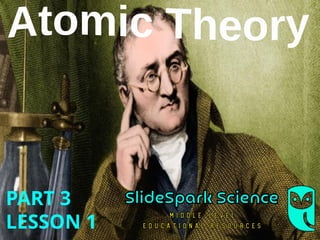
PART 3
LESSON 1

Atomic Theory Lesson from SlideSpark Science

  • 1.
  • 2.
    • Red Slides:Please record the important terms in your work bundle. Copyright © 2024 SlideSpark .LLC First and last Name Science, Grade, Class
  • 3.
    • Red Slides:Please record the important terms in your work bundle. – You’ll need these notes to complete the work bundle Copyright © 2024 SlideSpark .LLC First and last Name Science, Grade, Class
  • 4.
    • Red Slides:Please record the important terms in your work bundle. – You’ll need these notes to complete the work bundle and to be successful on the review game. Copyright © 2024 SlideSpark .LLC First and last Name Science, Grade, Class
  • 5.
    Make Good Choices Listen to theteacher and others. Please no shout outs. One speaker at a time. Please raise your hand. First, Last, and Always. Focus on Task completion Avoid Distractions Stay Organized Help Others Never Give Up! Copyright © 2024 SlideSpark .LLC Science from Murf LLC
  • 6.
  • 7.
    John Dalton’s AtomicTheories -All matter is composed of _________?
  • 8.
    John Dalton’s AtomicTheories -All matter is composed of atoms.
  • 9.
    Atoms cannot becreated or ___________.
  • 10.
    Atoms cannot becreated or destroyed.
  • 11.
    Atoms cannot becreated or destroyed. We’ll discuss changes to The laws at the end
  • 12.
    All atoms ofthe same element are _______.
  • 13.
    All atoms ofthe same element are identical.
  • 14.
    All atoms ofthe same element are identical. ????????????
  • 15.
    All atoms ofthe same element are identical. Isotopes
  • 16.
    Different elements havedifferent types of ________.
  • 17.
    Different elements havedifferent types of atoms.
  • 18.
    Chemical reactions occurwhen atoms are __________.
  • 19.
    Chemical reactions occurwhen atoms are rearranged.
  • 20.
    Compounds are formedfrom atoms of the _________.
  • 21.
    Compounds are formedfrom atoms of the elements.
  • 24.
    Compounds are formedfrom atoms of the elements.
  • 25.
    • Which isnot one of John Daltons Atomic Theories? A.) All matter is composed of atoms. B.) Atoms cannot be made or destroyed. C.) All atoms of the same element are identical. D.) Different elements have the same type of atoms. E.) Chemical reactions occur when atoms are rearranged. F.) Compounds are formed from atoms of the constituent elements. Copyright © 2024 SlideSpark .LLC
  • 26.
    • Which isnot one of John Daltons Atomic Theories? A.) All matter is composed of atoms. B.) Atoms cannot be made or destroyed. C.) All atoms of the same element are identical. D.) Different elements have the same type of atoms. E.) Chemical reactions occur when atoms are rearranged. F.) Compounds are formed from atoms of the constituent elements. Copyright © 2024 SlideSpark .LLC
  • 27.
    • Which isnot one of John Daltons Atomic Theories? A.) All matter is composed of atoms. B.) Atoms cannot be made or destroyed. C.) All atoms of the same element are identical. D.) Different elements have different types of atoms. E.) Chemical reactions occur when atoms are rearranged. F.) Compounds are formed from atoms of the constituent elements. Copyright © 2024 SlideSpark .LLC
  • 28.
  • 29.
    • Which isnot one of John Daltons Atomic Theories? A.) All matter is composed of atoms. B.) Atoms cannot be made or destroyed. C.) All atoms of the same element are different. D.) Different elements have different types of atoms. E.) Chemical reactions occur when atoms are rearranged. F.) Compounds are formed from atoms of the constituent elements. Copyright © 2024 SlideSpark .LLC
  • 30.
    • Which isnot one of John Daltons Atomic Theories? A.) All matter is composed of atoms. B.) Atoms cannot be made or destroyed. C.) All atoms of the same element are different. D.) Different elements have different types of atoms. E.) Chemical reactions occur when atoms are rearranged. F.) Compounds are formed from atoms of the constituent elements. Copyright © 2024 SlideSpark .LLC
  • 31.
    • Which isnot one of John Daltons Atomic Theories? A.) All matter is composed of atoms. B.) Atoms cannot be made or destroyed. C.) All atoms of the same element are identical. D.) Different elements have different types of atoms. E.) Chemical reactions occur when atoms are rearranged. F.) Compounds are formed from atoms of the constituent elements. Copyright © 2024 SlideSpark .LLC
  • 32.
    “I was oneof the first people to document color blindness.” Learn more: http://www.biography.com /people/john-dalton-92652 01
  • 34.
    Dalton’s Atomic theory.The general tenets of this theory were as follows:
  • 35.
    Dalton’s Atomic theory.The general tenets of this theory were as follows: •All matter is composed of extremely small particles called atoms.
  • 36.
    Dalton’s Atomic theory.The general tenets of this theory were as follows: •All matter is composed of extremely small particles called atoms. •Atoms of a given element are identical in size, mass, and other properties. Atoms of different elements differ in size, mass, and other properties.
  • 37.
    Dalton’s Atomic theory.The general tenets of this theory were as follows: •All matter is composed of extremely small particles called atoms. •Atoms of a given element are identical in size, mass, and other properties. Atoms of different elements differ in size, mass, and other properties. •Atoms cannot be subdivided, created, or destroyed.
  • 38.
    Dalton’s Atomic theory.The general tenets of this theory were as follows: •All matter is composed of extremely small particles called atoms. •Atoms of a given element are identical in size, mass, and other properties. Atoms of different elements differ in size, mass, and other properties. •Atoms cannot be subdivided, created, or destroyed. •Atoms of different elements can combine in simple whole number ratios to form chemical compounds.
  • 39.
    Dalton’s Atomic theory.The general tenets of this theory were as follows: •All matter is composed of extremely small particles called atoms. •Atoms of a given element are identical in size, mass, and other properties. Atoms of different elements differ in size, mass, and other properties. •Atoms cannot be subdivided, created, or destroyed. •Atoms of different elements can combine in simple whole number ratios to form chemical compounds. •In chemical reactions, atoms
  • 40.
    Dalton’s Atomic theory.The general tenets of this theory were as follows: •All matter is composed of extremely small particles called atoms. •Atoms of a given element are identical in size, mass, and other properties. Atoms of different elements differ in size, mass, and other properties. •Atoms cannot be subdivided, created, or destroyed. •Atoms of different elements can combine in simple whole number ratios to form chemical compounds. •In chemical reactions, atoms Three changes. We know now that (1) an atom can be further sub-divided, (2) all atoms of an element are not identical in mass (Isotopes), and (3) using nuclear fission and fusion techniques, we can create or destroy atoms by changing them into
  • 41.
    Atomic Mass =AMU Atomic Mass Units, The number of protons, neutrons, and electrons. Copyright © 2024 SlideSpark .LLC
  • 42.
    • Review! Tofind # of protons and electrons Copyright © 2024 SlideSpark .LLC
  • 43.
    • Review! Tofind # of protons and electrons – It is the atomic number, or count the P+ or E-. Copyright © 2024 SlideSpark .LLC
  • 44.
    • Review! Tofind # of protons and electrons – It is the atomic number, or count the P+ or E-. Copyright © 2024 SlideSpark .LLC
  • 45.
    • Review! Tofind # of protons and electrons – It is the atomic number, or count the P+ or E-. Copyright © 2024 SlideSpark .LLC An atom can gain or lose electrons, becoming what is known as an ion. An ion is nothing more than an electrically charged atom. Adding or removing electrons from an atom does not change which element it is, just its net charge.
  • 46.
    • Review! Tofind # of protons and electrons – It is the atomic number. – What is this atoms Atomic number? Copyright © 2024 SlideSpark .LLC
  • 47.
    • Answer! Copyright ©2024 SlideSpark .LLC
  • 48.
    • Answer! Countthe 11 Protons or 11 Electrons Copyright © 2024 SlideSpark .LLC
  • 49.
    • Answer! AtomicNumber 11. – What element is #11 Copyright © 2024 SlideSpark .LLC
  • 50.
    • Answer! AtomicNumber 11. – What element is #11 Sodium Copyright © 2024 SlideSpark .LLC
  • 51.
    • Review! Tofind # of neutrons Copyright © 2024 SlideSpark .LLC
  • 52.
    • Review! Tofind # of neutrons – Subtract the atomic number from the atomic mass to determine the difference. Copyright © 2024 SlideSpark .LLC
  • 53.
    • Review! Tofind # of neutrons – Subtract the atomic number from the atomic mass to determine the difference. – How many neutrons does Lithium have? Copyright © 2024 SlideSpark .LLC
  • 54.
    • Review! Tofind # of neutrons – Subtract the atomic number from the atomic mass to determine the difference. – How many neutrons does Lithium have? Atomic Mass Copyright © 2024 SlideSpark .LLC
  • 55.
    • Review! Tofind # of neutrons – Subtract the atomic number from the atomic mass to determine the difference. – How many neutrons does Lithium have? Atomic Mass Atomic Number Copyright © 2024 SlideSpark .LLC
  • 56.
    • Review! Tofind # of neutrons – Subtract the atomic number from the atomic mass to determine the difference. – How many neutrons does Lithium have? Atomic Mass Atomic Number 6.94 amu – 3 = Copyright © 2024 SlideSpark .LLC
  • 57.
    • Answer! 6.94– 3 = 3.94 Atomic Mass Atomic Number 6.94 amu – 3 = Copyright © 2024 SlideSpark .LLC
  • 58.
    • Answer! 6.94– 3 = 3.94 or 4 neutrons Atomic Mass Atomic Number 6.94 amu – 3 = Copyright © 2024 SlideSpark .LLC
  • 59.
    New Area ofFocus: Electron Orbitals Copyright © 2024 SlideSpark .LLC
  • 60.
    • Niels Bohr(1915): Student to Ernest Rutherford. – The Bohr model is a simplified picture of an atom. We will spend a lot of time learning this, and then…. – The correct theory of the atom… • (Quantum Mechanics) • More Difficult
  • 61.
    • Niels Bohr(1915): Student to Ernest Rutherford. – The Bohr model is a simplified picture of an atom. We will spend a lot of time learning this, and then…. – The correct theory of the atom… • (Quantum Mechanics) • More Difficult Learn more http://chemed.chem.p urdue.edu/genchem/h istory/bohr.html “Hey, I suggested the idea that electrons move from one energy level to another in large steps.”.- Quantum…. Learn more: http://en.wikipedia.org/ wiki/Niels_Bohr
  • 62.
    • Video Link!Electron Orbitals – http://www.youtube.com/watch?v=rNM21emkMJo
  • 63.
    Valence electrons: Electronsin the outer most shell. Copyright © 2024 SlideSpark .LLC
  • 64.
    Valence electrons: Electronsin the outer most shell. Copyright © 2024 SlideSpark .LLC How many valence electrons?
  • 65.
    Valence electrons: Electronsin the outer most shell. Copyright © 2024 SlideSpark .LLC
  • 66.
    Valence electrons: Electronsin the outer most shell. Copyright © 2024 SlideSpark .LLC 1
  • 67.
    Valence electrons: Electronsin the outer most shell. Copyright © 2024 SlideSpark .LLC 1
  • 68.
    Valence electrons: Electronsin the outer most shell. Copyright © 2024 SlideSpark .LLC 1 2
  • 69.
    Valence electrons: Electronsin the outer most shell. Copyright © 2024 SlideSpark .LLC 1 2
  • 70.
    Valence electrons: Electronsin the outer most shell. Copyright © 2024 SlideSpark .LLC 1 2 1
  • 71.
    Valence electrons: Electronsin the outer most shell. Copyright © 2024 SlideSpark .LLC 1 2 1
  • 72.
    Valence electrons: Electronsin the outer most shell. Copyright © 2024 SlideSpark .LLC 1 2 1 4
  • 73.
    Valence electrons: Electronsin the outer most shell. Copyright © 2024 SlideSpark .LLC 1 2 1 4
  • 74.
    Valence electrons: Electronsin the outer most shell. Copyright © 2024 SlideSpark .LLC 1 2 1 4 5
  • 75.
    Valence electrons: Electronsin the outer most shell. Copyright © 2024 SlideSpark .LLC 1 2 1 4 5
  • 76.
    Valence electrons: Electronsin the outer most shell. Copyright © 2024 SlideSpark .LLC 1 2 1 4 5 1
  • 77.
    Valence electrons: Electronsin the outer most shell. Copyright © 2024 SlideSpark .LLC 1 2 1 4 5 1 Total Electrons
  • 78.
    Valence electrons: Electronsin the outer most shell. Copyright © 2024 SlideSpark .LLC 1 2 1 4 5 1 Total Electrons
  • 79.
    • Activity! QuizWiz: Name the atom based on the electron orbitals / atomic number. – Also tell me how many valence the atom has? Copyright © 2024 SlideSpark .LLC
  • 80.
    • Answers! QuizWiz: The answer will be given after each questions instead of at the end. Copyright © 2024 SlideSpark .LLC We’ll just do out loud Please raise your hand
  • 101.
  • 102.
  • 103.
  • 104.
  • 105.
  • 106.
  • 107.
  • 108.
  • 109.
    *11 Bonus Name thisgum als Electron
  • 110.
    • Try andbe the first to name the picture hidden beneath the boxes? – Raise your hand when you think you know. You only get one guess. – These two box games are work bonus points on the balancing chemical equations sheet. Copyright © 2024 SlideSpark .LLC
  • 111.
    Copyright © 2024SlideSpark .LLC
  • 112.
    Copyright © 2024SlideSpark .LLC
  • 113.
    Copyright © 2024SlideSpark .LLC
  • 114.
    Copyright © 2024SlideSpark .LLC
  • 115.
    Copyright © 2024SlideSpark .LLC
  • 116.
    Copyright © 2024SlideSpark .LLC
  • 117.
    Copyright © 2024SlideSpark .LLC
  • 118.
    Copyright © 2024SlideSpark .LLC
  • 119.
    Copyright © 2024SlideSpark .LLC
  • 120.
    Copyright © 2024SlideSpark .LLC
  • 121.
    • Video AtomicTheory – https://www.youtube.com/watch?v=xazQRcSCRaY
  • 122.