Presentation on:
“Cephalopod mollusks are one of
the most successful group of
mollusks. Discuss this statement.”
W. GERARD OUEDRAOGO
INTODUCTION 2
 Phylum Mollusca
• Is the predominant phylum in marine environments (around 23%
of all known marine species & second largest Phylum with over
100,000 species living in marine, freshwater and terrestrial
environments).
• Mollusks share a few key characteristics, including a muscular
foot, a visceral mass containing internal organs, and a mantle that
may or may not secrete a shell of calcium carbonate
3
INTRODUCTION…
CEPHALOPODS…
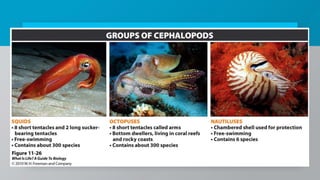
» One of the seven classes of Mollusca phylum.
» Cephalopods (“head foot” animals), include octopi, squids,
cuttlefishes, and nautiluses.
» About 17,000 named species of fossils (Endoceratoidea,
Bactritoidea…. Squid-like with external shell called orthocones)
» 800 living species - Octopus and common cuttlefish Sepia credited
each with more than 100 species.
4
CEPHALOPODS… 5
CEPHALOPODS… CHARACTERISTICS
» Exclusively marine and present in all of the world's oceans and
seas.
» Including shallow and deep-water octopuses, open-ocean
middle-water squids, etc.
» They are shell-bearing animals as well as mollusks with a
reduced shell. (Shell when exists is divided by septa).
6
CHARACTERISTICS…
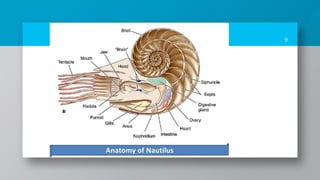
» Cephalopods have beak-like jaws at the anterior end and
are carnivorous predators .
» They are characteristically large, active, with complex
behavioral and physiological capabilities
» Present bilateral body symmetry, a prominent head, and a
set of arms (8, 10, 90) or tentacles (muscular hydrostats)
modified from the primitive molluscan foot.
7
CEPHALOPODS
CHARACTERISTICS
» All cephalopods show the presence of a very well-developed
nervous system along with eyes, as well as a closed circulatory
system. They are highly advanced and organized.
» The uniting of the major ganglionic centers of the central nervous
system constitutes a brain of considerable complexity
8
9
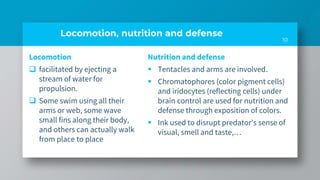
Locomotion, nutrition and defense
Locomotion
 facilitated by ejecting a
stream of water for
propulsion.
 Some swim using all their
arms or web, some wave
small fins along their body,
and others can actually walk
from place to place
Nutrition and defense
 Tentacles and arms are involved.
 Chromatophores (color pigment cells)
and iridocytes (reflecting cells) under
brain control are used for nutrition and
defense through exposition of colors.
 Ink used to disrupt predator’s sense of
visual, smell and taste,…
10
Reproduction & life cycle
 The sexes are usually separate in the Cephalopods.
 During courtship the male deposits spermatophores in the female,
either within the mantle cavity or on a pad below the mouth, by means
of a specially modified arm, the hectocotylus.
 All cephalopod eggs have a remarkable amount of yolk, unlike that in
the rest of the Mollusca. Development of the embryo is direct, without
the distinctive larval stages and metamorphoses that occur in other
mollusks.
 Growth is very rapid (exponential and logarithmic phases) and adult
size is reached in about a year (6–24 months)
11
12
1. P. Boyle, (2001) Cephalopods-
Encyclopedia of Ocean Sciences
(Second Edition). Retrieved October 23,
2020 from
https://www.sciencedirect.com/topics/a
gricultural-and-biological-
sciences/cephalopoda.
2. Facts: The Nautilus. Retrieved October
23, 2020 from
https://www.youtube.com/watch?v=nRC
qD5vdUJs.
3. why octopus have three hearts: The
biology behind the octopus anatomy.
Retried October 30, 2020 from
https://www.youtube.com/watch?v=BIQ
FblffD9w

Presentation on cephalopods 1

  • 1.
    Presentation on: “Cephalopod mollusksare one of the most successful group of mollusks. Discuss this statement.” W. GERARD OUEDRAOGO
  • 2.
    INTODUCTION 2  PhylumMollusca • Is the predominant phylum in marine environments (around 23% of all known marine species & second largest Phylum with over 100,000 species living in marine, freshwater and terrestrial environments). • Mollusks share a few key characteristics, including a muscular foot, a visceral mass containing internal organs, and a mantle that may or may not secrete a shell of calcium carbonate
  • 3.
  • 4.
    CEPHALOPODS… » One ofthe seven classes of Mollusca phylum. » Cephalopods (“head foot” animals), include octopi, squids, cuttlefishes, and nautiluses. » About 17,000 named species of fossils (Endoceratoidea, Bactritoidea…. Squid-like with external shell called orthocones) » 800 living species - Octopus and common cuttlefish Sepia credited each with more than 100 species. 4
  • 5.
  • 6.
    CEPHALOPODS… CHARACTERISTICS » Exclusivelymarine and present in all of the world's oceans and seas. » Including shallow and deep-water octopuses, open-ocean middle-water squids, etc. » They are shell-bearing animals as well as mollusks with a reduced shell. (Shell when exists is divided by septa). 6
  • 7.
    CHARACTERISTICS… » Cephalopods havebeak-like jaws at the anterior end and are carnivorous predators . » They are characteristically large, active, with complex behavioral and physiological capabilities » Present bilateral body symmetry, a prominent head, and a set of arms (8, 10, 90) or tentacles (muscular hydrostats) modified from the primitive molluscan foot. 7
  • 8.
    CEPHALOPODS CHARACTERISTICS » All cephalopodsshow the presence of a very well-developed nervous system along with eyes, as well as a closed circulatory system. They are highly advanced and organized. » The uniting of the major ganglionic centers of the central nervous system constitutes a brain of considerable complexity 8
  • 9.
  • 10.
    Locomotion, nutrition anddefense Locomotion  facilitated by ejecting a stream of water for propulsion.  Some swim using all their arms or web, some wave small fins along their body, and others can actually walk from place to place Nutrition and defense  Tentacles and arms are involved.  Chromatophores (color pigment cells) and iridocytes (reflecting cells) under brain control are used for nutrition and defense through exposition of colors.  Ink used to disrupt predator’s sense of visual, smell and taste,… 10
  • 11.
    Reproduction & lifecycle  The sexes are usually separate in the Cephalopods.  During courtship the male deposits spermatophores in the female, either within the mantle cavity or on a pad below the mouth, by means of a specially modified arm, the hectocotylus.  All cephalopod eggs have a remarkable amount of yolk, unlike that in the rest of the Mollusca. Development of the embryo is direct, without the distinctive larval stages and metamorphoses that occur in other mollusks.  Growth is very rapid (exponential and logarithmic phases) and adult size is reached in about a year (6–24 months) 11
  • 12.
    12 1. P. Boyle,(2001) Cephalopods- Encyclopedia of Ocean Sciences (Second Edition). Retrieved October 23, 2020 from https://www.sciencedirect.com/topics/a gricultural-and-biological- sciences/cephalopoda. 2. Facts: The Nautilus. Retrieved October 23, 2020 from https://www.youtube.com/watch?v=nRC qD5vdUJs. 3. why octopus have three hearts: The biology behind the octopus anatomy. Retried October 30, 2020 from https://www.youtube.com/watch?v=BIQ FblffD9w