DIJKSTRA'S ALGORITHM,
BY
DR HJH RAHMAH BT MURSHIDI
INTRODUCTION
 Dijkstra's algorithm, named after its
discoverer, Dutch computer scientist Edsger
Dijkstra
 A greedy algorithm that solves the single-source
shortest path problem for a directed graph with
non negative edge weights.
INTRODUCTION
 For example, if the vertices of the graph
represent cities and edge weights represent
driving distances between pairs of cities
connected by a direct road, Dijkstra's algorithm
can be used to find the shortest route between
two cities.
 The input of the algorithm consists of a weighted
directed graph G and a source vertex s in G
 Denote V as the set of all vertices in the graph G.
 Each edge of the graph is an ordered pair of
vertices (u,v)
 This representings a connection from vertex u to
vertex v
 The set of all edges is denoted E
 Weights of edges are given by a weight function
w: E → [0, ∞)
 Therefore w(u,v) is the cost of moving directly
from vertex u to vertex v
 The cost of an edge can be thought of as (a
generalization of) the distance between those
two vertices
 The cost of a path between two vertices is the
sum of costs of the edges in that path
 For a given pair of vertices s and t in V, the
algorithm finds the path from s to t with lowest
cost (i.e. the shortest path)
 It can also be used for finding costs of shortest
paths from a single vertex s to all other vertices
in the graph.
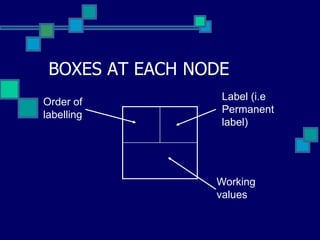
BOXES AT EACH NODE
Order of
labelling
Label (i.e
Permanent
label)
Working
values
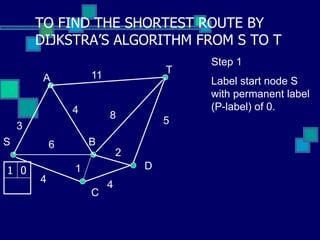
TO FIND THE SHORTEST ROUTE BY
DIJKSTRA’S ALGORITHM FROM S TO T
S
A
B
T
D
C
3
11
5
8
6
4
1
2
4
Step 1
Label start node S
with permanent label
(P-label) of 0.
1 0
4
TO FIND THE SHORTEST ROUTE BY
DIJKSTRA’S ALGORITHM
4
3
1 0
S
A
B
T
D
C
3
11
5
8
6
4
1
2
4
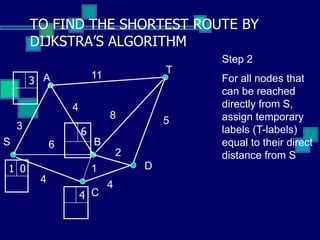
Step 2
For all nodes that
can be reached
directly from S,
assign temporary
labels (T-labels)
equal to their direct
distance from S
6
4
TO FIND THE SHORTEST ROUTE BY
DIJKSTRA’S ALGORITHM
4
2 3
1 0
S
A
B
T
D
C
3
11
5
8
6
4
1
2
4
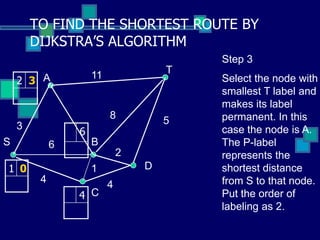
Step 3
Select the node with
smallest T label and
makes its label
permanent. In this
case the node is A.
The P-label
represents the
shortest distance
from S to that node.
Put the order of
labeling as 2.
6
TO FIND THE SHORTEST ROUTE BY
DIJKSTRA’S ALGORITHM
4
2 3
1 0
S
A
B
T
D
C
3
11
5
8
6
4
1
2
4
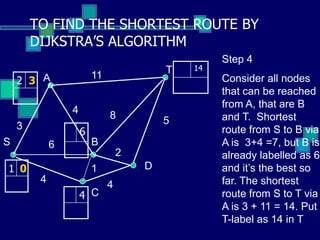
Step 4
Consider all nodes
that can be reached
from A, that are B
and T. Shortest
route from S to B via
A is 3+4 =7, but B is
already labelled as 6
and it’s the best so
far. The shortest
route from S to T via
A is 3 + 11 = 14. Put
T-label as 14 in T
6
4
14
TO FIND THE SHORTEST ROUTE BY
DIJKSTRA’S ALGORITHM
3 4
2 3
1 0
S
A
B
T
D
C
3
11
5
8
6
4
1
2
4
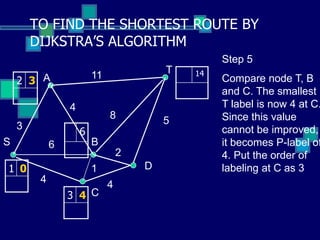
Step 5
Compare node T, B
and C. The smallest
T label is now 4 at C.
Since this value
cannot be improved,
it becomes P-label of
4. Put the order of
labeling at C as 3
6
4
14
TO FIND THE SHORTEST ROUTE BY
DIJKSTRA’S ALGORITHM
3 4
2 3
1 0
S
A
B
T
D
C
3
11
5
8
6
4
1
2
4
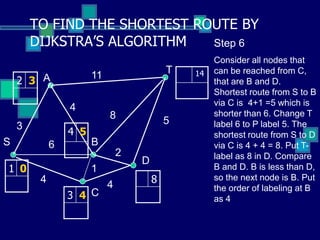
Step 6
Consider all nodes that
can be reached from C,
that are B and D.
Shortest route from S to B
via C is 4+1 =5 which is
shorter than 6. Change T
label 6 to P label 5. The
shortest route from S to D
via C is 4 + 4 = 8. Put T-
label as 8 in D. Compare
B and D. B is less than D,
so the next node is B. Put
the order of labeling at B
as 4
4 5
4
14
8
TO FIND THE SHORTEST ROUTE BY
DIJKSTRA’S ALGORITHM
3 4
4
2 3
3
1 0
S
A
B
T
D
C
3
11
5
8
6
4
1
2
4
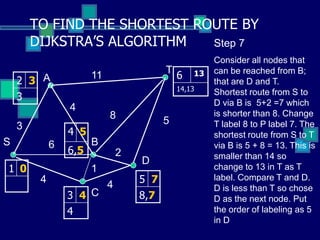
Step 7
Consider all nodes that
can be reached from B;
that are D and T.
Shortest route from S to
D via B is 5+2 =7 which
is shorter than 8. Change
T label 8 to P label 7. The
shortest route from S to T
via B is 5 + 8 = 13. This is
smaller than 14 so
change to 13 in T as T
label. Compare T and D.
D is less than T so chose
D as the next node. Put
the order of labeling as 5
in D
4 5
6,5
4
6 13
14,13
5 7
8,7
TO FIND THE SHORTEST ROUTE BY
DIJKSTRA’S ALGORITHM
3 4
4
2 3
3
1 0
S
A
B
T
D
C
3
11
5
8
6
4
1
2
4
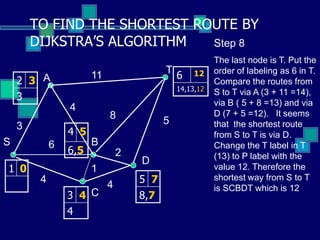
Step 8
The last node is T. Put the
order of labeling as 6 in T.
Compare the routes from
S to T via A (3 + 11 =14),
via B ( 5 + 8 =13) and via
D (7 + 5 =12). It seems
that the shortest route
from S to T is via D.
Change the T label in T
(13) to P label with the
value 12. Therefore the
shortest way from S to T
is SCBDT which is 12
4 5
6,5
4
6 12
14,13,12
5 7
8,7

Networks dijkstra's algorithm- pgsr

  • 1.
  • 2.
    INTRODUCTION  Dijkstra's algorithm,named after its discoverer, Dutch computer scientist Edsger Dijkstra  A greedy algorithm that solves the single-source shortest path problem for a directed graph with non negative edge weights.
  • 3.
    INTRODUCTION  For example,if the vertices of the graph represent cities and edge weights represent driving distances between pairs of cities connected by a direct road, Dijkstra's algorithm can be used to find the shortest route between two cities.
  • 4.
     The inputof the algorithm consists of a weighted directed graph G and a source vertex s in G  Denote V as the set of all vertices in the graph G.  Each edge of the graph is an ordered pair of vertices (u,v)  This representings a connection from vertex u to vertex v
  • 5.
     The setof all edges is denoted E  Weights of edges are given by a weight function w: E → [0, ∞)  Therefore w(u,v) is the cost of moving directly from vertex u to vertex v  The cost of an edge can be thought of as (a generalization of) the distance between those two vertices
  • 6.
     The costof a path between two vertices is the sum of costs of the edges in that path  For a given pair of vertices s and t in V, the algorithm finds the path from s to t with lowest cost (i.e. the shortest path)  It can also be used for finding costs of shortest paths from a single vertex s to all other vertices in the graph.
  • 7.
    BOXES AT EACHNODE Order of labelling Label (i.e Permanent label) Working values
  • 8.
    TO FIND THESHORTEST ROUTE BY DIJKSTRA’S ALGORITHM FROM S TO T S A B T D C 3 11 5 8 6 4 1 2 4 Step 1 Label start node S with permanent label (P-label) of 0. 1 0 4
  • 9.
    TO FIND THESHORTEST ROUTE BY DIJKSTRA’S ALGORITHM 4 3 1 0 S A B T D C 3 11 5 8 6 4 1 2 4 Step 2 For all nodes that can be reached directly from S, assign temporary labels (T-labels) equal to their direct distance from S 6 4
  • 10.
    TO FIND THESHORTEST ROUTE BY DIJKSTRA’S ALGORITHM 4 2 3 1 0 S A B T D C 3 11 5 8 6 4 1 2 4 Step 3 Select the node with smallest T label and makes its label permanent. In this case the node is A. The P-label represents the shortest distance from S to that node. Put the order of labeling as 2. 6
  • 11.
    TO FIND THESHORTEST ROUTE BY DIJKSTRA’S ALGORITHM 4 2 3 1 0 S A B T D C 3 11 5 8 6 4 1 2 4 Step 4 Consider all nodes that can be reached from A, that are B and T. Shortest route from S to B via A is 3+4 =7, but B is already labelled as 6 and it’s the best so far. The shortest route from S to T via A is 3 + 11 = 14. Put T-label as 14 in T 6 4 14
  • 12.
    TO FIND THESHORTEST ROUTE BY DIJKSTRA’S ALGORITHM 3 4 2 3 1 0 S A B T D C 3 11 5 8 6 4 1 2 4 Step 5 Compare node T, B and C. The smallest T label is now 4 at C. Since this value cannot be improved, it becomes P-label of 4. Put the order of labeling at C as 3 6 4 14
  • 13.
    TO FIND THESHORTEST ROUTE BY DIJKSTRA’S ALGORITHM 3 4 2 3 1 0 S A B T D C 3 11 5 8 6 4 1 2 4 Step 6 Consider all nodes that can be reached from C, that are B and D. Shortest route from S to B via C is 4+1 =5 which is shorter than 6. Change T label 6 to P label 5. The shortest route from S to D via C is 4 + 4 = 8. Put T- label as 8 in D. Compare B and D. B is less than D, so the next node is B. Put the order of labeling at B as 4 4 5 4 14 8
  • 14.
    TO FIND THESHORTEST ROUTE BY DIJKSTRA’S ALGORITHM 3 4 4 2 3 3 1 0 S A B T D C 3 11 5 8 6 4 1 2 4 Step 7 Consider all nodes that can be reached from B; that are D and T. Shortest route from S to D via B is 5+2 =7 which is shorter than 8. Change T label 8 to P label 7. The shortest route from S to T via B is 5 + 8 = 13. This is smaller than 14 so change to 13 in T as T label. Compare T and D. D is less than T so chose D as the next node. Put the order of labeling as 5 in D 4 5 6,5 4 6 13 14,13 5 7 8,7
  • 15.
    TO FIND THESHORTEST ROUTE BY DIJKSTRA’S ALGORITHM 3 4 4 2 3 3 1 0 S A B T D C 3 11 5 8 6 4 1 2 4 Step 8 The last node is T. Put the order of labeling as 6 in T. Compare the routes from S to T via A (3 + 11 =14), via B ( 5 + 8 =13) and via D (7 + 5 =12). It seems that the shortest route from S to T is via D. Change the T label in T (13) to P label with the value 12. Therefore the shortest way from S to T is SCBDT which is 12 4 5 6,5 4 6 12 14,13,12 5 7 8,7