Bellman-Ford Algorithm
Abdulaziz Awwad Aljuaid
44108981
Supervised by
Dr. MD Masoud
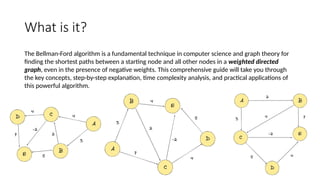
What is it?
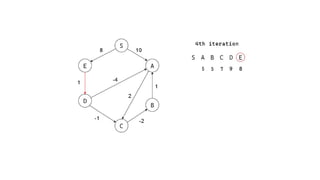
The Bellman-Ford algorithm is a fundamental technique in computer science and graph theory for
finding the shortest paths between a starting node and all other nodes in a weighted directed
graph, even in the presence of negative weights. This comprehensive guide will take you through
the key concepts, step-by-step explanation, time complexity analysis, and practical applications of
this powerful algorithm.
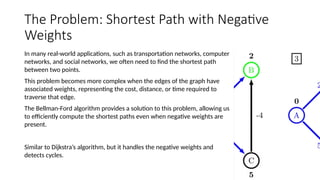
The Problem: Shortest Path with Negative
Weights
In many real-world applications, such as transportation networks, computer
networks, and social networks, we often need to find the shortest path
between two points.
This problem becomes more complex when the edges of the graph have
associated weights, representing the cost, distance, or time required to
traverse that edge.
The Bellman-Ford algorithm provides a solution to this problem, allowing us
to efficiently compute the shortest paths even when negative weights are
present.
Similar to Dijkstra’s algorithm, but it handles the negative weights and
detects cycles.
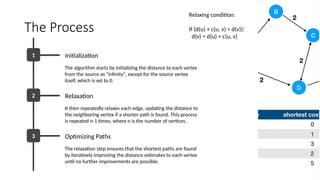
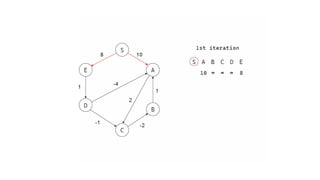
The Process
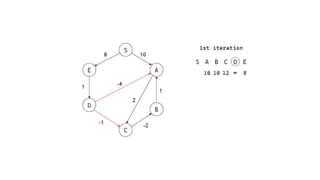
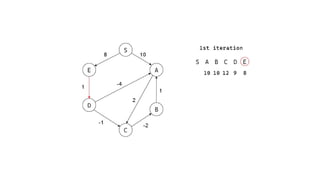
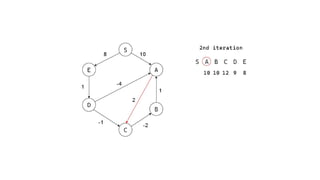
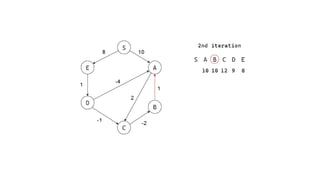
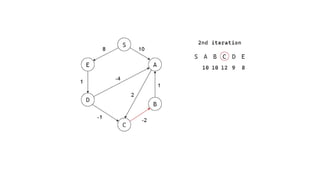
1 Initialization
The algorithm starts by initializing the distance to each vertex
from the source as "infinity", except for the source vertex
itself, which is set to 0.
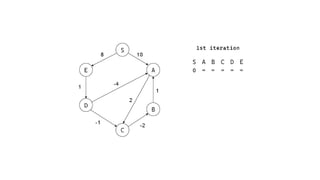
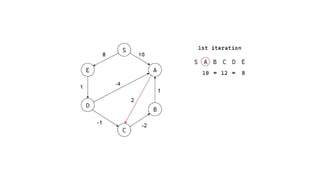
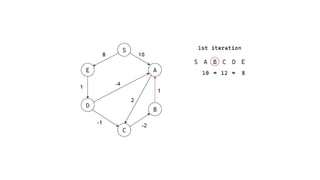
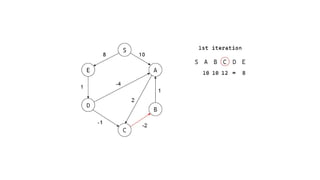
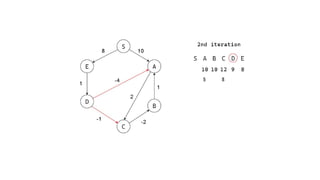
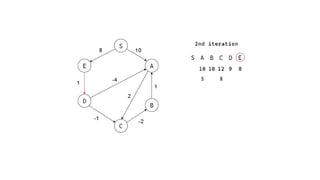
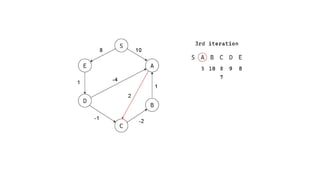
2 Relaxation
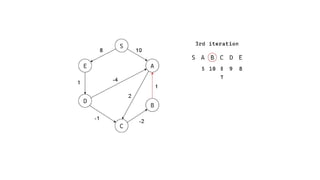
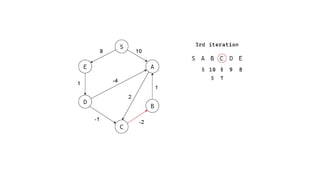
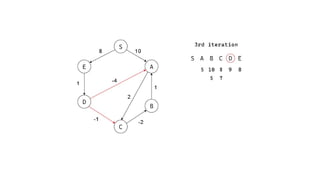
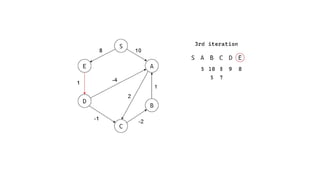
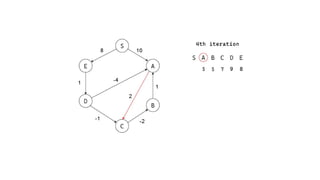
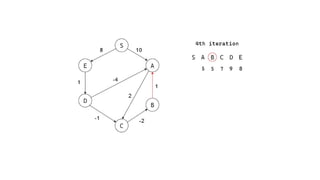
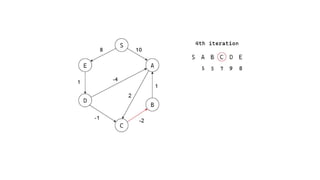
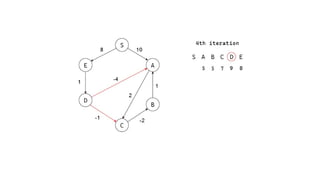
It then repeatedly relaxes each edge, updating the distance to
the neighboring vertex if a shorter path is found. This process
is repeated n-1 times, where n is the number of vertices.
3 Optimizing Paths
The relaxation step ensures that the shortest paths are found
by iteratively improving the distance estimates to each vertex
until no further improvements are possible.
Relaxing condition:
If (d(u) + c(u, v) < d(v)):
d(v) = d(u) + c(u, v)
Complexity
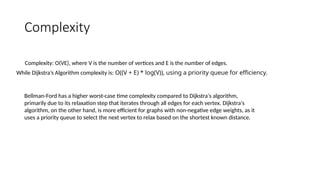
Complexity: O(VE), where V is the number of vertices and E is the number of edges.
While Dijkstra’s Algorithm complexity is: O((V + E) * log(V)), using a priority queue for efficiency.
Bellman-Ford has a higher worst-case time complexity compared to Dijkstra's algorithm,
primarily due to its relaxation step that iterates through all edges for each vertex. Dijkstra's
algorithm, on the other hand, is more efficient for graphs with non-negative edge weights, as it
uses a priority queue to select the next vertex to relax based on the shortest known distance.
Reference
• Bellman Ford Shortest Path Algorithm – Baeldung
• Dijkstra’s vs Bellman-Ford Algorithm
• Bellman Ford Algorithm | Shortest path & Negative cycles | Graph Theo
ry

Algorithms Analysis: Bellman-Ford Algorithm

  • 1.
    Bellman-Ford Algorithm Abdulaziz AwwadAljuaid 44108981 Supervised by Dr. MD Masoud
  • 2.
    What is it? TheBellman-Ford algorithm is a fundamental technique in computer science and graph theory for finding the shortest paths between a starting node and all other nodes in a weighted directed graph, even in the presence of negative weights. This comprehensive guide will take you through the key concepts, step-by-step explanation, time complexity analysis, and practical applications of this powerful algorithm.
  • 3.
    The Problem: ShortestPath with Negative Weights In many real-world applications, such as transportation networks, computer networks, and social networks, we often need to find the shortest path between two points. This problem becomes more complex when the edges of the graph have associated weights, representing the cost, distance, or time required to traverse that edge. The Bellman-Ford algorithm provides a solution to this problem, allowing us to efficiently compute the shortest paths even when negative weights are present. Similar to Dijkstra’s algorithm, but it handles the negative weights and detects cycles.
  • 4.
    The Process 1 Initialization Thealgorithm starts by initializing the distance to each vertex from the source as "infinity", except for the source vertex itself, which is set to 0. 2 Relaxation It then repeatedly relaxes each edge, updating the distance to the neighboring vertex if a shorter path is found. This process is repeated n-1 times, where n is the number of vertices. 3 Optimizing Paths The relaxation step ensures that the shortest paths are found by iteratively improving the distance estimates to each vertex until no further improvements are possible. Relaxing condition: If (d(u) + c(u, v) < d(v)): d(v) = d(u) + c(u, v)
  • 27.
    Complexity Complexity: O(VE), whereV is the number of vertices and E is the number of edges. While Dijkstra’s Algorithm complexity is: O((V + E) * log(V)), using a priority queue for efficiency. Bellman-Ford has a higher worst-case time complexity compared to Dijkstra's algorithm, primarily due to its relaxation step that iterates through all edges for each vertex. Dijkstra's algorithm, on the other hand, is more efficient for graphs with non-negative edge weights, as it uses a priority queue to select the next vertex to relax based on the shortest known distance.
  • 28.
    Reference • Bellman FordShortest Path Algorithm – Baeldung • Dijkstra’s vs Bellman-Ford Algorithm • Bellman Ford Algorithm | Shortest path & Negative cycles | Graph Theo ry