Behaviorism: A Learning
Theory
By: Samantha Pickering
Behaviorism Defined
 “a school of psychology that takes the
objective evidence of behavior (as
measured responses to stimuli) as the
only concern of its research and the
only basis of its theory without
reference to conscious experience”
Source: http://www.merriam-
webster.com/dictionary/behaviorism
Key Players in Behaviorism
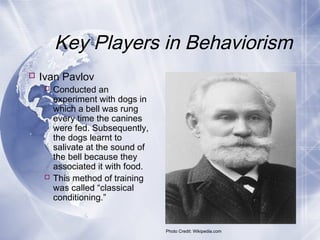
 Ivan Pavlov
 Conducted an
experiment with dogs in
which a bell was rung
every time the canines
were fed. Subsequently,
the dogs learnt to
salivate at the sound of
the bell because they
associated it with food.
 This method of training
was called “classical
conditioning.”
Photo Credit: Wikipedia.com
Key Players in Behaviorism
 B.F. Skinner
 Skinner is responsible for
the term “operant
conditioning.”
 Skinner heavily
emphasizes that positive
reinforcement is the most
effective way to
encourage a desirable
behavior.
 Negative reinforcement
will extinguish a behavior
Photo Credit: Wikipedia.com
Key Players in Behaviorism
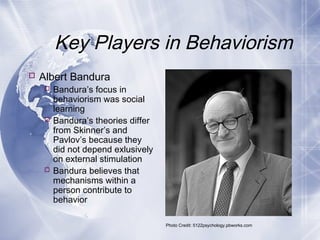
 Albert Bandura
 Bandura’s focus in
behaviorism was social
learning
 Bandura’s theories differ
from Skinner’s and
Pavlov’s because they
did not depend exlusively
on external stimulation
 Bandura believes that
mechanisms within a
person contribute to
behavior
Photo Credit: 5122psychology.pbworks.com
Reinforcement of a Behavior
Positive Reinforcement
Involves the increasing of a stimulus
Negative Reinforcement
Involves the decreasing of a stimulus
Punishment
Aims to decrease the chance of a behavior
occurring again
Can be positive or negative
Source: http://www.learning-
theories.com/behaviorism.html
Behaviorism in Education
Teachers can use behavior modification to
enhance their students’ learning experience
It is important to keep in mind that each child
is an individual, and may respond differently
to stimuli than his or her peers
Teachers should have a premeditated system
of reinforcements and punishments that are
applicable to their classExamples of Positive
and Negative Reinforcement
The Theory in Practice
Teachers should reward positive
behaviors, such as good attendance
and consistently maintaining good
conduct
Examples of rewards would be lunch
with the teacher, extra computer time,
or a class party (if the whole class is
being rewarded)
The Theory in Practice
Teachers should punish undesirable
behaviors
An example of positive punishment
would be assigning a student extra
work for not paying attention
An example of negative punishment
would be revoking a privilege from a
student, such as recess
The Theory in Practice
Teachers should punish undesirable
behaviors
An example of positive punishment
would be assigning a student extra
work for not paying attention
An example of negative punishment
would be revoking a privilege from a
student, such as recess

Behaviorism

  • 1.
  • 2.
    Behaviorism Defined  “aschool of psychology that takes the objective evidence of behavior (as measured responses to stimuli) as the only concern of its research and the only basis of its theory without reference to conscious experience” Source: http://www.merriam- webster.com/dictionary/behaviorism
  • 3.
    Key Players inBehaviorism  Ivan Pavlov  Conducted an experiment with dogs in which a bell was rung every time the canines were fed. Subsequently, the dogs learnt to salivate at the sound of the bell because they associated it with food.  This method of training was called “classical conditioning.” Photo Credit: Wikipedia.com
  • 4.
    Key Players inBehaviorism  B.F. Skinner  Skinner is responsible for the term “operant conditioning.”  Skinner heavily emphasizes that positive reinforcement is the most effective way to encourage a desirable behavior.  Negative reinforcement will extinguish a behavior Photo Credit: Wikipedia.com
  • 5.
    Key Players inBehaviorism  Albert Bandura  Bandura’s focus in behaviorism was social learning  Bandura’s theories differ from Skinner’s and Pavlov’s because they did not depend exlusively on external stimulation  Bandura believes that mechanisms within a person contribute to behavior Photo Credit: 5122psychology.pbworks.com
  • 6.
    Reinforcement of aBehavior Positive Reinforcement Involves the increasing of a stimulus Negative Reinforcement Involves the decreasing of a stimulus Punishment Aims to decrease the chance of a behavior occurring again Can be positive or negative Source: http://www.learning- theories.com/behaviorism.html
  • 7.
    Behaviorism in Education Teacherscan use behavior modification to enhance their students’ learning experience It is important to keep in mind that each child is an individual, and may respond differently to stimuli than his or her peers Teachers should have a premeditated system of reinforcements and punishments that are applicable to their classExamples of Positive and Negative Reinforcement
  • 8.
    The Theory inPractice Teachers should reward positive behaviors, such as good attendance and consistently maintaining good conduct Examples of rewards would be lunch with the teacher, extra computer time, or a class party (if the whole class is being rewarded)
  • 9.
    The Theory inPractice Teachers should punish undesirable behaviors An example of positive punishment would be assigning a student extra work for not paying attention An example of negative punishment would be revoking a privilege from a student, such as recess
  • 10.
    The Theory inPractice Teachers should punish undesirable behaviors An example of positive punishment would be assigning a student extra work for not paying attention An example of negative punishment would be revoking a privilege from a student, such as recess