Behaviorism Elisabeth Gordon
What is behaviorism? Behaviorism is a learning theory that only focuses on objectively observable behaviors and discounts any independent activities of the mind.  -http://www.funderstanding.com/content/behaviorism Behavior theorists define learning as nothing more than the acquisition of new behavior based on environmental conditions.  -http:// www.funderstanding.com/content/behaviorism Behaviorism is a worldview that operates on a principle of “stimulus-response”. All behavior is caused by external stimuli (operant conditioning). All behavior can be explained without the need to consider internal mental states or consciousness.  -http:// www.learning-theories.com/behaviorism.html
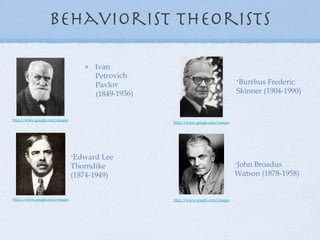
Behaviorist theorists Ivan Petrovich Pavlov (1849-1936)  Burrhus Frederic Skinner (1904-1990) Edward Lee Thorndike (1874-1949) John Broadus Watson (1878-1958) http://www.google.com/images http://www.google.com/images http://www.google.com/images http://www.google.com/images
Theorists contributions towards behaviorism Ivan Petrovich Pavlov (1849-1936):  Pioneer of the theory of “classical conditioning”. Burrhus Frederic Skinner (1904-1990):  Explorer of “operant conditioning”. Edward Lee Thorndike (1874-1949):  Developed the theory of “trial and error”. John Broadus Watson (1878-1958):  Built on Pavlov’s idea to maintain that the reflex was the basic unit of behavior.  - http://www.learningandteaching.info/learning/figures_behaviourism.htm
classroom implications Among the methods derived from the Behaviorist theory, most practical  educational implications include:   - contracts -consequences -reinforcement -extinction -behavior modification ... huh? -andres.myweb.uga.edu/PPT- behaviorism .ppt >  There are two different types of reinforcements used in the classroom due to behaviorism: positive and negative >  Positive reinforcement is presentation of a stimulus that increases the probability of a response. >  Negative reinforcement increases the probability of a response that removes or prevents an adverse condition.
for example: Behaviorism Implications Present in the Classroom: - Student Joe repeatedly yells out while raising his hand, anxious for the teacher to call on him. Positive Reinforcement: -The teacher calls on the students who are quietly raising their hand, positively reinforcing that if you raise your hand quietly you will be rewarded by being called on. Thus Joe learns in order to be called on he must raise his hand quietly. Negative Reinforcement: -The teacher yells across the room at Joe telling him not to scream while raising his hand, embarrassing the student in front of the class. Thus negatively reinforcing not to call out while raising his hand. Joe learned not to yell out again being negatively reinforced by getting embarrassed.
roles Teacher’s Role: -To either administer positive or negative reinforcement to students in order to guide them into correct and appropriate behavior. Student’s Role: -To react to positive or negative reinforcement administered, learning correct and appropriate behaviors.

Eme 2040 ppt learning theory

  • 1.
  • 2.
    What is behaviorism?Behaviorism is a learning theory that only focuses on objectively observable behaviors and discounts any independent activities of the mind. -http://www.funderstanding.com/content/behaviorism Behavior theorists define learning as nothing more than the acquisition of new behavior based on environmental conditions. -http:// www.funderstanding.com/content/behaviorism Behaviorism is a worldview that operates on a principle of “stimulus-response”. All behavior is caused by external stimuli (operant conditioning). All behavior can be explained without the need to consider internal mental states or consciousness. -http:// www.learning-theories.com/behaviorism.html
  • 3.
    Behaviorist theorists IvanPetrovich Pavlov (1849-1936) Burrhus Frederic Skinner (1904-1990) Edward Lee Thorndike (1874-1949) John Broadus Watson (1878-1958) http://www.google.com/images http://www.google.com/images http://www.google.com/images http://www.google.com/images
  • 4.
    Theorists contributions towardsbehaviorism Ivan Petrovich Pavlov (1849-1936): Pioneer of the theory of “classical conditioning”. Burrhus Frederic Skinner (1904-1990): Explorer of “operant conditioning”. Edward Lee Thorndike (1874-1949): Developed the theory of “trial and error”. John Broadus Watson (1878-1958): Built on Pavlov’s idea to maintain that the reflex was the basic unit of behavior. - http://www.learningandteaching.info/learning/figures_behaviourism.htm
  • 5.
    classroom implications Amongthe methods derived from the Behaviorist theory, most practical educational implications include: - contracts -consequences -reinforcement -extinction -behavior modification ... huh? -andres.myweb.uga.edu/PPT- behaviorism .ppt > There are two different types of reinforcements used in the classroom due to behaviorism: positive and negative > Positive reinforcement is presentation of a stimulus that increases the probability of a response. > Negative reinforcement increases the probability of a response that removes or prevents an adverse condition.
  • 6.
    for example: BehaviorismImplications Present in the Classroom: - Student Joe repeatedly yells out while raising his hand, anxious for the teacher to call on him. Positive Reinforcement: -The teacher calls on the students who are quietly raising their hand, positively reinforcing that if you raise your hand quietly you will be rewarded by being called on. Thus Joe learns in order to be called on he must raise his hand quietly. Negative Reinforcement: -The teacher yells across the room at Joe telling him not to scream while raising his hand, embarrassing the student in front of the class. Thus negatively reinforcing not to call out while raising his hand. Joe learned not to yell out again being negatively reinforced by getting embarrassed.
  • 7.
    roles Teacher’s Role:-To either administer positive or negative reinforcement to students in order to guide them into correct and appropriate behavior. Student’s Role: -To react to positive or negative reinforcement administered, learning correct and appropriate behaviors.