BEHAVIORISM
A Foundational Theory in Psychology
and Education
Miss Escalante
Introduction
• Definition: Behaviorism is a theory of learning which states that
all behaviors are acquired through conditioning.
• Key Proponents:
• Scope: Focuses on observable and measurable aspects of behavior.
Historical Background
• Early Origins: Established in the early 20th century
by John B. Watson.
• Influence of Ivan Pavlov: Pavlov’s work on classical
conditioning laid the foundation for behaviorism.
• B.F. Skinner's Contribution: Skinner expanded
behaviorism through his work on operant conditioning.
“Give me a dozen healthy infants, well-formed,
and my own special world to bring them up in and
I’ll guarantee to take any one at random and train
him to be any type of specialist I might select – a
doctor, a lawyer, artist, even a thief…”
-Watson 1924
Key Concepts of Behaviorism
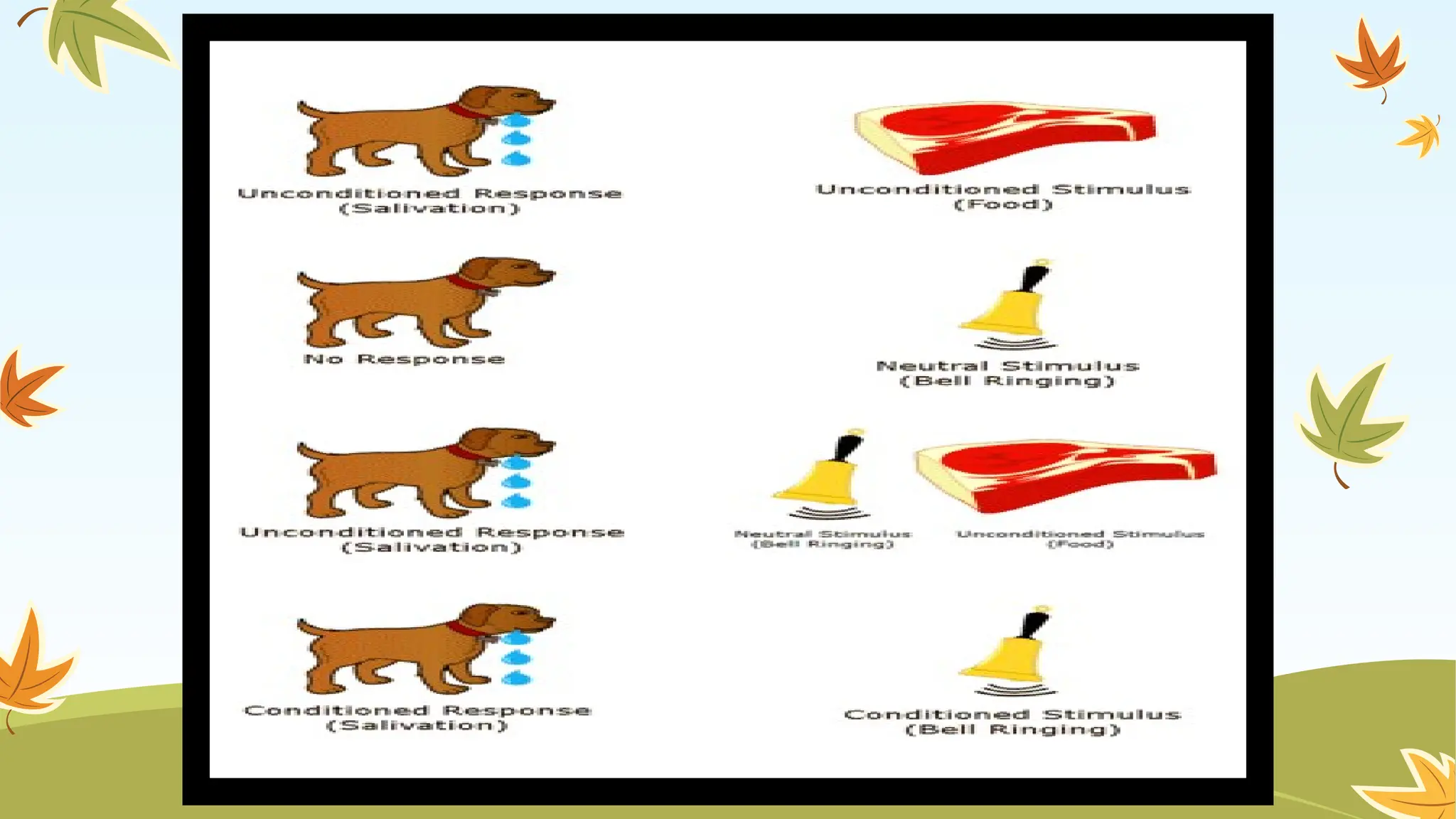
• Classical Conditioning (Pavlov):
- Learning occurs when a natural stimulus is paired
with a neutral stimulus, eventually eliciting a
conditioned response.
Example: Pavlov’s dogs salivating to the sound of a
bell.
• Operant Conditioning (Skinner):
- Behavior is shaped by reinforcement and
punishment.
- Positive reinforcement increases the likelihood of a
behavior; punishment decreases it.
Classical Conditioning
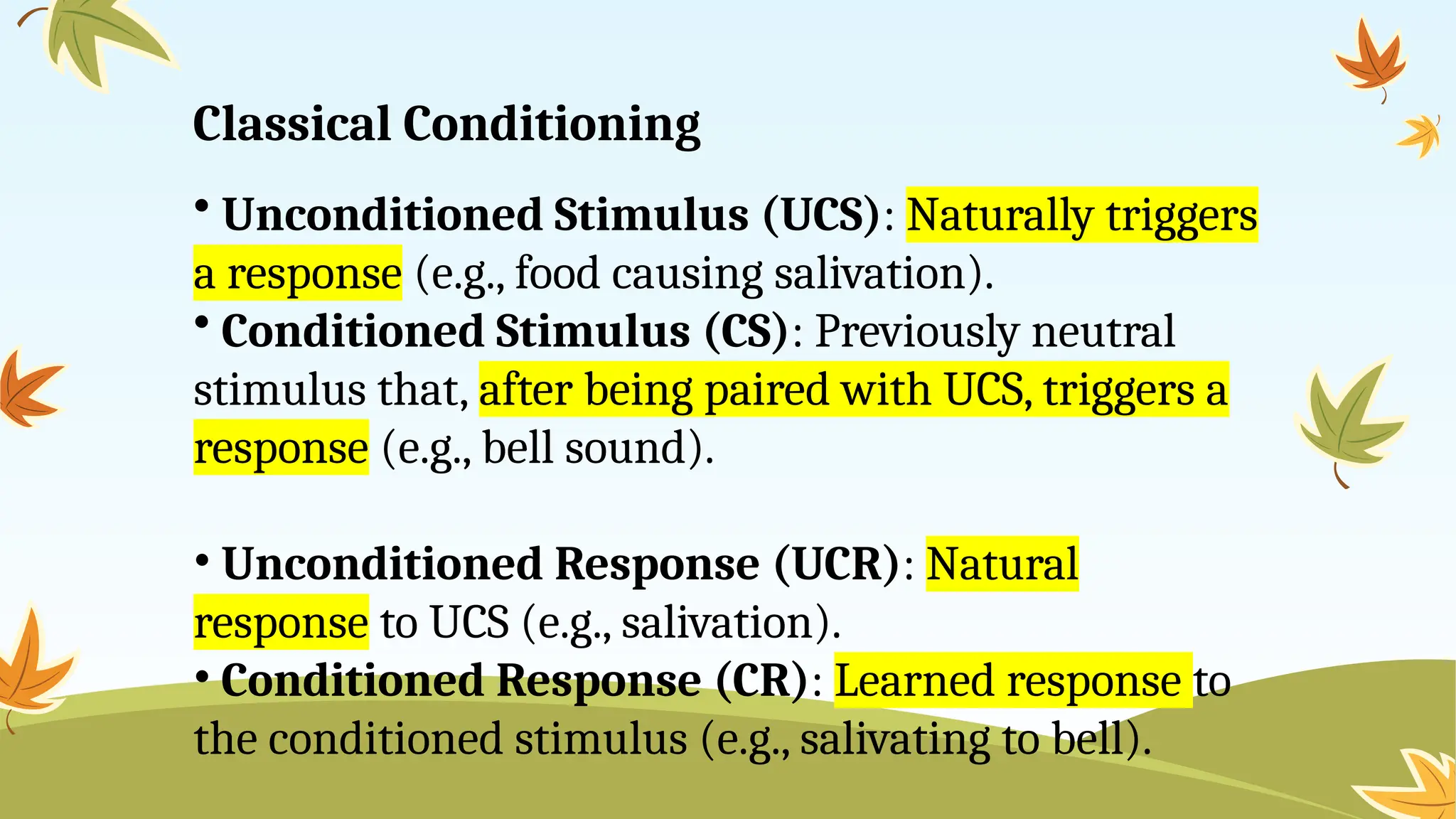
• Unconditioned Stimulus (UCS): Naturally triggers
a response (e.g., food causing salivation).
• Conditioned Stimulus (CS): Previously neutral
stimulus that, after being paired with UCS, triggers a
response (e.g., bell sound).
• Unconditioned Response (UCR): Natural
response to UCS (e.g., salivation).
• Conditioned Response (CR): Learned response to
the conditioned stimulus (e.g., salivating to bell).
Operant Conditioning
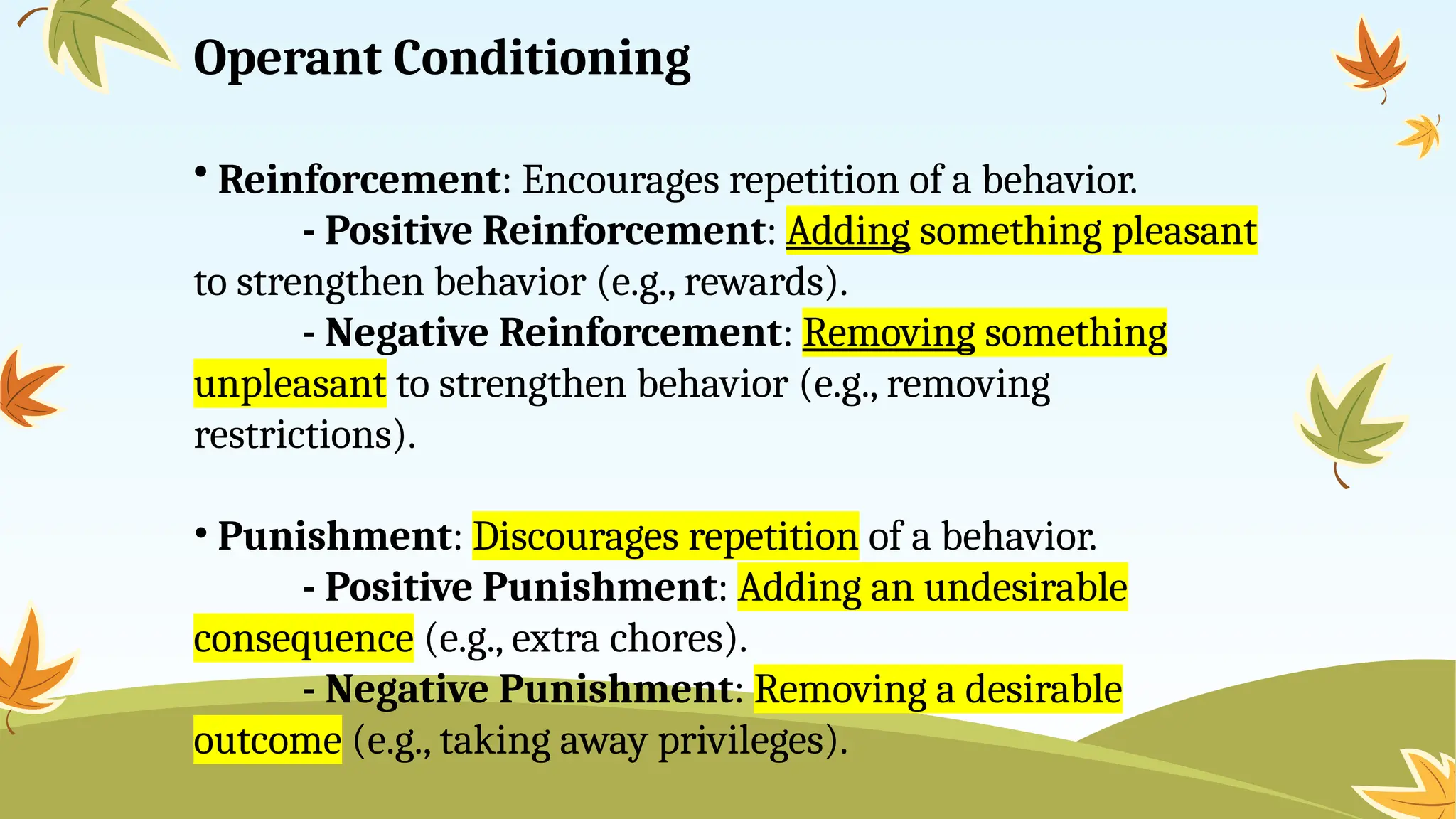
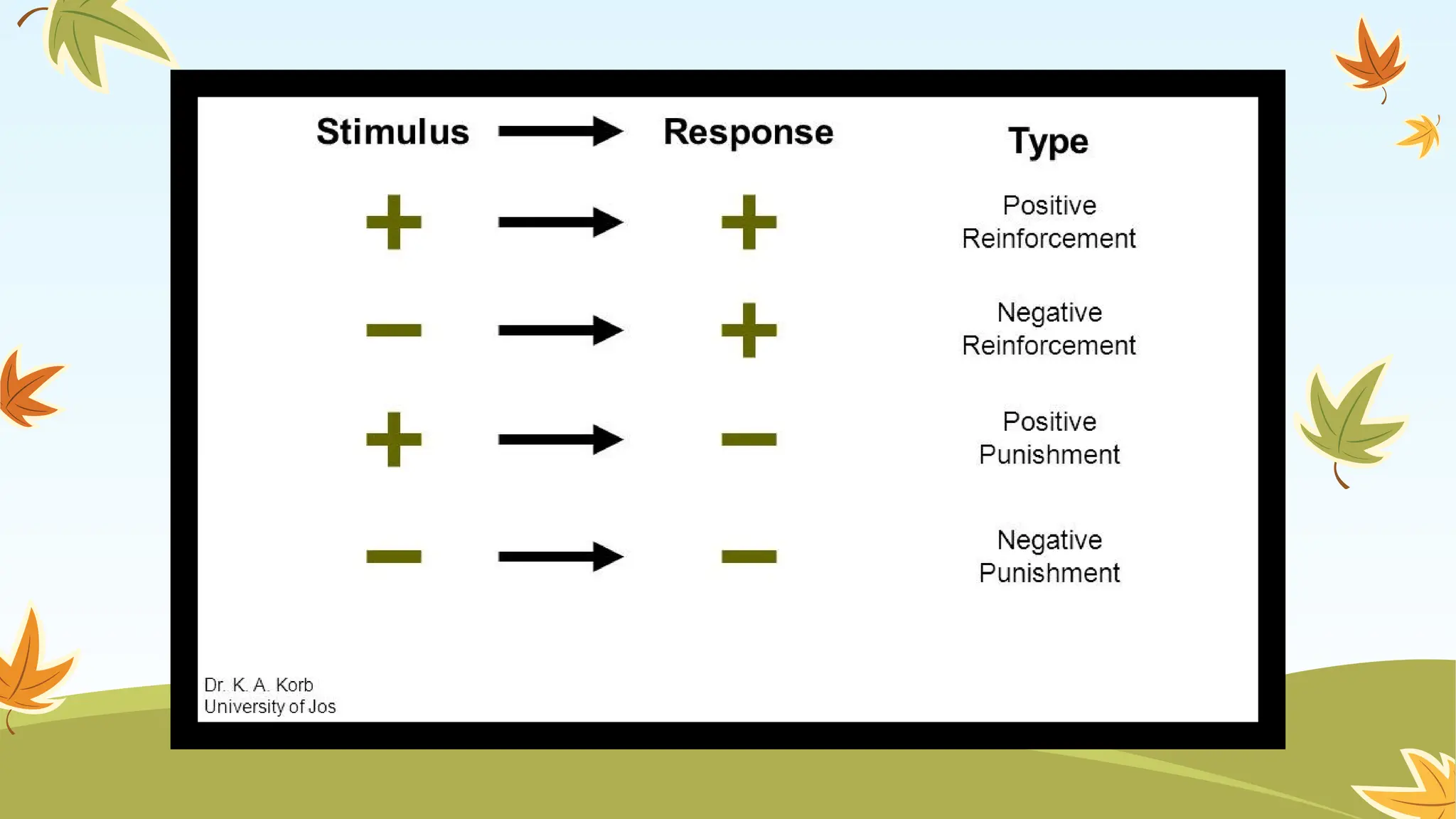
• Reinforcement: Encourages repetition of a behavior.
- Positive Reinforcement: Adding something pleasant
to strengthen behavior (e.g., rewards).
- Negative Reinforcement: Removing something
unpleasant to strengthen behavior (e.g., removing
restrictions).
• Punishment: Discourages repetition of a behavior.
- Positive Punishment: Adding an undesirable
consequence (e.g., extra chores).
- Negative Punishment: Removing a desirable
outcome (e.g., taking away privileges).
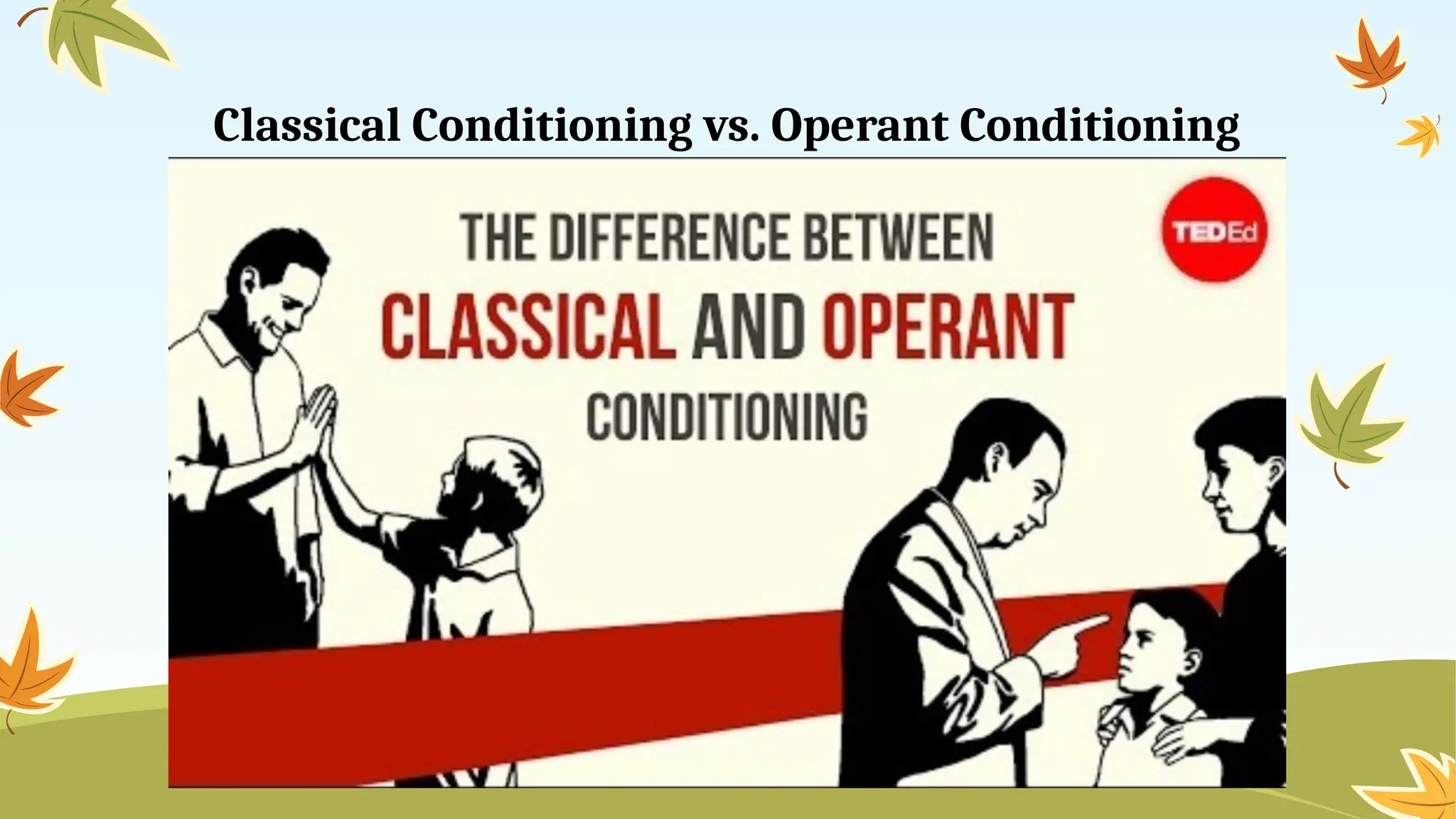
Classical Conditioning vs. Operant Conditioning
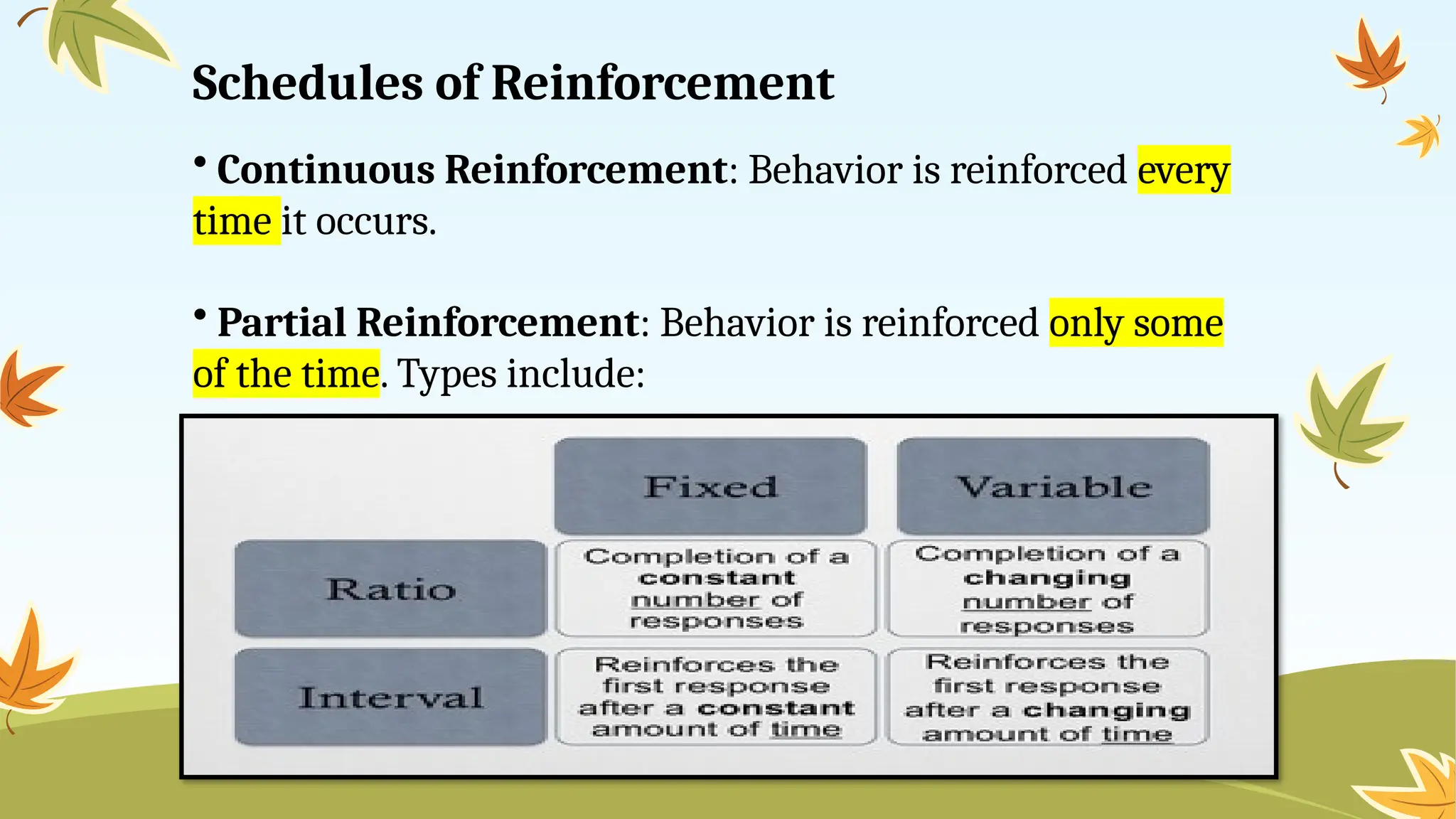
Schedules of Reinforcement
• Continuous Reinforcement: Behavior is reinforced every
time it occurs.
• Partial Reinforcement: Behavior is reinforced only some
of the time. Types include:
Applications of Behaviorism in Education
• Behavior Modification: Teachers can use
reinforcement to encourage positive behaviors and
discourage negative behaviors.
• Classroom Management: Reward systems, such as
gold stars or praise, can shape classroom behavior.
• Instructional Design: Break tasks into small steps
and provide immediate feedback.
Criticisms of
Behaviorism
• Ignores Internal Mental States: Critics argue
behaviorism overlooks cognitive processes like
thoughts, emotions, and problem-solving.
• Limited to Observable Behavior: It cannot explain
behaviors that arise without direct reinforcement or
punishment.
• Ethical Concerns: Some critics argue that strict
control of behavior can be manipulative.
Legacy and
Continuing
Influence of
Behaviorism
• Impact on Modern Psychology:
- Behaviorism influenced the development of
applied behavior analysis (ABA), widely used in
therapeutic settings.
• Use in Everyday Life:
- Behaviorist principles are used in parenting,
workplace management, advertising, and more.
Conclusions
• Summary:
- Behaviorism has been foundational in
psychology and education, focusing on the idea that
behavior is learned through interactions with the
environment.
- Despite criticism, its principles continue to
inform educational practices and behavior
modification programs.
• Final Thought:
- Understanding behaviorism is essential for
those working in fields of education, psychology, and
social sciences.
Check yourself!
Can you come up with language teaching
examples of:
– Classical Conditioning (use all the right labels)
– Operant Conditioning (again, use all the right
labels)
– Positive and Negative Reinforcement
– Punishment

Behaviorism Learning Theory Skinner and Watson .pptx

  • 1.
    BEHAVIORISM A Foundational Theoryin Psychology and Education Miss Escalante
  • 2.
    Introduction • Definition: Behaviorismis a theory of learning which states that all behaviors are acquired through conditioning. • Key Proponents: • Scope: Focuses on observable and measurable aspects of behavior.
  • 3.
    Historical Background • EarlyOrigins: Established in the early 20th century by John B. Watson. • Influence of Ivan Pavlov: Pavlov’s work on classical conditioning laid the foundation for behaviorism. • B.F. Skinner's Contribution: Skinner expanded behaviorism through his work on operant conditioning.
  • 4.
    “Give me adozen healthy infants, well-formed, and my own special world to bring them up in and I’ll guarantee to take any one at random and train him to be any type of specialist I might select – a doctor, a lawyer, artist, even a thief…” -Watson 1924
  • 5.
    Key Concepts ofBehaviorism • Classical Conditioning (Pavlov): - Learning occurs when a natural stimulus is paired with a neutral stimulus, eventually eliciting a conditioned response. Example: Pavlov’s dogs salivating to the sound of a bell. • Operant Conditioning (Skinner): - Behavior is shaped by reinforcement and punishment. - Positive reinforcement increases the likelihood of a behavior; punishment decreases it.
  • 6.
    Classical Conditioning • UnconditionedStimulus (UCS): Naturally triggers a response (e.g., food causing salivation). • Conditioned Stimulus (CS): Previously neutral stimulus that, after being paired with UCS, triggers a response (e.g., bell sound). • Unconditioned Response (UCR): Natural response to UCS (e.g., salivation). • Conditioned Response (CR): Learned response to the conditioned stimulus (e.g., salivating to bell).
  • 8.
    Operant Conditioning • Reinforcement:Encourages repetition of a behavior. - Positive Reinforcement: Adding something pleasant to strengthen behavior (e.g., rewards). - Negative Reinforcement: Removing something unpleasant to strengthen behavior (e.g., removing restrictions). • Punishment: Discourages repetition of a behavior. - Positive Punishment: Adding an undesirable consequence (e.g., extra chores). - Negative Punishment: Removing a desirable outcome (e.g., taking away privileges).
  • 10.
    Classical Conditioning vs.Operant Conditioning
  • 11.
    Schedules of Reinforcement •Continuous Reinforcement: Behavior is reinforced every time it occurs. • Partial Reinforcement: Behavior is reinforced only some of the time. Types include:
  • 12.
    Applications of Behaviorismin Education • Behavior Modification: Teachers can use reinforcement to encourage positive behaviors and discourage negative behaviors. • Classroom Management: Reward systems, such as gold stars or praise, can shape classroom behavior. • Instructional Design: Break tasks into small steps and provide immediate feedback.
  • 13.
  • 14.
    • Ignores InternalMental States: Critics argue behaviorism overlooks cognitive processes like thoughts, emotions, and problem-solving. • Limited to Observable Behavior: It cannot explain behaviors that arise without direct reinforcement or punishment. • Ethical Concerns: Some critics argue that strict control of behavior can be manipulative.
  • 15.
  • 16.
    • Impact onModern Psychology: - Behaviorism influenced the development of applied behavior analysis (ABA), widely used in therapeutic settings. • Use in Everyday Life: - Behaviorist principles are used in parenting, workplace management, advertising, and more.
  • 18.
    Conclusions • Summary: - Behaviorismhas been foundational in psychology and education, focusing on the idea that behavior is learned through interactions with the environment. - Despite criticism, its principles continue to inform educational practices and behavior modification programs. • Final Thought: - Understanding behaviorism is essential for those working in fields of education, psychology, and social sciences.
  • 19.
    Check yourself! Can youcome up with language teaching examples of: – Classical Conditioning (use all the right labels) – Operant Conditioning (again, use all the right labels) – Positive and Negative Reinforcement – Punishment