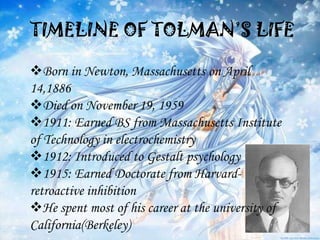
TIMELINE OF TOLMAN’S LIFE

Born in Newton, Massachusetts on April
14,1886
Died on November 19, 1959
1911: Earned BS from Massachusetts Institute
of Technology in electrochemistry
1912: Introduced to Gestalt psychology
1915: Earned Doctorate from Harvard-
retroactive inhibition
He spent most of his career at the university of
California(Berkeley)
PURPOSIVE
BEHAVIORISM
-It combines the objective study of
behavior while also considering the purpose
or goal of behavior
-Tolman thought that learning developed
from knowledge about the environment and
how the organism relates to its
environment.

-He is the only behaviorist who found the
stimulus-response theory unacceptable.
SIGN GESTALT THEORY

-He put forth the notion that there are three parts to
learning which work together as a gestalt.

-These are the “significant,” the “sign” and
“means-end relations”
COGNITIVE MAP
   -an internal perceptual representation of external environmental
   features and landmarks.


Tolman was a “centralist.”

Tolman also worked on “Latent Learning.”
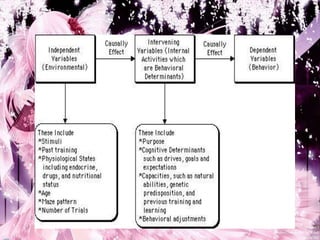
INTERVENING VARIABLES

 a.Dependent

 b.Independent

 c.Intervening
TOLMAN IDENTIFIED AT TLEAST
SIX TYPES OF LEARNING


I. Learning by cathexes.
II.Equivalence beliefs.
III.Field Expectancies.
IV.Field cognition modes.
V.Drive discrimination.
VI.Motor patterns.
TOLMAN WANTED TO DISPROVE THORNDIKE’S
 LAW OF EFFECT AND REPLACE IT WITH:


A.Law of motivation
B.Law of Emphasis
C.Law of Disruption

Tolman

  • 2.
    TIMELINE OF TOLMAN’SLIFE Born in Newton, Massachusetts on April 14,1886 Died on November 19, 1959 1911: Earned BS from Massachusetts Institute of Technology in electrochemistry 1912: Introduced to Gestalt psychology 1915: Earned Doctorate from Harvard- retroactive inhibition He spent most of his career at the university of California(Berkeley)
  • 3.
    PURPOSIVE BEHAVIORISM -It combines theobjective study of behavior while also considering the purpose or goal of behavior -Tolman thought that learning developed from knowledge about the environment and how the organism relates to its environment. -He is the only behaviorist who found the stimulus-response theory unacceptable.
  • 4.
    SIGN GESTALT THEORY -Heput forth the notion that there are three parts to learning which work together as a gestalt. -These are the “significant,” the “sign” and “means-end relations”
  • 5.
    COGNITIVE MAP -an internal perceptual representation of external environmental features and landmarks. Tolman was a “centralist.” Tolman also worked on “Latent Learning.”
  • 6.
    INTERVENING VARIABLES a.Dependent b.Independent c.Intervening
  • 8.
    TOLMAN IDENTIFIED ATTLEAST SIX TYPES OF LEARNING I. Learning by cathexes. II.Equivalence beliefs. III.Field Expectancies. IV.Field cognition modes. V.Drive discrimination. VI.Motor patterns.
  • 9.
    TOLMAN WANTED TODISPROVE THORNDIKE’S LAW OF EFFECT AND REPLACE IT WITH: A.Law of motivation B.Law of Emphasis C.Law of Disruption