


Neo Behaviorism
Reporters:
Espiritu, Dacze Catherine O.
Paras, Kathleen Y.
Novida, Mary Grace D.
Neo Behaviorism is a behavior cannot be full
understood simply in terms of observable stimuli and
reactions. Neo behaviorism introduce mediating
variables into the behaviorist stimulus-response
scheme.
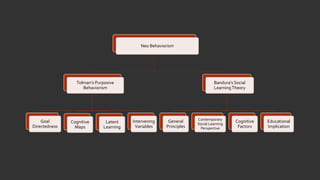
Neo Behaviorism
Tolman’s Purposive
Behaviorism
Goal
Directedness
Cognitive
Maps
Latent
Learning
Intervening
Variables
Bandura’s Social
LearningTheory
General
Principles
Contemporary
Social Learning
Perspective
Cognitive
Factors
Educational
Implication
Purposive Behaviorism
- it is also been referred to as Sign Learning
Theory and is often unite between behaviorism
and cognitive theory
Tolman believed that learning is a cognitive process.
Learning involves forming beliefs and obtaining
knowledge about the environment and then revealing
that knowledge through
purposeful and goal-directed behavior.
Tolman’s system was called purposive
behaviorism because it studies behavior as it is
organized around purposes.
Learning is always purposive and goal-
directed.
Individuals act on beliefs, attitudes, changing
conditions, and they strive towards goals. Tolman saw
behavior as holistic, purposive, and cognitive.
Cognitive map
Learning the location of reward. Once an individual has
learned where a given kind of reward is located, that
location can often be reached by means other than
those originally used.
Latent Learning
Whenever learning goes on without its being
evident in performance at the time.
The concept of intervening variable
These are not readily seen but serve as
determinants of behavior.
Reinforcement not essential for learning
Tolman concluded that reinforcement is not
essential for learning, although it provides an
incentive for performance.
1. Learn by observing.
2. Learning can occur through observation alone,
without a change in behavior.
3. Cognition plays a role in learning.
4. Transition between behaviorism and cognitive
learning theory.
1. Contemporary Theory purposes that
reinforcement and punishment have indirect
effects on learning.
2. Reinforcement and Punishment influence
the result of individuals’ behavior that has
been learned.
3. The expectation of reinforcement
influences cognitive processes.
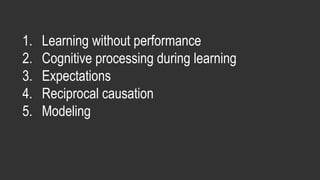
1. Learning without performance
2. Cognitive processing during learning
3. Expectations
4. Reciprocal causation
5. Modeling
1. Students often learn a great deal by
simply observing other people.
2. Describing the consequences of behavior
can effectively increase the appropriate
behaviors and decrease the inappropriate
ones.
3. Modeling provides an alternative to
shaping for teaching new behaviors. Instead
of using shaping, which is operant
conditioning, modeling can provide a faster,
more efficient means for teaching new
behavior.
4. Teachers and parents must model
appropriate behaviors and take care that
they do not model inappropriate behaviors.
5. Teachers should expose students to a
variety of other models. This technique is
especially important to break down traditional
stereotypes.
FACILITATING LEARNING: A Metacognitive Process
4th Edition
OBE and Kto12
Maria Rita D. Lucas, Ph.D.
Brenda B. Corpuz, Ph.D. and Lorimar Publishing, inc.
http://www.scribd.com/doc/239012133/Neo-Behaviorism#scribd

Neo Behaviorism

  • 1.
    Neo Behaviorism Reporters: Espiritu, DaczeCatherine O. Paras, Kathleen Y. Novida, Mary Grace D.
  • 3.
    Neo Behaviorism isa behavior cannot be full understood simply in terms of observable stimuli and reactions. Neo behaviorism introduce mediating variables into the behaviorist stimulus-response scheme.
  • 4.
    Neo Behaviorism Tolman’s Purposive Behaviorism Goal Directedness Cognitive Maps Latent Learning Intervening Variables Bandura’sSocial LearningTheory General Principles Contemporary Social Learning Perspective Cognitive Factors Educational Implication
  • 5.
    Purposive Behaviorism - itis also been referred to as Sign Learning Theory and is often unite between behaviorism and cognitive theory
  • 6.
    Tolman believed thatlearning is a cognitive process. Learning involves forming beliefs and obtaining knowledge about the environment and then revealing that knowledge through purposeful and goal-directed behavior.
  • 7.
    Tolman’s system wascalled purposive behaviorism because it studies behavior as it is organized around purposes.
  • 9.
    Learning is alwayspurposive and goal- directed. Individuals act on beliefs, attitudes, changing conditions, and they strive towards goals. Tolman saw behavior as holistic, purposive, and cognitive.
  • 10.
    Cognitive map Learning thelocation of reward. Once an individual has learned where a given kind of reward is located, that location can often be reached by means other than those originally used.
  • 11.
    Latent Learning Whenever learninggoes on without its being evident in performance at the time.
  • 12.
    The concept ofintervening variable These are not readily seen but serve as determinants of behavior.
  • 13.
    Reinforcement not essentialfor learning Tolman concluded that reinforcement is not essential for learning, although it provides an incentive for performance.
  • 15.
    1. Learn byobserving. 2. Learning can occur through observation alone, without a change in behavior. 3. Cognition plays a role in learning. 4. Transition between behaviorism and cognitive learning theory.
  • 17.
    1. Contemporary Theorypurposes that reinforcement and punishment have indirect effects on learning.
  • 18.
    2. Reinforcement andPunishment influence the result of individuals’ behavior that has been learned.
  • 19.
    3. The expectationof reinforcement influences cognitive processes.
  • 21.
    1. Learning withoutperformance 2. Cognitive processing during learning 3. Expectations 4. Reciprocal causation 5. Modeling
  • 23.
    1. Students oftenlearn a great deal by simply observing other people.
  • 24.
    2. Describing theconsequences of behavior can effectively increase the appropriate behaviors and decrease the inappropriate ones.
  • 25.
    3. Modeling providesan alternative to shaping for teaching new behaviors. Instead of using shaping, which is operant conditioning, modeling can provide a faster, more efficient means for teaching new behavior.
  • 26.
    4. Teachers andparents must model appropriate behaviors and take care that they do not model inappropriate behaviors.
  • 27.
    5. Teachers shouldexpose students to a variety of other models. This technique is especially important to break down traditional stereotypes.
  • 28.
    FACILITATING LEARNING: AMetacognitive Process 4th Edition OBE and Kto12 Maria Rita D. Lucas, Ph.D. Brenda B. Corpuz, Ph.D. and Lorimar Publishing, inc. http://www.scribd.com/doc/239012133/Neo-Behaviorism#scribd