1
Behaviorism and Behaviorist
Learning Theories
Presented By: Umesh Pakharin (MES II Semester, English Education)
Course: Developmental Psychology
Course Facilitators: Prof. Dr. Usha Acharya, Prof. Dr. Tolanath Kafle
Moderator: Dharani Prasad Subedi
Commentator: Kabi Limbu
04/03/2025
04/03/2025
2
Outlines of The Presentation
 Slide 1: Cover Page
 Slide 2: Outlines of The Presentation
 Slide 3: Introduction to Behaviorism
 Slide 4: Basic Concept of Behaviourism
 Slide 5:
04/03/2025
3
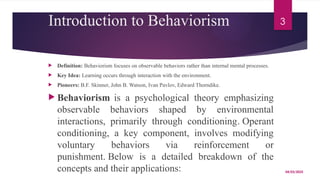
Introduction to Behaviorism
 Definition: Behaviorism focuses on observable behaviors rather than internal mental processes.
 Key Idea: Learning occurs through interaction with the environment.
 Pioneers: B.F. Skinner, John B. Watson, Ivan Pavlov, Edward Thorndike.
 Behaviorism is a psychological theory emphasizing
observable behaviors shaped by environmental
interactions, primarily through conditioning. Operant
conditioning, a key component, involves modifying
voluntary behaviors via reinforcement or
punishment. Below is a detailed breakdown of the
concepts and their applications:
04/03/2025
4
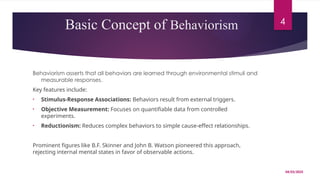
Basic Concept of Behaviorism
Behaviorism asserts that all behaviors are learned through environmental stimuli and
measurable responses.
Key features include:
• Stimulus-Response Associations: Behaviors result from external triggers.
• Objective Measurement: Focuses on quantifiable data from controlled
experiments.
• Reductionism: Reduces complex behaviors to simple cause-effect relationships.
Prominent figures like B.F. Skinner and John B. Watson pioneered this approach,
rejecting internal mental states in favor of observable actions.
04/03/2025
5
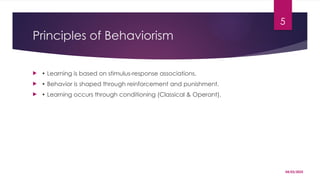
Principles of Behaviorism
 • Learning is based on stimulus-response associations.
 • Behavior is shaped through reinforcement and punishment.
 • Learning occurs through conditioning (Classical & Operant).
04/03/2025
6
Classical Conditioning (Ivan Pavlov)
 • Learning through association.
 • Pavlov’s dogs experiment: Association of a bell with food to produce
salivation.
 Key Terms:
 - Unconditioned Stimulus (UCS)
 - Unconditioned Response (UCR)
 - Conditioned Stimulus (CS)
 - Conditioned Response (CR)
04/03/2025
7
Operant Conditioning (B.F. Skinner)
 • Learning through consequences (reinforcement & punishment).
 • Skinner’s Box experiment: A rat learns to press a lever for food.
 Key Concepts:
 - Positive Reinforcement: Adding stimulus to increase behavior.
 - Negative Reinforcement: Removing stimulus to increase behavior.
 - Positive Punishment: Adding stimulus to decrease behavior.
 - Negative Punishment: Removing stimulus to decrease behavior.
04/03/2025
8
Thorndike’s Law of Effect
 • Behaviors followed by satisfying outcomes are more likely to be
repeated.
 • Experiment: Cats escaping from a puzzle box.
 • Impact: Formed the basis for Operant Conditioning.
04/03/2025
9
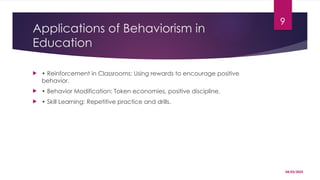
Applications of Behaviorism in
Education
 • Reinforcement in Classrooms: Using rewards to encourage positive
behavior.
 • Behavior Modification: Token economies, positive discipline.
 • Skill Learning: Repetitive practice and drills.
04/03/2025
10
Criticism of Behaviorism
 • Ignores internal thought processes and emotions.
 • Oversimplifies learning to external stimuli only.
 • Does not explain creativity or higher-order thinking.
04/03/2025
11
Conclusion
 • Behaviorism is a foundational learning theory that has shaped modern
educational practices.
 • While it has limitations, it is still widely applied in teaching and behavior
management.
04/03/2025
12
References
 List of books, research papers, and articles on Behaviorist Theories.

Behaviorist_Learning_Theories.ouuyyypptx

  • 1.
    1 Behaviorism and Behaviorist LearningTheories Presented By: Umesh Pakharin (MES II Semester, English Education) Course: Developmental Psychology Course Facilitators: Prof. Dr. Usha Acharya, Prof. Dr. Tolanath Kafle Moderator: Dharani Prasad Subedi Commentator: Kabi Limbu 04/03/2025
  • 2.
    04/03/2025 2 Outlines of ThePresentation  Slide 1: Cover Page  Slide 2: Outlines of The Presentation  Slide 3: Introduction to Behaviorism  Slide 4: Basic Concept of Behaviourism  Slide 5:
  • 3.
    04/03/2025 3 Introduction to Behaviorism Definition: Behaviorism focuses on observable behaviors rather than internal mental processes.  Key Idea: Learning occurs through interaction with the environment.  Pioneers: B.F. Skinner, John B. Watson, Ivan Pavlov, Edward Thorndike.  Behaviorism is a psychological theory emphasizing observable behaviors shaped by environmental interactions, primarily through conditioning. Operant conditioning, a key component, involves modifying voluntary behaviors via reinforcement or punishment. Below is a detailed breakdown of the concepts and their applications:
  • 4.
    04/03/2025 4 Basic Concept ofBehaviorism Behaviorism asserts that all behaviors are learned through environmental stimuli and measurable responses. Key features include: • Stimulus-Response Associations: Behaviors result from external triggers. • Objective Measurement: Focuses on quantifiable data from controlled experiments. • Reductionism: Reduces complex behaviors to simple cause-effect relationships. Prominent figures like B.F. Skinner and John B. Watson pioneered this approach, rejecting internal mental states in favor of observable actions.
  • 5.
    04/03/2025 5 Principles of Behaviorism • Learning is based on stimulus-response associations.  • Behavior is shaped through reinforcement and punishment.  • Learning occurs through conditioning (Classical & Operant).
  • 6.
    04/03/2025 6 Classical Conditioning (IvanPavlov)  • Learning through association.  • Pavlov’s dogs experiment: Association of a bell with food to produce salivation.  Key Terms:  - Unconditioned Stimulus (UCS)  - Unconditioned Response (UCR)  - Conditioned Stimulus (CS)  - Conditioned Response (CR)
  • 7.
    04/03/2025 7 Operant Conditioning (B.F.Skinner)  • Learning through consequences (reinforcement & punishment).  • Skinner’s Box experiment: A rat learns to press a lever for food.  Key Concepts:  - Positive Reinforcement: Adding stimulus to increase behavior.  - Negative Reinforcement: Removing stimulus to increase behavior.  - Positive Punishment: Adding stimulus to decrease behavior.  - Negative Punishment: Removing stimulus to decrease behavior.
  • 8.
    04/03/2025 8 Thorndike’s Law ofEffect  • Behaviors followed by satisfying outcomes are more likely to be repeated.  • Experiment: Cats escaping from a puzzle box.  • Impact: Formed the basis for Operant Conditioning.
  • 9.
    04/03/2025 9 Applications of Behaviorismin Education  • Reinforcement in Classrooms: Using rewards to encourage positive behavior.  • Behavior Modification: Token economies, positive discipline.  • Skill Learning: Repetitive practice and drills.
  • 10.
    04/03/2025 10 Criticism of Behaviorism • Ignores internal thought processes and emotions.  • Oversimplifies learning to external stimuli only.  • Does not explain creativity or higher-order thinking.
  • 11.
    04/03/2025 11 Conclusion  • Behaviorismis a foundational learning theory that has shaped modern educational practices.  • While it has limitations, it is still widely applied in teaching and behavior management.
  • 12.
    04/03/2025 12 References  List ofbooks, research papers, and articles on Behaviorist Theories.