Behavioral Theories of Instruction and their role in Learning and Teaching By: Jessica Terpstra and Tasha Buchler
Behaviorism Remember Pavlov’s salivating dog? That’s behaviorism Remember Skinner  and the rats That’s behaviorism
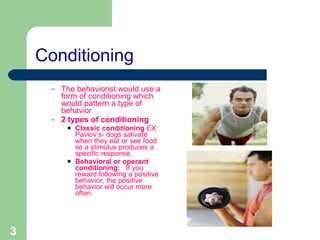
Conditioning The behaviorist would use a form of conditioning which would pattern a type of behavior  2 types of conditioning Classic conditioning  EX:  Pavlov’s- dogs salivate when they eat or see food so a stimulus produces a specific response. Behavioral or operant conditioning:  If you reward following a positive behavior, the positive behavior will occur more often.
What is Behaviorism? Behaviorism is a theory of animal and human learning that only focuses on objectively observable behaviors and discounts mental activities.  Behavior theorists define learning as nothing more than the acquisition of new behavior.  Behaviorism impacts learning because it only uses observable behavior.  Behaviorist learning involves a stimulus and a response.  The Behaviorist learning involved the old practices that learning occurred through rote memorization and the isolation of facts.  In the behaviorist learning environment, the teacher would instruct and the students would listen, no active participation.
Pros of Behavioral Theories With Autistic children rote behavior is necessary. Observable behaviors are easy to assess Some of the theories are proven effective Some of them necessary ex: memorization of sight words.
Cons of Behavioral Theories   Ignores mental activities and problem solving Does not include all of the different learning styles More teacher centered More authoritarian How is it that young children learn new things with the positive reinforcement?  Ex: young children recognize new language patterns
Group Participation Raise your hand if you think you use/have used this theory of teaching.  Now please type in an example of how you’ve used this theory in your teaching
Uses in Classroom Prize box (positive reinforcement) Detention (negative reinforcement) Sight words- memorization of thought process, rote memorization Reading taught through skill mastery

Jt Tb Behavior New

  • 1.
    Behavioral Theories ofInstruction and their role in Learning and Teaching By: Jessica Terpstra and Tasha Buchler
  • 2.
    Behaviorism Remember Pavlov’ssalivating dog? That’s behaviorism Remember Skinner and the rats That’s behaviorism
  • 3.
    Conditioning The behavioristwould use a form of conditioning which would pattern a type of behavior 2 types of conditioning Classic conditioning EX: Pavlov’s- dogs salivate when they eat or see food so a stimulus produces a specific response. Behavioral or operant conditioning: If you reward following a positive behavior, the positive behavior will occur more often.
  • 4.
    What is Behaviorism?Behaviorism is a theory of animal and human learning that only focuses on objectively observable behaviors and discounts mental activities. Behavior theorists define learning as nothing more than the acquisition of new behavior. Behaviorism impacts learning because it only uses observable behavior. Behaviorist learning involves a stimulus and a response. The Behaviorist learning involved the old practices that learning occurred through rote memorization and the isolation of facts. In the behaviorist learning environment, the teacher would instruct and the students would listen, no active participation.
  • 5.
    Pros of BehavioralTheories With Autistic children rote behavior is necessary. Observable behaviors are easy to assess Some of the theories are proven effective Some of them necessary ex: memorization of sight words.
  • 6.
    Cons of BehavioralTheories Ignores mental activities and problem solving Does not include all of the different learning styles More teacher centered More authoritarian How is it that young children learn new things with the positive reinforcement? Ex: young children recognize new language patterns
  • 7.
    Group Participation Raiseyour hand if you think you use/have used this theory of teaching. Now please type in an example of how you’ve used this theory in your teaching
  • 8.
    Uses in ClassroomPrize box (positive reinforcement) Detention (negative reinforcement) Sight words- memorization of thought process, rote memorization Reading taught through skill mastery