BehaviorismBy: Amanda Catherine JessicaTabitha Ashley
What is Behaviorism?The Theory that states:There is not an internal cognitive processing of information when learningThere is no difference between a human and an animalAnimals and humans learn to behave through a series of positive and negative rewards
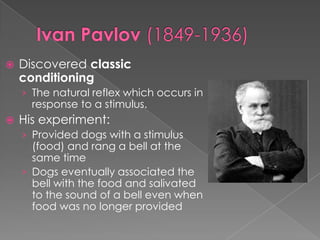
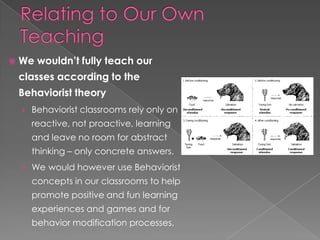
Ivan Pavlov (1849-1936)Discovered classic conditioningThe natural reflex which occurs in response to a stimulus.  His experiment:Provided dogs with a stimulus (food) and rang a bell at the same timeDogs eventually associated the bell with the food and salivated to the sound of a bell even when food was no longer provided
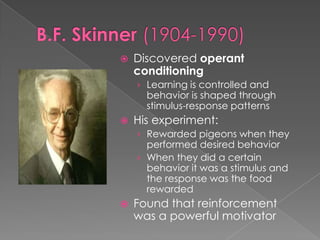
B.F. Skinner (1904-1990)Discovered operant conditioningLearning is controlled and behavior is shaped through stimulus-response patternsHis experiment:Rewarded pigeons when they performed desired behaviorWhen they did a certain behavior it was a stimulus and the response was the food rewardedFound that reinforcement was a powerful motivator
Albert Bandura(1925-present)Discovered the Social Cognitive Theory aka social learningSelf-regulation and motivation cause people to act a certain way, not just the environmentDiscovered observational modelingWatching someone and then copying their behaviorFocused on Self-efficacyPersonal observation about your perceived ability to feel
A Teacher’s Role in BehaviorismTeachers can mold their students behavior based on the theories of classic conditioning, operant conditioning, and social learning. They can use these theories to enforce rules such as when the lights go off, everyone is to be quiet.
Behavior can be encouraged and discouraged based on the positive or negative reward a teacher gives a student.
Also, teachers are to be a role model for students as students will be mimicking their behavior(observational modeling).
A teacher can model the use of technology such as a new software or computer program for all students to see, and the students can copy his or her ways.
Another example would be the teacher modeling a new technological device and showing the kids how to use it and then letting them copy her actions and try it themselves.How Do Students Use the Behaviorism Theory Without Using Technology?With the behaviorist theory children learn from positive or negative stimuli or feedback.The students use this theory in multiple ways without technology..A student raises their hand before speaking, so the teacher rewards the student with a piece of candy.  This child has now learned that raising their hand to speak is a good thing behavior, and positive feedback will follow this action.A student did a good deed and helped out a classmate, so the teacher gave the child a gold star on their chart.  The student has now learned if they do good deeds, they will earn gold stars.A student pushes another student over, so the teacher makes that child sit out of recess.  The student has learned not to push their peers because the consequence is sitting out of recess.
How Do Students Use the Behaviorism Theory While Using Technology?Below are some examples of how a student uses this theory while using technology…A student is taking a quiz on the computer.  He/she answers the question correctly, so a smiley face appears and congratulates the student.  Or the student answers incorrectly and a sad face appears, telling the child to try again.The student has a button that they press every time they need assistance from the teacher, this notifies the teacher to come over and offer help.

Behaviorism EME Module 13

  • 1.
    BehaviorismBy: Amanda CatherineJessicaTabitha Ashley
  • 2.
    What is Behaviorism?TheTheory that states:There is not an internal cognitive processing of information when learningThere is no difference between a human and an animalAnimals and humans learn to behave through a series of positive and negative rewards
  • 3.
    Ivan Pavlov (1849-1936)Discoveredclassic conditioningThe natural reflex which occurs in response to a stimulus. His experiment:Provided dogs with a stimulus (food) and rang a bell at the same timeDogs eventually associated the bell with the food and salivated to the sound of a bell even when food was no longer provided
  • 4.
    B.F. Skinner (1904-1990)Discoveredoperant conditioningLearning is controlled and behavior is shaped through stimulus-response patternsHis experiment:Rewarded pigeons when they performed desired behaviorWhen they did a certain behavior it was a stimulus and the response was the food rewardedFound that reinforcement was a powerful motivator
  • 5.
    Albert Bandura(1925-present)Discovered theSocial Cognitive Theory aka social learningSelf-regulation and motivation cause people to act a certain way, not just the environmentDiscovered observational modelingWatching someone and then copying their behaviorFocused on Self-efficacyPersonal observation about your perceived ability to feel
  • 6.
    A Teacher’s Rolein BehaviorismTeachers can mold their students behavior based on the theories of classic conditioning, operant conditioning, and social learning. They can use these theories to enforce rules such as when the lights go off, everyone is to be quiet.
  • 7.
    Behavior can beencouraged and discouraged based on the positive or negative reward a teacher gives a student.
  • 8.
    Also, teachers areto be a role model for students as students will be mimicking their behavior(observational modeling).
  • 9.
    A teacher canmodel the use of technology such as a new software or computer program for all students to see, and the students can copy his or her ways.
  • 10.
    Another example wouldbe the teacher modeling a new technological device and showing the kids how to use it and then letting them copy her actions and try it themselves.How Do Students Use the Behaviorism Theory Without Using Technology?With the behaviorist theory children learn from positive or negative stimuli or feedback.The students use this theory in multiple ways without technology..A student raises their hand before speaking, so the teacher rewards the student with a piece of candy. This child has now learned that raising their hand to speak is a good thing behavior, and positive feedback will follow this action.A student did a good deed and helped out a classmate, so the teacher gave the child a gold star on their chart. The student has now learned if they do good deeds, they will earn gold stars.A student pushes another student over, so the teacher makes that child sit out of recess. The student has learned not to push their peers because the consequence is sitting out of recess.
  • 11.
    How Do StudentsUse the Behaviorism Theory While Using Technology?Below are some examples of how a student uses this theory while using technology…A student is taking a quiz on the computer. He/she answers the question correctly, so a smiley face appears and congratulates the student. Or the student answers incorrectly and a sad face appears, telling the child to try again.The student has a button that they press every time they need assistance from the teacher, this notifies the teacher to come over and offer help.