






CONNECTIONISM
Edward L. Thorndike (1874-1949)
Teo Woon Chun
2 PISMP TESL/PM (SJKC) 2016
EDUP3033 LEARNING AND THE LEARNER
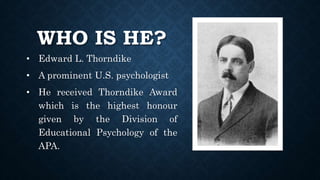
WHO IS HE?
• Edward L. Thorndike
• A prominent U.S. psychologist
• He received Thorndike Award
which is the highest honour
given by the Division of
Educational Psychology of the
APA.
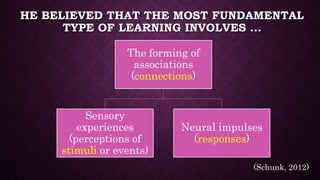
HE BELIEVED THAT THE MOST FUNDAMENTAL
TYPE OF LEARNING INVOLVES …
(Schunk, 2012)
The forming of
associations
(connections)
Sensory
experiences
(perceptions of
stimuli or events)
Neural impulses
(responses)
SO, FROM THE VIDEO WHICH YOU HAVE
WATCHED A MOMENT AGO…
1. Which item stands for the stimulus?
2. How does the stimulus affect the individual’s
response?
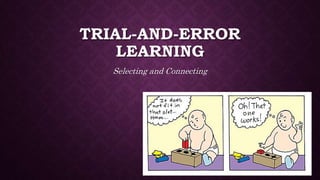
TRIAL-AND-ERROR
LEARNING
Selecting and Connecting
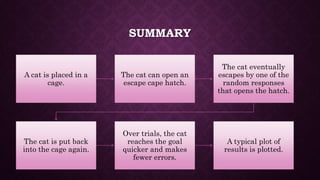
SUMMARY
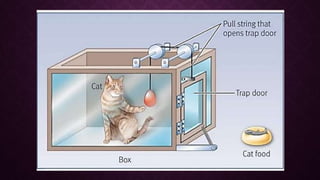
A cat is placed in a
cage.
The cat can open an
escape cape hatch.
The cat eventually
escapes by one of the
random responses
that opens the hatch.
The cat is put back
into the cage again.
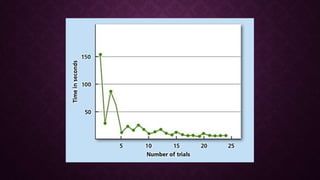
Over trials, the cat
reaches the goal
quicker and makes
fewer errors.
A typical plot of
results is plotted.
LAWS OF
EXERCISE AND EFFECT
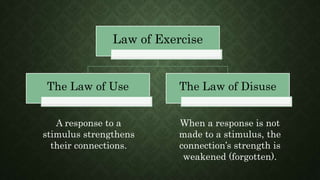
Law of Exercise
The Law of Use The Law of Disuse
A response to a
stimulus strengthens
their connections.
When a response is not
made to a stimulus, the
connection’s strength is
weakened (forgotten).
STIMULUS RESPONSE
The Stimulus-Response (S-R) bond will be
strengthened if an individual practises a skill for
many times. On the other hand, S-R bond will
become weakened if s/he does not practise it.
CONNECTIONISM
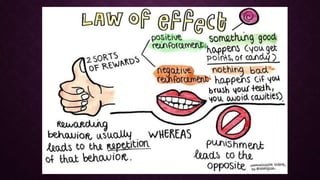
LAW OF EFFECT DEFINITION
When a modifiable connection between a
situation and a response is made and is
accompanied or followed by a satisfying state of
affairs, that connection’s strength is increased.
When made and accompanied or followed by an
annoying state of affairs, its strength is decreased.
(Thorndike, 1913b, p.4)
CONNECTIONISM
LAW OF EFFECT UNDERSTANDING CONCEPT
• Emphasise the consequences of behaviour
• Responses resulting in satisfying (rewarding) consequences
are learned; responses producing annoying (punishing)
consequences are not learned.
FOR EXAMPLE…
IF I …
The S-R bond between the studying and good grades is
strengthened.
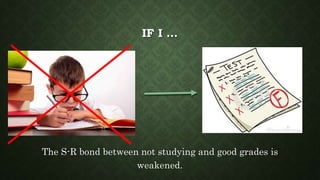
IF I …
The S-R bond between not studying and good grades is
weakened.
OTHER PRINCIPLES
LAW OF READINESS
• When one is prepared (ready) to act, to do so is rewarding
and not to do so is punishing.
• When students are ready to learn a particular action (in
terms of developmental level or prior skill acquisition), then
behaviours that foster this learning will be rewarding.
When students are not ready to learn or do not possess
prerequisite skills, then attempting to learn is punishing
and a waste of time.
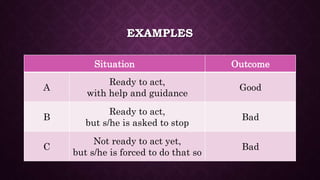
EXAMPLES
Situation Outcome
A
Ready to act,
with help and guidance
Good
B
Ready to act,
but s/he is asked to stop
Bad
C
Not ready to act yet,
but s/he is forced to do that so
Bad
ASSOCIATIVE SHIFTING
• Refers to a situation in which responses made to a
particular stimulus eventually are made to an entirely
different stimulus of, on repeated trials, there are small
changes in the nature of the stimulus.
• E.g. To teach students to divide two-digit number into a
four-digit number, we first teach them to divide a one-digit
number into another and then gradually add more digits to
the divisor and dividend.
TRANSFER (GENERALISATION)
• Strengthening or weakening of one connection
produces a similar change in another
connection.
• Transfer occurs when situations have identical
elements and call for similar responses.
TRANSFER (GENERALISATION)
• Practice or training in a skill in a specific context did not
improve one’s ability to execute that skill generally.
• E.g. Training on estimating the area of rectangles does not
advance learners’ ability to estimate the areas of triangles,
circles, and irregular figures.
IMPLICATIONS OF
THORNDIKE’S THEORY IN
TEACHING AND LEARNING
LAW OF READINESS
Teacher should prepare the facilities required
for students before starting a topic or teaching
and learning activity.
LAW OF EXERCISE
In order to ensure the lesson goes smoothly, a
variety of evaluation to apply the knowledge
learnt should be done more frequent to
enhance learning.
LAW OF EFFECT
Teacher should prepare a learning environment
which the opportunities of experiencing
success for students exist.
Praise… Gifts… Rewards…
On the other hand, advice should be given for
students who are mischievous.
Thorndike’s Revision to His Theory
LAW OF EXERCISE
• Throndike discarded the Law of Exercise when he
found that simple repetition of a situation does
not necessarily “stamp in” responses.
• Repetition of a situation may not increase the
future likelihood of the same response occurring.
LAW OF EFFECT
• Research showed that rewards strengthened connections,
but punishment did not necessarily weaken them.
Instead, connections are weakened when alternative
connections are strengthened.
• Reward improved learning, but punishment did not
diminish the probability of that response occurring to that
stimulus word.
LAW OF EFFECT (cont.)
• Punishment suppresses responses, but they are
not forgotten.
• Punishment is not an effective means of
alternating behaviour because it does not teach
students correct behaviours but rather inform
them what not to do.
REFERENCE
Campbell, M. (2014, November 4). Thorndike’s law of effect [Video file].
Retrieved from https://www.youtube.com/watch?v=4Uo40enXBKE
Jenningh. (2007, November 11). Thorndike-puzzle box [Video file].
Retrieved from https://www.youtube.com/watch?v=BDujDOLre-8
Managa, K. (2015, July 19). Connectionism law of effect [Video file].
Retrieved from https://www.youtube.com/watch?v=34BulWeqUo4
MrCookiedMilk’s channel (2011, December 2). Thorndike puzzle box-
Psychology experiment [Video file]. Retrieved from
https://www.youtube.com/watch?v=y-g2OmRXb0g
Noriati A. Rashid, Boon, P. Y., Sharifah Fakhriah Syed Ahmad (2009). Murid
dan
alam belajar. Shah Alam: Oxford Fajar Sdn Bhd.
Schunk, D. H. (2012). Learning theories: An educational perspective (6th
ed.). Boston: Pearson Education, Inc.

EDUP3033 Learning and The Learner - Learning Theories (Behaviourism) - Connectionism

  • 1.
    CONNECTIONISM Edward L. Thorndike(1874-1949) Teo Woon Chun 2 PISMP TESL/PM (SJKC) 2016 EDUP3033 LEARNING AND THE LEARNER
  • 2.
    WHO IS HE? •Edward L. Thorndike • A prominent U.S. psychologist • He received Thorndike Award which is the highest honour given by the Division of Educational Psychology of the APA.
  • 3.
    HE BELIEVED THATTHE MOST FUNDAMENTAL TYPE OF LEARNING INVOLVES … (Schunk, 2012) The forming of associations (connections) Sensory experiences (perceptions of stimuli or events) Neural impulses (responses)
  • 5.
    SO, FROM THEVIDEO WHICH YOU HAVE WATCHED A MOMENT AGO… 1. Which item stands for the stimulus? 2. How does the stimulus affect the individual’s response?
  • 6.
  • 8.
    SUMMARY A cat isplaced in a cage. The cat can open an escape cape hatch. The cat eventually escapes by one of the random responses that opens the hatch. The cat is put back into the cage again. Over trials, the cat reaches the goal quicker and makes fewer errors. A typical plot of results is plotted.
  • 11.
  • 12.
    Law of Exercise TheLaw of Use The Law of Disuse A response to a stimulus strengthens their connections. When a response is not made to a stimulus, the connection’s strength is weakened (forgotten).
  • 13.
    STIMULUS RESPONSE The Stimulus-Response(S-R) bond will be strengthened if an individual practises a skill for many times. On the other hand, S-R bond will become weakened if s/he does not practise it.
  • 14.
    CONNECTIONISM LAW OF EFFECTDEFINITION When a modifiable connection between a situation and a response is made and is accompanied or followed by a satisfying state of affairs, that connection’s strength is increased. When made and accompanied or followed by an annoying state of affairs, its strength is decreased. (Thorndike, 1913b, p.4)
  • 15.
    CONNECTIONISM LAW OF EFFECTUNDERSTANDING CONCEPT • Emphasise the consequences of behaviour • Responses resulting in satisfying (rewarding) consequences are learned; responses producing annoying (punishing) consequences are not learned.
  • 16.
  • 17.
    IF I … TheS-R bond between the studying and good grades is strengthened.
  • 18.
    IF I … TheS-R bond between not studying and good grades is weakened.
  • 21.
  • 22.
    LAW OF READINESS •When one is prepared (ready) to act, to do so is rewarding and not to do so is punishing. • When students are ready to learn a particular action (in terms of developmental level or prior skill acquisition), then behaviours that foster this learning will be rewarding. When students are not ready to learn or do not possess prerequisite skills, then attempting to learn is punishing and a waste of time.
  • 23.
    EXAMPLES Situation Outcome A Ready toact, with help and guidance Good B Ready to act, but s/he is asked to stop Bad C Not ready to act yet, but s/he is forced to do that so Bad
  • 24.
    ASSOCIATIVE SHIFTING • Refersto a situation in which responses made to a particular stimulus eventually are made to an entirely different stimulus of, on repeated trials, there are small changes in the nature of the stimulus. • E.g. To teach students to divide two-digit number into a four-digit number, we first teach them to divide a one-digit number into another and then gradually add more digits to the divisor and dividend.
  • 25.
    TRANSFER (GENERALISATION) • Strengtheningor weakening of one connection produces a similar change in another connection. • Transfer occurs when situations have identical elements and call for similar responses.
  • 26.
    TRANSFER (GENERALISATION) • Practiceor training in a skill in a specific context did not improve one’s ability to execute that skill generally. • E.g. Training on estimating the area of rectangles does not advance learners’ ability to estimate the areas of triangles, circles, and irregular figures.
  • 27.
    IMPLICATIONS OF THORNDIKE’S THEORYIN TEACHING AND LEARNING
  • 28.
    LAW OF READINESS Teachershould prepare the facilities required for students before starting a topic or teaching and learning activity.
  • 29.
    LAW OF EXERCISE Inorder to ensure the lesson goes smoothly, a variety of evaluation to apply the knowledge learnt should be done more frequent to enhance learning.
  • 30.
    LAW OF EFFECT Teachershould prepare a learning environment which the opportunities of experiencing success for students exist. Praise… Gifts… Rewards… On the other hand, advice should be given for students who are mischievous.
  • 31.
  • 32.
    LAW OF EXERCISE •Throndike discarded the Law of Exercise when he found that simple repetition of a situation does not necessarily “stamp in” responses. • Repetition of a situation may not increase the future likelihood of the same response occurring.
  • 33.
    LAW OF EFFECT •Research showed that rewards strengthened connections, but punishment did not necessarily weaken them. Instead, connections are weakened when alternative connections are strengthened. • Reward improved learning, but punishment did not diminish the probability of that response occurring to that stimulus word.
  • 34.
    LAW OF EFFECT(cont.) • Punishment suppresses responses, but they are not forgotten. • Punishment is not an effective means of alternating behaviour because it does not teach students correct behaviours but rather inform them what not to do.
  • 36.
    REFERENCE Campbell, M. (2014,November 4). Thorndike’s law of effect [Video file]. Retrieved from https://www.youtube.com/watch?v=4Uo40enXBKE Jenningh. (2007, November 11). Thorndike-puzzle box [Video file]. Retrieved from https://www.youtube.com/watch?v=BDujDOLre-8 Managa, K. (2015, July 19). Connectionism law of effect [Video file]. Retrieved from https://www.youtube.com/watch?v=34BulWeqUo4 MrCookiedMilk’s channel (2011, December 2). Thorndike puzzle box- Psychology experiment [Video file]. Retrieved from https://www.youtube.com/watch?v=y-g2OmRXb0g Noriati A. Rashid, Boon, P. Y., Sharifah Fakhriah Syed Ahmad (2009). Murid dan alam belajar. Shah Alam: Oxford Fajar Sdn Bhd. Schunk, D. H. (2012). Learning theories: An educational perspective (6th ed.). Boston: Pearson Education, Inc.

Editor's Notes

  • #4 The most fundamental type of learning involves between and that manifest themselves behaviourally.
  • #7 He believed that learning occurs by trial and error (selecting and connecting).
  • #9 The cat can open an escape cape hatch [ by pushing a stick or pulling a chain ].
  • #11 In early trials, Thorndike's cats would try many random moves to escape from the box. Through trial-and-error, the cats learned to more quickly repeat the successful behaviour (eg. pulling the string).
  • #18 So I will work harder in future to study because I understand that studying can lead too good grades.
  • #23 If one is hungry, responses that lead to food are in the state of readiness, whereas other responses not leading to the food are not in a state of readiness.
  • #27 Skills should be taught with different types of educational content for students to understand how to apply them.
  • #29 1. Hence, student will follow the lesson effectively and achieve the learning outcome as well.
  • #33 E.g. Participants closed their eyes and drew lines they thought were 2, 4, 6 and 8 inches long, hundreds of times over several days, without feedback on accuracy of the lengths. If the Law of Exercise was correct, then the response performed most often during the first 100 or so drawings ought to become more frequent outward.
  • #34 In one study, participants were presented with uncommon English words, each word was followed by five common English words, one of which was a correct synonym. On each trial, participants chose a synonym and underlined it, after which the experimenter said “right” (reward) or “wrong” (punishment).
  • #35 E.g. The students learn a incorrect method for solving a problem. When they are informed that the method is incorrect and are given corrective feedback and practice in solving the problems correctly, they learn the correct method but do not forget the old way.