CONNECTIONISM THEORY
Presented by:
Martin Jon E. Barnachia
EdwardLee
Thorndike
 Born August 31, 1874, Williamsburg, Massachusetts
 Died August 9, 1949, Montrose, New York
 Graduated from Wesleyan University in 1895
 Studied Animal Behavior with William James at
Harvard University (1895-1897)
 Received his Ph.D. at Columbia University (1898)
 1911 – published his doctoral dissertation on Animal
Intelligence (law of effect and exercise)
 Edward Thorndike Connectionism theory gave us
the original S-R framework of behavioral
psychology. He explained that learning is the
result of associations forming between stimuli
and responses.
 The model for S-R theory was trial and error
learning in which certain responses came to be
repeated than others because of rewards.
 Thorndike’s theory on connectionism stated that
learning has taken place when a strong
connection or bond between stimulus and
response is formed. He came up with three
primary laws:
 Law of Effect
 Law of Exercise
 Law of Readiness
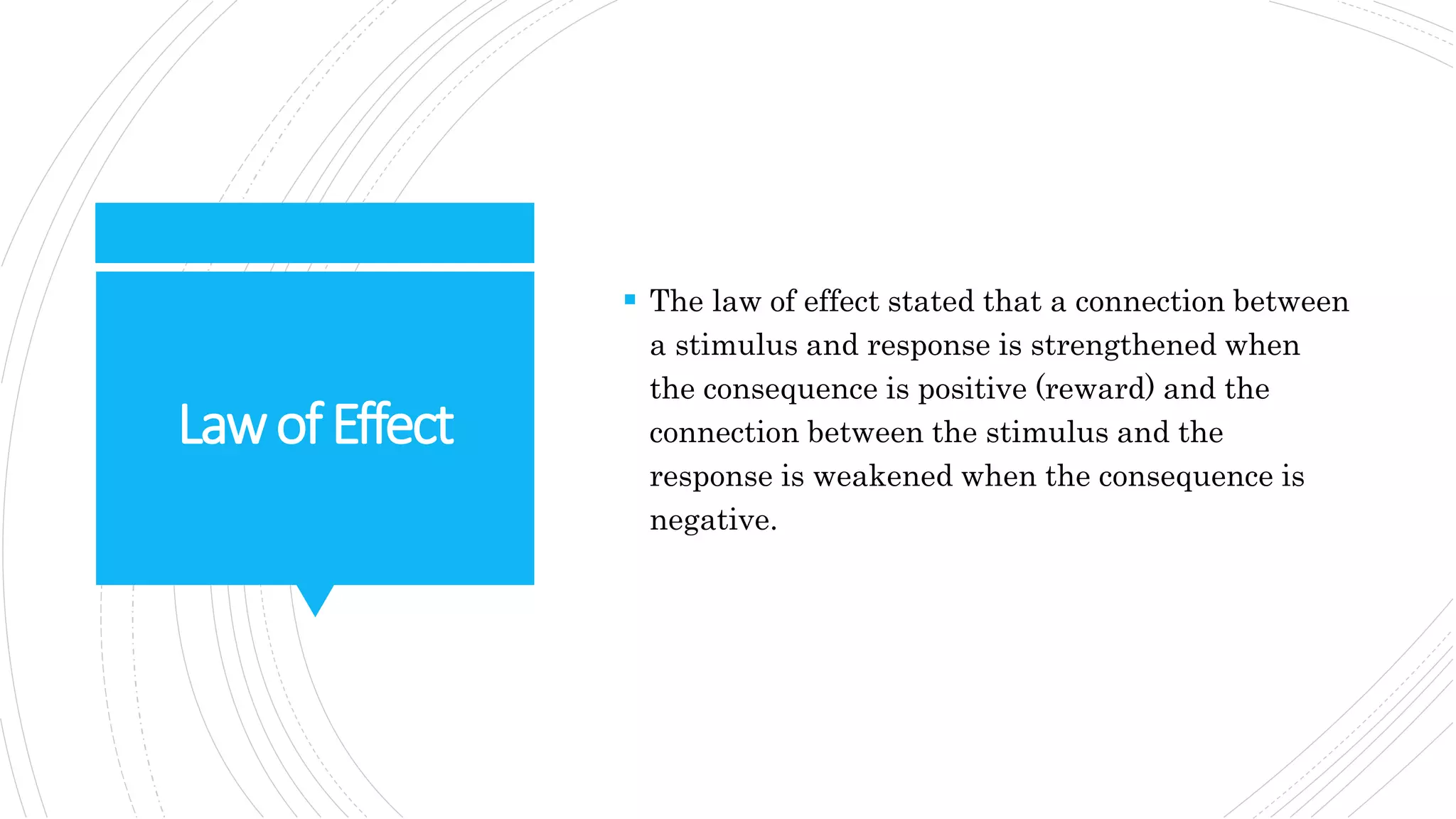
LawofEffect
 The law of effect stated that a connection between
a stimulus and response is strengthened when
the consequence is positive (reward) and the
connection between the stimulus and the
response is weakened when the consequence is
negative.
LawofExercise
 The more an S-R bond is practiced, the stronger
it will become. “Practice makes perfect” seem to
be associated with this. However, the law of
exercise had to be revised when Thorndike found
that practice without feedback does not
necessarily enhance performance.
Lawof
Readiness
 This states that the more readiness the learner
has to respond to the stimulus, the stronger will
be the bond between them. When a person is
ready to respond to a stimulus and is not made to
respond, it becomes annoying to the person.
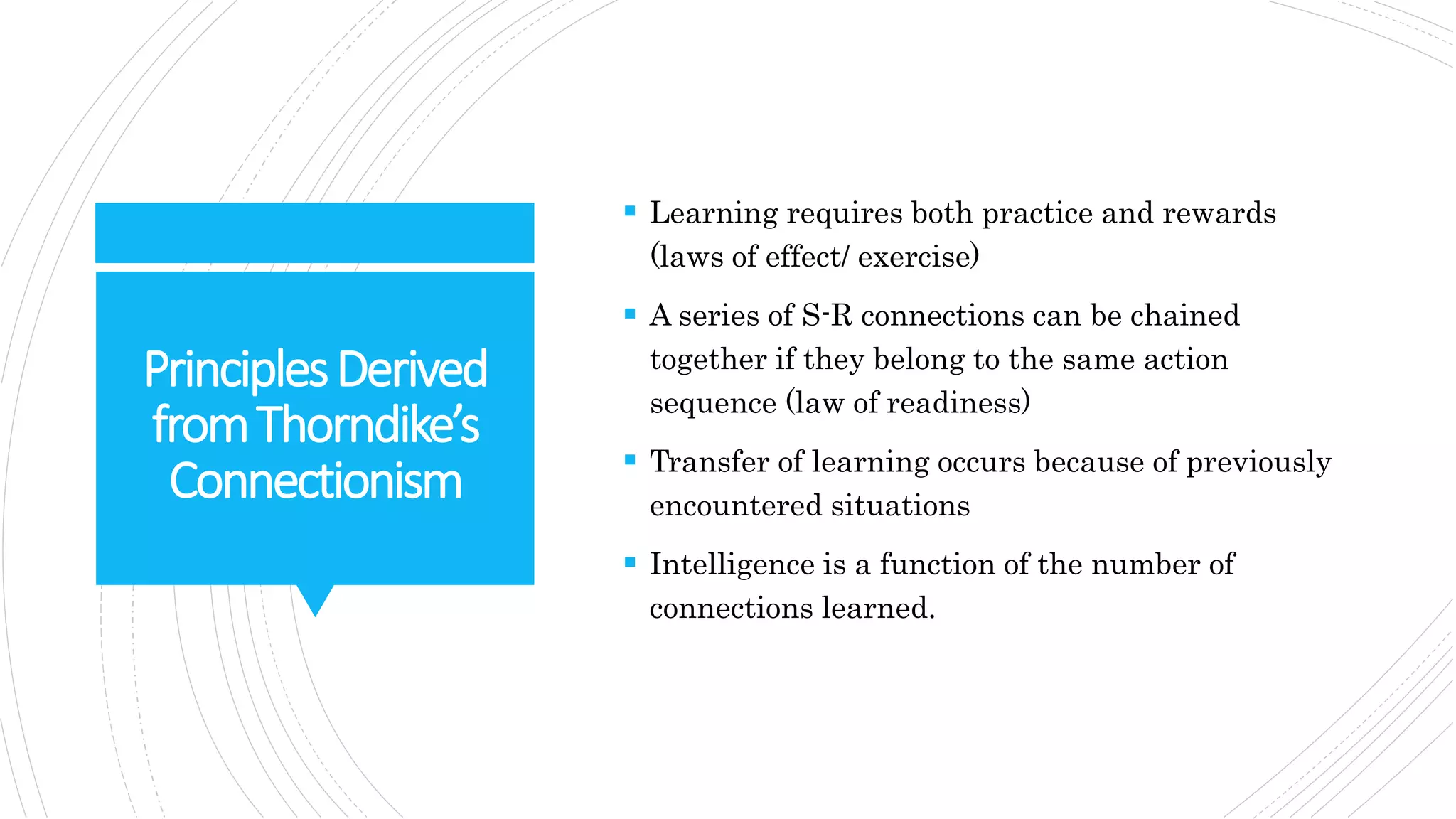
PrinciplesDerived
fromThorndike’s
Connectionism
 Learning requires both practice and rewards
(laws of effect/ exercise)
 A series of S-R connections can be chained
together if they belong to the same action
sequence (law of readiness)
 Transfer of learning occurs because of previously
encountered situations
 Intelligence is a function of the number of
connections learned.

Connectionism Theory

  • 1.
  • 2.
    EdwardLee Thorndike  Born August31, 1874, Williamsburg, Massachusetts  Died August 9, 1949, Montrose, New York  Graduated from Wesleyan University in 1895  Studied Animal Behavior with William James at Harvard University (1895-1897)  Received his Ph.D. at Columbia University (1898)  1911 – published his doctoral dissertation on Animal Intelligence (law of effect and exercise)
  • 3.
     Edward ThorndikeConnectionism theory gave us the original S-R framework of behavioral psychology. He explained that learning is the result of associations forming between stimuli and responses.  The model for S-R theory was trial and error learning in which certain responses came to be repeated than others because of rewards.
  • 4.
     Thorndike’s theoryon connectionism stated that learning has taken place when a strong connection or bond between stimulus and response is formed. He came up with three primary laws:  Law of Effect  Law of Exercise  Law of Readiness
  • 5.
    LawofEffect  The lawof effect stated that a connection between a stimulus and response is strengthened when the consequence is positive (reward) and the connection between the stimulus and the response is weakened when the consequence is negative.
  • 6.
    LawofExercise  The morean S-R bond is practiced, the stronger it will become. “Practice makes perfect” seem to be associated with this. However, the law of exercise had to be revised when Thorndike found that practice without feedback does not necessarily enhance performance.
  • 7.
    Lawof Readiness  This statesthat the more readiness the learner has to respond to the stimulus, the stronger will be the bond between them. When a person is ready to respond to a stimulus and is not made to respond, it becomes annoying to the person.
  • 8.
    PrinciplesDerived fromThorndike’s Connectionism  Learning requiresboth practice and rewards (laws of effect/ exercise)  A series of S-R connections can be chained together if they belong to the same action sequence (law of readiness)  Transfer of learning occurs because of previously encountered situations  Intelligence is a function of the number of connections learned.