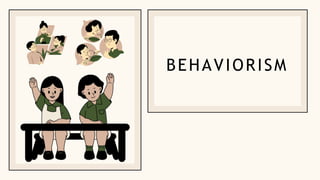
BEHAVIORISM
BEHAVIORISM
Behaviorism, also known as behavioral psychology,
is a theory of learning which states all behaviors
are learned through interaction with the
environment through a process called
conditioning. Thus, behavior is simply a response
to environmental stimuli.
BEHAVIORISM
Behaviorism is only concerned with
observable stimulus-response behaviors,
as they can be studied in a systematic
and observable manner.
BEHAVIORISM
The behaviorist movement began in 1913
when John B. Watson wrote an article
entitled 'Psychology as the behaviorist
views it,' which set out a number of
underlying assumptions regarding
methodology and behavioral analysis:
Tabula Rasa
Behaviorism emphasizes the role of environmental factors
in influencing behavior, to the near exclusion of innate or
inherited factors. This amounts essentially to a focus on
learning.
We learn new behavior through classical or operant
conditioning (collectively known as 'learning theory').
Therefore, when born our mind is 'tabula rasa' (a blank
slate).
Classical
Conditioning
vs Operant
Conditioning
CL ASSI CAL C O N DI TION ING
Classical conditioning is a process that
involves creating an association between a
naturally existing stimulus and a previously
neutral one.
OP ERAN T C O N DI TION ING
Operant conditioning (or instrumental
conditioning) focuses on using either
reinforcement or punishment to increase or
decrease a behavior. Through this process, an
association is formed between the behavior
and the consequences of that behavior.
CL ASSI CAL C ON DI TION ING VS
OP ERAN T C ON DI TION ING
Classical conditioning involves associating an
involuntary response and a stimulus, while operant
conditioning is about associating a voluntary behavior
and a consequence.
Example
Scenarios in
a classroom
Behaviorism
Reference:
Reference:
An example of behaviorism is when teachers
reward their class or certain students with a
party or special treat at the end of the week
for good behavior throughout the week. The
same concept is used with punishments. The
teacher can take away certain privileges if the
student misbehaves.
Scenarios: https://www.siue.edu/~ptheodo/foun
dations/behaviorism.html#:~:text=An
%20example%20of%20behaviorism%2
0is,privileges%20if%20the%20student
%20misbehaves.
Implications of Behaviorism in
Learning
Contracts
Behavior Modification
Consequences
Reinforcement
Extinction
Methods derived from
Behaviorist theory
Contracts
Effective in helping learners focus on
behavior change.
Behavior Modification
better performance
increasing self-esteem and confidence
established a pattern of success in engaging
in class discussions
POSITIVE
(Something
is added)
NEGATIVE
(Something
is removed)
REINFORCEMENT (Desired Behavior)
(Behavior Increases)
Ex: Smile and compliment student on
good performance
Increases the probability of a response
Ex: Give a free homework pass for
turning in all assignments
removing a consequence that a student
finds unpleasant
PUNISHMENT (Undesired Behavior)
(Behavior Decreases)
Ex: Give student detention for failing to
follow the class rules
Ex: Make student miss their time in
recess for not following the class rules
Consequences occur after the “target” behavior occurs
decreases the probability of a response by
contingent withdrawal of a previously
reinforced stimulus
Behavioral change occurs for a reason:
Students work for things that bring them positive feelings
for approval from people they admire.
to satisfy the desires they have learned to value.
They generally avoid behaviors they associate with unpleasantnessa and develop
habitual behaviors from those that are repeated often (Parkay & Hass, 2000)
Extinction
Implications of Behaviorism in
Teaching
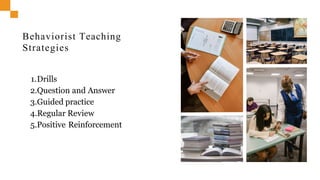
Behaviorist Teaching
Strategies
1.Drills
2.Question and Answer
3.Guided practice
4.Regular Review
5.Positive Reinforcement
1.) Drills
teachers may practice skills using drill patterns to
help students see the repetition and reinforcement
that behavioral learning theory uses.
2) Question and Answer
Teachers can use a question as a stimulus and
answer as a response gradually getting harder with
questions to help students.
3) Guided practice
Teachers can be directly involved in helping
students go through problems to give them the
reinforcement and behavior demonstration they
want them to follow.
4.) Regular Review
Reviews are important to behavioral learning theory
Going back over material and giving positive reinforcement
will help students retain information much better
5.) Positive Reinforcement
Behaviorist classrooms utilize positive reinforcement
regularly. This can be in the form of verbal reinforcement
and praise, reward systems, added privileges, and more
Implications of Behaviorism in
Classroom
It is the key for educators because it impacts how students react and behave in the
classroom
Teachers can directly in fluence how their students behave
It helps teachers understand that a student’s home environment and lifestyle can
be impacting their behavior.
Key in understanding on how to motivate and help students
The teaching environment shapes the behavior of the learners
Students should be given positive reinforcement by teachers to motivate learners
Teachers should not give too much negative reinforcement to the learners while
teaching
Teachers should note that learning is not new knowledge but acquired new
behavior
Learners should be motivated and encouraged by the teachers so that they enjoy
and take interest in learning
Rewarding students for working well with commendations or praise points (even
with vocal praise) will make the students to behave or to strive for better work
Careful analyzing and sequencing of the learners’ needs
and behaviors.
1
Specify the desire outcomes, what needs to be
changed, and how it will evaluated.
Abundant drills
2
4 Programmed instructions
3
Implication
in
Curriculum
Implicaton on Curriculum https://www.slideshare.net/masoud5912/behaviorism-
education-curriculum
Implication on Learning
Standridge, M.. (2002). Behaviorism. In M. Orey (Ed.), Emerging perspectives on learning,
teaching, and technology. Retrieved <July 12, 2022>, from https://learn-
u.com/lesson/behaviorism/
Implication on Teaching
https://youtu.be/cpWcqxnFEP4 /Behaviorism in Education
www.verywellmind.com/classical-vs-operant-conditioning-2794861#toc-classical-vs-
operant-conditioning?utm_source=canva&utm_medium=iframely
•

Behaviorism.pptx

  • 1.
  • 2.
    BEHAVIORISM Behaviorism, also knownas behavioral psychology, is a theory of learning which states all behaviors are learned through interaction with the environment through a process called conditioning. Thus, behavior is simply a response to environmental stimuli.
  • 3.
    BEHAVIORISM Behaviorism is onlyconcerned with observable stimulus-response behaviors, as they can be studied in a systematic and observable manner.
  • 4.
    BEHAVIORISM The behaviorist movementbegan in 1913 when John B. Watson wrote an article entitled 'Psychology as the behaviorist views it,' which set out a number of underlying assumptions regarding methodology and behavioral analysis:
  • 5.
    Tabula Rasa Behaviorism emphasizesthe role of environmental factors in influencing behavior, to the near exclusion of innate or inherited factors. This amounts essentially to a focus on learning. We learn new behavior through classical or operant conditioning (collectively known as 'learning theory'). Therefore, when born our mind is 'tabula rasa' (a blank slate).
  • 6.
    Classical Conditioning vs Operant Conditioning CL ASSICAL C O N DI TION ING Classical conditioning is a process that involves creating an association between a naturally existing stimulus and a previously neutral one. OP ERAN T C O N DI TION ING Operant conditioning (or instrumental conditioning) focuses on using either reinforcement or punishment to increase or decrease a behavior. Through this process, an association is formed between the behavior and the consequences of that behavior. CL ASSI CAL C ON DI TION ING VS OP ERAN T C ON DI TION ING Classical conditioning involves associating an involuntary response and a stimulus, while operant conditioning is about associating a voluntary behavior and a consequence.
  • 7.
  • 8.
    Reference: Reference: An example ofbehaviorism is when teachers reward their class or certain students with a party or special treat at the end of the week for good behavior throughout the week. The same concept is used with punishments. The teacher can take away certain privileges if the student misbehaves. Scenarios: https://www.siue.edu/~ptheodo/foun dations/behaviorism.html#:~:text=An %20example%20of%20behaviorism%2 0is,privileges%20if%20the%20student %20misbehaves.
  • 9.
  • 10.
  • 11.
    Contracts Effective in helpinglearners focus on behavior change. Behavior Modification better performance increasing self-esteem and confidence established a pattern of success in engaging in class discussions
  • 12.
    POSITIVE (Something is added) NEGATIVE (Something is removed) REINFORCEMENT(Desired Behavior) (Behavior Increases) Ex: Smile and compliment student on good performance Increases the probability of a response Ex: Give a free homework pass for turning in all assignments removing a consequence that a student finds unpleasant PUNISHMENT (Undesired Behavior) (Behavior Decreases) Ex: Give student detention for failing to follow the class rules Ex: Make student miss their time in recess for not following the class rules Consequences occur after the “target” behavior occurs
  • 13.
    decreases the probabilityof a response by contingent withdrawal of a previously reinforced stimulus Behavioral change occurs for a reason: Students work for things that bring them positive feelings for approval from people they admire. to satisfy the desires they have learned to value. They generally avoid behaviors they associate with unpleasantnessa and develop habitual behaviors from those that are repeated often (Parkay & Hass, 2000) Extinction
  • 14.
  • 15.
    Behaviorist Teaching Strategies 1.Drills 2.Question andAnswer 3.Guided practice 4.Regular Review 5.Positive Reinforcement
  • 16.
    1.) Drills teachers maypractice skills using drill patterns to help students see the repetition and reinforcement that behavioral learning theory uses. 2) Question and Answer Teachers can use a question as a stimulus and answer as a response gradually getting harder with questions to help students. 3) Guided practice Teachers can be directly involved in helping students go through problems to give them the reinforcement and behavior demonstration they want them to follow.
  • 17.
    4.) Regular Review Reviewsare important to behavioral learning theory Going back over material and giving positive reinforcement will help students retain information much better 5.) Positive Reinforcement Behaviorist classrooms utilize positive reinforcement regularly. This can be in the form of verbal reinforcement and praise, reward systems, added privileges, and more
  • 18.
  • 19.
    It is thekey for educators because it impacts how students react and behave in the classroom Teachers can directly in fluence how their students behave It helps teachers understand that a student’s home environment and lifestyle can be impacting their behavior. Key in understanding on how to motivate and help students The teaching environment shapes the behavior of the learners Students should be given positive reinforcement by teachers to motivate learners
  • 20.
    Teachers should notgive too much negative reinforcement to the learners while teaching Teachers should note that learning is not new knowledge but acquired new behavior Learners should be motivated and encouraged by the teachers so that they enjoy and take interest in learning Rewarding students for working well with commendations or praise points (even with vocal praise) will make the students to behave or to strive for better work
  • 22.
    Careful analyzing andsequencing of the learners’ needs and behaviors. 1 Specify the desire outcomes, what needs to be changed, and how it will evaluated. Abundant drills 2 4 Programmed instructions 3 Implication in Curriculum
  • 23.
    Implicaton on Curriculumhttps://www.slideshare.net/masoud5912/behaviorism- education-curriculum Implication on Learning Standridge, M.. (2002). Behaviorism. In M. Orey (Ed.), Emerging perspectives on learning, teaching, and technology. Retrieved <July 12, 2022>, from https://learn- u.com/lesson/behaviorism/ Implication on Teaching https://youtu.be/cpWcqxnFEP4 /Behaviorism in Education www.verywellmind.com/classical-vs-operant-conditioning-2794861#toc-classical-vs- operant-conditioning?utm_source=canva&utm_medium=iframely •