Created by: Hailey E.
Victoria N.
Felicia P.
Behaviorism
 The prediction and control of human behavior in
which introspection and/or independent thinking
play no essential part of its teaching method
 A worldview that operates on a principle of
“stimulus-response”
 All behavior can be explained without the need
to consider internal mental states or
consciousness.
 Behaviors recognize no dividing line between
man and animal-both learn to behave solely
through a system of positive and negative
rewards.
“Behaviorists such as Pavlov, Skinner, Watson, and
Bandura have contributed a great deal to the
understanding of human behavior.”
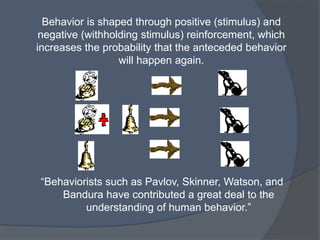
Behavior is shaped through positive (stimulus) and
negative (withholding stimulus) reinforcement, which
increases the probability that the anteceded behavior
will happen again.
Ivan Pavlov (1849-1936)
 Famous for his behavioral experiments
with dogs
 Used a type of conditioning to teach dogs
to salivate when he rang a bell-Classical
Conditioning
 Scientist who used these experiments to
study digestion, but as a result, other
behaviorists studied his work as an
example of stimulus response
 Won Noble Prize in Physiology in 1904
B.F Skinner (1904-1990)
 Operant Conditioning- describes learning
that is controlled and results in shaping
behavior through the reinforcement of
stimulus response patterns
 Conducted experiments with pigeons and
rewarded them when he saw them
behaving in a desired manner
 Ultimately, he taught them to engage in
complex tasks such as bowling in a
specially constructed alley.
 Found reinforcement as a powerful
motivator
John Watson (1878-1958)
 Conducted the “Little Albert” Experiment-
conditioned small children to fear white rats
 He accomplished this by repeatedly pairing
white rats with a loud frightening noise
 Demonstrated that this fear could be
generalized to other white furry objects
 Graduated from Furman University with a
Masters Degree
 Earned a Ph.D.in Psychology at the
University of Chicago
Albert Bandura (1925-present)
 Famous on ideas for social learning, which he
renamed Social Cognitive Theory
 Believes that people acquire behaviors first
through the observation of others and then by
using those observations to imitate what they
have observed
 Has focused his worked on the concept of self-
efficacy, a personal observation about one’s
perceived ability to feel, think, and motivate
one’s self to learn
 Also focused on imagery, a persons ability to
retain information through images in the mind
Ivan Pavlov
Graduated from
University of St.
Petersburg
Then entered
Military Medical
Academy
B.F Skinner
Entered Psychology
Department of Harvard
University
Invented cumulative
recorder
Albert Bandura
 Graduated from
University of British
Columbia with Bolocan
Award in Psychology
Classroom Implications
Teacher Student
 Reward students based
on their behavior with
extra computer time.
(with technology)
 Reward students with
extra credit points,
prizes, homework pass,
food, and recognition.
(without technology)
 Through positive
reinforcement, student is
motivated to do better
and succeed.
 Through negative
reinforcement, student
becomes discouraged
and indifferent about
assignments.
Thoughts on Theory
 Good way of modifying classroom behavior
 Great way to make students understand how they
should behave in a classroom setting
 Allows student to understand that good behaviors
are rewarded and bad behaviors are punished
 Important to teach students at a young age that
behavior has positive and negative outcomes-
reward motivates a student to work harder, while
opposition makes a student feel inadequate
References
 http://www.nobelprize.org/nobel_prizes/medicine/laur
eates/1904/pavlov-bio.html
 http://psychology.about.com/od/profilesofmajorthinke
rs/p/watson.htmhttp://www.bfskinner.org/BFSkinner/
Home.html
 http://www.des.emory.edu/mfp/bandurabio.html
 http://projects.coe.uga.edu/epltt/index.php?title=Beh
aviorism
 http://5122psychology.pbworks.com/w/page/992126/
Albert%20Bandura
 http://www.skeptically.org/skinner/id3.html
 http://www.nobelprize.org/nobel_prizes/medicine/laur
eates/1904/pavlov-bio.html

Learning Theories- Behaviorism

  • 1.
    Created by: HaileyE. Victoria N. Felicia P.
  • 2.
    Behaviorism  The predictionand control of human behavior in which introspection and/or independent thinking play no essential part of its teaching method  A worldview that operates on a principle of “stimulus-response”  All behavior can be explained without the need to consider internal mental states or consciousness.  Behaviors recognize no dividing line between man and animal-both learn to behave solely through a system of positive and negative rewards.
  • 3.
    “Behaviorists such asPavlov, Skinner, Watson, and Bandura have contributed a great deal to the understanding of human behavior.” Behavior is shaped through positive (stimulus) and negative (withholding stimulus) reinforcement, which increases the probability that the anteceded behavior will happen again.
  • 4.
    Ivan Pavlov (1849-1936) Famous for his behavioral experiments with dogs  Used a type of conditioning to teach dogs to salivate when he rang a bell-Classical Conditioning  Scientist who used these experiments to study digestion, but as a result, other behaviorists studied his work as an example of stimulus response  Won Noble Prize in Physiology in 1904
  • 5.
    B.F Skinner (1904-1990) Operant Conditioning- describes learning that is controlled and results in shaping behavior through the reinforcement of stimulus response patterns  Conducted experiments with pigeons and rewarded them when he saw them behaving in a desired manner  Ultimately, he taught them to engage in complex tasks such as bowling in a specially constructed alley.  Found reinforcement as a powerful motivator
  • 6.
    John Watson (1878-1958) Conducted the “Little Albert” Experiment- conditioned small children to fear white rats  He accomplished this by repeatedly pairing white rats with a loud frightening noise  Demonstrated that this fear could be generalized to other white furry objects  Graduated from Furman University with a Masters Degree  Earned a Ph.D.in Psychology at the University of Chicago
  • 7.
    Albert Bandura (1925-present) Famous on ideas for social learning, which he renamed Social Cognitive Theory  Believes that people acquire behaviors first through the observation of others and then by using those observations to imitate what they have observed  Has focused his worked on the concept of self- efficacy, a personal observation about one’s perceived ability to feel, think, and motivate one’s self to learn  Also focused on imagery, a persons ability to retain information through images in the mind
  • 8.
    Ivan Pavlov Graduated from Universityof St. Petersburg Then entered Military Medical Academy B.F Skinner Entered Psychology Department of Harvard University Invented cumulative recorder Albert Bandura  Graduated from University of British Columbia with Bolocan Award in Psychology
  • 9.
    Classroom Implications Teacher Student Reward students based on their behavior with extra computer time. (with technology)  Reward students with extra credit points, prizes, homework pass, food, and recognition. (without technology)  Through positive reinforcement, student is motivated to do better and succeed.  Through negative reinforcement, student becomes discouraged and indifferent about assignments.
  • 10.
    Thoughts on Theory Good way of modifying classroom behavior  Great way to make students understand how they should behave in a classroom setting  Allows student to understand that good behaviors are rewarded and bad behaviors are punished  Important to teach students at a young age that behavior has positive and negative outcomes- reward motivates a student to work harder, while opposition makes a student feel inadequate
  • 11.
    References  http://www.nobelprize.org/nobel_prizes/medicine/laur eates/1904/pavlov-bio.html  http://psychology.about.com/od/profilesofmajorthinke rs/p/watson.htmhttp://www.bfskinner.org/BFSkinner/ Home.html http://www.des.emory.edu/mfp/bandurabio.html  http://projects.coe.uga.edu/epltt/index.php?title=Beh aviorism  http://5122psychology.pbworks.com/w/page/992126/ Albert%20Bandura  http://www.skeptically.org/skinner/id3.html  http://www.nobelprize.org/nobel_prizes/medicine/laur eates/1904/pavlov-bio.html