BEHAVIORISM
AN OVERALL LOOK AND ITS INFLUENCES IN THE ACQUISITION OF ENGLISH AS A SECOND LANGUAGE
JOSSETTE TAVERAS, YARELLYS NEVÁREZ AND ELISA ROSAS
EDUC 501
PROFESSOR K.A. BARON
APRIL 5, 2015
Behaviorism
 Assumes that a learner is essentially passive,
responding to environmental stimuli
 Believes that a learner starts out with a “tabula
rassa”clean slate, and behavior is shaped by positive
and negative reinforcement
 Reinforcement, positive or negative, increases the
possibility of an event happening again
Behaviorism
 Positive reinforcement is the application of a stimulus
 Negative reinforcement is the withdrawal of a
stimulus
 Is a precursor to cognitive learning.
Behaviorism
Theory of Classical Conditioning
Ivan Pavlov
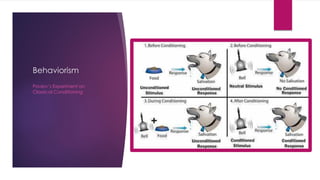
 After doing this for a certain period of
time, Pavlov would ring the bell without
presenting food. The dogs would salivate
just from the sound of the bell.
 The connection the dogs made
between the bell ringing and the food,
caused the dogs to associate the two,
so they responded to the bell even
without the presence of the food.
 Did the experiment with the dogs.
 Ivan Pavlov did a famous
experiment that demonstrates the
theory of classical conditioning (or
respondent conditioning).
 Every time Pavlov would bring put
out the dogs’ food he would ring a
bell.
Behaviorism
Pavlov’s Experiment on
Classical Conditioning
Behaviorism
Theory of Classical Conditioning
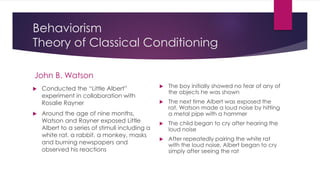
 Conducted the “Little Albert”
experiment in collaboration with
Rosalie Rayner
 Around the age of nine months,
Watson and Rayner exposed Little
Albert to a series of stimuli including a
white rat, a rabbit, a monkey, masks
and burning newspapers and
observed his reactions
 The boy initially showed no fear of any of
the objects he was shown
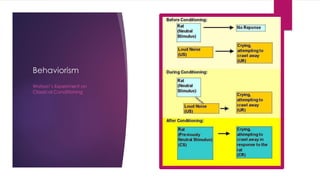
 The next time Albert was exposed the
rat, Watson made a loud noise by hitting
a metal pipe with a hammer
 The child began to cry after hearing the
loud noise
 After repeatedly pairing the white rat
with the loud noise, Albert began to cry
simply after seeing the rat
John B. Watson
Behaviorism
Watson’s Experiment on
Classical Conditioning
Behaviorism
Theory of Operant Conditioning
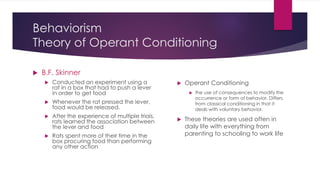
 B.F. Skinner
 Conducted an experiment using a
rat in a box that had to push a lever
in order to get food
 Whenever the rat pressed the lever,
food would be released.
 After the experience of multiple trials,
rats learned the association between
the lever and food
 Rats spent more of their time in the
box procuring food than performing
any other action
 Operant Conditioning
 the use of consequences to modify the
occurrence or form of behavior. Differs
from classical conditioning in that it
deals with voluntary behavior.
 These theories are used often in
daily life with everything from
parenting to schooling to work life
Behaviorism
Skinner’s Experiment on
Operant Conditioning
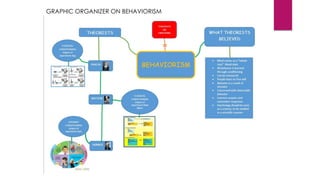
GRAPHIC ORGANIZER ON BEHAVIORISM
Behaviorism
Strengths
 Based upon observable behaviors, so it is easier to quantify and collect
data and information when conducting research
 Effective therapeutic techniques such as intensive behavioral intervention,
behavior analysis, token economies, and discrete trial training are all
rooted in behaviorism
 These approaches are often very useful in changing harmful behaviors in
both children and adults
Behaviorism
Weaknesses
 It is a one-dimensional approach to understanding human behavior
 behavioral theories do not account for free will and internal influences
such as moods, thoughts, and feelings
 Does not account for other types of learning, especially learning that
occurs without the use of reinforcement and punishment
 People and animals are able to adapt their behavior when new
information is introduced, even if a previous behavior pattern has been
established through reinforcement.
Behaviorism & The Acquisition of
English as a Second Language
 PROS
 People learn a new language according to the very same principles that they
identified to child language acquisition
 They imitate words, for example and are rewarded when people understand
what they say(positive reinforcement)
 They repeat the process, it becomes a “habit” and it is therefore learned
 In contrast, when they use a wrong pattern in the new language, they are
“punished” by others not understanding them
 Therefore this pattern is not repeated
Behaviorism & The Acquisition of
English as a Second Language
 CONS
 Behaviorists recognize that second language(L2) learning must
logically differ from first language(L1) acquisition where one of the
most crucial assumptions is the learners are older and hence no longer
a “tabula rasa”
 The language patterns learned from their first language have already
become habits
 Where the new language is very similar to the L1, this is not a problem.
Behaviorism & The Acquisition of
English as a Second Language
 CONS (continued)
 When the new language is quite different from the L1
 this leads to the problem of L1 transfer and interference
 The learner applies L1 patterns to the new language out of habit, and this leads
to using wrong patterns in the new language
 If uncorrected, these errors become habits in the new language, and thus, the
learner fails to learn the language correctly
 A great example of this is when Puerto Rican adults emigrated to the United States. Their
first language being Spanish, they had to learn from the spoken language, therefore
many times they were not corrected and used incorrect terms in English, particularly verb
tense or the absence of verbs: “You new here?
Behaviorism
Conclusions
 Students in behaviorism
 “tabula rasa”- they receive information from the teacher
 Receives orders-obedient
 Requires constant approval
 Depends on the teacher
 Passive in the teaching-learning process
 Tasks performed require that the behavior can be directly observed,
measured and evaluated
Behaviorism
Conclusions
 Teachers in behaviorism
 Are the providers of knowledge
 The central figure of the educational process
 Imparts education
 Centralizes authority and decisions
 Diagnoses the instructional needs
 Designs conditions for instruction
 Conducts instruction
 Manages evaluation techniques
Behaviorism
Conclusions
 Finally it may be added that behaviorism is the
conditioning of the students and therefore there is no
direct competition between students but within
themselves to inhibit undesired behaviors or attitudes.
Therefore the interaction between students is
unnecessary. With this being said, we may add that the
behaviorist approach is based in the vertical
relationship between the teacher and the students with
the teacher having the superior role.
Behaviorism
Any questions?
Behaviorism
Behaviorism
References:
Behaviourism 101. (n.d.). Retrieved from
https://www.youtube.com/watch?v=RU0zEGWp56Y
Cherry, K. (n.d.). Behaviorism: What it is and how it works. Retrieved from
http://psychology.about.com/od/behavioralpsychology/f/behaviorism.htm
Conductismo. (n.d.). Retrieved from http://uoctic-
grupo6.wikispaces.com/Conductismo#x1.%20Caracter%C3%ADsticas%20dife
renciales%20de%20la%20teor%C3%ADa

Presentation on behaviorism

  • 1.
    BEHAVIORISM AN OVERALL LOOKAND ITS INFLUENCES IN THE ACQUISITION OF ENGLISH AS A SECOND LANGUAGE JOSSETTE TAVERAS, YARELLYS NEVÁREZ AND ELISA ROSAS EDUC 501 PROFESSOR K.A. BARON APRIL 5, 2015
  • 2.
    Behaviorism  Assumes thata learner is essentially passive, responding to environmental stimuli  Believes that a learner starts out with a “tabula rassa”clean slate, and behavior is shaped by positive and negative reinforcement  Reinforcement, positive or negative, increases the possibility of an event happening again
  • 3.
    Behaviorism  Positive reinforcementis the application of a stimulus  Negative reinforcement is the withdrawal of a stimulus  Is a precursor to cognitive learning.
  • 4.
    Behaviorism Theory of ClassicalConditioning Ivan Pavlov  After doing this for a certain period of time, Pavlov would ring the bell without presenting food. The dogs would salivate just from the sound of the bell.  The connection the dogs made between the bell ringing and the food, caused the dogs to associate the two, so they responded to the bell even without the presence of the food.  Did the experiment with the dogs.  Ivan Pavlov did a famous experiment that demonstrates the theory of classical conditioning (or respondent conditioning).  Every time Pavlov would bring put out the dogs’ food he would ring a bell.
  • 5.
  • 6.
    Behaviorism Theory of ClassicalConditioning  Conducted the “Little Albert” experiment in collaboration with Rosalie Rayner  Around the age of nine months, Watson and Rayner exposed Little Albert to a series of stimuli including a white rat, a rabbit, a monkey, masks and burning newspapers and observed his reactions  The boy initially showed no fear of any of the objects he was shown  The next time Albert was exposed the rat, Watson made a loud noise by hitting a metal pipe with a hammer  The child began to cry after hearing the loud noise  After repeatedly pairing the white rat with the loud noise, Albert began to cry simply after seeing the rat John B. Watson
  • 7.
  • 8.
    Behaviorism Theory of OperantConditioning  B.F. Skinner  Conducted an experiment using a rat in a box that had to push a lever in order to get food  Whenever the rat pressed the lever, food would be released.  After the experience of multiple trials, rats learned the association between the lever and food  Rats spent more of their time in the box procuring food than performing any other action  Operant Conditioning  the use of consequences to modify the occurrence or form of behavior. Differs from classical conditioning in that it deals with voluntary behavior.  These theories are used often in daily life with everything from parenting to schooling to work life
  • 9.
  • 10.
  • 11.
    Behaviorism Strengths  Based uponobservable behaviors, so it is easier to quantify and collect data and information when conducting research  Effective therapeutic techniques such as intensive behavioral intervention, behavior analysis, token economies, and discrete trial training are all rooted in behaviorism  These approaches are often very useful in changing harmful behaviors in both children and adults
  • 12.
    Behaviorism Weaknesses  It isa one-dimensional approach to understanding human behavior  behavioral theories do not account for free will and internal influences such as moods, thoughts, and feelings  Does not account for other types of learning, especially learning that occurs without the use of reinforcement and punishment  People and animals are able to adapt their behavior when new information is introduced, even if a previous behavior pattern has been established through reinforcement.
  • 13.
    Behaviorism & TheAcquisition of English as a Second Language  PROS  People learn a new language according to the very same principles that they identified to child language acquisition  They imitate words, for example and are rewarded when people understand what they say(positive reinforcement)  They repeat the process, it becomes a “habit” and it is therefore learned  In contrast, when they use a wrong pattern in the new language, they are “punished” by others not understanding them  Therefore this pattern is not repeated
  • 14.
    Behaviorism & TheAcquisition of English as a Second Language  CONS  Behaviorists recognize that second language(L2) learning must logically differ from first language(L1) acquisition where one of the most crucial assumptions is the learners are older and hence no longer a “tabula rasa”  The language patterns learned from their first language have already become habits  Where the new language is very similar to the L1, this is not a problem.
  • 15.
    Behaviorism & TheAcquisition of English as a Second Language  CONS (continued)  When the new language is quite different from the L1  this leads to the problem of L1 transfer and interference  The learner applies L1 patterns to the new language out of habit, and this leads to using wrong patterns in the new language  If uncorrected, these errors become habits in the new language, and thus, the learner fails to learn the language correctly  A great example of this is when Puerto Rican adults emigrated to the United States. Their first language being Spanish, they had to learn from the spoken language, therefore many times they were not corrected and used incorrect terms in English, particularly verb tense or the absence of verbs: “You new here?
  • 16.
    Behaviorism Conclusions  Students inbehaviorism  “tabula rasa”- they receive information from the teacher  Receives orders-obedient  Requires constant approval  Depends on the teacher  Passive in the teaching-learning process  Tasks performed require that the behavior can be directly observed, measured and evaluated
  • 17.
    Behaviorism Conclusions  Teachers inbehaviorism  Are the providers of knowledge  The central figure of the educational process  Imparts education  Centralizes authority and decisions  Diagnoses the instructional needs  Designs conditions for instruction  Conducts instruction  Manages evaluation techniques
  • 18.
    Behaviorism Conclusions  Finally itmay be added that behaviorism is the conditioning of the students and therefore there is no direct competition between students but within themselves to inhibit undesired behaviors or attitudes. Therefore the interaction between students is unnecessary. With this being said, we may add that the behaviorist approach is based in the vertical relationship between the teacher and the students with the teacher having the superior role.
  • 19.
  • 20.
  • 21.
    Behaviorism References: Behaviourism 101. (n.d.).Retrieved from https://www.youtube.com/watch?v=RU0zEGWp56Y Cherry, K. (n.d.). Behaviorism: What it is and how it works. Retrieved from http://psychology.about.com/od/behavioralpsychology/f/behaviorism.htm Conductismo. (n.d.). Retrieved from http://uoctic- grupo6.wikispaces.com/Conductismo#x1.%20Caracter%C3%ADsticas%20dife renciales%20de%20la%20teor%C3%ADa