Click to edit Master text styles
Google Analytics
What is Google Analytics?
Author: Lee Trevena
October 2015
licensed under the Creative Commons Attribution 3.0 License
Click to edit Master text styles
What is Google Analytics?
1
2
3
A good basic description:
Continued onto next page…
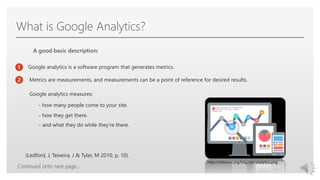
Google analytics is a software program that generates metrics.
Metrics are measurements, and measurements can be a point of reference for desired results.
Google analytics measures:
- how many people come to your site.
- how they get there.
- and what they do while they're there.
(Ledford, J, Teixeira, J & Tyler, M 2010, p. 10).
http://infonion.org/img/site/analytics.png
Click to edit Master text stylesAn important aspect in the above explanation is identifying how those measurements are attained.
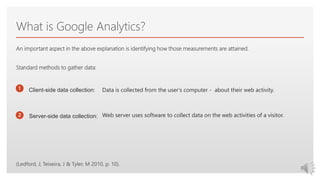
Standard methods to gather data:
What is Google Analytics?
Data is collected from the user’s computer - about their web activity.
Web server uses software to collect data on the web activities of a visitor.
1
2
(Ledford, J, Teixeira, J & Tyler, M 2010, p. 10).
Client-side data collection:
Server-side data collection:
Click to edit Master text styles
What is Google Analytics?
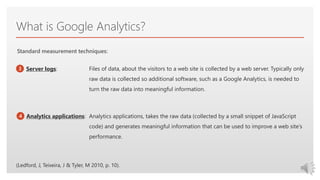
Files of data, about the visitors to a web site is collected by a web server. Typically only
raw data is collected so additional software, such as a Google Analytics, is needed to
turn the raw data into meaningful information.
Analytics applications, takes the raw data (collected by a small snippet of JavaScript
code) and generates meaningful information that can be used to improve a web site’s
performance.
Standard measurement techniques:
3
4
Server logs:
Analytics applications:
(Ledford, J, Teixeira, J & Tyler, M 2010, p. 10).
Click to edit Master text styles
What are the benefits to business?
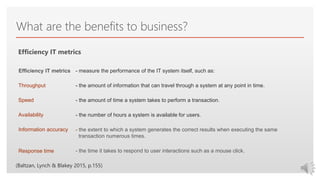
Efficiency IT metrics
- measure the performance of the IT system itself, such as:
- the amount of information that can travel through a system at any point in time.
- the amount of time a system takes to perform a transaction.
- the number of hours a system is available for users.
- the extent to which a system generates the correct results when executing the same
transaction numerous times.
- the time it takes to respond to user interactions such as a mouse click.
Efficiency IT metrics
Throughput
Speed
Availability
Information accuracy
Response time
(Baltzan, Lynch & Blakey 2015, p.155)
Click to edit Master text styles
What are the benefits to business?
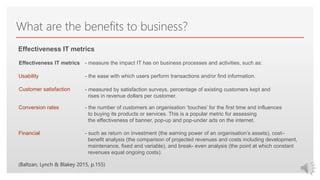
- measure the impact IT has on business processes and activities, such as:
- the ease with which users perform transactions and/or find information.
- measured by satisfaction surveys, percentage of existing customers kept and
rises in revenue dollars per customer.
- the number of customers an organisation ‘touches’ for the first time and influences
to buying its products or services. This is a popular metric for assessing
the effectiveness of banner, pop-up and pop-under ads on the internet.
Effectiveness IT metrics
- such as return on investment (the earning power of an organisation’s assets), cost–
benefit analysis (the comparison of projected revenues and costs including development,
maintenance, fixed and variable), and break- even analysis (the point at which constant
revenues equal ongoing costs).
Effectiveness IT metrics
Usability
Customer satisfaction
Conversion rates
Financial
(Baltzan, Lynch & Blakey 2015, p.155)
Click to edit Master text styles
What are the benefits to business?
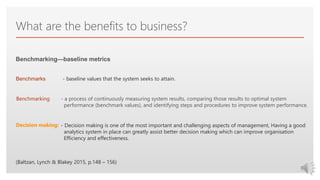
Benchmarking—baseline metrics
- baseline values that the system seeks to attain.
- a process of continuously measuring system results, comparing those results to optimal system
performance (benchmark values), and identifying steps and procedures to improve system performance.
Benchmarks
Benchmarking
- Decision making is one of the most important and challenging aspects of management, Having a good
analytics system in place can greatly assist better decision making which can improve organisation
Efficiency and effectiveness.
Decision making:
(Baltzan, Lynch & Blakey 2015, p.148 – 156)
Click to edit Master text styles
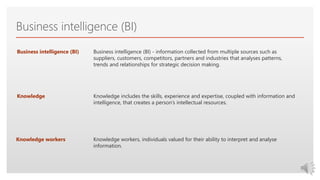
Business intelligence (BI)
Business intelligence (BI) - information collected from multiple sources such as
suppliers, customers, competitors, partners and industries that analyses patterns,
trends and relationships for strategic decision making.
Business intelligence (BI)
Knowledge includes the skills, experience and expertise, coupled with information and
intelligence, that creates a person’s intellectual resources.
Knowledge
Knowledge workers, individuals valued for their ability to interpret and analyse
information.
Knowledge workers
Click to edit Master text styles
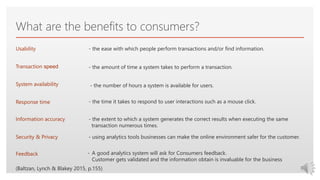
What are the benefits to consumers?
- the ease with which people perform transactions and/or find information.
Transaction speed - the amount of time a system takes to perform a transaction.
Usability
- the number of hours a system is available for users.System availability
- the time it takes to respond to user interactions such as a mouse click.Response time
- the extent to which a system generates the correct results when executing the same
transaction numerous times.
Information accuracy
Security & Privacy - using analytics tools businesses can make the online environment safer for the customer.
Feedback - A good analytics system will ask for Consumers feedback.
Customer gets validated and the information obtain is invaluable for the business
(Baltzan, Lynch & Blakey 2015, p.155)
Click to edit Master text styles
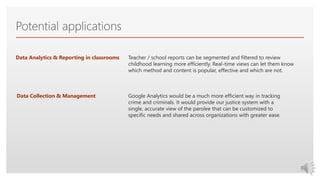
Potential applications
Data Analytics & Reporting in classrooms Teacher / school reports can be segmented and filtered to review
childhood learning more efficiently. Real-time views can let them know
which method and content is popular, effective and which are not.
Data Collection & Management Google Analytics would be a much more efficient way in tracking
crime and criminals. It would provide our justice system with a
single, accurate view of the parolee that can be customized to
specific needs and shared across organizations with greater ease.
Click to edit Master text styles
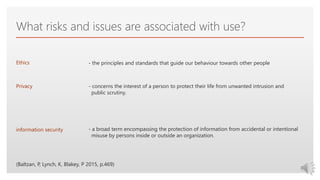
What risks and issues are associated with use?
Ethics
Privacy
information security
- the principles and standards that guide our behaviour towards other people
- concerns the interest of a person to protect their life from unwanted intrusion and
public scrutiny.
- a broad term encompassing the protection of information from accidental or intentional
misuse by persons inside or outside an organization.
(Baltzan, P, Lynch, K, Blakey, P 2015, p.469)
Click to edit Master text styles
Examples of future applications for this information
technology
Content customisation & Personalisation - Greater emphasis on content customisation
Robots - In the future Google Analytics could track the activities and
performance of humanoid like robots.
Space exploration - Analytics technology will be used to enhance space programs.
Analytics will provided greater insight and greater accuracy for decision
making
(Singh, K 2015).
(Tung, L 2015)
Bio-Technology - Analytics technology will be used in bio-technology to measure things like
Healthcare, security and military activities.
Bibliography
AdWords, 2011, Google Analytics: The What, The Why, The How, 19 July, viewed 12 October 2015,
<https://www.youtube.com/watch?v=opwrGPKcfYw>.
Baltzan, P, Lynch, K, Blakey, P 2015, Business Driven Information Systems, 2nd edn, McGraw-Hill, VitalBook.
Google Analytics, 2015, Features, Google Analytics, viewed 17th October 2015,
<https://www.google.com/analytics/standard/features/>.
Google Analytics, 2015, The importance of digital analytics, viewed 25th October 2015
<https://support.google.com/analytics/answer/6080732?hl=en/>.
Ledford, J, Teixeira, J, Tyler 2010, Google Analytics, 3rd edn, John Wiley & Sons, Safari Tech Books Online.
Tung, L 2015, From robotics to analytics, why NASA is offering startups over 1,000 patents for 'free‘, viewed 22nd October 2015,
<http://www.zdnet.com/article/from-robotics-to-analytics-why-nasa-is-offering-startups-over-1000-patents-for-free/>
Singh, K 2015, A quick guide to Google Analytics in 2015, The Drum, 2 February, viewed19 October 2015,
<http://www.thedrum.com/opinion/2015/02/02/quick-guide-google-analytics-2015>
Welch, M 2015, What Is API Integration?, Spark Pay, 28 May, viewed19 October 2015, <https://americommerce.zendesk.com/hc/en-
us/articles/203285490-What-Is-API-Integration->

Beginners discussion to - Google Analytics

  • 1.
    Click to editMaster text styles Google Analytics What is Google Analytics? Author: Lee Trevena October 2015 licensed under the Creative Commons Attribution 3.0 License
  • 2.
    Click to editMaster text styles What is Google Analytics? 1 2 3 A good basic description: Continued onto next page… Google analytics is a software program that generates metrics. Metrics are measurements, and measurements can be a point of reference for desired results. Google analytics measures: - how many people come to your site. - how they get there. - and what they do while they're there. (Ledford, J, Teixeira, J & Tyler, M 2010, p. 10). http://infonion.org/img/site/analytics.png
  • 3.
    Click to editMaster text stylesAn important aspect in the above explanation is identifying how those measurements are attained. Standard methods to gather data: What is Google Analytics? Data is collected from the user’s computer - about their web activity. Web server uses software to collect data on the web activities of a visitor. 1 2 (Ledford, J, Teixeira, J & Tyler, M 2010, p. 10). Client-side data collection: Server-side data collection:
  • 4.
    Click to editMaster text styles What is Google Analytics? Files of data, about the visitors to a web site is collected by a web server. Typically only raw data is collected so additional software, such as a Google Analytics, is needed to turn the raw data into meaningful information. Analytics applications, takes the raw data (collected by a small snippet of JavaScript code) and generates meaningful information that can be used to improve a web site’s performance. Standard measurement techniques: 3 4 Server logs: Analytics applications: (Ledford, J, Teixeira, J & Tyler, M 2010, p. 10).
  • 5.
    Click to editMaster text styles What are the benefits to business? Efficiency IT metrics - measure the performance of the IT system itself, such as: - the amount of information that can travel through a system at any point in time. - the amount of time a system takes to perform a transaction. - the number of hours a system is available for users. - the extent to which a system generates the correct results when executing the same transaction numerous times. - the time it takes to respond to user interactions such as a mouse click. Efficiency IT metrics Throughput Speed Availability Information accuracy Response time (Baltzan, Lynch & Blakey 2015, p.155)
  • 6.
    Click to editMaster text styles What are the benefits to business? - measure the impact IT has on business processes and activities, such as: - the ease with which users perform transactions and/or find information. - measured by satisfaction surveys, percentage of existing customers kept and rises in revenue dollars per customer. - the number of customers an organisation ‘touches’ for the first time and influences to buying its products or services. This is a popular metric for assessing the effectiveness of banner, pop-up and pop-under ads on the internet. Effectiveness IT metrics - such as return on investment (the earning power of an organisation’s assets), cost– benefit analysis (the comparison of projected revenues and costs including development, maintenance, fixed and variable), and break- even analysis (the point at which constant revenues equal ongoing costs). Effectiveness IT metrics Usability Customer satisfaction Conversion rates Financial (Baltzan, Lynch & Blakey 2015, p.155)
  • 7.
    Click to editMaster text styles What are the benefits to business? Benchmarking—baseline metrics - baseline values that the system seeks to attain. - a process of continuously measuring system results, comparing those results to optimal system performance (benchmark values), and identifying steps and procedures to improve system performance. Benchmarks Benchmarking - Decision making is one of the most important and challenging aspects of management, Having a good analytics system in place can greatly assist better decision making which can improve organisation Efficiency and effectiveness. Decision making: (Baltzan, Lynch & Blakey 2015, p.148 – 156)
  • 8.
    Click to editMaster text styles Business intelligence (BI) Business intelligence (BI) - information collected from multiple sources such as suppliers, customers, competitors, partners and industries that analyses patterns, trends and relationships for strategic decision making. Business intelligence (BI) Knowledge includes the skills, experience and expertise, coupled with information and intelligence, that creates a person’s intellectual resources. Knowledge Knowledge workers, individuals valued for their ability to interpret and analyse information. Knowledge workers
  • 9.
    Click to editMaster text styles What are the benefits to consumers? - the ease with which people perform transactions and/or find information. Transaction speed - the amount of time a system takes to perform a transaction. Usability - the number of hours a system is available for users.System availability - the time it takes to respond to user interactions such as a mouse click.Response time - the extent to which a system generates the correct results when executing the same transaction numerous times. Information accuracy Security & Privacy - using analytics tools businesses can make the online environment safer for the customer. Feedback - A good analytics system will ask for Consumers feedback. Customer gets validated and the information obtain is invaluable for the business (Baltzan, Lynch & Blakey 2015, p.155)
  • 10.
    Click to editMaster text styles Potential applications Data Analytics & Reporting in classrooms Teacher / school reports can be segmented and filtered to review childhood learning more efficiently. Real-time views can let them know which method and content is popular, effective and which are not. Data Collection & Management Google Analytics would be a much more efficient way in tracking crime and criminals. It would provide our justice system with a single, accurate view of the parolee that can be customized to specific needs and shared across organizations with greater ease.
  • 11.
    Click to editMaster text styles What risks and issues are associated with use? Ethics Privacy information security - the principles and standards that guide our behaviour towards other people - concerns the interest of a person to protect their life from unwanted intrusion and public scrutiny. - a broad term encompassing the protection of information from accidental or intentional misuse by persons inside or outside an organization. (Baltzan, P, Lynch, K, Blakey, P 2015, p.469)
  • 12.
    Click to editMaster text styles Examples of future applications for this information technology Content customisation & Personalisation - Greater emphasis on content customisation Robots - In the future Google Analytics could track the activities and performance of humanoid like robots. Space exploration - Analytics technology will be used to enhance space programs. Analytics will provided greater insight and greater accuracy for decision making (Singh, K 2015). (Tung, L 2015) Bio-Technology - Analytics technology will be used in bio-technology to measure things like Healthcare, security and military activities.
  • 13.
    Bibliography AdWords, 2011, GoogleAnalytics: The What, The Why, The How, 19 July, viewed 12 October 2015, <https://www.youtube.com/watch?v=opwrGPKcfYw>. Baltzan, P, Lynch, K, Blakey, P 2015, Business Driven Information Systems, 2nd edn, McGraw-Hill, VitalBook. Google Analytics, 2015, Features, Google Analytics, viewed 17th October 2015, <https://www.google.com/analytics/standard/features/>. Google Analytics, 2015, The importance of digital analytics, viewed 25th October 2015 <https://support.google.com/analytics/answer/6080732?hl=en/>. Ledford, J, Teixeira, J, Tyler 2010, Google Analytics, 3rd edn, John Wiley & Sons, Safari Tech Books Online. Tung, L 2015, From robotics to analytics, why NASA is offering startups over 1,000 patents for 'free‘, viewed 22nd October 2015, <http://www.zdnet.com/article/from-robotics-to-analytics-why-nasa-is-offering-startups-over-1000-patents-for-free/> Singh, K 2015, A quick guide to Google Analytics in 2015, The Drum, 2 February, viewed19 October 2015, <http://www.thedrum.com/opinion/2015/02/02/quick-guide-google-analytics-2015> Welch, M 2015, What Is API Integration?, Spark Pay, 28 May, viewed19 October 2015, <https://americommerce.zendesk.com/hc/en- us/articles/203285490-What-Is-API-Integration->