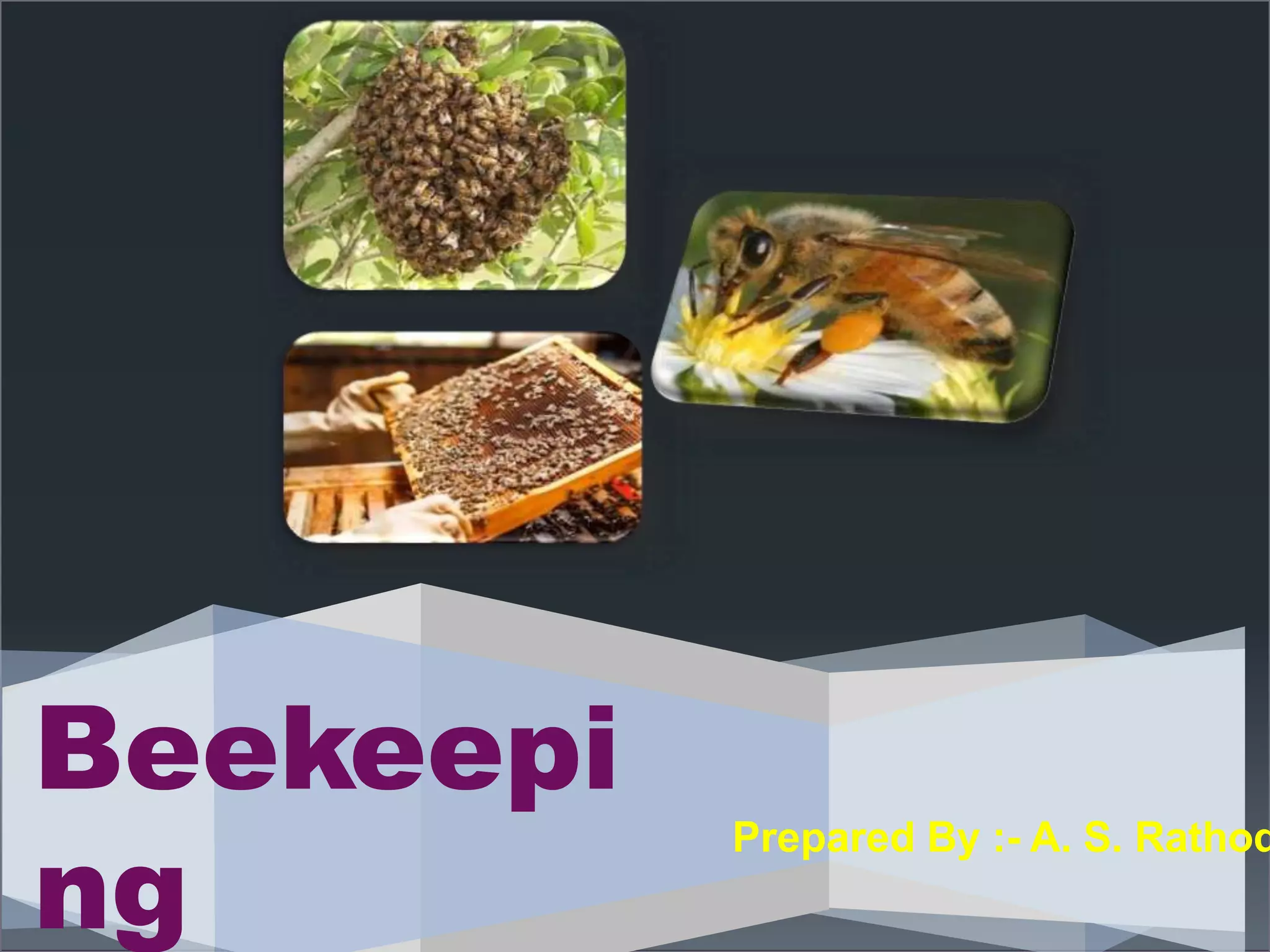
Prepared By :- A. S. Rathod
Beekeepi
ng
Beekeping Defination
History Of beekeeping
Beekeeping in india
What is bee hives?
Commercial Methods of bee rearing
What is an apiary?
Beekeeping Equipments
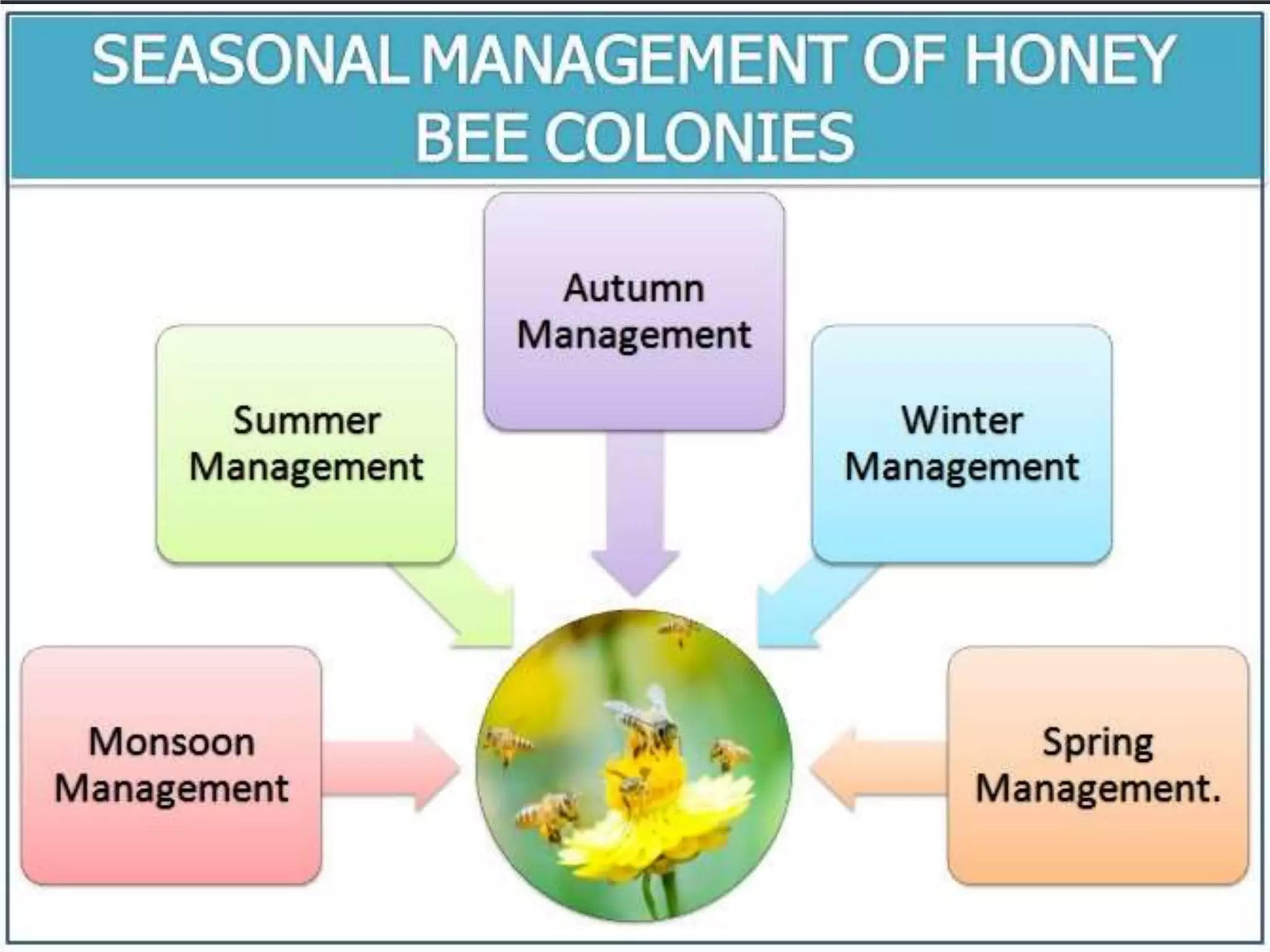
Seasonal Management Of Honey Bees
Beekeeping
• The Science and art of managing honey bees called
apiculture/beekeeping.
• Honey bees are reared in artificial hives for produce they
give honey, bees wax, and for the help render in pollinating
crop.
• The average annual per Capita consumption of honey in
india is 8.4 g.
Beekeeping/Apiculture
Some Terminology:-
Some Terminology
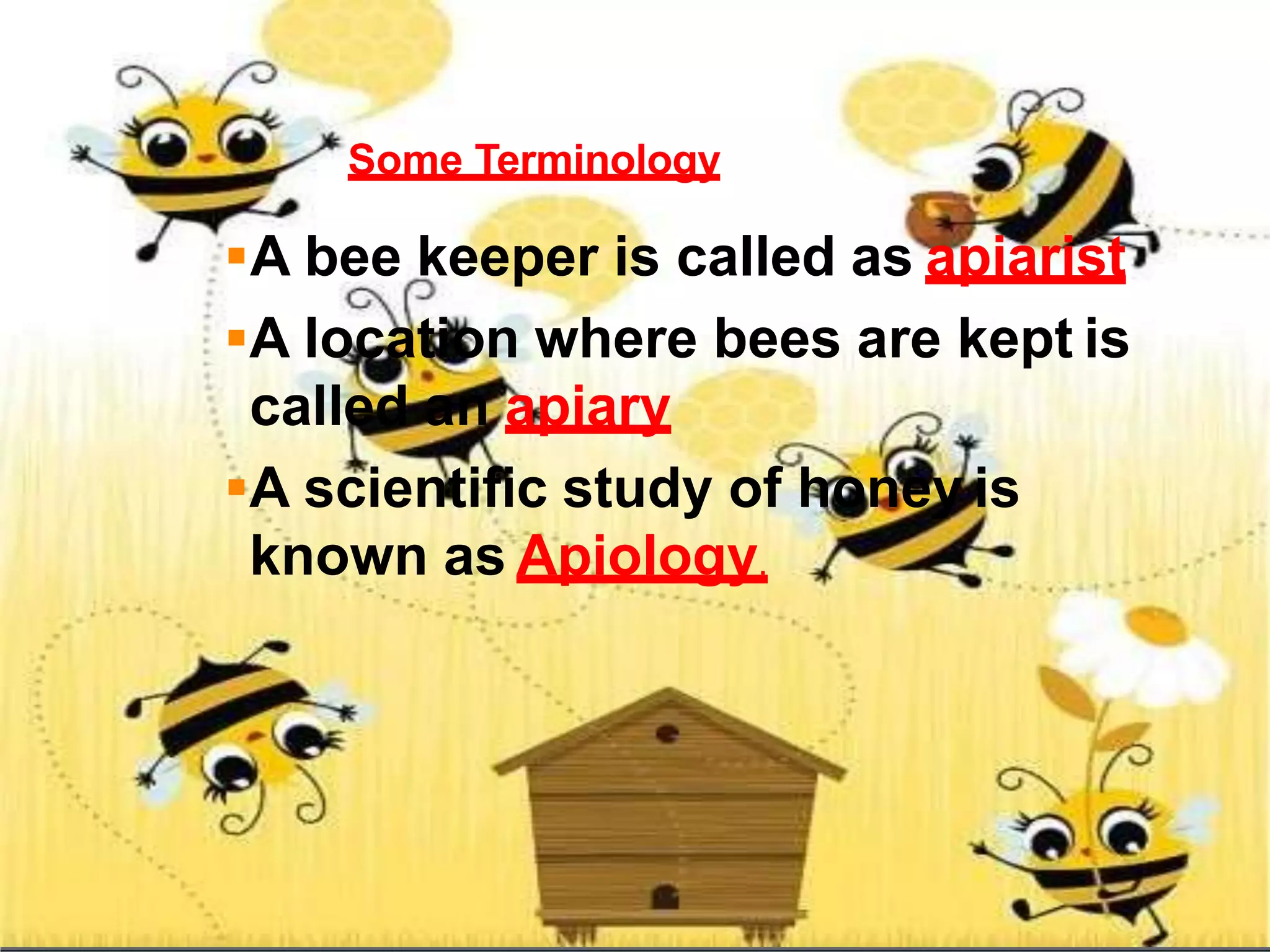
A bee keeper is called as apiarist
A location where bees are kept is
called an apiary
A scientific study of honey is
known as Apiology.
 History of beekeeping
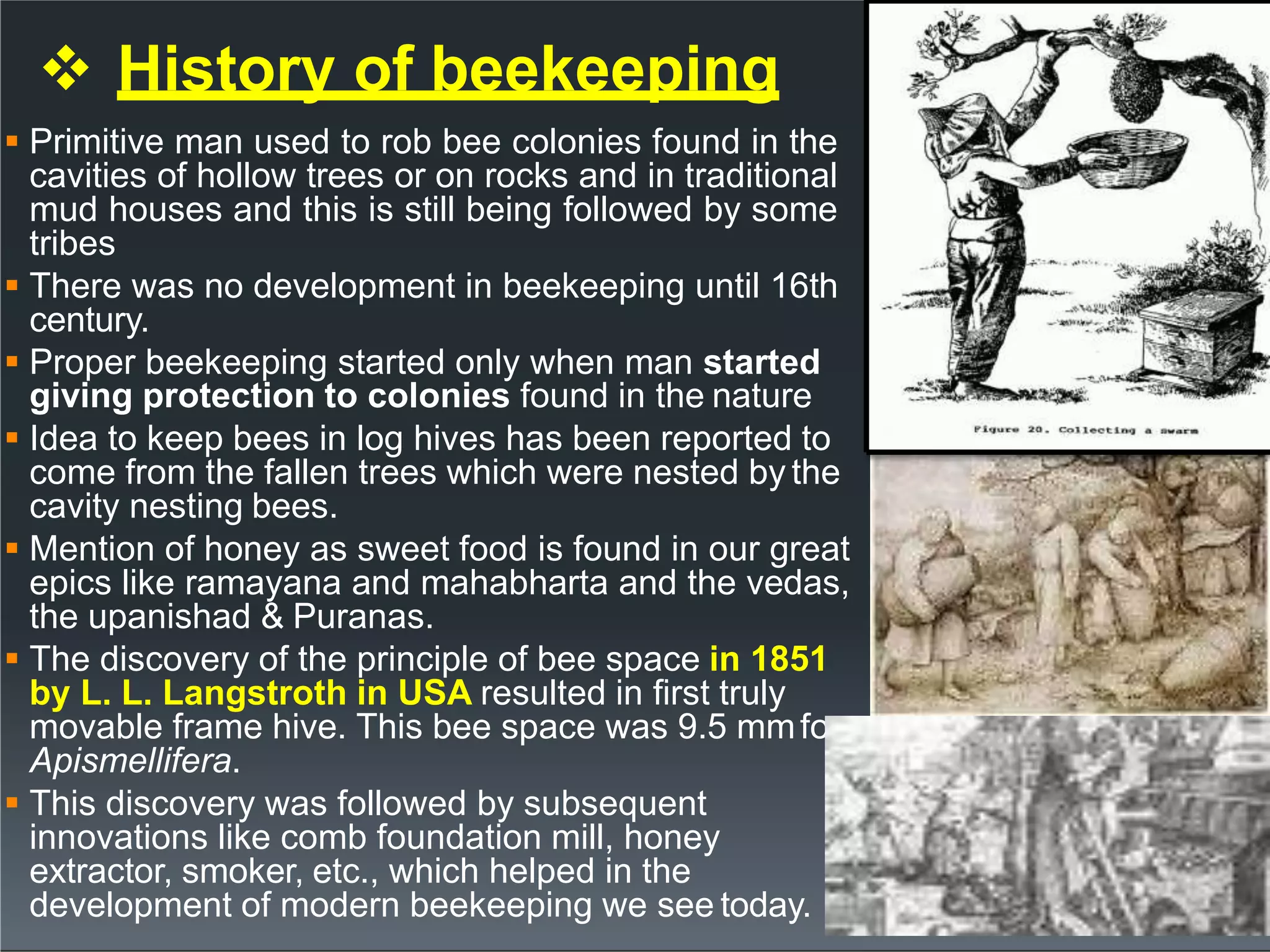
 Primitive man used to rob bee colonies found in the
cavities of hollow trees or on rocks and in traditional
mud houses and this is still being followed by some
tribes
 There was no development in beekeeping until 16th
century.
 Proper beekeeping started only when man started
giving protection to colonies found in the nature
 Idea to keep bees in log hives has been reported to
come from the fallen trees which were nested by the
cavity nesting bees.
 Mention of honey as sweet food is found in our great
epics like ramayana and mahabharta and the vedas,
the upanishad & Puranas.
 The discovery of the principle of bee space in 1851
by L. L. Langstroth in USA resulted in first truly
movable frame hive. This bee space was 9.5 mmfor
Apismellifera.
 This discovery was followed by subsequent
innovations like comb foundation mill, honey
extractor, smoker, etc., which helped in the
development of modern beekeeping we see today.
Beekeeping in India
 In India first attempt to keep bees in movable frame hives was made in
1882 in Bengal and then in 1883-84 in Punjab.
 In south India, Rev. Newton during 1911-1917 trained several beekeepers
and devised a hive for indigenous bee Apis cerana based on principle of
bee space (which was named after his name as “Newton hive”).
 Beekeeping was also started in the Travancore state (now Cochin) in 1917
and in Mysore in 1925.
 In Himachal Pradesh modern beekeeping with indigenous honey bee A.
cerana started in 1934 at Kullu and in 1936 at Kangra.
 The exotic bee A. mellifera was successfully introduced for the first time in
India in 1962 at NagrotaBagwan (then in Punjab state and now in Himachal
Pradesh), because this bee has potentials to produce more honey.
 At present both the hive bee species are being used in modern beekeeping
and lot of honey is also being collected from the wild bees viz. A. dorsata
and A. florea.
 India is producing approximately 70000 metric tons of honey annually from
all the four species of honey bees.
 A.S.Athawal is father of modern Keepeeing in india.
What is Bee hives?
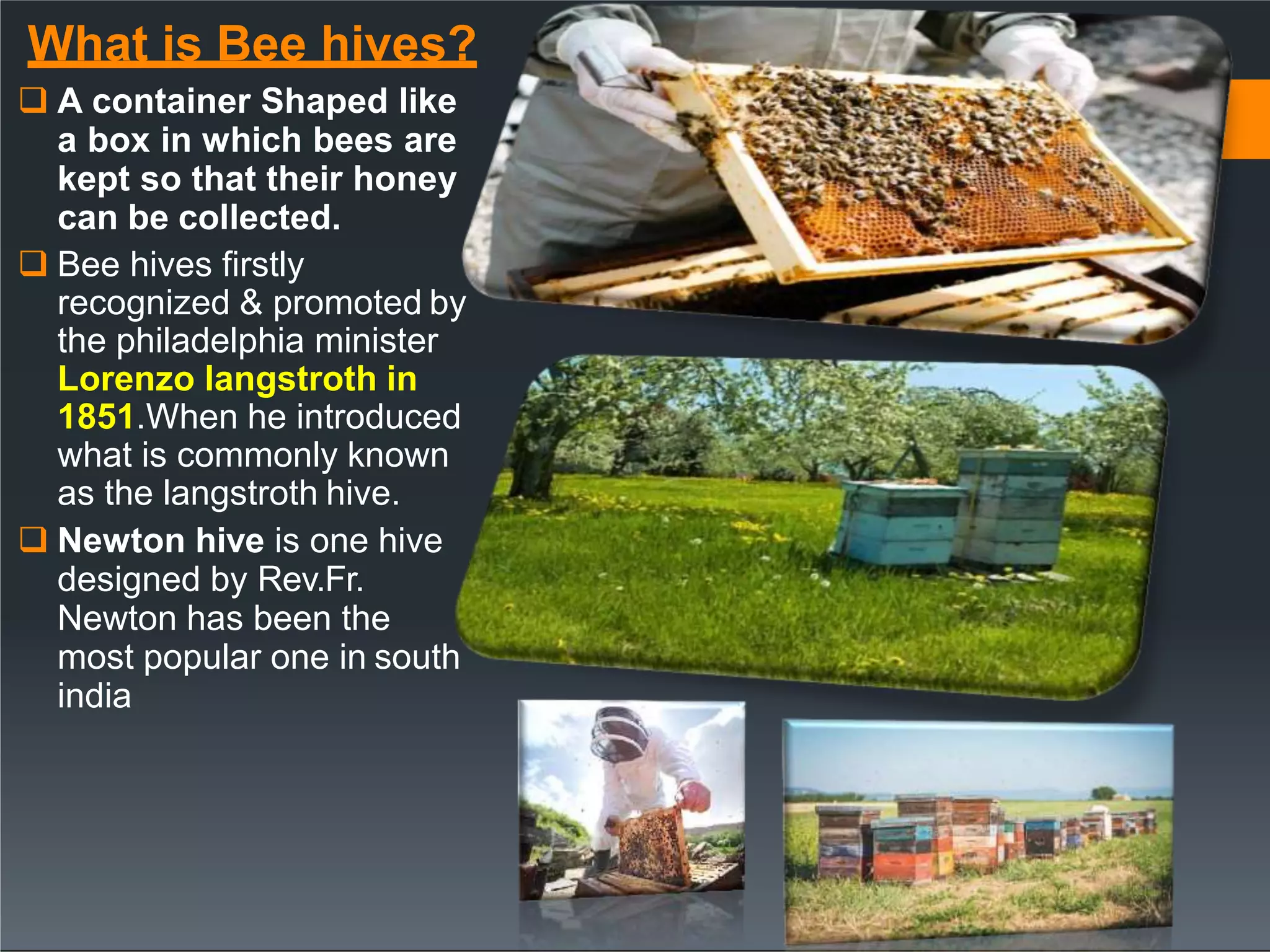
 A container Shaped like
a box in which bees are
kept so that their honey
can be collected.
 Bee hives firstly
recognized & promoted by
the philadelphia minister
Lorenzo langstroth in
1851.When he introduced
what is commonly known
as the langstroth hive.
 Newton hive is one hive
designed by Rev.Fr.
Newton has been the
most popular one in south
india
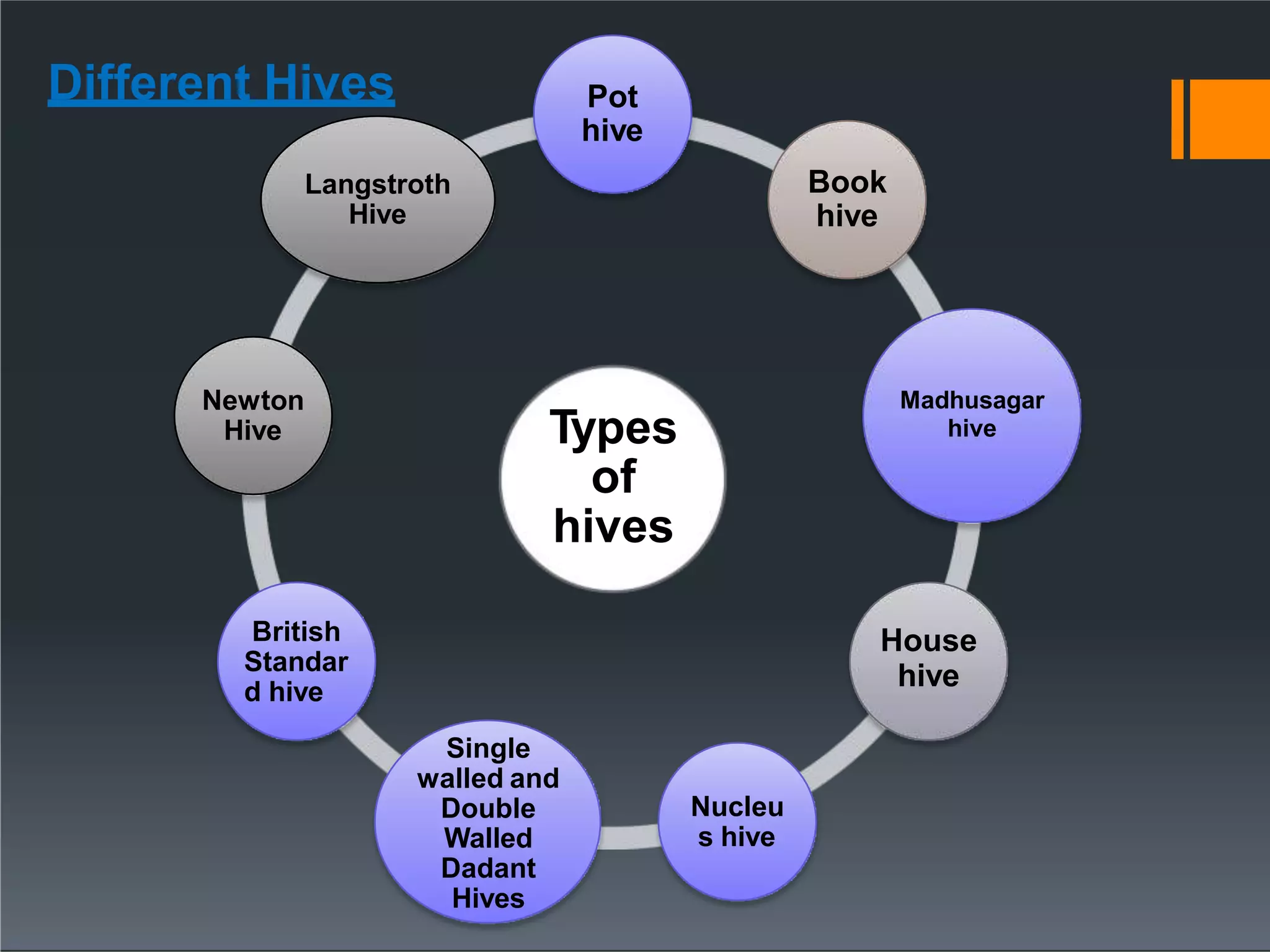
Types
of
hives
Pot
hive
Book
hive
Madhusagar
hive
House
hive
Nucleu
s hive
Single
walled and
Double
Walled
Dadant
Hives
British
Standar
d hive
Newton
Hive
Langstroth
Hive
Different Hives
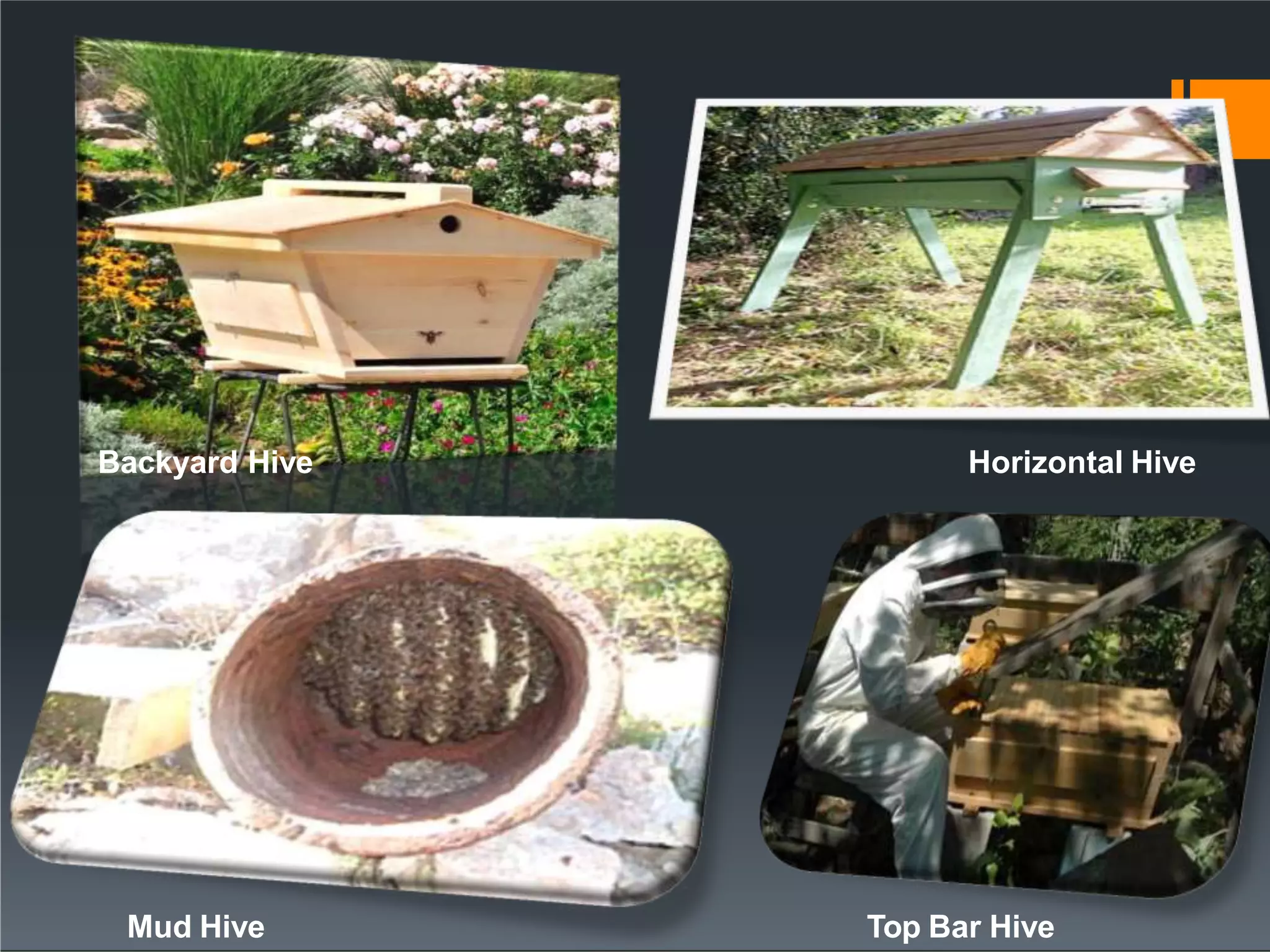
Backyard Hive Horizontal Hive
Mud Hive Top Bar Hive
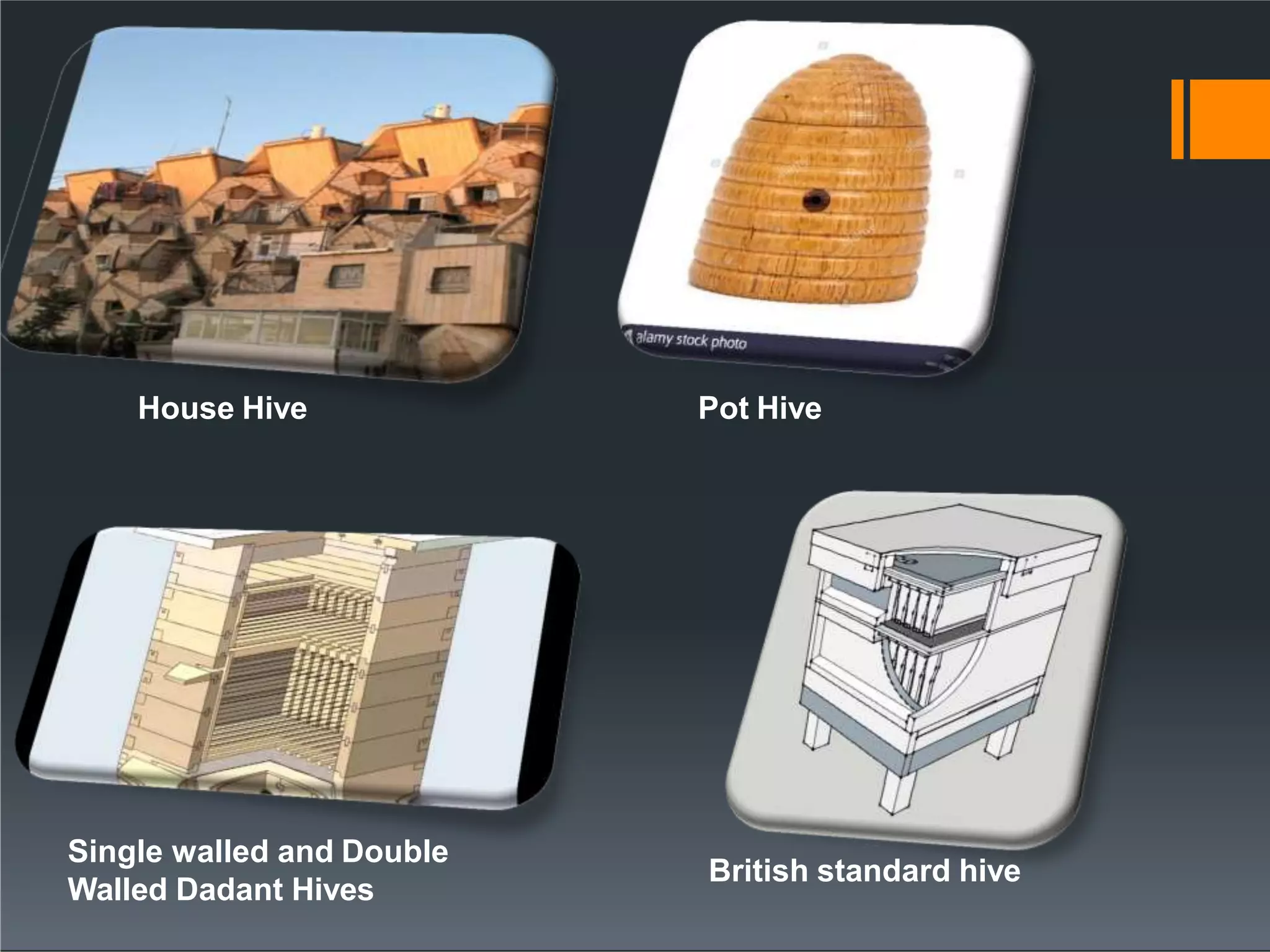
House Hive Pot Hive
Single walled and Double
Walled Dadant Hives
British standard hive
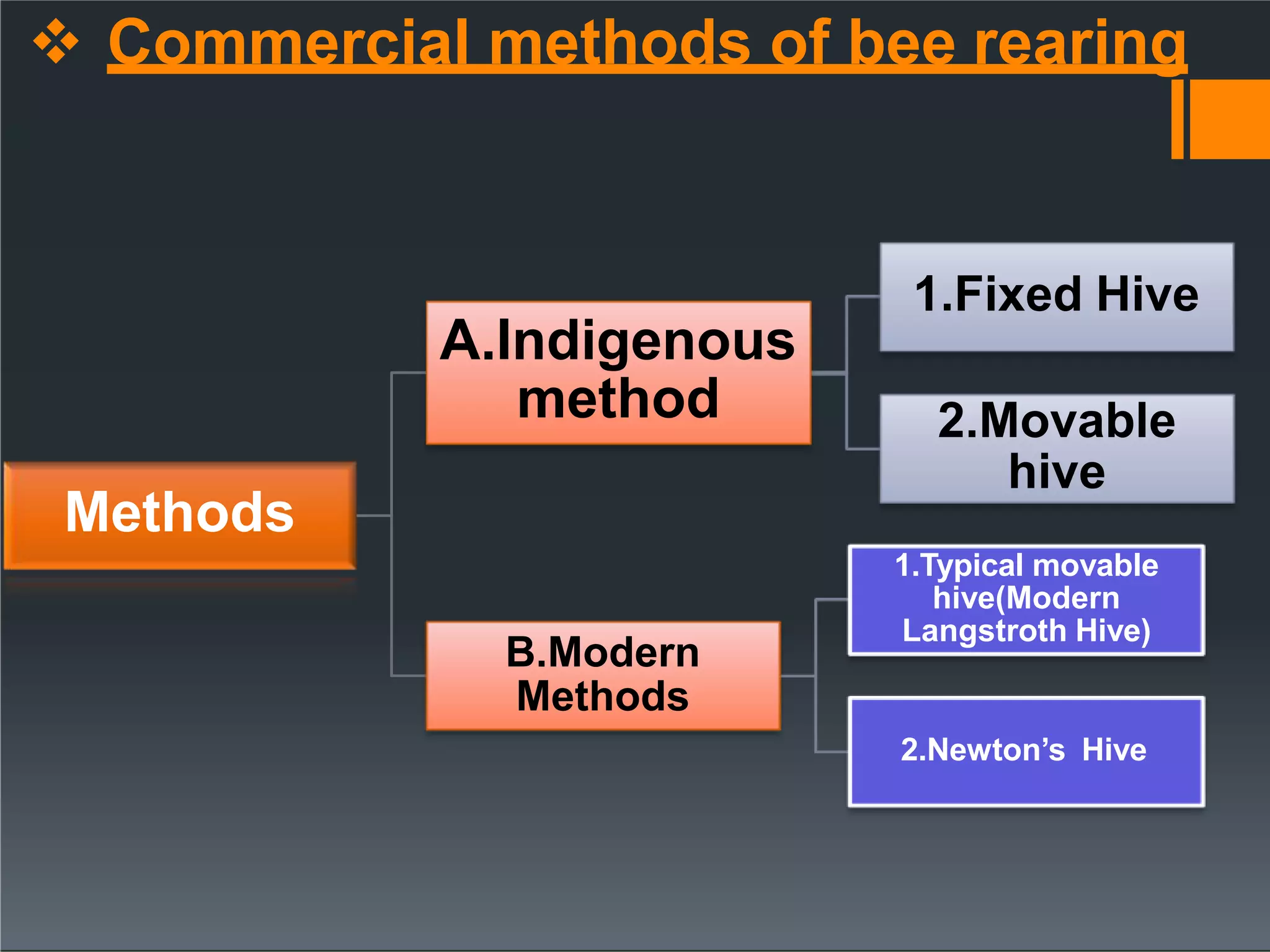
 Commercial methods of bee rearing
Methods
A.Indigenous
method
1.Fixed Hive
2.Movable
hive
B.Modern
Methods
1.Typical movable
hive(Modern
Langstroth Hive)
2.Newton’s Hive
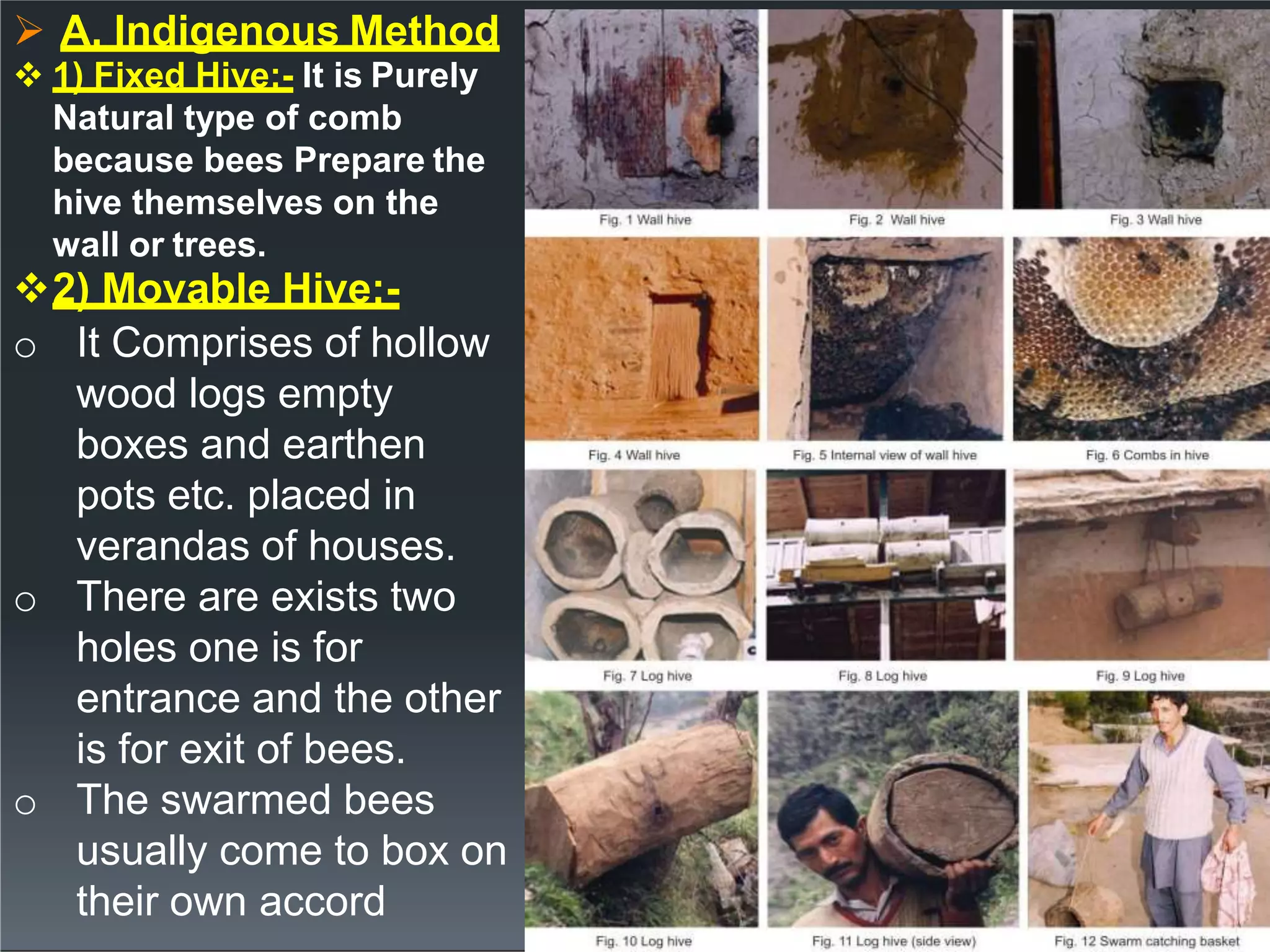
 A. Indigenous Method
 1) Fixed Hive:- It is Purely
Natural type of comb
because bees Prepare the
hive themselves on the
wall or trees.
2) Movable Hive:-
o It Comprises of hollow
wood logs empty
boxes and earthen
pots etc. placed in
verandas of houses.
o There are exists two
holes one is for
entrance and the other
is for exit of bees.
o The swarmed bees
usually come to box on
their own accord
o Some bees keepers use to
take the clusters of the
swarms from a tree and
keep them in hive.
Drawbacks of Indigenous
Method:-
• Honey Becomes Impure
because at the time of
Squeezing, the brood cells,
pollen cells, honey cells and
larvae cells also extracted.
• The Colony Becomes weak
due to killing of the eggs &
the larvae at the time of
squeezing.
o
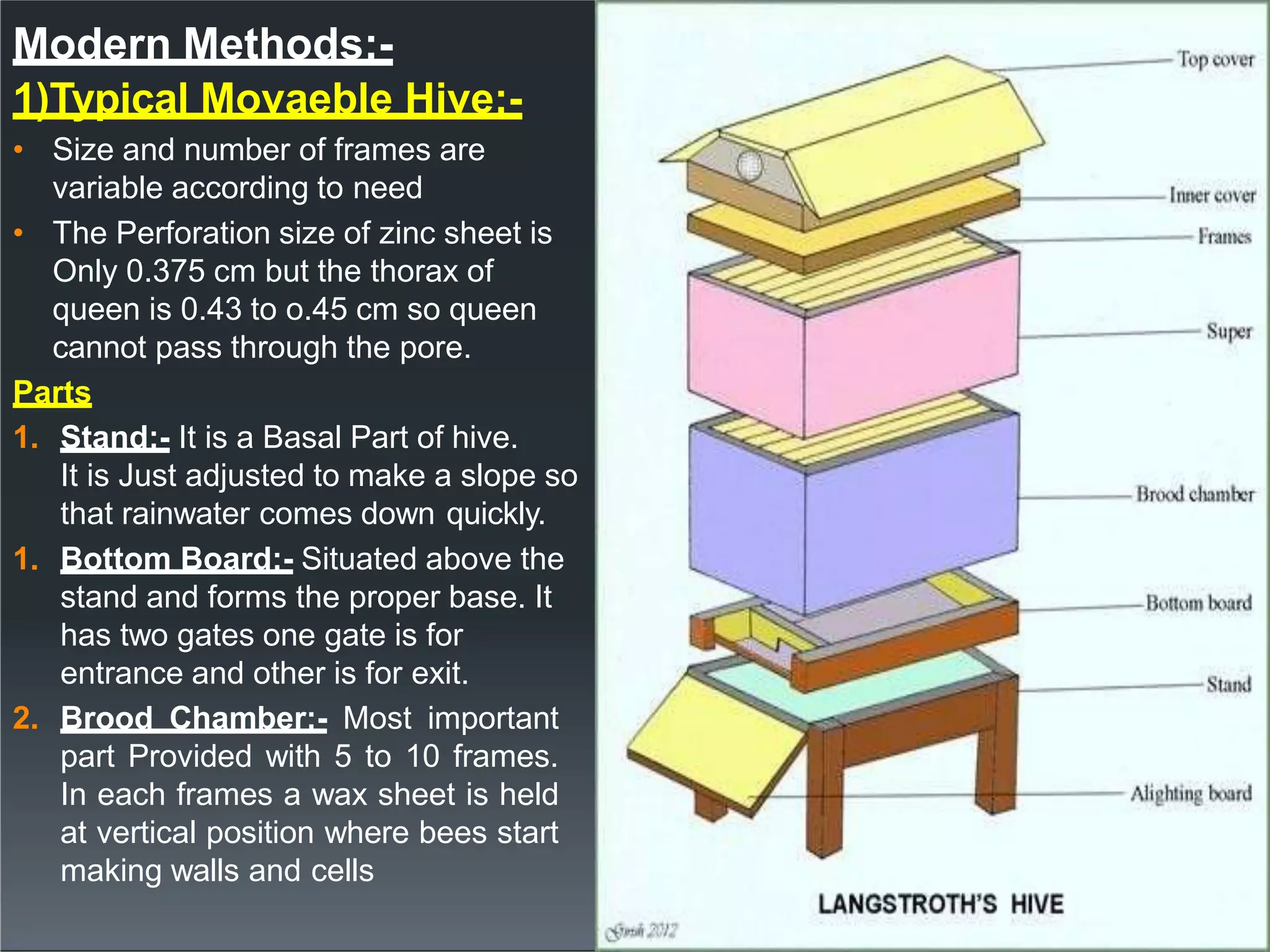
Modern Methods:-
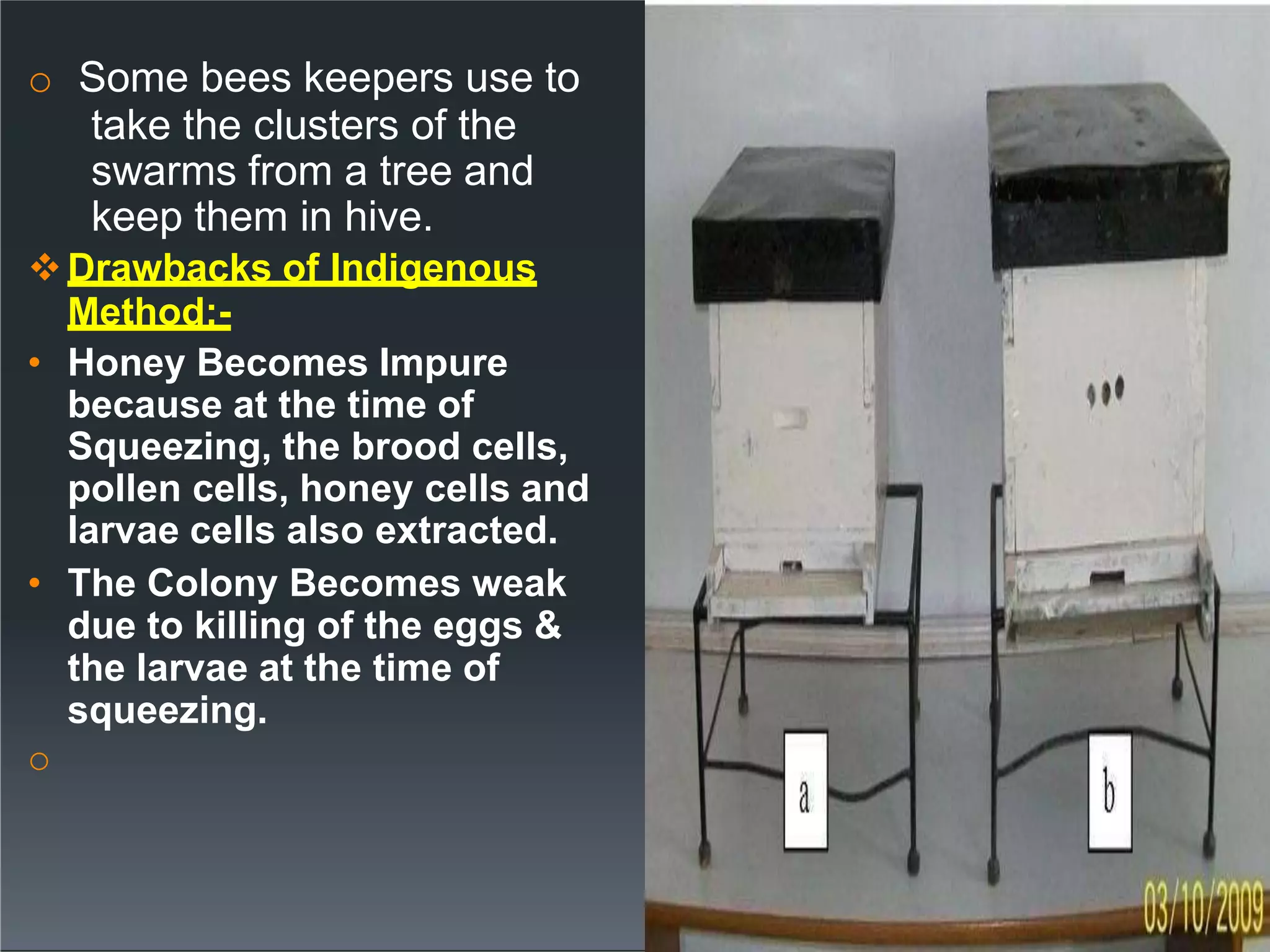
1)Typical Movaeble Hive:-
• Size and number of frames are
variable according to need
• The Perforation size of zinc sheet is
Only 0.375 cm but the thorax of
queen is 0.43 to o.45 cm so queen
cannot pass through the pore.
Parts
1. Stand:- It is a Basal Part of hive.
It is Just adjusted to make a slope so
that rainwater comes down quickly.
1. Bottom Board:- Situated above the
stand and forms the proper base. It
has two gates one gate is for
entrance and other is for exit.
2. Brood Chamber:- Most important
part Provided with 5 to 10 frames.
In each frames a wax sheet is held
at vertical position where bees start
making walls and cells
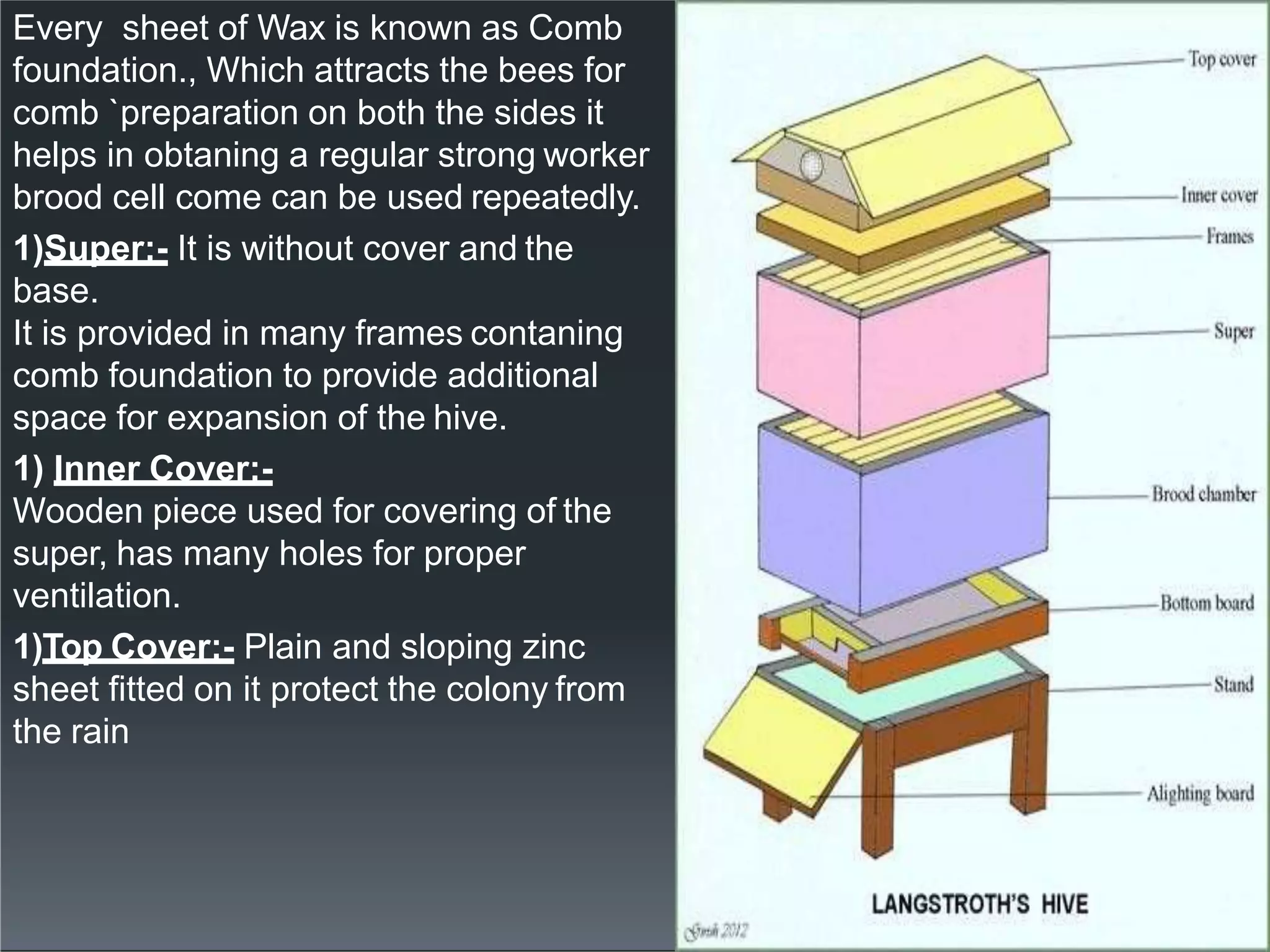
Every sheet of Wax is known as Comb
foundation., Which attracts the bees for
comb `preparation on both the sides it
helps in obtaning a regular strong worker
brood cell come can be used repeatedly.
1)Super:- It is without cover and the
base.
It is provided in many frames contaning
comb foundation to provide additional
space for expansion of the hive.
1) Inner Cover:-
Wooden piece used for covering of the
super, has many holes for proper
ventilation.
1)Top Cover:- Plain and sloping zinc
sheet fitted on it protect the colony from
the rain
2.Newtons bee hive
Newton’s bee hive has the following parts
made of wood:-
 Floor board: 14” x 91/2” in size with
an extension in front which serves as
an alighting board
 Brood chamber: -93/4 x 81/4” x 63/4”
in size with an entrance slit of 31/2” x
3/8” at the base; it is mounted over the
floor board
 Wooden frames: Seven separate
woodedn frames 81/4” x 53/4” x6” in
size and 7/8” broad: they are hung
inside the brood chamber
 Super chamber: 93/4” X 81/4” X31/8”
in size: it is kept over the brood
chamber
 Top cover: It is board having same
dimensions of brood or super
chamber. In the centre there is an
opening covered with wire gauge. It is
kept on super or brood chamber.
 It is the top cover of the hive. It is a box like structure with a
opening bottom portion.
 The portion of the box is covered with zinc or tin sheets. The
bottom open portion fits on the brood or super chamber and
completely covers them.
 There are two holes covered with wire mesh in the front and
back side for ventilation.
 The wooden frames inside the hive should have a space of
about ¼” in between any two.
 The hives are painted yellow, light blue, green or pink but never
with red, black or grey. Green and light blue colours are
preferable.
 The hive has to be fixed over a termite proof stand of about a
meter height and kept in a shady place under trees of under a
roof. It has to be protected from ants by providing oil-bands on
the stand or water-trought under them.
 What is an apiary?
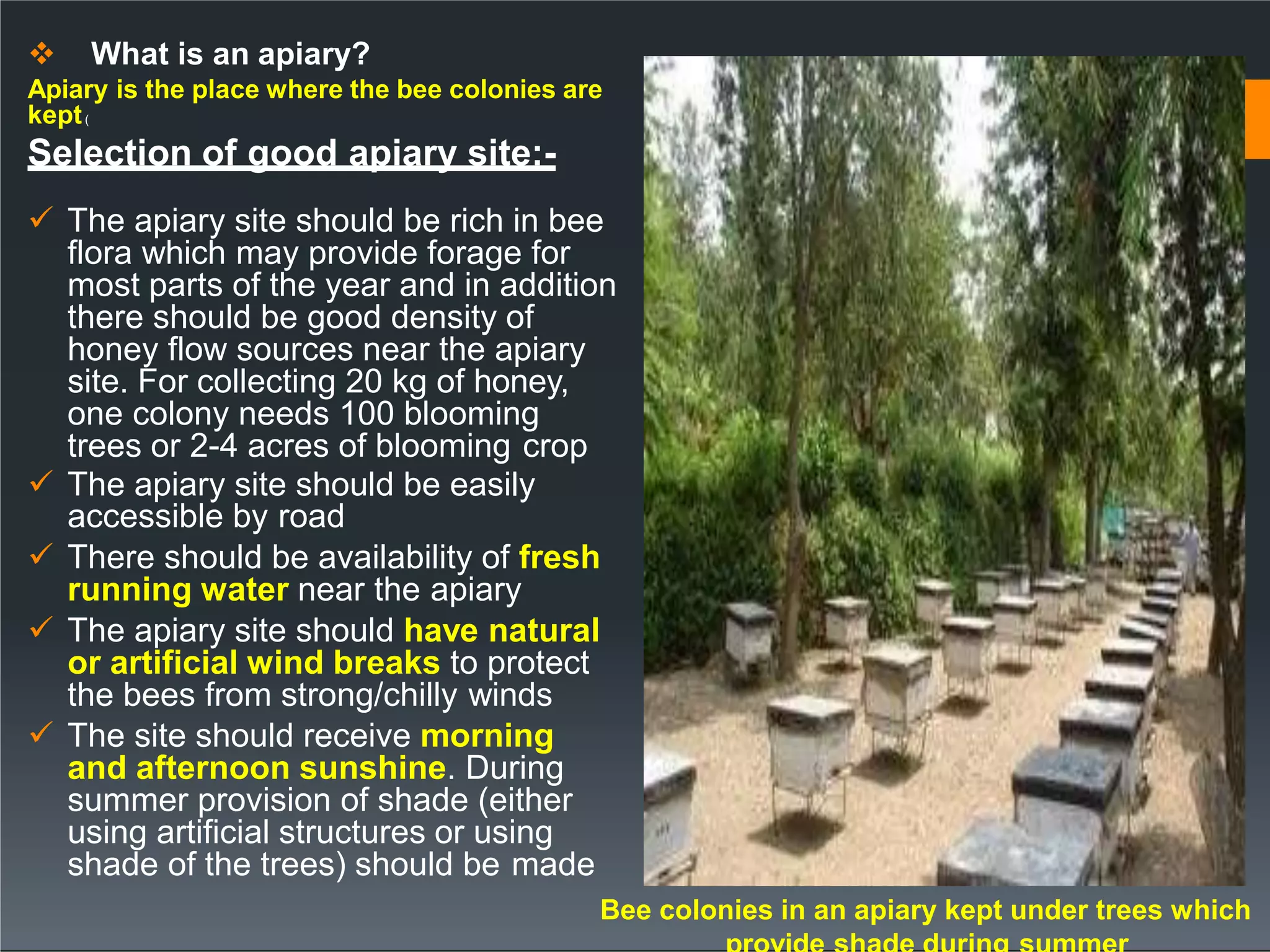
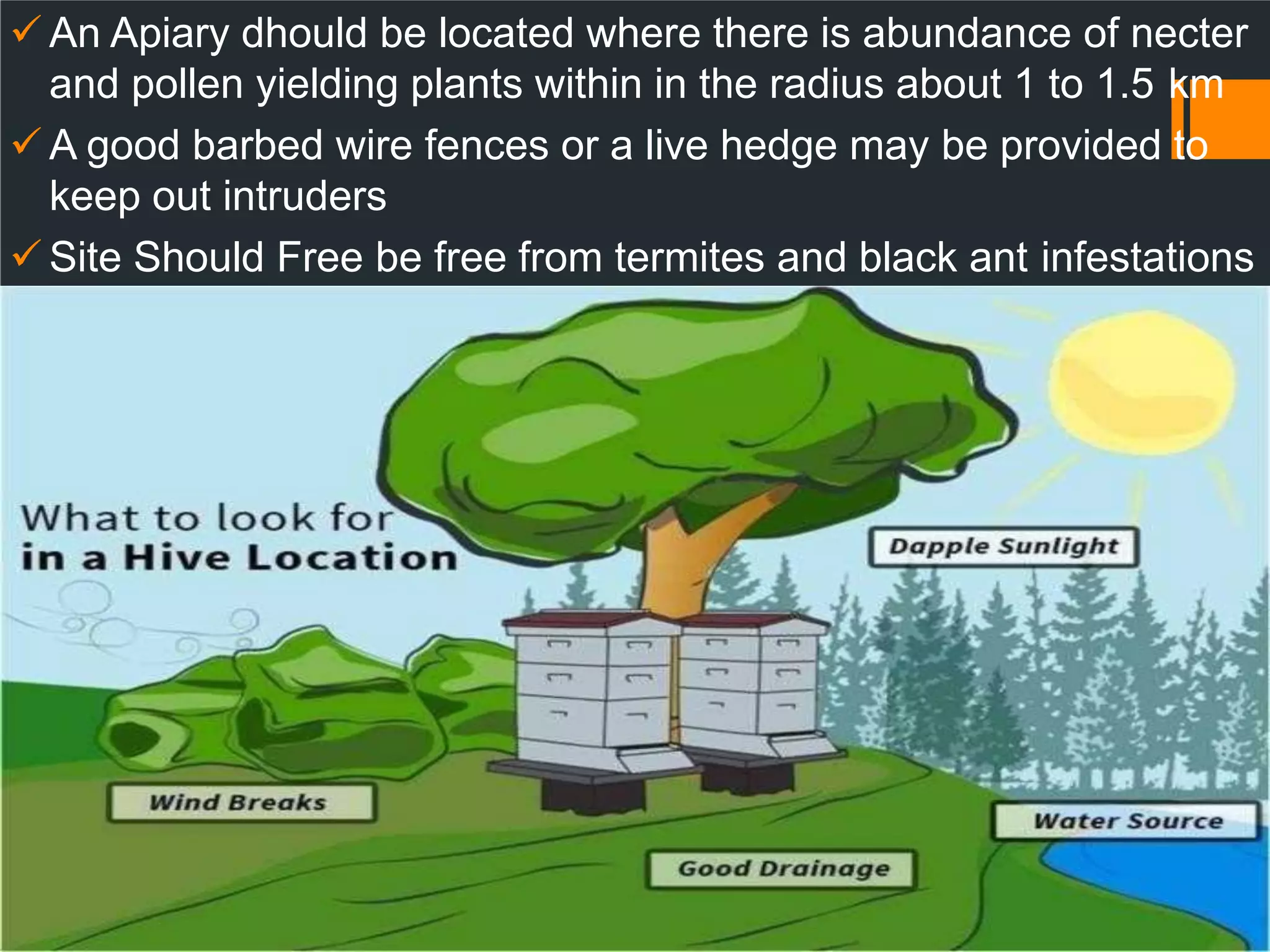
Apiary is the place where the bee colonies are
kept(
Selection of good apiary site:-
 The apiary site should be rich in bee
flora which may provide forage for
most parts of the year and in addition
there should be good density of
honey flow sources near the apiary
site. For collecting 20 kg of honey,
one colony needs 100 blooming
trees or 2-4 acres of blooming crop
 The apiary site should be easily
accessible by road
 There should be availability of fresh
running water near the apiary
 The apiary site should have natural
or artificial wind breaks to protect
the bees from strong/chilly winds
 The site should receive morning
and afternoon sunshine. During
summer provision of shade (either
using artificial structures or using
shade of the trees) should be made
Bee colonies in an apiary kept under trees which
 An Apiary dhould be located where there is abundance of necter
and pollen yielding plants within in the radius about 1 to 1.5 km
 A good barbed wire fences or a live hedge may be provided to
keep out intruders
 Site Should Free be free from termites and black ant infestations
Bee k e eping
Equipments
BEEKEEPING EQUIPMENTS

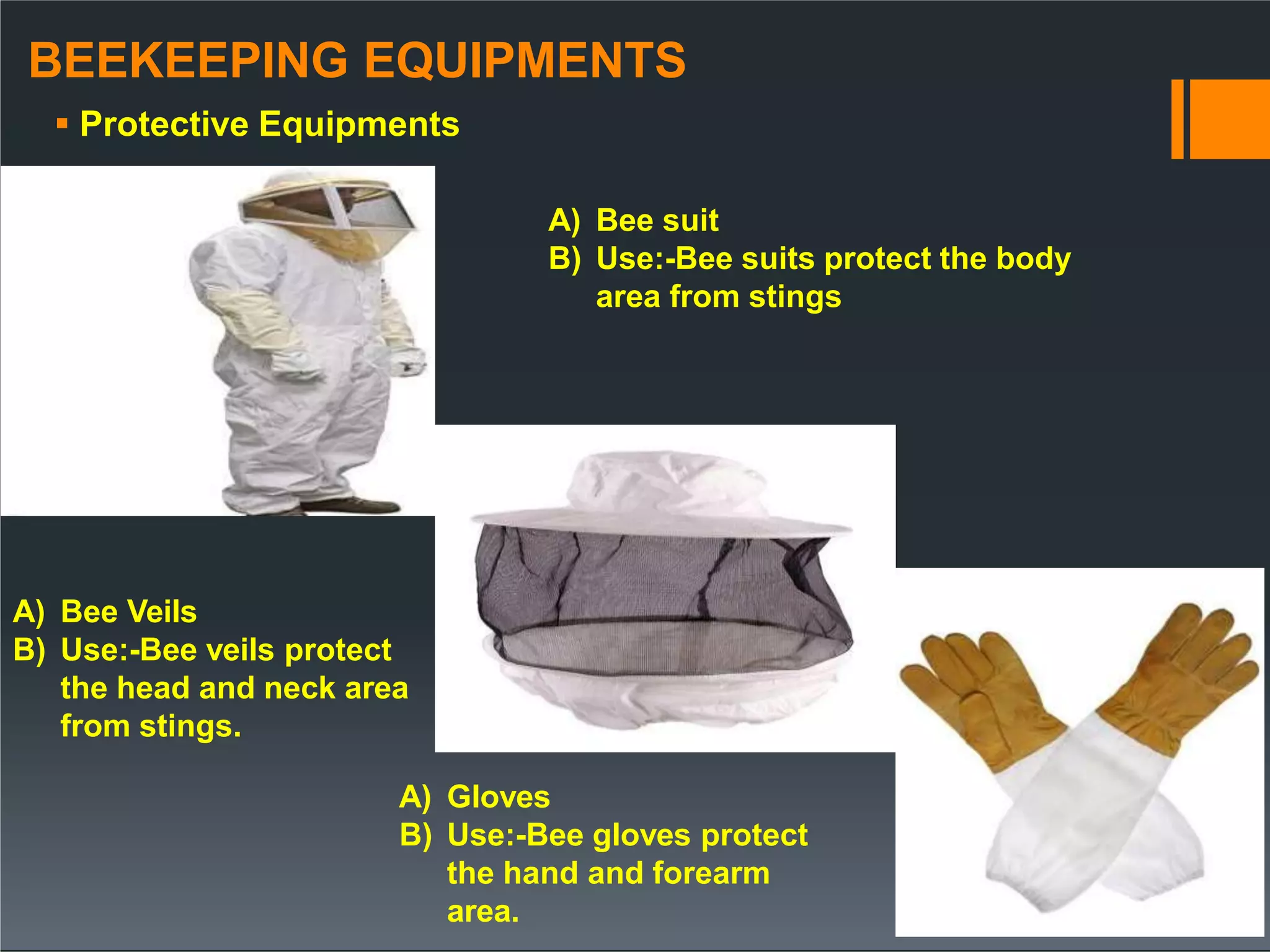
 Protective Equipments
A) Bee suit
B) Use:-Bee suits protect the body
area from stings
A) Bee Veils
B) Use:-Bee veils protect
the head and neck area
from stings.
A) Gloves
B) Use:-Bee gloves protect
the hand and forearm
area.
A) Nucleus Hive
B) Use:- Small be hive for keeping 4-6 frames.
These are using for mating of queens and
divisions of colonies
A) Comb foundation mill
B) Use:-Used to print natural cell size of desired comb
foundation sheets for A.mellifera & A. Cerena
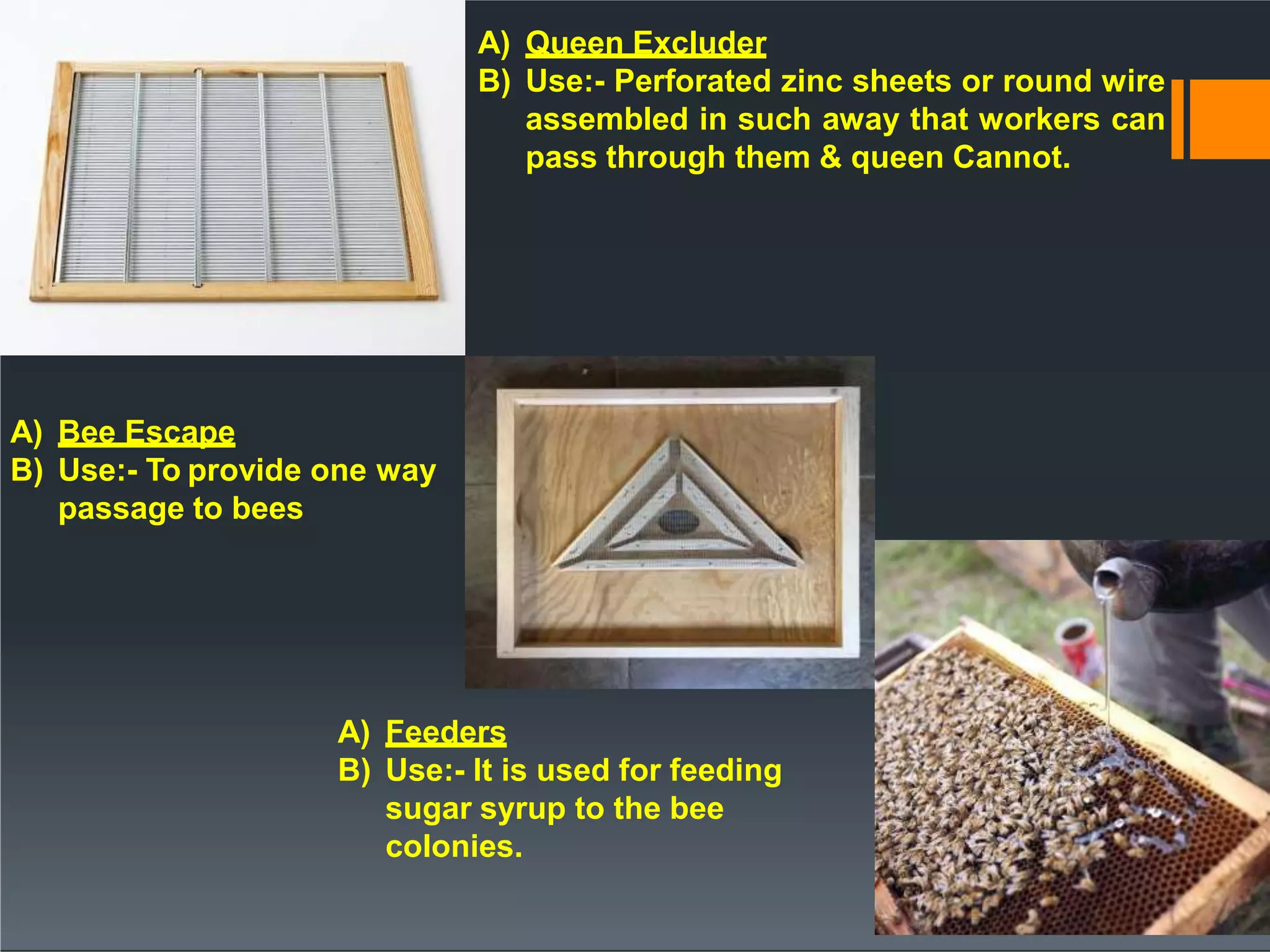
A) Queen Excluder
B) Use:- Perforated zinc sheets or round wire
assembled in such away that workers can
pass through them & queen Cannot.
A) Feeders
B) Use:- It is used for feeding
sugar syrup to the bee
colonies.
A) Bee Escape
B) Use:- To provide one way
passage to bees
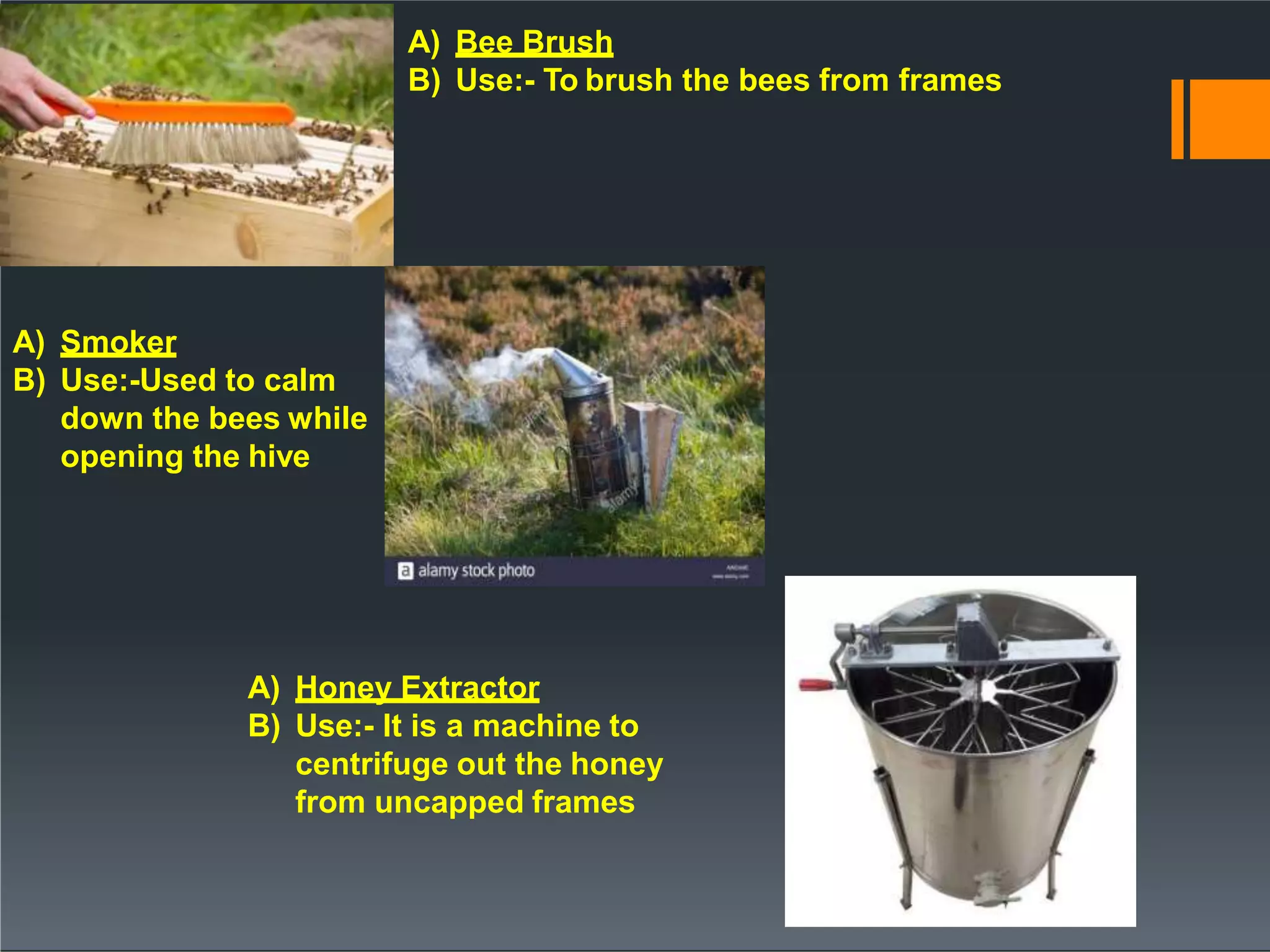
A) Bee Brush
B) Use:- To brush the bees from frames
A) Smoker
B) Use:-Used to calm
down the bees while
opening the hive
A) Honey Extractor
B) Use:- It is a machine to
centrifuge out the honey
from uncapped frames
A) Hive tool
B) Use:- An iron strip used for opening of hive
and its opening
A) Wax Melter
B) Use:- Double walled
chamber for melting of
bees wax for making comb
foundation sheets
A) Pollen Trap
B) Use:-For trapping corbicular pollen of
returning bee foragers. For A. mellifera
pollen trapping screen has holes of 4.7 to
5mm & for A.cerena 3.5 to 3.7mm
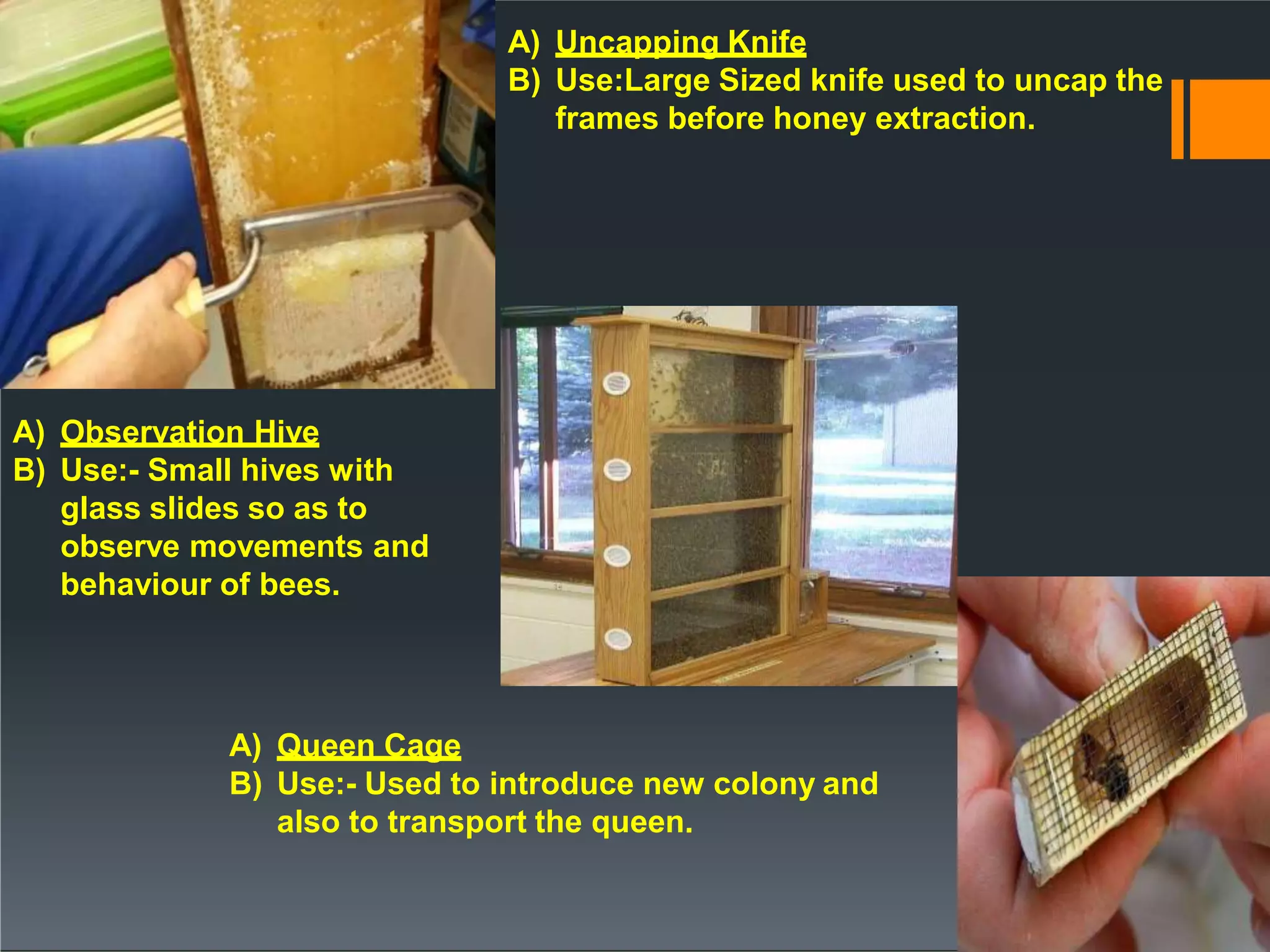
A) Uncapping Knife
B) Use:Large Sized knife used to uncap the
frames before honey extraction.
A) Observation Hive
B) Use:- Small hives with
glass slides so as to
observe movements and
behaviour of bees.
A) Queen Cage
B) Use:- Used to introduce new colony and
also to transport the queen.
A) Queen Cell Protector
B) Use:-A Spring like structure for protecting
queen cells.
A) Beekeeper honey refractometer
B) Use:-To measure the sugar content in
honey.
Some Rich Nectar Plants:-
Sunflower Goldenrod Coarinder
Alfalfa Honey bee on acid lime flower Cosmos
Seasonal
Management
of honey Bees
 Monsoon management:
 Weak colonies which have become queenless,
should be united with queen right colonies, since
during this period due to absence of drones new
virgin queen can not mate
Avoid broodlessness in colonies; if pollen stores and
fresh pollen is not available, feed the colonies either
pollen substitute or pollen supplement
If colonies have poor food stores (below 5kg) provide
sugar in the form of candy or dry sugar instead of
sugar syrup
Keep in check the attack of enemies like wax moth,
ants, mites and wasps.
The hives are kept on stands sloping towards
entrance in order to drain out water and prevent its
accumulation inside the hive.
Management during summer& Autumn:
Bees have to survive intense heat and dearth period by
following means.
Provide sufficient shade, under trees or artificial
structure
Increase RH and reduce heat by Sprinkling water twice
a day on gunny bag or rice straw put on hive
Increase ventilation by introducing a splinter between
brood and super chamber
Provide sugar syrup, pollen supplement, substitute and
water
Management During Winter
Colonies should be examined regularly.
Colonies should be shifted to place with enough sun
light.
Winter cover should be provided to weak colonies.
Sugar syrup or pollen substitute should be fed to weak
colonies as this Stimulative feeding provides energy
and helps initiating brood rearing.
Wind breakers should be used to protect bees from
chilly and frosty winds.
Weak colonies should be united with stronger ones.
 Spring Management.
Sufficient space and cleanness should be maintained and
provided.
Stimulative sugar/pollen substitute should be provided to
increase brood rearing.
Colonies should be balanced and equalized.
Old, contaminated and worn out hive parts should be replaced.
Extra frames should be raised by providing comb foundation
sheets.
Colonies should be supervised to prevent swarming.
Old queen should be replaced with new ones through mass
queen rearing or divide the colonies.
Colonies should be regularly monitored for ectoparasitic mites
and adopt control measures.
Honey should be extracted frequently during this season and
handled with hygiene.
Thank
you…

Beekeeping

  • 1.
    Prepared By :-A. S. Rathod Beekeepi ng
  • 2.
    Beekeping Defination History Ofbeekeeping Beekeeping in india What is bee hives? Commercial Methods of bee rearing What is an apiary? Beekeeping Equipments Seasonal Management Of Honey Bees
  • 3.
    Beekeeping • The Scienceand art of managing honey bees called apiculture/beekeeping. • Honey bees are reared in artificial hives for produce they give honey, bees wax, and for the help render in pollinating crop. • The average annual per Capita consumption of honey in india is 8.4 g. Beekeeping/Apiculture
  • 4.
    Some Terminology:- Some Terminology Abee keeper is called as apiarist A location where bees are kept is called an apiary A scientific study of honey is known as Apiology.
  • 5.
     History ofbeekeeping  Primitive man used to rob bee colonies found in the cavities of hollow trees or on rocks and in traditional mud houses and this is still being followed by some tribes  There was no development in beekeeping until 16th century.  Proper beekeeping started only when man started giving protection to colonies found in the nature  Idea to keep bees in log hives has been reported to come from the fallen trees which were nested by the cavity nesting bees.  Mention of honey as sweet food is found in our great epics like ramayana and mahabharta and the vedas, the upanishad & Puranas.  The discovery of the principle of bee space in 1851 by L. L. Langstroth in USA resulted in first truly movable frame hive. This bee space was 9.5 mmfor Apismellifera.  This discovery was followed by subsequent innovations like comb foundation mill, honey extractor, smoker, etc., which helped in the development of modern beekeeping we see today.
  • 6.
    Beekeeping in India In India first attempt to keep bees in movable frame hives was made in 1882 in Bengal and then in 1883-84 in Punjab.  In south India, Rev. Newton during 1911-1917 trained several beekeepers and devised a hive for indigenous bee Apis cerana based on principle of bee space (which was named after his name as “Newton hive”).  Beekeeping was also started in the Travancore state (now Cochin) in 1917 and in Mysore in 1925.  In Himachal Pradesh modern beekeeping with indigenous honey bee A. cerana started in 1934 at Kullu and in 1936 at Kangra.  The exotic bee A. mellifera was successfully introduced for the first time in India in 1962 at NagrotaBagwan (then in Punjab state and now in Himachal Pradesh), because this bee has potentials to produce more honey.  At present both the hive bee species are being used in modern beekeeping and lot of honey is also being collected from the wild bees viz. A. dorsata and A. florea.  India is producing approximately 70000 metric tons of honey annually from all the four species of honey bees.  A.S.Athawal is father of modern Keepeeing in india.
  • 7.
    What is Beehives?  A container Shaped like a box in which bees are kept so that their honey can be collected.  Bee hives firstly recognized & promoted by the philadelphia minister Lorenzo langstroth in 1851.When he introduced what is commonly known as the langstroth hive.  Newton hive is one hive designed by Rev.Fr. Newton has been the most popular one in south india
  • 8.
  • 9.
    Backyard Hive HorizontalHive Mud Hive Top Bar Hive
  • 10.
    House Hive PotHive Single walled and Double Walled Dadant Hives British standard hive
  • 11.
     Commercial methodsof bee rearing Methods A.Indigenous method 1.Fixed Hive 2.Movable hive B.Modern Methods 1.Typical movable hive(Modern Langstroth Hive) 2.Newton’s Hive
  • 12.
     A. IndigenousMethod  1) Fixed Hive:- It is Purely Natural type of comb because bees Prepare the hive themselves on the wall or trees. 2) Movable Hive:- o It Comprises of hollow wood logs empty boxes and earthen pots etc. placed in verandas of houses. o There are exists two holes one is for entrance and the other is for exit of bees. o The swarmed bees usually come to box on their own accord
  • 13.
    o Some beeskeepers use to take the clusters of the swarms from a tree and keep them in hive. Drawbacks of Indigenous Method:- • Honey Becomes Impure because at the time of Squeezing, the brood cells, pollen cells, honey cells and larvae cells also extracted. • The Colony Becomes weak due to killing of the eggs & the larvae at the time of squeezing. o
  • 14.
    Modern Methods:- 1)Typical MovaebleHive:- • Size and number of frames are variable according to need • The Perforation size of zinc sheet is Only 0.375 cm but the thorax of queen is 0.43 to o.45 cm so queen cannot pass through the pore. Parts 1. Stand:- It is a Basal Part of hive. It is Just adjusted to make a slope so that rainwater comes down quickly. 1. Bottom Board:- Situated above the stand and forms the proper base. It has two gates one gate is for entrance and other is for exit. 2. Brood Chamber:- Most important part Provided with 5 to 10 frames. In each frames a wax sheet is held at vertical position where bees start making walls and cells
  • 15.
    Every sheet ofWax is known as Comb foundation., Which attracts the bees for comb `preparation on both the sides it helps in obtaning a regular strong worker brood cell come can be used repeatedly. 1)Super:- It is without cover and the base. It is provided in many frames contaning comb foundation to provide additional space for expansion of the hive. 1) Inner Cover:- Wooden piece used for covering of the super, has many holes for proper ventilation. 1)Top Cover:- Plain and sloping zinc sheet fitted on it protect the colony from the rain
  • 16.
    2.Newtons bee hive Newton’sbee hive has the following parts made of wood:-  Floor board: 14” x 91/2” in size with an extension in front which serves as an alighting board  Brood chamber: -93/4 x 81/4” x 63/4” in size with an entrance slit of 31/2” x 3/8” at the base; it is mounted over the floor board  Wooden frames: Seven separate woodedn frames 81/4” x 53/4” x6” in size and 7/8” broad: they are hung inside the brood chamber  Super chamber: 93/4” X 81/4” X31/8” in size: it is kept over the brood chamber  Top cover: It is board having same dimensions of brood or super chamber. In the centre there is an opening covered with wire gauge. It is kept on super or brood chamber.
  • 17.
     It isthe top cover of the hive. It is a box like structure with a opening bottom portion.  The portion of the box is covered with zinc or tin sheets. The bottom open portion fits on the brood or super chamber and completely covers them.  There are two holes covered with wire mesh in the front and back side for ventilation.  The wooden frames inside the hive should have a space of about ¼” in between any two.  The hives are painted yellow, light blue, green or pink but never with red, black or grey. Green and light blue colours are preferable.  The hive has to be fixed over a termite proof stand of about a meter height and kept in a shady place under trees of under a roof. It has to be protected from ants by providing oil-bands on the stand or water-trought under them.
  • 18.
     What isan apiary? Apiary is the place where the bee colonies are kept( Selection of good apiary site:-  The apiary site should be rich in bee flora which may provide forage for most parts of the year and in addition there should be good density of honey flow sources near the apiary site. For collecting 20 kg of honey, one colony needs 100 blooming trees or 2-4 acres of blooming crop  The apiary site should be easily accessible by road  There should be availability of fresh running water near the apiary  The apiary site should have natural or artificial wind breaks to protect the bees from strong/chilly winds  The site should receive morning and afternoon sunshine. During summer provision of shade (either using artificial structures or using shade of the trees) should be made Bee colonies in an apiary kept under trees which
  • 19.
     An Apiarydhould be located where there is abundance of necter and pollen yielding plants within in the radius about 1 to 1.5 km  A good barbed wire fences or a live hedge may be provided to keep out intruders  Site Should Free be free from termites and black ant infestations
  • 20.
    Bee k eeping Equipments
  • 21.
    BEEKEEPING EQUIPMENTS   ProtectiveEquipments A) Bee suit B) Use:-Bee suits protect the body area from stings A) Bee Veils B) Use:-Bee veils protect the head and neck area from stings. A) Gloves B) Use:-Bee gloves protect the hand and forearm area.
  • 22.
    A) Nucleus Hive B)Use:- Small be hive for keeping 4-6 frames. These are using for mating of queens and divisions of colonies A) Comb foundation mill B) Use:-Used to print natural cell size of desired comb foundation sheets for A.mellifera & A. Cerena
  • 23.
    A) Queen Excluder B)Use:- Perforated zinc sheets or round wire assembled in such away that workers can pass through them & queen Cannot. A) Feeders B) Use:- It is used for feeding sugar syrup to the bee colonies. A) Bee Escape B) Use:- To provide one way passage to bees
  • 24.
    A) Bee Brush B)Use:- To brush the bees from frames A) Smoker B) Use:-Used to calm down the bees while opening the hive A) Honey Extractor B) Use:- It is a machine to centrifuge out the honey from uncapped frames
  • 25.
    A) Hive tool B)Use:- An iron strip used for opening of hive and its opening A) Wax Melter B) Use:- Double walled chamber for melting of bees wax for making comb foundation sheets A) Pollen Trap B) Use:-For trapping corbicular pollen of returning bee foragers. For A. mellifera pollen trapping screen has holes of 4.7 to 5mm & for A.cerena 3.5 to 3.7mm
  • 26.
    A) Uncapping Knife B)Use:Large Sized knife used to uncap the frames before honey extraction. A) Observation Hive B) Use:- Small hives with glass slides so as to observe movements and behaviour of bees. A) Queen Cage B) Use:- Used to introduce new colony and also to transport the queen.
  • 27.
    A) Queen CellProtector B) Use:-A Spring like structure for protecting queen cells. A) Beekeeper honey refractometer B) Use:-To measure the sugar content in honey.
  • 28.
    Some Rich NectarPlants:- Sunflower Goldenrod Coarinder Alfalfa Honey bee on acid lime flower Cosmos
  • 29.
  • 30.
     Monsoon management: Weak colonies which have become queenless, should be united with queen right colonies, since during this period due to absence of drones new virgin queen can not mate Avoid broodlessness in colonies; if pollen stores and fresh pollen is not available, feed the colonies either pollen substitute or pollen supplement If colonies have poor food stores (below 5kg) provide sugar in the form of candy or dry sugar instead of sugar syrup Keep in check the attack of enemies like wax moth, ants, mites and wasps. The hives are kept on stands sloping towards entrance in order to drain out water and prevent its accumulation inside the hive.
  • 31.
    Management during summer&Autumn: Bees have to survive intense heat and dearth period by following means. Provide sufficient shade, under trees or artificial structure Increase RH and reduce heat by Sprinkling water twice a day on gunny bag or rice straw put on hive Increase ventilation by introducing a splinter between brood and super chamber Provide sugar syrup, pollen supplement, substitute and water
  • 32.
    Management During Winter Coloniesshould be examined regularly. Colonies should be shifted to place with enough sun light. Winter cover should be provided to weak colonies. Sugar syrup or pollen substitute should be fed to weak colonies as this Stimulative feeding provides energy and helps initiating brood rearing. Wind breakers should be used to protect bees from chilly and frosty winds. Weak colonies should be united with stronger ones.
  • 33.
     Spring Management. Sufficientspace and cleanness should be maintained and provided. Stimulative sugar/pollen substitute should be provided to increase brood rearing. Colonies should be balanced and equalized. Old, contaminated and worn out hive parts should be replaced. Extra frames should be raised by providing comb foundation sheets. Colonies should be supervised to prevent swarming. Old queen should be replaced with new ones through mass queen rearing or divide the colonies. Colonies should be regularly monitored for ectoparasitic mites and adopt control measures. Honey should be extracted frequently during this season and handled with hygiene.
  • 34.