Bee biology and
communication
Dr. Denisha Rajkhowa
Assistant Professor
Department of Entomology
CoA, CAU, Imphal
Biology of Honeybee
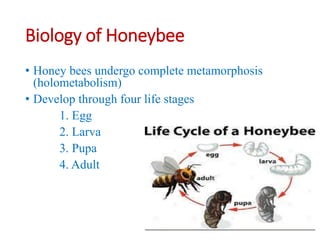
• Honey bees undergo complete metamorphosis
(holometabolism)
• Develop through four life stages
1. Egg
2. Larva
3. Pupa
4. Adult
Colony organization
• There are three castes in a honeybee colony: queen, workers and
drone
• Queen and workers are female bee and drones are male bee
• Only one queen can live in Apis species colony but in case of
stingless bee, there are more than one queen in a colony
• From fertilized egg, workers are developed and in Apis cerana
colony 10,000-30,000 workers and in Apis mellifera colony
30,000-50,000 workers are present
• Drones are developed from unfertilized egg and only 200-300
drones in Apis cerana colony and 400-500 in Apis mellifera
colony are present
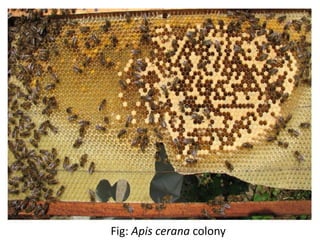
Fig: Apis cerana colony
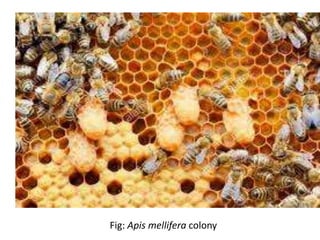
Fig: Apis mellifera colony
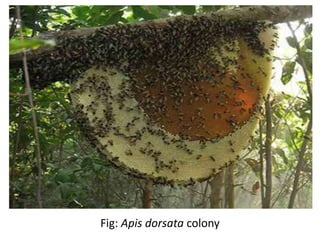
Fig: Apis dorsata colony
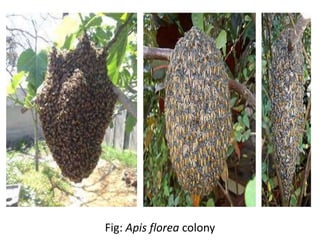
Fig: Apis florea colony
Queen
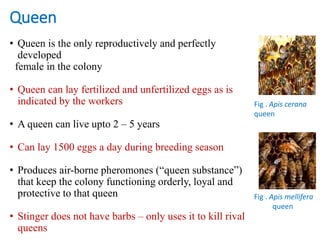
• Queen is the only reproductively and perfectly
developed
female in the colony
• Queen can lay fertilized and unfertilized eggs as is
indicated by the workers
• A queen can live upto 2 – 5 years
• Can lay 1500 eggs a day during breeding season
• Produces air-borne pheromones (“queen substance”)
that keep the colony functioning orderly, loyal and
protective to that queen
• Stinger does not have barbs – only uses it to kill rival
queens
Fig . Apis cerana
queen
Fig . Apis mellifera
queen
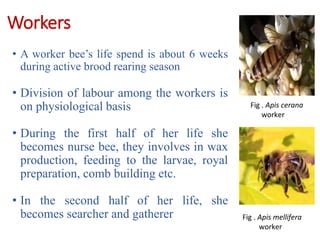
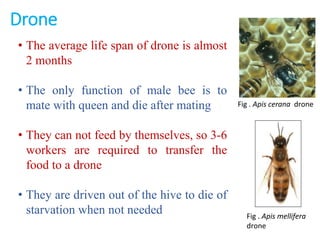
Workers
• A worker bee’s life spend is about 6 weeks
during active brood rearing season
• Division of labour among the workers is
on physiological basis
• During the first half of her life she
becomes nurse bee, they involves in wax
production, feeding to the larvae, royal
preparation, comb building etc.
• In the second half of her life, she
becomes searcher and gatherer
Fig . Apis cerana
worker
Fig . Apis mellifera
worker
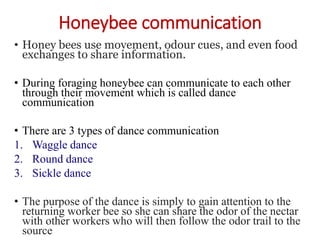
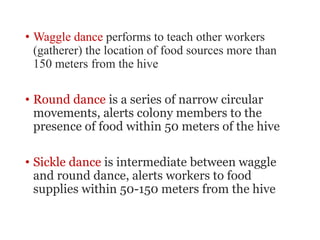
Drone
• The average life span of drone is almost
2 months
• The only function of male bee is to
mate with queen and die after mating
• They can not feed by themselves, so 3-6
workers are required to transfer the
food to a drone
• They are driven out of the hive to die of
starvation when not needed
Fig . Apis cerana drone
Fig . Apis mellifera
drone
Honeybee communication
• Honey bees use movement, odour cues, and even food
exchanges to share information.
• During foraging honeybee can communicate to each other
through their movement which is called dance
communication
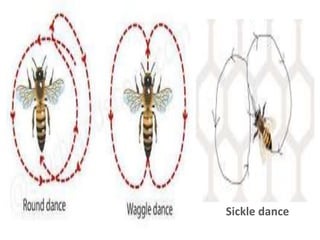
• There are 3 types of dance communication
1. Waggle dance
2. Round dance
3. Sickle dance
• The purpose of the dance is simply to gain attention to the
returning worker bee so she can share the odor of the nectar
with other workers who will then follow the odor trail to the
source
• Waggle dance performs to teach other workers
(gatherer) the location of food sources more than
150 meters from the hive
• Round dance is a series of narrow circular
movements, alerts colony members to the
presence of food within 50 meters of the hive
• Sickle dance is intermediate between waggle
and round dance, alerts workers to food
supplies within 50-150 meters from the hive
Sickle dance
• Odour cues also transmit important information to
members of the honey bee colony
1. Pheromones produced by the queen control
reproduction in the hive
2. Pheromones play a role in the defense of the hive
as well. When a worker honey bee stings, it
produces a pheromone that alerts her fellow
workers to the threat
3. During wax production, honey production they
also use different kind of pheromone
THANK YOU

Bee biology and communication.pptx

  • 1.
    Bee biology and communication Dr.Denisha Rajkhowa Assistant Professor Department of Entomology CoA, CAU, Imphal
  • 2.
    Biology of Honeybee •Honey bees undergo complete metamorphosis (holometabolism) • Develop through four life stages 1. Egg 2. Larva 3. Pupa 4. Adult
  • 3.
    Colony organization • Thereare three castes in a honeybee colony: queen, workers and drone • Queen and workers are female bee and drones are male bee • Only one queen can live in Apis species colony but in case of stingless bee, there are more than one queen in a colony • From fertilized egg, workers are developed and in Apis cerana colony 10,000-30,000 workers and in Apis mellifera colony 30,000-50,000 workers are present • Drones are developed from unfertilized egg and only 200-300 drones in Apis cerana colony and 400-500 in Apis mellifera colony are present
  • 4.
  • 5.
  • 6.
  • 7.
  • 8.
    Queen • Queen isthe only reproductively and perfectly developed female in the colony • Queen can lay fertilized and unfertilized eggs as is indicated by the workers • A queen can live upto 2 – 5 years • Can lay 1500 eggs a day during breeding season • Produces air-borne pheromones (“queen substance”) that keep the colony functioning orderly, loyal and protective to that queen • Stinger does not have barbs – only uses it to kill rival queens Fig . Apis cerana queen Fig . Apis mellifera queen
  • 9.
    Workers • A workerbee’s life spend is about 6 weeks during active brood rearing season • Division of labour among the workers is on physiological basis • During the first half of her life she becomes nurse bee, they involves in wax production, feeding to the larvae, royal preparation, comb building etc. • In the second half of her life, she becomes searcher and gatherer Fig . Apis cerana worker Fig . Apis mellifera worker
  • 10.
    Drone • The averagelife span of drone is almost 2 months • The only function of male bee is to mate with queen and die after mating • They can not feed by themselves, so 3-6 workers are required to transfer the food to a drone • They are driven out of the hive to die of starvation when not needed Fig . Apis cerana drone Fig . Apis mellifera drone
  • 11.
    Honeybee communication • Honeybees use movement, odour cues, and even food exchanges to share information. • During foraging honeybee can communicate to each other through their movement which is called dance communication • There are 3 types of dance communication 1. Waggle dance 2. Round dance 3. Sickle dance • The purpose of the dance is simply to gain attention to the returning worker bee so she can share the odor of the nectar with other workers who will then follow the odor trail to the source
  • 12.
    • Waggle danceperforms to teach other workers (gatherer) the location of food sources more than 150 meters from the hive • Round dance is a series of narrow circular movements, alerts colony members to the presence of food within 50 meters of the hive • Sickle dance is intermediate between waggle and round dance, alerts workers to food supplies within 50-150 meters from the hive
  • 13.
  • 14.
    • Odour cuesalso transmit important information to members of the honey bee colony 1. Pheromones produced by the queen control reproduction in the hive 2. Pheromones play a role in the defense of the hive as well. When a worker honey bee stings, it produces a pheromone that alerts her fellow workers to the threat 3. During wax production, honey production they also use different kind of pheromone
  • 15.