Assingnment on Pluse Beetles
Submitted to:-Dr. Swati Mehra
Submitted by:-Vishnu Kumar
K2015A55BIV
Gram dhora:-Callosobruchus chinenesis
Family:-Bruchidae, Order:-Coleoptera.
Distribution:-India,SriLanka,Myanmar,China,Japan,Indonesia.
Host range:-It is main pest of gram,mung,peas,cowpeas,lentil
and arhar.
Biology:-Eggs laid singly on grains.
• Fresh eggs are translucent white in color.
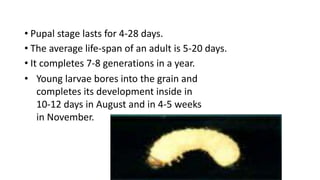
• Larva fleshy,curved,6-7mm.long and creamy white in color
with black mouth.
• Pupation takes place in a pupal cell prepared beneath the
seedcoat.
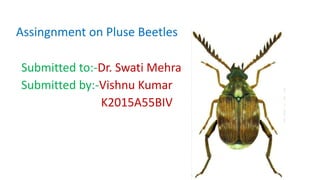
• Adults are 3-4mm.long with oval shaped body.
• Brownish grey in colour with dark spots.
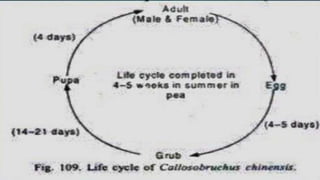
Life cycle:-The pest breeds from March to November.
• It hibernates in winter in larval stage.
• At the end of March adult appear and copulate.
• A day later female lay eggs.
• Egggs hatch in7-14 days.
Body is pointed towards front.
Adults are short lived and it is harmless and do
not feed on stored grain.
• Pupal stage lasts for 4-28 days.
• The average life-span of an adult is 5-20 days.
• It completes 7-8 generations in a year.
• Young larvae bores into the grain and
completes its development inside in
10-12 days in August and in 4-5 weeks
in November.
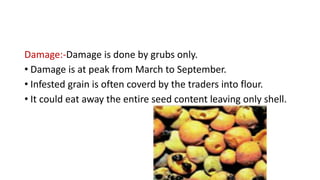
Damage:-Damage is done by grubs only.
• Damage is at peak from March to September.
• Infested grain is often coverd by the traders into flour.
• It could eat away the entire seed content leaving only shell.
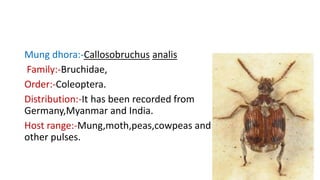
Mung dhora:-Callosobruchus analis
Family:-Bruchidae,
Order:-Coleoptera.
Distribution:-It has been recorded from
Germany,Myanmar and India.
Host range:-Mung,moth,peas,cowpeas and
other pulses.
Biology:-Both adults and larvae cause damage.
• Eggs are oval,whitish and glued to grain.
• Larva is recognized by its creamy-white,oval-shape.
• Adult is an oval-shaped beetle,smaller than Gram dhora.
• Female is chocolate color with a black trapezoidal area
surrounded by white streaks on three sides.
• The male is uniformly chocolate with a tinge of straw.
Life cycle:-They breeds from March to December.
• Hibernates in winter in the larval stage.
• In first week of March, adult escape by cutting out a circular
hole in the grain.
• Soon after copulation takes place and eggs are laid in
72hrs.of mating.
• Incubation period is changes with temperature,in May 3-6
days and in 18 days in December.
• The young larva,on emergence,bores into grains.
• Larval stage is of 2-3 weeks.
• Fully grown larva pupate inside the grain.
• Pupal stage is of 1-2 weeks.
• Life of adult varies from 5-10 days.
• The insect completes 9-19 generations in a year.
Damage:-Maximum damage is done in April to August.
• The larvae feed and breed inside the grain consuming entire
contents.
• When the infested grain happens to be in a poorly aerated
receptacle,a foul smelling fungus also develops.
Management of Pulse beetle:-Exposure of grains to sunlight.
• Dry grain before storage at a moisture level of 7%.
• Store the pulses in bulk with 7cm.layer of sand.
• Fumigation with Aluminium phosphide.
• Coat grain with small quantities of vegetable oil or mix neem
leaves in grain.
Pulse beetle

Pulse beetle

  • 1.
    Assingnment on PluseBeetles Submitted to:-Dr. Swati Mehra Submitted by:-Vishnu Kumar K2015A55BIV
  • 2.
    Gram dhora:-Callosobruchus chinenesis Family:-Bruchidae,Order:-Coleoptera. Distribution:-India,SriLanka,Myanmar,China,Japan,Indonesia. Host range:-It is main pest of gram,mung,peas,cowpeas,lentil and arhar.
  • 3.
    Biology:-Eggs laid singlyon grains. • Fresh eggs are translucent white in color. • Larva fleshy,curved,6-7mm.long and creamy white in color with black mouth. • Pupation takes place in a pupal cell prepared beneath the seedcoat. • Adults are 3-4mm.long with oval shaped body. • Brownish grey in colour with dark spots.
  • 4.
    Life cycle:-The pestbreeds from March to November. • It hibernates in winter in larval stage. • At the end of March adult appear and copulate. • A day later female lay eggs. • Egggs hatch in7-14 days. Body is pointed towards front. Adults are short lived and it is harmless and do not feed on stored grain.
  • 5.
    • Pupal stagelasts for 4-28 days. • The average life-span of an adult is 5-20 days. • It completes 7-8 generations in a year. • Young larvae bores into the grain and completes its development inside in 10-12 days in August and in 4-5 weeks in November.
  • 7.
    Damage:-Damage is doneby grubs only. • Damage is at peak from March to September. • Infested grain is often coverd by the traders into flour. • It could eat away the entire seed content leaving only shell.
  • 8.
    Mung dhora:-Callosobruchus analis Family:-Bruchidae, Order:-Coleoptera. Distribution:-Ithas been recorded from Germany,Myanmar and India. Host range:-Mung,moth,peas,cowpeas and other pulses.
  • 9.
    Biology:-Both adults andlarvae cause damage. • Eggs are oval,whitish and glued to grain. • Larva is recognized by its creamy-white,oval-shape. • Adult is an oval-shaped beetle,smaller than Gram dhora. • Female is chocolate color with a black trapezoidal area surrounded by white streaks on three sides. • The male is uniformly chocolate with a tinge of straw.
  • 10.
    Life cycle:-They breedsfrom March to December. • Hibernates in winter in the larval stage. • In first week of March, adult escape by cutting out a circular hole in the grain. • Soon after copulation takes place and eggs are laid in 72hrs.of mating. • Incubation period is changes with temperature,in May 3-6 days and in 18 days in December.
  • 11.
    • The younglarva,on emergence,bores into grains. • Larval stage is of 2-3 weeks. • Fully grown larva pupate inside the grain. • Pupal stage is of 1-2 weeks. • Life of adult varies from 5-10 days. • The insect completes 9-19 generations in a year.
  • 12.
    Damage:-Maximum damage isdone in April to August. • The larvae feed and breed inside the grain consuming entire contents. • When the infested grain happens to be in a poorly aerated receptacle,a foul smelling fungus also develops.
  • 13.
    Management of Pulsebeetle:-Exposure of grains to sunlight. • Dry grain before storage at a moisture level of 7%. • Store the pulses in bulk with 7cm.layer of sand. • Fumigation with Aluminium phosphide. • Coat grain with small quantities of vegetable oil or mix neem leaves in grain.