BEE FARMING FOR PLEASURE Dr. Alok bharti Ranchi Veterinary College Ranchi
1. Introduction & Prospects As gentle men profession – as hobby Bee keeping training centre at  Jeolikot, UP Indian Bee Journal All India Bee Keepers Association  Cottage Industries under KVIC The honey bee is the best little friend that a man has in this world Sir John moor – an English gentleman  Products as honey “Amrita” is used as food, medicine, cosmetics and holy ceremony. Products as bee wax used in industry, medicine and cosmetics. Produces bee venum and used for Api-therapy as toxin:vaseline:salicylic acid (1:10:1) for rheumatism, heart diseases, decrease cholesterol and B.P.  Collect propolis as resinous exudes for healing wounds/ cuts/ abscesses/ burns.
Produces Royal gelly by hypo-pharyngeal glands in nurse bee (6-12 days) for feeding of larvae and queen which is yellow. Cross pollination for increased production of agricultural and horticultural crops (about 14 times more than the honey production) Bee farming is for pleasure and profit  which can be done by gents, ladies, children, old, youngsters and retired personnels with little investments. Honey production for indigenous colony is 8-10kg and exotic 40-50 kg/ annum sold @ Rs.140-150/ kg. The honey bee teaches man the lesson of co-operation, loyalty, industry and discipline. Bee were used as war weapons during war. Honey and bee wax  was used as gift  to the king by the people. Bees can survive in different climatic  and floristic conditions. It requires light physical work for various production which can be done by children and women  It does not require constant labour and does not compete with other.
2. Position in Animal kingdom Kingdom:  Animal Phyllum:  Arthropoda Class:  Hexapoda or Insecta Order:  Hymenoptera Family:  Apidae Genus:  Apis Species:  i.  Apis-dorsata -  rock/   gaint bee ii. Apis-florae -  little bee iii. Apis-cerana indica -  Indian   bee iv. Apis-mellifera –  European/    Italian bee
3. Anatomy of Honey bee
 
4. Castes of honey bee i. Worker - Sterile females bee ii. Drone - Male bee iii. Queen - potent/ fertile female/    mother bee
Life span and periods of development castes Eggs (days) Larva (days) Pupa (days) Adult (total days) Queen 2 - 3 yrs 3 5 - 6 7 15 -16 Worker 6 - 8 weeks 3 5 - 6 10 -11 19 -20 Drone 6- 8 weeks 3 6 13 -14 23 -24
5. Equipments 1. Bee hive/ box contains a. Top cover b. Inner cover c. Super/ honey chamber d. Brood chamber e. Frames in honey & super chamber f.  Bottom board h. Stand i.  Alighting board j.  Water container 2. Comb foundation 3. Queen excluder sheet 4. Queen gate 5. Honey extractor 6. Uncapping knife 7. Smoker 8. Hive tools 9. Overall
10. Bee veil 11. Bee gloves 12. Bee brush 13. Bee feeder 14. Swarm bag 15. Swarm carrying box 16. Queen cage 17. Queen cell protector 18. Dummy or division board 19. Bee escape
A two-story Langstroth ten-frame hive.
Inspecting appliances
 
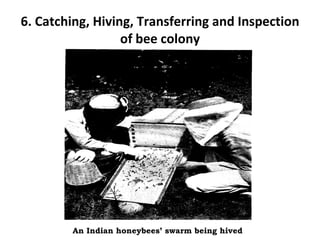
6. Catching, Hiving, Transferring and Inspection of bee colony An Indian honeybees’ swarm being hived
Hive Inspection Left-Taking out the frame  Right-Inspecting a frame.
Hive Inspection Left-Removing the super Right-Inspecting Brood chanber.
7. Bee colony uniting and dividing Bee colony can be united as and when needed by smoke and paper methods while division is made during spring (Feb-March) or Oct-Nov months. When bee population is large and queen develops.
8. Duties of honey bee i. Indoor duties: a. Comb building b. Feeding the broods c. Nursing broods and queen d. Cooling and warming the hive e. Cleaning/ defending f. Guarding the colony by guard bees g. Unloading the water, nectar, pollen and propolis h. Honey ripening i.e. sucrose to levulose (fructose) &    dextrose (glucose) ii. Out door duties: a. Searching for food  by bee dances or foraging dances as    round dance <10mts, sickle dance 10 -100mts and wag-tail    dance >100mts. b. Gathering for water, nectar, pollen and propolis.
 
9. Bee pasturages/ bee forage/ nectar and pollen plants Honey flow period, major honey flow period, minor honey flow period and dearth period. During dearth period artificial feeding of sugar solution (1:1) or (2:1) may be given in the feeder during evening/ night.  Pollen substitute is as under   Expelled soy flour : 3 parts Medicated yeast :  1 parts  Skimmed dry milk :  1 parts Water should be provided near the apiary as such small flow of running water may be provided near the apiary. The  crops, vegetables, fruits, wild trees available in different localities may serve as the sources of pollen and nectar.
Wild trees:   Eucalyptus, karanj, plumb, semal, neem etc. are good sources. Fruits:   Lichi, guava, banana, lemon, Jamun etc. Crops:   Maize, mustard, sun flower, niger, berseem, lucerne etc. Vegetables:   Carrot, coriander, onion, kohra, nanuan, brinjal etc.
10. Enemies and Diseases of honey bee  Bee enemies: Man Wax moths: greater and lesser wax moth - controlled by use of PDB. Wax beetle Wasps Black ants Termites Birds Lizards Cockroaches Spider Bears
Bee diseases The adult and brood are affected by various bacteria virus, fungi, protozoa, mites etc. the brood diseases commonly caused by bacteria ,virus and fungi. The common symptoms are discolored larvae, dark capping, punctured and sunken capping as American foul board in which infected colony is burned ,use of sulpha antibiotic drugs ,sac brood, chilled brood.
11. Honey extraction, processing and packing for marketing. Indigenous method of  squeezing out honey Frame with honey comb and bees
Brushing off the bees 2. Uncapping the cells 3. Putting frame into the extractor 4. Straining and bottling
Honey processing plant.
Bottling of honey in wide mouth transparent glass.
Characteristics of honey Sl. No. characteristics special Grade-A Standard 1 Specific gravity at 270c min. 1.41 1.39 1.37 2 Moisture% by wt.-max. 20 22 25 3 Total reducing sugar % min. 70 65 60 4 Sucrose % by wt.-max. 5 8 10 5 Fructose : glucose ratio 1 1 1 6 Ash %by wt.-max. 0.5 0.5 0.5 7 Acidity as formic acid % max. 0.2 0.2 0.2 8 Hydroxy methyl furfural ppm-max. 30 40 40
12. Pesticidal poisoning to honey bees The agricultural farmer use pesticides to protect the crop from pest problem and accordingly the honey as well as bees get exposed to pesticide during collection of pollen and nectar. The common symptoms are: appearance of large number of dead bees in front of hives, paralytic bees, uncoordinated movements, distended abdomen, irritated aggressive bees may sting, chilling of broods, contaminated pollen and honey may produce dead young bees, queen stops laying and longevity may reduced. The measures may be taken as to advice the farmers to spray in the evening or night time. Inform the bee keepers in the locality about the schedule of spray of pesticides and accordingly close the gate for prevention of foraging the bees, selection the pesticides as organic than inorganic ones. Use of bee repellents in pesticides, use of fresh pollen and sugar solution to protect the babies, transfer of colonies to safer place washing the comb by soaking in fresh water and uniting the bee colonies.
13. Testing the purity of honey Some times fake/ adulterated honey with sugar solution/ water is sold in the market, which may be injurious to consumers. Therefore honey should be purchased from standard/ reputed/ faithful/ govt. shops/ organization. However the consumers can go for spot test for purity of honey as under. Put 2-3 drops of honey in clean transparent water from top. The pure honey will straightway go to the bottom and settled. The fake honey will dissolve and leave a ray of sugar solution while going to the bottom. Drop the honey on a glass plate which will form zig-zag structure for pure honey but expand on the plate for fake honey. The pure honey is transparent but fake honey is not so transparent.
The housefly will not adhere or trap in the pure honey rather fly from the honey but the house fly will trap in the fake honey. The pure honey if put in the eyes will go for irritation for some time but do not stick to the eyes while fake honey will very much stick to the eyes. The thread/ wood will burn with pure honey but will not burn with adulterated honey. There will be specific flavor, aroma and test for unprocessed pure honey While the fake honey will be tasteless/ flavourless. The pure honey will go for crystallization on lower temperature and become white which will turn to original colour on melting while fake honey will not crystallize or if so will not melt. The pure honey will not form spot but fake honey will put spot on the cloth. The confirmatory chemical test will reveal that no colour formation with resorcinol test with pure honey while red colour will form with fake honey. However the consumer can  test  the purity of honey by their own experiences by putting in the mouth along with different sources of honey.
14. Economics of Honey production The bee keeping can be started with two boxes/ hives, extractors, bee veil, gloves, decapping knife, hive tools etc. initially 4-5 farmers will keep only one honey extractor. The current price is as under. S. No. Items Price (Rs.) Bee hive/ box 1200.00 Frame with bees @ Rs. 300.00 each for five frames 1500.00 Honey extractor 2200.00 Bee veil   100.00 Bee gloves   100.00 Comb foundation (Per Kg)   250.00 Sale of honey (Per Kg retail)   140.00-150.00   (Per Kg wholesale)    100.00-110.00 Sale of bee wax (Per Kg)  125.00 Production of honey on migration (Kg)   60-70 Production of honey without migration (Kg)   30-40
The bee farmer can start with 5-10 colonies which can sale 5-10 colonies each after proper division with retention of 5-10 colonies with them. Also the farmers can produce 2-3 colonies each year from single colony with modern scientific management.
Books on Bee Keeping (English) Bee farming in India  -  B. S. Rawat Bee keeping in India  -  Dr. Sardar  Singh, ICAR Honey bee and their management in India -  R. C. Mishra,  ICAR First lessons in Bee Keeping - Dadant 500 Answers to bee questions - Root Hive and the honey Bee - Dadant ABC & XYZ of Bee Culture - Root
Books on Bee Keeping (Hindi) Safal Monpalan - B. S. Rawat Rochak Monpalan - do Prarambhik Monpalan - do Saral monpalan  - do Madhumakhi Palan - R. K. Mission Address of B. S. Rawat The Manager The Rawat Apiarries  (Himalaya) Ranikhet, S. B. – 263648 Dist – Almora (Uttrakhand)
Bee Journals/ Magazines The Indian Bee Journal (Quart.) - India Indian Honey (Quart.) - India The Bee World - England British Bee Journal - England American Bee Journal - USA
Training on Bee Keeping Director for Bee Keeping Industries, Khadi & Village Industries Commission, Gramodyog, 3 Irla road, Vile Parle (West), Bombay-56. Chhotanagpur Khadi and Village Industries Commission, Ranchi, Near Firayalal Chowk, Ranchi (Jharkhand). HAU, Hissar, Hariyana NDRI, Karnal, Hariyana BAU, Ranchi, Jharkhand Bee keeping Training Centre, Jeolikote Distt. – U.S. Nagar (Uttarakhand)
Drone    Queen    Worker THANKS

Bee keeping

  • 1.
    BEE FARMING FORPLEASURE Dr. Alok bharti Ranchi Veterinary College Ranchi
  • 2.
    1. Introduction &Prospects As gentle men profession – as hobby Bee keeping training centre at Jeolikot, UP Indian Bee Journal All India Bee Keepers Association Cottage Industries under KVIC The honey bee is the best little friend that a man has in this world Sir John moor – an English gentleman Products as honey “Amrita” is used as food, medicine, cosmetics and holy ceremony. Products as bee wax used in industry, medicine and cosmetics. Produces bee venum and used for Api-therapy as toxin:vaseline:salicylic acid (1:10:1) for rheumatism, heart diseases, decrease cholesterol and B.P. Collect propolis as resinous exudes for healing wounds/ cuts/ abscesses/ burns.
  • 3.
    Produces Royal gellyby hypo-pharyngeal glands in nurse bee (6-12 days) for feeding of larvae and queen which is yellow. Cross pollination for increased production of agricultural and horticultural crops (about 14 times more than the honey production) Bee farming is for pleasure and profit which can be done by gents, ladies, children, old, youngsters and retired personnels with little investments. Honey production for indigenous colony is 8-10kg and exotic 40-50 kg/ annum sold @ Rs.140-150/ kg. The honey bee teaches man the lesson of co-operation, loyalty, industry and discipline. Bee were used as war weapons during war. Honey and bee wax was used as gift to the king by the people. Bees can survive in different climatic and floristic conditions. It requires light physical work for various production which can be done by children and women It does not require constant labour and does not compete with other.
  • 4.
    2. Position inAnimal kingdom Kingdom: Animal Phyllum: Arthropoda Class: Hexapoda or Insecta Order: Hymenoptera Family: Apidae Genus: Apis Species: i. Apis-dorsata - rock/ gaint bee ii. Apis-florae - little bee iii. Apis-cerana indica - Indian bee iv. Apis-mellifera – European/ Italian bee
  • 5.
    3. Anatomy ofHoney bee
  • 6.
  • 7.
    4. Castes ofhoney bee i. Worker - Sterile females bee ii. Drone - Male bee iii. Queen - potent/ fertile female/ mother bee
  • 8.
    Life span andperiods of development castes Eggs (days) Larva (days) Pupa (days) Adult (total days) Queen 2 - 3 yrs 3 5 - 6 7 15 -16 Worker 6 - 8 weeks 3 5 - 6 10 -11 19 -20 Drone 6- 8 weeks 3 6 13 -14 23 -24
  • 9.
    5. Equipments 1.Bee hive/ box contains a. Top cover b. Inner cover c. Super/ honey chamber d. Brood chamber e. Frames in honey & super chamber f. Bottom board h. Stand i. Alighting board j. Water container 2. Comb foundation 3. Queen excluder sheet 4. Queen gate 5. Honey extractor 6. Uncapping knife 7. Smoker 8. Hive tools 9. Overall
  • 10.
    10. Bee veil11. Bee gloves 12. Bee brush 13. Bee feeder 14. Swarm bag 15. Swarm carrying box 16. Queen cage 17. Queen cell protector 18. Dummy or division board 19. Bee escape
  • 11.
    A two-story Langstrothten-frame hive.
  • 12.
  • 13.
  • 14.
    6. Catching, Hiving,Transferring and Inspection of bee colony An Indian honeybees’ swarm being hived
  • 15.
    Hive Inspection Left-Takingout the frame Right-Inspecting a frame.
  • 16.
    Hive Inspection Left-Removingthe super Right-Inspecting Brood chanber.
  • 17.
    7. Bee colonyuniting and dividing Bee colony can be united as and when needed by smoke and paper methods while division is made during spring (Feb-March) or Oct-Nov months. When bee population is large and queen develops.
  • 18.
    8. Duties ofhoney bee i. Indoor duties: a. Comb building b. Feeding the broods c. Nursing broods and queen d. Cooling and warming the hive e. Cleaning/ defending f. Guarding the colony by guard bees g. Unloading the water, nectar, pollen and propolis h. Honey ripening i.e. sucrose to levulose (fructose) & dextrose (glucose) ii. Out door duties: a. Searching for food by bee dances or foraging dances as round dance <10mts, sickle dance 10 -100mts and wag-tail dance >100mts. b. Gathering for water, nectar, pollen and propolis.
  • 19.
  • 20.
    9. Bee pasturages/bee forage/ nectar and pollen plants Honey flow period, major honey flow period, minor honey flow period and dearth period. During dearth period artificial feeding of sugar solution (1:1) or (2:1) may be given in the feeder during evening/ night. Pollen substitute is as under Expelled soy flour : 3 parts Medicated yeast : 1 parts Skimmed dry milk : 1 parts Water should be provided near the apiary as such small flow of running water may be provided near the apiary. The crops, vegetables, fruits, wild trees available in different localities may serve as the sources of pollen and nectar.
  • 21.
    Wild trees: Eucalyptus, karanj, plumb, semal, neem etc. are good sources. Fruits: Lichi, guava, banana, lemon, Jamun etc. Crops: Maize, mustard, sun flower, niger, berseem, lucerne etc. Vegetables: Carrot, coriander, onion, kohra, nanuan, brinjal etc.
  • 22.
    10. Enemies andDiseases of honey bee Bee enemies: Man Wax moths: greater and lesser wax moth - controlled by use of PDB. Wax beetle Wasps Black ants Termites Birds Lizards Cockroaches Spider Bears
  • 23.
    Bee diseases Theadult and brood are affected by various bacteria virus, fungi, protozoa, mites etc. the brood diseases commonly caused by bacteria ,virus and fungi. The common symptoms are discolored larvae, dark capping, punctured and sunken capping as American foul board in which infected colony is burned ,use of sulpha antibiotic drugs ,sac brood, chilled brood.
  • 24.
    11. Honey extraction,processing and packing for marketing. Indigenous method of squeezing out honey Frame with honey comb and bees
  • 25.
    Brushing off thebees 2. Uncapping the cells 3. Putting frame into the extractor 4. Straining and bottling
  • 26.
  • 27.
    Bottling of honeyin wide mouth transparent glass.
  • 28.
    Characteristics of honeySl. No. characteristics special Grade-A Standard 1 Specific gravity at 270c min. 1.41 1.39 1.37 2 Moisture% by wt.-max. 20 22 25 3 Total reducing sugar % min. 70 65 60 4 Sucrose % by wt.-max. 5 8 10 5 Fructose : glucose ratio 1 1 1 6 Ash %by wt.-max. 0.5 0.5 0.5 7 Acidity as formic acid % max. 0.2 0.2 0.2 8 Hydroxy methyl furfural ppm-max. 30 40 40
  • 29.
    12. Pesticidal poisoningto honey bees The agricultural farmer use pesticides to protect the crop from pest problem and accordingly the honey as well as bees get exposed to pesticide during collection of pollen and nectar. The common symptoms are: appearance of large number of dead bees in front of hives, paralytic bees, uncoordinated movements, distended abdomen, irritated aggressive bees may sting, chilling of broods, contaminated pollen and honey may produce dead young bees, queen stops laying and longevity may reduced. The measures may be taken as to advice the farmers to spray in the evening or night time. Inform the bee keepers in the locality about the schedule of spray of pesticides and accordingly close the gate for prevention of foraging the bees, selection the pesticides as organic than inorganic ones. Use of bee repellents in pesticides, use of fresh pollen and sugar solution to protect the babies, transfer of colonies to safer place washing the comb by soaking in fresh water and uniting the bee colonies.
  • 30.
    13. Testing thepurity of honey Some times fake/ adulterated honey with sugar solution/ water is sold in the market, which may be injurious to consumers. Therefore honey should be purchased from standard/ reputed/ faithful/ govt. shops/ organization. However the consumers can go for spot test for purity of honey as under. Put 2-3 drops of honey in clean transparent water from top. The pure honey will straightway go to the bottom and settled. The fake honey will dissolve and leave a ray of sugar solution while going to the bottom. Drop the honey on a glass plate which will form zig-zag structure for pure honey but expand on the plate for fake honey. The pure honey is transparent but fake honey is not so transparent.
  • 31.
    The housefly willnot adhere or trap in the pure honey rather fly from the honey but the house fly will trap in the fake honey. The pure honey if put in the eyes will go for irritation for some time but do not stick to the eyes while fake honey will very much stick to the eyes. The thread/ wood will burn with pure honey but will not burn with adulterated honey. There will be specific flavor, aroma and test for unprocessed pure honey While the fake honey will be tasteless/ flavourless. The pure honey will go for crystallization on lower temperature and become white which will turn to original colour on melting while fake honey will not crystallize or if so will not melt. The pure honey will not form spot but fake honey will put spot on the cloth. The confirmatory chemical test will reveal that no colour formation with resorcinol test with pure honey while red colour will form with fake honey. However the consumer can test the purity of honey by their own experiences by putting in the mouth along with different sources of honey.
  • 32.
    14. Economics ofHoney production The bee keeping can be started with two boxes/ hives, extractors, bee veil, gloves, decapping knife, hive tools etc. initially 4-5 farmers will keep only one honey extractor. The current price is as under. S. No. Items Price (Rs.) Bee hive/ box 1200.00 Frame with bees @ Rs. 300.00 each for five frames 1500.00 Honey extractor 2200.00 Bee veil 100.00 Bee gloves 100.00 Comb foundation (Per Kg) 250.00 Sale of honey (Per Kg retail) 140.00-150.00 (Per Kg wholesale) 100.00-110.00 Sale of bee wax (Per Kg) 125.00 Production of honey on migration (Kg) 60-70 Production of honey without migration (Kg) 30-40
  • 33.
    The bee farmercan start with 5-10 colonies which can sale 5-10 colonies each after proper division with retention of 5-10 colonies with them. Also the farmers can produce 2-3 colonies each year from single colony with modern scientific management.
  • 34.
    Books on BeeKeeping (English) Bee farming in India - B. S. Rawat Bee keeping in India - Dr. Sardar Singh, ICAR Honey bee and their management in India - R. C. Mishra, ICAR First lessons in Bee Keeping - Dadant 500 Answers to bee questions - Root Hive and the honey Bee - Dadant ABC & XYZ of Bee Culture - Root
  • 35.
    Books on BeeKeeping (Hindi) Safal Monpalan - B. S. Rawat Rochak Monpalan - do Prarambhik Monpalan - do Saral monpalan - do Madhumakhi Palan - R. K. Mission Address of B. S. Rawat The Manager The Rawat Apiarries (Himalaya) Ranikhet, S. B. – 263648 Dist – Almora (Uttrakhand)
  • 36.
    Bee Journals/ MagazinesThe Indian Bee Journal (Quart.) - India Indian Honey (Quart.) - India The Bee World - England British Bee Journal - England American Bee Journal - USA
  • 37.
    Training on BeeKeeping Director for Bee Keeping Industries, Khadi & Village Industries Commission, Gramodyog, 3 Irla road, Vile Parle (West), Bombay-56. Chhotanagpur Khadi and Village Industries Commission, Ranchi, Near Firayalal Chowk, Ranchi (Jharkhand). HAU, Hissar, Hariyana NDRI, Karnal, Hariyana BAU, Ranchi, Jharkhand Bee keeping Training Centre, Jeolikote Distt. – U.S. Nagar (Uttarakhand)
  • 38.
    Drone Queen Worker THANKS