
Bcl2 family
Eman abd El-raouf ahmad Youssef
The content
definition
Apoptosis regulator Bcl-2 is a family of
evolutionarily related proteins. These proteins
govern mitochondrial outer membrane
permeabilization (MOMP) and can be either
pro-apoptotic (Bax, BAD, Bak and Bok among
others) or anti-apoptotic (including Bcl-2 proper,
Bcl-xL, and Bcl-w, among an assortment of
others). There are a total of 25 genes in the Bcl-2
family known to date.
Function:

There are a number of theories concerning how the Bcl-2 gene
family exert their pro- or anti-apoptotic effect. An important
one states that this is achieved by activation or inactivation of
an inner mitochondrial permeability transition pore, which is
involved in the regulation of matrix Ca2+, pH, and voltage. It is
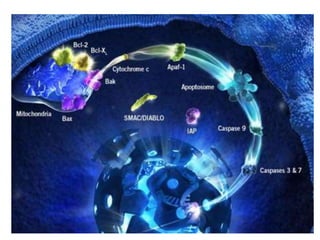
also thought that some Bcl-2 family proteins can induce (proapoptotic members) or inhibit (anti-apoptotic members) the
release of cytochrome c into the cytosol which, once there,
activates caspase-9 and caspase-3, leading to apoptosis.
Although Zamzami et al. suggest that the release of
cytochrome c is indirectly mediated by the PT pore on the
inner mitochondrial membrane, strong evidence suggest an
earlier implication of the MAC pore on the outer membrane.
Another theory suggests that Rho
proteins play a role in Bcl-2, Mcl-1 and
Bid activation. Rho inhibition reduces the
expression of anti-apoptotic Bcl-2
and Mcl-1 proteins and increases protein
levels of pro-apoptotic Bid but had no
effect on Bax or FLIP levels. Rho inhibition
induces caspase-9 and caspase-3dependent apoptosis of cultured human
endothelial cells.
Rho proteins
Rho GTPases
activation/deactivation cycle.
Rho GTPases are molecular
switches that cycle between
an inactive GDP-bound and an
active GTP-bound state.
Activation of Rho GTPases
occurs by stimulation with a
guanine exchange factor (GEF)
that causes the release of GDP
and the binding of GTP.
Structure:
structural studies have been
performed on six Bcl-2
family members
encompassing both anti(Bcl-x(L), Bcl-2, KSHV-Bcl-2,
Bcl-w) and pro-apoptotic
(Bax, Bid) members.
structure
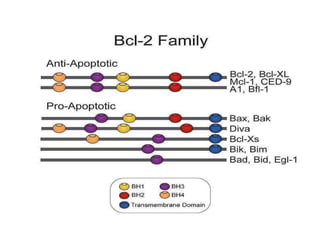
All proteins belonging to the Bcl-2 family contain either a
BH1, BH2, BH3 or BH4 domain. All anti-apoptotic proteins
contain BH1 and BH2 domains, some of them contain an
additional N-terminal BH4 domain (Bcl-2, Bcl-x(L), Bcl-w),
On the other hand, all pro-apoptotic proteins contain a
BH3 domain necessary for dimerization with other
proteins of Bcl-2 family and crucial for their killing
activity, some of them also contain BH1 and BH2
domains (Bax, Bak). The BH3 domain is also present in
some anti-apoptotic protein, such as Bcl-2 or Bcl-x(L).
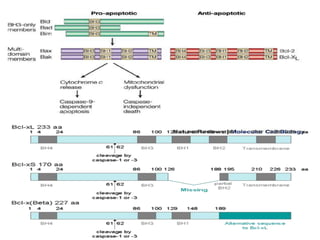
BH3-only family of proteins includes those of the Bcl-2 family proteins, which
contain only a single BH-domain. The BH3-only family members play a key
role in promoting apoptosis. The BH3-only family members

are Bim, Bid, BAD and others. Various apoptotic stimuli induce
expression and/or activation of specific BH3-only family members, which
translocate to the mitochondria and initiate Bax/Bak-dependent apoptosis.
Ex.Anti apoptotic B-cell lymphoma-extra large (Bcl-xl)

B-cell lymphoma-extra large (Bcl-xl) is a transmembrane
molecule in the mitochondria.
It is a member of the Bcl-2 family of proteins, and acts as a
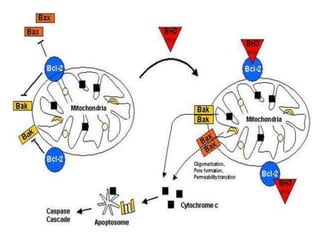
pro-survival protein by preventing the release of
mitochondrial contents such as cytochrome c, if more Bcl-xL
is present, pores are non-permeable and the cell survives.
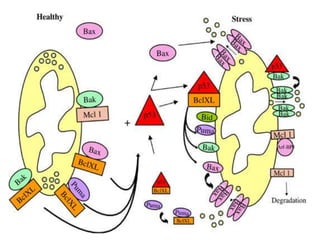
However, if Bax and Bak become activated, and Bcl-xL is
sequestered away by gatekeeper BH3-only factors (e.g. Bim),
causing a pore to form, cytochrome c is released leading to
initiation of caspase cascade leading to apoptotic events.
Role of(Bcl-xl)
Bcl-2
Bcl-2 (B-cell lymphoma 2), encoded by the BCL2 gene, is the founding member of the Bcl-2 family of regulator
proteins that regulate cell death (apoptosis), by either inducing (pro-apoptotic) it or inhibiting it (antiapoptotic).Bcl-2 is specifically considered as an important anti-apoptotic protein and is thus classified as an
oncogene.

Bcl-2 derives its name from B-cell lymphoma 2, as it is the second member of a range of proteins initially
described in chromosomal translocations involving chromosomes 14 and 18 in follicular lymphomas.

Role in disease:
Damage to the Bcl-2 gene has been identified as a cause of a number of cancers, including melanoma, breast,
prostate, chronic lymphocytic leukemia, and lung cancer, and a possible cause of schizophrenia and
autoimmunity. It is also a cause of resistance to cancer treatments.

Cancer occurs as the result of a disturbance in the homeostatic balance between cell growth and cell death.
Over-expression of anti-apoptotic genes, and under-expression of pro-apoptotic genes, can result in the lack of
cell death that is characteristic of cancer. An example can be seen in lymphomas.
Targeting BCL-2 family proteins for cancer therapy.
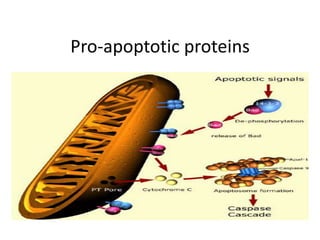
Pro-apoptotic proteins
References:
http://www.ncbi.nlm.nih.gov/pubmed/14996493
http://www.pnas.org/content/95/5/2603/F5.exphttp://flipper.diff.org/app/pathways/1847ansion.html
http://www.jbc.org/content/275/40/31546.full
http://www-personal.umich.edu/~ino/List/2342.htm
http://www.apoptosis.at/general.htm
http://www.plosbiology.org/article/info%3Adoi%2F10.1371%2Fjournal.pbio.0060147
http://www.nature.com/nchembio/journal/v9/n12/index.htmlhttp://www.broadinstitute.org/news/4119
http://www.vanderbilt.edu/vicb/DiscoveriesArchives/mcl-1_inhibitors_offer_hope.html
http://www.omicsonline.org/1948-593X/JBABM-04-034.php
Thank you

Bcl2 family

  • 2.
    Bcl2 family Eman abdEl-raouf ahmad Youssef
  • 3.
  • 4.
    definition Apoptosis regulator Bcl-2is a family of evolutionarily related proteins. These proteins govern mitochondrial outer membrane permeabilization (MOMP) and can be either pro-apoptotic (Bax, BAD, Bak and Bok among others) or anti-apoptotic (including Bcl-2 proper, Bcl-xL, and Bcl-w, among an assortment of others). There are a total of 25 genes in the Bcl-2 family known to date.
  • 7.
    Function: There are anumber of theories concerning how the Bcl-2 gene family exert their pro- or anti-apoptotic effect. An important one states that this is achieved by activation or inactivation of an inner mitochondrial permeability transition pore, which is involved in the regulation of matrix Ca2+, pH, and voltage. It is also thought that some Bcl-2 family proteins can induce (proapoptotic members) or inhibit (anti-apoptotic members) the release of cytochrome c into the cytosol which, once there, activates caspase-9 and caspase-3, leading to apoptosis. Although Zamzami et al. suggest that the release of cytochrome c is indirectly mediated by the PT pore on the inner mitochondrial membrane, strong evidence suggest an earlier implication of the MAC pore on the outer membrane.
  • 8.
    Another theory suggeststhat Rho proteins play a role in Bcl-2, Mcl-1 and Bid activation. Rho inhibition reduces the expression of anti-apoptotic Bcl-2 and Mcl-1 proteins and increases protein levels of pro-apoptotic Bid but had no effect on Bax or FLIP levels. Rho inhibition induces caspase-9 and caspase-3dependent apoptosis of cultured human endothelial cells.
  • 9.
    Rho proteins Rho GTPases activation/deactivationcycle. Rho GTPases are molecular switches that cycle between an inactive GDP-bound and an active GTP-bound state. Activation of Rho GTPases occurs by stimulation with a guanine exchange factor (GEF) that causes the release of GDP and the binding of GTP.
  • 11.
    Structure: structural studies havebeen performed on six Bcl-2 family members encompassing both anti(Bcl-x(L), Bcl-2, KSHV-Bcl-2, Bcl-w) and pro-apoptotic (Bax, Bid) members.
  • 12.
    structure All proteins belongingto the Bcl-2 family contain either a BH1, BH2, BH3 or BH4 domain. All anti-apoptotic proteins contain BH1 and BH2 domains, some of them contain an additional N-terminal BH4 domain (Bcl-2, Bcl-x(L), Bcl-w), On the other hand, all pro-apoptotic proteins contain a BH3 domain necessary for dimerization with other proteins of Bcl-2 family and crucial for their killing activity, some of them also contain BH1 and BH2 domains (Bax, Bak). The BH3 domain is also present in some anti-apoptotic protein, such as Bcl-2 or Bcl-x(L).
  • 13.
    BH3-only family ofproteins includes those of the Bcl-2 family proteins, which contain only a single BH-domain. The BH3-only family members play a key role in promoting apoptosis. The BH3-only family members are Bim, Bid, BAD and others. Various apoptotic stimuli induce expression and/or activation of specific BH3-only family members, which translocate to the mitochondria and initiate Bax/Bak-dependent apoptosis.
  • 15.
    Ex.Anti apoptotic B-celllymphoma-extra large (Bcl-xl) B-cell lymphoma-extra large (Bcl-xl) is a transmembrane molecule in the mitochondria. It is a member of the Bcl-2 family of proteins, and acts as a pro-survival protein by preventing the release of mitochondrial contents such as cytochrome c, if more Bcl-xL is present, pores are non-permeable and the cell survives. However, if Bax and Bak become activated, and Bcl-xL is sequestered away by gatekeeper BH3-only factors (e.g. Bim), causing a pore to form, cytochrome c is released leading to initiation of caspase cascade leading to apoptotic events.
  • 16.
  • 17.
    Bcl-2 Bcl-2 (B-cell lymphoma2), encoded by the BCL2 gene, is the founding member of the Bcl-2 family of regulator proteins that regulate cell death (apoptosis), by either inducing (pro-apoptotic) it or inhibiting it (antiapoptotic).Bcl-2 is specifically considered as an important anti-apoptotic protein and is thus classified as an oncogene. Bcl-2 derives its name from B-cell lymphoma 2, as it is the second member of a range of proteins initially described in chromosomal translocations involving chromosomes 14 and 18 in follicular lymphomas. Role in disease: Damage to the Bcl-2 gene has been identified as a cause of a number of cancers, including melanoma, breast, prostate, chronic lymphocytic leukemia, and lung cancer, and a possible cause of schizophrenia and autoimmunity. It is also a cause of resistance to cancer treatments. Cancer occurs as the result of a disturbance in the homeostatic balance between cell growth and cell death. Over-expression of anti-apoptotic genes, and under-expression of pro-apoptotic genes, can result in the lack of cell death that is characteristic of cancer. An example can be seen in lymphomas.
  • 18.
    Targeting BCL-2 familyproteins for cancer therapy.
  • 19.
  • 23.
  • 24.

Editor's Notes

  • #13 http://www.nature.com/nrm/journal/v3/n2/box/nrm731_BX3.html
  • #19 http://www.nature.com/nchembio/journal/v9/n6/fig_tab/nchembio.1256_F1.html