Course – PP– 603 – Signal Perceptions and Transductions
and Regulations of Physiological Processes (2+0)
Topic - Cross talk between signalling pathway
Department of Plant Physiology
Presented By -
Jyoti Prakash Sahoo
01ABT/PHD/17
Dept. of Agril.
Biotech.
OUAT, BBSR
1
 Biological crosstalk refers to instances in which
one or more components of one signal transduction
pathway affects another.
 This can be achieved through a number of ways
with the most common form being crosstalk between
proteins of signaling cascades.
 In these signal transduction pathways, there are
often shared components that can interact with either
pathway.
 A more complex instance of crosstalk can be
observed with transmembrane crosstalk between the
extracellular matrix (ECM) and the cytoskeleton.
Cross talk Biology
2
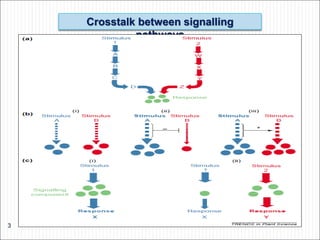
Crosstalk between signalling
pathways
3
Crosstalk between signalling pathways -
Example
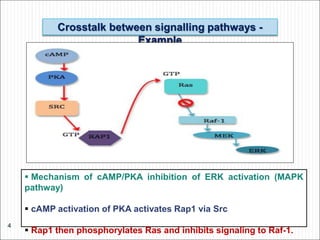
 Mechanism of cAMP/PKA inhibition of ERK activation (MAPK
pathway)
 cAMP activation of PKA activates Rap1 via Src
 Rap1 then phosphorylates Ras and inhibits signaling to Raf-1.
4
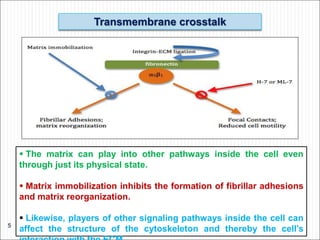
Transmembrane crosstalk
 The matrix can play into other pathways inside the cell even
through just its physical state.
 Matrix immobilization inhibits the formation of fibrillar adhesions
and matrix reorganization.
 Likewise, players of other signaling pathways inside the cell can
affect the structure of the cytoskeleton and thereby the cell’s
5
Crosstalk in lymphocyte activation
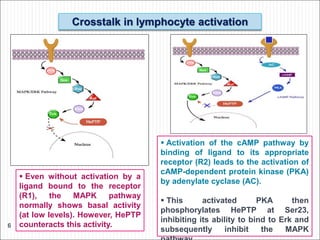
 Even without activation by a
ligand bound to the receptor
(R1), the MAPK pathway
normally shows basal activity
(at low levels). However, HePTP
counteracts this activity.
 Activation of the cAMP pathway by
binding of ligand to its appropriate
receptor (R2) leads to the activation of
cAMP-dependent protein kinase (PKA)
by adenylate cyclase (AC).
 This activated PKA then
phosphorylates HePTP at Ser23,
inhibiting its ability to bind to Erk and
subsequently inhibit the MAPK
6
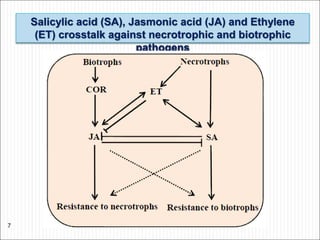
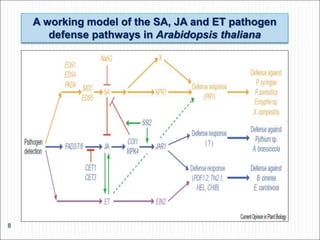
Salicylic acid (SA), Jasmonic acid (JA) and Ethylene
(ET) crosstalk against necrotrophic and biotrophic
pathogens
7
A working model of the SA, JA and ET pathogen
defense pathways in Arabidopsis thaliana
8
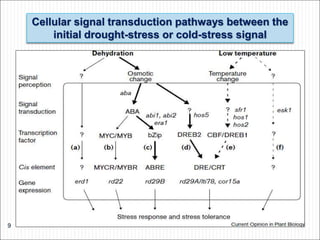
Cellular signal transduction pathways between the
initial drought-stress or cold-stress signal
9
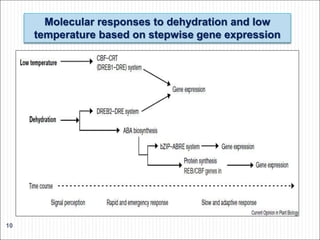
Molecular responses to dehydration and low
temperature based on stepwise gene expression
10
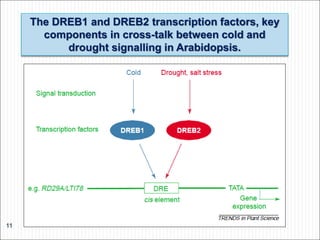
The DREB1 and DREB2 transcription factors, key
components in cross-talk between cold and
drought signalling in Arabidopsis.
11
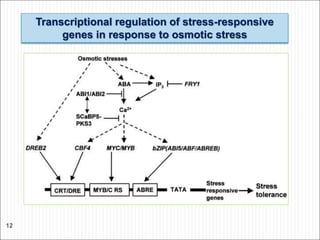
Transcriptional regulation of stress-responsive
genes in response to osmotic stress
12
13
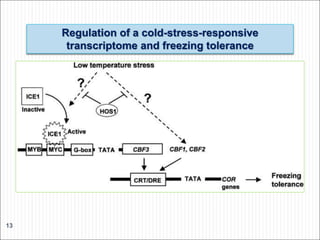
Regulation of a cold-stress-responsive
transcriptome and freezing tolerance
14
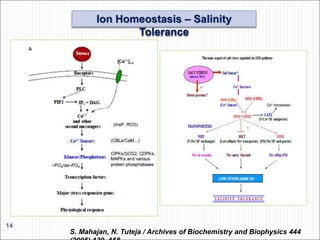
S. Mahajan, N. Tuteja / Archives of Biochemistry and Biophysics 444
Ion Homeostasis – Salinity
Tolerance
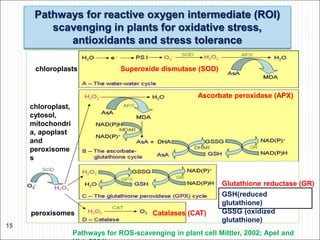
Pathways for reactive oxygen intermediate (ROI)
scavenging in plants for oxidative stress,
antioxidants and stress tolerance
15
Pathways for ROS-scavenging in plant cell Mittler, 2002; Apel and
Superoxide dismutase (SOD)
Ascorbate peroxidase (APX)
Catalases (CAT)
Glutathione reductase (GR)
GSH(reduced
glutathione)
GSSG (oxidized
glutathione)
chloroplasts
chloroplast,
cytosol,
mitochondri
a, apoplast
and
peroxisome
s
peroxisomes
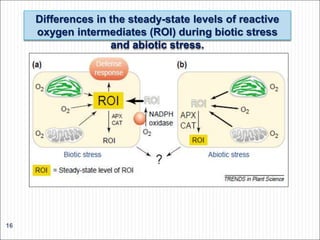
Differences in the steady-state levels of reactive
oxygen intermediates (ROI) during biotic stress
and abiotic stress.
16
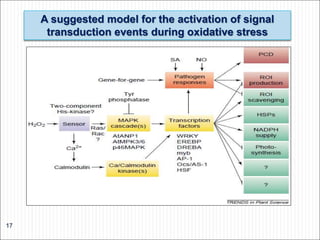
A suggested model for the activation of signal
transduction events during oxidative stress
17
18
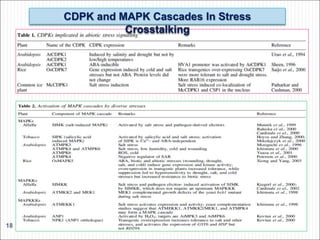
CDPK and MAPK Cascades In Stress
Crosstalking
19
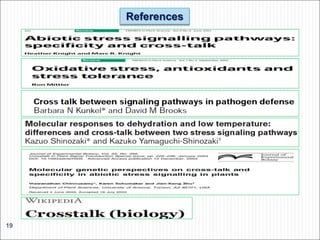
References
20

Cross talk between signalling pathway

  • 1.
    Course – PP–603 – Signal Perceptions and Transductions and Regulations of Physiological Processes (2+0) Topic - Cross talk between signalling pathway Department of Plant Physiology Presented By - Jyoti Prakash Sahoo 01ABT/PHD/17 Dept. of Agril. Biotech. OUAT, BBSR 1
  • 2.
     Biological crosstalkrefers to instances in which one or more components of one signal transduction pathway affects another.  This can be achieved through a number of ways with the most common form being crosstalk between proteins of signaling cascades.  In these signal transduction pathways, there are often shared components that can interact with either pathway.  A more complex instance of crosstalk can be observed with transmembrane crosstalk between the extracellular matrix (ECM) and the cytoskeleton. Cross talk Biology 2
  • 3.
  • 4.
    Crosstalk between signallingpathways - Example  Mechanism of cAMP/PKA inhibition of ERK activation (MAPK pathway)  cAMP activation of PKA activates Rap1 via Src  Rap1 then phosphorylates Ras and inhibits signaling to Raf-1. 4
  • 5.
    Transmembrane crosstalk  Thematrix can play into other pathways inside the cell even through just its physical state.  Matrix immobilization inhibits the formation of fibrillar adhesions and matrix reorganization.  Likewise, players of other signaling pathways inside the cell can affect the structure of the cytoskeleton and thereby the cell’s 5
  • 6.
    Crosstalk in lymphocyteactivation  Even without activation by a ligand bound to the receptor (R1), the MAPK pathway normally shows basal activity (at low levels). However, HePTP counteracts this activity.  Activation of the cAMP pathway by binding of ligand to its appropriate receptor (R2) leads to the activation of cAMP-dependent protein kinase (PKA) by adenylate cyclase (AC).  This activated PKA then phosphorylates HePTP at Ser23, inhibiting its ability to bind to Erk and subsequently inhibit the MAPK 6
  • 7.
    Salicylic acid (SA),Jasmonic acid (JA) and Ethylene (ET) crosstalk against necrotrophic and biotrophic pathogens 7
  • 8.
    A working modelof the SA, JA and ET pathogen defense pathways in Arabidopsis thaliana 8
  • 9.
    Cellular signal transductionpathways between the initial drought-stress or cold-stress signal 9
  • 10.
    Molecular responses todehydration and low temperature based on stepwise gene expression 10
  • 11.
    The DREB1 andDREB2 transcription factors, key components in cross-talk between cold and drought signalling in Arabidopsis. 11
  • 12.
    Transcriptional regulation ofstress-responsive genes in response to osmotic stress 12
  • 13.
    13 Regulation of acold-stress-responsive transcriptome and freezing tolerance
  • 14.
    14 S. Mahajan, N.Tuteja / Archives of Biochemistry and Biophysics 444 Ion Homeostasis – Salinity Tolerance
  • 15.
    Pathways for reactiveoxygen intermediate (ROI) scavenging in plants for oxidative stress, antioxidants and stress tolerance 15 Pathways for ROS-scavenging in plant cell Mittler, 2002; Apel and Superoxide dismutase (SOD) Ascorbate peroxidase (APX) Catalases (CAT) Glutathione reductase (GR) GSH(reduced glutathione) GSSG (oxidized glutathione) chloroplasts chloroplast, cytosol, mitochondri a, apoplast and peroxisome s peroxisomes
  • 16.
    Differences in thesteady-state levels of reactive oxygen intermediates (ROI) during biotic stress and abiotic stress. 16
  • 17.
    A suggested modelfor the activation of signal transduction events during oxidative stress 17
  • 18.
    18 CDPK and MAPKCascades In Stress Crosstalking
  • 19.
  • 20.