Kunal UpadhyayKunal Upadhyay
Build RELATIONSHIP with Good Person is like SUGARCANE, you break it,
Crush it, Squeeze it or even Beat & Grind it, Still you will get only
SWEETNESS…!!!
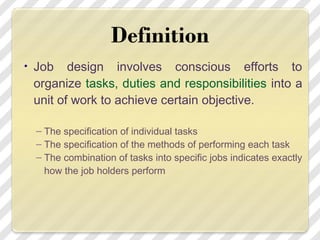
• Job design involves conscious efforts to
organize tasks, duties and responsibilities into a
unit of work to achieve certain objective.
– The specification of individual tasks
– The specification of the methods of performing each task
– The combination of tasks into specific jobs indicates exactly
how the job holders perform
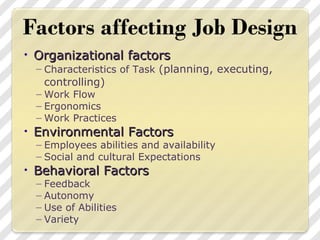
• Organizational factorsOrganizational factors
– Characteristics of Task (planning, executing,
controlling)
– Work Flow
– Ergonomics
– Work Practices
• Environmental FactorsEnvironmental Factors
– Employees abilities and availability
– Social and cultural Expectations
• Behavioral FactorsBehavioral Factors
– Feedback
– Autonomy
– Use of Abilities
– Variety
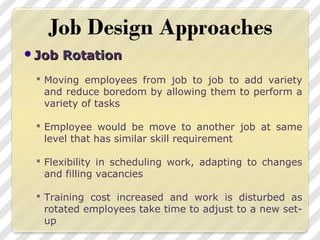
Job RotationJob Rotation
 Moving employees from job to job to add variety
and reduce boredom by allowing them to perform a
variety of tasks
 Employee would be move to another job at same
level that has similar skill requirement
 Flexibility in scheduling work, adapting to changes
and filling vacancies
 Training cost increased and work is disturbed as
rotated employees take time to adjust to a new set-
up
Job EngineeringJob Engineering
 Job engineering focuses on the tasks to be
performed, method to be used workflows amongmethod to be used workflows among
employees, layout of the workplace, performanceemployees, layout of the workplace, performance
standardsstandards and interdependencies among people and
machine
 Experts examine these job design factors by means
of TIME AND MOTION STUDIES determining the
time required to do each task
Allow employees to study a task rapidly
Permit short work cycles so that performance
can be almost automatic and involve little or
no mental efforts
Make hiring easier because low-skilled people
can be easily trained and paid relatively low
wages
Reduce the need of supervision
This approach continues to be successfully
used because:
 The end product/output of the work is clearly
defined and fully understood by the employees
 The steps/tasks to be performed to achieve the
require end product/output are clearly defined in
appropriate sequence
 Employees know their responsibilities and task
easily
 The tool, facilities and information need to perform
the work are readily available and fully understood
by the employees
 Employees are involved in work design
Job EnlargementJob Enlargement
 Refers to the expansion of the number of different tasks
performed by an employee in a single job.
 Task Variety (limited member with more tasks)
 Meaningful Work Modules (workers completed whole work)
 Ability Utilization (more skills and ability of workers )
 worker-placed Control (workers enjoy their workers)
 Performance Feedback (allows more feedback from
workers)
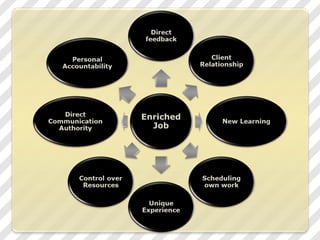
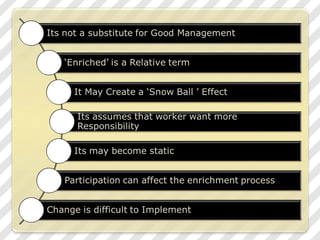
Job EnrichmentJob Enrichment
 Involves adding more motivators to a job to make it
more rewarding.
 It gives job-holder more decision-making, planning
and controlling power
BBA-SEM-3-HRM-Job design

BBA-SEM-3-HRM-Job design

  • 1.
    Kunal UpadhyayKunal Upadhyay BuildRELATIONSHIP with Good Person is like SUGARCANE, you break it, Crush it, Squeeze it or even Beat & Grind it, Still you will get only SWEETNESS…!!!
  • 2.
    • Job designinvolves conscious efforts to organize tasks, duties and responsibilities into a unit of work to achieve certain objective. – The specification of individual tasks – The specification of the methods of performing each task – The combination of tasks into specific jobs indicates exactly how the job holders perform
  • 3.
    • Organizational factorsOrganizationalfactors – Characteristics of Task (planning, executing, controlling) – Work Flow – Ergonomics – Work Practices • Environmental FactorsEnvironmental Factors – Employees abilities and availability – Social and cultural Expectations • Behavioral FactorsBehavioral Factors – Feedback – Autonomy – Use of Abilities – Variety
  • 4.
    Job RotationJob Rotation Moving employees from job to job to add variety and reduce boredom by allowing them to perform a variety of tasks  Employee would be move to another job at same level that has similar skill requirement  Flexibility in scheduling work, adapting to changes and filling vacancies  Training cost increased and work is disturbed as rotated employees take time to adjust to a new set- up
  • 5.
    Job EngineeringJob Engineering Job engineering focuses on the tasks to be performed, method to be used workflows amongmethod to be used workflows among employees, layout of the workplace, performanceemployees, layout of the workplace, performance standardsstandards and interdependencies among people and machine  Experts examine these job design factors by means of TIME AND MOTION STUDIES determining the time required to do each task
  • 6.
    Allow employees tostudy a task rapidly Permit short work cycles so that performance can be almost automatic and involve little or no mental efforts Make hiring easier because low-skilled people can be easily trained and paid relatively low wages Reduce the need of supervision
  • 7.
    This approach continuesto be successfully used because:  The end product/output of the work is clearly defined and fully understood by the employees  The steps/tasks to be performed to achieve the require end product/output are clearly defined in appropriate sequence  Employees know their responsibilities and task easily  The tool, facilities and information need to perform the work are readily available and fully understood by the employees  Employees are involved in work design
  • 8.
    Job EnlargementJob Enlargement Refers to the expansion of the number of different tasks performed by an employee in a single job.  Task Variety (limited member with more tasks)  Meaningful Work Modules (workers completed whole work)  Ability Utilization (more skills and ability of workers )  worker-placed Control (workers enjoy their workers)  Performance Feedback (allows more feedback from workers)
  • 9.
    Job EnrichmentJob Enrichment Involves adding more motivators to a job to make it more rewarding.  It gives job-holder more decision-making, planning and controlling power