
qw
ertyuiopasdfvbnmqwertyuiopasdfghjk
lzxcvbnmqwertyuiopasdfghjklzxcvbn
mqwertyuiopasdfghjklzxcvbnmqwerty
uiopasdfghjklzxcvbnmqwertyuiopasdf
ghjklzxcvbnmqwertyuiopasdfghjklzxc
vbnmqwertyuiopasdfghjklzxcvbnmqw
ertyuiopasdfghjklzxcvbnmqwertyuiop
asdfghjklzxcvbnmqwertyuiopasdfghjkl
zxcvbnmqwertyuiopasdfghjklzxcvbnm
qwertyuiopasdfghjklzxcvbnmqwertyui
opasdfghjklzxcvbnmqwertyuiopasdfgh
jklzxcvbnmqwertyuiopasdfghjklzxcvb
nmrtyuiopasdfghjklzxcvbnmqwertyui
Performance – linked compensation
PRESENTED IN Presented by:-
Class of :- SUMANT KR. SINGH
Dr shweta Mam MBA/15017/15
INTRODUCTION.
Performance means the degree or extent with which an
employee applies his skill, knowledge, and efforts to a
job assigned to him/her and the result of that
application. Performance appraisal means analysis,
review, or evaluation of performance or behaviour
analysis of an employee. It may be formal or informal,
oral or documented, open or confidential. However, in
organization we find formal appraisal systems in
documented form. It is, therefore, a formal process to
evaluate the performance of the employees in terms of
achieving organizational objectives.
The term ‘compensation’ as a substitute word for ‘wages’
and ‘salaries’, is of recent origin. Literatures on wage
amd salaries are enormous and consider the issues, more
from the legal perspectives.
A performance-linked compensation (PLC) is a form of
payment from an employer to an employee, which is
directly related to the performance output of an
employee and which may be specified in an employment
contract.
 Performance-Linked
compensation or compensation for
performance is money paid relating to how well one
works.
 Sales staff receive more pay for selling more, and
low performers do not earn enough to make keeping
the job worthwhile even if they manage to keep the
job.
 Many employers use this standards-basedsystem
for evaluating employees and for setting salaries.
Performance-Linkedcompensationis regardedby
many organizations as desirable for three reasons :-
 It motivates people to perform better or to
develop their skill and competences.
 It delivers the message that performance and
competence are important.
 It is fair and equitable to reward people
differentially according to their performance,
competence or contribution.
WWhhaattiissccoommppeennssaattiioonn
ppaayymmeenntt..
Is an integral part of human resource management
which helps in.
Motivating the employees and improving organizational
effectiveness .
If the compensation offered is effectively managed , it
contributes to high organizational productivity .
Benefits of performance – based
compensation.
 It helps in recognizing the efforts and
contributions of employees objectively and
thereby facilitates in effective job pricing,
both through cost optimization and
rewarding of talented performers.
 It facilitates in suitable compensation
design , rewarding employees based on the
performance linkage.
 It supports employee motivation (which
leads to increased performance), helping
employees to receive their performance
feedback, understanding their strengths
and weaknesses. Employees can develop
themselves through self-introspection and
thereby feel intrinsically motivated. So also
performance-based pay help in getting
extrinsically motivated. Both the
motivational constructs lead to improved
performance.
 It facilitates employees to develop their
core faculty of goal achievement.
 It retains good performers, through
competitive compensation design, offering
increased flexibility to earn more, based on
performance level.
 It attracts good performers from competing
organization.
Criteria of performancecompensation.
The eight golden rules for paying or teams for their
performance, as quoted by Armstrong and Murlis (1994),
are these :-
 Individuals and teams should be
clear about the targets and
standards of performance
required, whatever those may be.
 They should be able to track
performance against those targets
and standards throughout the
period over which the performance
is being assessed. They must be
able to measure their
performance, because if you
cannot measure their
performance, because if you
cannot measure performance you
cannot pay for performance.
 They must be in a position to
influence the performance by
changing their bahaviour or
decisions.
 They should understand what
rewards they will receive for
achieving the end results – there
should be a clear link between
effort and reward.
 The reward should follow as closely
as possible the accomplishment
that generated it.
 The reward should be worthwhile.
 The results to required generate
the reward should be attainable,
although not too easily.
 The basis upon which reward are
made should be communicated
positively and should be easy to
understand.
Advantages of performance linked
compensation.
The advantages claimed for performance linked
compensation can be summarized as follows:-
 It motivates.
 It delivers the right message.
 It is fair to reward people according to their
performance.
 It provides a tangible means of rewarding and
recognizing achievements.
Disadvantages of performance linked
compensation.
The disadvantages of performance linked compensation,
as pointed out by its many critics, are these :-
 It is not a guaranteed motivator; the performance-
pay criteria mentioned earlier in this assigement are
often difficult, if not impossible, to meet.
 Pay is not a motivator.
 It demotivates staff who do not benefit.
 It ruptures relationships and team work.
 It represents a diversion from managing staff
performance properly.
 It discourages risk-taking.
 It undermines the intrinsic interest in the work.
DDeevveellooppiinngg SSuucccceessssffuull
PPaayy--ffoorr--PPeerrffoorrmmaannccee PPllaannss..
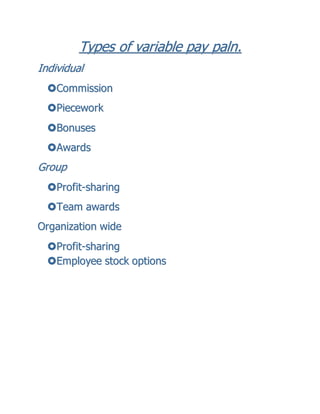
TTyyppeess ooff vvaarriiaabbllee ppaayy ppaallnn..
IInnddiivviidduuaall
CCoommmmiissssiioonn
PPiieecceewwoorrkk
BBoonnuusseess
AAwwaarrddss
GGrroouupp
PPrrooffiitt--sshhaarriinngg
TTeeaamm aawwaarrddss
OOrrggaanniizzaattiioonn wwiiddee
PPrrooffiitt--sshhaarriinngg
EEmmppllooyyeeee ssttoocckk ooppttiioonnss
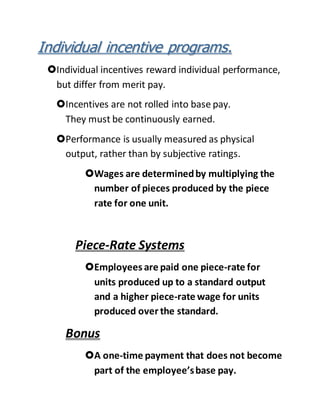
IInnddiivviidduuaall iinncceennttiivvee pprrooggrraammss..
Individual incentives reward individual performance,
but differ from merit pay.
Incentives are not rolled into base pay.
They must be continuously earned.
Performance is usually measured as physical
output, rather than by subjective ratings.
Wages are determinedby multiplying the
number of pieces produced by the piece
rate for one unit.
Piece-Rate Systems
Employees are paid one piece-rate for
units produced up to a standard output
and a higher piece-rate wage for units
produced over the standard.
Bonus
A one-time payment that does not become
part of the employee’sbase pay.
Awards
Cash or merchandise used as an incentive
reward.
Group incentive programs.
Group/organization wide incentive plans involve
cooperation among employees, management and union
in order to achieve broader objectives such as
organization wide reduction in manpower, materials and
supply cost, strengthening of loyalty to the organization,
harmonious IR, and decreased turnover and
absenteeism.
Gain sharing plan.
Isn't it a compensation systemthat places a big
carrot in front of employees in the form of a financial
incentive?
Isn't it the same as profit sharing that pays an annual
bonus to workers when times are good?
Is it about people working harder in order to make a
little more money?
Team awards.
Use a broader range of performance measures
(e.g. cost savings, meeting deadlines).
Organizational Incentives programs.
One of the first documented profit sharing plans in
the United States was introduced in 1794 at New
Geneva, PA, Glass Works.
Profit sharing plans are based on 2 premises:
i. the promise to provide additional economic rewards
when profits of the organization permit it.
ii. the implied acceptance of all employee
contributions that will advance the profit goal.
Profit Sharing
• A system to distribute a portionof the profits
in the organizationto employees
• Primary objectives of profit-sharing plans:
1.improve productivity
2.recruit/retainemployees
3.improve product/service quality
4.improve employeemorale
Drawbacks of Profit-Sharing Plan:
1.To disclose financial & profit
informationto employees
2.profits may vary a great deal fromyear
to year
3.payoffs far removedfromemployees’
effort
Employee Stock Option
• It give employeesthe right to purchase a fixed
number of shares of company stock at specified
price for a limited periodof time
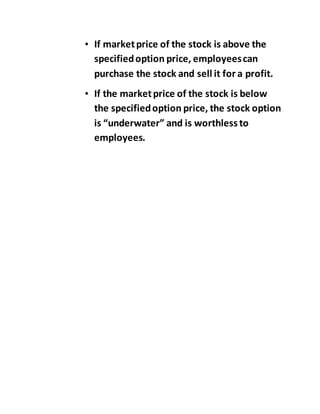
• If marketprice of the stock is above the
specifiedoption price, employeescan
purchase the stock and sell it for a profit.
• If the marketprice of the stock is below
the specifiedoption price, the stock option
is “underwater” and is worthless to
employees.
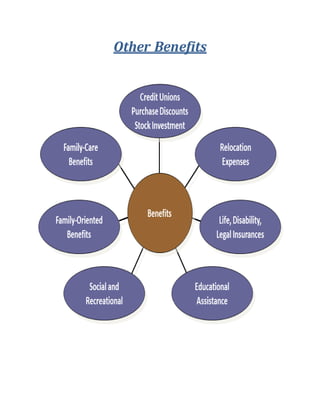
Other Benefits
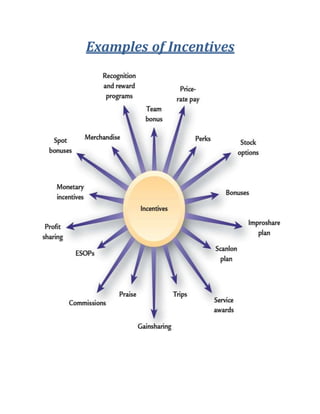
Examples of Incentives
Performance – linked compensation

Performance – linked compensation

  • 1.
  • 2.
    INTRODUCTION. Performance means thedegree or extent with which an employee applies his skill, knowledge, and efforts to a job assigned to him/her and the result of that application. Performance appraisal means analysis, review, or evaluation of performance or behaviour analysis of an employee. It may be formal or informal, oral or documented, open or confidential. However, in organization we find formal appraisal systems in documented form. It is, therefore, a formal process to evaluate the performance of the employees in terms of achieving organizational objectives. The term ‘compensation’ as a substitute word for ‘wages’ and ‘salaries’, is of recent origin. Literatures on wage amd salaries are enormous and consider the issues, more from the legal perspectives. A performance-linked compensation (PLC) is a form of payment from an employer to an employee, which is directly related to the performance output of an employee and which may be specified in an employment contract.
  • 3.
     Performance-Linked compensation orcompensation for performance is money paid relating to how well one works.  Sales staff receive more pay for selling more, and low performers do not earn enough to make keeping the job worthwhile even if they manage to keep the job.  Many employers use this standards-basedsystem for evaluating employees and for setting salaries. Performance-Linkedcompensationis regardedby many organizations as desirable for three reasons :-  It motivates people to perform better or to develop their skill and competences.  It delivers the message that performance and competence are important.  It is fair and equitable to reward people differentially according to their performance, competence or contribution.
  • 4.
    WWhhaattiissccoommppeennssaattiioonn ppaayymmeenntt.. Is an integralpart of human resource management which helps in. Motivating the employees and improving organizational effectiveness . If the compensation offered is effectively managed , it contributes to high organizational productivity .
  • 5.
    Benefits of performance– based compensation.  It helps in recognizing the efforts and contributions of employees objectively and thereby facilitates in effective job pricing, both through cost optimization and rewarding of talented performers.  It facilitates in suitable compensation design , rewarding employees based on the performance linkage.  It supports employee motivation (which leads to increased performance), helping employees to receive their performance feedback, understanding their strengths and weaknesses. Employees can develop themselves through self-introspection and thereby feel intrinsically motivated. So also performance-based pay help in getting extrinsically motivated. Both the
  • 6.
    motivational constructs leadto improved performance.  It facilitates employees to develop their core faculty of goal achievement.  It retains good performers, through competitive compensation design, offering increased flexibility to earn more, based on performance level.  It attracts good performers from competing organization.
  • 7.
    Criteria of performancecompensation. Theeight golden rules for paying or teams for their performance, as quoted by Armstrong and Murlis (1994), are these :-  Individuals and teams should be clear about the targets and
  • 8.
    standards of performance required,whatever those may be.  They should be able to track performance against those targets and standards throughout the period over which the performance is being assessed. They must be able to measure their performance, because if you cannot measure their performance, because if you cannot measure performance you cannot pay for performance.  They must be in a position to influence the performance by changing their bahaviour or decisions.  They should understand what rewards they will receive for achieving the end results – there should be a clear link between effort and reward.
  • 9.
     The rewardshould follow as closely as possible the accomplishment that generated it.  The reward should be worthwhile.  The results to required generate the reward should be attainable, although not too easily.  The basis upon which reward are made should be communicated positively and should be easy to understand.
  • 10.
    Advantages of performancelinked compensation. The advantages claimed for performance linked compensation can be summarized as follows:-  It motivates.  It delivers the right message.  It is fair to reward people according to their performance.  It provides a tangible means of rewarding and recognizing achievements.
  • 12.
    Disadvantages of performancelinked compensation. The disadvantages of performance linked compensation, as pointed out by its many critics, are these :-  It is not a guaranteed motivator; the performance- pay criteria mentioned earlier in this assigement are often difficult, if not impossible, to meet.  Pay is not a motivator.  It demotivates staff who do not benefit.  It ruptures relationships and team work.  It represents a diversion from managing staff performance properly.  It discourages risk-taking.  It undermines the intrinsic interest in the work.
  • 13.
  • 14.
    TTyyppeess ooff vvaarriiaabblleeppaayy ppaallnn.. IInnddiivviidduuaall CCoommmmiissssiioonn PPiieecceewwoorrkk BBoonnuusseess AAwwaarrddss GGrroouupp PPrrooffiitt--sshhaarriinngg TTeeaamm aawwaarrddss OOrrggaanniizzaattiioonn wwiiddee PPrrooffiitt--sshhaarriinngg EEmmppllooyyeeee ssttoocckk ooppttiioonnss
  • 15.
    IInnddiivviidduuaall iinncceennttiivvee pprrooggrraammss.. Individualincentives reward individual performance, but differ from merit pay. Incentives are not rolled into base pay. They must be continuously earned. Performance is usually measured as physical output, rather than by subjective ratings. Wages are determinedby multiplying the number of pieces produced by the piece rate for one unit. Piece-Rate Systems Employees are paid one piece-rate for units produced up to a standard output and a higher piece-rate wage for units produced over the standard. Bonus A one-time payment that does not become part of the employee’sbase pay.
  • 16.
    Awards Cash or merchandiseused as an incentive reward. Group incentive programs. Group/organization wide incentive plans involve cooperation among employees, management and union in order to achieve broader objectives such as organization wide reduction in manpower, materials and supply cost, strengthening of loyalty to the organization, harmonious IR, and decreased turnover and absenteeism. Gain sharing plan. Isn't it a compensation systemthat places a big carrot in front of employees in the form of a financial incentive? Isn't it the same as profit sharing that pays an annual bonus to workers when times are good? Is it about people working harder in order to make a little more money?
  • 17.
    Team awards. Use abroader range of performance measures (e.g. cost savings, meeting deadlines). Organizational Incentives programs. One of the first documented profit sharing plans in the United States was introduced in 1794 at New Geneva, PA, Glass Works. Profit sharing plans are based on 2 premises: i. the promise to provide additional economic rewards when profits of the organization permit it. ii. the implied acceptance of all employee contributions that will advance the profit goal. Profit Sharing • A system to distribute a portionof the profits in the organizationto employees
  • 18.
    • Primary objectivesof profit-sharing plans: 1.improve productivity 2.recruit/retainemployees 3.improve product/service quality 4.improve employeemorale Drawbacks of Profit-Sharing Plan: 1.To disclose financial & profit informationto employees 2.profits may vary a great deal fromyear to year 3.payoffs far removedfromemployees’ effort Employee Stock Option • It give employeesthe right to purchase a fixed number of shares of company stock at specified price for a limited periodof time
  • 19.
    • If marketpriceof the stock is above the specifiedoption price, employeescan purchase the stock and sell it for a profit. • If the marketprice of the stock is below the specifiedoption price, the stock option is “underwater” and is worthless to employees.
  • 20.
  • 21.