DevelopmentDevelopment
Kunal B. Upadhyay
Don’t think that ‘TIME’ will change our LIFE,Don’t think that ‘TIME’ will change our LIFE,
‘‘TIME’ only change The Expiry Dates of theTIME’ only change The Expiry Dates of the
‘OPPORTUNITIES’ !!‘OPPORTUNITIES’ !!
DevelopmentDevelopment
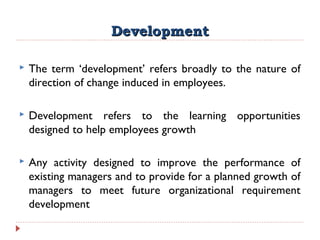
 The term ‘development’ refers broadly to the nature of
direction of change induced in employees.
 Development refers to the learning opportunities
designed to help employees growth
 Any activity designed to improve the performance of
existing managers and to provide for a planned growth of
managers to meet future organizational requirement
development
Needs & Objective of DevelopmentNeeds & Objective of Development
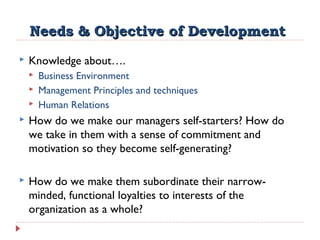
 Knowledge about….
 Business Environment
 Management Principles and techniques
 Human Relations
 How do we make our managers self-starters? How do
we take in them with a sense of commitment and
motivation so they become self-generating?
 How do we make them subordinate their narrow-
minded, functional loyalties to interests of the
organization as a whole?
Cont…
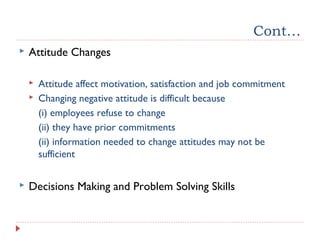
 Attitude Changes
 Attitude affect motivation, satisfaction and job commitment
 Changing negative attitude is difficult because
(i) employees refuse to change
(ii) they have prior commitments
(ii) information needed to change attitudes may not be
sufficient
 Decisions Making and Problem Solving Skills
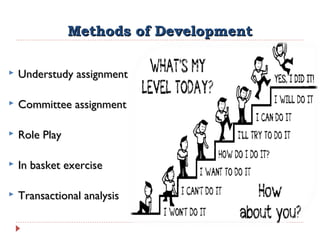
Methods of DevelopmentMethods of Development
 Understudy assignmentUnderstudy assignment
 Committee assignmentCommittee assignment
 Role PlayRole Play
 In basket exerciseIn basket exercise
 Transactional analysisTransactional analysis
Understudy AssignmentUnderstudy Assignment
 Involves a continuing flow of instructions, comments and
suggestions from managers to the subordinates
 The trainee works directly with a senior manager who is
responsible for coaching the junior
 The managers gives certain responsibilities , giving the trainee
a chance to learn the job
 Most irritating problem with such employees is their inability
to balance work with life Family, Profession, Health, Social ,
Financial, Spiritual and Mental
Committee AssignmentCommittee Assignment
 Managerial personnel may be developed through their
participation in deliberation and decision making in group
form such as committees
 Decision making in committees s through the process of
committees deliberations
 First at the initial stagesFirst at the initial stages, the group tries to acquire the
largest pool of common information about the fact of
situation
 Second ,Second , the group tries to make inferences and
evaluation of information to form common opinions in
general way
 Third,Third, it gets around more specific suggestions and
solution to the problem
Role PlayRole Play
 A method of learning was introduced by Moreno, a
Vatican psychiatrist . A method of learning involves
human interaction in imaginary situation
 While playing these roles they assume themselves as the
persons whose role they play
 Its used in groups where various individuals are given the
roles of different managers who are required to solve a
problem or to arrive at a decision
 The trainees to develop better perspective in performing
their jobs because they may see the jobs from different
angles
In-basket ExerciseIn-basket Exercise
 A variety of situations is presented in this exercise which
would usually be dealt by a manager in his typical working
day
 One method of this exercise is to present mail of various
types to a trainee whose reactions on these are noted
 The trainee is given certain incidents and his reactions are
noted down.
 Some trainees may play surprise roles which interrupt the
managers and gives him two or more problem like real on-
the-job pressures
 Feedback of his behaviour, the trainees come to know his
behavioural pattern and tries to overcome the one which is
not require
Transactional AnalysisTransactional Analysis
 TA refers to a method of analysing and understanding
interpersonal behaviour.
 When people interact, there is a social transaction in
which one person responds to another
 TA originally developed by Eric Berne a psychotherapist,
for psychotherapy in 1950
 People interact with each other in terms of three
Psychological positions, Or Behavioural patterns , known
as ego state
 CHILD EGO, ADULT EGO, PARENT EGO
CHILD EGOCHILD EGO
 Characteristics of child ego include
 Creativity
 Conformity
 Depression
 Anxiety (Worry, Nervousness)
 Dependence
 Fear and hate
 The child ego is characterised by non-logical and
immediate action which result in immediate satisfaction
 There are three parts of child ego: Natural, Adaptive
ADULT EGOADULT EGO
 The adult is characterised by logical thinking and
reasoning
 The ego state can be identified by verbal and physical
signs which include thoughtful concentration and factual
discussion
 He updates the parent data to determine what is valid
and what is no
 Similarly he also updates child data to determine which
feelings should be expressed, thus, he keeps and controls
emotional expression appropriately
PARENT EGOPARENT EGO
 The value and behaviour of these people are recorded in
the mind of the individual and these become the basic
values of the personality
 Characteristics of a person acting with the parent include
being
 Overprotective (Jealous, selfish)
 Distant (Reserved)
 Dogmatic (Rigid)
 Indispensable
 Upright

BBA-SEM-3-HRM-Development

  • 1.
    DevelopmentDevelopment Kunal B. Upadhyay Don’tthink that ‘TIME’ will change our LIFE,Don’t think that ‘TIME’ will change our LIFE, ‘‘TIME’ only change The Expiry Dates of theTIME’ only change The Expiry Dates of the ‘OPPORTUNITIES’ !!‘OPPORTUNITIES’ !!
  • 2.
    DevelopmentDevelopment  The term‘development’ refers broadly to the nature of direction of change induced in employees.  Development refers to the learning opportunities designed to help employees growth  Any activity designed to improve the performance of existing managers and to provide for a planned growth of managers to meet future organizational requirement development
  • 3.
    Needs & Objectiveof DevelopmentNeeds & Objective of Development  Knowledge about….  Business Environment  Management Principles and techniques  Human Relations  How do we make our managers self-starters? How do we take in them with a sense of commitment and motivation so they become self-generating?  How do we make them subordinate their narrow- minded, functional loyalties to interests of the organization as a whole?
  • 4.
    Cont…  Attitude Changes Attitude affect motivation, satisfaction and job commitment  Changing negative attitude is difficult because (i) employees refuse to change (ii) they have prior commitments (ii) information needed to change attitudes may not be sufficient  Decisions Making and Problem Solving Skills
  • 5.
    Methods of DevelopmentMethodsof Development  Understudy assignmentUnderstudy assignment  Committee assignmentCommittee assignment  Role PlayRole Play  In basket exerciseIn basket exercise  Transactional analysisTransactional analysis
  • 6.
    Understudy AssignmentUnderstudy Assignment Involves a continuing flow of instructions, comments and suggestions from managers to the subordinates  The trainee works directly with a senior manager who is responsible for coaching the junior  The managers gives certain responsibilities , giving the trainee a chance to learn the job  Most irritating problem with such employees is their inability to balance work with life Family, Profession, Health, Social , Financial, Spiritual and Mental
  • 7.
    Committee AssignmentCommittee Assignment Managerial personnel may be developed through their participation in deliberation and decision making in group form such as committees  Decision making in committees s through the process of committees deliberations  First at the initial stagesFirst at the initial stages, the group tries to acquire the largest pool of common information about the fact of situation  Second ,Second , the group tries to make inferences and evaluation of information to form common opinions in general way  Third,Third, it gets around more specific suggestions and solution to the problem
  • 8.
    Role PlayRole Play A method of learning was introduced by Moreno, a Vatican psychiatrist . A method of learning involves human interaction in imaginary situation  While playing these roles they assume themselves as the persons whose role they play  Its used in groups where various individuals are given the roles of different managers who are required to solve a problem or to arrive at a decision  The trainees to develop better perspective in performing their jobs because they may see the jobs from different angles
  • 9.
    In-basket ExerciseIn-basket Exercise A variety of situations is presented in this exercise which would usually be dealt by a manager in his typical working day  One method of this exercise is to present mail of various types to a trainee whose reactions on these are noted  The trainee is given certain incidents and his reactions are noted down.  Some trainees may play surprise roles which interrupt the managers and gives him two or more problem like real on- the-job pressures  Feedback of his behaviour, the trainees come to know his behavioural pattern and tries to overcome the one which is not require
  • 10.
    Transactional AnalysisTransactional Analysis TA refers to a method of analysing and understanding interpersonal behaviour.  When people interact, there is a social transaction in which one person responds to another  TA originally developed by Eric Berne a psychotherapist, for psychotherapy in 1950  People interact with each other in terms of three Psychological positions, Or Behavioural patterns , known as ego state  CHILD EGO, ADULT EGO, PARENT EGO
  • 11.
    CHILD EGOCHILD EGO Characteristics of child ego include  Creativity  Conformity  Depression  Anxiety (Worry, Nervousness)  Dependence  Fear and hate  The child ego is characterised by non-logical and immediate action which result in immediate satisfaction  There are three parts of child ego: Natural, Adaptive
  • 12.
    ADULT EGOADULT EGO The adult is characterised by logical thinking and reasoning  The ego state can be identified by verbal and physical signs which include thoughtful concentration and factual discussion  He updates the parent data to determine what is valid and what is no  Similarly he also updates child data to determine which feelings should be expressed, thus, he keeps and controls emotional expression appropriately
  • 13.
    PARENT EGOPARENT EGO The value and behaviour of these people are recorded in the mind of the individual and these become the basic values of the personality  Characteristics of a person acting with the parent include being  Overprotective (Jealous, selfish)  Distant (Reserved)  Dogmatic (Rigid)  Indispensable  Upright