
UNIT 1
Frame work for
International
Business
Kunal Upadhyay
OUTLINE OF UNIT
• GlobalizationGlobalization : Concept & Factors affecting globalization & Restraining
• International BusinessInternational Business : Reasons for expansion
• ConceptsConcepts : International Trade, International Marketing, International Investment,
International Management & Global Business
• New Trade TheoryNew Trade Theory : Internal and External Economics of Scale
• International Political System and IdeologiesInternational Political System and Ideologies
• Types of Govt., Economies System, Political SystemTypes of Govt., Economies System, Political System
• Principles of International LawPrinciples of International Law
• Culture Orientation in International BusinessCulture Orientation in International Business
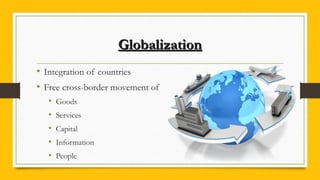
GlobalizationGlobalization
• Integration of countries
• Free cross-border movement of
• Goods
• Services
• Capital
• Information
• People
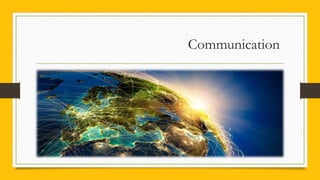
Communication
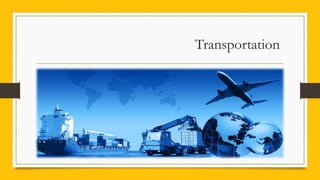
Transportation
Technologies
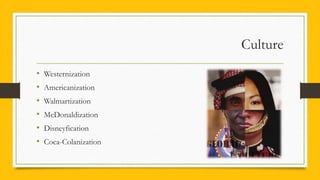
Culture
• Westernization
• Americanization
• Walmartization
• McDonaldization
• Disneyfication
• Coca-Colanization
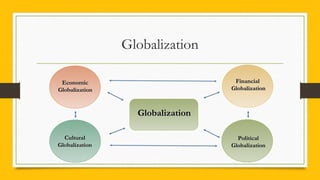
Globalization
GlobalizationGlobalization
FinancialFinancial
GlobalizationGlobalization
PoliticalPolitical
GlobalizationGlobalization
CulturalCultural
GlobalizationGlobalization
EconomicEconomic
GlobalizationGlobalization
Factors Influencing Globalization
• Economic Liberalization
• Technological Breakthroughs
• Manufacturing Technology
• Transportation Technology
• Information & Communication Technology
• Multilateral Institutions [GATT, WTO, TRIMS, TRIPS,GATS]
• International Economic Integrations [in 1957 EEC, in 1995 NAFTA]
Cont..
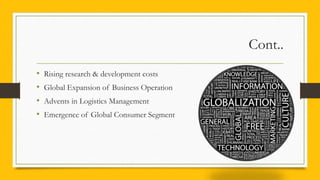
• Rising research & development costs
• Global Expansion of Business Operation
• Advents in Logistics Management
• Emergence of Global Consumer Segment
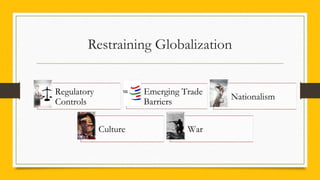
Restraining Globalization
Regulatory
Controls
Emerging Trade
Barriers
Nationalism
Culture War
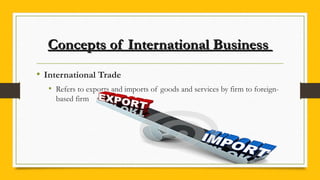
Concepts of International BusinessConcepts of International Business
• International Trade
• Refers to exports and imports of goods and services by firm to foreign-
based firm
Cont..
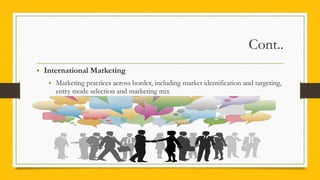
• International Marketing
• Marketing practices across border, including market identification and targeting,
entry mode selection and marketing mix
Cont..
• International Investment
• Cross-border either be portfolio investment with short-term objective or Capital
investment with long-term objective
Cont..
• International Management
• Refers to application of management concepts and techniques in cross –country
environment and adaptation to different social, economic, legal political and
technological environment
Cont..
• International Business
• Refers all those business activities that involve cross-border transactions of
goods, services, and resources between two or more nations
Cont..
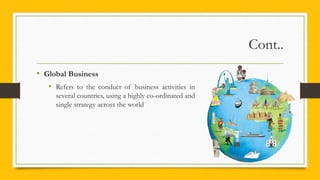
• Global Business
• Refers to the conduct of business activities in
several countries, using a highly co-ordinated and
single strategy across the world
Reasons for International Business
Expansion
• Market-seeking Motive
• Opportunities due to Life Cycles
• Uniqueness of Product or Services
• Economic Motive
• Profitability
• Achieving economies of scale
• Spreading R&D costs
• Strategic Motives
• Growth
• Risk spread
New Trade Theory
• Countries do not necessarily trade because of their differences
• But they also trade so as to increase their returns
• International trade increase the output due to its specializations
• Trade theory explain when the economies of scale achieve by
production of specific product
What is Economies Scale ? ?
• Economies of scale means Average CostAverage Cost of production declines
as the number of units increases.
• Internal scale economies (Helpman & Krugman): AC declines
with output of individual firm
• External scale economies (Markusen & Melvin): AC declines as
the size of the industry grows.
Internal Economies Scale
• Benefit by when the cost per unit of output depends upon their
size
• Firms enhance their internal economies of scale can decrease
their price and monopolize the industry
• Internal economies of scale leads firms to specialized in a narrow
product line to produce the volume necessary to achieve cost
benefits
• Industries requires massive investment in R&D
External Economies of Scale
• If the cost per unit of output depends upon the size of the
industry, not upon the size of an individual firm.
• Its enables the industry in a country to produce at a lower rate
when the size is large compared to the same industry in another
country
• A skilled labour workforce, A good reputations, Specialist market,
Improve infrastructure, Special Services
International Political System & IdeologiesInternational Political System & Ideologies
Cont..
• International political and economic systems hardly function
independently.
• The two are mutually interdependent.
• Political and diplomatic relations
• political system of a country comprise various stakeholders, such
as government, political parties with different ideologies, labor
unions, religious organizations, environmental activists and various
NGOs.
Cont..
• Ideology is a set of beliefs or ideas as to how
the society or group should be organized,
politically, economically or morally
• Political ideology is a set of ideas or beliefs
that people hold about their political rule and
its institutions about their position and role
in it.
Cont..
• Principal political ideologies may be categorized by :-
I. Economic System
II. Political System
III.Governance Structure
Types of Government : Economic Systems
• CommunismCommunism
• Based on Karl Marx’s theory of social change directed at the idea of
classless society, all the major factors of production in a country under
communism are owned by the government and shared by all the people
rather than profit seeking enterprises, for the benefit of the society
• The government controls all the productive resources and industrial
enterprises, it uses significant control on determining production, price
employment, and practically everything else
• The focus of communism is on human welfare rather than profit
making.
Cont..
• SocialismSocialism
• In a socialist form of government , basic and heavy industries are
operated by the government, where as small businesses may be
privately owned. Basic industries, such as mining, oil exploration,
steel, ship building, railways, roads, airlines, etc. are kept under
government control.
• The extent of government control under socialism is lower than
communism.
Cont..
• Countries following socialist system include Sweden ,France,
India, Poland etc.
• However, the socialist countries too differ from each other in
terms of the degrees of public and private ownership.
Cont..
• Capitalism:Capitalism:
• In contrast to communism, capitalism is the economic system in
which there is a complete freedom of private ownership of
productive resources and industries.
• Thus, there is freedom to both the business enterprises and the
consumers that provides for a ‘free market economy’.
Cont..
• Under capitalism, individuals are allowed to produce goods and
services under competitive conditions giving rise to a ‘market-
oriented system’.
• Market prices are determined by the forces of demand and supply.
• As individuals are motivated by private gains, it leads to product
innovation, quality up gradation, increase in efficiency and lower
market prices. For instance, the US is highly capitalistic compared to
Japan.
Types of Government : Political System
• DemocracyDemocracy
• Totalitarianism (Autocracy)Totalitarianism (Autocracy)
- Secular totalitarianism
- Fascist totalitarianism
- Authoritarian totalitarianism
- Communist totalitarianism
- Theocratic totalitarianism
Cont..
• Democracy:
• The word democracy is derived from demokratia, which means rule of
the people or government by the people where citizens are directly
involved in decision making.
• Over a period of time, there has been proliferation (process) of
population across the world and societies have become more complex.
• This has led to decision making by people’s elected representatives in
democratic countries
Cont..
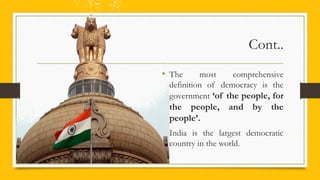
• The most comprehensive
definition of democracy is the
government ‘of the people, for
the people, and by the
people’.
• India is the largest democratic
country in the world.
Cont..
• Totalitarianism:Totalitarianism:
• It is a autocratic form of centralized government that regulates every
aspect of public and private behavior.
• Power is centralized in the hands of a dictator who operates through a
mixture of cultivating devoted followers and terrorizing those who do
not agree with its policies.
Cont..
• Citizens in totalitarianism state are generally removes of their basic
rights of freedom of expression, organizing meetings, free media,
tolerance, and elections, which are available under democracy.
• Secular totalitarianism : In secular totalitarianism, the government
uses military power to rule.
• Fascist totalitarianism: Fascism is a right wing nationalistic
political ideology fundamentally opposed to democracy with a
totalitarianism & categorized structure.
Cont..
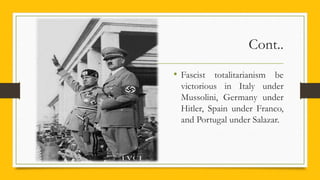
• Fascist totalitarianism be
victorious in Italy under
Mussolini, Germany under
Hitler, Spain under Franco,
and Portugal under Salazar.
Cont..
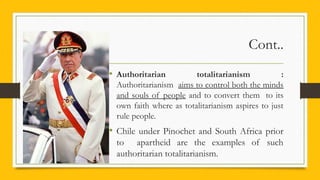
• Authoritarian totalitarianism :
Authoritarianism aims to control both the minds
and souls of people and to convert them to its
own faith where as totalitarianism aspires to just
rule people.
• Chile under Pinochet and South Africa prior
to apartheid are the examples of such
authoritarian totalitarianism.
Cont..
• Communist totalitarianism : This is the most widespread form
of secular totalitarianism which advocates that socialism can be
achieved only through totalitarian dictatorship.
• It is the left wing totalitarianism that believes in equal distribution
of wealth and complete government ownership and control on
national resources.
Cont..
• Theocratic totalitarianism : Religious leaders also assume
political leadership in theocratic totalitarianism
• for example, in the Islamic Republic of Iran.
Types of Government : Governance Structure
• Parliamentary: the government consults its citizens from time to time
and the parliament has power to formulate and execute law. The British
parliamentary system is one of the oldest in the world
• Parliamentary republics the Prime Minister is the executive head of the
government & also leader of the legislature.
• INDIA, SINGAPORE , FINLAND, GERMANY, AUSTRIA, GREECE etc.
Cont..
• Semi-presidential system a president and a prime minster co-exist. The
president genuine executive authority. But the prime minister is the
head of the legislature and also heads the government
• FRANCE, RUSSIA, PAKISTAN & THE REPUBLIC OF KOREA
• Fully presidential system the president is both head of the state and
head of the government in fully presidential system and there is NO
prime minister.
• US, PHILIPPINES, MEXICO, BRAZIL, TANZANIA, INDONESIA
Cont..
• Commonwealth CountriesCommonwealth Countries These countries represent
constitutional kingdoms that recognize the British King as state
over an independent government.
• A governor-general to each country other than UK is appointed
by the QUEEN as a representative.
• UK, AUSTRIA, NEW ZELAND, CANADA, JAMAICA
Cont..
• MonarchiesMonarchies
Constitutional Monarchies a form of government in which a
king or queen acts as head of state, while the ability to make
and pass legislation exist in with an elected parliament.
The constitutional monarch cannot make or pass legislation, and
must remain politically natural
JAPAN, THAILAND, SPAN, DENMARK, SWEDEN, BELGIUM
Cont..
• Absolute Monarchies it includes countries that have monarchs as
the executive head of government, exercising all powers
• UAE, SAUDI AREBIA, OMAN, QATAR, BHUTAN
• TheocracyTheocracy Greek word theokratia, which means THE RULE OF
GOD. The civil leader is believed to have a direct personal
connections with god in pure theocracy
INTERNATIONAL LAW
Introduction
• International law is less clear compared to domestic law since it
embodies a multiplicity of agreements (bilateral, multilateral, or
universal) and conventions (agreements) such as( the Vienna
convention on diplomatic security, Geneva convention on human
Rights , etc.) besides the laws of individual countries.
• International Managers need to understand the basic principles
that govern the conduct of international law.
Principles of Sovereignty
• A ‘ sovereign’ state is independent and free from all external
control or enjoys complete legal equality with other states.
• It governs its own territory, has the right to select and implement
its own political, economic, and social systems and has the power
to enter into bilateral or multilateral agreements with other
nations.
Cont..
• Thus, a sovereign state exercises
powers over its own members its own
members and in relation to other
countries.
International Jurisdiction
• Under international law, there are three basic types of
jurisdictional principles:
- Nationality Principle
- Territoriality principle
- Protective principle
Cont..
• Doctrine of ComityDoctrine of Comity As a part of international customs and
traditions, there must be mutual respect for the laws, institutions,
and the government system of other countries in the matter of
jurisdiction over their own citizens
• Act of state of doctrineAct of state of doctrine this jurisdiction principle of
international law, all acts of other governments are considered to
be valid by a country’s court, even if such act are not appropriate
in the country.
Cont..
• Treatment & Rights of aliensTreatment & Rights of aliens Nations have the right to impose
restriction upon foreign citizens on their rights to travel and stay,
their conduct, or area of business operations.
• A country may also refuse entry to foreign citizens or restrict their
travel.
Cont..
• Setting of DisputeSetting of Dispute courts are bound to examine issues, such as
place from where evidence must be collected, location of the
property under restitution
• For instance after the disaster of union Carbide’s pesticide plant
located at Bhopal in India, the New York court of appeals sent
back the case to India for resolution.
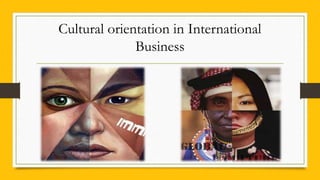
Cultural orientation in International
Business
Introduction
• The orientation of its international managers affects the ability of
a company to adapt any foreign business environment.
• The major types of cultural orientation include parochialism
versus simplification and EPRG approach.
Parochialism
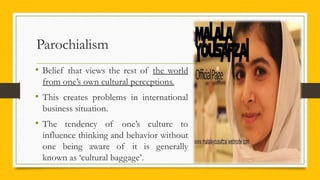
• Belief that views the rest of the world
from one’s own cultural perceptions.
• This creates problems in international
business situation.
• The tendency of one’s culture to
influence thinking and behavior without
one being aware of it is generally
known as ‘cultural baggage’.
Simplification
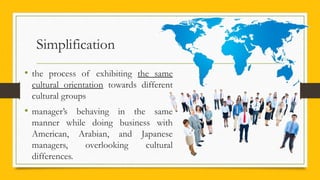
• the process of exhibiting the same
cultural orientation towards different
cultural groups
• manager’s behaving in the same
manner while doing business with
American, Arabian, and Japanese
managers, overlooking cultural
differences.
EPRG Approach
• The behavioral attributes of international managers may be
portrayed through EPRG approach.
• Ethnocentric orientation
• Polycentric orientation
• Regiocentric orientation
• Geocentric orientation
Ethnocentric orientation
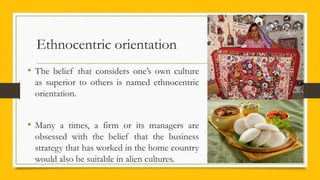
• The belief that considers one’s own culture
as superior to others is named ethnocentric
orientation.
• Many a times, a firm or its managers are
obsessed with the belief that the business
strategy that has worked in the home country
would also be suitable in alien cultures.
Polycentric orientation
• The approach recognizes cultural difference in the host countries
and, therefore, is strongly market oriented.
• It is based on the belief that substantial differences exist among
various countries.
• Therefore, a single business strategy cannot be effective across the
world and customized business strategies needed to be adopted.
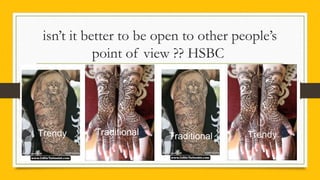
isn’t it better to be open to other people’s
point of view ?? HSBC
Trendy TrendyTraditional Traditional
Regiocentric orientation
• In the regiocentric approach, the firm
treats the region as a uniform cultural
segment and adopts a similar business
strategy within the region, but not across
the region.
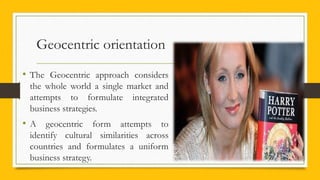
Geocentric orientation
• The Geocentric approach considers
the whole world a single market and
attempts to formulate integrated
business strategies.
• A geocentric form attempts to
identify cultural similarities across
countries and formulates a uniform
business strategy.

Unit 1 - Frame Work for International Business

  • 1.
    UNIT 1 Frame workfor International Business Kunal Upadhyay
  • 2.
    OUTLINE OF UNIT •GlobalizationGlobalization : Concept & Factors affecting globalization & Restraining • International BusinessInternational Business : Reasons for expansion • ConceptsConcepts : International Trade, International Marketing, International Investment, International Management & Global Business • New Trade TheoryNew Trade Theory : Internal and External Economics of Scale • International Political System and IdeologiesInternational Political System and Ideologies • Types of Govt., Economies System, Political SystemTypes of Govt., Economies System, Political System • Principles of International LawPrinciples of International Law • Culture Orientation in International BusinessCulture Orientation in International Business
  • 3.
    GlobalizationGlobalization • Integration ofcountries • Free cross-border movement of • Goods • Services • Capital • Information • People
  • 4.
  • 5.
  • 6.
  • 7.
    Culture • Westernization • Americanization •Walmartization • McDonaldization • Disneyfication • Coca-Colanization
  • 8.
  • 9.
    Factors Influencing Globalization •Economic Liberalization • Technological Breakthroughs • Manufacturing Technology • Transportation Technology • Information & Communication Technology • Multilateral Institutions [GATT, WTO, TRIMS, TRIPS,GATS] • International Economic Integrations [in 1957 EEC, in 1995 NAFTA]
  • 10.
    Cont.. • Rising research& development costs • Global Expansion of Business Operation • Advents in Logistics Management • Emergence of Global Consumer Segment
  • 11.
  • 12.
    Concepts of InternationalBusinessConcepts of International Business • International Trade • Refers to exports and imports of goods and services by firm to foreign- based firm
  • 13.
    Cont.. • International Marketing •Marketing practices across border, including market identification and targeting, entry mode selection and marketing mix
  • 14.
    Cont.. • International Investment •Cross-border either be portfolio investment with short-term objective or Capital investment with long-term objective
  • 15.
    Cont.. • International Management •Refers to application of management concepts and techniques in cross –country environment and adaptation to different social, economic, legal political and technological environment
  • 16.
    Cont.. • International Business •Refers all those business activities that involve cross-border transactions of goods, services, and resources between two or more nations
  • 17.
    Cont.. • Global Business •Refers to the conduct of business activities in several countries, using a highly co-ordinated and single strategy across the world
  • 18.
    Reasons for InternationalBusiness Expansion • Market-seeking Motive • Opportunities due to Life Cycles • Uniqueness of Product or Services • Economic Motive • Profitability • Achieving economies of scale • Spreading R&D costs • Strategic Motives • Growth • Risk spread
  • 19.
    New Trade Theory •Countries do not necessarily trade because of their differences • But they also trade so as to increase their returns • International trade increase the output due to its specializations • Trade theory explain when the economies of scale achieve by production of specific product
  • 20.
    What is EconomiesScale ? ? • Economies of scale means Average CostAverage Cost of production declines as the number of units increases. • Internal scale economies (Helpman & Krugman): AC declines with output of individual firm • External scale economies (Markusen & Melvin): AC declines as the size of the industry grows.
  • 21.
    Internal Economies Scale •Benefit by when the cost per unit of output depends upon their size • Firms enhance their internal economies of scale can decrease their price and monopolize the industry • Internal economies of scale leads firms to specialized in a narrow product line to produce the volume necessary to achieve cost benefits • Industries requires massive investment in R&D
  • 22.
    External Economies ofScale • If the cost per unit of output depends upon the size of the industry, not upon the size of an individual firm. • Its enables the industry in a country to produce at a lower rate when the size is large compared to the same industry in another country • A skilled labour workforce, A good reputations, Specialist market, Improve infrastructure, Special Services
  • 23.
    International Political System& IdeologiesInternational Political System & Ideologies
  • 24.
    Cont.. • International politicaland economic systems hardly function independently. • The two are mutually interdependent. • Political and diplomatic relations • political system of a country comprise various stakeholders, such as government, political parties with different ideologies, labor unions, religious organizations, environmental activists and various NGOs.
  • 25.
    Cont.. • Ideology isa set of beliefs or ideas as to how the society or group should be organized, politically, economically or morally • Political ideology is a set of ideas or beliefs that people hold about their political rule and its institutions about their position and role in it.
  • 26.
    Cont.. • Principal politicalideologies may be categorized by :- I. Economic System II. Political System III.Governance Structure
  • 27.
    Types of Government: Economic Systems • CommunismCommunism • Based on Karl Marx’s theory of social change directed at the idea of classless society, all the major factors of production in a country under communism are owned by the government and shared by all the people rather than profit seeking enterprises, for the benefit of the society • The government controls all the productive resources and industrial enterprises, it uses significant control on determining production, price employment, and practically everything else • The focus of communism is on human welfare rather than profit making.
  • 28.
    Cont.. • SocialismSocialism • Ina socialist form of government , basic and heavy industries are operated by the government, where as small businesses may be privately owned. Basic industries, such as mining, oil exploration, steel, ship building, railways, roads, airlines, etc. are kept under government control. • The extent of government control under socialism is lower than communism.
  • 29.
    Cont.. • Countries followingsocialist system include Sweden ,France, India, Poland etc. • However, the socialist countries too differ from each other in terms of the degrees of public and private ownership.
  • 30.
    Cont.. • Capitalism:Capitalism: • Incontrast to communism, capitalism is the economic system in which there is a complete freedom of private ownership of productive resources and industries. • Thus, there is freedom to both the business enterprises and the consumers that provides for a ‘free market economy’.
  • 31.
    Cont.. • Under capitalism,individuals are allowed to produce goods and services under competitive conditions giving rise to a ‘market- oriented system’. • Market prices are determined by the forces of demand and supply. • As individuals are motivated by private gains, it leads to product innovation, quality up gradation, increase in efficiency and lower market prices. For instance, the US is highly capitalistic compared to Japan.
  • 32.
    Types of Government: Political System • DemocracyDemocracy • Totalitarianism (Autocracy)Totalitarianism (Autocracy) - Secular totalitarianism - Fascist totalitarianism - Authoritarian totalitarianism - Communist totalitarianism - Theocratic totalitarianism
  • 33.
    Cont.. • Democracy: • Theword democracy is derived from demokratia, which means rule of the people or government by the people where citizens are directly involved in decision making. • Over a period of time, there has been proliferation (process) of population across the world and societies have become more complex. • This has led to decision making by people’s elected representatives in democratic countries
  • 34.
    Cont.. • The mostcomprehensive definition of democracy is the government ‘of the people, for the people, and by the people’. • India is the largest democratic country in the world.
  • 35.
    Cont.. • Totalitarianism:Totalitarianism: • Itis a autocratic form of centralized government that regulates every aspect of public and private behavior. • Power is centralized in the hands of a dictator who operates through a mixture of cultivating devoted followers and terrorizing those who do not agree with its policies.
  • 36.
    Cont.. • Citizens intotalitarianism state are generally removes of their basic rights of freedom of expression, organizing meetings, free media, tolerance, and elections, which are available under democracy. • Secular totalitarianism : In secular totalitarianism, the government uses military power to rule. • Fascist totalitarianism: Fascism is a right wing nationalistic political ideology fundamentally opposed to democracy with a totalitarianism & categorized structure.
  • 37.
    Cont.. • Fascist totalitarianismbe victorious in Italy under Mussolini, Germany under Hitler, Spain under Franco, and Portugal under Salazar.
  • 38.
    Cont.. • Authoritarian totalitarianism: Authoritarianism aims to control both the minds and souls of people and to convert them to its own faith where as totalitarianism aspires to just rule people. • Chile under Pinochet and South Africa prior to apartheid are the examples of such authoritarian totalitarianism.
  • 39.
    Cont.. • Communist totalitarianism: This is the most widespread form of secular totalitarianism which advocates that socialism can be achieved only through totalitarian dictatorship. • It is the left wing totalitarianism that believes in equal distribution of wealth and complete government ownership and control on national resources.
  • 40.
    Cont.. • Theocratic totalitarianism: Religious leaders also assume political leadership in theocratic totalitarianism • for example, in the Islamic Republic of Iran.
  • 41.
    Types of Government: Governance Structure • Parliamentary: the government consults its citizens from time to time and the parliament has power to formulate and execute law. The British parliamentary system is one of the oldest in the world • Parliamentary republics the Prime Minister is the executive head of the government & also leader of the legislature. • INDIA, SINGAPORE , FINLAND, GERMANY, AUSTRIA, GREECE etc.
  • 42.
    Cont.. • Semi-presidential systema president and a prime minster co-exist. The president genuine executive authority. But the prime minister is the head of the legislature and also heads the government • FRANCE, RUSSIA, PAKISTAN & THE REPUBLIC OF KOREA • Fully presidential system the president is both head of the state and head of the government in fully presidential system and there is NO prime minister. • US, PHILIPPINES, MEXICO, BRAZIL, TANZANIA, INDONESIA
  • 43.
    Cont.. • Commonwealth CountriesCommonwealthCountries These countries represent constitutional kingdoms that recognize the British King as state over an independent government. • A governor-general to each country other than UK is appointed by the QUEEN as a representative. • UK, AUSTRIA, NEW ZELAND, CANADA, JAMAICA
  • 44.
    Cont.. • MonarchiesMonarchies Constitutional Monarchiesa form of government in which a king or queen acts as head of state, while the ability to make and pass legislation exist in with an elected parliament. The constitutional monarch cannot make or pass legislation, and must remain politically natural JAPAN, THAILAND, SPAN, DENMARK, SWEDEN, BELGIUM
  • 45.
    Cont.. • Absolute Monarchiesit includes countries that have monarchs as the executive head of government, exercising all powers • UAE, SAUDI AREBIA, OMAN, QATAR, BHUTAN • TheocracyTheocracy Greek word theokratia, which means THE RULE OF GOD. The civil leader is believed to have a direct personal connections with god in pure theocracy
  • 46.
  • 47.
    Introduction • International lawis less clear compared to domestic law since it embodies a multiplicity of agreements (bilateral, multilateral, or universal) and conventions (agreements) such as( the Vienna convention on diplomatic security, Geneva convention on human Rights , etc.) besides the laws of individual countries. • International Managers need to understand the basic principles that govern the conduct of international law.
  • 48.
    Principles of Sovereignty •A ‘ sovereign’ state is independent and free from all external control or enjoys complete legal equality with other states. • It governs its own territory, has the right to select and implement its own political, economic, and social systems and has the power to enter into bilateral or multilateral agreements with other nations.
  • 49.
    Cont.. • Thus, asovereign state exercises powers over its own members its own members and in relation to other countries.
  • 50.
    International Jurisdiction • Underinternational law, there are three basic types of jurisdictional principles: - Nationality Principle - Territoriality principle - Protective principle
  • 51.
    Cont.. • Doctrine ofComityDoctrine of Comity As a part of international customs and traditions, there must be mutual respect for the laws, institutions, and the government system of other countries in the matter of jurisdiction over their own citizens • Act of state of doctrineAct of state of doctrine this jurisdiction principle of international law, all acts of other governments are considered to be valid by a country’s court, even if such act are not appropriate in the country.
  • 52.
    Cont.. • Treatment &Rights of aliensTreatment & Rights of aliens Nations have the right to impose restriction upon foreign citizens on their rights to travel and stay, their conduct, or area of business operations. • A country may also refuse entry to foreign citizens or restrict their travel.
  • 53.
    Cont.. • Setting ofDisputeSetting of Dispute courts are bound to examine issues, such as place from where evidence must be collected, location of the property under restitution • For instance after the disaster of union Carbide’s pesticide plant located at Bhopal in India, the New York court of appeals sent back the case to India for resolution.
  • 54.
    Cultural orientation inInternational Business
  • 55.
    Introduction • The orientationof its international managers affects the ability of a company to adapt any foreign business environment. • The major types of cultural orientation include parochialism versus simplification and EPRG approach.
  • 56.
    Parochialism • Belief thatviews the rest of the world from one’s own cultural perceptions. • This creates problems in international business situation. • The tendency of one’s culture to influence thinking and behavior without one being aware of it is generally known as ‘cultural baggage’.
  • 57.
    Simplification • the processof exhibiting the same cultural orientation towards different cultural groups • manager’s behaving in the same manner while doing business with American, Arabian, and Japanese managers, overlooking cultural differences.
  • 58.
    EPRG Approach • Thebehavioral attributes of international managers may be portrayed through EPRG approach. • Ethnocentric orientation • Polycentric orientation • Regiocentric orientation • Geocentric orientation
  • 59.
    Ethnocentric orientation • Thebelief that considers one’s own culture as superior to others is named ethnocentric orientation. • Many a times, a firm or its managers are obsessed with the belief that the business strategy that has worked in the home country would also be suitable in alien cultures.
  • 60.
    Polycentric orientation • Theapproach recognizes cultural difference in the host countries and, therefore, is strongly market oriented. • It is based on the belief that substantial differences exist among various countries. • Therefore, a single business strategy cannot be effective across the world and customized business strategies needed to be adopted.
  • 61.
    isn’t it betterto be open to other people’s point of view ?? HSBC Trendy TrendyTraditional Traditional
  • 62.
    Regiocentric orientation • Inthe regiocentric approach, the firm treats the region as a uniform cultural segment and adopts a similar business strategy within the region, but not across the region.
  • 63.
    Geocentric orientation • TheGeocentric approach considers the whole world a single market and attempts to formulate integrated business strategies. • A geocentric form attempts to identify cultural similarities across countries and formulates a uniform business strategy.