
An insight into Wage Incentives 
|Meaning |Pros & Cons | Kinds| 
Analysis| Fringe Benefits|
Incentive Compensation or Wage 
Incentives 
• Extra financial motivations designed to 
stimulate human effort by rewarding the 
person. 
• Given to improve performance thereby 
achieving desired results. 
• Designed to attract and retain talent and for 
better utilization of human resource
Valid Incentive Plan - Essentials 
• Mutual trust & understanding while 
developing an incentive plan. 
• Sound Industrial relations 
• Worker’s participation 
• Scientific standards for payment of wages 
• Guaranteed minimum wage 
• Simplicity 
• Equitable
Valid Incentive Plan - Essentials 
• Economical 
• Flexibility 
• Prompt Payment 
• Adequate Incentive 
• Ceiling on earnings 
• Based on reasonable standards 
• Grievance Machinery 
• Proper Appraisal system 
• Follow-up
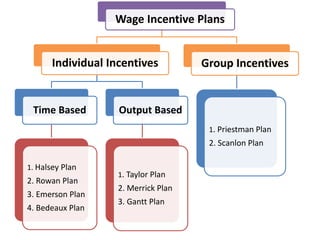
Wage Incentive Plans 
Individual Incentives 
Time Based 
1. Halsey Plan 
2. Rowan Plan 
3. Emerson Plan 
4. Bedeaux Plan 
Output Based 
1. Taylor Plan 
2. Merrick Plan 
3. Gantt Plan 
Group Incentives 
1. Priestman Plan 
2. Scanlon Plan
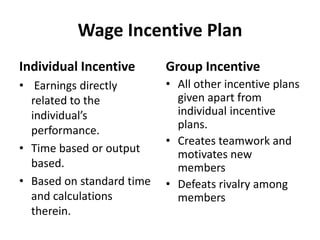
Wage Incentive Plan 
Individual Incentive 
• Earnings directly 
related to the 
individual’s 
performance. 
• Time based or output 
based. 
• Based on standard time 
and calculations 
therein. 
Group Incentive 
• All other incentive plans 
given apart from 
individual incentive 
plans. 
• Creates teamwork and 
motivates new 
members 
• Defeats rivalry among 
members
Indi v idua l 
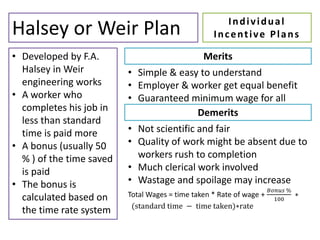
Inc ent i ve Plans Halsey or Weir Plan 
• Developed by F.A. 
Halsey in Weir 
engineering works 
• A worker who 
completes his job in 
less than standard 
time is paid more 
• A bonus (usually 50 
% ) of the time saved 
is paid 
• The bonus is 
calculated based on 
the time rate system 
Merits 
• Simple & easy to understand 
• Employer & worker get equal benefit 
• Guaranteed minimum wage for all 
Demerits 
• Not scientific and fair 
• Quality of work might be absent due to 
workers rush to completion 
• Much clerical work involved 
• Wastage and spoilage may increase 
퐵표푛푢푠 % 
Total Wages = time taken * Rate of wage + 
100 
∗ 
(standard time − time taken)∗rate
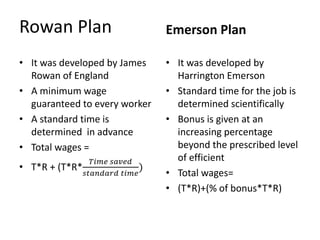
Rowan Plan 
• It was developed by James 
Rowan of England 
• A minimum wage 
guaranteed to every worker 
• A standard time is 
determined in advance 
• Total wages = 
• T*R + (T*R* 
푇푖푚푒 푠푎푣푒푑 
푠푡푎푛푑푎푟푑 푡푖푚푒 
) 
Emerson Plan 
• It was developed by 
Harrington Emerson 
• Standard time for the job is 
determined scientifically 
• Bonus is given at an 
increasing percentage 
beyond the prescribed level 
of efficient 
• Total wages= 
• (T*R)+(% of bonus*T*R)
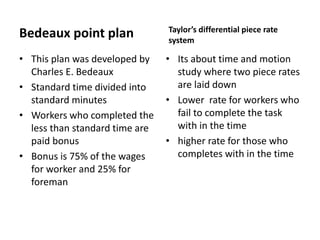
Bedeaux point plan 
• This plan was developed by 
Charles E. Bedeaux 
• Standard time divided into 
standard minutes 
• Workers who completed the 
less than standard time are 
paid bonus 
• Bonus is 75% of the wages 
for worker and 25% for 
foreman 
Taylor’s differential piece rate 
system 
• Its about time and motion 
study where two piece rates 
are laid down 
• Lower rate for workers who 
fail to complete the task 
with in the time 
• higher rate for those who 
completes with in the time
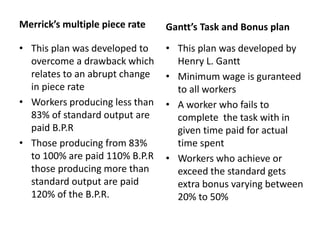
Merrick’s multiple piece rate 
• This plan was developed to 
overcome a drawback which 
relates to an abrupt change 
in piece rate 
• Workers producing less than 
83% of standard output are 
paid B.P.R 
• Those producing from 83% 
to 100% are paid 110% B.P.R 
those producing more than 
standard output are paid 
120% of the B.P.R. 
Gantt’s Task and Bonus plan 
• This plan was developed by 
Henry L. Gantt 
• Minimum wage is guranteed 
to all workers 
• A worker who fails to 
complete the task with in 
given time paid for actual 
time spent 
• Workers who achieve or 
exceed the standard gets 
extra bonus varying between 
20% to 50%
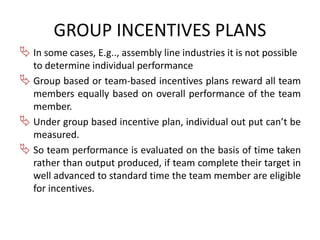
GROUP INCENTIVES PLANS 
 In some cases, E.g.., assembly line industries it is not possible 
to determine individual performance 
 Group based or team-based incentives plans reward all team 
members equally based on overall performance of the team 
member. 
 Under group based incentive plan, individual out put can’t be 
measured. 
 So team performance is evaluated on the basis of time taken 
rather than output produced, if team complete their target in 
well advanced to standard time the team member are eligible 
for incentives.
CONTINUED….. 
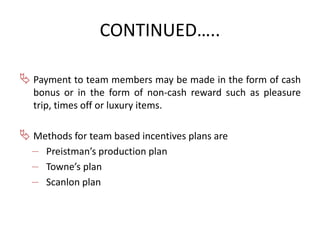
 Payment to team members may be made in the form of cash 
bonus or in the form of non-cash reward such as pleasure 
trip, times off or luxury items. 
 Methods for team based incentives plans are 
– Preistman’s production plan 
– Towne’s plan 
– Scanlon plan
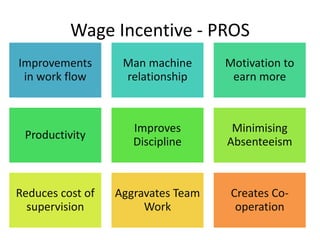
Wage Incentive - PROS 
Improvements 
in work flow 
Man machine 
relationship 
Motivation to 
earn more 
Productivity 
Improves 
Discipline 
Minimising 
Absenteeism 
Reduces cost of 
supervision 
Aggravates Team 
Work 
Creates Co-operation
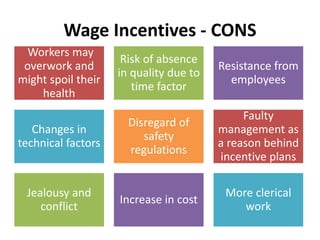
Wage Incentives - CONS 
Workers may 
overwork and 
might spoil their 
health 
Risk of absence 
in quality due to 
time factor 
Resistance from 
employees 
Changes in 
technical factors 
Disregard of 
safety 
regulations 
Faulty 
management as 
a reason behind 
incentive plans 
Jealousy and 
conflict 
Increase in cost 
More clerical 
work
Fringe Benefits 
fringe benefits refers to the extra benefits 
provided to employees in addition to 
the normal compensation paid in the 
form of wage or salary.
Main features 
supplementary forms 
paid to all employees 
indirect compensation 
help raise the living conditions 
may be statutory or voluntary
Objectives of Fringe Benefits 
• To create & improve sound IR. 
• To motivate the employees. 
• To provide security to the employees. 
• To protect the health of the employees. 
• To promote employee’s welfare. 
• To create a sense of belongingness. 
• To meet the requirements of various 
legislations relating to FB.
Types of Fringe Benefits 
Payment for time not worked. 
Employee security. 
Safety & health. 
Workmen’s compensation. 
Health benefits. 
Voluntary arrangements. 
Welfare & recreational facilities. 
Old age & retirement benefits.
An insight into wage incentives

An insight into wage incentives

  • 1.
    An insight intoWage Incentives |Meaning |Pros & Cons | Kinds| Analysis| Fringe Benefits|
  • 2.
    Incentive Compensation orWage Incentives • Extra financial motivations designed to stimulate human effort by rewarding the person. • Given to improve performance thereby achieving desired results. • Designed to attract and retain talent and for better utilization of human resource
  • 3.
    Valid Incentive Plan- Essentials • Mutual trust & understanding while developing an incentive plan. • Sound Industrial relations • Worker’s participation • Scientific standards for payment of wages • Guaranteed minimum wage • Simplicity • Equitable
  • 4.
    Valid Incentive Plan- Essentials • Economical • Flexibility • Prompt Payment • Adequate Incentive • Ceiling on earnings • Based on reasonable standards • Grievance Machinery • Proper Appraisal system • Follow-up
  • 5.
    Wage Incentive Plans Individual Incentives Time Based 1. Halsey Plan 2. Rowan Plan 3. Emerson Plan 4. Bedeaux Plan Output Based 1. Taylor Plan 2. Merrick Plan 3. Gantt Plan Group Incentives 1. Priestman Plan 2. Scanlon Plan
  • 6.
    Wage Incentive Plan Individual Incentive • Earnings directly related to the individual’s performance. • Time based or output based. • Based on standard time and calculations therein. Group Incentive • All other incentive plans given apart from individual incentive plans. • Creates teamwork and motivates new members • Defeats rivalry among members
  • 7.
    Indi v idual Inc ent i ve Plans Halsey or Weir Plan • Developed by F.A. Halsey in Weir engineering works • A worker who completes his job in less than standard time is paid more • A bonus (usually 50 % ) of the time saved is paid • The bonus is calculated based on the time rate system Merits • Simple & easy to understand • Employer & worker get equal benefit • Guaranteed minimum wage for all Demerits • Not scientific and fair • Quality of work might be absent due to workers rush to completion • Much clerical work involved • Wastage and spoilage may increase 퐵표푛푢푠 % Total Wages = time taken * Rate of wage + 100 ∗ (standard time − time taken)∗rate
  • 8.
    Rowan Plan •It was developed by James Rowan of England • A minimum wage guaranteed to every worker • A standard time is determined in advance • Total wages = • T*R + (T*R* 푇푖푚푒 푠푎푣푒푑 푠푡푎푛푑푎푟푑 푡푖푚푒 ) Emerson Plan • It was developed by Harrington Emerson • Standard time for the job is determined scientifically • Bonus is given at an increasing percentage beyond the prescribed level of efficient • Total wages= • (T*R)+(% of bonus*T*R)
  • 9.
    Bedeaux point plan • This plan was developed by Charles E. Bedeaux • Standard time divided into standard minutes • Workers who completed the less than standard time are paid bonus • Bonus is 75% of the wages for worker and 25% for foreman Taylor’s differential piece rate system • Its about time and motion study where two piece rates are laid down • Lower rate for workers who fail to complete the task with in the time • higher rate for those who completes with in the time
  • 10.
    Merrick’s multiple piecerate • This plan was developed to overcome a drawback which relates to an abrupt change in piece rate • Workers producing less than 83% of standard output are paid B.P.R • Those producing from 83% to 100% are paid 110% B.P.R those producing more than standard output are paid 120% of the B.P.R. Gantt’s Task and Bonus plan • This plan was developed by Henry L. Gantt • Minimum wage is guranteed to all workers • A worker who fails to complete the task with in given time paid for actual time spent • Workers who achieve or exceed the standard gets extra bonus varying between 20% to 50%
  • 11.
    GROUP INCENTIVES PLANS  In some cases, E.g.., assembly line industries it is not possible to determine individual performance  Group based or team-based incentives plans reward all team members equally based on overall performance of the team member.  Under group based incentive plan, individual out put can’t be measured.  So team performance is evaluated on the basis of time taken rather than output produced, if team complete their target in well advanced to standard time the team member are eligible for incentives.
  • 12.
    CONTINUED…..  Paymentto team members may be made in the form of cash bonus or in the form of non-cash reward such as pleasure trip, times off or luxury items.  Methods for team based incentives plans are – Preistman’s production plan – Towne’s plan – Scanlon plan
  • 13.
    Wage Incentive -PROS Improvements in work flow Man machine relationship Motivation to earn more Productivity Improves Discipline Minimising Absenteeism Reduces cost of supervision Aggravates Team Work Creates Co-operation
  • 14.
    Wage Incentives -CONS Workers may overwork and might spoil their health Risk of absence in quality due to time factor Resistance from employees Changes in technical factors Disregard of safety regulations Faulty management as a reason behind incentive plans Jealousy and conflict Increase in cost More clerical work
  • 15.
    Fringe Benefits fringebenefits refers to the extra benefits provided to employees in addition to the normal compensation paid in the form of wage or salary.
  • 16.
    Main features supplementaryforms paid to all employees indirect compensation help raise the living conditions may be statutory or voluntary
  • 17.
    Objectives of FringeBenefits • To create & improve sound IR. • To motivate the employees. • To provide security to the employees. • To protect the health of the employees. • To promote employee’s welfare. • To create a sense of belongingness. • To meet the requirements of various legislations relating to FB.
  • 18.
    Types of FringeBenefits Payment for time not worked. Employee security. Safety & health. Workmen’s compensation. Health benefits. Voluntary arrangements. Welfare & recreational facilities. Old age & retirement benefits.