METALLURGY
BASIC DEFINITIONS
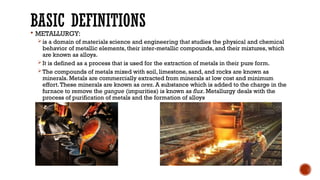
 METALLURGY:
is a domain of materials science and engineering that studies the physical and chemical
behavior of metallic elements, their inter-metallic compounds, and their mixtures, which
are known as alloys.
It is defined as a process that is used for the extraction of metals in their pure form.
The compounds of metals mixed with soil, limestone, sand, and rocks are known as
minerals. Metals are commercially extracted from minerals at low cost and minimum
effort.These minerals are known as ores. A substance which is added to the charge in the
furnace to remove the gangue (impurities) is known as flux. Metallurgy deals with the
process of purification of metals and the formation of alloys
BASIC DEFINITIONS
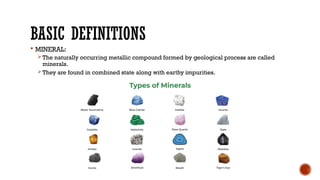
 MINERAL:
The naturally occurring metallic compound formed by geological process are called
minerals.
They are found in combined state along with earthy impurities.
BASIC DEFINITIONS
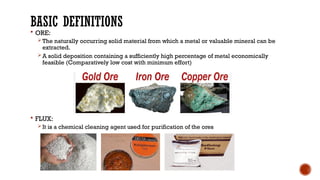
 ORE:
The naturally occurring solid material from which a metal or valuable mineral can be
extracted.
A solid deposition containing a sufficiently high percentage of metal economically
feasible (Comparatively low cost with minimum effort)
 FLUX:
It is a chemical cleaning agent used for purification of the ores
BASIC DEFINITIONS
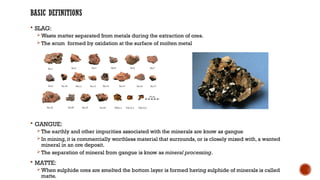
 SLAG:
 Waste matter separated from metals during the extraction of ores.
 The scum formed by oxidation at the surface of molten metal
 GANGUE:
 The earthly and other impurities associated with the minerals are know as gangue
 In mining, it is commercially worthless material that surrounds, or is closely mixed with, a wanted
mineral in an ore deposit.
 The separation of mineral from gangue is know as mineral processing.
 MATTE:
 When sulphide ores are smelted the bottom layer is formed having sulphide of minerals is called
matte.
BASIC CONCEPTS
Steps in Metallurgical Process
The various processes involved in extracting metals from their ores and refining them for
use are referred to as metallurgy.
The following are the various steps in the metal extraction or metallurgical process:
1. Crushing and grinding the ore.
2. Concentration or Dressing of the Ore
3. Metal extraction from concentrated ore.
4. Impure metals are refined or purified.
METALLURGICAL PROCESS
The following are the various steps in the metal
extraction or metallurgical process:
1. Crushing and grinding the ore.
The primary process involved in the
metallurgy of metals is pulverization, which
involves the crushing of ores into fine powder
in a crusher.
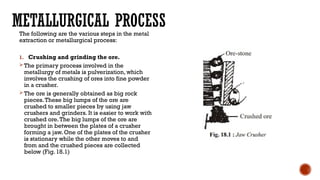
The ore is generally obtained as big rock
pieces.These big lumps of the ore are
crushed to smaller pieces by using jaw
crushers and grinders. It is easier to work with
crushed ore.The big lumps of the ore are
brought in between the plates of a crusher
forming a jaw. One of the plates of the crusher
is stationary while the other moves to and
from and the crushed pieces are collected
below (Fig. 18.1)
METALLURGICAL PROCESS
The following are the various steps in the metal
extraction or metallurgical process:
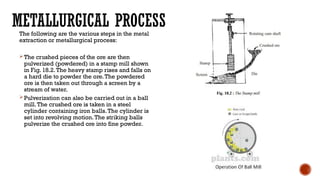
The crushed pieces of the ore are then
pulverized (powdered) in a stamp mill shown
in Fig. 18.2.The heavy stamp rises and falls on
a hard die to powder the ore.The powdered
ore is then taken out through a screen by a
stream of water.
Pulverization can also be carried out in a ball
mill.The crushed ore is taken in a steel
cylinder containing iron balls.The cylinder is
set into revolving motion.The striking balls
pulverize the crushed ore into fine powder.
METALLURGICAL PROCESS
2. Concentration or Dressing of the Ore
The ores extracted from the earth's crust contains a large number of unwanted impurities
called gangue mixed with them, such as quartz, silicates, sand, feldspar, mica, etc.
The removal of these unwanted impurities from the ore is called dressing.
The dressing of ore is also called concentration of the ore because it gradually increases
the percentage of metal.
In metallurgy, the concentration of ore is achieved using the following methods:
a) Gravity separation (Hydraulic Washing)
b) Magnetic separation method
c) Froth floatation method
d) Chemical method
METALLURGICAL PROCESS
a) Gravity separation (HydraulicWashing):
o In this method, the light (low specific gravity)
earthy impurities are removed from the
heavier metallic ore particles by washing
with water.
o It is therefore, used for the concentration of
heavier oxide ores, like haematite (Fe2O3)
tinstone (SnO2) and gold (Au).
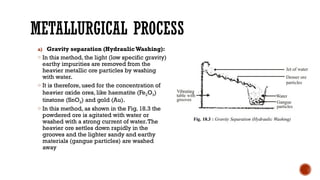
o In this method, as shown in the Fig. 18.3 the
powdered ore is agitated with water or
washed with a strong current of water.The
heavier ore settles down rapidly in the
grooves and the lighter sandy and earthy
materials (gangue particles) are washed
away
METALLURGICAL PROCESS
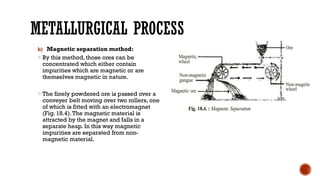
b) Magnetic separation method:
o By this method, those ores can be
concentrated which either contain
impurities which are magnetic or are
themselves magnetic in nature.
o The finely powdered ore is passed over a
conveyer belt moving over two rollers, one
of which is fitted with an electromagnet
(Fig. 18.4).The magnetic material is
attracted by the magnet and falls in a
separate heap. In this way magnetic
impurities are separated from non-
magnetic material.
METALLURGICAL PROCESS
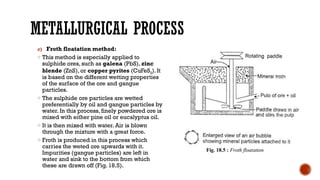
c) Froth floatation method:
o This method is especially applied to
sulphide ores, such as galena (PbS), zinc
blende (ZnS), or copper pyrites (CuFeS2). It
is based on the different wetting properties
of the surface of the ore and gangue
particles.
o The sulphide ore particles are wetted
preferentially by oil and gangue particles by
water. In this process, finely powdered ore is
mixed with either pine oil or eucalyptus oil.
o It is then mixed with water. Air is blown
through the mixture with a great force.
o Froth is produced in this process which
carries the weted ore upwards with it.
Impurities (gangue particles) are left in
water and sink to the bottom from which
these are drawn off (Fig. 18.5).
METALLURGICAL PROCESS
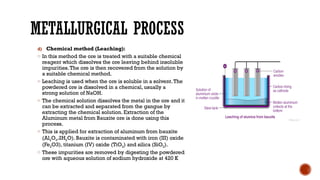
d) Chemical method (Leaching):
o In this method the ore is treated with a suitable chemical
reagent which dissolves the ore leaving behind insoluble
impurities.The ore is then recovered from the solution by
a suitable chemical method.
o Leaching is used when the ore is soluble in a solvent.The
powdered ore is dissolved in a chemical, usually a
strong solution of NaOH.
o The chemical solution dissolves the metal in the ore and it
can be extracted and separated from the gangue by
extracting the chemical solution. Extraction of the
Aluminum metal from Bauxite ore is done using this
process.
o This is applied for extraction of aluminum from bauxite
(Al2O3.2H2O). Bauxite is contaminated with iron (III) oxide
(Fe2O3), titanium (IV) oxide (TiO2) and silica (SiO2).
o These impurities are removed by digesting the powdered
ore with aqueous solution of sodium hydroxide at 420 K
METALLURGICAL PROCESS
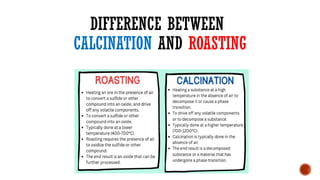
3. Calcination or roasting of the ore
 The concentrated ore is converted into metal oxide by calcination or roasting.
A. Calcination:
Calcination involves heating of the concentrated ore in a limited supply of air so that it
loses moisture, water of hydration and gaseous volatile substances.The ore is heated to
a temperature so that it does not melt.Two examples of calcination are given below:
i. Removal of water of hydration
ii. Expulsion of CO2 from carbonate
B. Roasting:
Roasting is a process in which the concentrated ore is heated in a free supply of air at a
temperature insufficient to melt it.The following changes take place during roasting
i. Drying of the ore.
ii. Removal of the volatile impurities like arsenic, sulphur, phosphorus and organic matter.
iii. Conversion of the sulphide ores into oxides
DIFFERENCE BETWEEN
CALCINATION AND ROASTING
METALLURGICAL PROCESS
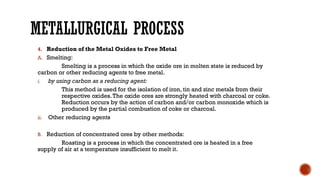
4. Reduction of the Metal Oxides to Free Metal
A. Smelting:
Smelting is a process in which the oxide ore in molten state is reduced by
carbon or other reducing agents to free metal.
i. by using carbon as a reducing agent:
This method is used for the isolation of iron, tin and zinc metals from their
respective oxides.The oxide ores are strongly heated with charcoal or coke.
Reduction occurs by the action of carbon and/or carbon monoxide which is
produced by the partial combustion of coke or charcoal.
ii. Other reducing agents
B. Reduction of concentrated ores by other methods:
Roasting is a process in which the concentrated ore is heated in a free
supply of air at a temperature insufficient to melt it.
PRINCIPLES OF METALLURGY:
The metallurgical process can be classified as the following:
1. Crushing and grinding:The first process in metallurgy is crushing of ores into a fine
powder in a crusher or ball mill.This process is known as pulverization.
2. The concentration of ores:The process of removing impurities from ore is known as a
concentration of minerals or ore dressing. In metallurgy, we concentrate the ores mainly
by the following methods.
3. Hydrolytic method: In this method, we pour the ore over a sloping, vibrating corrugated
table with grooves. A jet of water is allowed to flow over the surface.The denser ore
particles settle in the grooves, and the impurities are washed away by water.
4. Magnetic separation: In this case, the crushed ore is placed on a conveyor belt.This belt
rotates around two wheels in which one of the wheels is magnetic, and therefore the
magnetic particles get attracted to the magnetic wheel and fall apart from the non-
magnetic particles.
PRINCIPLES OF METALLURGY:
The metallurgical process can be classified as the following:
5. Froth floatation: In this process, we take the crushed ore in a large tank which
contains oil and water. A current of compressed air is passed through it.The ore
gets wet by oil and is separated from the impurities in the form of froth. Ore is
lighter, and so it comes on the surface and impurities are left behind.
6. Roasting and calcination: In metallurgy, the process of heating a concentrated
ore in the presence of oxygen is known as roasting.This process is applied in the
case of sulfide ores. For ores containing carbonate or hydrated oxides, heating is
done in the absence of air to melt the ores, and this process is known as
calcination.

Metallurgical Processes and principles.pptx

  • 1.
  • 2.
    BASIC DEFINITIONS  METALLURGY: isa domain of materials science and engineering that studies the physical and chemical behavior of metallic elements, their inter-metallic compounds, and their mixtures, which are known as alloys. It is defined as a process that is used for the extraction of metals in their pure form. The compounds of metals mixed with soil, limestone, sand, and rocks are known as minerals. Metals are commercially extracted from minerals at low cost and minimum effort.These minerals are known as ores. A substance which is added to the charge in the furnace to remove the gangue (impurities) is known as flux. Metallurgy deals with the process of purification of metals and the formation of alloys
  • 3.
    BASIC DEFINITIONS  MINERAL: Thenaturally occurring metallic compound formed by geological process are called minerals. They are found in combined state along with earthy impurities.
  • 4.
    BASIC DEFINITIONS  ORE: Thenaturally occurring solid material from which a metal or valuable mineral can be extracted. A solid deposition containing a sufficiently high percentage of metal economically feasible (Comparatively low cost with minimum effort)  FLUX: It is a chemical cleaning agent used for purification of the ores
  • 5.
    BASIC DEFINITIONS  SLAG: Waste matter separated from metals during the extraction of ores.  The scum formed by oxidation at the surface of molten metal  GANGUE:  The earthly and other impurities associated with the minerals are know as gangue  In mining, it is commercially worthless material that surrounds, or is closely mixed with, a wanted mineral in an ore deposit.  The separation of mineral from gangue is know as mineral processing.  MATTE:  When sulphide ores are smelted the bottom layer is formed having sulphide of minerals is called matte.
  • 6.
    BASIC CONCEPTS Steps inMetallurgical Process The various processes involved in extracting metals from their ores and refining them for use are referred to as metallurgy. The following are the various steps in the metal extraction or metallurgical process: 1. Crushing and grinding the ore. 2. Concentration or Dressing of the Ore 3. Metal extraction from concentrated ore. 4. Impure metals are refined or purified.
  • 7.
    METALLURGICAL PROCESS The followingare the various steps in the metal extraction or metallurgical process: 1. Crushing and grinding the ore. The primary process involved in the metallurgy of metals is pulverization, which involves the crushing of ores into fine powder in a crusher. The ore is generally obtained as big rock pieces.These big lumps of the ore are crushed to smaller pieces by using jaw crushers and grinders. It is easier to work with crushed ore.The big lumps of the ore are brought in between the plates of a crusher forming a jaw. One of the plates of the crusher is stationary while the other moves to and from and the crushed pieces are collected below (Fig. 18.1)
  • 8.
    METALLURGICAL PROCESS The followingare the various steps in the metal extraction or metallurgical process: The crushed pieces of the ore are then pulverized (powdered) in a stamp mill shown in Fig. 18.2.The heavy stamp rises and falls on a hard die to powder the ore.The powdered ore is then taken out through a screen by a stream of water. Pulverization can also be carried out in a ball mill.The crushed ore is taken in a steel cylinder containing iron balls.The cylinder is set into revolving motion.The striking balls pulverize the crushed ore into fine powder.
  • 9.
    METALLURGICAL PROCESS 2. Concentrationor Dressing of the Ore The ores extracted from the earth's crust contains a large number of unwanted impurities called gangue mixed with them, such as quartz, silicates, sand, feldspar, mica, etc. The removal of these unwanted impurities from the ore is called dressing. The dressing of ore is also called concentration of the ore because it gradually increases the percentage of metal. In metallurgy, the concentration of ore is achieved using the following methods: a) Gravity separation (Hydraulic Washing) b) Magnetic separation method c) Froth floatation method d) Chemical method
  • 10.
    METALLURGICAL PROCESS a) Gravityseparation (HydraulicWashing): o In this method, the light (low specific gravity) earthy impurities are removed from the heavier metallic ore particles by washing with water. o It is therefore, used for the concentration of heavier oxide ores, like haematite (Fe2O3) tinstone (SnO2) and gold (Au). o In this method, as shown in the Fig. 18.3 the powdered ore is agitated with water or washed with a strong current of water.The heavier ore settles down rapidly in the grooves and the lighter sandy and earthy materials (gangue particles) are washed away
  • 11.
    METALLURGICAL PROCESS b) Magneticseparation method: o By this method, those ores can be concentrated which either contain impurities which are magnetic or are themselves magnetic in nature. o The finely powdered ore is passed over a conveyer belt moving over two rollers, one of which is fitted with an electromagnet (Fig. 18.4).The magnetic material is attracted by the magnet and falls in a separate heap. In this way magnetic impurities are separated from non- magnetic material.
  • 12.
    METALLURGICAL PROCESS c) Frothfloatation method: o This method is especially applied to sulphide ores, such as galena (PbS), zinc blende (ZnS), or copper pyrites (CuFeS2). It is based on the different wetting properties of the surface of the ore and gangue particles. o The sulphide ore particles are wetted preferentially by oil and gangue particles by water. In this process, finely powdered ore is mixed with either pine oil or eucalyptus oil. o It is then mixed with water. Air is blown through the mixture with a great force. o Froth is produced in this process which carries the weted ore upwards with it. Impurities (gangue particles) are left in water and sink to the bottom from which these are drawn off (Fig. 18.5).
  • 13.
    METALLURGICAL PROCESS d) Chemicalmethod (Leaching): o In this method the ore is treated with a suitable chemical reagent which dissolves the ore leaving behind insoluble impurities.The ore is then recovered from the solution by a suitable chemical method. o Leaching is used when the ore is soluble in a solvent.The powdered ore is dissolved in a chemical, usually a strong solution of NaOH. o The chemical solution dissolves the metal in the ore and it can be extracted and separated from the gangue by extracting the chemical solution. Extraction of the Aluminum metal from Bauxite ore is done using this process. o This is applied for extraction of aluminum from bauxite (Al2O3.2H2O). Bauxite is contaminated with iron (III) oxide (Fe2O3), titanium (IV) oxide (TiO2) and silica (SiO2). o These impurities are removed by digesting the powdered ore with aqueous solution of sodium hydroxide at 420 K
  • 14.
    METALLURGICAL PROCESS 3. Calcinationor roasting of the ore  The concentrated ore is converted into metal oxide by calcination or roasting. A. Calcination: Calcination involves heating of the concentrated ore in a limited supply of air so that it loses moisture, water of hydration and gaseous volatile substances.The ore is heated to a temperature so that it does not melt.Two examples of calcination are given below: i. Removal of water of hydration ii. Expulsion of CO2 from carbonate B. Roasting: Roasting is a process in which the concentrated ore is heated in a free supply of air at a temperature insufficient to melt it.The following changes take place during roasting i. Drying of the ore. ii. Removal of the volatile impurities like arsenic, sulphur, phosphorus and organic matter. iii. Conversion of the sulphide ores into oxides
  • 15.
  • 16.
    METALLURGICAL PROCESS 4. Reductionof the Metal Oxides to Free Metal A. Smelting: Smelting is a process in which the oxide ore in molten state is reduced by carbon or other reducing agents to free metal. i. by using carbon as a reducing agent: This method is used for the isolation of iron, tin and zinc metals from their respective oxides.The oxide ores are strongly heated with charcoal or coke. Reduction occurs by the action of carbon and/or carbon monoxide which is produced by the partial combustion of coke or charcoal. ii. Other reducing agents B. Reduction of concentrated ores by other methods: Roasting is a process in which the concentrated ore is heated in a free supply of air at a temperature insufficient to melt it.
  • 17.
    PRINCIPLES OF METALLURGY: Themetallurgical process can be classified as the following: 1. Crushing and grinding:The first process in metallurgy is crushing of ores into a fine powder in a crusher or ball mill.This process is known as pulverization. 2. The concentration of ores:The process of removing impurities from ore is known as a concentration of minerals or ore dressing. In metallurgy, we concentrate the ores mainly by the following methods. 3. Hydrolytic method: In this method, we pour the ore over a sloping, vibrating corrugated table with grooves. A jet of water is allowed to flow over the surface.The denser ore particles settle in the grooves, and the impurities are washed away by water. 4. Magnetic separation: In this case, the crushed ore is placed on a conveyor belt.This belt rotates around two wheels in which one of the wheels is magnetic, and therefore the magnetic particles get attracted to the magnetic wheel and fall apart from the non- magnetic particles.
  • 18.
    PRINCIPLES OF METALLURGY: Themetallurgical process can be classified as the following: 5. Froth floatation: In this process, we take the crushed ore in a large tank which contains oil and water. A current of compressed air is passed through it.The ore gets wet by oil and is separated from the impurities in the form of froth. Ore is lighter, and so it comes on the surface and impurities are left behind. 6. Roasting and calcination: In metallurgy, the process of heating a concentrated ore in the presence of oxygen is known as roasting.This process is applied in the case of sulfide ores. For ores containing carbonate or hydrated oxides, heating is done in the absence of air to melt the ores, and this process is known as calcination.