Framework for Academic andFramework for Academic and
Administrative Audit Administrative Audit 
in Higher Education Institutionsin Higher Education Institutions
Prof. A. Prof. A. BalasubramanianBalasubramanian
University of MysoreUniversity of Mysore
M soreM soreMysoreMysore
NAAC releasedNAAC releasedNAAC released NAAC released 
• The first Guidelines for  the Creation of the 
Internal Quality Assurance Cell (IQAC) in y ( )
Accredited Institutions ‐ A Post‐Accreditation 
Quality Sustenance Activity in 2007Quality Sustenance Activity  in 2007 .
• IQAC will become a part of an institution’s 
k l h l fsystem and work towards realising the goals of 
quality enhancement and sustenance.
NAAC has provided the latestNAAC has provided the latestNAAC has provided the latest NAAC has provided the latest 
• Guidelines for the Creation of the  Internal 
Quality Assurance Cell (IQAC) and Submission of 
Annual Quality Assurance Report (AQAR) by 
Accredited Institutions (Revised as per Revised ( p
Accreditation Framework in November, 2017).
• To make quality the defining element of higher• To make quality the defining element of higher 
education in India through a combination of self 
and external quality evaluation promotion andand external quality evaluation, promotion and 
sustenance initiatives (Hinting to hit the ball). 
Academic and Administrative Audit Academic and Administrative Audit 
(AAA) (AAA) 
b i f d i• A brief advisory note:
• The monitoring and evaluation of the 
institutional processes require a carefully 
structured system of internal and external review. 
• The NAAC expects the Institutions to undertake 
continuous Academic and Administrative Audits 
(AAA). 
• This brief note is intended to serve as advisory to y
all accredited HEIs who volunteer to undertake 
AAA.
About Academic and Administrative About Academic and Administrative 
Audit (AAA):Audit (AAA):
• Academic and Administrative Audit (AAA), are 
very essential for the excellence in Higher y g
Education. 
Th i t l t d t• These are interrelated concepts. 
• Thus in order to have a quality oriented q y
academic, there should be a strong 
administrative backgroundadministrative background.
Major objectives of AAA:Major objectives of AAA:Major objectives of AAA: Major objectives of AAA: 
T d t d th i ti t d th t th• To understand the existing system and assess the strengths 
and weaknesses of the Departments and Administrative 
Units and to suggest the methods for improvement and for 
overcoming the weaknesses. 
• To identify the bottlenecks in the existing administrative 
mechanisms and to identify the opportunities for academicmechanisms and to identify the opportunities for academic 
reforms, administrative reforms and examination reforms 
etc. 
T l t th ti tili ti f fi i l d th• To evaluate the optimum utilization of financial and other 
resources. 
• To suggest the methods for continuous improvement ofTo suggest the methods for continuous improvement of 
quality keeping in mind criteria and reports by NAAC and 
other bodies. 
Methodology:Methodology:Methodology: Methodology: 
• NAAC has not prescribed any specific 
methodology or guidelines for conducting gy g g
AAA. 
• It is expected that each HEI may evolve its• It is expected that each HEI may evolve its 
own guidelines and methodology by learning 
f f ll b lfrom good practices followed by leading 
institutions within and outside India.
Mission of IQACMission of IQACMission of IQACMission of IQAC
• To arrange for periodic assessment and 
accreditation of institutions of higheraccreditation of institutions of higher 
education or units thereof, or specific 
academic programmes or projects
• To encourage self evaluation• To encourage self‐evaluation, 
accountability, autonomy and 
innovations in higher education
The primary aim of IQAC isThe primary aim of IQAC isThe primary aim of IQAC is The primary aim of IQAC is 
• To develop a system for conscious, 
consistent and catalytic action toconsistent and catalytic action to 
improve the academic and p
administrative performance of the 
i tit tiinstitution. 
IQAC shall evolve mechanisms and IQAC shall evolve mechanisms and 
procedures for procedures for 
• Ensuring timely, efficient and 
i f fprogressive performance of 
academic administrative andacademic, administrative and 
financial tasks
Functions of IQACFunctions of IQACFunctions of IQACFunctions of IQAC
t d f th IQAC• expected of the IQAC
• a) Development and application of quality benchmarks 
• b) Parameters for various academic and administrativeb) Parameters for various academic and administrative 
activities of the institution; 
• c) Facilitating the creation of a learner‐centric environment 
d i li d iconducive to quality education
• ‐‐‐‐‐‐
• i) Periodical conduct of Academic and Administrative• i) Periodical conduct of Academic and Administrative 
Audit and its follow‐up 
• j) Preparation and submission of the Annual Quality 
Assurance Report (AQAR) as per guidelines and parameters 
of NAAC. 
Academic and Administrative Audit Academic and Administrative Audit 
(AAA) (AAA) 
i h k d• AAA is a system to check and promote 
reasonable standards in the functioning of 
HEIs.
• It is expected to play a vital role in the process p p y p
of IQAC related activities. 
• Since it is not mandatory it is not done by allSince it is not mandatory, it is not done by all.
• It is considered as a prelude to NAAC process.
• During the process of auditing it gives a 360 
degrees feedback.
AAA is also a continuous processAAA is also a continuous processAAA is also a continuous processAAA is also a continuous process
It t ib t t th ti th• It contributes to the continuous growth  
• It is nothing but self‐introspection to correct the 
deficiencies in the administrationdeficiencies in the administration. 
• Assessment of policies, strategies, fee collection, 
scholarship distribution departmentalscholarship distribution, departmental 
functioning like preparation of time table, 
competency mapping, and syllabus distribution,competency mapping, and syllabus distribution,  
student support systems, activities, 
• the involvement of IQACs in the functioning of Q g
the system for quality enhancement and 
institutionalization of best practices.
Institutional academic audit:Institutional academic audit:Institutional academic audit:Institutional academic audit:
• The experiences of New Zealand’s  universities
• All the New Zealand universities accepted the p
value of scrutiny of their academic processes 
and acknowledge the value of examiningand acknowledge the value of examining 
practice within a quality assurance framework.
U i it ’ li i d t hi it• University’s policies and processes to achieve  its 
stated objectives.
• AUSTRALIAN  UNIVERSITIES  QUALITY AGENCY
In overseas institutionsIn overseas institutionsIn overseas institutions In overseas institutions 
• A self‐examination is compiled into a Quality 
Portfolio (QP) ‐ is submitted to the AAU Panel ( )
three months before its scheduled audit visit.
• The visit then revolves around verification• The visit then revolves around verification, 
clarification and further exploration of the 
hissues in the QP.
Conducting AAA in IndiaConducting AAA in IndiaConducting AAA in IndiaConducting AAA in India
i d bli h h i• HEIs  are motivated to establish their own 
internal mechanism for sustenance, assurance 
d h t f th lit d ti ithiand enhancement of the quality education within 
the institution.
• To make appropriate recommendations for 
continuous improvement of the processes and  
d d f li dprocedures used for quality assurance and 
enhancement.
• The assessment components normally include 
the   7 criteria of NAAC assessment.
AAAAAAAAA AAA 
• It is a Challenging task to conduct AAA
• People feel that it is a MOCK visit to NAACPeople feel that it is a MOCK visit to NAAC 
process PT visit
I i l i il di f PT i i• It involves similar expenditure of a PT visit
• Availability of Funds for IQAC & AAAy Q
• Scheduling of AAA‐ End of a cycle before 
b itti SSR t NAACsubmitting SSR to NAAC
AAA Should focus onAAA Should focus onAAA Should focus on AAA Should focus on 
• 1.  Quality culture of the institution in terms of 
Quality Initiatives, Quality Sustenance and y y
Quality Enhancement.
• 2 Taking stock of what are the scope• 2. Taking stock of what are the scope, 
processes, products & deliverables, problems 
addressed, pending issues, prominence & 
outstanding achievements, SWOC, suggestions 
for improvement. 
Terms of Reference for AAA in HEIsTerms of Reference for AAA in HEIsTerms of Reference for AAA in HEIsTerms of Reference for AAA in HEIs
Q li A (QA) b d b h h• Quality Assessment (QA) can be done better through 
self‐evaluation and external AAA 
Sh ld i l th ti i ti f ll th t k h ld• Should involve  the participation of all the stakeholders 
– management, faculty members, administrative staff, 
students parents employers community and alumnistudents, parents, employers, community and alumni.
• Should lead to newer initiatives, interaction with the 
external stakeholders facilitate the developmentexternal stakeholders facilitate the development 
process of the institution and their educational 
services. 
• Should also verify the trend of growth & failures, if any.
• Propose corrective measures as per need.p p
Quality Assessment canQuality Assessment canQuality Assessment canQuality Assessment can
l f i i i l lf• Serve  as a catalyst for institutional self‐
improvement. 
• Promote innovation and strengthen the urge 
to excel in HEIs. 
• Accelerate  the process but also bring in 
greater objectivity into the processgreater objectivity into the process.
• Help to focus on the developments an 
I tit ti h tt t d ft th iInstitution has attempted after the previous 
A&A cycle. 
AAA committeeAAA committeeAAA committeeAAA committee
• Composition ?   Size 
• Capabilities of members = Invariably good (Capabilities of members   Invariably good ( 
Reason is NAAC PT experiences)
M l if l i i i i i lli d• Multifaculty  institutions  ‐ expertise in allied 
fields
• Known or unknown members
A th f I di ’ T 100 i tit ti• Are they from India’s Top 100 institutions
• Availability for four days
NAAC process v/s AAA processNAAC process v/s AAA processNAAC process v/s AAA processNAAC process v/s AAA process
F t• Formats are same
• Data may come or may be seen within a short 
notice in AAAnotice in AAA
• NAAC process will decide a grade‐ hence 
seriousness is also for itseriousness is also for it
• AAA will help to improve the system (Solace), 
corrective measures= seriousnesscorrective measures= seriousness 
• NAAC PT recommendations can be  done slowly
• AAAC recommendations should be done• AAAC  recommendations should be done 
immediately 
ISO CertificationISO CertificationISO Certification ISO Certification 
• Quality practices= Documented 
• annual improvement,annual improvement, 
• incremental growth, 
• settling the non‐cornformities on the same 
day.y
BenchmarkingBenchmarkingBenchmarking Benchmarking 
►Benchmarking is an increasingly popular tool 
in industry and is used extensively by both y y y
manufacturing and service organizations.
►Benchmarking is an ongoing systematic►Benchmarking is an ongoing systematic 
means for measuring and comparing the work 
fprocesses of an organization.
Checks and balancesChecks and balancesChecks and balancesChecks and balances
► f i b h h h►Are we performing better than what we have 
performed earlier? 
►Are there any other organizations that are 
performing well and from whom we can learn? 
►Are there any practices that will improve our 
performance?
►Some institutions have done this analysis and 
improved without AAA alsop
►In AAA, is there any set goal?  
Types of BenchmarkingTypes of BenchmarkingTypes of Benchmarking Types of Benchmarking 
►E h id ifi d diff f►Experts have identified different types of 
benchmarking. 
►Th i t l f ti l titi d►These are internal, functional,  competitive, and 
generic benchmarking. 
►Internal benchmarking is done within an organization►Internal benchmarking is done within an  organization 
and typically between closely related units, using 
common or shared performance parameters as acommon or shared  performance parameters as a 
basis for comparison. 
►Functional benchmarking is a comparison of g p
performance and procedures between similar 
functions, across different  organizations.
►Competitive benchmarking generally focuses►Competitive benchmarking  generally focuses 
on direct competitors and with specific 
bl icomparable operations. 
►Generic benchmarking  is undertaken with g
external institutions which represent the 
‘best‐in‐class’ for particular aspects of thebest‐in‐class  for particular aspects of the 
selected operations. 
►Best Practices Benchmarking 
Situation todaySituation todaySituation todaySituation today
• Ranking Frameworks have brought some 
benchmarks 
• Quantitative or qualitative data
O i i l il b d• Opinion pool, email‐based  surveys 
• Too many players for grading HEIs ( within y p y g g (
and Outside)
C AAA h l t hi f th ?• Can AAA helps to achieve any of these? 
Early Days of BenchmarkingEarly Days of BenchmarkingEarly Days of BenchmarkingEarly Days of Benchmarking
Th h i i il tThe emphasis was primarily    on measurement 
per se, and   on relatively straightforward 
comparisons of suitable performancecomparisons of suitable performance 
parameters within and between companies. 
►Such parameters were usually simple►Such parameters were usually simple 
productivity  and efficiency measures. 
►This was followed by a gradual shift in►This was followed by a gradual shift in 
attention to processes within a more 
diverse range of functions which influenceddiverse range of functions which influenced 
overall performance. 
AAAAAAAAAAAA
• Is within IQAC bucket ( budget too)
• Should it help to submit AQAR( annually) 
• At the end of 4 th year, few months before going to 
submit SSR to NAAC, how much impact is expectedsubmit SSR to NAAC, how much impact is expected 
to improve the system, if an institution slept earlier.
• An institution which has done excellently well in all• An institution which has done excellently well in all 
criteria for all the past 5 years has gone for NAAC 
process and might have got the best grade withoutprocess and might have got the best grade without 
AAA also.
Some equationsSome equationsSome equations Some equations 
C i d d i d b• NAAC is mandatory, so do it, do not worry about 
the grade  
• NAAC grade determines national funding, so do it 
for that purpose
• My institution should be among the top, come 
what may, spend and create avenues, employ 
people and strive for excellence(do not sleep)
• Mine is an Aided institution, funds are limited, , ,
appointments of vacant positions are remote, but 
our aim is to get the highest grade(?)g g g
AAACAAACAAACAAAC
• Has its own limitations, due to terms of Ref.
• Some of the recommendations coming out ofSome of the recommendations coming out of 
AAA are found to be facts and correct also
Whi h k h ld ( h h l f ff i ) h• Which stakeholder( at the helm of affairs) has 
to see and help the institution in an aided 
system, may not be knowing or bothering.
• But NAAC PT looks into it• But NAAC PT looks into it. 
NBA v/s NAAC v/s AAANBA v/s NAAC v/s AAANBA v/s NAAC v/s AAANBA v/s NAAC v/s AAA
ifi li i• Specific or Holistic
• Statutory bodies have specific criteria for y p
every programme ( One can not run a 
programme without fulfilling them)p g g )
• If NAAC assessment is holistic, AAA may be a 
Holy holistic processHoly holistic process
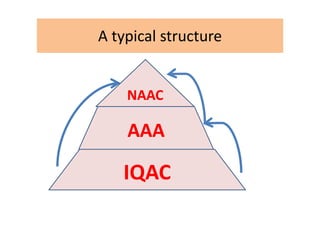
• What type of hierarchy in assessment and 
dit ti d dit b i i t baccreditation and audit , we can bring, is to be 
decided.
A typical structureA typical structure
NAACNAAC
AAAAAA
IQAC IQAC 
Document verification & InspectionDocument verification & InspectionDocument verification & InspectionDocument verification & Inspection
• Some institutions have understood the 
process, so they skip AAAp y p
• Some institutions have put forth everything to 
AAA and submitted AQARs and SSRsAAA and submitted AQARs and SSRs
• Some institutions have done everything but 
the grade is low (Why we did all these)‐what 
needs to be improved have not been done.needs to be improved have not been done.
AuditingAuditingAuditing Auditing 
f d i h b i h h ill b h• If we do inch by inch, what will be the 
outcome?
• May bring more weaknesses? (seen inside the 
system), some outstanding things, best & y ), g g ,
worst practices. Shall we throw this into public 
domain(?) through AAA (Why should we?)( ) g ( y )
• Other than verifying students feedback, can 
AAA do student satisfaction survey and comeAAA do student satisfaction survey and come 
for AAA? This is not a part of AAA.
AuditingAuditing definitelydefinitelyAuditingAuditing definitelydefinitely
C h l i f• Can help to improve performance 
• Can help reforming processes, if there are flaws
( weaknesses, missing links, etc)
• Can put forth the issues of concern to be addressed
• Can lead to do  better preparations before going for 
NAAC
• Can push the level of the institution‐ one step up 
always (AAA will never let an institution to go down).
• Since NAAC’s 7 criteria are invariably used by AAA, it  is 
not deviating from the primary focus.
Audit sequence is to be debatedAudit sequence is to be debatedAudit sequence is to be debatedAudit sequence is to be debated
Sh ld b d dSh ld b d d•• Should AAA  be conductedShould AAA  be conducted
• Every year(annual)
• Mid time Review between two sequential NAAC 
Peer Team Visits
• OR  Once in 5 Years (as seen in many HEIs)
• It is sometimes done as a formal requirement• It is sometimes done as a formal requirement.
• Audit with fully External members
C i b i i i i l i l i i i hi 2• Can it be in one visit or in multiple visits within 2 
months
AAAC reportsAAAC reportsAAAC reportsAAAC reports
• Are not uniform
• Line by line of NAAC ‐ QIF is not followedLine by line of NAAC  QIF is not followed           
( shall somebody say that you do AAA wrf to 
line by line QIF of NAAC)line by line QIF of NAAC)
• Some committees elaborate things and others 
not ( shall we fix the checklist?)
• Normal Structure = preamble /features• Normal Structure = preamble /features, 
observations, recommendations, SWOC
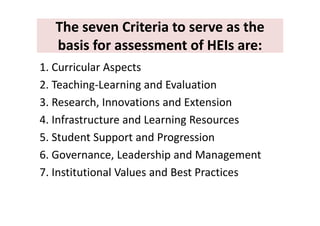
The seven Criteria to serve as the The seven Criteria to serve as the 
basis for assessment of HEIs are: basis for assessment of HEIs are: 
1. Curricular Aspects 
2. Teaching‐Learning and Evaluation2. Teaching Learning and Evaluation 
3. Research, Innovations and Extension 
4. Infrastructure and Learning Resources 
5 Student Support and Progression5. Student Support and Progression 
6. Governance, Leadership and Management 
7. Institutional Values and Best Practices 
Checklist contains 470 Checklist contains 470 itemsitems
Use the keywords to load the fileUse the keywords to load the file

Framework for academic and administrative audit

  • 1.
  • 2.
    NAAC releasedNAAC releasedNAAC released NAAC released  •The first Guidelines for  the Creation of the  Internal Quality Assurance Cell (IQAC) in y ( ) Accredited Institutions ‐ A Post‐Accreditation  Quality Sustenance Activity in 2007Quality Sustenance Activity  in 2007 . • IQAC will become a part of an institution’s  k l h l fsystem and work towards realising the goals of  quality enhancement and sustenance.
  • 3.
    NAAC has providedthe latestNAAC has provided the latestNAAC has provided the latest NAAC has provided the latest  • Guidelines for the Creation of the  Internal  Quality Assurance Cell (IQAC) and Submission of  Annual Quality Assurance Report (AQAR) by  Accredited Institutions (Revised as per Revised ( p Accreditation Framework in November, 2017). • To make quality the defining element of higher• To make quality the defining element of higher  education in India through a combination of self  and external quality evaluation promotion andand external quality evaluation, promotion and  sustenance initiatives (Hinting to hit the ball). 
  • 4.
    Academic and Administrative Audit Academic and Administrative Audit  (AAA) (AAA)  b i fd i• A brief advisory note: • The monitoring and evaluation of the  institutional processes require a carefully  structured system of internal and external review.  • The NAAC expects the Institutions to undertake  continuous Academic and Administrative Audits  (AAA).  • This brief note is intended to serve as advisory to y all accredited HEIs who volunteer to undertake  AAA.
  • 5.
    About Academic and Administrative About Academic and Administrative  Audit (AAA):Audit (AAA): • Academic and Administrative Audit (AAA), are  very essential for the excellence in Higher y g Education.  Thi t l t d t• These are interrelated concepts.  • Thus in order to have a quality oriented q y academic, there should be a strong  administrative backgroundadministrative background.
  • 6.
    Major objectives ofAAA:Major objectives of AAA:Major objectives of AAA: Major objectives of AAA:  T d t d th i ti t d th t th• To understand the existing system and assess the strengths  and weaknesses of the Departments and Administrative  Units and to suggest the methods for improvement and for  overcoming the weaknesses.  • To identify the bottlenecks in the existing administrative  mechanisms and to identify the opportunities for academicmechanisms and to identify the opportunities for academic  reforms, administrative reforms and examination reforms  etc.  T l t th ti tili ti f fi i l d th• To evaluate the optimum utilization of financial and other  resources.  • To suggest the methods for continuous improvement ofTo suggest the methods for continuous improvement of  quality keeping in mind criteria and reports by NAAC and  other bodies. 
  • 7.
    Methodology:Methodology:Methodology: Methodology:  • NAAC has not prescribed any specific  methodology or guidelines for conducting gy gg AAA.  • It is expected that each HEI may evolve its• It is expected that each HEI may evolve its  own guidelines and methodology by learning  f f ll b lfrom good practices followed by leading  institutions within and outside India.
  • 8.
    Mission of IQACMissionof IQACMission of IQACMission of IQAC • To arrange for periodic assessment and  accreditation of institutions of higheraccreditation of institutions of higher  education or units thereof, or specific  academic programmes or projects • To encourage self evaluation• To encourage self‐evaluation,  accountability, autonomy and  innovations in higher education
  • 9.
    The primary aimof IQAC isThe primary aim of IQAC isThe primary aim of IQAC is The primary aim of IQAC is  • To develop a system for conscious,  consistent and catalytic action toconsistent and catalytic action to  improve the academic and p administrative performance of the  i tit tiinstitution. 
  • 10.
    IQAC shall evolve mechanisms and IQAC shall evolve mechanisms and  procedures for procedures for  • Ensuring timely, efficient and  i ffprogressive performance of  academic administrative andacademic, administrative and  financial tasks
  • 11.
    Functions of IQACFunctionsof IQACFunctions of IQACFunctions of IQAC t d f th IQAC• expected of the IQAC • a) Development and application of quality benchmarks  • b) Parameters for various academic and administrativeb) Parameters for various academic and administrative  activities of the institution;  • c) Facilitating the creation of a learner‐centric environment  d i li d iconducive to quality education • ‐‐‐‐‐‐ • i) Periodical conduct of Academic and Administrative• i) Periodical conduct of Academic and Administrative  Audit and its follow‐up  • j) Preparation and submission of the Annual Quality  Assurance Report (AQAR) as per guidelines and parameters  of NAAC. 
  • 12.
    Academic and Administrative Audit Academic and Administrative Audit  (AAA) (AAA)  i h kd• AAA is a system to check and promote  reasonable standards in the functioning of  HEIs. • It is expected to play a vital role in the process p p y p of IQAC related activities.  • Since it is not mandatory it is not done by allSince it is not mandatory, it is not done by all. • It is considered as a prelude to NAAC process. • During the process of auditing it gives a 360  degrees feedback.
  • 13.
    AAA is alsoa continuous processAAA is also a continuous processAAA is also a continuous processAAA is also a continuous process It t ib t t th ti th• It contributes to the continuous growth   • It is nothing but self‐introspection to correct the  deficiencies in the administrationdeficiencies in the administration.  • Assessment of policies, strategies, fee collection,  scholarship distribution departmentalscholarship distribution, departmental  functioning like preparation of time table,  competency mapping, and syllabus distribution,competency mapping, and syllabus distribution,   student support systems, activities,  • the involvement of IQACs in the functioning of Q g the system for quality enhancement and  institutionalization of best practices.
  • 14.
    Institutional academic audit:Institutionalacademic audit:Institutional academic audit:Institutional academic audit: • The experiences of New Zealand’s  universities • All the New Zealand universities accepted the p value of scrutiny of their academic processes  and acknowledge the value of examiningand acknowledge the value of examining  practice within a quality assurance framework. U i it ’ li i d t hi it• University’s policies and processes to achieve  its  stated objectives. • AUSTRALIAN  UNIVERSITIES  QUALITY AGENCY
  • 15.
    In overseas institutionsInoverseas institutionsIn overseas institutions In overseas institutions  • A self‐examination is compiled into a Quality  Portfolio (QP) ‐ is submitted to the AAU Panel ( ) three months before its scheduled audit visit. • The visit then revolves around verification• The visit then revolves around verification,  clarification and further exploration of the  hissues in the QP.
  • 16.
    Conducting AAA inIndiaConducting AAA in IndiaConducting AAA in IndiaConducting AAA in India i d bli h h i• HEIs  are motivated to establish their own  internal mechanism for sustenance, assurance  d h t f th lit d ti ithiand enhancement of the quality education within  the institution. • To make appropriate recommendations for  continuous improvement of the processes and   d d f li dprocedures used for quality assurance and  enhancement. • The assessment components normally include  the   7 criteria of NAAC assessment.
  • 17.
    AAAAAAAAA AAA  • It is a Challenging task to conduct AAA • Peoplefeel that it is a MOCK visit to NAACPeople feel that it is a MOCK visit to NAAC  process PT visit I i l i il di f PT i i• It involves similar expenditure of a PT visit • Availability of Funds for IQAC & AAAy Q • Scheduling of AAA‐ End of a cycle before  b itti SSR t NAACsubmitting SSR to NAAC
  • 18.
    AAA Should focusonAAA Should focus onAAA Should focus on AAA Should focus on  • 1.  Quality culture of the institution in terms of  Quality Initiatives, Quality Sustenance and y y Quality Enhancement. • 2 Taking stock of what are the scope• 2. Taking stock of what are the scope,  processes, products & deliverables, problems  addressed, pending issues, prominence &  outstanding achievements, SWOC, suggestions  for improvement. 
  • 19.
    Terms of Referencefor AAA in HEIsTerms of Reference for AAA in HEIsTerms of Reference for AAA in HEIsTerms of Reference for AAA in HEIs Q li A (QA) b d b h h• Quality Assessment (QA) can be done better through  self‐evaluation and external AAA  Sh ld i l th ti i ti f ll th t k h ld• Should involve  the participation of all the stakeholders  – management, faculty members, administrative staff,  students parents employers community and alumnistudents, parents, employers, community and alumni. • Should lead to newer initiatives, interaction with the  external stakeholders facilitate the developmentexternal stakeholders facilitate the development  process of the institution and their educational  services.  • Should also verify the trend of growth & failures, if any. • Propose corrective measures as per need.p p
  • 20.
    Quality Assessment canQualityAssessment canQuality Assessment canQuality Assessment can l f i i i l lf• Serve  as a catalyst for institutional self‐ improvement.  • Promote innovation and strengthen the urge  to excel in HEIs.  • Accelerate  the process but also bring in  greater objectivity into the processgreater objectivity into the process. • Help to focus on the developments an  I tit ti h tt t d ft th iInstitution has attempted after the previous  A&A cycle. 
  • 21.
    AAA committeeAAA committeeAAA committeeAAA committee •Composition ?   Size  • Capabilities of members = Invariably good (Capabilities of members   Invariably good (  Reason is NAAC PT experiences) M l if l i i i i i lli d• Multifaculty  institutions  ‐ expertise in allied  fields • Known or unknown members A th f I di ’ T 100 i tit ti• Are they from India’s Top 100 institutions • Availability for four days
  • 22.
    NAAC process v/sAAA processNAAC process v/s AAA processNAAC process v/s AAA processNAAC process v/s AAA process F t• Formats are same • Data may come or may be seen within a short  notice in AAAnotice in AAA • NAAC process will decide a grade‐ hence  seriousness is also for itseriousness is also for it • AAA will help to improve the system (Solace),  corrective measures= seriousnesscorrective measures= seriousness  • NAAC PT recommendations can be  done slowly • AAAC recommendations should be done• AAAC  recommendations should be done  immediately 
  • 23.
    ISO CertificationISO CertificationISO Certification ISO Certification  •Quality practices= Documented  • annual improvement,annual improvement,  • incremental growth,  • settling the non‐cornformities on the same  day.y
  • 24.
    BenchmarkingBenchmarkingBenchmarking Benchmarking  ►Benchmarking is an increasingly popular tool  in industry and is used extensively by both y y y manufacturing and service organizations. ►Benchmarkingis an ongoing systematic►Benchmarking is an ongoing systematic  means for measuring and comparing the work  fprocesses of an organization.
  • 25.
    Checks and balancesChecksand balancesChecks and balancesChecks and balances ► f i b h h h►Are we performing better than what we have  performed earlier?  ►Are there any other organizations that are  performing well and from whom we can learn?  ►Are there any practices that will improve our  performance? ►Some institutions have done this analysis and  improved without AAA alsop ►In AAA, is there any set goal?  
  • 26.
    Types of BenchmarkingTypesof BenchmarkingTypes of Benchmarking Types of Benchmarking  ►E h id ifi d diff f►Experts have identified different types of  benchmarking.  ►Th i t l f ti l titi d►These are internal, functional,  competitive, and  generic benchmarking.  ►Internal benchmarking is done within an organization►Internal benchmarking is done within an  organization  and typically between closely related units, using  common or shared performance parameters as acommon or shared  performance parameters as a  basis for comparison.  ►Functional benchmarking is a comparison of g p performance and procedures between similar  functions, across different  organizations.
  • 27.
    ►Competitive benchmarking generallyfocuses►Competitive benchmarking  generally focuses  on direct competitors and with specific  bl icomparable operations.  ►Generic benchmarking  is undertaken with g external institutions which represent the  ‘best‐in‐class’ for particular aspects of thebest‐in‐class  for particular aspects of the  selected operations.  ►Best Practices Benchmarking 
  • 28.
    Situation todaySituation todaySituation todaySituation today •Ranking Frameworks have brought some  benchmarks  • Quantitative or qualitative data O i i l il b d• Opinion pool, email‐based  surveys  • Too many players for grading HEIs ( within y p y g g ( and Outside) C AAA h l t hi f th ?• Can AAA helps to achieve any of these? 
  • 29.
    Early Days ofBenchmarkingEarly Days of BenchmarkingEarly Days of BenchmarkingEarly Days of Benchmarking Th h i i il tThe emphasis was primarily    on measurement  per se, and   on relatively straightforward  comparisons of suitable performancecomparisons of suitable performance  parameters within and between companies.  ►Such parameters were usually simple►Such parameters were usually simple  productivity  and efficiency measures.  ►This was followed by a gradual shift in►This was followed by a gradual shift in  attention to processes within a more  diverse range of functions which influenceddiverse range of functions which influenced  overall performance. 
  • 30.
    AAAAAAAAAAAA • Is within IQAC bucket ( budget too) • Should it help to submit AQAR( annually)  •At the end of 4 th year, few months before going to  submit SSR to NAAC, how much impact is expectedsubmit SSR to NAAC, how much impact is expected  to improve the system, if an institution slept earlier. • An institution which has done excellently well in all• An institution which has done excellently well in all  criteria for all the past 5 years has gone for NAAC  process and might have got the best grade withoutprocess and might have got the best grade without  AAA also.
  • 31.
    Some equationsSome equationsSome equations Some equations  Ci d d i d b• NAAC is mandatory, so do it, do not worry about  the grade   • NAAC grade determines national funding, so do it  for that purpose • My institution should be among the top, come  what may, spend and create avenues, employ  people and strive for excellence(do not sleep) • Mine is an Aided institution, funds are limited, , , appointments of vacant positions are remote, but  our aim is to get the highest grade(?)g g g
  • 32.
    AAACAAACAAACAAAC • Has its own limitations, due to terms of Ref. • Someof the recommendations coming out ofSome of the recommendations coming out of  AAA are found to be facts and correct also Whi h k h ld ( h h l f ff i ) h• Which stakeholder( at the helm of affairs) has  to see and help the institution in an aided  system, may not be knowing or bothering. • But NAAC PT looks into it• But NAAC PT looks into it. 
  • 33.
    NBA v/s NAACv/s AAANBA v/s NAAC v/s AAANBA v/s NAAC v/s AAANBA v/s NAAC v/s AAA ifi li i• Specific or Holistic • Statutory bodies have specific criteria for y p every programme ( One can not run a  programme without fulfilling them)p g g ) • If NAAC assessment is holistic, AAA may be a  Holy holistic processHoly holistic process • What type of hierarchy in assessment and  dit ti d dit b i i t baccreditation and audit , we can bring, is to be  decided.
  • 34.
  • 35.
    Document verification &InspectionDocument verification & InspectionDocument verification & InspectionDocument verification & Inspection • Some institutions have understood the  process, so they skip AAAp y p • Some institutions have put forth everything to  AAA and submitted AQARs and SSRsAAA and submitted AQARs and SSRs • Some institutions have done everything but  the grade is low (Why we did all these)‐what  needs to be improved have not been done.needs to be improved have not been done.
  • 36.
    AuditingAuditingAuditing Auditing  f d ih b i h h ill b h• If we do inch by inch, what will be the  outcome? • May bring more weaknesses? (seen inside the  system), some outstanding things, best & y ), g g , worst practices. Shall we throw this into public  domain(?) through AAA (Why should we?)( ) g ( y ) • Other than verifying students feedback, can  AAA do student satisfaction survey and comeAAA do student satisfaction survey and come  for AAA? This is not a part of AAA.
  • 37.
    AuditingAuditing definitelydefinitelyAuditingAuditing definitelydefinitely Ch l i f• Can help to improve performance  • Can help reforming processes, if there are flaws ( weaknesses, missing links, etc) • Can put forth the issues of concern to be addressed • Can lead to do  better preparations before going for  NAAC • Can push the level of the institution‐ one step up  always (AAA will never let an institution to go down). • Since NAAC’s 7 criteria are invariably used by AAA, it  is  not deviating from the primary focus.
  • 38.
    Audit sequence isto be debatedAudit sequence is to be debatedAudit sequence is to be debatedAudit sequence is to be debated Sh ld b d dSh ld b d d•• Should AAA  be conductedShould AAA  be conducted • Every year(annual) • Mid time Review between two sequential NAAC  Peer Team Visits • OR  Once in 5 Years (as seen in many HEIs) • It is sometimes done as a formal requirement• It is sometimes done as a formal requirement. • Audit with fully External members C i b i i i i l i l i i i hi 2• Can it be in one visit or in multiple visits within 2  months
  • 39.
    AAAC reportsAAAC reportsAAAC reportsAAAC reports •Are not uniform • Line by line of NAAC ‐ QIF is not followedLine by line of NAAC  QIF is not followed            ( shall somebody say that you do AAA wrf to  line by line QIF of NAAC)line by line QIF of NAAC) • Some committees elaborate things and others  not ( shall we fix the checklist?) • Normal Structure = preamble /features• Normal Structure = preamble /features,  observations, recommendations, SWOC
  • 40.
    The seven Criteria to serve as the The seven Criteria to serve as the  basis for assessment of HEIs are: basis for assessment of HEIs are:  1. Curricular Aspects  2. Teaching‐Learning andEvaluation2. Teaching Learning and Evaluation  3. Research, Innovations and Extension  4. Infrastructure and Learning Resources  5 Student Support and Progression5. Student Support and Progression  6. Governance, Leadership and Management  7. Institutional Values and Best Practices 
  • 41.